British Environmental Orientalism and the Palestinian Goat,1917–1948
Table of contents
Bibliographic information
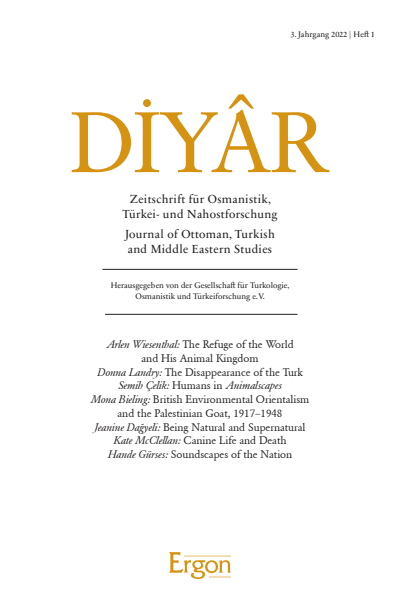
DIYÂR
Volume 3 (2022), Edition 1
- Authors:
- Publisher
- Ergon, Baden-Baden
- Copyright year
- 2022
- ISSN-Online
- 2942-3155
- ISSN-Print
- 2625-9842
Chapter information
Volume 3 (2022), Edition 1
British Environmental Orientalism and the Palestinian Goat,1917–1948
- Authors:
- ISSN-Print
- 2625-9842
- ISSN-Online
- 2942-3155
- Preview:
British colonial understanding of arid Mediterranean environments was characterised by the idea of degradation: these environments were seen as an aberration from the ‘norm’ of the lush and fertile British forests and grasslands. The struggle against desertification was central to British efforts to model the people and environments of their colonies according to their own ideals. The goat played an important role in the British understanding of arid landscapes as degraded, desertified and generally ‘lacking’, as it became the ultimate symbol for destruction. Nomadic goat-herding, a practice with hundreds of years of history, was singled out as the most destructive form of land use. Connected to the negative image of the goat was the stereotypical image of its owner: nomadic and semi-nomadic lifestyles were deemed not only unproductive but outright reckless. Sedentarisation of the nomad was one of the main goals of British colonisers as a form of population control and maintenance of colonial power. This article examines the British colonial belief in Ruined Landscape Theory as applied to arid Mediterranean environments and tries to uncover the goat’s role in British environmental orientalism, focusing on Palestine during the British Mandate period, ca. 1917-1948.
Bibliography
No match found. Try another term.
- Primary Sources Open Google Scholar doi.org/10.5771/2625-9842-2022-1-9
- Abdurrahman Abdi Paşa. 2008. Abdurrahman Abdi Paşa Vekāyi‘-Nāmesi [Osmanlı Tarihi (1648–1682)]. Derin, Fahri Ç. (ed.). Istanbul: Çamlıca. Open Google Scholar doi.org/10.5771/2625-9842-2022-1-9
- Ala’ud-din Ata-Malek Jovayni. 1912–37. Tārikh-e Jahān-goshāy. Vol. I. Qazvini, Mirza Muhammad (ed.). Leiden: Brill. Open Google Scholar doi.org/10.5771/2625-9842-2022-1-9
- Evliya Çelebi. 2001. Evliyā Çelebi Seyahatnāmesi. Vol. V. Dağlı, Yücel; Kahraman, Seyit Ali and Sezgin, İbrahim (eds.). Istanbul: Yapı Kredi Yayınları. Open Google Scholar doi.org/10.5771/2625-9842-2022-1-9
- Mustafa Naima Efendi. 2007. Tārih-i Naʿīmā: Ravzatü’l-Hüseyn fī hulāsati ahbāri’l-Hāfıkeyn. Vol. III. İpşirli, Mehmet (ed.). Ankara: Türk Tarih Kurumu. Open Google Scholar doi.org/10.5771/2625-9842-2022-1-9
- Secondary Sources Open Google Scholar doi.org/10.5771/2625-9842-2022-1-9
- Alkan, Mustafa, and Ferdi Gökbuğa. 2015. ‘XVI. Yüzyılda Osmanlı Devleti’nde Av Teşkilatı’nın Silistre Sancağındaki Yapılanması’. Gazi Akademik Bakış Dergisi. 9. 23–39. Open Google Scholar doi.org/10.5771/2625-9842-2022-1-9
- Allsen, Thomas T. 2006. The Royal Hunt in Eurasian History. Philadelphia: University of Pennsylvania Press. Open Google Scholar doi.org/10.5771/2625-9842-2022-1-9
- Altun, Hilal Oytun and Emine Gürsoy Naskali (eds.). 2008. Av ve Avcılık Kitabı. Istanbul: Kitabevi. Open Google Scholar doi.org/10.5771/2625-9842-2022-1-9
- Artan, Tülay. 2008. ‘A Book of Kings Produced and Presented as a Treatise on Hunting’. Muqarnas: An Annual on the Visual Culture of the Islamic World. 25. 299–330. Open Google Scholar doi.org/10.5771/2625-9842-2022-1-9
- Artan, Tülay. 2010. ‘Ahmed I and ‘Tuhfet’ül-mülūk ve’s-selatīn’: A Period Manuscript on Horses, Horsemanship and Hunting’. In Faroqhi, Suraiya (ed.). Animals and People in the Ottoman Empire. Istanbul: Eren. 235–270. Open Google Scholar doi.org/10.5771/2625-9842-2022-1-9
- Artan, Tülay. 2011. ‘Ahmed I’s Hunting Parties: Feasting in Adversity, Enhancing the Ordinary’. Princeton Papers: Interdisciplinary Journal of Middle Eastern Studies. 16. 93–138. Open Google Scholar doi.org/10.5771/2625-9842-2022-1-9
- Baer, Marc David. 2008. Honored by the Glory of Islam: Conversion and Conquest in Ottoman Europe. New York: Oxford University Press. Open Google Scholar doi.org/10.5771/2625-9842-2022-1-9
- Borromeo, Elisabetta. 2010. ‘The Ottomans and Hunting According to Julien Bordier’s Travelogue (1604–1612)’. In Faroqhi, Suraiya (ed.). Animals and People in the Ottoman Empire. Istanbul: Eren. 219–234. Open Google Scholar doi.org/10.5771/2625-9842-2022-1-9
- Coşkun, Ali. 2014. ‘Bir Din Sosyolojisi Öncüsü: Naima’. Toplum Bilimleri. 8.16. 117–136. Open Google Scholar doi.org/10.5771/2625-9842-2022-1-9
- Çelik, Şenol. 2002. ‘Osmanlı Padişahlarının Av Geleneğinde: Edirne’nin Yeri ve Edirne Kazasındaki Av Alanları (Hassa Şikār-Gāhı)’. XII. Türk Tarih Kongresi, Kongreye Sunulan Bildiriler. 3.2. 1–15. Open Google Scholar doi.org/10.5771/2625-9842-2022-1-9
- Çelik, Şenol. 2012. ‘Evliya Çelebi’nin Sultan IV. Mehmed ile Birlikte Katıldığı Bursa ve Çanakkale Boğazı Gezisi’. Balıkesir Üniversitesi Sosyal Bilimler Enstitüsü Dergisi. 15.28. 139–197. Open Google Scholar doi.org/10.5771/2625-9842-2022-1-9
- Faroqhi, Suraiya. 2008. ‘Exotic Animals at the Sultan’s Court’. In Faroqhi, Suraiya (ed.). Another Mirror for Princes: The Public Image of the Ottoman Sultans and its Reception. Istanbul: Isis Press. 87–101. Open Google Scholar doi.org/10.5771/2625-9842-2022-1-9
- Fisher, Alan W. and Carol G. Fisher. 1985–1987. ‘Topkapı Sarayı in the Mid-Seventeenth Century: Bobovi’s Descriptions’. Archivum Ottomanicum. 10. 5–82. Open Google Scholar doi.org/10.5771/2625-9842-2022-1-9
- Karateke, Hakan T. 2013. ‘The Trip from Bursa to Edirne’. In Karateke, Hakan (ed.). Evliyā Çelebī’s Journey from Bursa to the Dardanelles and Edirne: From the Fifth Book of the Seyāḥatnāme. Leiden and Boston: Brill. 1–7. Open Google Scholar doi.org/10.5771/2625-9842-2022-1-9
- Kunt, Metin. 1973. ‘Naīmā, Köprülü, and the Grand Vezirate’. Boğaziçi Üniversitesi Dergisi- Hümaniter Bilimler. 1. 57–63. Open Google Scholar doi.org/10.5771/2625-9842-2022-1-9
- Kurtaran, Uğur. 2018. ‘Sultan II. Mustafa’nın Avcılığı Üzerine Bir Araştırma’. Social Sciences Research Journal. 7.1. 147–166. Open Google Scholar doi.org/10.5771/2625-9842-2022-1-9
- Mikhail, Alan. 2014. ‘Part Three: Charisma and Capital’. In The Animal in Ottoman Egypt. Oxford and New York: Oxford University Press. 109–176. Open Google Scholar doi.org/10.5771/2625-9842-2022-1-9
- Murphey, Rhoads. 1993. ‘Continuity and Discontinuity in Ottoman Administrative Theory and Practice during the Late Seventeenth Century’. Poetics Today. 14.2. 414–443. Open Google Scholar doi.org/10.5771/2625-9842-2022-1-9
- Murphey, Rhoads. 2008. ‘Dynastic Origins: Medieval Inheritances and Major Influences on Ottoman Concepts of Sovereignty’. In Exploring Ottoman Sovereignty: Tradition, Image and Practice in the Ottoman Imperial Household, 1400–1800. London: Continuum. 19–40. Open Google Scholar doi.org/10.5771/2625-9842-2022-1-9
- Murphey, Rhoads. 2009. ‘Mustafa Safi’s Version of the Kingly Virtues as Presented in his Zübdet’ül Tevarih, or Annals of Sultan Ahmed, 1012–1023 A.H./1603–1614 A. D.’. In Essays on Ottoman Historians and Historiography. Istanbul: Eren. 69–86. Open Google Scholar doi.org/10.5771/2625-9842-2022-1-9
- Özel, Oktay. 2012. ‘The Reign of Violence: The Celalis c. 1550-1700’. In Woodhead, Christine (ed.). The Ottoman World. Milton Park, Abingdon, Oxon, New York: Routledge. 184–202. Open Google Scholar doi.org/10.5771/2625-9842-2022-1-9
- Taner, Melis. 2009. ‘Power to Kill’: A Discourse on the Royal Hunt During the Reigns of Süleyman the Magnificent and Ahmed I. MA Thesis, Sabancı University, Istanbul. Open Google Scholar doi.org/10.5771/2625-9842-2022-1-9
- Thomas, Lewis V. 1972. A Study of Naima. Itzkowitz, Norman (ed.). New York: New York University Press. Open Google Scholar doi.org/10.5771/2625-9842-2022-1-9
- Türkmen, Mustafa N. 2009. ‘Osmanlıda Av Seferleri’. Acta Turcica Çevrimiçi Tematik Türkoloji Dergisi, Türk Kültüründe Av. 1. 22–32. Open Google Scholar doi.org/10.5771/2625-9842-2022-1-9
- Veinstein, Gilles. 2010. ‘Falconry in the Mid-sixteenth Century Ottoman Empire’. In Faroqhi, Suraiya (ed.). Animals and People in the Ottoman Empire. Istanbul: Eren. 205–218. Open Google Scholar doi.org/10.5771/2625-9842-2022-1-9
- White, Sam. 2011. The Climate of Rebellion in the Early Modern Ottoman Empire. Cambridge and New York: Cambridge University Press. Open Google Scholar doi.org/10.5771/2625-9842-2022-1-9
- Yoldaşlar, Özgün Deniz. 2013. The Realization of Mehmed IV's Ghazi Title at the Campaign of Kamaniçe. MA Thesis, Sabancı University, Istanbul. Open Google Scholar doi.org/10.5771/2625-9842-2022-1-9
- Unpublished primary sources Open Google Scholar doi.org/10.5771/2625-9842-2022-1-28
- North Yorkshire County Archives Open Google Scholar doi.org/10.5771/2625-9842-2022-1-28
- Darley, Thomas Open Google Scholar doi.org/10.5771/2625-9842-2022-1-28
- ‘Letter from Thomas Darley, Aleppo, to Henry Darley, Aldby Park, 21 December 1703’ Open Google Scholar doi.org/10.5771/2625-9842-2022-1-28
- ZDA DAR CP1 Open Google Scholar doi.org/10.5771/2625-9842-2022-1-28
- British Library, London Open Google Scholar doi.org/10.5771/2625-9842-2022-1-28
- Harley, Nathaniel Open Google Scholar doi.org/10.5771/2625-9842-2022-1-28
- ‘Nathaniel Harley’s letters 1682-1720’ Open Google Scholar doi.org/10.5771/2625-9842-2022-1-28
- British Library Additional Manuscript 70143 Open Google Scholar doi.org/10.5771/2625-9842-2022-1-28
- Published primary sources Open Google Scholar doi.org/10.5771/2625-9842-2022-1-28
- ‘Alī, ‘Abdullah Yūsuf. 1997. The Meaning of the Holy Qur’an. New edition. Beltsville, MD: Amana Press. Open Google Scholar doi.org/10.5771/2625-9842-2022-1-28
- Blunt, Lady Anne. 1879. Bedouin Tribes of the Euphrates. Edited, with a Preface and Some Account of the Arabs and Their Horses, By W. S. B. 2 vols. London: John Murray. Reprint: London: Frank Cass & Co. 1968. Open Google Scholar doi.org/10.5771/2625-9842-2022-1-28
- Blunt, Lady Anne. 1986. Archer, Rosemary and Fleming, James (eds.). Lady Anne Blunt: Journals and Correspondence, 1878–1917. Northleach, Cheltenham, Gloucs: Alexander Heriot and Co. Ltd. Open Google Scholar doi.org/10.5771/2625-9842-2022-1-28
- Brown, William Robinson. 1947. The Horse of the Desert. New York: The Macmillan Company. Open Google Scholar doi.org/10.5771/2625-9842-2022-1-28
- Dawood, N. J. 1990. The Koran. 5th rev. edn. Harmondsworth and New York: Penguin. Open Google Scholar doi.org/10.5771/2625-9842-2022-1-28
- Evliya Çelebi bin Derviş Mehemmed Zilli. 1834–1850. Von Hammer, Joseph (trans.) Narrative of Travels in Europe, Asia, and Africa, in the seventeenth century. 2 vols. 1st vol. in 2 parts. London: Printed for the Oriental Translation Fund of Great Britain and Ireland; Sold by Parbury, Allen, & Co. Open Google Scholar doi.org/10.5771/2625-9842-2022-1-28
- Evliyâ Çelebi bin Derviş Mehemmed Zillî. 1996-2007. Dağlı, Yücel, Kahraman, Seyit Ali and Dankoff, Robert (eds.). Evliyâ Çelebi Seyahatnâmesi. 10 vols. Istanbul: Yapı Kredi Yayınları. Open Google Scholar doi.org/10.5771/2625-9842-2022-1-28
- Evliya Chelebi. 2010a. Javadi, Hasan and Floor, Willem (trans.). Travels in Iran and the Caucasus in 1647 & 1654. Washington, DC: Mage Publishers. Open Google Scholar doi.org/10.5771/2625-9842-2022-1-28
- Evliya Çelebi. 2010b. Dankoff, Robert and Kim, Sooyong (trans.). An Ottoman Traveller: Selections from the ‘Book of Travels’ of Evliya Çelebi. London: Eland. Open Google Scholar doi.org/10.5771/2625-9842-2022-1-28
- Dankoff, Robert. 1991a. An Evliya Çelebi Glossary: Unusual, Dialectal, and Foreign Words in the Seyahat-name. Sources of Oriental Languages and Literatures 14. Cambridge, MA: Harvard University Press. Open Google Scholar doi.org/10.5771/2625-9842-2022-1-28
- Dankoff, Robert. 1991b. The Intimate Life of an Ottoman Statesman: Melek Ahmed Pasha (1588–1662) As Portrayed in Evliya Çelebi’s ‘Book of Travels’ (‘Seyahat-name’). Dankoff, Robert (ed. and trans.). With a Historical Introduction by Rhoads Murphey. Albany, NY: State University of New York Press. Open Google Scholar doi.org/10.5771/2625-9842-2022-1-28
- Keppel, Captain, the Hon. George. 1827. Personal Narrative of a Journey from India to England, by Bussorah, Bagdad, the Ruins of Babylon, Curdistan, the Court of Persia, the Western Shore of the Caspian Sea, Astrakhan, Nishney Novogorod, Moscow, and St Petersburgh, in the Year 1824. 2nd edn. 2 vols. London: Henry Colburn. Open Google Scholar doi.org/10.5771/2625-9842-2022-1-28
- Kinneir, John Macdonald. 1813. A Geographical Memoir of the Persian Empire, Accompanied by A Map. London: John Murray. Open Google Scholar doi.org/10.5771/2625-9842-2022-1-28
- Malcolm, John, Colonel Sir. 1815. The History of Persia, From the Most Early Period to The Present Time: Containing an Account of the Religion, Government, Usages, And Character of the Inhabitants of that Kingdom. 2 vols. London: Murray. Open Google Scholar doi.org/10.5771/2625-9842-2022-1-28
- Tavernier, Jean Baptiste. 1676. Les Sixe Voyages de Jean Baptiste Tavernier, Ecuyer Baron d’Aubonne. En Turquie, en Perse, et Aux Indies. Paris: Gervais Clouzier and Claude Barbin. Open Google Scholar doi.org/10.5771/2625-9842-2022-1-28
- Tavernier, Jean Baptist. 1677. The Six Voyages of John Baptista Tavernier, A Noble Man of France now living, Through Turky into Persia, and the East Indies, Finished in the Year 1670. “Together with a New Relation of the Present Grand Seignor's Seraglio. Made English by J[ohn]. P[hilips]”. London: William Godbid. Open Google Scholar doi.org/10.5771/2625-9842-2022-1-28
- Tolstoy, Leo. 1974. [1886.] ‘Strider, the Story of a Horse’. In The Snow Storm and Other Stories. Maude, Louise and Maude, Aylmer (trans.). London: Oxford University Press. 389–439. Open Google Scholar doi.org/10.5771/2625-9842-2022-1-28
- Secondary sources Open Google Scholar doi.org/10.5771/2625-9842-2022-1-28
- Alwair, Dr. Hazaim. 2007. ‘Bedouin Strains’. 2007 WAHO Conference, Damascus, Syria. 74–88. Open Google Scholar doi.org/10.5771/2625-9842-2022-1-28
- Artan, Tülay. 2008. ‘A Book of Kings Produced and Presented as a Treatise on Hunting’. Muqarnas. 25. 299–330. Open Google Scholar doi.org/10.5771/2625-9842-2022-1-28
- Artan, Tülay. 2010. ‘Ahmet I and “Tuhfetü’l-Mülûk ve’s-Selâtîn”: A Period Manuscript on Horses, Horsemanship, and Hunting’. In Faroqhi, Suraiya (ed.). Animals and People in the Ottoman Empire. Istanbul: Eren. 235–269. Open Google Scholar doi.org/10.5771/2625-9842-2022-1-28
- Brewer, John. 1989. The Sinews of Power: War, Money, and the English State, 1688–1783. London: Unwin Hyman. Open Google Scholar doi.org/10.5771/2625-9842-2022-1-28
- Cosgrove, Elissa J., Sadeghi, Raheleh, Schlamp, Florencia, et al. 2020. ‘Genome Diversity and the Origin of the Arabian Horse’. Nature Scientific Reports. 10: 9702. https://www.nature.com/articles/s41598-020-66232-1 (accessed 23 March 2021) Open Google Scholar doi.org/10.5771/2625-9842-2022-1-28
- Dankoff, Robert. 2004. An Ottoman Mentality: The World of Evliya Çelebi. Leiden and Boston, MA: Brill. Open Google Scholar doi.org/10.5771/2625-9842-2022-1-28
- Derry, Margaret E. 2003. Bred for Perfection: Shorthorn Cattle, Collies, and Arabian Horses since 1800. Baltimore: The Johns Hopkins University Press. Open Google Scholar doi.org/10.5771/2625-9842-2022-1-28
- Derry, Margaret E. 2006. Horses in Society: A Story of Animal Breeding and Marketing Culture, 1800–1920. Toronto: University of Toronto Press. Open Google Scholar doi.org/10.5771/2625-9842-2022-1-28
- Edwards, Peter. 1988. The Horse Trade of Tudor and Stuart England. Cambridge: Cambridge University Press. Open Google Scholar doi.org/10.5771/2625-9842-2022-1-28
- The Equinest. 2010. URL: http://www.theequinest.com/breeds/akhal-teke/ (accessed 28 April 2020) Open Google Scholar doi.org/10.5771/2625-9842-2022-1-28
- Faroqhi, Suraiya (ed.). 2010. Animals and People in the Ottoman Empire. Istanbul: Eren. Open Google Scholar doi.org/10.5771/2625-9842-2022-1-28
- Fattah, Hala. 1997. The Politics of Regional Trade in Iraq, Arabia, and the Gulf 1745–1900. Albany, NY: State University of New York Press. Open Google Scholar doi.org/10.5771/2625-9842-2022-1-28
- Felkel, Sabine, Vogl, Claus, Rigler, Doris, et al. 2019. ‘The horse Y chromosome as an informative marker for tracing sire lines’. Scientific Reports. 9.6095. URL: https://www.ncbi.nlm.nih.gov/pmc/articles/PMC6465346/ (accessed 25 April 2020) Open Google Scholar doi.org/10.5771/2625-9842-2022-1-28
- Gopal, Priyamvada. 2020. Insurgent Empire: Anticolonial Resistance and British Dissent. London: Verso. Open Google Scholar doi.org/10.5771/2625-9842-2022-1-28
- Guest, Kristin and Mattfeld, Monica. 2020. ‘Horse Breeds: Introduction’. In Guest, Kristin and Mattfeld, Monica (eds.). Horse Breeds and Human Society: Purity, Identity and the Making of the Modern Horse. Abingdon and New York: Routledge. 1–9. Open Google Scholar doi.org/10.5771/2625-9842-2022-1-28
- Hill, E. W., Bradley, D. G., Al-Barody, M. et al. 2002. ‘History and integrity of thoroughbred dam lines revealed in equine mtDNA variation’. Animal Genetics. 33. 287-294. URL: http://www.tbheritage.com/GeneticMarkers/HillAnimalGenetics.pdf (accessed 28 April 2020) Open Google Scholar doi.org/10.5771/2625-9842-2022-1-28
- İnal, Onur. 2020. ‘One-Humped History: The Camel as Historical Actor in the Late Ottoman Empire’. International Journal of Middle East Studies. 1–16. Open Google Scholar doi.org/10.5771/2625-9842-2022-1-28
- James, Jeremy. 2005. The Byerley Turk: The True Story of the First Thoroughbred. Ludlow, Salop: Merlin Unwin. Open Google Scholar doi.org/10.5771/2625-9842-2022-1-28
- James, Jeremy. 2007. Turk Atı: Ingiliz Yarış Atlarının Atası. Olcaytu, Neşe (trans.) Istanbul: E Yayınları. Open Google Scholar doi.org/10.5771/2625-9842-2022-1-28
- James, Jeremy. 2015. Private communication to the author. Open Google Scholar doi.org/10.5771/2625-9842-2022-1-28
- Kleimola, Ann M. 2005. ‘Cultural Convergence: The Equine Connection between Muscovy and Europe’. In Raber, Karen and Tucker, Treva J. (eds.). The Culture of the Horse: Status, Discipline, and Identity in the Early Modern World. Houndmills, Basingstoke: Palgrave Macmillan. 45–62. Open Google Scholar doi.org/10.5771/2625-9842-2022-1-28
- Lacy, Lisa McCracken. 2018. Lady Anne Blunt in the Middle East: Politics, Travel and the Idea of Empire. London: I. B. Tauris. Open Google Scholar doi.org/10.5771/2625-9842-2022-1-28
- Landry, Donna. 2008. Noble Brutes: How Eastern Horses Transformed English Culture. Baltimore, MD: The Johns Hopkins University Press. Open Google Scholar doi.org/10.5771/2625-9842-2022-1-28
- Landry, Donna. 2013. ‘“Delight makes all of the one mind”: Irish Collectivity at the Races’. In Lyons, Paddy, Miller, John and Maley, Willey (eds.). Romantic Ireland: From Tone to Gonne; Fresh Perspectives on Nineteenth-Century Ireland. Newcastle: Cambridge Scholars Publishing. 337–347. Open Google Scholar doi.org/10.5771/2625-9842-2022-1-28
- Landry, Donna. 2015a. Akıllı, Sinan (trans.) Asıl Hayvanlar: Ingiliz Kültürürnü Değiştiren Doğulu Atlar. Istanbul: E Yayınları. Open Google Scholar doi.org/10.5771/2625-9842-2022-1-28
- Landry, Donna. 2015b. ‘Horse-Human Companionship: Creaturely Cosmopolitanism across Eurasia’. In Nagai, Kaori; Jones, Karen; Landry, Donna et al. (eds.) Cosmopolitan Animals. Houndmills, Basingstoke: Palgrave Macmillan. 181–193. Open Google Scholar doi.org/10.5771/2625-9842-2022-1-28
- Landry, Donna. 2018. ‘Evliya Çelebi, Explorer on Horseback: Knowledge Gathering by a Seventeenth-Century Ottoman’. In Craciun, Adriana and Terrall, Mary (eds.). Curious Encounters: Voyaging, Collecting, and Making Knowledge in the Long Eighteenth Century. Toronto: University of Toronto Press. 43–70. Open Google Scholar doi.org/10.5771/2625-9842-2022-1-28
- Landry, Donna. 2019. ‘Horses at Waterloo, 1815’. In Guest, Kristen and Mattfeld, Monica (eds.). Equestrian Cultures: Horses, Human Society, and the Discourse of Modernity. Chicago and London: University of Chicago Press. 26–38. Open Google Scholar doi.org/10.5771/2625-9842-2022-1-28
- Landry, Donna. 2020. ‘Habsburg Lippizaners, English Thoroughbreds and the Paradoxes of Purity’. In Guest, Kristin and Mattfeld, Monica (eds.). Horse Breeds and Human Society: Purity, Identity and the Making of the Modern Horse. Abingdon and New York: Routledge. 27–49. Open Google Scholar doi.org/10.5771/2625-9842-2022-1-28
- Landry, Donna. 2021. ‘Ottoman Ecocriticism and Political Ecology: Horse-Human Relations in Evliya Çelebi and After’. In Oppermann, Serpil and Akıllı, Sinan (eds.). Turkish Ecocriticism: From Neolithic to Contemporary Timescapes. Ecocritical Theory and Praxis Series. Lanham, MD: Lexington Books. 149–161. Open Google Scholar doi.org/10.5771/2625-9842-2022-1-28
- Landry, Donna, and Mansel, Philip. 2019. ‘Introduction: Horses and Courts: The Reins of Power’. In Landry, Donna and Mansel, Philip (eds.). Horses and Courts: The Reins of Power. Special issue of The Court Historian 24: 3 (December): 197–204. https://www.tandfonline.com/eprint/H8V5GUWHRQ29F4G7R8MC/full?target=10.1080/14629712.2019.1675315 (accessed 21 March 2021) Open Google Scholar doi.org/10.5771/2625-9842-2022-1-28
- Lange, Christoph. 2020. ‘The Making and Remaking of the Arabian Horse – From the Arab Bedouin Horse to the Modern Straight Egyptian’. In Guest, Kristin and Mattfeld, Monica (eds.). Horse Breeds and Human Society: Purity, Identity and the Making of the Modern Horse. Abingdon and New York: Routledge. 234–250. Open Google Scholar doi.org/10.5771/2625-9842-2022-1-28
- Lowe, C. Bruce. 1895. Allison, William (ed.). Breeding Racehorses by the Figure System. London: Horace Cox. Open Google Scholar doi.org/10.5771/2625-9842-2022-1-28
- Mackay-Smith, Alexander. 2000. Speed and the Thoroughbred: The Complete History. Lanham, MD: The Derrydale Press. Open Google Scholar doi.org/10.5771/2625-9842-2022-1-28
- Mikhail, Alan. 2014. The Animal in Ottoman Egypt. Oxford and New York: Oxford University Press. Open Google Scholar doi.org/10.5771/2625-9842-2022-1-28
- Murray, Katrina. 2011. Private communication to the author. Open Google Scholar doi.org/10.5771/2625-9842-2022-1-28
- Nash, Richard. 2005. “‘Honest English Breed”: The Thoroughbred as Cultural Metaphor’. In Raber, Karen and Tucker, Treva J. (eds.). The Culture of the Horse: Status, Discipline, and Identity in the Early Modern World. Houndmills, Basingstoke: Palgrave Macmillan. 245–272. Open Google Scholar doi.org/10.5771/2625-9842-2022-1-28
- Nash, Richard. 2012. ‘“Beware a Bastard Breed”: Notes Towards a Revisionist History of the Thoroughbred Racehorse’. In Edwards, Peter, Enenkel, Karl A. E., and Graham, Elspeth (eds.). The Horse as Cultural Icon: The Real and the Symbolic Horse in the Early Modern World. Leiden and Boston, MA; Brill. 191–216. Open Google Scholar doi.org/10.5771/2625-9842-2022-1-28
- Pedigree Query. 2020. URL: http://www.pedigreequery.com/frankel3 (accessed 18 April 2020). Open Google Scholar doi.org/10.5771/2625-9842-2022-1-28
- Peters, Anne. 2005. ‘Portraits: Byerley Turk’. Thoroughbred Heritage. URL: http://www.tbheritage.com/Portraits/ByerleyTurk.html (accessed 25 April 2020). Open Google Scholar doi.org/10.5771/2625-9842-2022-1-28
- Pickrell, John. 2005. ‘95% of Thoroughbreds Linked to one Super-Stud’. New Scientist. 6 September. URL: https://www.newscientist.com/article/dn7941-95-of-thoroughbreds-linked-to-one-superstud/ (accessed 21 April 2020). Open Google Scholar doi.org/10.5771/2625-9842-2022-1-28
- Ritvo, Harriet. 1987. The Animal Estate: The English and Other Creatures in the Victorian Age. Cambridge, MA: Harvard University Press. Open Google Scholar doi.org/10.5771/2625-9842-2022-1-28
- Shaw, David Gary. 2013. ‘The Torturer’s Horse: Agency and Animals in History’. History and Theory. 52.4. Theme Issue 52: ‘Does History Need Animals?’. 146–167. Open Google Scholar doi.org/10.5771/2625-9842-2022-1-28
- Steen, Andrew K. n.d. Count Jozef Potocki, The Man Who Bred Skowronek. Seville: A Tale of the Breed/Escandón Impresores. Open Google Scholar doi.org/10.5771/2625-9842-2022-1-28
- Tempest, Bridget. [2001.] Turkmen at Wimpole: Artists from Turkmenistan. Ashgabat: Visiting Artists. Open Google Scholar doi.org/10.5771/2625-9842-2022-1-28
- Thoroughbred Heritage. 2013. URL: http://www.tbheritage.com (accessed 18 April 2020). Open Google Scholar doi.org/10.5771/2625-9842-2022-1-28
- Wallner, Barbara, Palmieri, Nicola, Vogl, Claus, Rigler, Doris, Bozlak, Elif, et al. 2017. ‘Y Chromosome Uncovers the Recent Oriental Origin of Modern Stallions’. Current Biology. 27.13. 2029–2035. URL: https://www.cell.com/current-biology/fulltext/S0960-9822(17)30694-2?_returnURL=https%3A%2F%2Flinkinghub.elsevier.com%2Fretrieve%2Fpii%2FS0960982217306942%3Fshowall%3Dtrue#back-bib25 (accessed 26 April 2020). Open Google Scholar doi.org/10.5771/2625-9842-2022-1-28
- White, Sam. 2011. The Climate of Rebellion in the Early Modern Ottoman Empire. Cambridge and New York: Cambridge University Press. Open Google Scholar doi.org/10.5771/2625-9842-2022-1-28
- Winstone, H. V. F. 2003. Lady Anne Blunt: A Biography. London: Barzan. Open Google Scholar doi.org/10.5771/2625-9842-2022-1-28
- Wynmalen, Henry. 1950. Horse Breeding & Stud Management. London and New York: Country Life and Charles Scribner’s Sons. Open Google Scholar doi.org/10.5771/2625-9842-2022-1-28
- Unpublished Primary Sources Open Google Scholar doi.org/10.5771/2625-9842-2022-1-49
- Manuscripts Open Google Scholar doi.org/10.5771/2625-9842-2022-1-49
- Risāle-i Ḥikmet-i Ḥaşarāt-ı Menāfi‘. [n.d.]. Balıkesir Public Library: 10 HK 19/4, fol. 52–60. Open Google Scholar doi.org/10.5771/2625-9842-2022-1-49
- Archives Open Google Scholar doi.org/10.5771/2625-9842-2022-1-49
- Cumhurbaşkanlığı Osmanlı Arşivleri (BOA), Istanbul Open Google Scholar doi.org/10.5771/2625-9842-2022-1-49
- Bab-ı Defteri – Baş Muhasebe defterleri (D.BŞM.d) 803 Open Google Scholar doi.org/10.5771/2625-9842-2022-1-49
- Hatt-ı Hümayun (HAT) 548-27100. Open Google Scholar doi.org/10.5771/2625-9842-2022-1-49
- Şura-yı Devlet (ŞD) 542-44 13 May 1909 Open Google Scholar doi.org/10.5771/2625-9842-2022-1-49
- Şura-yı Devlet (ŞD) 2339-63 14 November 1869 Open Google Scholar doi.org/10.5771/2625-9842-2022-1-49
- Published material Open Google Scholar doi.org/10.5771/2625-9842-2022-1-49
- Ainsworth, William. 1842. Travels and Researches in Asia Minor, Mesopotamia, Chaldea, and Armenia. Vol. 2. London: John W. Parker. Open Google Scholar doi.org/10.5771/2625-9842-2022-1-49
- Arbel, Benjamin. 2010. ‘The Attitude of Muslims to Animals: Renaissance Perceptions and Beyond’. In Faroqhi, Suraiya (ed.). Animals and People in the Ottoman Empire. İstanbul: Eren Yayınları. 57–74. Open Google Scholar doi.org/10.5771/2625-9842-2022-1-49
- Aşık Mehmed. 2007. Menazırü’l-Evalim. 3 Vols. Ak, Mahmut (ed.). Ankara: Türk Tarih Kurumu. Open Google Scholar doi.org/10.5771/2625-9842-2022-1-49
- Bauman, Zygmunt. 1990. Thinking Sociologically. Oxford: Blackwell. Open Google Scholar doi.org/10.5771/2625-9842-2022-1-49
- Benkheira, Mohammed Hocine, Mayeur-Jaouen, Catherine and Sublet, Jacqueline. 2005. L’Animal en Islam. Paris: Les Indes des Savantes. Open Google Scholar doi.org/10.5771/2625-9842-2022-1-49
- Bilgin, Halim. 2019. Lugat-i Remzi (Sözlükbilimsel İnceleme, Metin). PhD Thesis, Eskişehir Osmangazi Üniversitesi, Eskişehir. Open Google Scholar doi.org/10.5771/2625-9842-2022-1-49
- Candelaria, Matthew. 2009. ‘The Microecology of Infestation in Relationship Spaces’. In McFarland, Sarah and Hediger, Ryan (eds.). Animals and Agency. An Interdisciplinary Exploration. Leiden: Brill. 301–320. Open Google Scholar doi.org/10.5771/2625-9842-2022-1-49
- Cole, Lucinda. 2016. Imperfect Creatures: Vermin, Literature, and the Sciences of Life (1600–1740). Michigan: Michigan University Press. Open Google Scholar doi.org/10.5771/2625-9842-2022-1-49
- Cragoe, Matthew and Briony McDonagh. 2013. ‘Parliamentary enclosure, vermin and the cultural life of English parishes, 1750–1850’. Contiunity and Change. 28.1. 27–50. Open Google Scholar doi.org/10.5771/2625-9842-2022-1-49
- Çavuş, Ömer. 2017. ‘Osmanlı Devleti’nde Çekirgelere Karşı Mücadele’. Osmanlı Bilimi Araştırmaları. 13.2. 59–76. Open Google Scholar doi.org/10.5771/2625-9842-2022-1-49
- Çelik, Ahmet Faruk. 2018. XVII. Yüzyıl Osmanlı Merkez ve Taşrasında Fetva: `Kitabu’s Siyer Örneği’. MA. Thesis, Marmara University, Istanbul. Open Google Scholar doi.org/10.5771/2625-9842-2022-1-49
- Çelik, Semih. 2019. ‘“It’s a Bad Fate to Be Born Near a Forest”: Forest, People and Buffaloes in Mid-Nineteenth Century North-Western Anatolia’. In İnal, Onur and Köse, Yavuz (eds.). Seeds of Power: Explorations in Ottoman Environmental History. Cambridgeshire, UK: White Horse Press. 111–133. Open Google Scholar doi.org/10.5771/2625-9842-2022-1-49
- Çıplak, Battal. 2021. ‘Locust and Grasshopper Outbreaks in the Near East: Review under Global Warming Context’. Agronomy. 11.111. 1–17. Open Google Scholar doi.org/10.5771/2625-9842-2022-1-49
- Dağyeli, Jeanine Elif. 2020. ‘The Fight Against Heaven-Sent Insects: Dealing with Locust Plagues in the Emirate of Bukhara’. Environment and History. 26. 79–104. Open Google Scholar doi.org/10.5771/2625-9842-2022-1-49
- Demir, Alpaslan. 2014. ‘Osmanlı Devleti’nde Haşerelere Karşı Bir Önlem: Çekirge Suyu’. Erdem İnsan ve Toplum Bilimleri Dergisi. 67. 33–45. Open Google Scholar doi.org/10.5771/2625-9842-2022-1-49
- Dinzelbacher, Peter. 2002. ‘Animal Trials: A Multidisciplinary Approach’. Journal of Interdisciplinary History. 32.3. 405–421. Open Google Scholar doi.org/10.5771/2625-9842-2022-1-49
- Dolbee, Samuel. 2017. The Locust and the Starling: People, Insects, and Disease in the Late Ottoman Jazira and After, 1860–1940. PhD Thesis, New York University, New York. Open Google Scholar doi.org/10.5771/2625-9842-2022-1-49
- Ducène, Jean Charles. 2016. ‘Les animaux dans les cosmographies arabes médiévales’. In Peperstraeete, Sylvie (ed.). Animal et Religion. Brussels: Editions de l’Universite de Bruxelles. 129–140. Open Google Scholar doi.org/10.5771/2625-9842-2022-1-49
- Erler, Mehmet Yavuz. ‘Animals during Disasters’. In Faroqhi, Suraiya (ed.). Animals and People in the Ottoman Empire. Istanbul: Eren. 333–353. Open Google Scholar doi.org/10.5771/2625-9842-2022-1-49
- Evliya Çelebi b. Derviş Mehemmed Zılli. 2000. Evliya Çelebi Seyahatnamesi. Dankoff, Robert; Kahraman, Seyit Ali and Dağlı, Yücel (eds.). Istanbul: Yapı Kredi Yayınları. 9 vols. Open Google Scholar doi.org/10.5771/2625-9842-2022-1-49
- Faroqhi, Suraiya. 2010. ‘Introduction’. In Faroqhi, Suraiya (ed.). Animals and People in the Ottoman Empire. Istanbul: Eren Yayınları. 11–54. Open Google Scholar doi.org/10.5771/2625-9842-2022-1-49
- Fissell, Mary. 1999. ‘Imagining Vermin in Early Modern England’. History Workshop Journal. 47. 1–29. Open Google Scholar doi.org/10.5771/2625-9842-2022-1-49
- Fudge, Erica. 2002. ‘A left-handed blow: Writing the history of animals’. In Rothfels, Nigel (ed.). Representing animals. Theories of Contemporary Culture. Bloomington: Indiana University Press. 3–18. Open Google Scholar doi.org/10.5771/2625-9842-2022-1-49
- Gündoğdu, Cihangir. ‘The State and the Stray Dogs in Late Ottoman Istanbul: From Unruly Subjects to Servile Friends’. Middle Eastern Studies. 54.4. 555–574. Open Google Scholar doi.org/10.5771/2625-9842-2022-1-49
- Hassan, Marwa. 2017. 16. Yüzyıla Ait Arapça-Türkçe Sözlük Miratü’l-Luga (Metin-İnceleme-Dizin) MAThesis, Yıldız Teknik Üniversitesi, Istanbul. Open Google Scholar doi.org/10.5771/2625-9842-2022-1-49
- Howell, Philip. 2019. ‘Animals, Agency, and History’. In Kean, Hilda and Howell, Philip (eds.). The Routledge Companion to Animal-Human History. London: Routledge. 197–221. Open Google Scholar doi.org/10.5771/2625-9842-2022-1-49
- İnal, Onur. 2020. ‘One-humped History: The Camel as Historical Actor in the Late Ottoman Empire’. International Journal of Middle East Studies. 53. 57–72. Open Google Scholar doi.org/10.5771/2625-9842-2022-1-49
- Jennings, Ronald C. 1993. Christians and Muslims in Ottoman Cyprus and the Mediterranean World, 1571–1640. New York: New York University Press. Open Google Scholar doi.org/10.5771/2625-9842-2022-1-49
- Jones, Owain. 2000. ‘(Un)ethical Geographies of Human – Non-human Relations: Encounters, Collectives and Spaces’. In Philo, Chris and Wilbert, Chris (eds.). Animal Spaces, Beastly Places: New Geographies of Human-Animal Relations. London: Routledge. 267–290. Open Google Scholar doi.org/10.5771/2625-9842-2022-1-49
- Khoury, Dina Rizk. 1997. State and Provincial Society in the Ottoman Empire, Mosul 1540–1834. Cambridge: Cambridge University Press. Open Google Scholar doi.org/10.5771/2625-9842-2022-1-49
- Kiyak-Oral, Abide Eser. 2014. İmam Leknevi’nin Fetava’sının Değerlendirilmesi. MA Thesis, Marmara University, Istanbul. Open Google Scholar doi.org/10.5771/2625-9842-2022-1-49
- Krawietz, Birgit. 2014. ‘Falconry as a Cultural Icon of the Arab Gulf Region’. In Wippel, Steffen; Bromber, Katrin and Steiner, Christian et. al. (eds.). Under Construction: Logics of Urbanism in the Gulf Region. Surrey: Ashgate. 131–146. Open Google Scholar doi.org/10.5771/2625-9842-2022-1-49
- Leeson, Peter T. 2013. ‘Vermin Trials’. The Journal of Law & Economics. 56.3. 811–836. Open Google Scholar doi.org/10.5771/2625-9842-2022-1-49
- Littmann, Enno. 1925. Vom morgenländischen Floh. Dichtung und Wahrheit über den Floh bei Hebräern, Syriern, Arabern, Abessiniern und Türken. Insel Verlag: Leipzig. Open Google Scholar doi.org/10.5771/2625-9842-2022-1-49
- MacFarlane, Charles. Kismet or the Doom of Turkey. London: Thomas Bosworth. Open Google Scholar doi.org/10.5771/2625-9842-2022-1-49
- Mehmed Süreyya. 1329 [1913]. ‘Aydın Vilayetinde Çekirge Afeti (1)’. Felahat: Zirai, Baytari, Sınai ve Ticari Mecmua. 12. 188–190. Open Google Scholar doi.org/10.5771/2625-9842-2022-1-49
- Mehmed Süreyya. 1332 [1916]. Haşarat-ı Ziraiyye Mecmuası. Dersaadet: Osmanlı Ziraat ve Ticaret Gazetesi Matbaası. Open Google Scholar doi.org/10.5771/2625-9842-2022-1-49
- Mikhail, Alan. 2010. ‘Animals as Property in Early Modern Ottoman Egypt’. Journal of the Economic and Social History of the Orient. 53.4. 621–652. Open Google Scholar doi.org/10.5771/2625-9842-2022-1-49
- Mikhail, Alan. 2013a. The Animal in Ottoman Egypt. Oxford: Oxford University Press. Open Google Scholar doi.org/10.5771/2625-9842-2022-1-49
- Mikhail, Alan. 2013b. ‘Unleashing the Beast: Animals, Energy, and the Economy of Labor in Ottoman Egypt’. American Historical Review. 118.2. 317–348. Open Google Scholar doi.org/10.5771/2625-9842-2022-1-49
- Mitchell, Timothy. 2002. Rule of Experts. Egypt, Techno-Politics, Modernity. Berkeley: UCLA Press. Open Google Scholar doi.org/10.5771/2625-9842-2022-1-49
- Mustafa Behçet Efendi, Molla Abdülhak Efendi and [Tabib] Hayrullah. 1869. Hezar Esrar. İstanbul: Muhib Matbaası. Open Google Scholar doi.org/10.5771/2625-9842-2022-1-49
- Nagy, Kelsi and Johnson II, Philip David. 2013. ‘Introduction’. In Nagy, Kelsi and Johnson II, Phillip David (eds.). Trash Animals. How We Live with Nature’s Filthy, Feral, Invasive, and Unwanted Species. Minneapolis: University of Minnesota Press. 1–27. Open Google Scholar doi.org/10.5771/2625-9842-2022-1-49
- Neale, Fred Arthur. 1851. Eight Years in Syria, Palestine, and Asia Minor: From 1842 to 1850. Vol. 2. London: Colborn and Co. Publishers. Open Google Scholar doi.org/10.5771/2625-9842-2022-1-49
- Oxford English Dictionary. ‘Vermin, N. (and Adj.)’. URL: OED.com http://www.oed.com/view/Entry/222579?rskey=Qa3W7c&result=1&isAdvanced=false (accessed 12 June 2019). Open Google Scholar doi.org/10.5771/2625-9842-2022-1-49
- Özbilge, Nebahat. 2020. Çekirgeler, Kürtler ve Devlet: Erken Cumhuriyet Dönemine Yeniden Bakmak. İstanbul: Tarih Vakfı Yurt Yayınları. Open Google Scholar doi.org/10.5771/2625-9842-2022-1-49
- Özer, Sevilay. 2016. Anadolu’da Görülen Çekirge İstilaları ve Halk Üzerindeki Etkisi (1914–1945). Ankara: Türk Tarih Kurumu. Open Google Scholar doi.org/10.5771/2625-9842-2022-1-49
- Parikka, Jussi. 2010. Insect Media: An Archaeology of Animals and Technology. Minneapolis: University of Minnesota Press. Open Google Scholar doi.org/10.5771/2625-9842-2022-1-49
- Philo, Chris and Wilbert, Chris. 2000. ‘Animal Spaces, Beastly Places: An Introduction’. In Philo, Chris and Wilbert, Chris (eds.). Animal Spaces, Beastly Places: New Geographies of Human-Animal Relations. London: Routledge. 1–36. Open Google Scholar doi.org/10.5771/2625-9842-2022-1-49
- Rangarajan, Mahesh. 2013. ‘Animals with Rich Histories: The Case of the Lions of Gir Forest, Gujarat, India’. History and Theory. 52. 109–127 Open Google Scholar doi.org/10.5771/2625-9842-2022-1-49
- Riede, Peter. 2002. Im Spiegel Der Tiere. Studien zum Verhaltnis von Mensch und Tier im alten Israel. Ruprecht Göttingen: Universitätsverlag Freiburg Schweiz. Open Google Scholar doi.org/10.5771/2625-9842-2022-1-49
- Schimmel, Annemarie. 2003. Islam and the Wonders of Creation. The Animal Kingdom. London: Al-Furqan Islamic Heritage Foundation. Open Google Scholar doi.org/10.5771/2625-9842-2022-1-49
- Sprenger, Jana. 2015. ‘An Ocean of Locusts – The Perception and Control of Insect Pests in Prussian Brandenburg (1700-1850)’. Environment and History. 21.4. 513–536. Open Google Scholar doi.org/10.5771/2625-9842-2022-1-49
- Royle, Camilla. 2018. ‘Shaking the Ground: Histories of Earthworms from Darwin to Niche Construction’. In Wilcox, Sharon and Rutherford, Stephanie (eds.). Historical Animal Geographies. London: Routledge. 37–50. Open Google Scholar doi.org/10.5771/2625-9842-2022-1-49
- Sanchez-Bayo, Francisco and Wyckhuys, Kris. A. G. 2019. ‘Worldwide decline of the entomofauna: A review of its drivers’. Biological Conservation. 232. 8–27. Open Google Scholar doi.org/10.5771/2625-9842-2022-1-49
- Secmezsoy-Urquhart, Jessica. 2017. ‘The Troublesome Enemy: Vermin Agency in Pre-Modern Europe 1000-1800’. Slouth. A Journal of Emerging Voices in Human-Animal Studies. 3.2. URL: https://www.animalsandsociety.org/human-animal-studies/sloth/sloth-volume-3-no-2-summer-2017/troublesome-enemy-vermin-agency-pre-modern-europe-1000-1800/ (accessed 20 April 2021). Open Google Scholar doi.org/10.5771/2625-9842-2022-1-49
- Seeley, Joseph and Aaron Skabelund. 2015. ‘Tigers – Real and Imagined – in Korea’s Physical and Cultural Landscape’. Environmental History. 20. 475–503. Open Google Scholar doi.org/10.5771/2625-9842-2022-1-49
- Sunar, Nuşin. 2014. Ahmed bin Bali – Mecmua’ü’l-Mücerrebat (Giriş-İnceleme-Ses Bilgisi-Metin-Dizin 11–15. Varaklar Arası-Sözlük). 2 vols. Abant İzzet Baysal Üniversitesi, Bolu. Open Google Scholar doi.org/10.5771/2625-9842-2022-1-49
- Sysse, Victoria Lykke. 2014. ‘Stumbling over Animals in the Landscape: Methodological Accidents and Anecdotes’. Nordic Journal of Science and Technology Studies. 2.1. 20–26. Open Google Scholar doi.org/10.5771/2625-9842-2022-1-49
- Şemseddin Sami. 1317 [1899]. Kamus-i Türki. İstanbul: Akdam Matbaası. Open Google Scholar doi.org/10.5771/2625-9842-2022-1-49
- Timofeeva, Oxana. 2018. The History of Animals: A Philosophy. London: Bloomsbury. Open Google Scholar doi.org/10.5771/2625-9842-2022-1-49
- Topuz, Gülşah. 2019. Osmanlı Türkçesi Devri Çok Dilli Sözlüklerinden Lugat-i Erba’a (Arapça – Farsça – Türkçe – Yunanca) (İnceleme-Metin-Girit Yunancası Sözlük-Dizin). MA Thesis, Istanbul Medeniyet Universitesi, Istanbul. Open Google Scholar doi.org/10.5771/2625-9842-2022-1-49
- Tsing, Anna L. 2012. The Mushroom at the End of the World. On the Possibility of Life in Capitalist Ruins. Princeton: Princeton University Press. Open Google Scholar doi.org/10.5771/2625-9842-2022-1-49
- Tuğ, Ramazan. 2000. Gunyetü’l-Muhassilin ve Panzehir Risalesine Göre (18. Yüzyılda) Zehir ve Panzehir. MA Thesis, Istanbul University, Istanbul. Open Google Scholar doi.org/10.5771/2625-9842-2022-1-49
- von Uexküll, Jacob. 2010. A Foray into the Worlds of Animals and Humans. Translated by Joseph D. O’Neil. Minneapolis: University of Minnesota Press. Open Google Scholar doi.org/10.5771/2625-9842-2022-1-49
- Uzunkaya, Uğur. 2013. Felahat-name (İnceleme-Metin-Dizin). MA. Thesis, Sakarya Universitesi, Sakarya. Open Google Scholar doi.org/10.5771/2625-9842-2022-1-49
- Van Lennep, Henry John. 1870. Travels in Little Known Parts of Asia Minor. New York: A. O. Van Lennep. Open Google Scholar doi.org/10.5771/2625-9842-2022-1-49
- Van der Ploeg, Jan, Merlijn van Weerd and Gerard A. Persoon. 2011. ‘A Cultural History of Crocodiles in the Philippines: Towards a New Peace Pact?’. Environment and History.17. 229–264. Open Google Scholar doi.org/10.5771/2625-9842-2022-1-49
- Varlık, Nükhet. 2015. Plague and Empire in the Early Modern Mediterranean World: The Ottoman Experience, 1347–1600. Cambridge: Cambridge University Press. Open Google Scholar doi.org/10.5771/2625-9842-2022-1-49
- Weindling, Paul. 1994. ‘The uses and abuses of biological technologies: Zyklon B and gas dinfestation between the first world war and the holocaust’. History and Technology: An International Journal. 11.2. 291–298. Open Google Scholar doi.org/10.5771/2625-9842-2022-1-49
- White, Sam. 2011. The Climate of Rebellion in the Early Modern Ottoman Empire. Cambridge: Cambridge University Press. Open Google Scholar doi.org/10.5771/2625-9842-2022-1-49
- Wischermann, Clemens and Howell, Philip. ‘“Liminality: A Governing Category in Animate History’. In Wischermann, Clemens; Howell, Philip and Steinbrecher, Aline (eds.). Animal History in the Modern City: Exploring Liminality. London: Bloomsbury. 1–24 Open Google Scholar doi.org/10.5771/2625-9842-2022-1-49
- Yıldırım, Mehmet Ali. 2014. ‘Birinci Dünya Savaşı Yıllarında Osmanlı Devleti’nin Beşinci Düşmanı: Çekirgeler’. Gaziantep University Journal of Social Sciences. 13.4. 1017–1042. Open Google Scholar doi.org/10.5771/2625-9842-2022-1-49
- Primary sources Open Google Scholar doi.org/10.5771/2625-9842-2022-1-67
- The National Library Israel (TNLI), Jerusalem Open Google Scholar doi.org/10.5771/2625-9842-2022-1-67
- Walter Clay Lowdermilk, Palestine. Land of Promise (1944). (76 B 2771). Open Google Scholar doi.org/10.5771/2625-9842-2022-1-67
- Unpublished primary sources Open Google Scholar doi.org/10.5771/2625-9842-2022-1-67
- Central Zionist Archives (CZA), Jerusalem Open Google Scholar doi.org/10.5771/2625-9842-2022-1-67
- Memo titled “Afforestation and Soil Conservation” by N. Sale (1942). (S90\675). Open Google Scholar doi.org/10.5771/2625-9842-2022-1-67
- Israel State Archives (ISA), online Open Google Scholar doi.org/10.5771/2625-9842-2022-1-67
- Declaration of grazing control under the shepherds licencing ordinance. (22/10 – מ). Open Google Scholar doi.org/10.5771/2625-9842-2022-1-67
- Grazing and grazing practices in Palestine. (20/23 – מ). Open Google Scholar doi.org/10.5771/2625-9842-2022-1-67
- The National Archives (TNA), London Open Google Scholar doi.org/10.5771/2625-9842-2022-1-67
- Scheme for fixation of sand dunes lying along the Mediterranean Coast for a distance of nearly 100 kilometres between Jaffa and Palestine-Sinai Frontier at Rafa (1945–1946). (CO 733/470/7). Open Google Scholar doi.org/10.5771/2625-9842-2022-1-67
- Colonial Development Act: Sand Dune Fixation Scheme; application for assistance; photographs and maps. (CO 733/492/3). Open Google Scholar doi.org/10.5771/2625-9842-2022-1-67
- Weston Library (WL), Oxford Open Google Scholar doi.org/10.5771/2625-9842-2022-1-67
- Cyprus & Palestine Forestry, 1922–1948. (Sale MSS. Medit. s. 23.). Open Google Scholar doi.org/10.5771/2625-9842-2022-1-67
- Secondary sources Open Google Scholar doi.org/10.5771/2625-9842-2022-1-67
- Alatout, Samer. 2009. ‘Bringing Abundance into Environmental Politics: Constructing a Zionist Network of Water Abundance, Immigration, and Colonization’. Social Studies of Science. 39.3. 363-394. Open Google Scholar doi.org/10.5771/2625-9842-2022-1-67
- Amara, Ahmad; Abu-Saad, Ismael and Yiftachel, Oren (eds.). 2012. Indigenous (in)Justice: Human Rights Law and Bedouin Arabs in the Naqb/Negev. Cambridge, Massachusetts: Harvard University Press. Open Google Scholar doi.org/10.5771/2625-9842-2022-1-67
- Amir, Shaul and Rechtman, Orly. 2006. ‘The development of forest policy in Israel in the 20th century: implications for the future’. Forest Policy and Economics. 8. 35– 51. Open Google Scholar doi.org/10.5771/2625-9842-2022-1-67
- Benvenisti, Meron. 2000. Sacred Landscape: The Buried History of the Holy Land since 1948. Berkeley: California University Press. Open Google Scholar doi.org/10.5771/2625-9842-2022-1-67
- Braverman, Irus. 2009. Planted Flags. Trees, Land, and Law in Israel/Palestine. New York: Cambridge University Press. Open Google Scholar doi.org/10.5771/2625-9842-2022-1-67
- Braverman, Irus. 2020. ‘Silent Springs: The Nature of Water and Israel’s Military Occupation’. Environment and Planning. E, Nature and Space. 3.2. 527–551. Open Google Scholar doi.org/10.5771/2625-9842-2022-1-67
- Broich, John. 2013. ‘British Water Policy in Mandate Palestine: Environmental Orientalism and Social Transformation’. Environment and History. 19.3. 255–281. Open Google Scholar doi.org/10.5771/2625-9842-2022-1-67
- Bunton, Martin. 1999. ‘Inventing the Status Quo: Ottoman Land-Law during the Palestine Mandate, 1917–1936’. The International History Review. 21.1. 28–56. Open Google Scholar doi.org/10.5771/2625-9842-2022-1-67
- Cohen, Shaul Ephraim. 1993. The Politics of Planting. Israeli-Palestinian Competition for Control of Land in the Jerusalem Periphery. Chicago and London: The University of Chicago Press. Open Google Scholar doi.org/10.5771/2625-9842-2022-1-67
- Davis, Diana K. 2007. Resurrecting the Granary of Rome. Environmental History and French Colonial Expansion in North Africa. Athens, Ohio: Ohio University Press. Open Google Scholar doi.org/10.5771/2625-9842-2022-1-67
- Davis, Diana K. 2016. The Arid Lands: History, Power, Knowledge. Cambridge Massachusetts: The MIT Press. Open Google Scholar doi.org/10.5771/2625-9842-2022-1-67
- Davis, Diana K. and Burke III, Edmund (eds.). 2011. Environmental Imaginaries of the Middle East and North Africa. Athens, Ohio: Ohio University Press. Open Google Scholar doi.org/10.5771/2625-9842-2022-1-67
- Deringil, Selim. 2003. ‘“They Live in a State of Nomadism and Savagery”: The Late Ottoman Empire and the Post-Colonial Debate’. Comparative Studies in Society and History. 45.2. 311–342. Open Google Scholar doi.org/10.5771/2625-9842-2022-1-67
- Duffy, Andrea E. 2019. Nomad’s Land. Pastoralism and French Environmental Policy in the Nineteenth-Century Mediterranean World. Lincoln: University of Nebraska Press. Open Google Scholar doi.org/10.5771/2625-9842-2022-1-67
- El-Eini, Roza I.M. 1999. ‘British Forestry Policy in Mandate Palestine, 1929–48: Aims and Realities’. Middle Eastern Studies. 35.3. 72–155. Open Google Scholar doi.org/10.5771/2625-9842-2022-1-67
- Falah, Ghazi. 1990. ‘The evolution of semi-nomadism in non-desert environment: the case of northern Palestine in the 19th Century’. GeoJournal. 21.4. 397–410. Open Google Scholar doi.org/10.5771/2625-9842-2022-1-67
- Falah, Ghazi. 1991. ‘Pre-state Jewish colonization in northern Palestine and its impact on local Bedouin sedentarization 1914–1948’. Journal of Historical Geography. 17.3. 289–309. Open Google Scholar doi.org/10.5771/2625-9842-2022-1-67
- Fletcher, Robert. 2015. British Imperialism and ‘the Tribal Question’: Desert Administration and Nomadic Societies in the Middle East, 1919–1936. Oxford: Oxford University Press. Open Google Scholar doi.org/10.5771/2625-9842-2022-1-67
- Gilad, Efrat. 2021. Meat in the Heat: A History of Tel Aviv under the British Mandate for Palestine (1920s–1940s). PhD dissertation. Graduate Institute of International and Development Studies, Geneva. Open Google Scholar doi.org/10.5771/2625-9842-2022-1-67
- Gratien, Chris. 2017. ‘The Ottoman Quagmire: Malaria, Swamps, and Settlement in the Late Ottoman Mediterranean’. International Journal of Middle East Studies. 49.4. 583–604. Open Google Scholar doi.org/10.5771/2625-9842-2022-1-67
- Grove, Alfred Thomas and Rackham, Oliver. 2001. The Nature of Mediterranean Europe. An Ecological History. New Haven: Yale University Press. Open Google Scholar doi.org/10.5771/2625-9842-2022-1-67
- Liphschitz, Nili, and Biger, Gideon. 2004. Green Dress for a Country, Afforestation in Eretz Israel: The First Hundred Years, 1850–1959. Jerusalem: JNF and Ariel Publishing House. Open Google Scholar doi.org/10.5771/2625-9842-2022-1-67
- Long, Joanna C. 2009. ‘Rooting diaspora, reviving nation: Zionist landscapes of Palestine–Israel’. Transactions of the Institute of British Geographers. 34.1. 61–77. Open Google Scholar doi.org/10.5771/2625-9842-2022-1-67
- Mané, Amir. 2011. ‘Americans in Haifa: The Lowdermilks and the American-Israeli relationship’. The Journal of Israeli History. 30.1. 65–82. Open Google Scholar doi.org/10.5771/2625-9842-2022-1-67
- Merchant, Carolyn. 2002. The Columbia Guide to American Environmental History. New York: Columbia University Press. Open Google Scholar doi.org/10.5771/2625-9842-2022-1-67
- Miller, Rory. 2003. ‘Bible and Soil: Walter Clay Lowdermilk, the Jordan Valley Project and the Palestine Debate’. Middle Eastern Studies. 39.2. 55–81. Open Google Scholar doi.org/10.5771/2625-9842-2022-1-67
- Nadan, Amos. 2003. ‘Colonial Misunderstanding of an Efficient Peasant Institution: Land Settlement and Mushāʿ Tenure in Mandate Palestine, 1921–47’. Journal of the Economic and Social History of the Orient. 46.3. 320–354. Open Google Scholar doi.org/10.5771/2625-9842-2022-1-67
- Nasasra, Mansour. 2012. ‘The Ongoing Judaisation of the Naqab and the Struggle for Recognising the Indigenous Rights of the Arab Bedouin People’. Settler Colonial Studies. 2.1. 81–107. Open Google Scholar doi.org/10.5771/2625-9842-2022-1-67
- Nasasra, Mansour. 2015. ‘Ruling the Desert: Ottoman and British Policies towards the Bedouin of the Naqab and Transjordan Region, 1900–1948’. British Journal of Middle Eastern Studies. 42.3. 262–267. Open Google Scholar doi.org/10.5771/2625-9842-2022-1-67
- Norris, Jacob. 2013. Land of Progress. Palestine in the Age of Colonial Development, 1905–1948. Oxford: Oxford University Press. Open Google Scholar doi.org/10.5771/2625-9842-2022-1-67
- Novick, Tamar. 2014. Milk & Honey: Technologies of Plenty in the Making of a Holy Land, 1880–1960. PhD dissertation. University of Pennsylvania. Open Google Scholar doi.org/10.5771/2625-9842-2022-1-67
- Piekarska, Maria. 2020. ‘“Instead of Tombstones – a Tree, a Garden, a Grove”: Early Israeli Forests as Environmental Memorials’. Colloquia Humanistica. 9. 101–120. Open Google Scholar doi.org/10.5771/2625-9842-2022-1-67
- Said, Edward. 1979. Orientalism. New York: Vintage Books. Open Google Scholar doi.org/10.5771/2625-9842-2022-1-67
- Selcer, Perrin. 2018. The Postwar Global Origins of the Global Environment. How the United Nations Built Spaceship Earth. New York: Columbia University Press. Open Google Scholar doi.org/10.5771/2625-9842-2022-1-67
- Sufian, Sandra M. 2008. Healing the Land and the Nation: Malaria and the Zionist Project in Palestine, 1920–1947. Chicago: University of Chicago Press. Open Google Scholar doi.org/10.5771/2625-9842-2022-1-67
- Tabak, Faruk. 2008. The Waning of the Mediterranean, 1550–1870: a Geohistorical Approach. Baltimore, Md: Johns Hopkins University Press. Open Google Scholar doi.org/10.5771/2625-9842-2022-1-67
- Tal, Alon; Orenstein, Daniel and Miller, Char (eds.). 2012. Between Ruin and Restoration: An Environmental History of Israel. Pittsburgh PA: University of Pittsburgh Press. Open Google Scholar doi.org/10.5771/2625-9842-2022-1-67
- Weisiger, Marsha. 2011. Dreaming of Sheep in Navajo Country. Seattle and London: University of Washington Press. Open Google Scholar doi.org/10.5771/2625-9842-2022-1-67
- Primary Sources Open Google Scholar doi.org/10.5771/2625-9842-2022-1-85
- Unpublished Primary Sources Open Google Scholar doi.org/10.5771/2625-9842-2022-1-85
- Institute of Oriental Studies of the Russian Academy of Sciences (RAS), St. Petersburg Open Google Scholar doi.org/10.5771/2625-9842-2022-1-85
- Risāla-yi asf fūrūshlūq IVR RAN A 403. Not dated. Open Google Scholar doi.org/10.5771/2625-9842-2022-1-85
- Institut français d‘études sur l‘Asie centrale (IFEAC), Tashkent (closed until further notice) Open Google Scholar doi.org/10.5771/2625-9842-2022-1-85
- Risāla-yi dehqānchilīq 171/1. Not dated. Open Google Scholar doi.org/10.5771/2625-9842-2022-1-85
- Private holding (AYI), Jom, Uzbekistan Open Google Scholar doi.org/10.5771/2625-9842-2022-1-85
- Risāla-yi chārvādārchīlīgh. Not dated. Open Google Scholar doi.org/10.5771/2625-9842-2022-1-85
- Published Primary Sources Open Google Scholar doi.org/10.5771/2625-9842-2022-1-85
- Gavrilov, Mikhail. 1912. Risolĭa sartovskikh remeslennikov. Izsledovanie predaniĭ musulmanskikh cekhov. Tashkent: n.p. Open Google Scholar doi.org/10.5771/2625-9842-2022-1-85
- Secondary Sources Open Google Scholar doi.org/10.5771/2625-9842-2022-1-85
- Abdirashidov, Zaĭnabidin. 2011. Annotirovannaĭa bibliografiĭa Turkestanskikh materialov v gazete “Tarjumān” (1883–1917). Tokyo: TIAS. Open Google Scholar doi.org/10.5771/2625-9842-2022-1-85
- Baĭalieva, Toktobĭubĭu. 1972. Doislamskie verovaniĭa i ikh perezhitki u Kirgizov. Frunze: Ilim. Open Google Scholar doi.org/10.5771/2625-9842-2022-1-85
- Barak, On. 2020. Powering Empire. How Coal Made the Middle East and Sparked Global Carbonization. Oakland: University of California Press. Open Google Scholar doi.org/10.5771/2625-9842-2022-1-85
- Bellér-Hann, Ildikó. 2000. The Written and the Spoken. Literacy and Oral Transmission among the Uyghur. Berlin: Das Arabische Buch. Open Google Scholar doi.org/10.5771/2625-9842-2022-1-85
- Cummings, Sally (ed.). 2010. Symbolism and Power in Central Asia. Politics of the Spectacular. Milton Park and New York: Routledge. Open Google Scholar doi.org/10.5771/2625-9842-2022-1-85
- Dağyeli, Jeanine. 2011. »Gott liebt das Handwerk«. Moral, Identität und religiöse Legitimierung in der mittelasiatischen Handwerks-risāla. Wiesbaden: Reichert. Open Google Scholar doi.org/10.5771/2625-9842-2022-1-85
- Dağyeli, Jeanine. 2016. ‘A “deserted site of display”: Performing the crafts’ risāla in pre-socialist Central Asia. In Weinreich, Ines (ed.). Performing Religion: Actors, Contexts, and Texts. Würzburg: Ergon. 127–143. Open Google Scholar doi.org/10.5771/2625-9842-2022-1-85
- Dağyeli, Jeanine. 2020. ‘The Fight Against Heaven-Sent Insects: Dealing with Locust Plagues in the Emirate of Bukhara’. Environment & History. 26. 79–104. Open Google Scholar doi.org/10.5771/2625-9842-2022-1-85
- Descola, Philippe. 1996. ‘Constructing natures. Symbolic ecology and social practice’. In Descola, Philippe and Pálsson, Gísli (eds.). Nature and Society. Anthropological Perspectives. London and New York: Routledge. 82–102. Open Google Scholar doi.org/10.5771/2625-9842-2022-1-85
- DeWeese, Devin. 2013. ‘Muslim Medical Culture in Modern Central Asia: A Brief Note on Manuscript Sources from the Sixteenth to Twentieth Centuries’. Central Asian Survey. 32.1. 3–18. Open Google Scholar doi.org/10.5771/2625-9842-2022-1-85
- Esenova, Saulesh. 2002. ‘Soviet Nationality, Identity, and Ethnicity in Central Asia: Historic Narratives and Kazakh Ethnic Identity’. Journal of Muslim Minority Affairs. 22.1. 11–38. Open Google Scholar doi.org/10.5771/2625-9842-2022-1-85
- Gesing, Friederike; Knecht, Michi; Flitner, Michael and Amelang, Katrin (eds.). 2019. NaturenKulturen. Denkräume und Werkzeuge für neue politische Ökologien. Bielefeld: Transcript. Open Google Scholar doi.org/10.5771/2625-9842-2022-1-85
- Haraway, Donna. 1999. How Like a Leaf: An Interview with Donna Haraway. New York: Routledge. Open Google Scholar doi.org/10.5771/2625-9842-2022-1-85
- İnal, Onur and Yavuz Köse. 2019. ‘Introduction: The Ottoman Environments Revisited’. In İnal, Onur and Köse, Yavuz (eds.). Seeds of Power: Explorations in Ottoman Environmental History. Winwick, Cambridgeshire: The White Horse Press. 1–14. Open Google Scholar doi.org/10.5771/2625-9842-2022-1-85
- Ingold, Tim. 2000. The Perception of the Environment. Essays on Livelihood, Dwelling and Skill. London and New York: Routledge. Open Google Scholar doi.org/10.5771/2625-9842-2022-1-85
- Ingold, Tim. 2011. Being Alive. Essays on Movement, Knowledge and Description. London and New York: Routledge. Open Google Scholar doi.org/10.5771/2625-9842-2022-1-85
- Iudakhin, K.K. 1985. Kirgizsko-russkiĭ slovar’. 2 vols. Frunze: Sovetskaĭa Enciklopedia. Open Google Scholar doi.org/10.5771/2625-9842-2022-1-85
- Jacquesson, Svetlana. 2016. ‘Genealogies as a Craft: The Search for “Truth” and Authority in Contemporary Kyrgyzstan’. In Jacquesson, Svetlana (ed.). History Making in Central and Northern Eurasia. Contemporary Actors and Practices. Wiesbaden: Reichert. 100–121. Open Google Scholar doi.org/10.5771/2625-9842-2022-1-85
- Karutz, Richard. 1924. Unter Kirgisen und Turkmenen. Aus dem Leben der Steppe. Berlin: Ullstein. Open Google Scholar doi.org/10.5771/2625-9842-2022-1-85
- Krasnowolska, Anna. 1998. Some Key Figures of Iranian Calendar Mythology (Winter and Spring). Krakow: Jagiellonian University. Open Google Scholar doi.org/10.5771/2625-9842-2022-1-85
- Kulinova, Anastassiya. 2021. From Humans to Dandelions, Hippos, and Cockroaches: What does it Mean to be Involved in Affective Interconnections of the Kazakhstani Zoo Assemblage? Unpublished MA Thesis submitted to the Graduate School of Eurasian Studies, Nazarbayev University, Nur-Sultan. Open Google Scholar doi.org/10.5771/2625-9842-2022-1-85
- Larouelle, Marlène. 2007. ‘‘Religious revival, nationalism and the ‘invention of tradition’: political Tengrism in Central Asia and Tatarstan’. Central Asian Survey. 26.2. 203–216. Open Google Scholar doi.org/10.5771/2625-9842-2022-1-85
- Madvaliev, A. (red.). 2006. O‘zbek tilining izohli lug‘ati. Vol. 1–5. Tashkent: O‘zbekiston milliy enciklopediasi Davlat ilmiy nashriyoti. Open Google Scholar doi.org/10.5771/2625-9842-2022-1-85
- McBrien, Julie. 2017. From Belonging to Belief. Modern Secularisms and the Construction of Religion in Kyrgyzstan. Pittsburgh: University of Pittsburgh Press. Open Google Scholar doi.org/10.5771/2625-9842-2022-1-85
- Meakin, Annette. 1903. In Russian Turkestan. A Garden of Asia and Its People. London: G. Alen. Open Google Scholar doi.org/10.5771/2625-9842-2022-1-85
- Münster, Daniel. 2014. ‘A Letter to Subhash Palekar, Natural Farmer’. In Kelsey, Elin (ed.). Beyond Doom and Gloom. RCC Perspectives 5. 23–25. Open Google Scholar doi.org/10.5771/2625-9842-2022-1-85
- Münster, Daniel. 2016a. ‘Agro-Ecological Double Movements? Zero Budget Farming and Alternative Agricultures after the Neoliberal Crisis in Kerala’. In Mohanty, B.B. (ed.). Critical Perspectives on Agrarian Transition: India in the Global Debate. New Delhi: Routledge. 222–244. Open Google Scholar doi.org/10.5771/2625-9842-2022-1-85
- Münster, Daniel. 2016b. ‘Zero Budget Natural Farming and Bovine Entanglements in South India’. In The Multispecies Editing Team (eds.). Troubling Species: Care and Belonging in a Relational World. RCC Perspectives 6. 25–32. Open Google Scholar doi.org/10.5771/2625-9842-2022-1-85
- Mundkur, Balaji. 1994. ‘Human Animality, the Mental Imagery of Fear, and Religiosity’. In Ingold, Tim (ed.). What is an Animal? London and New York: Routledge. 141–184. Open Google Scholar doi.org/10.5771/2625-9842-2022-1-85
- Nalivkin, Vladimir and Maria Nalivkina. 2016. Muslim Women of the Ferghana Valley. A 19th Century Ethnography from Central Asia. Kamp, Marianne (ed.). Translated by Mariana Markova and Marianne Kamp. Bloomington and Indianapolis: Indiana University Press. Open Google Scholar doi.org/10.5771/2625-9842-2022-1-85
- Nazari Tavakkoli, Saeid. 2013. Animals Welfare Acts and Utilization Limits in Islam. Mashhad: A.Q.R. Printing and Publishing Institute. Open Google Scholar doi.org/10.5771/2625-9842-2022-1-85
- Nazarzoda, Sayfiddin; Sanginov, Ahmadjon; Karimov, Said and Sulton, Mirzo Hasani (eds.). 2008. Farhangi tafsirii zaboni tojikī. Vol. 2. Dushanbe: Pazhūhishgohi zabon va adabiyoti Rūdakī. Open Google Scholar doi.org/10.5771/2625-9842-2022-1-85
- Papagaroufali, Eleni. 1996. ‘Xenotransplantation and transgenesis. Im-moral stories about human-animal relations in the West’. In Descola, Philippe and Pálsson, Gísli (eds). Nature and Society. Anthropological Perspectives. London and New York: Routledge. 242–255. Open Google Scholar doi.org/10.5771/2625-9842-2022-1-85
- Peschard, K. 2014. ‘Farmers’ Rights and Food Sovereignty: Critical Insights from India’. Journal of Peasant Studies 41.6. 1085–1108. Open Google Scholar doi.org/10.5771/2625-9842-2022-1-85
- Privratsky, Bruce. 2001. Muslim Turkestan: Kazakh Religion and Collective Memory. Richmond, Surrey: Curzon Press. Open Google Scholar doi.org/10.5771/2625-9842-2022-1-85
- Qurbonxonova, Nurijahon M. 2011. Usturai jonvaron dar folklori Badaxshon. Dushanbe: Donish. Open Google Scholar doi.org/10.5771/2625-9842-2022-1-85
- Sarimsoqov, A.A. 2005. ‘Shimoliy Farg‘ona qipchoqlarning chorvadorchilik bilan bog‘lik marosim va urf-odatlari’. In O‘zbekiston Respublikasi Fan akademiyasi Tarix instituti, O‘zbekiston Respublikasi Oliy va o‘rta maxsus ta‘lim vazirligi and Toshkent Davlat sharqshunoslik instituti (eds). Markaziy Osiyoda an‘anaviy va zamonaviy etnomadaniy jarayonlar. Vol. 2. Tashkent: O’zR AN Tarix Instituti. 136–141. Open Google Scholar doi.org/10.5771/2625-9842-2022-1-85
- Sax, Boria. 2001. The Mythical Zoo: An Encyclopedia of Animals in World Myth, Legend, and Literature. Santa Barbara et al.: ABC Clio. Open Google Scholar doi.org/10.5771/2625-9842-2022-1-85
- Snesarev, Gleb P. 1969. Relikty domusul’manskix veronvaniĭ i obrĭadov u uzbekov Xorezma. Moscow: Nauka. Open Google Scholar doi.org/10.5771/2625-9842-2022-1-85
- Stawkowski, Magdalena E. 2016. ‘I am a Radioactive Mutant: Emergent Biological Subjectivities at Kazakhstan’s Semipalatinsk Nuclear Test Site’. American Ethnologist 43.1. 144–157. Open Google Scholar doi.org/10.5771/2625-9842-2022-1-85
- Sucharewa, Olga. 1991. ‘Das Ornament der dekorativen Stickerei Samarkands in the 2. Hälfte des 19. bis Anfang des 20. Jahrhunderts’. In Tschepelewezkaja, G.I. and Sucharewa, O.A. (eds.). Susani Usbekistans. Hamburg: Schletzer. 76–88. Open Google Scholar doi.org/10.5771/2625-9842-2022-1-85
- Watters, Kate. 2009. ‘The Fight for Community Justice against Big Oil in the Caspian Region: The Case of Berezovka, Kazakhstan’. In Agyeman, Julian and Ognaeva-Himmelberger, Yelena (eds.). Environmental Justice and Sustainability in the Former Soviet Union. Cambridge and London: MIT. 153–188. Open Google Scholar doi.org/10.5771/2625-9842-2022-1-85
- Welsapar, Ak. 2018. ‘The Death of the Snake Catcher’. In Welsapar, Ak (ed.). Death of the Snake Catcher. Short Stories. London: Glagoslav. 62–77. Open Google Scholar doi.org/10.5771/2625-9842-2022-1-85
- Wheeler, William. 2018. ‘Mitigating Disaster: The Aral Sea and (post-)Soviet Property’. Global Environment 11. 346–376. Open Google Scholar doi.org/10.5771/2625-9842-2022-1-85
- Wierzbicka, Anna. ‘Polish Zwierzȩta ‘Animals’ and Jabłka ‘Apples’: An Ethnosemantic Inquiry’. In Głas, Adam; Danaher, David S. and Łozowski, Przemysław (eds.). The Linguistic Worldview. Ethnolinguistics, Cognition and Culture. London: Versita. 137–159. Open Google Scholar doi.org/10.5771/2625-9842-2022-1-85
- Wooden, Amanda. 2013. ‘Another Way of Saying Enough: Environmental Concern and Popular Mobilization in Kyrgyzstan’. Post Soviet Affairs 29.4. 314–353. Open Google Scholar doi.org/10.5771/2625-9842-2022-1-85
- Yarmatov, Alisher. 2009. Ilonlar sultoni yoki doktor kobra. Samarkand: Zarafshon. Open Google Scholar doi.org/10.5771/2625-9842-2022-1-85
- Yates-Doerr, Emily. 2019. ‘Kommt Fleisch von Tieren? Eine Multispezies-Annäherung an Klassifikation und Zugehörigkeit im Hochland Guatemalas’. In Gesing, Friederike; Knecht, Michi; Flitner, Michael and Amelang, Katrin (eds.). NaturenKulturen. Denkräume und Werkzeuge für neue politische Ökologien. Bielefeld: Transcript. 203–231. Open Google Scholar doi.org/10.5771/2625-9842-2022-1-85
- Internet resources Open Google Scholar doi.org/10.5771/2625-9842-2022-1-85
- Alisher Aka Yarmatov [Elder brother Alisher Yarmatov]. Youtube video, uploaded 04.09.2017. https://www.youtube.com/watch?v=VwZUGkznWUg&pbjreload=101 (accessed 13 December 2020). Open Google Scholar doi.org/10.5771/2625-9842-2022-1-85
- Dunyoga mashxur Samarkandlik morboz, tabib, olim, samimiy va kamtar inson Alisher Yarmatov bilan suhbat. Uzbek video blog Shov-Shuv Uz, uploaded 08.02.2020. https://www.youtube.com/watch?v=CD77-3q_fzI (last accessed 13 December 2020). Open Google Scholar doi.org/10.5771/2625-9842-2022-1-85
- Adely, Fida J. 2012. Gendered Paradoxes: Educating Jordanian Women in Nation, Faith, and Progress. Chicago: The University of Chicago Press. Open Google Scholar doi.org/10.5771/2625-9842-2022-1-101
- Barnes, Jessica, ed. 2016. Environmental Futures. MA: John Wiley and Sons. Open Google Scholar doi.org/10.5771/2625-9842-2022-1-101
- Berglund, Jenny. 2014. ‘Princely Companion or Object of Offense? The Dog’s Ambiguous Status in Islam’. Society & Animals. 22. 545–559. Open Google Scholar doi.org/10.5771/2625-9842-2022-1-101
- Dave, Naisargi N. 2014. ‘Witness: Humans, Animals, and Politics of Becoming’. Cultural Anthropology. 29.3. 433–456. Open Google Scholar doi.org/10.5771/2625-9842-2022-1-101
- Govindrajan, Radhika. 2018. Animal Intimacies: Interspecies Relatedness in India’s Central Himalayas. Chicago: The University of Chicago Press. Open Google Scholar doi.org/10.5771/2625-9842-2022-1-101
- Hart, Kimberly. 2019a. ‘Caring for Istanbul’s Street Animals: Empathy, Altruism, and Rage’. In Soreson, John and Matsuoka, Atsuko (eds.). Man's Best Friend? Rethinking Human-Canid Relations. Montreal: McGill-Queens University Press. 230–247. Open Google Scholar doi.org/10.5771/2625-9842-2022-1-101
- Hart, Kimberly. 2019b. ‘Istanbul’s intangible cultural heritage as embodied by street animals’. History and Anthropology. 30.3. 448–59. Open Google Scholar doi.org/10.5771/2625-9842-2022-1-101
- Kalof, Linda and Amy Fitzgerald (eds.). 2007. The Animals Reader: The Essential Classic and Contemporary Writings. New York: Bloomsbury. Open Google Scholar doi.org/10.5771/2625-9842-2022-1-101
- Karamaniola, Lavrentia. 2017. Bucharest Barks: Street Dogs, Urban Lifestyle Aspirations, and the Non-Civilized City. PhD Dissertation. University of Michigan, Ann Arbor, Michigan. Open Google Scholar doi.org/10.5771/2625-9842-2022-1-101
- Khan, Naveeda. 2014. ‘Dogs and Humans and What Earth Can Be’. HAU: Journal of Ethnographic Theory. 4.3. 245–264. Open Google Scholar doi.org/10.5771/2625-9842-2022-1-101
- Lemon, Alaina. 2015. ‘MetroDogs: the heart in the machine’. Journal of the Royal Anthropological Institute (N.S.). 21. 660–679. Open Google Scholar doi.org/10.5771/2625-9842-2022-1-101
- McClellan, Kate. 2019. ‘Becoming Animal People: Empathy Pedagogies and the Contested Politics of Care in Jordanian Animal Welfare Work’. Anthropological Quarterly. 923. 787–816. Open Google Scholar doi.org/10.5771/2625-9842-2022-1-101
- Mikhail, Alan. 2014. The Animal in Ottoman Egypt. Oxford: Oxford University Press. Open Google Scholar doi.org/10.5771/2625-9842-2022-1-101
- Musa, Majd. 2017. Amman: Gulf Capital, Identity, and Contemporary Megaprojects. New York: Routledge. Open Google Scholar doi.org/10.5771/2625-9842-2022-1-101
- Ogden, Laura. 2011. Swamplife: People, Gators, and Mangroves Entangled in the Everglades. Minneapolis: University of Minnesota Press. Open Google Scholar doi.org/10.5771/2625-9842-2022-1-101
- Orr, Yancey. 2016. ‘Interspecies Semiotics and the Specter of Taboo: The Perception and Interpretation of Dogs and Rabies in Bali, Indonesia’. American Anthropologist. 118.1. 67–77. Open Google Scholar doi.org/10.5771/2625-9842-2022-1-101
- Pandian, Anand. 2008. ‘Pastoral Power in the Postcolony: On the Biopolitics of the Criminal Animal in South India’. Cultural Anthropology 23.1. 85–117. Open Google Scholar doi.org/10.5771/2625-9842-2022-1-101
- Parreñas, Juno Salazar. 2018. Decolonizing Extinction: The Work of Care in Orangutan Rehabilitation. Durham, NC: Duke University Press. Open Google Scholar doi.org/10.5771/2625-9842-2022-1-101
- Singh, Bhrigupati and Naisargi Dave. 2015. ‘On the Killing and Killability of Animals: Nonmoral Thoughts for the Anthropology of Ethics’. Comparative Studies of South Asia, Africa and the Middle East. 35.2. 232–245. Open Google Scholar doi.org/10.5771/2625-9842-2022-1-101
- Su, Alice. 2017. ‘Jordan’s “Holy War” on Dogs: The fatwa to kill wasn’t real, but the consequences were’. The Atlantic, November 27, 2017, https://www.theatlantic.com/international/archive/2017/11/jordans-holy-war-on-dogs/546401/ (accessed 1 May 2021). Open Google Scholar doi.org/10.5771/2625-9842-2022-1-101
- Sukarieh, Mayssoun. 2012. ‘The Hope Crusades: Culturalism and Reform in the Arab World’. PoLAR: Political and Legal Anthropology Review. 35.1. 115–134. Open Google Scholar doi.org/10.5771/2625-9842-2022-1-101
- Ticktin, Miriam. 2015. ‘Non-Human Suffering: A Humanitarian Project’. In The Clinic and the Court: Law, Medicine and Anthropology. Kelly, Tobias; Harper, Ian and Akshay Khanna (eds.). 49–71. Cambridge, UK: Cambridge University Press. Open Google Scholar doi.org/10.5771/2625-9842-2022-1-101
- Tlili, Sarra. 2012. Animals in the Qur’an. New York: Cambridge University Press. Open Google Scholar doi.org/10.5771/2625-9842-2022-1-101
- Agamben, Giorgio. 1998. Homo Sacer: Sovereign Life and Bare Life. Stanford, California: Stanford University Press. Open Google Scholar doi.org/10.5771/2625-9842-2022-1-116
- Ahmad, Feroz. 2003. Turkey: The Quest for Identity. London: Oneworld Publications,. Open Google Scholar doi.org/10.5771/2625-9842-2022-1-116
- Ahmad, Feroz. 2010. The Young Turks: The Committee of Union and Progress in Turkish Politics 1908–1914. New York, New York: Columbia University Press. Open Google Scholar doi.org/10.5771/2625-9842-2022-1-116
- Ahmad, Feroz. 2014. The Young Turks and the Ottoman Nationalities: Armenians, Greeks, Albanians, Jews, and Arabs, 1908–1918. Salt Lake City, Utah: The University of Utah Press. Open Google Scholar doi.org/10.5771/2625-9842-2022-1-116
- Arendt, Hannah. 1976. The Origins of Totalitarianism. New York, New York: Harvest Book. Open Google Scholar doi.org/10.5771/2625-9842-2022-1-116
- Aslan, Senem. 2007. ‘“Citizen, Speak Turkish!”: A Nation in the Making’. Nationalism and Ethnic Politics. 13.2. 245–272. Open Google Scholar doi.org/10.5771/2625-9842-2022-1-116
- Baluken, İdris. 2019. Oko. İstanbul: Dipnot Yayınları. Open Google Scholar doi.org/10.5771/2625-9842-2022-1-116
- Bennington, Geoffrey. 2009. ‘Political Animals’. Diacritics. 39.2. 21–35. Open Google Scholar doi.org/10.5771/2625-9842-2022-1-116
- Beyer, Eric. 2020. In Conversation with Kemal Varol, Poet and Author: Celebrating his Novel Wûf. URL: https://yabangee.com/in-conversation-with-kemal-varol-poet-and-author-celebrating-his-latest-novel-wuf/ (accessed 6 June 2021). Open Google Scholar doi.org/10.5771/2625-9842-2022-1-116
- Calarco, R. Matthew. 2021. Animal Studies: Key Concepts. London and New York: Routledge. Open Google Scholar doi.org/10.5771/2625-9842-2022-1-116
- Cornell, Svante E. 2001. ‘The Kurdish Question in Turkish Politics’. Orbis. 45.1. 31–46. Open Google Scholar doi.org/10.5771/2625-9842-2022-1-116
- Derince, Mehmet Serif. 2013. ‘A break or continuity? Turkey’s politics of Kurdish language in the new millennium’. Dialectical Anthropology. 37.1.145–152. Open Google Scholar doi.org/10.5771/2625-9842-2022-1-116
- Derrida, Jacques. 2000. Demeure: Fiction and Testimony. Stanford, California: Stanford University Press. Open Google Scholar doi.org/10.5771/2625-9842-2022-1-116
- Derrida, Jacques. 2008. The Animal that therefore I am. Stanford, California: Stanford University Press. Open Google Scholar doi.org/10.5771/2625-9842-2022-1-116
- Descola, Philippe. 2014. ‘Modes of being and forms of prediction’. Hau: Journal of Ethnographic Theory. 4.1. 271–280. Open Google Scholar doi.org/10.5771/2625-9842-2022-1-116
- Goh, Irving. 2009. ‘Becoming-Animal: Transversal Politics’. Diacritics. 39.2. 37–57. Open Google Scholar doi.org/10.5771/2625-9842-2022-1-116
- Göçek, Fatma Müge. 2011. The Transformation of Turkey: Redefining State and Society from the Ottoman Empire to the Modern Era. London: I.B. Tauris. Open Google Scholar doi.org/10.5771/2625-9842-2022-1-116
- Hakyemez, Serra. 2017. ‘Turkey’s Failed Peace Process with the Kurds: A Different Explanation’. Crown Center for Middle East Brief. No. 111. URL: www.brandeis.edu/crown/publications/middle-east-briefs/pdfs/101-200/meb111.pdf. (accessed 20 December 2019). Open Google Scholar doi.org/10.5771/2625-9842-2022-1-116
- Hirsh, Marianne. 2008. ‘The Generation of Postmemory’. Poetics Today. 29.1. 103–128. Open Google Scholar doi.org/10.5771/2625-9842-2022-1-116
- Hobsbawn, Eric. 1996. ‘Language, Culture, and National Identity’. Social Research. 63. 4. 1065–1080. Open Google Scholar doi.org/10.5771/2625-9842-2022-1-116
- Jamison, Kelda. 2016. ‘Hefty Dictionaries in Incomprehensible Tongues: Commensurating Code and Language Community in Turkey’. Anthropological Quarterly. 89.1. 31–62. Open Google Scholar doi.org/10.5771/2625-9842-2022-1-116
- Levinas, Emmanuel. 1997. ‘The Name of a Dog, or Natural Rights’. Difficult Freedom: Essays on Judaism. Baltimore, Maryland: Johns Hopkins University Press. Open Google Scholar doi.org/10.5771/2625-9842-2022-1-116
- Lewis, Bernard. 2002. The Emergence of Modern Turkey. Oxford: Oxford University Press. Open Google Scholar doi.org/10.5771/2625-9842-2022-1-116
- Maksudyan, Nazan. 2014. ‘Elde var insan’. URL: www.sabitfikir.com/elestiri/elde-var-insan. (accessed 19 December 2019). Open Google Scholar doi.org/10.5771/2625-9842-2022-1-116
- Mater, Nadire. 2005. Voices from the Front: Turkish Soldiers on the War with the Kurdish Guerrillas. London: Palgrave Macmillan. Open Google Scholar doi.org/10.5771/2625-9842-2022-1-116
- McDowall, David. 2004. A Modern History of the Kurds. London: I.B. Tauris. Open Google Scholar doi.org/10.5771/2625-9842-2022-1-116
- Özkırımlı, Umut. 2014. ‘Multiculturalism, Recognition and the “Kurdish question” in Turkey: the Outline of a Normative Framework’. Democratization. 21.6. 1055–1073. Open Google Scholar doi.org/10.5771/2625-9842-2022-1-116
- Pamuk, Orhan. 2006. Istanbul: Memories of a City. London: Faber and Faber. Open Google Scholar doi.org/10.5771/2625-9842-2022-1-116
- Rogers, Dayla. 2019. ‘Translator’s Statement’. Wûf. Austin, Texas: The University of Texas at Austin. Open Google Scholar doi.org/10.5771/2625-9842-2022-1-116
- Seshadri, Kalpana Rahita. 2012. HumAnimal: Race, Law, Language. Minneapolis, Minnesota: University of Minnesota Press. Open Google Scholar doi.org/10.5771/2625-9842-2022-1-116
- Timofeeva, Oxana. 2018. The History of Animals. London: Bloomsbury Academic. Open Google Scholar doi.org/10.5771/2625-9842-2022-1-116
- Varol, Kemal. 2014. Haw. İstanbul: İletişim Yayınları. Open Google Scholar doi.org/10.5771/2625-9842-2022-1-116
- Varol, Kemal. 2019. Wûf. Translated by Dayla Rogers. Austin, Texas: The University of Texas at Austin. Open Google Scholar doi.org/10.5771/2625-9842-2022-1-116
- Tlili, Sarra. 2018. ‘The Canina Companion of the Cave: The Place of the Dog in Qur’ānic Taxonomy’. Journal of Islamic and Muslim Studies. 3.2. 43–60. Open Google Scholar doi.org/10.5771/2625-9842-2022-1-116
- Zeydanlıoğlu, Welat. 2012. ‘Turkey’s Kurdish language policy’. International Journal of the Sociology of Language. 217. 99–125. Open Google Scholar doi.org/10.5771/2625-9842-2022-1-116