Narratives of European Integration in Times of Crisis: Images of Europe in the 1970s
Table of contents
Bibliographic information
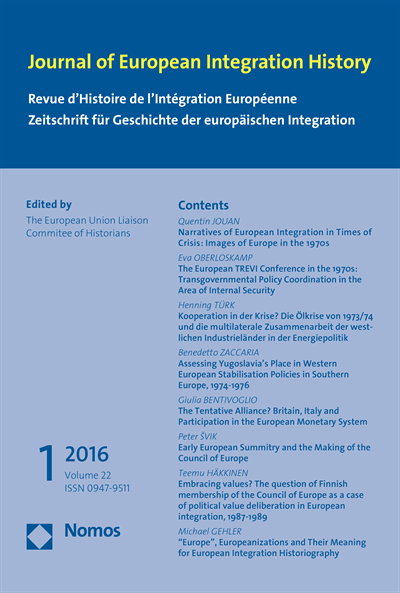
JEIH Journal of European Integration History
Volume 22 (2016), Issue 1
- Authors:
- Publisher
- Nomos, Baden-Baden
- Copyright Year
- 2016
- ISSN-Online
- 2942-321X
- ISSN-Print
- 0947-9511
Chapter information
Volume 22 (2016), Issue 1
Narratives of European Integration in Times of Crisis: Images of Europe in the 1970s
- Authors:
- ISSN-Print
- 0947-9511
- ISSN-Online
- 2942-321X
- Preview:
What should an ideal European Union look like? In 1975, Léo Tindemans attempted to answer this question by asking the opinion of socio-economic elites in the then nine Member states. These national perceptions of Europe are the core of our analysis. How do they narrate Europe? How are European integration and the European Economic Community (EEC) depicted in their speeches? We have observed three main narratives. First, European integration is seen as being solely an economic process. Second, the EEC is deemed to be a divided and non-homogenous whole, ruled by technocrats. Third, the direct election of the European Parliament is said to be a prerequisite to democratizing the European political system. This paper highlights the permanence of such narratives up to the present day. It also explains how all three narratives rest on one central theme: the need to bring Europe closer to its citizens, an issue that must be historicized due to its vivid relevance in the present.
