The Disappearance of the Turk: The Cultural Politics ofThoroughbred Horses in the Ottoman and British Empires
Table of contents
Bibliographic information
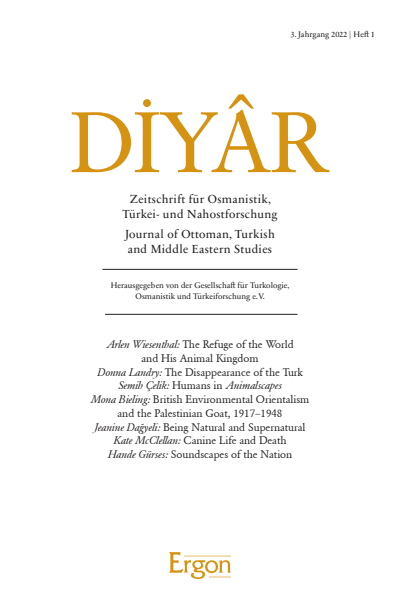
DIYÂR
Volume 3 (2022), Issue 1
- Authors:
- Publisher
- Ergon, Baden-Baden
- Copyright Year
- 2022
- ISSN-Online
- 2942-3155
- ISSN-Print
- 2625-9842
Chapter information
Volume 3 (2022), Issue 1
The Disappearance of the Turk: The Cultural Politics ofThoroughbred Horses in the Ottoman and British Empires
- Authors:
- ISSN-Print
- 2625-9842
- ISSN-Online
- 2942-3155
- Preview:
Between 1650 and 1750, the English Thoroughbred horse was created from Ottoman imports grafted upon native racing stock in an asymmetrical Anglo-Ottoman exchange, with appropriation leading to naturalisation and radical assimilation. The Ottoman Empire was a rich source of equine genetic material of the superior bloodhorse type. The Ottomans were equine multiculturalists. For Evliya Çelebi, the küheylân (Arab thoroughbred) was as Ottoman a breed as any other. Evliya never speaks of “Turk” or “Turkoman” horses as Western visitors did; instead he particularizes the breeds of the steppe, employing the Tatar term aġırmaq (thoroughbred), and identifying the Nogay and Karaçubuk as ‘thoroughbred’ breeds. Yet it was this “Turkoman” lineage of early imports such as the ‘Byerley Turk’ that was most originally formative for the English Thoroughbred, evidenced by studbook records, contemporary observers, phenotypical resemblances, and recent genome research. From the evidence of Evliya Çelebi, Jean-Baptiste Tavernier, Sir John Malcolm, Lady Anne Blunt, and others, this essay argues for the formative influence of the Ottoman “Turkoman” genotype that, as a consequence of imperial rivalries, British prejudices, and equine bloodstock politics, has been erased from history. The impact made by Ottoman imported horses constitutes an instance of collective, rather than individual, equine agency.
Bibliography
No match found. Try another term.
- Unpublished primary sources Open Google Scholar DOI: 10.5771/2625-9842-2022-1-28
- North Yorkshire County Archives Open Google Scholar DOI: 10.5771/2625-9842-2022-1-28
- Darley, Thomas Open Google Scholar DOI: 10.5771/2625-9842-2022-1-28
- ‘Letter from Thomas Darley, Aleppo, to Henry Darley, Aldby Park, 21 December 1703’ Open Google Scholar DOI: 10.5771/2625-9842-2022-1-28
- ZDA DAR CP1 Open Google Scholar DOI: 10.5771/2625-9842-2022-1-28
- British Library, London Open Google Scholar DOI: 10.5771/2625-9842-2022-1-28
- Harley, Nathaniel Open Google Scholar DOI: 10.5771/2625-9842-2022-1-28
- ‘Nathaniel Harley’s letters 1682-1720’ Open Google Scholar DOI: 10.5771/2625-9842-2022-1-28
- British Library Additional Manuscript 70143 Open Google Scholar DOI: 10.5771/2625-9842-2022-1-28
- Published primary sources Open Google Scholar DOI: 10.5771/2625-9842-2022-1-28
- ‘Alī, ‘Abdullah Yūsuf. 1997. The Meaning of the Holy Qur’an. New edition. Beltsville, MD: Amana Press. Open Google Scholar DOI: 10.5771/2625-9842-2022-1-28
- Blunt, Lady Anne. 1879. Bedouin Tribes of the Euphrates. Edited, with a Preface and Some Account of the Arabs and Their Horses, By W. S. B. 2 vols. London: John Murray. Reprint: London: Frank Cass & Co. 1968. Open Google Scholar DOI: 10.5771/2625-9842-2022-1-28
- Blunt, Lady Anne. 1986. Archer, Rosemary and Fleming, James (eds.). Lady Anne Blunt: Journals and Correspondence, 1878–1917. Northleach, Cheltenham, Gloucs: Alexander Heriot and Co. Ltd. Open Google Scholar DOI: 10.5771/2625-9842-2022-1-28
- Brown, William Robinson. 1947. The Horse of the Desert. New York: The Macmillan Company. Open Google Scholar DOI: 10.5771/2625-9842-2022-1-28
- Dawood, N. J. 1990. The Koran. 5th rev. edn. Harmondsworth and New York: Penguin. Open Google Scholar DOI: 10.5771/2625-9842-2022-1-28
- Evliya Çelebi bin Derviş Mehemmed Zilli. 1834–1850. Von Hammer, Joseph (trans.) Narrative of Travels in Europe, Asia, and Africa, in the seventeenth century. 2 vols. 1st vol. in 2 parts. London: Printed for the Oriental Translation Fund of Great Britain and Ireland; Sold by Parbury, Allen, & Co. Open Google Scholar DOI: 10.5771/2625-9842-2022-1-28
- Evliyâ Çelebi bin Derviş Mehemmed Zillî. 1996-2007. Dağlı, Yücel, Kahraman, Seyit Ali and Dankoff, Robert (eds.). Evliyâ Çelebi Seyahatnâmesi. 10 vols. Istanbul: Yapı Kredi Yayınları. Open Google Scholar DOI: 10.5771/2625-9842-2022-1-28
- Evliya Chelebi. 2010a. Javadi, Hasan and Floor, Willem (trans.). Travels in Iran and the Caucasus in 1647 & 1654. Washington, DC: Mage Publishers. Open Google Scholar DOI: 10.5771/2625-9842-2022-1-28
- Evliya Çelebi. 2010b. Dankoff, Robert and Kim, Sooyong (trans.). An Ottoman Traveller: Selections from the ‘Book of Travels’ of Evliya Çelebi. London: Eland. Open Google Scholar DOI: 10.5771/2625-9842-2022-1-28
- Dankoff, Robert. 1991a. An Evliya Çelebi Glossary: Unusual, Dialectal, and Foreign Words in the Seyahat-name. Sources of Oriental Languages and Literatures 14. Cambridge, MA: Harvard University Press. Open Google Scholar DOI: 10.5771/2625-9842-2022-1-28
- Dankoff, Robert. 1991b. The Intimate Life of an Ottoman Statesman: Melek Ahmed Pasha (1588–1662) As Portrayed in Evliya Çelebi’s ‘Book of Travels’ (‘Seyahat-name’). Dankoff, Robert (ed. and trans.). With a Historical Introduction by Rhoads Murphey. Albany, NY: State University of New York Press. Open Google Scholar DOI: 10.5771/2625-9842-2022-1-28
- Keppel, Captain, the Hon. George. 1827. Personal Narrative of a Journey from India to England, by Bussorah, Bagdad, the Ruins of Babylon, Curdistan, the Court of Persia, the Western Shore of the Caspian Sea, Astrakhan, Nishney Novogorod, Moscow, and St Petersburgh, in the Year 1824. 2nd edn. 2 vols. London: Henry Colburn. Open Google Scholar DOI: 10.5771/2625-9842-2022-1-28
- Kinneir, John Macdonald. 1813. A Geographical Memoir of the Persian Empire, Accompanied by A Map. London: John Murray. Open Google Scholar DOI: 10.5771/2625-9842-2022-1-28
- Malcolm, John, Colonel Sir. 1815. The History of Persia, From the Most Early Period to The Present Time: Containing an Account of the Religion, Government, Usages, And Character of the Inhabitants of that Kingdom. 2 vols. London: Murray. Open Google Scholar DOI: 10.5771/2625-9842-2022-1-28
- Tavernier, Jean Baptiste. 1676. Les Sixe Voyages de Jean Baptiste Tavernier, Ecuyer Baron d’Aubonne. En Turquie, en Perse, et Aux Indies. Paris: Gervais Clouzier and Claude Barbin. Open Google Scholar DOI: 10.5771/2625-9842-2022-1-28
- Tavernier, Jean Baptist. 1677. The Six Voyages of John Baptista Tavernier, A Noble Man of France now living, Through Turky into Persia, and the East Indies, Finished in the Year 1670. “Together with a New Relation of the Present Grand Seignor's Seraglio. Made English by J[ohn]. P[hilips]”. London: William Godbid. Open Google Scholar DOI: 10.5771/2625-9842-2022-1-28
- Tolstoy, Leo. 1974. [1886.] ‘Strider, the Story of a Horse’. In The Snow Storm and Other Stories. Maude, Louise and Maude, Aylmer (trans.). London: Oxford University Press. 389–439. Open Google Scholar DOI: 10.5771/2625-9842-2022-1-28
- Secondary sources Open Google Scholar DOI: 10.5771/2625-9842-2022-1-28
- Alwair, Dr. Hazaim. 2007. ‘Bedouin Strains’. 2007 WAHO Conference, Damascus, Syria. 74–88. Open Google Scholar DOI: 10.5771/2625-9842-2022-1-28
- Artan, Tülay. 2008. ‘A Book of Kings Produced and Presented as a Treatise on Hunting’. Muqarnas. 25. 299–330. Open Google Scholar DOI: 10.5771/2625-9842-2022-1-28
- Artan, Tülay. 2010. ‘Ahmet I and “Tuhfetü’l-Mülûk ve’s-Selâtîn”: A Period Manuscript on Horses, Horsemanship, and Hunting’. In Faroqhi, Suraiya (ed.). Animals and People in the Ottoman Empire. Istanbul: Eren. 235–269. Open Google Scholar DOI: 10.5771/2625-9842-2022-1-28
- Brewer, John. 1989. The Sinews of Power: War, Money, and the English State, 1688–1783. London: Unwin Hyman. Open Google Scholar DOI: 10.5771/2625-9842-2022-1-28
- Cosgrove, Elissa J., Sadeghi, Raheleh, Schlamp, Florencia, et al. 2020. ‘Genome Diversity and the Origin of the Arabian Horse’. Nature Scientific Reports. 10: 9702. https://www.nature.com/articles/s41598-020-66232-1 (accessed 23 March 2021) Open Google Scholar DOI: 10.5771/2625-9842-2022-1-28
- Dankoff, Robert. 2004. An Ottoman Mentality: The World of Evliya Çelebi. Leiden and Boston, MA: Brill. Open Google Scholar DOI: 10.5771/2625-9842-2022-1-28
- Derry, Margaret E. 2003. Bred for Perfection: Shorthorn Cattle, Collies, and Arabian Horses since 1800. Baltimore: The Johns Hopkins University Press. Open Google Scholar DOI: 10.5771/2625-9842-2022-1-28
- Derry, Margaret E. 2006. Horses in Society: A Story of Animal Breeding and Marketing Culture, 1800–1920. Toronto: University of Toronto Press. Open Google Scholar DOI: 10.5771/2625-9842-2022-1-28
- Edwards, Peter. 1988. The Horse Trade of Tudor and Stuart England. Cambridge: Cambridge University Press. Open Google Scholar DOI: 10.5771/2625-9842-2022-1-28
- The Equinest. 2010. URL: http://www.theequinest.com/breeds/akhal-teke/ (accessed 28 April 2020) Open Google Scholar DOI: 10.5771/2625-9842-2022-1-28
- Faroqhi, Suraiya (ed.). 2010. Animals and People in the Ottoman Empire. Istanbul: Eren. Open Google Scholar DOI: 10.5771/2625-9842-2022-1-28
- Fattah, Hala. 1997. The Politics of Regional Trade in Iraq, Arabia, and the Gulf 1745–1900. Albany, NY: State University of New York Press. Open Google Scholar DOI: 10.5771/2625-9842-2022-1-28
- Felkel, Sabine, Vogl, Claus, Rigler, Doris, et al. 2019. ‘The horse Y chromosome as an informative marker for tracing sire lines’. Scientific Reports. 9.6095. URL: https://www.ncbi.nlm.nih.gov/pmc/articles/PMC6465346/ (accessed 25 April 2020) Open Google Scholar DOI: 10.5771/2625-9842-2022-1-28
- Gopal, Priyamvada. 2020. Insurgent Empire: Anticolonial Resistance and British Dissent. London: Verso. Open Google Scholar DOI: 10.5771/2625-9842-2022-1-28
- Guest, Kristin and Mattfeld, Monica. 2020. ‘Horse Breeds: Introduction’. In Guest, Kristin and Mattfeld, Monica (eds.). Horse Breeds and Human Society: Purity, Identity and the Making of the Modern Horse. Abingdon and New York: Routledge. 1–9. Open Google Scholar DOI: 10.5771/2625-9842-2022-1-28
- Hill, E. W., Bradley, D. G., Al-Barody, M. et al. 2002. ‘History and integrity of thoroughbred dam lines revealed in equine mtDNA variation’. Animal Genetics. 33. 287-294. URL: http://www.tbheritage.com/GeneticMarkers/HillAnimalGenetics.pdf (accessed 28 April 2020) Open Google Scholar DOI: 10.5771/2625-9842-2022-1-28
- İnal, Onur. 2020. ‘One-Humped History: The Camel as Historical Actor in the Late Ottoman Empire’. International Journal of Middle East Studies. 1–16. Open Google Scholar DOI: 10.5771/2625-9842-2022-1-28
- James, Jeremy. 2005. The Byerley Turk: The True Story of the First Thoroughbred. Ludlow, Salop: Merlin Unwin. Open Google Scholar DOI: 10.5771/2625-9842-2022-1-28
- James, Jeremy. 2007. Turk Atı: Ingiliz Yarış Atlarının Atası. Olcaytu, Neşe (trans.) Istanbul: E Yayınları. Open Google Scholar DOI: 10.5771/2625-9842-2022-1-28
- James, Jeremy. 2015. Private communication to the author. Open Google Scholar DOI: 10.5771/2625-9842-2022-1-28
- Kleimola, Ann M. 2005. ‘Cultural Convergence: The Equine Connection between Muscovy and Europe’. In Raber, Karen and Tucker, Treva J. (eds.). The Culture of the Horse: Status, Discipline, and Identity in the Early Modern World. Houndmills, Basingstoke: Palgrave Macmillan. 45–62. Open Google Scholar DOI: 10.5771/2625-9842-2022-1-28
- Lacy, Lisa McCracken. 2018. Lady Anne Blunt in the Middle East: Politics, Travel and the Idea of Empire. London: I. B. Tauris. Open Google Scholar DOI: 10.5771/2625-9842-2022-1-28
- Landry, Donna. 2008. Noble Brutes: How Eastern Horses Transformed English Culture. Baltimore, MD: The Johns Hopkins University Press. Open Google Scholar DOI: 10.5771/2625-9842-2022-1-28
- Landry, Donna. 2013. ‘“Delight makes all of the one mind”: Irish Collectivity at the Races’. In Lyons, Paddy, Miller, John and Maley, Willey (eds.). Romantic Ireland: From Tone to Gonne; Fresh Perspectives on Nineteenth-Century Ireland. Newcastle: Cambridge Scholars Publishing. 337–347. Open Google Scholar DOI: 10.5771/2625-9842-2022-1-28
- Landry, Donna. 2015a. Akıllı, Sinan (trans.) Asıl Hayvanlar: Ingiliz Kültürürnü Değiştiren Doğulu Atlar. Istanbul: E Yayınları. Open Google Scholar DOI: 10.5771/2625-9842-2022-1-28
- Landry, Donna. 2015b. ‘Horse-Human Companionship: Creaturely Cosmopolitanism across Eurasia’. In Nagai, Kaori; Jones, Karen; Landry, Donna et al. (eds.) Cosmopolitan Animals. Houndmills, Basingstoke: Palgrave Macmillan. 181–193. Open Google Scholar DOI: 10.5771/2625-9842-2022-1-28
- Landry, Donna. 2018. ‘Evliya Çelebi, Explorer on Horseback: Knowledge Gathering by a Seventeenth-Century Ottoman’. In Craciun, Adriana and Terrall, Mary (eds.). Curious Encounters: Voyaging, Collecting, and Making Knowledge in the Long Eighteenth Century. Toronto: University of Toronto Press. 43–70. Open Google Scholar DOI: 10.5771/2625-9842-2022-1-28
- Landry, Donna. 2019. ‘Horses at Waterloo, 1815’. In Guest, Kristen and Mattfeld, Monica (eds.). Equestrian Cultures: Horses, Human Society, and the Discourse of Modernity. Chicago and London: University of Chicago Press. 26–38. Open Google Scholar DOI: 10.5771/2625-9842-2022-1-28
- Landry, Donna. 2020. ‘Habsburg Lippizaners, English Thoroughbreds and the Paradoxes of Purity’. In Guest, Kristin and Mattfeld, Monica (eds.). Horse Breeds and Human Society: Purity, Identity and the Making of the Modern Horse. Abingdon and New York: Routledge. 27–49. Open Google Scholar DOI: 10.5771/2625-9842-2022-1-28
- Landry, Donna. 2021. ‘Ottoman Ecocriticism and Political Ecology: Horse-Human Relations in Evliya Çelebi and After’. In Oppermann, Serpil and Akıllı, Sinan (eds.). Turkish Ecocriticism: From Neolithic to Contemporary Timescapes. Ecocritical Theory and Praxis Series. Lanham, MD: Lexington Books. 149–161. Open Google Scholar DOI: 10.5771/2625-9842-2022-1-28
- Landry, Donna, and Mansel, Philip. 2019. ‘Introduction: Horses and Courts: The Reins of Power’. In Landry, Donna and Mansel, Philip (eds.). Horses and Courts: The Reins of Power. Special issue of The Court Historian 24: 3 (December): 197–204. https://www.tandfonline.com/eprint/H8V5GUWHRQ29F4G7R8MC/full?target=10.1080/14629712.2019.1675315 (accessed 21 March 2021) Open Google Scholar DOI: 10.5771/2625-9842-2022-1-28
- Lange, Christoph. 2020. ‘The Making and Remaking of the Arabian Horse – From the Arab Bedouin Horse to the Modern Straight Egyptian’. In Guest, Kristin and Mattfeld, Monica (eds.). Horse Breeds and Human Society: Purity, Identity and the Making of the Modern Horse. Abingdon and New York: Routledge. 234–250. Open Google Scholar DOI: 10.5771/2625-9842-2022-1-28
- Lowe, C. Bruce. 1895. Allison, William (ed.). Breeding Racehorses by the Figure System. London: Horace Cox. Open Google Scholar DOI: 10.5771/2625-9842-2022-1-28
- Mackay-Smith, Alexander. 2000. Speed and the Thoroughbred: The Complete History. Lanham, MD: The Derrydale Press. Open Google Scholar DOI: 10.5771/2625-9842-2022-1-28
- Mikhail, Alan. 2014. The Animal in Ottoman Egypt. Oxford and New York: Oxford University Press. Open Google Scholar DOI: 10.5771/2625-9842-2022-1-28
- Murray, Katrina. 2011. Private communication to the author. Open Google Scholar DOI: 10.5771/2625-9842-2022-1-28
- Nash, Richard. 2005. “‘Honest English Breed”: The Thoroughbred as Cultural Metaphor’. In Raber, Karen and Tucker, Treva J. (eds.). The Culture of the Horse: Status, Discipline, and Identity in the Early Modern World. Houndmills, Basingstoke: Palgrave Macmillan. 245–272. Open Google Scholar DOI: 10.5771/2625-9842-2022-1-28
- Nash, Richard. 2012. ‘“Beware a Bastard Breed”: Notes Towards a Revisionist History of the Thoroughbred Racehorse’. In Edwards, Peter, Enenkel, Karl A. E., and Graham, Elspeth (eds.). The Horse as Cultural Icon: The Real and the Symbolic Horse in the Early Modern World. Leiden and Boston, MA; Brill. 191–216. Open Google Scholar DOI: 10.5771/2625-9842-2022-1-28
- Pedigree Query. 2020. URL: http://www.pedigreequery.com/frankel3 (accessed 18 April 2020). Open Google Scholar DOI: 10.5771/2625-9842-2022-1-28
- Peters, Anne. 2005. ‘Portraits: Byerley Turk’. Thoroughbred Heritage. URL: http://www.tbheritage.com/Portraits/ByerleyTurk.html (accessed 25 April 2020). Open Google Scholar DOI: 10.5771/2625-9842-2022-1-28
- Pickrell, John. 2005. ‘95% of Thoroughbreds Linked to one Super-Stud’. New Scientist. 6 September. URL: https://www.newscientist.com/article/dn7941-95-of-thoroughbreds-linked-to-one-superstud/ (accessed 21 April 2020). Open Google Scholar DOI: 10.5771/2625-9842-2022-1-28
- Ritvo, Harriet. 1987. The Animal Estate: The English and Other Creatures in the Victorian Age. Cambridge, MA: Harvard University Press. Open Google Scholar DOI: 10.5771/2625-9842-2022-1-28
- Shaw, David Gary. 2013. ‘The Torturer’s Horse: Agency and Animals in History’. History and Theory. 52.4. Theme Issue 52: ‘Does History Need Animals?’. 146–167. Open Google Scholar DOI: 10.5771/2625-9842-2022-1-28
- Steen, Andrew K. n.d. Count Jozef Potocki, The Man Who Bred Skowronek. Seville: A Tale of the Breed/Escandón Impresores. Open Google Scholar DOI: 10.5771/2625-9842-2022-1-28
- Tempest, Bridget. [2001.] Turkmen at Wimpole: Artists from Turkmenistan. Ashgabat: Visiting Artists. Open Google Scholar DOI: 10.5771/2625-9842-2022-1-28
- Thoroughbred Heritage. 2013. URL: http://www.tbheritage.com (accessed 18 April 2020). Open Google Scholar DOI: 10.5771/2625-9842-2022-1-28
- Wallner, Barbara, Palmieri, Nicola, Vogl, Claus, Rigler, Doris, Bozlak, Elif, et al. 2017. ‘Y Chromosome Uncovers the Recent Oriental Origin of Modern Stallions’. Current Biology. 27.13. 2029–2035. URL: https://www.cell.com/current-biology/fulltext/S0960-9822(17)30694-2?_returnURL=https%3A%2F%2Flinkinghub.elsevier.com%2Fretrieve%2Fpii%2FS0960982217306942%3Fshowall%3Dtrue#back-bib25 (accessed 26 April 2020). Open Google Scholar DOI: 10.5771/2625-9842-2022-1-28
- White, Sam. 2011. The Climate of Rebellion in the Early Modern Ottoman Empire. Cambridge and New York: Cambridge University Press. Open Google Scholar DOI: 10.5771/2625-9842-2022-1-28
- Winstone, H. V. F. 2003. Lady Anne Blunt: A Biography. London: Barzan. Open Google Scholar DOI: 10.5771/2625-9842-2022-1-28
- Wynmalen, Henry. 1950. Horse Breeding & Stud Management. London and New York: Country Life and Charles Scribner’s Sons. Open Google Scholar DOI: 10.5771/2625-9842-2022-1-28