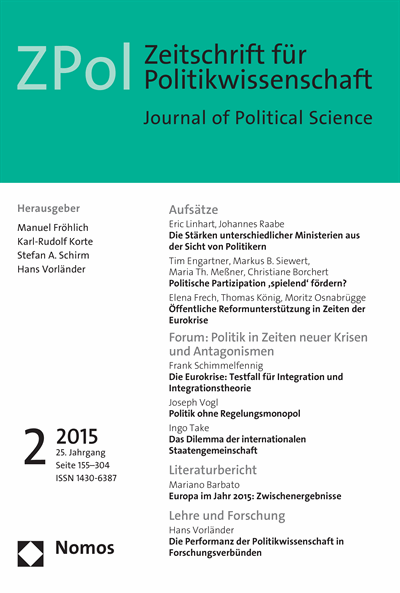
Die Stärken unterschiedlicher Ministerien aus der Sicht von Politikern
Table of contents
Bibliographic information
No access
Journal of Political Science
Volume 25 (2015), Edition 2
- Authors:
- Publisher
- Nomos, Baden-Baden
- Publication year
- 2015
- ISSN-Online
- 1430-6387
- ISSN-Print
- 1430-6387
Chapter information
No access
Volume 25 (2015), Edition 2
Die Stärken unterschiedlicher Ministerien aus der Sicht von Politikern
- Authors:
- ISSN-Print
- 1430-6387
- ISSN-Online
- 1430-6387
- Preview:
Bibliography
No match found. Try another term.
- Andeweg, Rudy B., 2000: Ministers as double agents? The delegation process between cabinet and ministers, in: European Journal of Political Research 37 (3), 377-395. Open Google Scholar doi.org/10.1111/1475-6765.00518
- Austen-Smith, David/Banks, Jeffrey, 1988: Elections, coalitions, and legislative outcomes, in: American Political Science Review 82 (2), 405-422. Open Google Scholar doi.org/10.2307/1957393
- Bäck, Hanna/Debus, Marc/Dumont, Patrick, 2011: Who gets what in coalition governments? Predictors of portfolio allocation in parliamentary democracies, in: European Journal of Political Research 50 (4), 441-478. Open Google Scholar doi.org/10.1111/j.1475-6765.2010.01980.x
- Baron, David P./Diermeier, Daniel, 2001: Elections, governments, and parliaments in proportional representation systems, in: The Quarterly Journal of Economics 116 (3), 933-967. Open Google Scholar doi.org/10.1162/00335530152466278
- Browne, Eric C./Frendreis, John P., 1980: Allocating coalition payoffs by conventional norm. An assessment of the evidence from cabinet coalition situations, in: American Journal of Political Science 24 (4), 753-768. Open Google Scholar doi.org/10.2307/2110957
- Carroll, Royce/Cox, Gary W., 2007: The logic of Gamson’s Law. Pre-electoral coalitions and portfolio allocations, in: American Journal of Political Science 51 (2), 300-313. Open Google Scholar doi.org/10.1111/j.1540-5907.2007.00252.x
- Ceron, Andrea, 2014: Gamson rule not for all. Patterns of portfolio allocation among Italian party factions, in: European Journal of Political Research 53 (1), 180-199. Open Google Scholar doi.org/10.1111/1475-6765.12020
- Cohen, Jacob, 1988: Statistical power analysis for the behavioural sciences, Hillsdale (2. Aufl.). Open Google Scholar
- Debus, Marc, 2008: Office and policy payoffs in coalition governments, in: Party Politics 14 (5), 515-538. Open Google Scholar doi.org/10.1177/1354068807088121
- Doemens, Karl, 2013: Schwierige Suche, in: Frankfurter Rundschau, 8. Oktober 2013, 2. Open Google Scholar
- Gamson, William A., 1961: A theory of coalition formation, in: American Sociological Review 26 (3), 373-382. Open Google Scholar doi.org/10.2307/2090664
- Gianetti, Daniela/Laver, Michael, 2005: Policy positions and jobs in the government, in: European Journal of Political Research 44 (1), 91-120. Open Google Scholar
- Heller, William B., 2001: Making policy stick. Why the government gets what it wants in multiparty parliaments, in: American Journal of Political Science 45 (4), 780-798. Open Google Scholar doi.org/10.2307/2669324
- Helms, Ludger, 2005: Regierungsorganisation und politische Führung in Deutschland, Wiesbaden. Open Google Scholar doi.org/10.1007/978-3-322-80797-7
- Kammholz, Karsten/Sturm, Daniel F., 2013: Skurril. SPD streitet über Schwarz-Grün, in: Die Welt, 7. Oktober 2013, 1. Open Google Scholar
- Larsson, Torbjörn, 1994: Cabinet ministers and parliamentary government in Sweden, in: Michael Laver/Kenneth A. Shepsle (Hrsg.), Cabinet Ministers and Parliamentary Government, Cambridge, 169-186. Open Google Scholar
- Laver, Michael/Hunt, William B., 1992: Policy and party competition, New York. Open Google Scholar
- Laver, Michael/Schofield, Norman, 1990: Multiparty government. The politics of coalition in Europe, Oxford. Open Google Scholar
- Laver, Michael/Shepsle, Kenneth A. (Hrsg.), 1994: Cabinet ministers and parliamentary government, Cambridge. Open Google Scholar
- Linhart, Eric, 2013: Does an appropriate coalition theory exist for Germany? An overview of recent office- and policy-oriented coalition theories, in: German Politics 22 (3), 288-313. Open Google Scholar doi.org/10.1080/09644008.2013.832216
- Linhart, Eric/Pappi, Franz U., 2009: Koalitionsbildungen zwischen Ämter- und Politikmotivation. Konstruktion einer interdependenten Nutzenfunktion, in: Politische Vierteljahresschrift 50 (1), 23-49. Open Google Scholar doi.org/10.1007/s11615-009-0124-7
- Linhart, Eric/Pappi, Franz U./Schmitt, Ralf, 2008: Die proportionale Ministerienaufteilung in deutschen Koalitionsregierungen. Akzeptierte Norm oder das Ausnutzen strategischer Vorteile?, in: Politische Vierteljahresschrift 49 (1), 46-67. Open Google Scholar doi.org/10.1007/s11615-008-0087-0
- Linhart, Eric/Shikano, Susumu, 2015: Koalitionsbildung nach der Bundestagswahl 2013. Parteien im Spannungsfeld zwischen Ämter-, Politik- und Stimmenmotivation, in: Karl-Rudolf Korte/Jan Schoofs (Hrsg.), Die Bundestagswahl 2013. Analysen der Wahl-, Parteien-, Kommunikations- und Regierungsforschung, Wiesbaden, 457-484. Open Google Scholar doi.org/10.1007/978-3-658-02915-9_20
- Linhart, Eric/Windwehr, Jana, 2012: Die Bedeutung bestimmter Ministerien, Geschäftsbereiche und Politikfelder für die Parteien in den deutschen Bundesländern, in: Zeitschrift für Parlamentsfragen 43 (3), 579-597. Open Google Scholar
- Ministerium der Justiz und für Europa und Verbraucherschutz Brandenburg, 2015: Die Aufgabenverteilung, http://www.mdj.brandenburg.de/cms/detail.php/lbm1.c.276380.de (Stand: 02.07.15). Open Google Scholar
- Ministerium der Justiz und für Verbraucherschutz Rheinland-Pfalz, 2015: Aufgaben des Ministeriums, http://www.mjv.rlp.de/Ministerium/Wir-ueber-uns/Aufgaben-des-Ministeriums/ (Stand: 02.07.15). Open Google Scholar
- Müller, Wolfgang C./Strøm, Kaare, 1999: Policy, office, or votes? How political parties in Western Europe make hard decisions, Cambridge. Open Google Scholar
- n-tv.de, 2001: Posten-Schacher beendet. Schill Zweiter Bürgermeister, http://www.n-tv.de/politik/Schill-Zweiter-Buergermeister-article135486.html (Stand: 02.07.15). Open Google Scholar
- n24.de, 2013: Angela Merkel am Drücker. Posten-Schach in Großer Koalition beginnt, http://www.n24.de/n24/Nachrichten/Politik/d/3981530/posten-schach-in-grosser-koalition-beginnt.html (Stand: 02.07.15). Open Google Scholar
- Narud, Hanne M./Valen, Henry, 2008: Coalition membership and electoral performance, in: Kaare Strøm/Wolfgang C. Müller/Torbjörn Bergman (Hrsg.), Cabinets and coalition bargaining. The democratic life cycle in Western Europe, Oxford, 369-402. Open Google Scholar
- Norpoth, Helmut, 1982: The German Federal Republic. Coalition government at the brink of majority rule, in: Eric C. Browne/John Dreijmanis (Hrsg.), Government coalitions in Western democracies, New York, 7-32. Open Google Scholar
- Ono, Yoshikuni, 2012: Portfolio allocation as leadership strategy. Intraparty bargaining in Japan, in: American Journal of Political Science 56 (3), 553-567. Open Google Scholar doi.org/10.1111/j.1540-5907.2012.00586.x
- Pappi, Franz U./Schmitt, Ralf/Linhart, Eric, 2008: Die Ministeriumsverteilung in den deutschen Landesregierungen seit dem Zweiten Weltkrieg, in: Zeitschrift für Parlamentsfragen 39 (2), 323-342. Open Google Scholar doi.org/10.5771/0340-1758-2008-2-323
- Raabe, Johannes, 2015: Die Ministerienaufteilung in Koalitionsregierungen. Eine modelltheoretische Näherung mit Hilfe von Divisor-Verfahren, in: André Bächtiger/Susumu Shikano/Eric Linhart (Hrsg.), Jahrbuch für Handlungs- und Entscheidungstheorie. Band 9, Wiesbaden, 159-191. Open Google Scholar doi.org/10.1007/978-3-658-07583-5_6
- Raabe, Johannes/Linhart, Eric, 2014: Disentangling the value of a ministry. Party leaders’ evaluations of German state ministries, in: West European Politics 37 (5), 1065-1086. Open Google Scholar doi.org/10.1080/01402382.2013.852833
- Raabe, Johannes/Linhart, Eric, 2015: Does substance matter? A model of qualitative portfolio allocation and application to German state governments between 1990 and 2010, in: Party Politics 21 (3), 481-492. Open Google Scholar doi.org/10.1177/1354068813487107
- Saalfeld, Thomas, 2000: Coalitions in Germany. Stable parties, chancellor democracy and the art of informal settlement, in: Wolfgang C. Müller/Kaare Strøm (Hrsg.), Coalition government in Western Europe, Oxford, 32-85. Open Google Scholar
- Saalfeld, Thomas, 2007: Parteien und Wahlen, Baden-Baden. Open Google Scholar
- Sened, Itai, 1995: Equilibria in weighted voting games with side payments, in: Journal of Theoretical Politics 7 (3), 283-300. Open Google Scholar doi.org/10.1177/0951692895007003003
- Sened, Itai, 1996: A model of coalition formation. Theory and evidence, in: Journal of Politics 58 (2), 360-372. Open Google Scholar doi.org/10.2307/2960230
- Shepsle, Kenneth A./Weingast, Barry R., 1981: Political preferences for the pork barrel. A generalization, in: American Journal of Political Science 25 (1), 96-111. Open Google Scholar doi.org/10.2307/2110914
- Strøm, Kaare/Müller, Wolfgang C./Smith, Daniel M., 2010: Parliamentary control of coalition governments, in: Annual Review of Political Science 13, 517-535. Open Google Scholar doi.org/10.1146/annurev.polisci.10.071105.104340
- Verzichelli, Luca, 2010: Portfolio allocation, in: Kaare Strøm/Wolfgang C. Müller/Torbjörn Bergman (Hrsg.), Cabinets and coalition bargaining. The democratic life cycle in Western Europe, Oxford, 237-267. Open Google Scholar
- Warwick, Paul V., 2001: Coalition policy in parliamentary democracies. Who gets how much and why, in: Comparative Political Studies 34 (10), 1212-1236. Open Google Scholar
- Warwick, Paul V./Druckman, James N., 2001: Portfolio salience and the proportionality of payoffs on coalition governments, in: British Journal of Political Science 31 (4), 627-649. Open Google Scholar doi.org/10.1017/S0007123401000242
- Warwick, Paul V./Druckman, James N., 2006: The portfolio allocation paradox. An investigation into the nature of a very strong but puzzling relationship, in: European Journal of Political Research 45 (4), 635-665. Open Google Scholar doi.org/10.1111/j.1475-6765.2006.00632.x
Citation
No access
You do not have access to this content.