Zwischen Anpassung und Kontinuität: Die Beziehungen zwischen politischer Pressearbeit und Journalismus im Zeitalter von Social Media
Table of contents
Bibliographic information
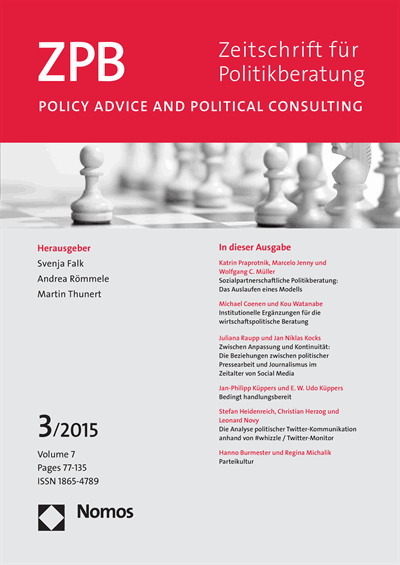
Full access
Policy Advice and Political Consulting
Volume 7 (2015), Edition 3
- Authors:
- Publisher
- Nomos, Baden-Baden
- Publication year
- 2015
- ISSN-Online
- 1865-4789
- ISSN-Print
- 1865-4789
Chapter information
Full access
Volume 7 (2015), Edition 3
Zwischen Anpassung und Kontinuität: Die Beziehungen zwischen politischer Pressearbeit und Journalismus im Zeitalter von Social Media
- Authors:
- ISSN-Print
- 1865-4789
- ISSN-Online
- 1865-4789
- Preview:
Bibliography
No match found. Try another term.
- Altmeppen, K.-D., Röttger, U., & Bentele, G. (2004). Public Relations und Journalismus: Eine lang andauernde und interessante "Beziehungskiste". In K.-D. Altmeppen, U. Röttger & G. Bentele (Hrsg.), Schwierige Verhältnisse (S. 7-15). Wiesbaden: VS Verlag. Open Google Scholar
- Baerns, B. (1991). Öffentlichkeitsarbeit oder Journalismus?: Zum Einfluss im Mediensystem. Köln: Verlag Wissenschaft und Politik. Open Google Scholar
- Bajkiewicz, T. E., Kraus, J. J., & Hong, S. Y. (2011). The impact of newsroom changes and the rise of social media on the practice of media relations. Public Relations Review, 37(3), 329-33. doi: 10.1016/ j.pubrev. 2011.05.001 Open Google Scholar doi.org/10.1016/j.pubrev.2011.05.001
- Becker, L. B., & Vlad, T. (2009). News organizations and routines. In Open Google Scholar doi.org/10.4337/9781848447240
- K. Wahl-Jorgensen & T. Hanitzsch (Hrsg.), The handbook of journalism studies (S. 59-72). New York: Routledge. Open Google Scholar
- Bennett, L. W. (2004). New media power. The internet and global activism. In N. Couldry & J. Curran (Hrsg.), Contesting media power: Alternative media in a networked world (S. 17-38). Oxford: Rowman & Littlefield. Open Google Scholar
- Bennett, L. W., Breunig, C., & Givens, T. (2008). Communication and political mobilization: Digital media and the organization of anti-Iraq war demonstrations in the U.S. Political Communication, 25(3), 269-289. doi: 10.1080/10584600802197434 Open Google Scholar doi.org/10.1080/10584600802197434
- Bentele, G., Großkurth, L., & Seidenglanz, R. (2007). Profession Pressesprecher 2007. Vermessung eines Berufsstandes. Berlin: Helios. Open Google Scholar
- Bentele, G., Seidenglanz, R., & Fechner, R. (2015). Profession Pressesprecher 2015. Vermessung eines Berufsstandes. Berlin: Helios. Open Google Scholar
- Brants, K., & Voltmer, K. (2011). Introduction: Mediatization and decentralization of political communication. In K. Brants & K. Voltmer (Hrsg.), Challenging the primacy of politics (S. 1-16). New York: Palgrave McMillan. Open Google Scholar
- Brüggemann, M., Esser, F., & Humprecht, E. (2012). The strategic repertoire of publishers in the media crisis. The “Five C” scheme in Germany. Journalism Studies, 13(5-6), 742-752. doi: 10.1080/1461670X. 2012.664336 Open Google Scholar
- Curtin, P. A. (1999). Reevaluating public relations informations subsidies. Market-driven journalism and agenda-building theory and practice. Journal of Public Relations Research, 11(1), 53-90. doi: 10.1207/ s1532754xjprr1101_03 Open Google Scholar
- Dahlgren, P. (2005). The Internet, public spheres, and political communication: Dispersion and deliberation. Political Communication, 22(2), 147-162. doi: 10.1080/10584600590933160 Open Google Scholar doi.org/10.1080/10584600590933160
- Davis, A. (2000). Public relations, news production and changing patterns of source access in the British national media. Media, Culture & Society, 22(1), 39-59. doi: 10.1177/016344300022001003 Open Google Scholar doi.org/10.1177/016344300022001003
- Davis, A. (2007). The mediation of power. A critical introduction. New York: Routledge. Open Google Scholar doi.org/10.4324/9780203945827
- DeLorme, D. E., & Fedler, F. (2003). Journalists’ hostility toward public relations: an historical analysis. Public Relations Review, 29(2), 99-124. doi: doi:10.1016/S0363-8111(03)00019-5 Open Google Scholar doi.org/10.1016/S0363-8111(03)00019-5
- Deuze, M. (2005). What is journalism? Professional identity and ideology of journalists reconsidered. Journalism, 6(4), 442-464. doi: 10.1177/1464884905056815 Open Google Scholar doi.org/10.1177/1464884905056815
- Donsbach, W., & Klett, B. (1993). Subjective objectivity. How journalists in four countries define a key term of their profession. International Communication Gazette, 51(1), 53-83. doi: 10.1177/001654929305100104 Open Google Scholar doi.org/10.1177/001654929305100104
- Duhé, S. (2015). An overview of new media research in public relations journals from 1981 to 2014. Public Relations Review, 41(2), 153-169. Open Google Scholar doi.org/10.1016/j.pubrev.2014.11.002
- doi: 10.1016/j.pubrev. 2014.11.002 Open Google Scholar
- Fredriksson, M., & Johansson, B. (2014). The dynamics of professional identity. Journalism Practice, 8(5), 585-595. doi: 10.1080/17512786.2014.884746 Open Google Scholar doi.org/10.1080/17512786.2014.884746
- Fröhlich, R., & Rüdiger, B. (2006). Framing political public relations: Measuring success of strategies in Germany. Public Relations Review, 31(1), 18-25. doi: 10.1016/j.pubrev. 2005.10.003 Open Google Scholar
- Gandy, O. H. (1982). Beyond agenda setting: Information subsidies and public policy. Norwood: Ablex Publishing Corp. Open Google Scholar
- Gans, H. J. (1979). Deciding what's news: A study of CBS Evening News, NBC Nightly News, Newsweek, and Time. New York: Pantheon Books. Open Google Scholar
- Gurevitch, M., Coleman, S., & Blumler, J. G. (2009). Political communication ˗ old and new media relationships. The ANNALS of the American Academy of Political and Social Science, 625(1), 164-181. doi: 10.1177/0002716209339345 Open Google Scholar doi.org/10.1177/0002716209339345
- Herman, E. S., & Chomsky, N. (1994). Manufacturing consent: the political economy of the mass media. New York: Random House. Open Google Scholar
- Jarren, O., & Meier, W. (2002). Mediensysteme und Medienorganisationen als Rahmen für den Journalismus. In O. Jarren & H. Weßler (Hrsg.), Journalismus ˗ Medien ˗ Öffentlichkeit: Eine Einführung (S. 99-158). Wiesbaden: Westdeutscher Verlag. Open Google Scholar
- Jarren, O., & Donges, P. (2011). Politische Kommunikation in der Mediengesellschaft: Eine Einführung. Wiesbaden: VS Verlag. Open Google Scholar doi.org/10.1007/978-3-531-93446-4
- Kent, M. L. (2013). Using social media dialogically: Public relations role in reviving democracy. Public Relations Review, 39(4), 337-345. doi: 10.1016/j.pubrev. 2013.07.024 Open Google Scholar
- Klinger, U., & Svensson, J. (2014). The emergence of network media logic in political communication: A theoretical approach. New Media & Society, 17(8), 1241-1257. doi: 10.1177/1461444814522952 Open Google Scholar doi.org/10.1177/1461444814522952
- Kocks, J. (2017, i.E.): Staatliche Öffentlichkeitsarbeit aus netzwerkanalytischer Perspektive. In: Raupp, J., Kocks, J.N., & Murphy, K. (Hrsg.): Regierungskommunikation und Staatliche Öffentlichkeitsarbeit im Wandel. Wiesbaden: VS Verlag.. Open Google Scholar doi.org/10.1007/978-3-658-20589-8_7
- Kocks, J., Raupp, J., & Murphy, K. (2016): Egos, elites and social capital: Analyzing media-government relations from a network perspective. Paper präsentiert im Rahmen der ECPR General Conference 2016, Prag. Open Google Scholar doi.org/10.1007/978-3-658-13551-5_3
- Kocks, J., Raupp, J., & Schink, C. (2014). Staatliche Öffentlichkeitsarbeit zwischen Distribution und Dialog: Interaktive Potentiale digitaler Medien und ihre Nutzung im Rahmen der Außenkommunikation politischer Institutionen. In R. Fröhlich & T. Koch (Hrsg.): Politik ˗ PR ˗ Persuasion. Strukturen, Funktionen und Wirkungen politischer Öffentlichkeitsarbeit (S. 71-87). Wiesbaden: VS Verlag. Open Google Scholar
- Lariscy, R. W., Johnson Avery, E., Sweetser, K. D., & Howes, P. (2009). An examination of the role of online social media in journalists’ source mix. Public Relations Review, 35(3), 314-316. doi: 10.1016/ j.pubrev. 2009.05.008 Open Google Scholar doi.org/10.1016/j.pubrev.2009.05.008
- Larsson, L. (2008). Media relations. In W. Donsbach (Hrsg.), The international encyclopedia of communication (S. 2995-2999). Malden: Blackwell. Open Google Scholar
- Larsson, L. (2009). PR and the media: A collaborative relationship? Open Google Scholar doi.org/10.1504/IJECRM.2009.027952
- Nordicom Review, 30(1), 131-147. Open Google Scholar
- Lester, L. (2010). Big tree, small news: Media access, symbolic power and strategic intervention. Journalism, 11(5), 589-606. doi: 10.1177/1464884910373537 Open Google Scholar doi.org/10.1177/1464884910373537
- Lewis, J., Williams, A., & Franklin, B. (2008). A compromised fourth estate? UK news journalism, public relations and news sources. Journalism Studies, 9(1), 1-20. doi: 10.1080/14616700701767974 Open Google Scholar doi.org/10.1080/14616700701767974
- Lieber, P. S., & Golan, G. J. (2011). Political public relations, news management, and agenda indexing. In J. Strömbäck & S. Kiousis (Hrsg.), Political public relations: Principles and applications. New York: Routledge. Open Google Scholar
- Machill, M., Beiler, M., & Zenker, M. (2008). Journalistische Recherche im Internet: Bestandsaufnahme journalistischer Arbeitsweisen in Zeitungen, Fernsehen, Hörfunk und Online. Berlin: Vistas. Open Google Scholar
- Macnamara, J. (2014). Journalism-PR relations revisited: The good news, the bad news, and insights into tomorrow's news. Public Relations Review, 40(5), 739-750. doi: 10.1016/j.pubrev. 2014.07.002 Open Google Scholar
- McManus, J. (1995). A market-based model of news production. Communication Theory, 5(4), 301-338. Open Google Scholar doi.org/10.1111/j.1468-2885.1995.tb00113.x
- Manning, P. (2001). News and news sources. A critical introduction. London: Sage. Open Google Scholar
- Mitchelstein, E., & Boczkowski, P. J. (2009). Between tradition and change: A review of recent research on online news production. Journalism, 10(5), 562-586. doi: 10.1177/1464884909106533 Open Google Scholar doi.org/10.1177/1464884909106533
- Neuberger, C., Nuernbergk, C., & Rischke, M. (2009). „Googleisierung“ oder neue Quellen im Netz? In C. Neuberger, C. Nuernbergk & Open Google Scholar doi.org/10.1007/978-3-531-91562-3_9
- M. Rischke (Hrsg.), Journalismus im Internet (S. 295-334). Wiesbaden: VS Verlag. Open Google Scholar
- Oeckl, A. (2011). Taschenbuch des öffentlichen Lebens. Bonn: Festland Verlag. Open Google Scholar
- Pfetsch, B. (2003). Politische Kommunikationskultur: Politische Sprecher und Journalisten in der Bundesrepublik und den USA im Vergleich. Wiesbaden: Westdeutscher Verlag. Open Google Scholar doi.org/10.1007/978-3-663-08085-5
- Pfetsch, B., & Marcinkowski, F. (2013). Die Macht der Medien in der Demokratie ˗ Zum Wandel von wissenschaftlichen Perspektiven, realweltlichen Konstellationen und subjektiven Perzeptionen. In E. Czerwick (Hrsg.), Politische Kommunikation in der repräsentativen Demokratie der Bundesrepublik Deutschland (S. 133-148). Wiesbaden: VS Verlag. Open Google Scholar
- Reich, Z. (2009). Sourcing the news. Key issues in journalism: an innovative study of the Israeli press. Creskill: Hampton Press. Open Google Scholar
- Reich, Z. (2010). Measuring the impact of pr on published news in increasingly fragmented news environments ˗ A multifaceted approach. Journalism Studies, 11(6), 799-816. doi: 10.1080/14616701003760550 Open Google Scholar doi.org/10.1080/14616701003760550
- Ruß-Mohl, S. (2004). PR und Journalismus in der AufmerksamkeitsÖkonomie. In J. Raupp & J. Klewes (Hrsg.), Quo vadis Public Relations? (S. 52-65). Wiesbaden: VS Verlag. Open Google Scholar
- Sallot, L. M., Steinfatt, T. M., & Salwen, M. B. (1998). Journalists’ and public relations practitioners’ news values: Perceptions and cross-perceptions. Journalism & Mass Communication Quarterly, 75, 366-377. doi: 10.1177/107769909807500211 Open Google Scholar doi.org/10.1177/107769909807500211
- Sallott, L. M., & Johnson, E. A. (2006). To contact... or not? Investigating journalists’ assessments of public relations subsidies and contact preferences. Public Relations Review, 32(1), 83-86. Open Google Scholar
- Schudson, M., & Anderson, C. (2008). Objectivity, professionalism, and truth seeking in journalism. In K. Wahl-Jorgensen & T. Hanitzsch (Hrsg.), The handbook of journalism studies (S. 88-101). New York: Routledge. Open Google Scholar
- Sellers, P. (2010). Cycles of spin. Strategic communication in the U.S. Congress. Cambridge: Cambridge University Press. Open Google Scholar
- Siles, I., & Boczkowski, P.J. (2012). Making sense of the newspaper crisis: A critical assessment of existing research and an agenda for future work. New Media & Society, 14(8), 1375-1394. doi: 10.1177/1461444812455148. Open Google Scholar doi.org/10.1177/1461444812455148
- Sinaga, S. T., & Wu, D. W. (2007). Predicting Indonesian journalists' use of public relations-generated news material. Journal of Public Relations Research, 19(1), 69-90. Doi: 10.1080/10627260709336596 Open Google Scholar doi.org/10.1080/10627260709336596
- Singer, J. B. (2014). User-generated visibility: Secondary gatekeeping in a shared media space. New Media & Society, 16(1), 55-73. Doi: 10.1177/1461444813477833 Open Google Scholar doi.org/10.1177/1461444813477833
- Strömbäck, J., & Kiousis, S. (Hrsg.) (2011). Political public relations. Principles and applications. New York: Routledge. Open Google Scholar doi.org/10.4324/9780203864173
- Supa, D. W., & Zoch, L. M. (2009). Maximizing media relations through a better understanding of the public relations-journalist relationship: a quantitative analysis of changes over the past 23 years. Public Relations Journal, 3(4), 1-28. Open Google Scholar
- Sweetser, K. D. (2011). Political Public Relations. In J. Strömbäck & S. Kiousis (Hrsg.), Political public relations: Principles and applications (S. 293-313). New York: Routledge. Open Google Scholar
- Tilley, E., & Hollings, J. (2008). Still stuck in “A love-hate relationship”: Understanding journalists’ enduring and impassioned duality towards public relations. Paper presented at the ANZCA 2008 Conference Power and Place, Wellington, New Zealand. Open Google Scholar
- Valentini, C. (2015). Is using social media "good" for the public relations profession? A critical reflection. Public Relations Review, 41(2), 170-177. doi:10.1016/j.pubrev. 2014.11.009 Open Google Scholar
- Valentini, C., & Kruckeberg, D. (2011). New and social media:The meaning and the use of communication technologies in public relations. Paper presented at the Research Conference UNCC Charlotte. March 15, 2011. Open Google Scholar
- Van Laer, J., & Van Aelst, P. (2010). Internet and social movement action repertoires. Information, Communication & Society, 13(8), 1146-1171. doi: 10.1080/13691181003628307 Open Google Scholar doi.org/10.1080/13691181003628307
- Waters, R. D., Tindall, N. T. J., & Morton, T. S. (2010). Media catching and the journalist-public relations practitioner relationship: How social media are changing the practice of media relations. Journal of Public Relations Research, 22(3), 241-264. doi: 10.1080/10627261003799202 Open Google Scholar doi.org/10.1080/10627261003799202
- Wilson, D., & Supa, D. W. (2013). Examining modern media relations: An exploratory study of the effect of twitter on the public relations ˗ journalist relationship. Public Relations Journal, 7(3), 1-20. Open Google Scholar
- Yoon, Y. (2005). Legitimacy, public relations, and media access: Proposing and testing a media access model. Communication Research, 32(6), 762-793. Open Google Scholar doi.org/10.1177/0093650205281081
- Zoch, L. M., & Molleda, J.-C. (2006). Building a theoretical model of media relations using framing, information subsidies and agenda building. In C. H. Botan & V. Hazleton (Hrsg.), Public relations theory II (S. 245-271). Mahwah: Erlbaum. Open Google Scholar