Remedies and Institutional Support in Social Rights Litigation
Table of contents
Bibliographic information
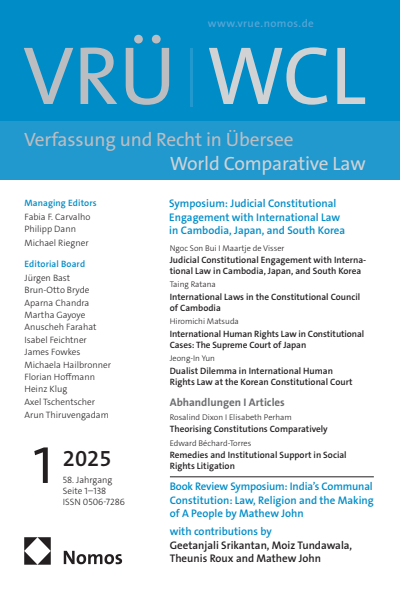
VRÜ Verfassung und Recht in Übersee
Volume 58 (2025), Issue 1
- Authors:
- Publisher
- Nomos, Baden-Baden
- Copyright Year
- 2025
- ISSN-Online
- 2941-9603
- ISSN-Print
- 0506-7286
Chapter information
Volume 58 (2025), Issue 1
Remedies and Institutional Support in Social Rights Litigation
- Authors:
- ISSN-Print
- 0506-7286
- ISSN-Online
- 2941-9603
- Preview:
In some jurisdictions of the Global South, courts seized with social rights claims have occasionally issued orders that help build state capacity. These remedies can take various forms. Some are managerial, others are dialogic. Some are specific and individualized, while others attempt to confront structural problems. Generally, these orders neglect the work of developing substantive rights doctrine. Instead, they work to build a more effective, coordinated, and attentive government. In short, these orders see courts offer institutional support to other state actors. This Article surfaces institutional support as a potential approach in social rights litigation. Drawing on landmark social rights proceedings in India, South Africa, and Colombia, the Article argues that this varied remedial approach has already been successfully deployed and may constitute one of the contributions of courts in the Global South to comparative law. Institutional support can also be understood as a trade-off between the competing dimensions of transformative constitutionalism. On one hand, the approach presents paths for achieving meaningful judicial impact, while curbing some of the risks associated with enforcing social rights. On the other, it neglects the work of elaborating social rights’ critical political vision, as well as substantive rights doctrine. Institutional support also implies an uncoupling of constitutional rights and judicial remedies, but this particular feature is welcome. The uncoupling of right and remedy can help manage the public’s expectations of what courts can accomplish, and it can help foster a rights discourse that is less court centric.
