„Heimat – das ist ein Gefühl“. Begriffsklärungen, Desiderate und Perspektiven für die kommunikationswissenschaftliche Forschung zu Heimat in den Medien
Table of contents
Bibliographic information
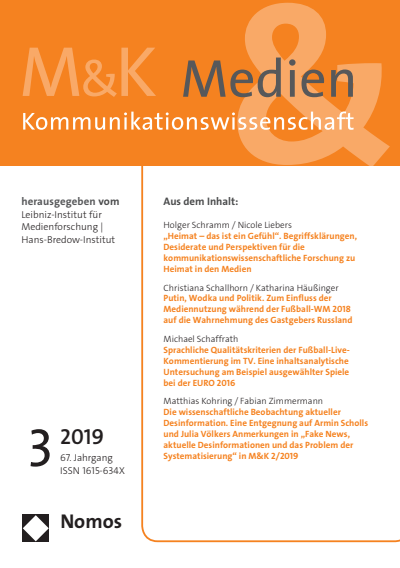
Open Access Full access
M&K Medien & Kommunikationswissenschaft
Volume 67 (2019), Issue 3
- Authors:
- Publisher
- Nomos, Baden-Baden
- Copyright Year
- 2019
- ISSN-Online
- 2942-3317
- ISSN-Print
- 1615-634X
Chapter information
Open Access Full access
Volume 67 (2019), Issue 3
„Heimat – das ist ein Gefühl“. Begriffsklärungen, Desiderate und Perspektiven für die kommunikationswissenschaftliche Forschung zu Heimat in den Medien
- Authors:
- ISSN-Print
- 1615-634X
- ISSN-Online
- 2942-3317
- Preview:
Bibliography
No match found. Try another term.
- Applegate, C. (1990). A nation of provincials: The German idea of Heimat. Oxford: University of California Press. Open Google Scholar DOI: 10.5771/1615-634X-2019-3-259
- Barrett, F. S., Grimm, K. J., Robins, R. W.,Wildschut, T., Sedikides, C. & Janata, P. (2010). Music-evoked nostalgia: Affect, memory, and personality. Emotion, 10, 390–403. Open Google Scholar DOI: 10.5771/1615-634X-2019-3-259
- Bastian, A. (1995). Der Heimat-Begriff. Eine begriffsgeschichtliche Untersuchung in verschiedenen Funktionsbereichen der deutschen Sprache. Tübingen: Niemeyer. Open Google Scholar DOI: 10.5771/1615-634X-2019-3-259
- Bausinger, H. (1983). Auf dem Wege zu einem neuen, aktiven Heimatverständnis. Heimat heute, Der Bürger im Staat, 33, 211–217. Open Google Scholar DOI: 10.5771/1615-634X-2019-3-259
- Bausinger, H. (1990). Heimat in einer offenen Gesellschaft. Begriffsgeschichte als Problemgeschichte. In H. Cremer & L. Klein (Hrsg.), Heimat: Analysen, Themen, Perspektiven (S. 76–90). Bonn: Westfalen Verlag. Open Google Scholar DOI: 10.5771/1615-634X-2019-3-259
- Boltz, D. M. (2008). Emotionale Bindungsqualitäten von Marken: Heimat als strategisches Modell der Markenführung. In C. Baumgarth, G. K. Schneider & B. Ceritoğlu (Hrsg.), Impulse für die Markenforschung und Markenführung (S. 3–18). Wiesbaden: Springer Gabler. Open Google Scholar DOI: 10.5771/1615-634X-2019-3-259
- Costadura, E. & Ries, K. (2016). Heimat – ein Problemaufriss. In E. Costadura & K. Ries (Hrsg.), Heimat gestern und heute: Interdisziplinäre Perspektiven (S. 7–12). Bielefeld: transcript Verlag. Open Google Scholar DOI: 10.5771/1615-634X-2019-3-259
- Çan, G., Ökten, A. & Green, J. (2001). The role of local mass media in promoting the consumption of iodized table salt. Health Education Research, 16, 603–608. Open Google Scholar DOI: 10.5771/1615-634X-2019-3-259
- Csikszentmihalyi, M. (1990). Flow the psychology of optimal experience. New York: Harper & Row. Open Google Scholar DOI: 10.5771/1615-634X-2019-3-259
- De Bens, E. & De Smaele, H. (2001). The inflow of American television fiction on European broadcasting channels revisited. European Journal of Communication, 16, 51–76. Open Google Scholar DOI: 10.5771/1615-634X-2019-3-259
- Dorner, C. & Pfurtscheller, D. (2013). Lokales Fernsehen in Tirol. In V. Dander, V. Gründhammer, H. Ortner, D. Pfurtscheller & M. Rizzolli (Hrsg.), Medienräume. Materialität und Regionalität (S. 131–146). Innsbruck: University Press. Open Google Scholar DOI: 10.5771/1615-634X-2019-3-259
- Eggert, S. (2014). Heimaterleben mit Medien. Mediale Unterstützung eines Heimatgefühls von Menschen mit Migrationshintergrund. merz – medien+erziehung, 58(4), 33–39. Open Google Scholar DOI: 10.5771/1615-634X-2019-3-259
- Fleming, K. & Thorson, E. (2008). Assessing the role of information-processing strategies in learning from local news media about sources of social capital. Mass Communication & Society, 11, 398–419. Open Google Scholar DOI: 10.5771/1615-634X-2019-3-259
- Fleming, K., Thorson, E. & Zhang, Y. (2006). Going beyond exposure to local news media: An information-processing examination of public perceptions of food safety. Journal of Health Communication, 11, 789–806. Open Google Scholar DOI: 10.5771/1615-634X-2019-3-259
- Fogarty, B. J. (2011). The nature of local news media issue coverage of U.S. house members. The Social Science Journal, 48, 651–658. Open Google Scholar DOI: 10.5771/1615-634X-2019-3-259
- Geißler, R. (2010). Mediale Integration von ethnischen Minderheiten. Der Beitrag der Massenmedien zur interkulturellen Integration. WISO Diskurs (S. 8–20). Bonn: Friedrich-Ebert-Stiftung. Open Google Scholar DOI: 10.5771/1615-634X-2019-3-259
- Heller, W. & Narr, W.-D. (2011). Heimat – zu Verwendungen dieses Begriffs. Geographische Revue, 13, 11–28. Open Google Scholar DOI: 10.5771/1615-634X-2019-3-259
- Henning, B. & Vorderer, P. (2001). Psychological escapism: Predicting the amount of television viewing by need for cognition. Journal of Communication, 51, 100–120. Open Google Scholar DOI: 10.5771/1615-634X-2019-3-259
- Jerit, J., Zhao, Y. Tan, M. & Wheeler, M. (2018). Differences between national and local media in news coverage of the zika virus. Health Communication. [Online First]. Open Google Scholar DOI: 10.5771/1615-634X-2019-3-259
- Joeng, M., Gilmore, J. S., Bleakley, A. & Jordan, A. (2014). Local news media framing of obesity in the context of a sugar-sweetened beverage reduction media campaign. Journal of Nutrition Edu¬cation and Behaviour, 46, 583–588. Open Google Scholar DOI: 10.5771/1615-634X-2019-3-259
- Katz, E. & Foulkes, D. (1962). On the use of the mass media as ‘escape’: Clarification of a concept. Public Opinion Quarterly, 26, 377–388. Open Google Scholar DOI: 10.5771/1615-634X-2019-3-259
- Klose, J. (2013). ‚Heimat‘ als gelingende Ordnungskonstruktion. In W. Patzelt (Hrsg.), Die Machbarkeit politischer Ordnung. Transzendenz und Konstruktion (S. 391–416). Bielefeld: transcript. Open Google Scholar DOI: 10.5771/1615-634X-2019-3-259
- Kortas, O. (2017, 20. April). Hashtag Heimat. Jungen Menschen steht die Welt offen, doch auf Instagram laden sie Fotos von Tracht und idyllischen Naturlandschaften hoch. Jetzt (Jugendmagazin der Süddeutschen Zeitung). Open Google Scholar DOI: 10.5771/1615-634X-2019-3-259
- Kurp, M. (1965). Lokale Medien und kommunale Eliten: partizipatorische Potentiale des Lokaljournalismus bei Printmedien und Hörfunk in Nordrhein-Westfalen. Opladen: Westdeutscher Verlag. Open Google Scholar DOI: 10.5771/1615-634X-2019-3-259
- Lutz, K. & Fußmann, A. (2014). Im Universum zuhause. merz – medien+erziehung, 58(4), 7–11. Open Google Scholar DOI: 10.5771/1615-634X-2019-3-259
- McDonald, R. I., Yi Chai, H. & Newell, B. R. (2015). Personal experience and the ‘psychological distance’ of climate change: An integrative review. Journal of Environmental Psychology, 44, 109–118. Open Google Scholar DOI: 10.5771/1615-634X-2019-3-259
- Mitzscherlich, B. (1997). „Heimat ist etwas, was ich mache“: Eine psychologische Untersuchung zum individuellen Prozess von Beheimatung. Pfaffenweiler: Centaurus-Verlagsgesellschaft. Open Google Scholar DOI: 10.5771/1615-634X-2019-3-259
- Montiel, C. J., Salvador, A. M. O., See, D. C. & De Leon, M. M. (2014). Nationalism in local media during international conflict: Text mining domestic news reports of the China-Philippines maritime dispute. Journal of Language and Social Psychology, 33, 445–464. Open Google Scholar DOI: 10.5771/1615-634X-2019-3-259
- Mously, S. (2007). Heimat im Fernsehen. Eine medienpsychologische Untersuchung am Beispiel des „Tatort“. Saarbrücken: VDM Verlag Dr. Müller e.K. Open Google Scholar DOI: 10.5771/1615-634X-2019-3-259
- Moy, P., McCluskey, M. R., McCoy, K. & Spratt, M. A. (2004). Political correlates of local news media use. Journal of Communication, 54, 532–546. Open Google Scholar DOI: 10.5771/1615-634X-2019-3-259
- Muehling, D. D. & Pascal, V. J. (2011). An empirical investigation of the differential effects of personal, historical, and non-nostalgic advertising on consumer responses. Journal of Advertising, 40, 107–122. Open Google Scholar DOI: 10.5771/1615-634X-2019-3-259
- Mummendey, A. (1985). Verhalten zwischen sozialen Gruppen: Die Theorie der sozialen Identität. In D. Frey & M. Irle (Hrsg.), Theorien der Sozialpsychologie (Bd. 2, S. 185–216). Bern: Huber. Open Google Scholar DOI: 10.5771/1615-634X-2019-3-259
- Mummendey, A. & Schreiber, H. J. (1983). Better or different? Positive social identity by discrimination against or by differentiation from outgroups. European Journal of Social Psychology, 13, 389–397. Open Google Scholar DOI: 10.5771/1615-634X-2019-3-259
- Pörner, G. (1990). Die Schwarzwaldklinik. Eine qualitative Untersuchung zum Erfolg der gleichnamigen Serie im deutschen Fernsehen. Dissertation an der Universität Salzburg. Open Google Scholar DOI: 10.5771/1615-634X-2019-3-259
- Reber, R., Schwarz, N. & Winkielman, P. (2004). Processing fluency and aesthetic pleasure: Is beauty in the perceiver’s processing experience? Personality and Social Psychology Review, 8, 364–382. Open Google Scholar DOI: 10.5771/1615-634X-2019-3-259
- Reber, R., Winkielman, P. & Schwarz, N. (1998). Effects of perceptual fluency on affective judgements. Psychological Science, 9, 45–48. Open Google Scholar DOI: 10.5771/1615-634X-2019-3-259
- Röll, F. J. (2014). Digitale Heimat. merz – medien+erziehung, 58(4), 12–21. Open Google Scholar DOI: 10.5771/1615-634X-2019-3-259
- Schröter, C. (2016). Themenwoche „Heimat“: Angebot, Rezeption und Urteile des Publikums. Ergebnisse der Begleitforschung zur zehnten ARD-Themenwoche. Media Perspektiven, 47(12), 598–606. Open Google Scholar DOI: 10.5771/1615-634X-2019-3-259
- Schwarz, N. & Clore, G. L. (1988). How do I feel about it? The informative function of affective states. In K. Fiedler & J. P. Forgas (Hrsg.), Affect, cognition, and social behavior (S. 44–62). Toronto: Hogrefe & Huber. Open Google Scholar DOI: 10.5771/1615-634X-2019-3-259
- Sherry, J. L. (2004). Flow and media enjoyment. Communication Theory, 14, 328–347. Open Google Scholar DOI: 10.5771/1615-634X-2019-3-259
- Suckfüll, M. (2014). Ästhetisches Erleben. In C. Wünsch, H. Schramm, V. Gehrau & H. Bilandzic (Hrsg.), Handbuch Medienrezeption (S. 305–320). Baden-Baden: Nomos. Open Google Scholar DOI: 10.5771/1615-634X-2019-3-259
- Süper, D. (2013). Meine Heimat. Meine Zeitung. Zur Ortsbindung von Lokalzeitungslesern und Nutzern lokaler Nachrichtenseiten. In H. Pöttker & A. Vehmeier (Hrsg.), Das verkannte Ressort (S. 101–114). Wiesbaden: Springer. Open Google Scholar DOI: 10.5771/1615-634X-2019-3-259
- Tajfel, H. & Turner, J. C. (1986). The social identity theory of intergroup behavior. In S. Worchel & W. G. Austin (Hrsg.), Psychology of intergroup relations (S. 7–24). Chicago: Nelson-Hall Publishers. Open Google Scholar DOI: 10.5771/1615-634X-2019-3-259
- Teubner-Guerra, R. L. (2014). Heimatkonzepte und Bindung. Ein Beitrag zur soziokulturellen Erweiterung der Bindungstheorie. Hamburg: Dr. Kovac. Open Google Scholar DOI: 10.5771/1615-634X-2019-3-259
- Trepte, S. (2004). Soziale Identität und Medienwahl. Eine binationale Studie zum Einfluss von Gender-Identität und nationaler Identität auf die Selektion unterhaltender Medieninhalte. Medien & Kommunikationswissenschaft, 52(2), 230–249. Open Google Scholar DOI: 10.5771/1615-634X-2019-3-259
- Trepte, S. & Reinecke, L. (2013). Medienpsychologie. Stuttgart: Kohlhammer. Open Google Scholar DOI: 10.5771/1615-634X-2019-3-259
- Tse, Y.-K. (2016). Televisions changing role in social togetherness in the personalized online consumption of foreign TV. New Media & Society, 18, 1547–1562. Open Google Scholar DOI: 10.5771/1615-634X-2019-3-259
- Waisbord, S. (2004). McTV: Understanding the global popularity of television formats. Television & New Media, 5, 359–383. Open Google Scholar DOI: 10.5771/1615-634X-2019-3-259
- Weber-Menges, S. (2007). Unübersichtliche Vielfalt und hohe Fluktuation. Eine Typologie der Ethnomedien in Deutschland. Journalistik Journal, 10, 25–27. Open Google Scholar DOI: 10.5771/1615-634X-2019-3-259
- Wippersberg. J. & Dietrich, A. (2007). Lokales Fernsehen in Österreich. Eine explorative Studie zu Programmstruktur und Programminhalt sowie zu Nutzung und Nutzen von lokalen Fernsehprogrammanbietern. Wien: RTR (Schriftenreihe der Rundfunk und Telekom Regulierungs-GmbH; 4). Open Google Scholar DOI: 10.5771/1615-634X-2019-3-259
- Wirth, W. (2014). Zur Rezeption von Infotainment: Informations- und Unterhaltungserleben als Konstituenten der Infotainment-Rezeption. In M. Dohle & G. Vowe (Hrsg.), Politische Unterhaltung – Unterhaltende Politik. Forschung zu Medieninhalten, Medienrezeption und Medienwirkungen (S. 57–93). Köln: Halem. Open Google Scholar DOI: 10.5771/1615-634X-2019-3-259
- Wirth, W., Hofer, M. & Schramm, H. (2012). Beyond Pleasure: Exploring the Eudaimonic Entertainment Experience. Human Communication Research, 38, 406–428. Open Google Scholar DOI: 10.5771/1615-634X-2019-3-259
- Wulf, T. & Rieger, D. (2018). Wallowing in media past: Media-induced nostalgia’s connection to parasocial relationships. Communication Research Reports, 35, 178–182. Open Google Scholar DOI: 10.5771/1615-634X-2019-3-259
- Wulf, T., Rieger, D. & Schmitt, J. B. (2018). Blissed by the past: Theorizing media-induced nostalgia as an audience response factor for entertainment and well-being. Poetics, 69, 70–80. Open Google Scholar DOI: 10.5771/1615-634X-2019-3-259
- Zejnuni, K. (2012). Diaspora zwischen den Stühlen. Hat das Internet Einfluss auf die Ethnisierung und die Identitätsbildung von Migrantinnen und Migranten? Sociology in Switzerland – Towards Cybersociety and Vireal Social Relations. Zürich: Online Publications. Open Google Scholar DOI: 10.5771/1615-634X-2019-3-259
- Zillmann, D. (1988). Mood management: Using entertainment to full advantage. In L. Donohew, H. E. Sypher & E. T. Higgins (Hrsg.), Communication. Communication, social cognition, and affect (S. 147–171). Hillsdale, NJ: Lawrence Erlbaum Associates. Open Google Scholar DOI: 10.5771/1615-634X-2019-3-259
- Zillmann, D. & Bryant, J. (1985). Selective-Exposure Phenomena. In D. Zillmann & J. Bryant (Hrsg.), Selective exposure to communication (S. 1–10). Hillsdale, NJ: Lawrence Erlbaum Associates. Open Google Scholar DOI: 10.5771/1615-634X-2019-3-259
- Zubayr, C. & Gerhard, H. (2018). Tendenzen im Zuschauerverhalten. Fernsehgewohnheiten und Fernsehreichweiten im Jahr 2017. Media Perspektiven, 49(3), 102–117. Open Google Scholar DOI: 10.5771/1615-634X-2019-3-259
- Beck, D. (2017). Ereignis- und Hintergrundberichterstattung über kontroverse große Sportanlässe. In H. Ihle, M. Meyen, J. Mittag & J. U. Nieland (Hrsg.), Globales Mega-Event und nationaler Konfliktherd. Die Fußball-WM 2014 in Medien und Politik (S. 67–81). Wiesbaden: Springer VS. Open Google Scholar DOI: 10.5771/1615-634X-2019-3-277
- Bläser, V. (2014). Zum Russlandbild in den deutschen Medien. Aus Politik und Zeitgeschichte. Ukraine, Russland, Europa, 47–48. http://www.bpb.de/apuz/194826/zum-russlandbild-in-den-deutschen-medien [03.07.2019]. Open Google Scholar DOI: 10.5771/1615-634X-2019-3-277
- Boykoff, J. & Yasuoka, M. (2014). Media coverage of the 2014 Winter Olympics in Sochi, Russia: Putin, politics, and Pussy Riot. Olympika: The International Journal of Olympic Studies, 23, 27–55. Open Google Scholar DOI: 10.5771/1615-634X-2019-3-277
- Dixon, T. L. (2008). Network news and racial beliefs: Exploring the connection between national television news exposure and stereotypical perceptions of African Americans. Journal of Communication, 58, 321–337. Open Google Scholar DOI: 10.5771/1615-634X-2019-3-277
- Eckstein, R., Moss, D. M. & Delaney, K. J. (2010). Sports sociology’s still untapped potential. Sociological Forum, 25, 500–518. Open Google Scholar DOI: 10.5771/1615-634X-2019-3-277
- Falkheimer, J. (2007). Events framed by the mass media: Media coverage and effects of America’s cup preregatta in Sweden. Event Management, 11, 81–88. Open Google Scholar DOI: 10.5771/1615-634X-2019-3-277
- Fifa.com (2014). FIFA statement on Russia 2018. https://www.fifa.com/worldcup/news/fifa-state ment-on-russia-2018-2408050 [03.07.2019]. Open Google Scholar DOI: 10.5771/1615-634X-2019-3-277
- Galtung, J. & Ruge, M. H. (1965). The structure of foreign news: The presentation of the Congo, Cuba and Cyprus Crises in four Norwegian Newspapers. Journal of Peace Research, 2, 64–90. Open Google Scholar DOI: 10.5771/1615-634X-2019-3-277
- Gao, F. (2010). Politics/nationalism affect 2008 Olympics coverage. Newspaper Research Journal, 31, 77–92. Open Google Scholar DOI: 10.5771/1615-634X-2019-3-277
- Gerhard, H. & Gescheidle, C. (2018). Die Fußball-Weltmeisterschaft 2018 im Fernsehen. Media Perspektiven, o. J., 476–485. Open Google Scholar DOI: 10.5771/1615-634X-2019-3-277
- Giffard, C. A. & Rivenburgh, N. K. (2000). News agencies, national images, and global media events. Journalism & Mass Communication Quarterly, 77, 8–21. Open Google Scholar DOI: 10.5771/1615-634X-2019-3-277
- Gripsrud, G., Nes, E. B. & Olsson, U. H. (2010). Effects of hosting a mega-sport event on country image. Event Management, 14, 193–204. Open Google Scholar DOI: 10.5771/1615-634X-2019-3-277
- Hafez, K. (2005). Mythos Globalisierung. Wiesbaden: VS. Open Google Scholar DOI: 10.5771/1615-634X-2019-3-277
- Hammett, D. (2011). British media representations of South Africa and the 2010 FIFA World Cup. South African Geographical Journal, 93, 63–74. Open Google Scholar DOI: 10.5771/1615-634X-2019-3-277
- Hede, A.-M. (2005). Sports-events, tourism and destination marketing strategies: An Australian case study of Athens 2004 and its media telecast. Journal of Sport & Tourism, 10, 187–200. Open Google Scholar DOI: 10.5771/1615-634X-2019-3-277
- Heimprecht, C. (2017). Determinanten der Auslandsberichterstattung. Eine Mehrebenenanalyse des internationalen Nachrichtenflusses. Wiesbaden: Springer VS. Open Google Scholar DOI: 10.5771/1615-634X-2019-3-277
- Heslop, L. A., Nadeau, J., O’Reilly, N. & Armenakyan, A. (2013). Mega-event and country co-branding: Image shifts, transfers and reputational impacts. Corporate Reputation Review, 16, 7–33. Open Google Scholar DOI: 10.5771/1615-634X-2019-3-277
- Hutchings, S., Gillespie, M., Yablokov, I., Lvov, I. & Voss, A. (2015). Staging the Sochi winter Olympics 2014 on Russia Today and BBC World News: From soft power to geopolitical crisis. Participations: Journal of Audience Reception Studies, 12, 630–658. Open Google Scholar DOI: 10.5771/1615-634X-2019-3-277
- Ihle, H. (2017). Die Fußball-WM 2014 in Brasilien als Sportgroßveranstaltung – kommunikations- und politikwissenschaftliche Zugänge. In H. Ihle, M. Meyen, J. Mittag & J.-U. Nieland (Hrsg.), Globales Mega-Event und nationaler Konfliktherd (S. 3–27). Wiesbaden: Springer VS. Open Google Scholar DOI: 10.5771/1615-634X-2019-3-277
- Ingenhoff, D. & Buhmann, A. (2019). Public Diplomacy: Messung, Entstehung und Gestaltung von Länderimages. Köln: Herbert von Halem. Open Google Scholar DOI: 10.5771/1615-634X-2019-3-277
- Kastrinos, A., Damiani, R. & Treise, D. (2018). Print to podium: Exploring media coverage of 2016 Olympic athletes’ perceptions about the Zika virus. International Journal of Sport Communication, 11, 447–461. Open Google Scholar DOI: 10.5771/1615-634X-2019-3-277
- Kim, J., Kang, J. H. & Kim, Y. K. (2014). Impact of mega sport events on destination image and country image. Sport Marketing Quarterly, 23, 161–175. Open Google Scholar DOI: 10.5771/1615-634X-2019-3-277
- Kiousis, S. & Wu, X. (2008). International agenda-building and agenda-setting: Exploring the influence of public relations counsel on US news media and public perceptions of foreign nations. International Communication Gazette, 70, 58–75. Open Google Scholar DOI: 10.5771/1615-634X-2019-3-277
- Knoll, J., Schramm, H. & Schallhorn, C. (2014). Mood effects of televised sports events: The impact of the FIFA World Cup on viewers’ mood and judgements. Communication & Sport, 2, 242–260. Open Google Scholar DOI: 10.5771/1615-634X-2019-3-277
- Krüger, U. M. (2015). Fernsehnachrichten: Auslandsberichterstattung nimmt zu. Media Perspektiven, o. J., 573–601. Open Google Scholar DOI: 10.5771/1615-634X-2019-3-277
- Lepp, A. & Gibson, H. (2011). Reimaging a nation: South Africa and the 2010 FIFA World Cup. Journal of Sport & Tourism, 16, 211–230. Open Google Scholar DOI: 10.5771/1615-634X-2019-3-277
- Manzenreiter, W. (2010). The Beijing games in the western imagination of China: The weak power of soft power. Journal of Sport and Social issues, 34, 29–48. Open Google Scholar DOI: 10.5771/1615-634X-2019-3-277
- McNelly, J. T. & Izcaray, F. (1986). International news exposure and images of nations. Journalism & Mass Communication Quarterly, 63, 546–553. Open Google Scholar DOI: 10.5771/1615-634X-2019-3-277
- Milovanova, M. V. & Svinkina, M. Y. (2018). Representation of Russia’s image in German media discourse in the context of the 2018 FIFA World Cup. Vestnik Volgogradskogo gosudarstvennogo universiteta. Seriya 2, Yazykoznanie, 17, 148–157. Open Google Scholar DOI: 10.5771/1615-634X-2019-3-277
- Mittag, J. (2017). Protest statt Party: Die Weltmeisterschaft 2014 in Brasilien als politische Bühne. In H. Ihle, M. Meyen, J. Mittag & J.-U. Nieland (Hrsg.), Globales Mega-Event und nationaler Konfliktherd (S. 155–167) Wiesbaden: Springer VS. Open Google Scholar DOI: 10.5771/1615-634X-2019-3-277
- Panagiotopoulou, R. (2011). Hosting the Olympic Games. From promoting the nation to nation-branding. In A. Tomlinson, C. Young & R. Holt (Eds.), Sport and the Transformation of Modern Europe. States, Media and Markets, 1950–2010 (S. 150–170). Abingdon, Oxon: Routledge. Open Google Scholar DOI: 10.5771/1615-634X-2019-3-277
- Roche, M. (1994). Mega-events and urban policy. Annals of Tourism Research, 21, 1–19. Open Google Scholar DOI: 10.5771/1615-634X-2019-3-277
- Rössler, P. (2011). Mediennutzung. In P. Rössler (Hrsg.), Skalenhandbuch Kommunikationswissenschaft (S. 1–44). Wiesbaden: Springer VS. Open Google Scholar DOI: 10.5771/1615-634X-2019-3-277
- Schallhorn, C. (2017). Kultivierung durch Sportgroßereignisse. Zum Einfluss der Medienberichterstattung über die Fußballweltmeisterschaft 2014 auf die Wahrnehmung des Gastgeberlandes Brasilien. Köln: Herbert von Halem. Open Google Scholar DOI: 10.5771/1615-634X-2019-3-277
- Schallhorn, C. (2019). Samba, sun and social issues: How the 2014 FIFA World Cup and the 2016 Rio Olympics changed perceptions of Germans about Brazil. International Review for the Sociology of Sport. Online first: DOI: 10.1177/1012690218822994 [03.07.2019]. Open Google Scholar DOI: 10.5771/1615-634X-2019-3-277
- Schulz, W. (1976). Die Konstruktion von Realität in den Nachrichtenmedien. Freiburg, München: Karl Alber. Open Google Scholar DOI: 10.5771/1615-634X-2019-3-277
- Semetko, H. A., Brzinski, J. B., Weaver, D. & Willnat, L. (1992). TV news and US public opinion about foreign countries: The impact of exposure and attention. International Journal of Public Opinion Research, 4, 18–36. Open Google Scholar DOI: 10.5771/1615-634X-2019-3-277
- Stiehler, H.-J. & Marr, M. (2003). Attribution of failure: A German soccer story. In A. Bernstein & N. Blain (Eds.), Sport, Media, Culture. Global and Local Dimensions (S. 139–165). London: F. Cass. Open Google Scholar DOI: 10.5771/1615-634X-2019-3-277
- Trunkos, J. & Heere, B. (2017). Sport diplomacy: A review of how sports can be used to improve international relationships. In C. Esherick, R. E. Baker, S. Jackson & M. Sam (Eds.), Case Studies in Sport Diplomacy (S. 1–18). Morgantown, West Virgina: Fit Publishing. Open Google Scholar DOI: 10.5771/1615-634X-2019-3-277
- Urban, D. & Mayerl, J. (2006). Regressionsanalyse: Theorie, Technik und Anwendung. Wiesbaden: Springer VS. Open Google Scholar DOI: 10.5771/1615-634X-2019-3-277
- Van den Broucke, S. & Gato, L. G. (2018). Contesting the brand: a media analysis of the image of Rio de Janeiro as host of the 2016 Summer Olympics in Dutch language newspapers, European Journal for Sport and Society, 15, 268–287. Open Google Scholar DOI: 10.5771/1615-634X-2019-3-277
- Wanta, W., Golan, G. & Lee, C. (2004). Agenda setting and international news: Media influence on public perceptions of foreign nations. Journalism & Mass Communication Quarterly, 81, 364–377. Open Google Scholar DOI: 10.5771/1615-634X-2019-3-277
- Zhang, C. & Meadows III, C. W. (2012). International coverage, foreign policy, and national image: Exploring the complexities of media coverage, public opinion, and presidential agenda. International Journal of Communication, 6, 76–95. Open Google Scholar DOI: 10.5771/1615-634X-2019-3-277
- Zeng, G., Go, F. & Kolmer, C. (2011). Beijing Olympics 2008 impact on China’s image formation in international TV coverage: A media content analysis perspective. International Journal of Sports Marketing & Sponsorship, 12, 319–336. Open Google Scholar DOI: 10.5771/1615-634X-2019-3-277
- Arnold, K. (2008): Qualität im Journalismus – ein integratives Konzept. In: Publizistik, 4, 489–508. Open Google Scholar DOI: 10.5771/1615-634X-2019-3-294
- Arnold, K. (2013): Qualität im Journalismus. In: Meier, K. & Neuberger, C. (Hrsg.): Journalismusforschung. Stand und Perspektiven. Baden-Baden: Nomos, 77–88. Open Google Scholar DOI: 10.5771/1615-634X-2019-3-294
- Arnold, K. (2016): Qualität im Journalismus. In: Löffelholz, M. & Rothenberger, L. (Hrsg.): Handbuch Journalismustheorien. Wiesbaden: Springer VS, 551–563. Open Google Scholar DOI: 10.5771/1615-634X-2019-3-294
- Baiocchi-Wagner, E. & Behm-Morawitz, E. (2010): Audience Perceptions of Female Sports Reporters: A Social-Identity Approach. In: International Journal of Sport Communication, 3, 261–274. Open Google Scholar DOI: 10.5771/1615-634X-2019-3-294
- Barnfield, A. (2013): Soccer, Broadcasting and Narrative: On Televising a Live Soccer Match. In: Communication & Sport, 1 (4), 326–341. DOI: 10.1177/2167479513479107. Open Google Scholar DOI: 10.5771/1615-634X-2019-3-294
- Beentjes, J. W., van Oordt, M. & van der Voort, T. H. (2002): How Television Commentary Affects Children’s Judgments on Soccer Fouls. In: Communication Research, 29 (1), 31–45. DOI: 10.1177/0093650202029001002. Open Google Scholar DOI: 10.5771/1615-634X-2019-3-294
- Berger, M. (2008): Die Entwicklung der Bundesliga-Fußballberichterstattung im deutschen Fernsehen. Von den Anfängen bis zur Gegenwart. Saarbrücken: VDM Verlag Dr. Müller. Open Google Scholar DOI: 10.5771/1615-634X-2019-3-294
- Brandt, W. (1983): Zeitstruktur und Tempusgebrauch in Fußballreportagen des Hörfunks. Mit einem Beitrag von Regina Quentin. Marburg: Elwert. Open Google Scholar DOI: 10.5771/1615-634X-2019-3-294
- Broch, T. B. (2011): Norwegian Big Bang Theory: Production of Gendered Sound during Team Handball Broadcasts. In: International Journal of Sport Communication, 4, 344–358. Open Google Scholar DOI: 10.5771/1615-634X-2019-3-294
- Brosius, H.-B., Haas, A. & Koschel, F. (2016): Methoden der empirischen Kommunikationsforschung. Eine Einführung (7. Auflage). Wiesbaden: Springer VS. Open Google Scholar DOI: 10.5771/1615-634X-2019-3-294
- Bryant, J., Comisky, P. & Zillman, D. (1977a): Drama in Sports and Commentary. In: Journal of Communication, 3, 140–149. Open Google Scholar DOI: 10.5771/1615-634X-2019-3-294
- Bryant, J., Comisky, P. & Zillman, D. (1977b): Commentary as a Substitute for Action. In: Journal of Communication, 3, 150–153. Open Google Scholar DOI: 10.5771/1615-634X-2019-3-294
- Bryant, J., Comisky, P. & Zillman, D. (1981): The Appeal of Rough-and-Tumble-Play in Televised Professional Football. In: Communication Quarterly, 4, 256–262. Open Google Scholar DOI: 10.5771/1615-634X-2019-3-294
- Bryant, J., Comisky, P., Zillman, D. & Brown, D. (1982): Sports and Spectators: Commentary and Appreciation. In: Journal of Communication, 4, 109–119. Open Google Scholar DOI: 10.5771/1615-634X-2019-3-294
- Bucher, H.-J. (2003): Journalistische Qualität und Theorien des Journalismus. In: Bucher, H.-J. & Altmeppen, K.-D. (Hrsg.): Qualität im Journalismus. Grundlagen – Dimensionen – Praxismodelle. Wiesbaden: Westdeutscher Verlag, 11–35. Open Google Scholar DOI: 10.5771/1615-634X-2019-3-294
- Bues, M. (1937): Die Versportung der deutschen Sprache im 20. Jahrhundert. Greifswald: Universitätsverlag L. Bamberg. Open Google Scholar DOI: 10.5771/1615-634X-2019-3-294
- Dankert, H. (1969): Sportsprache und Kommunikation. Untersuchungen zur Struktur der Fußballsprache und zum Stil der Sportberichterstattung. Tübingen: Tübinger Vereinigung für Volkskunde e. V. Open Google Scholar DOI: 10.5771/1615-634X-2019-3-294
- Danneboom, M. (1988): Der Einfluss des Kommentars bei Fußballübertragungen. In: Hackforth, J. (Hrsg.): Sportmedien & Mediensport. Wirkungen – Nutzung – Inhalte der Sportberichterstattung. Berlin: Vistas, 147–159. Open Google Scholar DOI: 10.5771/1615-634X-2019-3-294
- Dohle, M. & Vowe, G. (2006): Der Sport auf der „Mediatisierungstreppe?“ Ein Modell zur Analyse medienbedingter Veränderungen des Sports. In: merz – Medien und Erziehung, 50 (6), 18–28. Open Google Scholar DOI: 10.5771/1615-634X-2019-3-294
- Fingerhut, M. (1991): Fußballberichterstattung in Ost und West. Eine diachronische Sprachanalyse. Frankfurt am Main: Verlag Peter Lang. Open Google Scholar DOI: 10.5771/1615-634X-2019-3-294
- Flügel, C. (2009): Aktuelle TV-Sportberichterstattung. In: Horky, T., Schauerte, T., Schwier, J. & DFJV (Hrsg.): Sportjournalismus. Konstanz: UVK, 205–218. Open Google Scholar DOI: 10.5771/1615-634X-2019-3-294
- Fries, N. (2000): Sprache und Emotion. Ausführungen zum besseren Verständnis, Anregungen zum Nachdenken. Bergisch Gladbach: Luebbe Verlagsgruppe. Open Google Scholar DOI: 10.5771/1615-634X-2019-3-294
- Früh, W. (2017): Inhaltsanalyse (9. Auflage). Konstanz: UVK Verlagsgesellschaft. Open Google Scholar DOI: 10.5771/1615-634X-2019-3-294
- Gerhard, H. & Geese, S. (2016): Die Fußball-Europameisterschaft 2016 im Fernsehen. Daten zur Rezeption und Bewertung. In: Media Perspektiven, 10, 491–500. Open Google Scholar DOI: 10.5771/1615-634X-2019-3-294
- Gerhard, H. & Gscheidle, C. (2018): Die Fußball-Weltmeisterschaft 2018 im Fernsehen. In: Media Perspektiven, 10, 476–485. Open Google Scholar DOI: 10.5771/1615-634X-2019-3-294
- Haller, M. (2006): Die Reportage. Ein Handbuch für Journalisten (3. Auflage). Konstanz: UVK. Open Google Scholar DOI: 10.5771/1615-634X-2019-3-294
- Hendrischke, P. (2012): „Fußballkommentatoren im Abseits“. Eine empirische Untersuchung über die Kritik, Erwartungen und Zufriedenheit der Zuschauer gegenüber Fußball-Live-Kommentatoren im deutschen Fernsehen. Magdeburg: Unveröffentlichte Bachelorarbeit. Open Google Scholar DOI: 10.5771/1615-634X-2019-3-294
- Henrichs, B. (1974): Der Kaiser als Hebamme. Wie der deutsche Fußballjournalismus mit der deutschen Sprache kämpft. In: Die Zeit, Nr. 30, 19.07.2017, 15. Open Google Scholar DOI: 10.5771/1615-634X-2019-3-294
- Horky, T., Baranovskaa, M., Grimmer, C., Jakubowska, H. & Stelzner, B. (2019): Television Sport Journalism at the UEFA EURO 2016 Championships: A Comparison of Live Commentary from Four Countries. In: International Journal of Sport Communication, 1, 1–26. Open Google Scholar DOI: 10.5771/1615-634X-2019-3-294
- Jung, K. (2009): Fußball als Medienereignis: die mediale und sprachliche Inszenierung von Fußballevents als Sportspektakel. In: Burkhardt, A. & Schlobinski, P. (Hrsg.): Flickflack, Foul und Tsukahara. Der Sport und seine Sprache. Mannheim: Dudenverlag, 143–159. Open Google Scholar DOI: 10.5771/1615-634X-2019-3-294
- Klimmt, C., Bepler, M. & Scherer, H. (2006): „Das war ein Schuss wie ein Mehlkloß ins Gebüsch!“. Fußball-Live-Kommentatoren zwischen Journalistik und Entertainment. In: Schramm, H., Wirth, W. & Bilandzic, H. (Hrsg.): Empirische Unterhaltungsforschung: Studien zu Rezeption und Wirkung von medialer Unterhaltung. München: Verlag Reinhard Fischer, 169–189. Open Google Scholar DOI: 10.5771/1615-634X-2019-3-294
- Kühnert, D. (2004): Sportfernsehen & Fernsehsport: Die Inszenierung von Fußball, Formel 1 und Skispringen im deutschen Fernsehen. Baden-Baden: Nomos. Open Google Scholar DOI: 10.5771/1615-634X-2019-3-294
- Kuiper, K. & Lewis, R. (2013): The Effect of the Broadcast Medium on the Language of Radio and Television Sports Commentary Genres: The Rugby Union Lineout. In: Journal of Sports Media, 8 (2), 31–51. Open Google Scholar DOI: 10.5771/1615-634X-2019-3-294
- Lang, M. (2009): Fußball-TV-Kommentierung. Sicherung von Qualität und Standards. Eine Online-Befragung unter Sportjournalisten. Berlin: LIT-Verlag. Open Google Scholar DOI: 10.5771/1615-634X-2019-3-294
- La Roche, W. von (2008): Einführung in den praktischen Journalismus (18. aktualisierte und erweiterte Aufl.). Berlin: Econ. Open Google Scholar DOI: 10.5771/1615-634X-2019-3-294
- Marr, M. & Stiehler, H.-J. (1995): „Zwei Fehler sind gemacht worden, und deshalb sind wir nicht mehr im Wettbewerb“: Erklärungsmuster der Medien und des Publikums in der Kommentierung des Scheiterns der deutschen Nationalmannschaft bei der Fußball-Weltmeisterschaft 1994. In: Rundfunk und Fernsehen, 43 (3), 330–349. Open Google Scholar DOI: 10.5771/1615-634X-2019-3-294
- Mast, C. (2004): ABC des Journalismus (10. Auflage). Konstanz: UVK. Open Google Scholar DOI: 10.5771/1615-634X-2019-3-294
- McQuail, D. (1992): Media Performance. Mass Communication and the Public Interest. London, Newbury Park, New Delphi: Sage. Open Google Scholar DOI: 10.5771/1615-634X-2019-3-294
- Meier, H. E. & Hagenah, J. (2016): „Fußballisierung“ im deutschen Fernsehen? Eine Untersuchung zum Wandel von Angebot und Nachfrage bei den wichtigsten Free TV-Sendern. In: Medien & Kommunikationswissenschaft, 64(1), 12–35. Open Google Scholar DOI: 10.5771/1615-634X-2019-3-294
- Neuberger, C. & Kapern, P. (2013): Grundlagen des Journalismus. Wiesbaden: Springer VS. Open Google Scholar DOI: 10.5771/1615-634X-2019-3-294
- Neufeldt, G. (2004): Fernsehen, Pars pro toto. Die Reportage als Spiegel des großen Ganzen. In: Mast, C. (Hrsg.): ABC des Journalismus (10. Auflage). Konstanz: UVK, 269–272. Open Google Scholar DOI: 10.5771/1615-634X-2019-3-294
- Neugebauer, E. (1986): Mitspielen beim Zuschauer. Analyse zeitgleicher Sportberichterstattung des Fernsehens. Frankfurt: Peter Lang. Open Google Scholar DOI: 10.5771/1615-634X-2019-3-294
- Neumüller, B. (2007): Nur die Besten schaffen den Sprung ins Fernsehen. In: Schaffrath, M. (Hrsg.): Traumberuf Sportjournalismus. Ausbildungswege und Anforderungsprofile in der Sportmedienbranche. Berlin: LIT-Verlag, 31–40. Open Google Scholar DOI: 10.5771/1615-634X-2019-3-294
- Ordmann, V. & Zillmann, D. (1994): Women Sports Reporters: Have They Caught Up? In: Journal of Sport and Social Issues, 18, 66–75. Open Google Scholar DOI: 10.5771/1615-634X-2019-3-294
- Quentin, R. (1989): Sprache im Bild. Fußballreportagen in Sportsendungen des deutschen Fernsehens. Marburg: Hitzeroth Verlag. Open Google Scholar DOI: 10.5771/1615-634X-2019-3-294
- Rager, G. (1994): Dimensionen der Qualität. Weg aus den allseitig offenen Richterskalen. In: Bentele, G. & Hesse, K. R. (Hrsg.): Publizistik in der Gesellschaft. Konstanz: Universitätsverlag, 89–210. Open Google Scholar DOI: 10.5771/1615-634X-2019-3-294
- Reichart Smith, L. & Bissell, K. L. (2014): Nice Dig! An Analysis of the Verbal and Visual Coverage of Men’s and Women’s Beach Volleyball during the 2008 Olympic Games. In: Communication & Sport, Vol 2 (I), 48–64. DOI: 10.1177/2167479512467771. Open Google Scholar DOI: 10.5771/1615-634X-2019-3-294
- Ruß-Mohl, S. (1992): Am eigenen Schopfe … Qualitätssicherung im Journalismus – Grundfragen, Ansätze, Näherungsversuche. In: Publizistik, 1, 83–96. Open Google Scholar DOI: 10.5771/1615-634X-2019-3-294
- Schaffrath, M. (2003): Mehr als 1:0! Bedeutung des Live-Kommentars bei Fußballübertragungen – eine explorative Fallstudie. In: Medien & Kommunikationswissenschaft, 51(1), 82–104. Open Google Scholar DOI: 10.5771/1615-634X-2019-3-294
- Schaffrath, M. (2010): Vermittler, Vermarkter und Verkäufer. Empirische Studie zum beruflichen Selbstverständnis von TV-Sportjournalisten. In: Medien & Kommunikationswissenschaft, 58(2), 247–267. Open Google Scholar DOI: 10.5771/1615-634X-2019-3-294
- Schaffrath, M. (2018): Fachliche Qualitätskriterien der Fußball-Kommentierung. Theoretische Annäherung und empirische Überprüfung. In: Journal für Sportkommunikation und Mediensport, 1, 51–81. Open Google Scholar DOI: 10.5771/1615-634X-2019-3-294
- Schaffrath, M. & Schmid, P. (2017): „Tor in Mönchengladbach“, „Elfmeter für die Bayern“ und „Rote Karte in Dortmund“. Inhaltsanalytischer Vergleich der Fußball-Radio-Konferenzschaltungen der ARD und des Internet-Anbieters Sport1.fm. In: Journal für Sportkommunikation und Mediensport, 1, 46–64. Open Google Scholar DOI: 10.5771/1615-634X-2019-3-294
- Schalkowski, E. (2011): Kommentar, Glosse, Kritik. Konstanz: UVK Verlagsgesellschaft. Open Google Scholar DOI: 10.5771/1615-634X-2019-3-294
- Schatz, H. & Schulz, W. (1992): Qualität von Fernsehprogrammen. Kriterien und Methoden zur Beurteilung von Programmqualität im dualen Fernsehsystem. In: Media Perspektiven, 11, 690–712. Open Google Scholar DOI: 10.5771/1615-634X-2019-3-294
- Scheu, H.-R. (2013): Beiträge und Darstellungsformen. Sportreportage. In: La Roche, W. von & Buchholz, A. (Hrsg.): Radio-Journalismus. Ein Handbuch für Ausbildung und Praxis im Hörfunk (10. Auflage). Wiesbaden: Springer VS, 192–200. Open Google Scholar DOI: 10.5771/1615-634X-2019-3-294
- Scheu, H.-R. (2007): Zwischen Animation und Information. Die Live-Reportage im Fernsehen. In: Hackforth, J. & Fischer, C. (Hrsg.): ABC des Sportjournalismus. Konstanz: UVK Verlagsgesellschaft, 246–277. Open Google Scholar DOI: 10.5771/1615-634X-2019-3-294
- Schmalenbach, H. (2014): Qualität im Sportjournalismus. Entwicklung eines Konzepts zur Beurteilung des Sportressorts im Print. Köln-Pulheim: MedienSportVerlag. Open Google Scholar DOI: 10.5771/1615-634X-2019-3-294
- Schneider, P. (1974): Die Sprache des Sports. Terminologie und Präsentation in Massenmedien. Eine statistisch vergleichende Analyse. Düsseldorf: Pädagogischer Verlag Schwann. Open Google Scholar DOI: 10.5771/1615-634X-2019-3-294
- Schütte, C. (2006): Matchwinner und Pechvögel. Ergebniserklärung in der Fußballberichterstattung in Hörfunk, Internet, Fernsehen und Printmedien. Münster: LIT-Verlag. Open Google Scholar DOI: 10.5771/1615-634X-2019-3-294
- Seifart, H. (1996): Zum Fernseh-Kommentar bei Live Ereignissen. In: Boschert, B. & Gebauer, G. (Hrsg.): Texte und Spiele. Sprachspiele des Sports. St. Augustin: Academia Verlag, 97–120. Open Google Scholar DOI: 10.5771/1615-634X-2019-3-294
- Seip, A. (2013): Beiträge und Darstellungsformen. Reportage. In: La Roche, W. von & Buchholz, A. (Hrsg.): Radio-Journalismus. Ein Handbuch für Ausbildung und Praxis im Hörfunk (10. Auflage). Wiesbaden: Springer VS, 180–192. Open Google Scholar DOI: 10.5771/1615-634X-2019-3-294
- Stiehler, H.-J. & Marr, M. (2001): Das Ende der Ausreden. Mediale Diskurse zum Scheitern im Sport. In: Roters, G., Klingler, W. & Gerhards, M. (Hrsg.): Sport und Sportrezeption. Baden-Baden: Nomos, 111–131. Open Google Scholar DOI: 10.5771/1615-634X-2019-3-294
- Sullivan, D. B. (1991): Commentary and Viewer Perception of Player Hostility: Adding Punch to Televised Sports. In: Journal of Broadcasting & Electronic Media, 35(4), 487–504. DOI:10.1080/08838159109364142. Open Google Scholar DOI: 10.5771/1615-634X-2019-3-294
- Vögele, C. & Gölz, H. (2016): „Das ist der Wahnsinn von Salvador. So ist wohl noch nie ein Weltmeister filetiert worden“: Der Einfluss des Live-Kommentars bei Fußballübertragungen am Beispiel des WM-Gruppenspiels Spanien vs. Niederlande. In: Journal für Sportkommunikation und Mediensport, (1–2), 1–14. Open Google Scholar DOI: 10.5771/1615-634X-2019-3-294
- Vowe, G. & Dohle, M. (2016): Sportkommunikation und Mediensport im Wandel. Grundzüge eines Forschungsprogramms für die Sportkommunikationsforschung. In: Journal für Sportkommunikation und Mediensport, 1(1–2), 4–18. Open Google Scholar DOI: 10.5771/1615-634X-2019-3-294
- Watanabe, N. M., Nie, T. & Yan, G. (2013): Evolution of Sport-Broadcast Commentary: The Case of China. In: International Journal of Sport Communication, 6, 288–311. Open Google Scholar DOI: 10.5771/1615-634X-2019-3-294
- Wernecken, J. (2000): Wir und die anderen… Nationale Stereotypen im Kontext des Mediensports. Berlin: Vistas Verlag. Open Google Scholar DOI: 10.5771/1615-634X-2019-3-294
- Woo, C. W., Kim, J. K., Nichols, C. & Zheng, L. (2010): International Sports Commentary Frame and Entertainment: A Cross-Cultural Analysis of Commentary Differences in World Series Broadcasts. In: International Journal of Sport Communication, 3, 240–255. Open Google Scholar DOI: 10.5771/1615-634X-2019-3-294
- Wyss, V. (2002): Redaktionelles Qualitätsmanagement. Ziele, Normen, Ressourcen. Konstanz: UVK. Open Google Scholar DOI: 10.5771/1615-634X-2019-3-294
- Zhou, S., Xu, J. & Ye, Y. (2013): Effect of Complimentary and Conflicting Commentary on Sports Enjoyment. In: International Journal of Sport Communication, 6, 173–184. Open Google Scholar DOI: 10.5771/1615-634X-2019-3-294
- Zimmer, W. (2016): Sportreportage. In: Buchholz, A. & Schult, G. (Hrsg.): Fernseh-Journalismus. Ein Handbuch für Ausbildung und Praxis (9. Auflage). München: List-Verlag, 141–146. Open Google Scholar DOI: 10.5771/1615-634X-2019-3-294
- Bennett, W. L. & Livingston, S. (2018). The disinformation order: Disruptive communication and the decline of democratic institutions. European Journal of Communication, 33, 122–139. https://doi.org/10.1177/0267323118760317. Open Google Scholar DOI: 10.5771/1615-634X-2019-3-319
- Chaffee, S. H. (1991). Explication. Newbury Park, CA: Sage. Open Google Scholar DOI: 10.5771/1615-634X-2019-3-319
- Egelhofer, J. L. & Lecheler, S. (2019). Fake news as a two-dimensional phenomenon: A framework and research agenda. Annals of the International Communication Association, 43, 97–116. Open Google Scholar DOI: 10.5771/1615-634X-2019-3-319
- Luhmann, N. (1990): Die Wissenschaft der Gesellschaft. Frankfurt am Main: Suhrkamp. Open Google Scholar DOI: 10.5771/1615-634X-2019-3-319
- Mahon, J. E. (2008). Two definitions of lying. International Journal of Applied Philosophy, 22, 211–230. Open Google Scholar DOI: 10.5771/1615-634X-2019-3-319
- Opp, K.-D. (2005). Methodologie der Sozialwissenschaften. Einführung in Probleme ihrer Theorienbildung und praktischen Anwendung (6. Aufl.). Wiesbaden: VS Verlag für Sozialwissenschaften. Open Google Scholar DOI: 10.5771/1615-634X-2019-3-319
- Scholl, A. & Völker, J. (2019). Fake News, aktuelle Desinformationen und das Problem der Systematisierung: Anmerkungen zum Aufsatz von Fabian Zimmermann & Matthias Kohring „‚Fake News‘ als aktuelle Desinformation – systematische Bestimmung eines heterogenen Begriffs“ in M&K 4/2018. Medien & Kommunikationswissenschaft, 67, 206–214. https://doi.org/10.5771/1615-634X-2019-2-206. Open Google Scholar DOI: 10.5771/1615-634X-2019-3-319
- Schurz, G. (2006). Einführung in die Wissenschaftstheorie. Darmstadt: Wissenschaftliche Buchgesellschaft. Open Google Scholar DOI: 10.5771/1615-634X-2019-3-319
- Silverman, C. & Alexander, L. (2016, 3. November). How teens in the Balkans are duping Trump supporters with fake news. Buzzfeed. https://www.buzzfeednews.com/article/craigsilverman/how-macedonia-became-a-global-hub-for-pro-trump-misinfo#.le9lEzpEo [10.07.2019]. Open Google Scholar DOI: 10.5771/1615-634X-2019-3-319
- Tandoc, E. C., Lim, Z. W. & Ling, R. (2018). Defining ‘fake news’: A typology of scholarly definitions. Digital Journalism, 6, 137–153. https://doi.org/10.1080/21670811.2017.1360143. Open Google Scholar DOI: 10.5771/1615-634X-2019-3-319
- Zimmermann, F. & Kohring, M. (2018). „Fake News“ als aktuelle Desinformation. Systematische Bestimmung eines heterogenen Begriffs“. Medien & Kommunikationswissenschaft, 66, 526–541. https://doi.org/10.5771/1615-634X-2018-4-526. Open Google Scholar DOI: 10.5771/1615-634X-2019-3-319
