Trust and Responsibility in AI: An Interdisciplinary Social-Sector Perspective
Table of contents
Bibliographic information
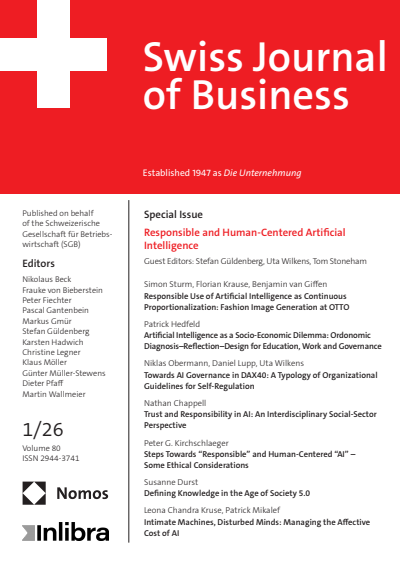
Swiss Journal of Business
Volume 80 (2026), Issue 1
- Authors:
- Publisher
- Nomos, Baden-Baden
- Copyright Year
- 2026
- ISSN-Online
- 2944-3741
- ISSN-Print
- 2944-3741
Chapter information
Volume 80 (2026), Issue 1
Trust and Responsibility in AI: An Interdisciplinary Social-Sector Perspective
- Authors:
- ISSN-Print
- 2944-3741
- ISSN-Online
- 2944-3741
- Preview:
The rapid adoption of artificial intelligence has intensified debates about responsibility, ethics, and trust. While regulatory frameworks and organizational ethics statements are proliferating, responsible AI is too often treated as compliance or reputation management rather than an organizing principle of practice. This perspective argues that social-sector organizations - including nonprofits, NGOs, and other mission-driven institutions - offer an instructive lens for rethinking responsible AI because they operate with structural vulnerability and high trust dependence. Drawing on business ethics, organizational theory, nonprofit and social-sector management, and human flourishing scholarship, the paper proposes shifting from harm-avoidance toward trust-centered, flourishing-oriented AI integration.
Bibliography
No match found. Try another term.
- European Union. (2024). Regulation (EU) 2024/1689 of the European Parliament and of the Council of 13 June 2024 laying down harmonised rules on artificial intelligence (Artificial Intelligence Act). Official Journal of the European Union. Open Google Scholar DOI: 10.5771/2944-3741-2026-1-72
- Floridi, L., Cowls, J., Beltrametti, M., Chatila, R., Chazerand, P., Dignum, V., Luetge, C., Madelin, R., Pagallo, U., Rossi, F., Schafer, B., Valcke, P., & Vayena, E. (2018). AI4People – An ethical framework for a good AI society: Opportunities and risks. Minds and Machines, 28(4), 689-707. https://doi.org/10.1007/s11023-018-9482-5 Open Google Scholar DOI: 10.5771/2944-3741-2026-1-72
- Mayer, R. C., Davis, J. H., & Schoorman, F. D. (1995). An integrative model of organizational trust. Academy of Management Review, 20(3), 709-734. https://doi.org/10.5465/amr.1995.9508080335 Open Google Scholar DOI: 10.5771/2944-3741-2026-1-72
- Organisation for Economic Co-operation and Development. (2019). OECD AI principles. Adopted May 2019; updated May 2024. OECD. https://oecd.ai/en/ai-principles Open Google Scholar DOI: 10.5771/2944-3741-2026-1-72
- UNESCO. (2021). Recommendation on the ethics of artificial intelligence. Adopted 23 November 2021. United Nations Educational, Scientific and Cultural Organization. Open Google Scholar DOI: 10.5771/2944-3741-2026-1-72
- VanderWeele, T. J. (2017). On the promotion of human flourishing. Proceedings of the National Academy of Sciences of the United States of America, 114(31), 8148-8156. https://doi.org/10.1073/pnas.1702996114 Open Google Scholar DOI: 10.5771/2944-3741-2026-1-72
