Humans in Animalscapes: Reconstructing Vermin-HumanInteractions in Rural Anatolia and Mesopotamia (ca. 1600–1850)
Table of contents
Bibliographic information
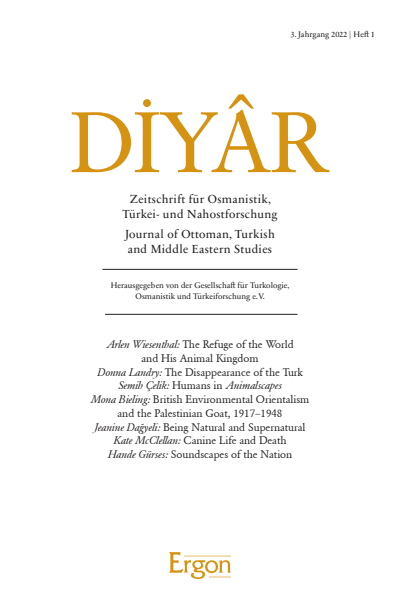
DIYÂR
Volume 3 (2022), Issue 1
- Authors:
- Publisher
- Ergon, Baden-Baden
- Copyright Year
- 2022
- ISSN-Online
- 2942-3155
- ISSN-Print
- 2625-9842
Chapter information
Volume 3 (2022), Issue 1
Humans in Animalscapes: Reconstructing Vermin-HumanInteractions in Rural Anatolia and Mesopotamia (ca. 1600–1850)
- Authors:
- ISSN-Print
- 2625-9842
- ISSN-Online
- 2942-3155
- Preview:
One of the most frequent cases in which vermin appear in Ottoman official correspondence is when they “attack” or “invade” human settlements, consuming or destroying food produced specifically for human consumption. Until effective ways and tools to manage them emerged in the late nineteenth century, communities withstood flies, locusts, and rats. Indeed, specific categories of animals subsumed within the category of vermin/haşarat seem to have become among the biggest troublemakers in rural Anatolia and Mesopotamia. These vermin caused not only short-term scarcity of food, especially concerning during famines, but also writ-large settlement abandonment, resulting in the temporary and even long-term problems of rural/regional economic systems. Yet very few Ottoman historians have reconstructed these stories within a critical animal history perspective. While it is true that these attacks and invasions of vermin created great burdens on human (and other animal) communities throughout history globally, the ways we historians have handled such cases tend to be anthropocentric. Here I argue for an ontological turn towards spatial aspects of vermin lives within human settlements and thus position my line of thinking about interaction from the ground-up, both literally and figuratively. From early-modern Ottoman discourses about vermin and the strategies used to cope with them from dictionaries/lexicons, literary and scientific texts, legal codices, and archival material, I develop a new analytical tool to understand interaction between humans and vermin as competition over perceived and actual space. I argue that we approach vermin behavior from the perspective of a spatial consciousness that constructed extended liminal configurations of space, which I call animalscapes. Human communities in Anatolia and Mesopotamia on the other hand, acknowledged the vermin perception of animalscapes and negotiated their place within, until the invention of chemical weapons against vermin at the end of the nineteenth century.
Bibliography
No match found. Try another term.
- Unpublished Primary Sources Open Google Scholar DOI: 10.5771/2625-9842-2022-1-49
- Manuscripts Open Google Scholar DOI: 10.5771/2625-9842-2022-1-49
- Risāle-i Ḥikmet-i Ḥaşarāt-ı Menāfi‘. [n.d.]. Balıkesir Public Library: 10 HK 19/4, fol. 52–60. Open Google Scholar DOI: 10.5771/2625-9842-2022-1-49
- Archives Open Google Scholar DOI: 10.5771/2625-9842-2022-1-49
- Cumhurbaşkanlığı Osmanlı Arşivleri (BOA), Istanbul Open Google Scholar DOI: 10.5771/2625-9842-2022-1-49
- Bab-ı Defteri – Baş Muhasebe defterleri (D.BŞM.d) 803 Open Google Scholar DOI: 10.5771/2625-9842-2022-1-49
- Hatt-ı Hümayun (HAT) 548-27100. Open Google Scholar DOI: 10.5771/2625-9842-2022-1-49
- Şura-yı Devlet (ŞD) 542-44 13 May 1909 Open Google Scholar DOI: 10.5771/2625-9842-2022-1-49
- Şura-yı Devlet (ŞD) 2339-63 14 November 1869 Open Google Scholar DOI: 10.5771/2625-9842-2022-1-49
- Published material Open Google Scholar DOI: 10.5771/2625-9842-2022-1-49
- Ainsworth, William. 1842. Travels and Researches in Asia Minor, Mesopotamia, Chaldea, and Armenia. Vol. 2. London: John W. Parker. Open Google Scholar DOI: 10.5771/2625-9842-2022-1-49
- Arbel, Benjamin. 2010. ‘The Attitude of Muslims to Animals: Renaissance Perceptions and Beyond’. In Faroqhi, Suraiya (ed.). Animals and People in the Ottoman Empire. İstanbul: Eren Yayınları. 57–74. Open Google Scholar DOI: 10.5771/2625-9842-2022-1-49
- Aşık Mehmed. 2007. Menazırü’l-Evalim. 3 Vols. Ak, Mahmut (ed.). Ankara: Türk Tarih Kurumu. Open Google Scholar DOI: 10.5771/2625-9842-2022-1-49
- Bauman, Zygmunt. 1990. Thinking Sociologically. Oxford: Blackwell. Open Google Scholar DOI: 10.5771/2625-9842-2022-1-49
- Benkheira, Mohammed Hocine, Mayeur-Jaouen, Catherine and Sublet, Jacqueline. 2005. L’Animal en Islam. Paris: Les Indes des Savantes. Open Google Scholar DOI: 10.5771/2625-9842-2022-1-49
- Bilgin, Halim. 2019. Lugat-i Remzi (Sözlükbilimsel İnceleme, Metin). PhD Thesis, Eskişehir Osmangazi Üniversitesi, Eskişehir. Open Google Scholar DOI: 10.5771/2625-9842-2022-1-49
- Candelaria, Matthew. 2009. ‘The Microecology of Infestation in Relationship Spaces’. In McFarland, Sarah and Hediger, Ryan (eds.). Animals and Agency. An Interdisciplinary Exploration. Leiden: Brill. 301–320. Open Google Scholar DOI: 10.5771/2625-9842-2022-1-49
- Cole, Lucinda. 2016. Imperfect Creatures: Vermin, Literature, and the Sciences of Life (1600–1740). Michigan: Michigan University Press. Open Google Scholar DOI: 10.5771/2625-9842-2022-1-49
- Cragoe, Matthew and Briony McDonagh. 2013. ‘Parliamentary enclosure, vermin and the cultural life of English parishes, 1750–1850’. Contiunity and Change. 28.1. 27–50. Open Google Scholar DOI: 10.5771/2625-9842-2022-1-49
- Çavuş, Ömer. 2017. ‘Osmanlı Devleti’nde Çekirgelere Karşı Mücadele’. Osmanlı Bilimi Araştırmaları. 13.2. 59–76. Open Google Scholar DOI: 10.5771/2625-9842-2022-1-49
- Çelik, Ahmet Faruk. 2018. XVII. Yüzyıl Osmanlı Merkez ve Taşrasında Fetva: `Kitabu’s Siyer Örneği’. MA. Thesis, Marmara University, Istanbul. Open Google Scholar DOI: 10.5771/2625-9842-2022-1-49
- Çelik, Semih. 2019. ‘“It’s a Bad Fate to Be Born Near a Forest”: Forest, People and Buffaloes in Mid-Nineteenth Century North-Western Anatolia’. In İnal, Onur and Köse, Yavuz (eds.). Seeds of Power: Explorations in Ottoman Environmental History. Cambridgeshire, UK: White Horse Press. 111–133. Open Google Scholar DOI: 10.5771/2625-9842-2022-1-49
- Çıplak, Battal. 2021. ‘Locust and Grasshopper Outbreaks in the Near East: Review under Global Warming Context’. Agronomy. 11.111. 1–17. Open Google Scholar DOI: 10.5771/2625-9842-2022-1-49
- Dağyeli, Jeanine Elif. 2020. ‘The Fight Against Heaven-Sent Insects: Dealing with Locust Plagues in the Emirate of Bukhara’. Environment and History. 26. 79–104. Open Google Scholar DOI: 10.5771/2625-9842-2022-1-49
- Demir, Alpaslan. 2014. ‘Osmanlı Devleti’nde Haşerelere Karşı Bir Önlem: Çekirge Suyu’. Erdem İnsan ve Toplum Bilimleri Dergisi. 67. 33–45. Open Google Scholar DOI: 10.5771/2625-9842-2022-1-49
- Dinzelbacher, Peter. 2002. ‘Animal Trials: A Multidisciplinary Approach’. Journal of Interdisciplinary History. 32.3. 405–421. Open Google Scholar DOI: 10.5771/2625-9842-2022-1-49
- Dolbee, Samuel. 2017. The Locust and the Starling: People, Insects, and Disease in the Late Ottoman Jazira and After, 1860–1940. PhD Thesis, New York University, New York. Open Google Scholar DOI: 10.5771/2625-9842-2022-1-49
- Ducène, Jean Charles. 2016. ‘Les animaux dans les cosmographies arabes médiévales’. In Peperstraeete, Sylvie (ed.). Animal et Religion. Brussels: Editions de l’Universite de Bruxelles. 129–140. Open Google Scholar DOI: 10.5771/2625-9842-2022-1-49
- Erler, Mehmet Yavuz. ‘Animals during Disasters’. In Faroqhi, Suraiya (ed.). Animals and People in the Ottoman Empire. Istanbul: Eren. 333–353. Open Google Scholar DOI: 10.5771/2625-9842-2022-1-49
- Evliya Çelebi b. Derviş Mehemmed Zılli. 2000. Evliya Çelebi Seyahatnamesi. Dankoff, Robert; Kahraman, Seyit Ali and Dağlı, Yücel (eds.). Istanbul: Yapı Kredi Yayınları. 9 vols. Open Google Scholar DOI: 10.5771/2625-9842-2022-1-49
- Faroqhi, Suraiya. 2010. ‘Introduction’. In Faroqhi, Suraiya (ed.). Animals and People in the Ottoman Empire. Istanbul: Eren Yayınları. 11–54. Open Google Scholar DOI: 10.5771/2625-9842-2022-1-49
- Fissell, Mary. 1999. ‘Imagining Vermin in Early Modern England’. History Workshop Journal. 47. 1–29. Open Google Scholar DOI: 10.5771/2625-9842-2022-1-49
- Fudge, Erica. 2002. ‘A left-handed blow: Writing the history of animals’. In Rothfels, Nigel (ed.). Representing animals. Theories of Contemporary Culture. Bloomington: Indiana University Press. 3–18. Open Google Scholar DOI: 10.5771/2625-9842-2022-1-49
- Gündoğdu, Cihangir. ‘The State and the Stray Dogs in Late Ottoman Istanbul: From Unruly Subjects to Servile Friends’. Middle Eastern Studies. 54.4. 555–574. Open Google Scholar DOI: 10.5771/2625-9842-2022-1-49
- Hassan, Marwa. 2017. 16. Yüzyıla Ait Arapça-Türkçe Sözlük Miratü’l-Luga (Metin-İnceleme-Dizin) MAThesis, Yıldız Teknik Üniversitesi, Istanbul. Open Google Scholar DOI: 10.5771/2625-9842-2022-1-49
- Howell, Philip. 2019. ‘Animals, Agency, and History’. In Kean, Hilda and Howell, Philip (eds.). The Routledge Companion to Animal-Human History. London: Routledge. 197–221. Open Google Scholar DOI: 10.5771/2625-9842-2022-1-49
- İnal, Onur. 2020. ‘One-humped History: The Camel as Historical Actor in the Late Ottoman Empire’. International Journal of Middle East Studies. 53. 57–72. Open Google Scholar DOI: 10.5771/2625-9842-2022-1-49
- Jennings, Ronald C. 1993. Christians and Muslims in Ottoman Cyprus and the Mediterranean World, 1571–1640. New York: New York University Press. Open Google Scholar DOI: 10.5771/2625-9842-2022-1-49
- Jones, Owain. 2000. ‘(Un)ethical Geographies of Human – Non-human Relations: Encounters, Collectives and Spaces’. In Philo, Chris and Wilbert, Chris (eds.). Animal Spaces, Beastly Places: New Geographies of Human-Animal Relations. London: Routledge. 267–290. Open Google Scholar DOI: 10.5771/2625-9842-2022-1-49
- Khoury, Dina Rizk. 1997. State and Provincial Society in the Ottoman Empire, Mosul 1540–1834. Cambridge: Cambridge University Press. Open Google Scholar DOI: 10.5771/2625-9842-2022-1-49
- Kiyak-Oral, Abide Eser. 2014. İmam Leknevi’nin Fetava’sının Değerlendirilmesi. MA Thesis, Marmara University, Istanbul. Open Google Scholar DOI: 10.5771/2625-9842-2022-1-49
- Krawietz, Birgit. 2014. ‘Falconry as a Cultural Icon of the Arab Gulf Region’. In Wippel, Steffen; Bromber, Katrin and Steiner, Christian et. al. (eds.). Under Construction: Logics of Urbanism in the Gulf Region. Surrey: Ashgate. 131–146. Open Google Scholar DOI: 10.5771/2625-9842-2022-1-49
- Leeson, Peter T. 2013. ‘Vermin Trials’. The Journal of Law & Economics. 56.3. 811–836. Open Google Scholar DOI: 10.5771/2625-9842-2022-1-49
- Littmann, Enno. 1925. Vom morgenländischen Floh. Dichtung und Wahrheit über den Floh bei Hebräern, Syriern, Arabern, Abessiniern und Türken. Insel Verlag: Leipzig. Open Google Scholar DOI: 10.5771/2625-9842-2022-1-49
- MacFarlane, Charles. Kismet or the Doom of Turkey. London: Thomas Bosworth. Open Google Scholar DOI: 10.5771/2625-9842-2022-1-49
- Mehmed Süreyya. 1329 [1913]. ‘Aydın Vilayetinde Çekirge Afeti (1)’. Felahat: Zirai, Baytari, Sınai ve Ticari Mecmua. 12. 188–190. Open Google Scholar DOI: 10.5771/2625-9842-2022-1-49
- Mehmed Süreyya. 1332 [1916]. Haşarat-ı Ziraiyye Mecmuası. Dersaadet: Osmanlı Ziraat ve Ticaret Gazetesi Matbaası. Open Google Scholar DOI: 10.5771/2625-9842-2022-1-49
- Mikhail, Alan. 2010. ‘Animals as Property in Early Modern Ottoman Egypt’. Journal of the Economic and Social History of the Orient. 53.4. 621–652. Open Google Scholar DOI: 10.5771/2625-9842-2022-1-49
- Mikhail, Alan. 2013a. The Animal in Ottoman Egypt. Oxford: Oxford University Press. Open Google Scholar DOI: 10.5771/2625-9842-2022-1-49
- Mikhail, Alan. 2013b. ‘Unleashing the Beast: Animals, Energy, and the Economy of Labor in Ottoman Egypt’. American Historical Review. 118.2. 317–348. Open Google Scholar DOI: 10.5771/2625-9842-2022-1-49
- Mitchell, Timothy. 2002. Rule of Experts. Egypt, Techno-Politics, Modernity. Berkeley: UCLA Press. Open Google Scholar DOI: 10.5771/2625-9842-2022-1-49
- Mustafa Behçet Efendi, Molla Abdülhak Efendi and [Tabib] Hayrullah. 1869. Hezar Esrar. İstanbul: Muhib Matbaası. Open Google Scholar DOI: 10.5771/2625-9842-2022-1-49
- Nagy, Kelsi and Johnson II, Philip David. 2013. ‘Introduction’. In Nagy, Kelsi and Johnson II, Phillip David (eds.). Trash Animals. How We Live with Nature’s Filthy, Feral, Invasive, and Unwanted Species. Minneapolis: University of Minnesota Press. 1–27. Open Google Scholar DOI: 10.5771/2625-9842-2022-1-49
- Neale, Fred Arthur. 1851. Eight Years in Syria, Palestine, and Asia Minor: From 1842 to 1850. Vol. 2. London: Colborn and Co. Publishers. Open Google Scholar DOI: 10.5771/2625-9842-2022-1-49
- Oxford English Dictionary. ‘Vermin, N. (and Adj.)’. URL: OED.com http://www.oed.com/view/Entry/222579?rskey=Qa3W7c&result=1&isAdvanced=false (accessed 12 June 2019). Open Google Scholar DOI: 10.5771/2625-9842-2022-1-49
- Özbilge, Nebahat. 2020. Çekirgeler, Kürtler ve Devlet: Erken Cumhuriyet Dönemine Yeniden Bakmak. İstanbul: Tarih Vakfı Yurt Yayınları. Open Google Scholar DOI: 10.5771/2625-9842-2022-1-49
- Özer, Sevilay. 2016. Anadolu’da Görülen Çekirge İstilaları ve Halk Üzerindeki Etkisi (1914–1945). Ankara: Türk Tarih Kurumu. Open Google Scholar DOI: 10.5771/2625-9842-2022-1-49
- Parikka, Jussi. 2010. Insect Media: An Archaeology of Animals and Technology. Minneapolis: University of Minnesota Press. Open Google Scholar DOI: 10.5771/2625-9842-2022-1-49
- Philo, Chris and Wilbert, Chris. 2000. ‘Animal Spaces, Beastly Places: An Introduction’. In Philo, Chris and Wilbert, Chris (eds.). Animal Spaces, Beastly Places: New Geographies of Human-Animal Relations. London: Routledge. 1–36. Open Google Scholar DOI: 10.5771/2625-9842-2022-1-49
- Rangarajan, Mahesh. 2013. ‘Animals with Rich Histories: The Case of the Lions of Gir Forest, Gujarat, India’. History and Theory. 52. 109–127 Open Google Scholar DOI: 10.5771/2625-9842-2022-1-49
- Riede, Peter. 2002. Im Spiegel Der Tiere. Studien zum Verhaltnis von Mensch und Tier im alten Israel. Ruprecht Göttingen: Universitätsverlag Freiburg Schweiz. Open Google Scholar DOI: 10.5771/2625-9842-2022-1-49
- Schimmel, Annemarie. 2003. Islam and the Wonders of Creation. The Animal Kingdom. London: Al-Furqan Islamic Heritage Foundation. Open Google Scholar DOI: 10.5771/2625-9842-2022-1-49
- Sprenger, Jana. 2015. ‘An Ocean of Locusts – The Perception and Control of Insect Pests in Prussian Brandenburg (1700-1850)’. Environment and History. 21.4. 513–536. Open Google Scholar DOI: 10.5771/2625-9842-2022-1-49
- Royle, Camilla. 2018. ‘Shaking the Ground: Histories of Earthworms from Darwin to Niche Construction’. In Wilcox, Sharon and Rutherford, Stephanie (eds.). Historical Animal Geographies. London: Routledge. 37–50. Open Google Scholar DOI: 10.5771/2625-9842-2022-1-49
- Sanchez-Bayo, Francisco and Wyckhuys, Kris. A. G. 2019. ‘Worldwide decline of the entomofauna: A review of its drivers’. Biological Conservation. 232. 8–27. Open Google Scholar DOI: 10.5771/2625-9842-2022-1-49
- Secmezsoy-Urquhart, Jessica. 2017. ‘The Troublesome Enemy: Vermin Agency in Pre-Modern Europe 1000-1800’. Slouth. A Journal of Emerging Voices in Human-Animal Studies. 3.2. URL: https://www.animalsandsociety.org/human-animal-studies/sloth/sloth-volume-3-no-2-summer-2017/troublesome-enemy-vermin-agency-pre-modern-europe-1000-1800/ (accessed 20 April 2021). Open Google Scholar DOI: 10.5771/2625-9842-2022-1-49
- Seeley, Joseph and Aaron Skabelund. 2015. ‘Tigers – Real and Imagined – in Korea’s Physical and Cultural Landscape’. Environmental History. 20. 475–503. Open Google Scholar DOI: 10.5771/2625-9842-2022-1-49
- Sunar, Nuşin. 2014. Ahmed bin Bali – Mecmua’ü’l-Mücerrebat (Giriş-İnceleme-Ses Bilgisi-Metin-Dizin 11–15. Varaklar Arası-Sözlük). 2 vols. Abant İzzet Baysal Üniversitesi, Bolu. Open Google Scholar DOI: 10.5771/2625-9842-2022-1-49
- Sysse, Victoria Lykke. 2014. ‘Stumbling over Animals in the Landscape: Methodological Accidents and Anecdotes’. Nordic Journal of Science and Technology Studies. 2.1. 20–26. Open Google Scholar DOI: 10.5771/2625-9842-2022-1-49
- Şemseddin Sami. 1317 [1899]. Kamus-i Türki. İstanbul: Akdam Matbaası. Open Google Scholar DOI: 10.5771/2625-9842-2022-1-49
- Timofeeva, Oxana. 2018. The History of Animals: A Philosophy. London: Bloomsbury. Open Google Scholar DOI: 10.5771/2625-9842-2022-1-49
- Topuz, Gülşah. 2019. Osmanlı Türkçesi Devri Çok Dilli Sözlüklerinden Lugat-i Erba’a (Arapça – Farsça – Türkçe – Yunanca) (İnceleme-Metin-Girit Yunancası Sözlük-Dizin). MA Thesis, Istanbul Medeniyet Universitesi, Istanbul. Open Google Scholar DOI: 10.5771/2625-9842-2022-1-49
- Tsing, Anna L. 2012. The Mushroom at the End of the World. On the Possibility of Life in Capitalist Ruins. Princeton: Princeton University Press. Open Google Scholar DOI: 10.5771/2625-9842-2022-1-49
- Tuğ, Ramazan. 2000. Gunyetü’l-Muhassilin ve Panzehir Risalesine Göre (18. Yüzyılda) Zehir ve Panzehir. MA Thesis, Istanbul University, Istanbul. Open Google Scholar DOI: 10.5771/2625-9842-2022-1-49
- von Uexküll, Jacob. 2010. A Foray into the Worlds of Animals and Humans. Translated by Joseph D. O’Neil. Minneapolis: University of Minnesota Press. Open Google Scholar DOI: 10.5771/2625-9842-2022-1-49
- Uzunkaya, Uğur. 2013. Felahat-name (İnceleme-Metin-Dizin). MA. Thesis, Sakarya Universitesi, Sakarya. Open Google Scholar DOI: 10.5771/2625-9842-2022-1-49
- Van Lennep, Henry John. 1870. Travels in Little Known Parts of Asia Minor. New York: A. O. Van Lennep. Open Google Scholar DOI: 10.5771/2625-9842-2022-1-49
- Van der Ploeg, Jan, Merlijn van Weerd and Gerard A. Persoon. 2011. ‘A Cultural History of Crocodiles in the Philippines: Towards a New Peace Pact?’. Environment and History.17. 229–264. Open Google Scholar DOI: 10.5771/2625-9842-2022-1-49
- Varlık, Nükhet. 2015. Plague and Empire in the Early Modern Mediterranean World: The Ottoman Experience, 1347–1600. Cambridge: Cambridge University Press. Open Google Scholar DOI: 10.5771/2625-9842-2022-1-49
- Weindling, Paul. 1994. ‘The uses and abuses of biological technologies: Zyklon B and gas dinfestation between the first world war and the holocaust’. History and Technology: An International Journal. 11.2. 291–298. Open Google Scholar DOI: 10.5771/2625-9842-2022-1-49
- White, Sam. 2011. The Climate of Rebellion in the Early Modern Ottoman Empire. Cambridge: Cambridge University Press. Open Google Scholar DOI: 10.5771/2625-9842-2022-1-49
- Wischermann, Clemens and Howell, Philip. ‘“Liminality: A Governing Category in Animate History’. In Wischermann, Clemens; Howell, Philip and Steinbrecher, Aline (eds.). Animal History in the Modern City: Exploring Liminality. London: Bloomsbury. 1–24 Open Google Scholar DOI: 10.5771/2625-9842-2022-1-49
- Yıldırım, Mehmet Ali. 2014. ‘Birinci Dünya Savaşı Yıllarında Osmanlı Devleti’nin Beşinci Düşmanı: Çekirgeler’. Gaziantep University Journal of Social Sciences. 13.4. 1017–1042. Open Google Scholar DOI: 10.5771/2625-9842-2022-1-49