Haushaltsüberschüsse, konservative Parteien und das Trilemma der Fiskalpolitik
Table of contents
Bibliographic information
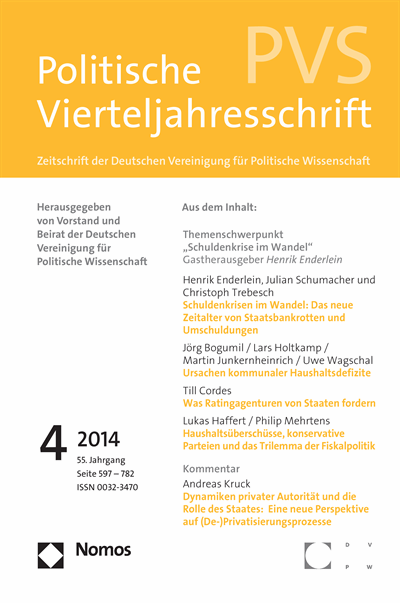
Full access
Zeitschrift der Deutschen Vereinigung für Politikwissenschaft
Volume 55 (2014), Edition 4
- Authors:
- Publisher
- Nomos, Baden-Baden
- Publication year
- 2014
- ISSN-Online
- 0032-3470
- ISSN-Print
- 0032-3470
Chapter information
Full access
Volume 55 (2014), Edition 4
Haushaltsüberschüsse, konservative Parteien und das Trilemma der Fiskalpolitik
- Authors:
- ISSN-Print
- 0032-3470
- ISSN-Online
- 0032-3470
- Preview:
Bibliography
No match found. Try another term.
- Adams, James, und Zeynep Somer-Topcu. 2009. Policy Adjustment by Parties in Response to Rival Parties’ Policy Shifts: Spatial Theory and the Dynamics of Party Competition in Twenty-Five Post-War Democracies. British Journal of Political Science 39: 825-846. DOI: 10.1017/S0007123409000635. Open Google Scholar doi.org/10.1017/S0007123409000635
- Alesina, Alberto, und Silvia Ardagna. 2012. The Design of Fiscal Adjustments. NBER Working Paper 18423. Cambridge, MA: National Bureau of Economic Research. DOI: 10.3386/w18423. Open Google Scholar doi.org/10.3386/w18423
- Alesina, Alberto, und Guido Tabellini. 1990. A Positive Theory of Fiscal Deficits and Government Debt. Review of Economic Studies 57: 403-414. DOI: 10.2307/2298021. Open Google Scholar doi.org/10.2307/2298021
- Arndt, Christoph. 2014. Beating Social Democracy on Its Own Turf: Issue Convergence as Winning Formula for the Centre-Right in Universal Welfare States. Scandinavian Political Studies 37: 149-170. DOI: 10.1111/1467-9477.12018. Open Google Scholar doi.org/10.1111/1467-9477.12018
- Aulich, Chris. 2010. Reconstructing the Australian State: The Privatization Factor. In Dealing With Debt: Lessons From Abroad, Hrsg. John Springford, 74-92. London: Centre Forum. Open Google Scholar doi.org/10.22459/RG.12.2010.01
- Bartlett, Bruce. 2007. “Starve the Beast”. Origins and Development of a Budgetary Metaphor. The Independent Review 12: 5-26. Open Google Scholar
- Battin, Tim. 2002. The Australian Labor Party and the Notion of Economic Management. Journal of Economic and Social Policy 6: 1-12. Open Google Scholar
- Becker, Gary S. 2001. The Real Reason We Need a Tax Cut. Business Week 28, 19.03.2001. Open Google Scholar
- Blomqvist, Paula. 2004. The Choice Revolution: Privatization of Swedish Welfare Services in the 1990s. Social Policy and Administration 38: 139-155. DOI: 10.1111/j.1467- 9515.2004.00382.x. Open Google Scholar
- Boix, Carles. 2000. Partisan Governments, the International Economy, and Macroeconomic Policies in Advanced Nations, 1960-93. World Politics 53: 38-73. DOI: 10.1017/S0043887100009370. Open Google Scholar doi.org/10.1017/S0043887100009370
- Brender, Adi, und Allan Drazen. 2008. How Do Budget Deficits and Economic Growth Affect Reelection Prospects? Evidence from a Large Panel of Countries. American Economic Review 98: 2203-2220. DOI: 10.1257/aer.98.5.2203. Open Google Scholar doi.org/10.1257/aer.98.5.2203
- Brown, Kevin. 1991. Riding to the End of a Wave. Financial Times, 24.05.1991. Open Google Scholar
- Costello, Peter. 1997. Charter of Budget Honesty Bill 1996, Second Reading. Commonwealth of Australia, Parliamentary Debates, House of Representatives, 05.12.1997. Open Google Scholar
- Costello, Peter. 2000. Budget Speech 2000-01. Department of the Treasury. Canberra. Open Google Scholar
- Costello, Peter. 2008. The Costello Memoirs. Melbourne: Melbourne University Press. Open Google Scholar
- Crean, Simon. 2003. Budget Debate. Commonwealth of Australia, Parliamentary Debates, House of Representatives, 15.03.2003. Open Google Scholar
- Cusack, Thomas R. 1999. Partisan Politics and Fiscal Policy. Comparative Political Studies 32: 464-486. DOI: 10.1177/0010414099032004003. Open Google Scholar doi.org/10.1177/0010414099032004003
- Davidsson, Johan Bo, und Paul Marx. 2013. Losing the Issue, Losing the Vote: Issue Competition and the Reform of Unemployment Insurance in Germany and Sweden Political Studies 61: 505-522. DOI: 10.1111/j.1467-9248.2012.00997.x. Open Google Scholar doi.org/10.1111/j.1467-9248.2012.00997.x
- DeVries, Pete, Jaime Guajardo, Daniel Leigh, und Andrea Pescatori. 2011. A New Action-based Dataset of Fiscal Consolidation. IMF Working Paper 11/128. Washington, D. C.: International Monetary Fund. Open Google Scholar doi.org/10.5089/9781455264407.001
- Errington, Wayne, und Peter Van Onselen. 2007. John Winston Howard. Melbourne: Melbourne University Press. Open Google Scholar doi.org/10.1177/1329878X0712300103
- Fenna, Alan. 2007. Governing in Good Times: Fiscal Policy and Tax Reform in Australia 1996-2006. Australian Journal of Political Science 42: 329-350. DOI: 10.1080/ 10361140701320059. Open Google Scholar doi.org/10.1080/10361140701320059
- Finanzpolitischer Rat 2008. Swedish Fiscal Policy. Report of the Swedish Fiscal Policy Council 2008. Stockholm: Finanspolitiska rådet. Open Google Scholar
- Finanzpolitischer Rat 2009. Swedish Fiscal Policy. Report of the Swedish Fiscal Policy Council 2009. Stockholm: Finanspolitiska rådet. Open Google Scholar
- Franzese, Robert J. 2002. Electoral and Partisan Cycles in Economic Policies and Outcomes. Annual Review of Political Science 5: 369-421. DOI: 10.1146/annurev.polisci.5.112801.080924. Open Google Scholar doi.org/10.1146/annurev.polisci.5.112801.080924
- Friedman, Milton. 2003. What Every American Wants. Wall Street Journal, 15.01.2003. Open Google Scholar
- Girouard, Nathalie, und Christophe André. 2005. Measuring Cyclically-adjusted Budget Balances for OECD Countries. OECD Economics Department Working Paper 434. Paris: OECD. DOI: 10.1787/787626008442. Open Google Scholar doi.org/10.1787/787626008442
- Gittins, Ross. 1999. The high cost of paying less tax. Sydney Morning Herald, 25.08.1999. Open Google Scholar
- Gmeiner, Jens. 2013. Die „Zukunftspartei“ Schwedens? Die Schwedische Sozialdemokratie zwischen erfolgreicher Vergangenheit und unsicherer Zukunft. Berlin: Friedrich-Ebert-Stiftung. Open Google Scholar
- Green-Pedersen, Christoffer. 2002. The Politics of Justification. Amsterdam: Amsterdam University Press. Open Google Scholar doi.org/10.5117/9789053565902
- Green, John H. 1995. Public Finances, Adjustment Programs, and Debt Dynamics. In Challenges to the Swedish Welfare State, Hrsg. Desmond Lachman, Adam Bennett, John H. Green, Robert Hagemann und Ramana Ramaswamy, 20-29. Washington, D. C.: International Monetary Fund. Open Google Scholar doi.org/10.5089/9781557754868.084
- Gruen, David, und Amanda Sayegh. 2005. The Evolution of Fiscal Policy in Australia. Oxford Review of Economic Policy 21: 618-635. DOI: 10.1093/oxrep/gri035. Open Google Scholar doi.org/10.1093/oxrep/gri035
- Haffert, Lukas. 2014. Freiheit von Schulden - Freiheit zur Gestaltung? Die politische Ökonomie von Haushaltsüberschüssen. Köln: Universität zu Köln. Open Google Scholar
- Haffert, Lukas, und Philip Mehrtens. 2014. Haushaltsüberschüsse und ihre Verwendung: Wiedergewinnung staatlicher Handlungsfähigkeit? Zeitschrift für Staats- und Europawissenschaften (ZSE) 12: 210-241. Open Google Scholar doi.org/10.5771/1610-7780-2014-2-3-210
- Haffert, Lukas, und Philip Mehrtens. Im Erscheinen. From Austerity to Expansion? Consolidation, Budget Surpluses, and the Decline of Fiscal Capacity. Politics & Society. Open Google Scholar
- Hancock, M. Donald. 2002. Sweden. In Politics in Europe. An Introduction to the Politics of the United Kingdom, France, Germany, Italy, Sweden, Russia, and the European Union, Hrsg. M. Donald Hancock, 347-401. Houndmills: Palgrave Macmillan. Open Google Scholar
- Häusermann, Silja, Georg Picot, und Dominik Geering. 2013. Rethinking Party Politics and the Welfare State - Recent Advances in the Literature. British Journal of Political Science 43: 221-240. DOI: http://dx.doi.org/10.1017/S0007123412000336. Open Google Scholar doi.org/10.1017/S0007123412000336
- Hellwig, Timothy. 2012. Constructing Accountability: Party Position Taking and Eco- Open Google Scholar doi.org/10.1177/0010414011422516
- nomic Voting. Comparative Political Studies 45: 91-118. DOI: 10.1177/ 0010414011422516. Open Google Scholar
- Henriksson, Jens. 2007. Ten Lessons About Budget Consolidation. Brüssel: Bruegel. Open Google Scholar
- Hibbs, Douglas A., Jr. 1977. Political Parties and Macroeconomic Policy. American Political Science Review 71: 1467-1487. DOI: 10.1017/S0003055406232568. Open Google Scholar doi.org/10.1017/S0003055406232568
- Hicks, Alexander M., und Duane H. Swank. 1992. Politics, Institutions, and Welfare Spending in Industrialized Democracies, 1960-82. The American Political Science Review 86: 658-674. DOI: 10.2307/1964129. Open Google Scholar doi.org/10.2307/1964129
- Jensen, Carsten. 2010. Issue Compensation and Right-Wing Government Social Spending. European Journal of Political Research 49: 282-299. DOI: 10.1111/j.1475-6765. 2009.01898.x. Open Google Scholar
- Kalyvas, Stathis N., und Kees Van Kersbergen. 2010. Christian Democracy. Annual Review of Political Science 13: 183-209. DOI: 10.1146/annurev.polisci.11.021406.172506. Open Google Scholar doi.org/10.1146/annurev.polisci.11.021406.172506
- Kitschelt, Herbert. 2001. Partisan Competition and Welfare State Retrenchment: When Do Politicians Choose Unpopular Policies? In The New Politics of the Welfare State, Hrsg. Paul Pierson, 265-302. Oxford: Oxford University Press. Open Google Scholar doi.org/10.1093/0198297564.003.0010
- Lindbom, Anders. 2006. The Swedish Conservative Party and the Welfare State: Institutional Change and Adapting Preferences. Arbetsrapport 2006: 12. Stockholm: Institutet för Framtidsstudier. Open Google Scholar
- Martin, Aaron. 2011. Partisan Identification and Attitudes to Big Versus Small Government in Australia: Evidence from the ISSP. Australian Journal of Political Science 46: 243-256. DOI:10.1080/10361146.2011.567971. Open Google Scholar doi.org/10.1080/10361146.2011.567971
- McFarlane, Ian. 2006. The real reasons why it was the 1990s recession we had to have. The Age 02.12.2006. http://www.theage.com.au/news/business/the-real-reasons-why-it-was-the-1990s-recession-we-had-to-have/2006/12/01/1164777791623.html. Zugegriffen: 24.10.2014. Open Google Scholar
- Mehrtens, Philip. 2014. Staatsschulden und Staatstätigkeit. Zur Transformation der politischen Ökonomie Schwedens. Frankfurt: Campus Verlag. Open Google Scholar
- Morgan, Iwan W. 2009. The Age of Deficits. Presidents and Unbalanced Budgets from Jimmy Carter to George W. Bush. Lawrence: University Press of Kansas. Open Google Scholar
- Murphy, Katharine. 2007. Labor seizes on Lib’s Future Fund backing. The Age 27.03.2007. <http://www.theage.com.au/news/national/labor-seizes-on-libs-future-fund-backing/2007/03/26/1174761379941.html>. Zugegriffen: 24.10.2014. Open Google Scholar
- Newspoll. 1996. Federal Budget: Impact on Economy. http://polling.newspoll.com.au.tmp.anchor.net.au/cgi-bin/polling/display_poll_data.pl. Zugegriffen: 24.10.2014. Open Google Scholar
- Niskanen, William A. 2006. Limiting Government: The Failure of „Starve the Beast“. Cato Journal 26: 553-558. Open Google Scholar
- OECD 2013. OECD Economic Outlook Database: Statistics and Projections. Paris: OECD. Open Google Scholar doi.org/10.1787/data-00655-en
- OECD AUS. 1997. OECD Economic Survey: Australia. Paris: OECD. Open Google Scholar doi.org/10.1787/eco_surveys-aus-1997-en
- OECD AUS. 1999. OECD Economic Survey: Australia. Paris: OECD. Open Google Scholar
- OECD AUS. 2010. OECD Economic Survey: Australia. Paris: OECD. Open Google Scholar doi.org/10.1787/eco_surveys-aus-2010-en
- Persson, Torsten, und Lars E. O. Svensson. 1989. Why a Stubborn Conservative would Run a Deficit: Policy with Time-Inconsistent Preferences. Quarterly Journal of Economics 104: 325-345. DOI: 10.2307/2937850. Open Google Scholar doi.org/10.2307/2937850
- Picot, Georg. 2009. Party Competition and Reforms of Unemployment Benefits in Germany: How a Small Change in Electoral Demand Can Make a Big Difference. German Politics 18: 155-179. DOI: 10.1080/09644000902874257. Open Google Scholar doi.org/10.1080/09644000902874257
- Pierson, Paul. 2001. From Expansion to Austerity. The New Politics of Taxing and Spending. In Seeking the Center: Politics and Policymaking in the New Century, Hrsg. Martin A. Levin, Marc K. Landy und Martin Shapiro, 54-80. Washington, D. C.: Georgetown University Press. Open Google Scholar doi.org/10.1093/0198297564.003.0014
- Rexed, Knud. 1999. Schwedische Steuerpolitik. In Schweden im Wandel: Entwicklungen, Probleme, Perspektiven, Hrsg. Claudius H. Riegler und Olaf Schneider, 217-230. Berlin: BWV - Berliner Wissenschaftsverlag. Open Google Scholar
- Romer, Christina, und David Romer. 2009. Do Tax Cuts Starve the Beast? The Effect of Tax Changes on Government Spending. NBER Working Paper No. 13548. Cambridge, MA: National Bureau of Economic Research. Open Google Scholar
- Rothstein, Bo. 1998. Just Institutions Matter. The Moral and Political Logic of the Universal Welfare State. Cambridge: Cambridge University Press. Open Google Scholar
- Settergren, Ole. 2001. The Automatic Balance Mechanism of the Swedish Pension System. Wirtschaftspolitische Blätter 48: 339-349. Open Google Scholar
- Stein, Herbert. 1969. The Fiscal Revolution in America. Chicago: University of Chicago Press. Open Google Scholar
- Steinmo, Sven. 2010. The Evolution of Modern States: Sweden, Japan, and the United States. Cambridge: Cambridge University Press. Open Google Scholar
- Stockman, David. 1986. The Triumph of Politics. How the Reagan Revolution Failed. New York: Harper & Row. Open Google Scholar
- Streeck, Wolfgang, und Kathleen Thelen, 2005. Introduction: Institutional Change in Advanced Political Economies. In dies.: Beyond Continuity: Institutional Change in Advanced Political Economies, 3-39. Oxford: Oxford University Press. Open Google Scholar
- Svallfors, Stefan. 2011. A Bedrock of Support? Trends in Welfare State Attitudes in Sweden, 1981-2010. Social Policy & Administration 45: 806-825. DOI: 10.1111/ j.1467-9515.2011.00796.x. Open Google Scholar doi.org/10.1111/j.1467-9515.2011.00796.x
- Swan, Wayne. 2008. Budget Speech 2008-09. Canberra: Department of the Treasury. Open Google Scholar
- The New York Times. 25.01.1987. The State of the President. Open Google Scholar
- Tufte, Edward R. 1978. Political Control of the Economy. Princeton: Princeton University Press. Open Google Scholar
- Turnbull, Malcolm. 2009. Budget Debate. Commonwealth of Australia, Parliamentary Debates, House of Representatives, 14.05.2009. Open Google Scholar
- Turner, David. 2006. Should Measures of Fiscal Stance be Adjusted for Terms of Trade Effects? OECD Economics Department Working Paper 519. Paris: OECD Open Google Scholar doi.org/10.1787/416678318453
- Wagschal, Uwe. 1996. Staatsverschuldung: Ursachen im internationalen Vergleich. Opladen: Leske+Budrich. Open Google Scholar doi.org/10.1007/978-3-663-11473-4_3
- Walter, Ryan, und John Uhr. 2013. Budget Talk: Rhetorical Constraints and Contests. Australian Journal of Political Science 48: 431-444. DOI: 10.1080/10361146.2013.837426. Open Google Scholar doi.org/10.1080/10361146.2013.837426
- Wanna, John. 2006. Between a Rock and a Hard Place: the Nonsense of Australia’s Charter of Budget Honesty Act 1998. Paper presented at the Australasian Political Studies Association Conference. University of Newcastle. Open Google Scholar
- Wenzelburger, Georg. 2010. Haushaltskonsolidierungen und Reformprozesse. Determinanten, Konsolidierungsprofile und Reformstrategien in der Analyse. Berlin: LIT Verlag. Open Google Scholar
- Williams, Paul D. 2008. The 2007 Australian Federal Election: The Story of Labor’s Return from the Electoral Wilderness. Australian Journal of Politics and History 54: 104-125. DOI: 10.1111/j.1467-8497.2008.00487.x. Open Google Scholar doi.org/10.1111/j.1467-8497.2008.00487.x
- Wilson, Shaun. 2013. The Limits of Low-Tax Social Democracy? Welfare, Tax and Fiscal Dilemmas for Labor in Government. Australian Journal of Political Science 48: 286-306. DOI: 10.1080/10361146.2013.821102. Open Google Scholar doi.org/10.1080/10361146.2013.821102