“The more, the merrier?” – A Systematic Review of the Effects of Technology-Induced Employee Transparency on Frontline Service Employees
Table of contents
Bibliographic information
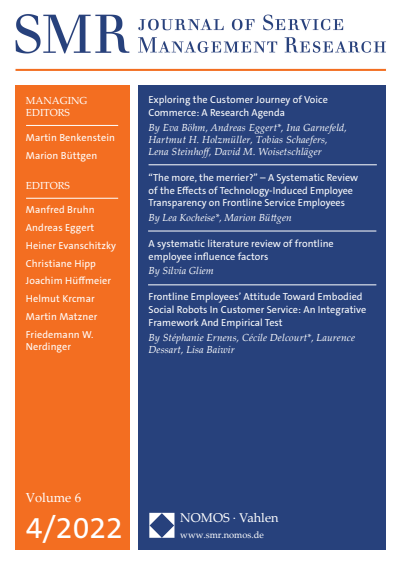
SMR - Journal of Service Management Research
Volume 6 (2022), Edition 4
- Authors:
- , , , , , , , , , , , , ,
- Publisher
- Nomos, Baden-Baden
- Publication year
- 2022
- ISSN-Online
- 2942-3392
- ISSN-Print
- 2511-8676
Chapter information
Volume 6 (2022), Edition 4
“The more, the merrier?” – A Systematic Review of the Effects of Technology-Induced Employee Transparency on Frontline Service Employees
- Authors:
- ,
- ISSN-Print
- 2511-8676
- ISSN-Online
- 2942-3392
- Preview:
Technology infusion in the service encounter is profoundly altering the workplace of frontline service employees. As digitalization increasingly enables data-driven transparency of employee conduct, this paper argues for a more employee-centric approach to organizational transparency, consequently introducing technology-induced employee transparency as a refined transparency conceptualization. Further, service literature has largely neglected studying the implications of frontline technology use on frontline workers. In an effort to fill this void in organizational frontline research, this paper provides an interdisciplinary systematic literature review on technology-induced transparency and its effects on employees and their work outcomes in related fields like management, psychology, social sciences, and computer science. Reflecting on the findings, directions for future research in the service management domain are proposed.
Bibliography
No match found. Try another term.
- References Open Google Scholar
- Abraham, M., Niessen, C., Schnabel, C., Lorek, K., Grimm, V., Möslein, K., & Wrede, M. (2019). Electronic monitoring at work: The role of attitudes, functions, and perceived control for the ac-ceptance of tracking technologies. Human Resource Management Journal, 29(4), 657–675. Open Google Scholar
- Aizenberg, E., & van den Hoven, J. (2020). Designing for human rights in AI. Big Data & Society, 7(2), 1-14. Open Google Scholar
- Albu, O. B., & Flyverbom, M. (2019). Organizational Transparency: Conceptualizations, Condi-tions, and Consequences. Business & Society, 58(2), 268–297. Open Google Scholar
- Alge, B. J. (2001). Effects of computer surveillance on perceptions of privacy and procedural justice. The Journal of Applied Psychology, 86(4), 797–804. Open Google Scholar
- Anteby, M., & Chan, C. K. (2018). Why Monitoring Your Employees’ Behavior Can Backfire. Harvard Business Review. https://hbr.org/2018/04/why-monitoring-your-employees-behavior-can-backfire?ab=at_art_art_1x1 Open Google Scholar
- Antons, D., & Breidbach, C. F. (2018). Big Data, Big Insights? Advancing Service Innovation and Design With Machine Learning. Journal of Service Research, 21(1), 17–39. Open Google Scholar
- Bakewell, L. L., Vasileiou, K., Long, K. S., Atkinson, M., Rice, H., Barreto, M., Barnett, J., Wil-son, M., Lawson, S., & Vines, J. (2018). Everything We Do, Everything We Press. In R. Man-dryk, M. Hancock, M. Perry, & A. Cox (Eds.), Proceedings of the 2018 CHI Conference on Hu-man Factors in Computing Systems (pp. 1–14). ACM. Open Google Scholar
- Barber, L. K., & Santuzzi, A. M. (2015). Please respond ASAP: Workplace telepressure and em-ployee recovery. Journal of Occupational Health Psychology, 20(2), 172–189. Open Google Scholar
- Bennis, W. (2013). Leadership in a Digital World: Embracing Transparency and Adaptive Capaci-ty. MIS Quarterly, 37(2), 635–636. Open Google Scholar
- Berendt, B. (2017). Better Data Protection by Design Through Multicriteria Decision Making: On False Tradeoffs Between Privacy and Utility. In E. Schweighofer, H. Leitold, A. Mitrakas, & K. Rannenberg (Eds.), Lecture Notes in Computer Science. Privacy Technologies and Policy: 5th Annual Privacy Forum, APF 2017, Vienna, Austria, June 7-8, 2017, Revised Selected Papers (1st ed., Vol. 10518, pp. 210–230). Springer. Open Google Scholar
- Berglund, T. (2014). Corporate Governance and Optimal Transparency. In J. Forssbæck, L. Ox-elheim, & T. Berglund (Eds.), The Oxford Handbook of Economic and Institutional Transparency (pp. 358–370). Oxford University Press. Open Google Scholar
- Bernstein, E. S. (2017). Making Transparency Transparent: The Evolution of Observation in Management Theory. Academy of Management Annals, 11(1), 1–103. Open Google Scholar
- Bitner, M. J., Booms, B. H., & Tetreault, M. S. (1990). The Service Encounter: Diagnosing Fa-vorable and Unfavorable Incidents. Journal of Marketing, 54(1), 71–84. Open Google Scholar
- Bolton, R. (2020). Commentary: future directions of the service discipline. Journal of Services Marketing, 34(3), 279–289. Open Google Scholar
- Bowen, D. E. (2016). The changing role of employees in service theory and practice: An inter-disciplinary view. Human Resource Management Review, 26(1), 4–13. Open Google Scholar
- Breidbach, C. F., Choi, S., Ellway, B., Keating, B. W., Kormusheva, K., Kowalkowski, C., Lim, C., & Maglio, P. (2018). Operating without operations: how is technology changing the role of the firm? Journal of Service Management, 29(5), 809–833. Open Google Scholar
- Breit, E., Egeland, C., Løberg, I. B., & Røhnebæk, M. T. (2021). Digital coping: How frontline workers cope with digital service encounters. Social Policy & Administration, 55(5), 833–847. Open Google Scholar
- Button, G., Mason, D., & Sharrock, W. (2003). Disempowerment and resistance in the print in-dustry? Reactions to surveillance-capable technology. New Technology, Work and Employment, 18(1), 50–61. Open Google Scholar
- Camarena, L., & Fusi, F. (2022). Always Connected: Technology Use Increases Technostress Among Public Managers. The American Review of Public Administration, 52(2), 154–168. Open Google Scholar
- Carrigan, C., Green, M. W., & Rahman-Davies, A. (2021). “The revolution will not be super-vised”: Consent and open secrets in data science. Big Data & Society, 8(2), 1-13. Open Google Scholar
- Charbonneau, É., & Doberstein, C. (2020). An Empirical Assessment of the Intrusiveness and Reasonableness of Emerging Work Surveillance Technologies in the Public Sector. Public Ad-ministration Review, 80(5), 780–791. Open Google Scholar
- Cortellazzo, L., Bruni, E., & Zampieri, R. (2019). The Role of Leadership in a Digitalized World: A Review. Frontiers in Psychology, 10, 1938. Open Google Scholar
- Da Vieira Cunha, J. (2013). A Dramaturgical Model of the Production of Performance Data. MIS Quarterly, 37(3), 723–748. Open Google Scholar
- Da Vieira Cunha, J., & Carugati, A. (2009). Information technology and the first-line manager's dilemma: Lessons from an ethnographic study. In ECIS 2009 Proceedings 2009. Open Google Scholar
- Da Vieira Cunha, J., & Carugati, A. (2011). The Sociomateriality of IT Surveillance: A Dramaturgi-cal Model of IT Adoption. In International Conference on Information Systems 2011, ICIS 2011. Open Google Scholar
- Da Vieira Cunha, J., & Carugati, A. (2013). Systems of Transfiguration and the Adoption of IT under Surveillance. In R. Baskerville & M. Chau (Chairs), ICIS 2013 Proceedings. Open Google Scholar
- De Keyser, A., Köcher, S., Alkire, L., Verbeeck, C., & Kandampully, J. (2019). Frontline Service Technology infusion: conceptual archetypes and future research directions. Journal of Service Management, 30(1), 156–183. Open Google Scholar
- Dehling, F., Feth, D., Polst, S., Steffes, B., & Tolsdorf, J. (2021). Components and Architecture for the Implementation of Technology-Driven Employee Data Protection. In S. Fischer-Hübner, C. Lambrinoudakis, G. Kotsis, A. M. Tjoa, & I. Khalil (Eds.), Lecture Notes in Computer Science. TRUST, PRIVACY AND SECURITY IN DIGITAL BUSINESS: 18th international (Vol. 12927, pp. 99–111). SPRINGER NATURE. Open Google Scholar
- Ertz, E., Becker, L., Büttgen, M., & Izogo, E. E. (2022). An imitation game – supervisors’ influ-ence on customer sweethearting. Journal of Services Marketing, 36(3), 432–444. Open Google Scholar
- Frey, C. B., & Osborne, M. A. (2017). The future of employment: How susceptible are jobs to computerisation? Technological Forecasting and Social Change, 114, 254–280. Open Google Scholar
- Furrer, O., Yu Kerguignas, J., Delcourt, C., & Gremler, D. D. (2020). Twenty-seven years of service research: a literature review and research agenda. Journal of Services Marketing, 34(3), 299–316. Open Google Scholar
- George, J. F. (1996). Computer-Based Monitoring: Common Perceptions and Empirical Results. MIS Quarterly, 20(4), 459. Open Google Scholar
- Giacalone, R. A., & Rosenfeld, P. (Eds.). (2013). Impression Management in the Organization (0th ed.). Taylor & Francis Group. Open Google Scholar
- Gierlich-Joas, M., Hess, T [Thomas], & Neuburger, R. (2020). More self-organization, more con-trol—or even both? Inverse transparency as a digital leadership concept. Business Research, 13(3), 921–947. Open Google Scholar
- Hood, C., & Heald, D. (Eds.). (2006). Proceedings of the British Academy: The key to better governance? (Vol. 135). Oxford University Press. Open Google Scholar
- Huang, M.‑H., Malthouse, E., Noble, S., & Wetzels, M. (2021). Moving Service Research For-ward. Journal of Service Research, 24(4), 459–461. Open Google Scholar
- Huang, M.‑H., & Rust, R. T. (2017). Technology-driven service strategy. Journal of the Acade-my of Marketing Science, 45(6), 906–924. Open Google Scholar
- Jandl, C., Taurer, F., Hartner-Tiefenthaler, M., Wagner, M., Moser, T., & Schlund, S. (2021). Perceptions of Using Tracking and Tracing Systems in Work Environments. In F. F.-H. Nah & K. Siau (Eds.), Lecture Notes in Computer Science. HCI in Business, Government and Organiza-tions (Vol. 12783, pp. 384–398). Springer International Publishing. Open Google Scholar
- Kochetkov, D., Birukou, A., & Ermolayeva, A. (2020, October 4). The Importance of Conference Proceedings in Research Evaluation: a Methodology for Assessing Conference Impact. https://arxiv.org/pdf/2010.01540 Open Google Scholar
- Kristiansen, K. H., Valeur-Meller, M. A., Dombrowski, L., & Holten Moller, N. L. (2018). Account-ability in the Blue-Collar Data-Driven Workplace. In R. Mandryk, M. Hancock, M. Perry, & A. Cox (Eds.), Proceedings of the 2018 CHI Conference on Human Factors in Computing Systems (pp. 1–12). ACM. Open Google Scholar
- Larivière, B., Bowen, D., Andreassen, T. W., Kunz, W., Sirianni, N. J., Voss, C., Wünder-lich, N. V., & De Keyser, A. (2017). “Service Encounter 2.0”: An investigation into the roles of technology, employees and customers. Journal of Business Research, 79, 238–246. Open Google Scholar
- Leclercq-Vandelannoitte, A. (2017). An Ethical Perspective on Emerging Forms of Ubiquitous IT-Based Control. Journal of Business Ethics, 142(1), 139–154. Open Google Scholar
- Manley, A., & Williams, S. (2022). ‘We’re not run on Numbers, We’re People, We’re Emotional People’: Exploring the experiences and lived consequences of emerging technologies, organiza-tional surveillance and control among elite professionals. Organization, 29(4), 692–713. Open Google Scholar
- Marinova, D., Ruyter, K. de, Huang, M.‑H., Meuter, M. L., & Challagalla, G. (2017). Getting Smart: Learning From Technology-Empowered Frontline Interactions. Journal of Service Re-search, 20(1), 29–42. Open Google Scholar
- Mathur, A., van den Broeck, M., Vanderhulst, G., Mashhadi, A., & Kawsar, F. (2015). Tiny habits in the giant enterprise. In K. Mase, M. Langheinrich, D. Gatica-Perez, H. Gellersen, T. Choudhury, & K. Yatani (Eds.), Proceedings of the 2015 ACM International Joint Conference on Pervasive and Ubiquitous Computing - UbiComp '15 (pp. 577–588). ACM Press. Open Google Scholar
- McNall, L. A., & Stanton, J. M. (2011). Private Eyes Are Watching You: Reactions to Location Sensing Technologies. Journal of Business and Psychology, 26(3), 299–309. Open Google Scholar
- Morlok, T., Matt, C., & Hess, T [T.]. (2015). Privatheit und Datenflut in der neuen Arbeitswelt - Chancen und Risiken einer erhöhten Transparenz. Open Google Scholar
- Newlands, G. (2021). Algorithmic Surveillance in the Gig Economy: The Organization of Work through Lefebvrian Conceived Space. Organization Studies, 42(5), 719–737. Open Google Scholar
- Nussbaumer, P., Matter, I., & Schwabe, G. (2012). “Enforced” vs. “Casual” Transparency -- Findings from IT-Supported Financial Advisory Encounters. ACM Transactions on Management Information Systems, 3(2), 1–19. Open Google Scholar
- Ostrom, A. L., Field, J. M., Fotheringham, D., Subramony, M., Gustafsson, A., Lemon, K. N., Huang, M.‑H., & McColl-Kennedy, J. R. (2021). Service Research Priorities: Managing and De-livering Service in Turbulent Times. Journal of Service Research, 24(3), 329–353. Open Google Scholar
- Parris, D. L., Dapko, J. L., Arnold, R. W., & Arnold, D. (2016). Exploring transparency: a new framework for responsible business management. Management Decision, 54(1), 222–247. Open Google Scholar
- Paul, J., Lim, W. M., O’Cass, A., Hao, A. W., & Bresciani, S. (2021). Scientific procedures and rationales for systematic literature reviews (SPAR‐4‐SLR). International Journal of Consumer Studies, 45(4). Open Google Scholar
- Pierce, L., Snow, D. C., & McAfee, A. (2015). Cleaning House: The Impact of Information Tech-nology Monitoring on Employee Theft and Productivity. Management Science, 61(10), 2299–2319. Open Google Scholar
- Rafaeli, A., Altman, D., Gremler, D. D., Huang, M.‑H., Grewal, D., Iyer, B., Parasuraman, A., & Ruyter, K. de (2017). The Future of Frontline Research. Journal of Service Research, 20(1), 91–99. Open Google Scholar
- Rafnsdóttir, G. L., & Gudmundsdottir, M. L. (2011). EPM technology and the psychosocial work environment. New Technology, Work and Employment, 26(3), 210–221. Open Google Scholar
- Ravid, D. M., Tomczak, D. L., White, J. C., & Behrend, T. S. (2020). EPM 20/20: A Review, Framework, and Research Agenda for Electronic Performance Monitoring. Journal of Manage-ment, 46(1), 100–126. Open Google Scholar
- Ravid, D. M., White, J. C., Tomczak, D. L., Miles, A. F., & Behrend, T. S. (2022). A meta‐analysis of the effects of electronic performance monitoring on work outcomes. Personnel Psychology. Advance online publication. Open Google Scholar
- Rust, R. T., & Huang, M.‑H. (2014). The Service Revolution and the Transformation of Market-ing Science. Marketing Science, 33(2), 206–221. Open Google Scholar
- Sahqani, W., & Turchet, L. (2021). Co-designing Employees' Data Privacy: a Technology Con-sultancy Company Use Case. In 2021 28th Conference of Open Innovations Association (FRUCT) (pp. 398–406). IEEE. Open Google Scholar
- Samaranayake, V., & Gamage, C. (2012). Employee perception towards electronic monitoring at work place and its impact on job satisfaction of software professionals in Sri Lanka. Telematics and Informatics, 29(2), 233–244. Open Google Scholar
- Sarpong, S., & Rees, D. (2014). Assessing the effects of ‘big brother’ in a workplace: The case of WAST. European Management Journal, 32(2), 216–222. Open Google Scholar
- Schnackenberg, A. K., Tomlinson, E., & Coen, C. (2021). The dimensional structure of transpar-ency: A construct validation of transparency as disclosure, clarity, and accuracy in organizations. Human Relations, 74(10), 1628–1660. Open Google Scholar
- Schneider, B., & Bowen, D. E. (2019). Perspectives on the Organizational Context of Frontlines: A Commentary. Journal of Service Research, 22(1), 3–7. Open Google Scholar
- Sewell, G., & Barker, J. R. (2006). Coercion Versus Care: Using Irony to Make Sense of Organi-zational Surveillance. Academy of Management Review, 31(4), 934–961. Open Google Scholar
- Shook, E., Knickrehm, M., & Sage-Gavin, E. (2019). Putting Trust to Work: Decoding Organiza-tional DNA: Trust, Data and Unlocking Value in the Digital Workplace. https://www.accenture.com/_acnmedia/Thought-Leadership-Assets/PDF/Accenture-WF-Decoding-Organizational-DNA.pdf#zoom=50 Open Google Scholar
- Singh, J., Brady, M., Arnold, T., & Brown, T. (2017). The Emergent Field of Organizational Frontlines. Journal of Service Research, 20(1), 3–11. Open Google Scholar
- Spitzmüller, C., & Stanton, J. M. (2006). Examining employee compliance with organizational surveillance and monitoring. Journal of Occupational and Organizational Psychology, 79(2), 245–272. Open Google Scholar
- Subramony, M., Solnet, D., Groth, M., Yagil, D., Hartley, N., Beomcheol Kim, P., & Golu-bovskaya, M. (2018). Service work in 2050: toward a work ecosystems perspective. Journal of Service Management, 29(5), 956–974. Open Google Scholar
- Tolsdorf, J., & Dehling, F. (2020). In Our Employer We Trust: Mental Models of Office Workers’ Privacy Perceptions. In M. Bernhard, A. Bracciali, L. J. Camp, S. Matsuo, A. Maurushat, P. B. Rønne, & M. Sala (Eds.), Lecture Notes in Computer Science. Financial Cryptography and Data Security (Vol. 12063, pp. 122–136). Springer International Publishing. Open Google Scholar
- Tomczak, D. L., Lanzo, L. A., & Aguinis, H. (2018). Evidence-based recommendations for em-ployee performance monitoring. Business Horizons, 61(2), 251–259. Open Google Scholar
- Tursunbayeva, A., Di Lauro, S., & Pagliari, C. (2018). People analytics—A scoping review of conceptual boundaries and value propositions. International Journal of Information Manage-ment, 43, 224–247. Open Google Scholar
- van Doorn, J., Mende, M., Noble, S. M., Hulland, J., Ostrom, A. L., Grewal, D., & Petersen, J. A. (2017). Domo Arigato Mr. Roboto. Journal of Service Research, 20(1), 43–58. Open Google Scholar
- World Economic Forum. (2018). Digital Transformation Initiative: Unlocking $100 Trillion for Business and Society from Digital Transformation. World Economic Forum. https://reports.weforum.org/digital-transformation/ Open Google Scholar
- Zitz, V., Wolfel, M., & Hoffmann, R. (2021). Investigating the Acceptance of the Cognitive Assis-tant Reflect that Supports Humans in Computer-Oriented Work. In 2021 International Confer-ence on Cyberworlds (CW) (pp. 151–158). IEEE. Open Google Scholar
- Zupic, I., & Čater, T. (2015). Bibliometric Methods in Management and Organization. Organiza-tional Research Methods, 18(3), 429–472. Open Google Scholar
- Zweig, D., & Webster, J. (2002). Where is the line between benign and invasive? An examina-tion of psychological barriers to the acceptance of awareness monitoring systems. Journal of Organizational Behavior, 23(5), 605–633. Open Google Scholar
- Zysman, J., Feldman, S., Kushida, K. E., Murray, J., & Nielsen, N. C. (2013). Services with Eve-rything. In D. Breznitz & J. Zysman (Eds.), The Third Globalization (pp. 99–129). Oxford Univer-sity Press. Open Google Scholar