Defining Knowledge in the Age of Society 5.0
Table of contents
Bibliographic information
Open Access Full access
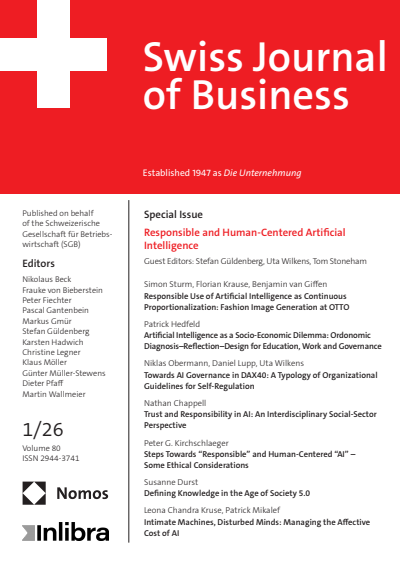
Swiss Journal of Business
Volume 80 (2026), Issue 1
- Authors:
- Publisher
- Nomos, Baden-Baden
- Copyright Year
- 2026
- ISSN-Online
- 2944-3741
- ISSN-Print
- 2944-3741
Chapter information
Open Access Full access
Volume 80 (2026), Issue 1
Defining Knowledge in the Age of Society 5.0
- Authors:
- ISSN-Print
- 2944-3741
- ISSN-Online
- 2944-3741
- Preview:
The aim of this perspective contribution is to introduce the concept of responsible knowledge management (rKM) and its usefulness for implementing ethically accepted AI solutions in organizations. Illustrative examples are presented to demonstrate the latter. The article concludes with a series of research questions that serve as an outlook and inspiration for further reflection on rKM and ethically acceptable AI solutions in companies.
Bibliography
No match found. Try another term.
- Alavi, M., & Leidner, D. E. (2001). Review: Knowledge Management and Knowledge Management Systems: Conceptual Foundations and Research Issues. MIS Quarterly, 25(1), 107–136. https://doi.org/10.2307/3250961 Open Google Scholar DOI: 10.5771/2944-3741-2026-1-83
- Caddy, I. (2000). Intellectual capital: recognizing both assets and liabilities. Journal of Intellectual Capital, 1(2), 129-146. Open Google Scholar DOI: 10.5771/2944-3741-2026-1-83
- Carayannis, E. G., & Morawska-Jancelewicz, J. (2022). The Futures of Europe: Society 5.0 and Industry 5.0 as Driving Forces of Future Universities. Journal of the Knowledge Economy, 13(4), 3445-3471. https://doi.org/10.1007/s13132-021-00854-2 Open Google Scholar DOI: 10.5771/2944-3741-2026-1-83
- Dalkir, K. (2025). Handbook of inclusive knowledge management. CRC Press, Abingdon, Oxon. Open Google Scholar DOI: 10.5771/2944-3741-2026-1-83
- Davenport, T. H. (1994). Saving IT's Soul: Human Centered Information Management. Harvard Business Review, March-April, 72(2), 119-131. Open Google Scholar DOI: 10.5771/2944-3741-2026-1-83
- Davenport, T., & Prusak, L. (1998). Working Knowledge: How Organizations Manage What They Know. Ubiquity 2000, August, Article 6 (August 1 - August 31, 2000). https://doi.org/10.1145/347634.348775 Open Google Scholar DOI: 10.5771/2944-3741-2026-1-83
- de Holan, P. M., & Phillips, N. (2004). Organizational forgetting as strategy. Strategic Organization, 2(4), 423-433. https://doi.org/10.1177/1476127004047620 Open Google Scholar DOI: 10.5771/2944-3741-2026-1-83
- Du Plessis, M. (2007). The role of knowledge management in innovation. Journal of knowledge management, 11(4), 20-29. Open Google Scholar DOI: 10.5771/2944-3741-2026-1-83
- Durst, S. (2024). A plea for responsible and inclusive knowledge management at the world level. VINE Journal of Information and Knowledge Management Systems; 54(1), 211–219. https://doi.org/10.1108/VJIKMS-09-2021-0204 Open Google Scholar DOI: 10.5771/2944-3741-2026-1-83
- Durst, S., & Foli, S. (2024). Responsible and inclusive knowledge management made concrete. In Handbook of Inclusive Knowledge Management: Ensuring Inclusivity, Diversity, and Equity in Knowledge Processing Activities (pp. 1-12). CRC Press. Open Google Scholar DOI: 10.5771/2944-3741-2026-1-83
- Durst, S., & Khadir, Y. (2025). Towards Responsible Knowledge Management. In S. Durst and Y. Khadir (eds) Knowledge Management at the Crossroads. Navigating Risks and Benefits (pp. 79-88). Springer, Cham. Open Google Scholar DOI: 10.5771/2944-3741-2026-1-83
- Durst, S., & Zieba, M. (2018). Mapping knowledge risks: towards a better understanding of knowledge management. Knowledge Management Research & Practice, 17(1), 1-13, https://doi.org/10.1080/14778238.2018.1538603 Open Google Scholar DOI: 10.5771/2944-3741-2026-1-83
- Dyllick, T., & Muff, K. (2016). Clarifying the Meaning of Sustainable Business: Introducing a Typology From Business-as-Usual to True Business Sustainability. Organization & Environment, 29(2), 156-174. https://doi.org/10.1177/1086026615575176 Open Google Scholar DOI: 10.5771/2944-3741-2026-1-83
- Ferreira, J., Mueller, J., & Papa, A. (2020). Strategic knowledge management: theory, practice and future challenges. Journal of Knowledge Management, 24 (2), 121–126. https://doi.org/10.1108/JKM-07-2018-0461 Open Google Scholar DOI: 10.5771/2944-3741-2026-1-83
- McGill, M. E., & Slocum, J. W. (1993). Unlearning the organization. Organizational Dynamics, 22(2), 67–79. https://doi.org/10.1016/0090-2616(93)90054-5 Open Google Scholar DOI: 10.5771/2944-3741-2026-1-83
- Merhi, M. I. (2023). An evaluation of the critical success factors impacting artificial intelligence implementation. International Journal of Information Management, 69, 102545. Open Google Scholar DOI: 10.5771/2944-3741-2026-1-83
- Mökander, J., Sheth, M., Gersbro-Sundler, M., Blomgren, P., & Floridi, L. (2022). Challenges and best practices in corporate AI governance: Lessons from the biopharmaceutical industry. Frontiers in Computer Science, 4, 1068361. https://doi.org/10.3389/fcomp.2022.1068361 Open Google Scholar DOI: 10.5771/2944-3741-2026-1-83
- Ng, D. T. K., Leung, J. K. L., Chu, S. K. W., & Qiao, M. S. (2021). Conceptualizing AI literacy: An exploratory review. Computers and Education: Artificial Intelligence, 2, 100041. Open Google Scholar DOI: 10.5771/2944-3741-2026-1-83
- Schneider, J., Abraham, R., Meske, C., & Vom Brocke, J. (2023). Artificial Intelligence Governance For Businesses. Information Systems Management, 40(3), 229–249. https://doi.org/10.1080/10580530.2022.2085825 Open Google Scholar DOI: 10.5771/2944-3741-2026-1-83
- Williams, C., & Durst, S. (2019). Exploring the transition phase in offshore outsourcing: Decision making amidst knowledge at risk. Journal of Business Research, 103, 460-471. Open Google Scholar DOI: 10.5771/2944-3741-2026-1-83
- Zack, M.H. (2002). Developing a knowledge strategy. California Management Review, 41(3), 125-223. Open Google Scholar DOI: 10.5771/2944-3741-2026-1-83
