Der Islam und sein Umgang mit Menschen mit Behinderung
Table of contents
Bibliographic information
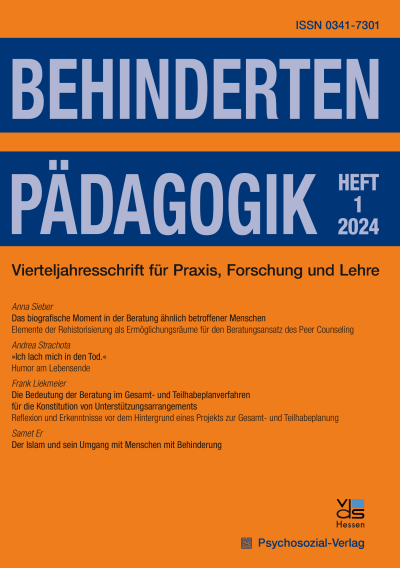
Vierteljahresschrift für Behindertenpädagogik und Integration Behinderter in Praxis, Forschung und Lehre
Volume 63 (2024), Edition 1
- Authors:
- Publisher
- Psychosozial-Verlag, Gießen
- Publication year
- 2024
- ISSN-Online
- 0341-7301
- ISSN-Print
- 0341-7301
Chapter information
Volume 63 (2024), Edition 1
Der Islam und sein Umgang mit Menschen mit Behinderung
- Authors:
- ISSN-Print
- 0341-7301
- ISSN-Online
- 0341-7301
- Preview:
The article examines Islam’s approach to individuals with disabilities, tracing historical developments from early civilizations to contemporary challenges. It underscores Islam’s emphasis on valuing and treating individuals with disabilities equally, rooted in principles like the perfection of creation and justice. Prophet Muhammad is presented as a model for the integration and support of people with disabilities, with various measures such as vocational rehabilitation and education highlighted. Nevertheless, many Islamic countries and mosque communities continue to face challenges in implementing these principles, including social biases and inadequate accessibility facilities. The article concludes by urging improvements and the advancement of the integration of individuals with disabilities within the Muslim community.
Bibliography
No match found. Try another term.
- Acara, Y. (2013). Saadet Asri Modeli toplum tecrübesinin engellilere ilsikin kodlari. Dini bilimleri akademik arastirma dergisi, XIII(1), 131–171. Open Google Scholar
- Akdemir, F. (2014) Kur’an Baglaminda Peygamberlerin sifatlar. Düzce Universitesi Sosyal Bilimler Enstitüsü Dergisi, 8(1), 51–84. Open Google Scholar
- Akyüz, I. (2014). Islam’da dini pratiklerin toplumsal dayanisma etkisi. International Journal of Social Science, 25, 461–482. Open Google Scholar
- Baş, E., Fayda, M. & Yazici, N. (2012). I’slam Tarihi El Kitabı. Ankara: Grafiker Yayınları. Open Google Scholar
- Dalaz, A. (2021). Engelliler ve Islam, Diyanet. https://webdosyasp.diyanet.gov.tr/muftuluk/UserFiles/kirikkale/UserFiles/Files/03.12.2021%20Engelliler%20ve%20İslam-_58717c3b-ae19-438c-9f9a-03f9623c54cb.pdf (20.10.2023). Open Google Scholar
- Elliesie, H. (Hrsg.). (2010). Beiträge zum Islamischen Recht VII. Islam und Menschenrechte. Leipziger Beiträge zur Orientforschung. Frankfurt am Main: Peter Lang GmbH. Open Google Scholar
- Hamidullah, M. (1990). Medine Döneminde Peygamberin (s.a.) I’craatındaki Hoşgörü, I’slâm, Bilim ve Felsefe, I’stanbul. Open Google Scholar
- Islamiq.de. Barrierefreie Moscheen – eine kollektive Verantwortung. https://www.islamiq.de/2022/03/05/barrierefreie-moscheen-eine-kollektive-verantwortung/ (22.10.2023). Open Google Scholar
- Karaman, H. (1975). Fıkıh Usulü (Fiqh-Methode). Istanbul: İrfan Verlag. Open Google Scholar
- Kermani, N. (1999). Gott ist schön, Das ästhetische Erleben des Koran. München: Beck. Open Google Scholar
- Masuhr, L. (2012). Zur Geschichte des Umgangs mit Behinderung. Leidmedien.de. https://leidmedien.de/geschichte/zur-geschichte-des-umgangs-mit-behinderung/ (18.10.2023). Open Google Scholar
- Rispler-Chaim, V. (2018). Menschen mit Behinderung im Koran. Deutschlandfunk. https://www.deutschlandfunk.de/sure-24-vers-61-menschen-mit-behinderung-im-koran-100.html (20.10.2023). Open Google Scholar
- Saglam, H. (2016). Günümüzdeki sosyal güvenlik kurumunun tarihsel kökeni hakkinda özet bir tahlil. Erzincan: Üniversitesi Sosyal Bilimler Enstitüsü Dergisi, IX(1), 131–142. Open Google Scholar
- Sancaklı, S. (2008). Hz. Peygamber’in Engellilere Karşı Bakış Açısının Tespi- ti. Istanbul: Manevî Sosyal Hizmetler, Edt. Ali Seyyar, 179–217. Open Google Scholar
- Scholz, T. (2012). Die Entwicklung der Beschäftigung von Menschen mit Behinderung im Laufe der Geschichte und der heutige Stand. München: Grin Verlag. Open Google Scholar
- Sebeh, G.A. (2013). Menschen mit Behinderung im Nahen Osten und in Nordafrika. Hintergrundbemerkungen. In T.G. Schneiders (Hrsg.), Die Araber im 21. Jahrhundert (S. 110–112). Wiesbaden: Springer. https://link.springer.com/content/pdf/10.1007%2F978-3-531-19093-8_7.pdf (16.10.2023). Open Google Scholar
- Seyyar, A. (2011). Yildizlar engel tanimaz. Istanbul: Ragbet Yayinlari. Open Google Scholar