Responsible Use of Artificial Intelligence as Continuous Proportionalization: Fashion Image Generation at OTTO
Table of contents
Bibliographic information
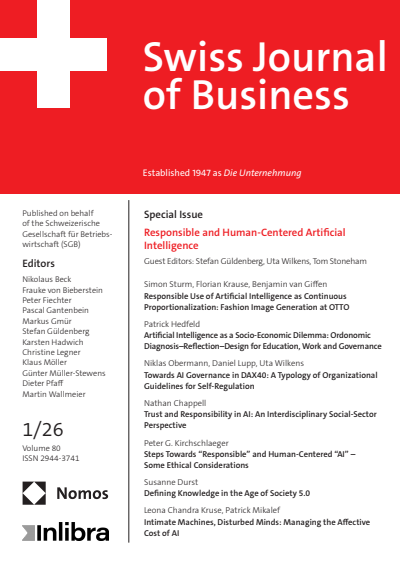
Swiss Journal of Business
Volume 80 (2026), Issue 1
- Authors:
- Publisher
- Nomos, Baden-Baden
- Copyright Year
- 2026
- ISSN-Online
- 2944-3741
- ISSN-Print
- 2944-3741
Chapter information
Volume 80 (2026), Issue 1
Responsible Use of Artificial Intelligence as Continuous Proportionalization: Fashion Image Generation at OTTO
- Authors:
- ISSN-Print
- 2944-3741
- ISSN-Online
- 2944-3741
- Preview:
The inherent ambivalence of machine learning-based artificial intelligence (AI) technologies makes ensuring their responsible use a pressing concern. While the literature converges on the importance of governance at the organizational level, uncertainty remains about what responsible (use of) AI actually is. We conceptualize responsible AI as both a process and outcome of social evaluation. We propose a model (“continuous proportionalization”) that explains how organizations construct collective interpretations of responsible AI along the dimensions of legitimacy, suitability, necessity, and proportionality. We illustrate the model through a case study of AI-based fashion image generation at Germany’s largest e-commerce company, OTTO.
Bibliography
No match found. Try another term.
- Bach, T. A., Kaarstad, M., Solberg, E., & Babic, A. (2025). Insights into suggested Responsible AI (RAI) practices in real-world settings: a systematic literature review. AI and Ethics, 5(3), 3185–3232. https://doi.org/10.1007/s43681-024-00648-7 Open Google Scholar DOI: 10.5771/2944-3741-2026-1-7
- Bitektine, A., & Haack, P. (2015). The “macro” and the “micro” of legitimacy: Toward a multilevel theory of the legitimacy process. Academy of Management Review, 40(1), 49–75. https://doi.org/10.5465/amr.2013.0318 Open Google Scholar DOI: 10.5771/2944-3741-2026-1-7
- Bughin, J. (2025a). Doing versus saying: responsible AI among large firms. AI & Society, 40(4), 2751–2763. https://doi.org/10.1007/s00146-024-02014-x Open Google Scholar DOI: 10.5771/2944-3741-2026-1-7
- Bughin, J. (2025b). The role of AI assets and capabilities in shaping responsible AI deepening: a random forest machine learning view. AI and Ethics, 5(6), 6313–6327. https://doi.org/10.1007/s43681-025-00802-9 Open Google Scholar DOI: 10.5771/2944-3741-2026-1-7
- Christophersen, T., & Pärn, J. (2021). Data Science bei OTTO. In P. Buxmann & H. Schmidt (Eds.), Künstliche Intelligenz (pp. 101–115). Springer Berlin Heidelberg. https://doi.org/10.1007/978-3-662-61794-6_6 Open Google Scholar DOI: 10.5771/2944-3741-2026-1-7
- Cihon, P., Schuett, J., & Baum, S. D. (2021). Corporate governance of artificial intelligence in the public interest. Information (Basel), 12(7), 275. https://doi.org/10.3390/info12070275 Open Google Scholar DOI: 10.5771/2944-3741-2026-1-7
- Coeckelbergh, M. (2020). AI Ethics. MIT Press. Open Google Scholar DOI: 10.5771/2944-3741-2026-1-7
- Coeckelbergh, M. (2024). Artificial intelligence, the common good, and the democratic deficit in AI governance. AI and Ethics, 5(2), 1491–1497. https://doi.org/10.1007/s43681-024-00492-9 Open Google Scholar DOI: 10.5771/2944-3741-2026-1-7
- Cohen-Eliya, M., & Porat, I. (2010). American balancing and German proportionality: The historical origins. International Journal of Constitutional Law, 8(2), 263–286. https://doi.org/10.1093/icon/moq004 Open Google Scholar DOI: 10.5771/2944-3741-2026-1-7
- de-Lima-Santos, M.-F., Yeung, W. N., & Dodds, T. (2025). Guiding the way: a comprehensive examination of AI guidelines in global media. AI & Society, 40(4), 2585–2603. https://doi.org/10.1007/s00146-024-01973-5 Open Google Scholar DOI: 10.5771/2944-3741-2026-1-7
- Elia, M., Ziethmann, P., Krumme, J., Schlögl-Flierl, K., & Bauer, B. (2025). Responsible AI, ethics, and the AI lifecycle: how to consider the human influence? AI and Ethics, 5(4), 4011–4028. https://doi.org/10.1007/s43681-025-00666-z Open Google Scholar DOI: 10.5771/2944-3741-2026-1-7
- Floridi, L., Cowls, J., Beltrametti, M., Chatila, R., Chazerand, P., Dignum, V., Luetge, C., Madelin, R., Pagallo, U., Rossi, F., Schafer, B., Valcke, P., & Vayena, E. (2018). AI4People-An Ethical Framework for a Good AI Society: Opportunities, Risks, Principles, and Recommendations. Minds and Machines, 28(4), 689–707. https://doi.org/10.1007/s11023-018-9482-5 Open Google Scholar DOI: 10.5771/2944-3741-2026-1-7
- Garibay, O. O., Winslow, B., Andolina, S., Antona, M., Bodenschatz, A., Coursaris, C., Falco, G., Fiore, S. M., Garibay, I., Grieman, K., Havens, J. C., Jirotka, M., Kacorri, H., Karwowski, W., Kider, J., Konstan, J., Koon, S., Lopez-Gonzalez, M., Maifeld-Carucci, I., … Xu, W. (2023). Six Human-Centered Artificial Intelligence Grand Challenges. International Journal of Human–Computer Interaction, 39(3), 391–437. https://doi.org/10.1080/10447318.2022.2153320 Open Google Scholar DOI: 10.5771/2944-3741-2026-1-7
- Gerken, T. (2024, December 11). Chatbot “encouraged teen to kill parents over screen time limit.” BBC News. https://www.bbc.com/news/articles/cd605e48q1vo Open Google Scholar DOI: 10.5771/2944-3741-2026-1-7
- Gogoll, J., Zuber, N., Kacianka, S., Greger, T., Pretschner, A., & Nida-Rümelin, J. (2021). Ethics in the Software Development Process: from Codes of Conduct to Ethical Deliberation. Philosophy & Technology, 34(4), 1085–1108. https://doi.org/10.1007/s13347-021-00451-w Open Google Scholar DOI: 10.5771/2944-3741-2026-1-7
- Hagendorff, T. (2022). A virtue-based framework to support putting AI ethics into practice. Philosophy & Technology, 35(3), 1–24. https://doi.org/10.1007/s13347-022-00553-z Open Google Scholar DOI: 10.5771/2944-3741-2026-1-7
- Heger, A. K., Passi, S., Dhanorkar, S., Kahn, Z., Wang, R., & Vorvoreanu, M. (2025). Towards a Responsible AI Organizational Maturity model. Proceedings of the ACM on Human-Computer Interaction, 9(7), 1–33. https://doi.org/10.1145/3757514 Open Google Scholar DOI: 10.5771/2944-3741-2026-1-7
- Horneber, D. (2025). Understanding the implementation of responsible artificial intelligence in organizations: A Neo-institutional theory perspective. Communications of the Association for Information Systems, 57, 8. https://doi.org/10.17705/1cais.05708 Open Google Scholar DOI: 10.5771/2944-3741-2026-1-7
- Jobin, A., Ienca, M., & Vayena, E. (2019). The global landscape of AI ethics guidelines. Nature Machine Intelligence, 1(9), 389–399. https://doi.org/10.1038/s42256-019-0088-2 Open Google Scholar DOI: 10.5771/2944-3741-2026-1-7
- Kallina, E., & Singh, J. (2024). Stakeholder involvement for responsible AI development: A process framework. Proceedings of the 4th ACM Conference on Equity and Access in Algorithms, Mechanisms, and Optimization, 1–14. https://doi.org/10.1145/3689904.3694698 Open Google Scholar DOI: 10.5771/2944-3741-2026-1-7
- Karliuk, M. (2023). Proportionality principle for the ethics of artificial intelligence. AI and Ethics, 3(3), 985–990. https://doi.org/10.1007/s43681-022-00220-1 Open Google Scholar DOI: 10.5771/2944-3741-2026-1-7
- Katirai, A., Garcia, N., Ide, K., Nakashima, Y., & Kishimoto, A. (2024). Situating the social issues of image generation models in the model life cycle: a sociotechnical approach. AI and Ethics, 5(2), 1769–1786. https://doi.org/10.1007/s43681-024-00517-3 Open Google Scholar DOI: 10.5771/2944-3741-2026-1-7
- Krijger, J., Thuis, T., de Ruiter, M., Ligthart, E., & Broekman, I. (2023). The AI ethics maturity model: a holistic approach to advancing ethical data science in organizations. AI and Ethics, 3(2), 355–367. https://doi.org/10.1007/s43681-022-00228-7 Open Google Scholar DOI: 10.5771/2944-3741-2026-1-7
- Kuznia, R., Gordon, A., & Lavandera, E. (2025, November 6). “You”re not rushing. You’re just ready:’ Parents say ChatGPT encouraged son to kill himself. CNN. https://www.cnn.com/2025/11/06/us/openai-chatgpt-suicide-lawsuit-invs-vis Open Google Scholar DOI: 10.5771/2944-3741-2026-1-7
- Mikalef, P., Conboy, K., Lundström, J. E., & Popovič, A. (2022). Thinking responsibly about responsible AI and “the dark side” of AI. European Journal of Information Systems: An Official Journal of the Operational Research Society, 31(3), 257–268. https://doi.org/10.1080/0960085x.2022.2026621 Open Google Scholar DOI: 10.5771/2944-3741-2026-1-7
- Minkkinen, M., Zimmer, M. P., & Mäntymäki, M. (2023). Co-shaping an ecosystem for responsible AI: Five types of expectation work in response to a technological frame. Information Systems Frontiers: A Journal of Research and Innovation, 25(1), 103–121. https://doi.org/10.1007/s10796-022-10269-2 Open Google Scholar DOI: 10.5771/2944-3741-2026-1-7
- Mittelstadt, B. (2019). Principles alone cannot guarantee ethical AI. Nature Machine Intelligence, 1(11), 501–507. https://doi.org/10.1038/s42256-019-0114-4 Open Google Scholar DOI: 10.5771/2944-3741-2026-1-7
- Otto. (2021, September 16). Ethik vs. Wirtschaftlichkeit, können wir KI vertrauen? | MAIN Session – OTTO [Ethics vs. economics, can we trust AI?]. Youtube. https://www.youtube.com/watch?v=aiay2hfDiOg Open Google Scholar DOI: 10.5771/2944-3741-2026-1-7
- Polanyi, M. (1962). The Republic of science: Its political and economic theory. Minerva, 1(1), 54–73. https://doi.org/10.1007/bf01101453 Open Google Scholar DOI: 10.5771/2944-3741-2026-1-7
- Radford, A., Kim, J. W., Xu, T., Brockman, G., McLeavey, C., & Sutskever, I. (2022). Robust Speech Recognition via Large-Scale Weak Supervision. In arXiv [eess.AS]. arXiv. http://arxiv.org/abs/2212.04356 Open Google Scholar DOI: 10.5771/2944-3741-2026-1-7
- Rufo, Y. (2025, July 27). What Guess’s AI model in Vogue means for beauty standards. BBC News. https://www.bbc.com/news/articles/cgeqe084nn4o Open Google Scholar DOI: 10.5771/2944-3741-2026-1-7
- Ryan, M., & Stahl, B. C. (2021). Artificial intelligence ethics guidelines for developers and users: clarifying their content and normative implications. Journal of Information Communication and Ethics in Society, 19(1), 61–86. https://doi.org/10.1108/jices-12-2019-0138 Open Google Scholar DOI: 10.5771/2944-3741-2026-1-7
- Saharia, C., Chan, W., Saxena, S., Li, L., Whang, J., Denton, E. L., Ghasemipour, S. K. S., Ayan, B. K., Mahdavi, S. S., Lopes, R. G., Salimans, T., Ho, J., Fleet, D. J., & Norouzi, M. (2022). Photorealistic text-to-image diffusion models with deep language understanding. Neural Information Processing Systems, abs/2205.11487, 36479–36494. https://doi.org/10.48550/arXiv.2205.11487 Open Google Scholar DOI: 10.5771/2944-3741-2026-1-7
- Sobek, T., & Montag, J. (2018). Proportionality Test. In Encyclopedia of Law and Economics (pp. 1–5). Springer New York. https://doi.org/10.1007/978-1-4614-7883-6_721-1 Open Google Scholar DOI: 10.5771/2944-3741-2026-1-7
- Stahl, B. C. (2012). Responsible research and innovation in information systems. European Journal of Information Systems: An Official Journal of the Operational Research Society, 21(3), 207–211. https://doi.org/10.1057/ejis.2012.19 Open Google Scholar DOI: 10.5771/2944-3741-2026-1-7
- Suchman, M. C. (1995). Managing legitimacy: Strategic and institutional approaches. Academy of Management Review, 20(3), 571. https://doi.org/10.2307/258788 Open Google Scholar DOI: 10.5771/2944-3741-2026-1-7
- Suddaby, R., Bitektine, A., & Haack, P. (2017). Legitimacy. Academy of Management Annals, 11(1), 451–478. https://doi.org/10.5465/annals.2015.0101 Open Google Scholar DOI: 10.5771/2944-3741-2026-1-7
- Taddeo, M., & Floridi, L. (2018). How AI can be a force for good. Science, 361(6404), 751–752. https://doi.org/10.1126/science.aat5991 Open Google Scholar DOI: 10.5771/2944-3741-2026-1-7
- Watson, D. S., Mökander, J., & Floridi, L. (2025). Competing narratives in AI ethics: a defense of sociotechnical pragmatism. AI & Society, 40(5), 3163–3185. https://doi.org/10.1007/s00146-024-02128-2 Open Google Scholar DOI: 10.5771/2944-3741-2026-1-7
- Yilma, K. (2025). From principles to process: the principlist approach to AI ethics and lessons from Internet bills of rights. AI and Ethics, 5(4), 4279–4291. https://doi.org/10.1007/s43681-025-00719-3 Open Google Scholar DOI: 10.5771/2944-3741-2026-1-7
- Yin, R. K. (1981). The Case Study Crisis: Some Answers. Administrative Science Quarterly, 26(1), 58–65. https://doi.org/10.2307/2392599 Open Google Scholar DOI: 10.5771/2944-3741-2026-1-7
- Yin, R. K. (1994). Case Study Research: Design and Methods. SAGE Publications. Open Google Scholar DOI: 10.5771/2944-3741-2026-1-7
- Zhang, Z., & Wang, J. (2024). Can AI replace psychotherapists? Exploring the future of mental health care. Frontiers in Psychiatry, 15, 1444382. https://doi.org/10.3389/fpsyt.2024.1444382 Open Google Scholar DOI: 10.5771/2944-3741-2026-1-7
