Mit Interventionismus oder Selbstermächtigung zu einem guten Zusammenleben? Journalistische Rollenerwartungen und Ideale des gesellschaftlichen Zusammenlebens in der deutschen Bevölkerung
Table of contents
Bibliographic information
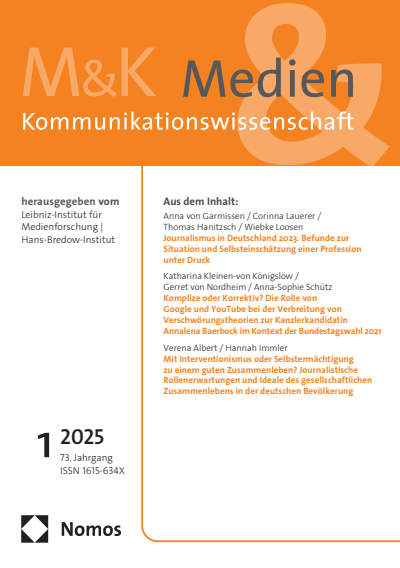
M&K Medien & Kommunikationswissenschaft
Volume 73 (2025), Issue 1
- Authors:
- Publisher
- Nomos, Baden-Baden
- Copyright Year
- 2025
- ISSN-Online
- 2942-3317
- ISSN-Print
- 1615-634X
Chapter information
Volume 73 (2025), Issue 1
Mit Interventionismus oder Selbstermächtigung zu einem guten Zusammenleben? Journalistische Rollenerwartungen und Ideale des gesellschaftlichen Zusammenlebens in der deutschen Bevölkerung
- Authors:
- ISSN-Print
- 1615-634X
- ISSN-Online
- 2942-3317
- Preview:
Journalism plays a crucial role for cohesion in a society, as it creates publicity and reduces complexity, particularly in the face of current social challenges. This study analyzes the relationship between the German population’s expectations of journalism’s role and their ideals of good social coexistence. Our inquiry aims to identify patterns of expectations and attitudes within the German population to illuminate the nuances shaping societal discourse and coexistence. Drawing from data from a nationally representative survey of the German population, this study encompasses 25 journalistic role items and 12 ideals of coexistence. A latent profile analysis was employed to identify three distinct groups withing the population, each with a unique set of objectives: A pluralistic coexistence combined with interventionist journalism, a liberal coexistence linked with empowering journalism, and a compliant ideal of coexistence with agenda-setting journalism. The results contribute to a better understanding of journalism’s role in the social fabric by showing that expectations of journalistic work are related to broader societal ideals, offering new perspectives for journalism research.
Bibliography
No match found. Try another term.
- Altmeppen, K.-D. (2006). Journalismus und Medien als Organisationen: Leistungen, Strukturen und Management. VS Verlag für Sozialwissenschaften. Open Google Scholar DOI: 10.5771/1615-634X-2025-1-58
- Bacher, J., & Vermunt, J. K. (2010). Analyse latenter Klassen. In C. Wolf & H. Best (Hrsg.), Handbuch der sozialwissenschaftlichen Datenanalyse (S. 553–574). VS Verlag für Sozialwissenschaften. Open Google Scholar DOI: 10.5771/1615-634X-2025-1-58
- Biernacki, C., Celeux, G., & Govaert, G. (2000). Assessing a mixture model for clustering with the integrated completed likelihood. IEEE Transactions on Pattern Analysis and Machine Intelligence, 22(7), 719–725. https://doi.org/10.1109/34.865189 Open Google Scholar DOI: 10.5771/1615-634X-2025-1-58
- Blöbaum, B. (2016). Journalismus als Funktionssystem der Gesellschaft. In M. Löffelholz & L. Rothenberger (Hrsg.), Handbuch Journalismustheorien (S. 151–163). Springer Fachmedien Wiesbaden. https://doi.org/10.1007/978-3-531-18966-6_7 Open Google Scholar DOI: 10.5771/1615-634X-2025-1-58
- Bornschier, S. (2010). The new cultural divide and the two-dimensional space in Western Europe. West European Politics, 33(3), 419–444. https://doi.org/10.1080/01402381003654387 Open Google Scholar DOI: 10.5771/1615-634X-2025-1-58
- Carlson, M. (2017). Journalistic authority: Legitimating news in the digital era. Columbia University Press. Open Google Scholar DOI: 10.5771/1615-634X-2025-1-58
- Chan, J., To, H.-P., & Chan, E. (2006). Reconsidering social cohesion: Developing a definition and analytical framework for empirical research. Social Indicators Research, 75(2), 273–302. https://doi.org/10.1007/s11205-005-2118-1 Open Google Scholar DOI: 10.5771/1615-634X-2025-1-58
- Christians, C. G., Glasser, T. L., McQuail, D., Nordenstreng, K., & White, R. A. (2009). Normative theories of the media. Journalism in democratic societies. University of Illinois Press. Open Google Scholar DOI: 10.5771/1615-634X-2025-1-58
- Couldry, N., & Hepp, A. (2023). Die mediale Konstruktion der Wirklichkeit: Eine Theorie der Mediatisierung und Datafizierung. Springer VS Wiesbaden. https://doi.org/10.1007/978-3-658-37713-7 Open Google Scholar DOI: 10.5771/1615-634X-2025-1-58
- Durkheim, É. (1984). The division of labour in society. Macmillan. Open Google Scholar DOI: 10.5771/1615-634X-2025-1-58
- Fawzi, N., & Mothes, C. (2020). Perceptions of media performance: Expectation-evaluation discrepancies and their relationship with media-related and populist attitudes. Media and Communication, 8(3), Article 3. https://doi.org/10.17645/mac.v8i3.3142 Open Google Scholar DOI: 10.5771/1615-634X-2025-1-58
- Ferguson, S. L., Moore, E. W. G., & Hull, Darell M. (2020). Finding latent groups in observed data: A primer on latent profile analysis in Mplus for applied researchers. International Journal of Behavioral Development, 44(5), 458–468. https://doi.org/10.1177/0165025419881721 Open Google Scholar DOI: 10.5771/1615-634X-2025-1-58
- Fonseca, X., Lukosch, S., & Brazier, F. (2019). Social cohesion revisited: A new definition and how to characterize it. Innovation: The European Journal of Social Science Research, 32(2), 231–253. https://doi.org/10.1080/13511610.2018.1497480 Open Google Scholar DOI: 10.5771/1615-634X-2025-1-58
- Forst, R. (2020). Gesellschaftlicher Zusammenhalt. Zur Analyse eines sperrigen Begriffs. In N. Deitelhoff, O. Groh-Samberg & M. Middell (Hrsg.), Gesellschaftlicher Zusammenhalt. Ein interdisziplinärer Dialog (S. 41–53). Campus Verlag. Open Google Scholar DOI: 10.5771/1615-634X-2025-1-58
- Fraley, C., Raftery, A. E., & Scrucca, L. (2023). mclust: Gaussian mixture modelling for model-based clustering, classification, and density estimation (R package version 6.0.0). https://CRAN.R-project.org/package=mclust [23.02.2025]. Open Google Scholar DOI: 10.5771/1615-634X-2025-1-58
- Gemkow, J., & Ganguin, S. (2024). Strukturwandel der Öffentlichkeit und gesellschaftlicher Zusammenhalt. In M. Middell (Hrsg.), Varianzen des Zusammenhalts. Historisch und transregional vergleichende Perspektiven (S. 313–336). Campus Verlag. Open Google Scholar DOI: 10.5771/1615-634X-2025-1-58
- Gil de Zúñiga, H., & Hinsley, A. (2013). The press versus the public: What is „good journalism?“ Journalism Studies, 14(6), 926–942. https://doi.org/10.1080/1461670X.2012.744551 Open Google Scholar DOI: 10.5771/1615-634X-2025-1-58
- Grimm, N., Holubek-Schaum, S., Kaufhold, I., Koevel, A., & Schmidt, A. (2022). Gesellschaftliche Konflikte in der Pandemie: Neue Spaltungen oder alte Brüche? Zusammenhalt begreifen. https://doi.org/10.58079/oq5e Open Google Scholar DOI: 10.5771/1615-634X-2025-1-58
- Grunow, D., Sachweh, P., Schimank, U., & Traunmüller, R. (2022). Gesellschaftliche Sozialintegration. Konzeptionelle Grundlagen und offene Fragen (FGZ Working Paper Nr. 2). Forschungsinstitut Gesellschaftlicher Zusammenhalt. https://fgz-risc.de/bibliothek/publikationsdatenbank/details/gesellschaftliche-sozialintegration-konzeptionelle-grundlagen-und-offene-fragen [23.02.2025]. Open Google Scholar DOI: 10.5771/1615-634X-2025-1-58
- Hanitzsch, T. (2004). Integration oder Koorientierung? Risiken funktionaler Differenzierung und Journalismustheorie. In M. Löffelholz (Hrsg.), Theorien des Journalismus. Ein diskursives Handbuch (2. Auflage, S. 217–232). VS Verlag für Sozialwissenschaften. Open Google Scholar DOI: 10.5771/1615-634X-2025-1-58
- Hanitzsch, T. (2011). Populist disseminators, detached watchdogs, critical change agents and opportunist facilitators: Professional milieus, the journalistic field and autonomy in 18 countries. International Communication Gazette, 73(6), 477–494. https://doi.org/10.1177/1748048511412279 Open Google Scholar DOI: 10.5771/1615-634X-2025-1-58
- Hanitzsch, T., & Vos, T. P. (2017). Journalistic roles and the struggle over institutional identity: The discursive constitution of journalism. Communication Theory, 27(2), 115–135. https://doi.org/10.1111/comt.12112 Open Google Scholar DOI: 10.5771/1615-634X-2025-1-58
- Hanitzsch, T., & Vos, T. P. (2018). Journalism beyond democracy: A new look into journalistic roles in political and everyday life. Journalism, 19(2), 146–164. https://doi.org/10.1177/1464884916673386 Open Google Scholar DOI: 10.5771/1615-634X-2025-1-58
- Hanitzsch, T., Vos, T., Standaert, O., Hanusch, F., Hovden, J., Hermans, L., & Ramaprasad, J. (2019). Role orientations: Journalists’ views on their place in society. In T. Hanitzsch, F. Hanusch, J. Ramaprasad & A. de Beer, (Hrsg.), Worlds of Journalism. Journalistic cultures around the globe (S. 161–197). Columbia University Press. Open Google Scholar DOI: 10.5771/1615-634X-2025-1-58
- Hasebrink, U., Schmidt, J.-H., Loosen, W., & Schulz, W. (2020). Medien und gesellschaftlicher Zusammenhalt. In N. Deitelhoff, O. Groh-Samberg & M. Middell (Hrsg.), Gesellschaftlicher Zusammenhalt. Ein interdisziplinärer Dialog (S. 333–348). Campus Verlag. Open Google Scholar DOI: 10.5771/1615-634X-2025-1-58
- Hasebrink, U., Schröder, H.-D., Storll, D., & Schumacher, G. (2019). Mediennutzung und soziale Integration. Eine explorative Studie zur Bestimmung medialer Integrationsleistungen. Media Perspektiven, 50(11), 500–514. Open Google Scholar DOI: 10.5771/1615-634X-2025-1-58
- Jackob, N., Schultz, T., Jakobs, I., Quiring, O., Schemer, C., Ziegele, M., & Viehmann, C. (2023). Medienvertrauen in Deutschland. Bundeszentrale für politische Bildung. Open Google Scholar DOI: 10.5771/1615-634X-2025-1-58
- Kramp, L., & Loosen, W. (2018). The transformation of journalism: From changing newsroom cultures to a new communicative orientation? In A. Hepp, A. Breiter & U. Hasebrink (Hrsg.), Communicative figurations. Transforming communications in times of deep mediatization (S. 205–239). Palgrave Macmillan. https://doi.org/10.1007/978-3-319-65584-0_9 Open Google Scholar DOI: 10.5771/1615-634X-2025-1-58
- Kühne, S., Kroh, M., Liebig, S., Rees, J., Zick, A., Entringer, T., Goebel, J., Graeber, D., Kröger, H., Schröder, C., Schupp, J., Seebauer, J., & Zinn, S. (2020). Gesellschaftlicher Zusammenhalt in Zeiten von Corona: Eine Chance in der Krise? SOEPpapers on Multidisciplinary Panel Data Research at DIW Berlin. https://www.diw.de/de/diw_01.c.793229.de/publikationen/soeppapers/2020_1091/gesellschaftlicher_zusammenhalt_in_zeiten_von_corona__eine_chance_in_der_krise.html [23.02.2025]. Open Google Scholar DOI: 10.5771/1615-634X-2025-1-58
- Lanosga, G., & Houston, B. (2017). Spotlight: Journalists assess investigative reporting and its status in society. Journalism Practice, 11(9), 1101–1120. https://doi.org/10.1080/17512786.2016.1228472 Open Google Scholar DOI: 10.5771/1615-634X-2025-1-58
- Lipset, S. M., & Rokkan, S. (1967). Cleavage structures, party systems, and voter alignments: An introduction. In S. M. Lipset & S. Rokkan (Hrsg.), Party systems and voter alignments: Cross-national perspectives. Free Press. Open Google Scholar DOI: 10.5771/1615-634X-2025-1-58
- Loosen, W., Reimer, J., & Hölig, S. (2020). Was Journalisten sollen und wollen. (In-)Kongruenzen zwischen journalistischem Rollenselbstverständnis und Publikumserwartungen (Arbeitspapiere des Hans-Bredow-Instituts | Projektergebnisse; 49). Leibniz-Institut für Medienforschung | Hans-Bredow-Institut. https://doi.org/10.21241/ssoar.71726 Open Google Scholar DOI: 10.5771/1615-634X-2025-1-58
- Loosen, W., & Schmidt, J.-H. (2012). (Re-)Discovering the audience: The relationship between journalism and audience in networked digital media. Information, Communication & Society, 15(6), 867–887. https://doi.org/10.1080/1369118X.2012.665467 Open Google Scholar DOI: 10.5771/1615-634X-2025-1-58
- Luhmann, N. (2012). Theory of society. Volume 1. (R. Barrett, Übers.). Stanford University Press. Open Google Scholar DOI: 10.5771/1615-634X-2025-1-58
- Magin, M., Geiß, S., Stark, B., & Jürgens, P. (2022). Common core in danger? Personalized information and the fragmentation of the public agenda. The International Journal of Press/Politics, 27(4), 887–909. https://doi.org/10.1177/19401612211026595 Open Google Scholar DOI: 10.5771/1615-634X-2025-1-58
- Mau, S., Westheuser, L., & Lux, T. (2024). Triggerpunkte: Konsens und Konflikt in der Gegenwartsgesellschaft (8. Auflage). Suhrkamp. Open Google Scholar DOI: 10.5771/1615-634X-2025-1-58
- McCluskey, M., & Kim, Y. M. (2012). Moderatism or polarization? Representation of advocacy groups’ ideology in newspapers. Journalism & Mass Communication Quarterly, 89(4), 565–584. https://doi.org/10.1177/1077699012455385 Open Google Scholar DOI: 10.5771/1615-634X-2025-1-58
- Muthén, B., & Muthén, L. K. (2000). Integrating person-centered and variable-centered analyses: Growth mixture modeling with latent trajectory class. Alcoholism: Clinical and Experimental Research, 24(6), 882–891. https://doi.org/10.1111/j.1530-0277.2000.tb02070.x Open Google Scholar DOI: 10.5771/1615-634X-2025-1-58
- Nylund, K. L., Asparouhov, T., & Muthén, B. O. (2007). Deciding on the number of classes in latent class analysis and growth mixture modeling: A Monte Carlo simulation study. Structural Equation Modeling: A Multidisciplinary Journal, 14(4), 535–569. https://doi.org/10.1080/10705510701575396 Open Google Scholar DOI: 10.5771/1615-634X-2025-1-58
- Nylund-Gibson, K., & Choi, A. Y. (2018). Ten frequently asked questions about latent class analysis. Translational Issues in Psychological Science, 4(4), 440–461. https://doi.org/10.1037/tps0000176 Open Google Scholar DOI: 10.5771/1615-634X-2025-1-58
- Potthoff, M. (2012). Medien-Frames und ihre Entstehung. VS Verlag für Sozialwissenschaften. Open Google Scholar DOI: 10.5771/1615-634X-2025-1-58
- Quiring, O., Ziegele, M., Schultz, T., Fawzi, N., Jackob, N., Jakobs, I., Schemer, C., Stegmann, D., & Viehmann, C. (2024). Zurück zum Niveau vor der Pandemie – Konsolidierung von Vertrauen und Misstrauen. Media Perspektiven, 55(9), 1–14, https://www.ard-media.de/media-perspektiven/publikationsarchiv/detailseite-2024/mainzer-langzeitstudie-medienvertrauen-2023 [23.02.2025]. Open Google Scholar DOI: 10.5771/1615-634X-2025-1-58
- Rau, J. P., & Stier, S. (2019). Die Echokammer-Hypothese: Fragmentierung der Öffentlichkeit und politische Polarisierung durch digitale Medien? Zeitschrift für Vergleichende Politikwissenschaft, 13(3), 399–417. https://doi.org/10.1007/s12286-019-00429-1 Open Google Scholar DOI: 10.5771/1615-634X-2025-1-58
- Reimer, J., Albert, V., & Loosen, W. (2025). On society’s reachability, representability, and ability for dialogue: Exploring the interrelation between journalism and social cohesion. Journalism, 26(1), 89–107. https://doi.org/10.1177/14648849231172372 Open Google Scholar DOI: 10.5771/1615-634X-2025-1-58
- Riedl, A. (2019). Which Journalists for Which Democracy? Liberal-representative, deliberative and participatory roles among Austrian journalists. Journalism Studies, 20(10), 1377–1399. https://doi.org/10.1080/1461670X.2018.1519638 Open Google Scholar DOI: 10.5771/1615-634X-2025-1-58
- Riedl, A., & Eberl, J.-M. (2022). Audience expectations of journalism: What’s politics got to do with it? Journalism, 23(8), 1682–1699. https://doi.org/10.1177/1464884920976422 Open Google Scholar DOI: 10.5771/1615-634X-2025-1-58
- Scherke, K. (2023). Sozialer Zusammenhalt in der Krise: Überlegungen zu Heterogenität und Kohäsion moderner Gesellschaften im Lichte des Solidaritätskonzeptes Émile Durkheims. In B. Ratzenböck, K. Scherke, A. Sprung & W. Suppanz (Hrsg.), Sozialer Zusammenhalt in der Krise (S. 17–40). transcript Verlag. https://doi.org/10.1515/9783839462065-002 Open Google Scholar DOI: 10.5771/1615-634X-2025-1-58
- Schiefer, D., & van Der Noll, J. (2017). The essentials of social cohesion: A literature review. Social Indicators Research, 132(2), 579–603. https://doi.org/10.1007/s11205-016-1314-5 Open Google Scholar DOI: 10.5771/1615-634X-2025-1-58
- Schwarz, G. (1978). Estimating the dimension of a model. The Annals of Statistics, 6(2), 461–464. https://doi.org/10.1214/aos/1176344136 Open Google Scholar DOI: 10.5771/1615-634X-2025-1-58
- Scrucca, L., Fop, M., Murphy, T. B., & Raftery, A. E. (2016). mclust 5: Clustering, classification and density estimation using Gaussian finite mixture models. The R Journal, 8(1), 289–317. https://doi.org/10.32614/RJ-2016-021 Open Google Scholar DOI: 10.5771/1615-634X-2025-1-58
- Sprengelmeyer, L., Reimer, J., Immler, H., Loosen, W., Behre, J., & Hölig, S. (2022). „Neutral vermitteln“ oder „ermächtigend berichten“? Strukturelle Unterschiede von journalistischem Rollenselbstverständnis und bevölkerungsseitigen Erwartungen. M&K Medien & Kommunikationswissenschaft, 70(3), 213–233. https://doi.org/10.5771/1615-634X-2022-3-213 Open Google Scholar DOI: 10.5771/1615-634X-2025-1-58
- Teichler, N., Gerlitz, J.-Y., Cornesse, C., Dilger, C., Groh-Samberg, O., Lengfeld, H., Nissen, E., Reinecke, J., Skolarski, S., Traunmüller, R., & Verneuer-Emre, L. M. (2023). Entkoppelte Lebenswelten? Soziale Beziehungen und gesellschaftlicher Zusammenhalt in Deutschland. Erster Zusammenhaltsbericht des FGZ. Forschungszentrum Ungleichheit und Sozialpolitik (SOCIUM); Forschungsinstitut Gesellschaftlicher Zusammenhalt (FGZ). https://doi.org/10.26092/elib/2517 Open Google Scholar DOI: 10.5771/1615-634X-2025-1-58
- Viehmann, C., Ziegele, M., & Quiring, O. (2022). Communication, cohesion, and Corona: The impact of people’s use of different information sources on their sense of societal cohesion in times of crises. Journalism Studies, 23(5–6), 629–649. https://doi.org/10.1080/1461670X.2021.1965907 Open Google Scholar DOI: 10.5771/1615-634X-2025-1-58
- Vlasic, A. (2004). Die Integrationsfunktion der Massenmedien: Begriffsgeschichte, Modelle, Operationalisierung. VS Verlag für Sozialwissenschaften. Open Google Scholar DOI: 10.5771/1615-634X-2025-1-58
- Vos, T. P., Eichholz, M., & Karaliova, T. (2019). Audiences and journalistic capital. Roles of journalism. Journalism Studies, 20(7), 1009–1027. https://doi.org/10.1080/1461670X.2018.1477551 Open Google Scholar DOI: 10.5771/1615-634X-2025-1-58
- Wardenaar, K. J. (2024). Latent profile analysis in R: A tutorial and comparison to Mplus. https://doi.org/10.31234/osf.io/wzftr Open Google Scholar DOI: 10.5771/1615-634X-2025-1-58
- Weaver, D. H., & Wilhoit, G. C. (Hrsg.). (1986). The American journalist: A portrait of U.S. news people and their work. Indiana University Press. Open Google Scholar DOI: 10.5771/1615-634X-2025-1-58
- Weaver, D., Beam, R., Brownlee, B., Voakes, P., & Wilhoit, G. (2007). The American journalist in the 21st century. U.S. news people at the dawn of a new millennium. Erlbaum. Open Google Scholar DOI: 10.5771/1615-634X-2025-1-58
- Weischenberg, S., Malik, M., & Scholl, A. (2012). Journalism in Germany in the 21st century. In D. H. Weaver & L. Willnat (Hrsg.), The global journalist in the 21st Century (S. 205–219). Routledge. Open Google Scholar DOI: 10.5771/1615-634X-2025-1-58
- Weiß, R., & Jandura, O. (2017). Medien und gesellschaftlicher Zusammenhalt. In O. Jandura, M. Wendelin, M. Adolf & J. Wimmer (Hrsg.), Zwischen Integration und Diversifikation (S. 11–31). Springer Fachmedien Wiesbaden. https://doi.org/10.1007/978-3-658-15031-0_2 Open Google Scholar DOI: 10.5771/1615-634X-2025-1-58
- Weßler, H. (2002). Multiple Differenzierung und kommunikative Integration. Symbolische Gemeinschaften und Medien. In K. Imhof, O. Jarren & R. Blum (Hrsg.), Integration und Medien (S. 56–76). VS Verlag für Sozialwissenschaften. https://doi.org/10.1007/978-3-322-97101-2_5 Open Google Scholar DOI: 10.5771/1615-634X-2025-1-58
- Willnat, L., Weaver, D. H., & Wilhoit, G. C. (2019). The American journalist in the digital age. How journalists and the public think about journalism in the United States. Journalism Studies, 20(3), 423–441. https://doi.org/10.1080/1461670X.2017.1387071 Open Google Scholar DOI: 10.5771/1615-634X-2025-1-58
