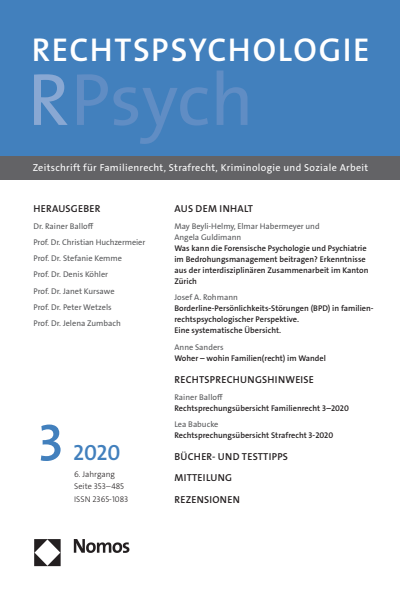
Was kann die Forensische Psychologie und Psychiatrie im Bedrohungsmanagement beitragen? Erkenntnisse aus der interdisziplinären Zusammenarbeit im Kanton Zürich.
Table of contents
Bibliographic information
Full access
RPsych Rechtspsychologie
Volume 6 (2020), Edition 3
- Authors:
- Publisher
- Nomos, Baden-Baden
- Copyright year
- 2020
- ISSN-Online
- 2942-335X
- ISSN-Print
- 2365-1083
Chapter information
Full access
Volume 6 (2020), Edition 3
Was kann die Forensische Psychologie und Psychiatrie im Bedrohungsmanagement beitragen? Erkenntnisse aus der interdisziplinären Zusammenarbeit im Kanton Zürich.
- Authors:
- ISSN-Print
- 2365-1083
- ISSN-Online
- 2942-335X
- Preview:
Bibliography
No match found. Try another term.
- Borum, R., Fein, R., Vossekuil, B. & Berglund, J. (1999). Threat assessment: Defining an approach for evaluating risk of targeted violence. Behavioral Sciences and the Law, 17, 323–337. Open Google Scholar doi.org/10.5771/2365-1083-2020-3-357
- Brunner, R. (2017). Bedrohungsmanagement im Kanton Zürich – Praxisbericht zum Stand der Projekte und Entwicklungen. In Ch. Schwarzenegger & R. Brunner (Hrsg.). Bedrohungsmanagement – Gewaltprävention (S. 15–50). Zürich: Schulthess. Open Google Scholar doi.org/10.5771/2365-1083-2020-3-357
- Cook, A.N., Murray, A.A., Amat, G. & Hart, S.D. (2014). Using structured professional judgment guidelines in threat assessment and management: Presentation, analysis, and formulation of a case of serial intimate partner violence. Journal of Threat Assessment and Management, 1(2), 67–86. Open Google Scholar doi.org/10.5771/2365-1083-2020-3-357
- Douglas, K. S., Hart, S. D., Webster, C. D., & Belfrage, H. (2013). HCR20 V3: Assessing risk for violence – User guide. Burnaby, Canada: Mental Health, Law, and Policy Institute, Simon Fraser University. Open Google Scholar doi.org/10.5771/2365-1083-2020-3-357
- Dunn, J. (2008). Operations of the LAPD Threat Management Unit. In J.R. Meloy, L. Sheridan & J. Hoffmann (Hrsg.), Stalking, threatening, and attacking public figures: A psychological and behavioral analysis (S. 325–342). New York: Oxford University Press. Open Google Scholar doi.org/10.5771/2365-1083-2020-3-357
- Greuel, L., Giese, J., Leiding, K., Jeck, D. & Kestermann, C. (2010). Evaluation von Massnahmen zur Verhinderung von Gewalteskalationen in Paarbeziehungen bis hin zu Tötungsdelikten und vergleichbaren Bedrohungsdelikten. Bremen: Institut für Polizei und Sicherheitsforschung. Open Google Scholar doi.org/10.5771/2365-1083-2020-3-357
- Greuter, K. (2017). Erfahrungen mit dem Instrument der Gefährderansprache. Befragung und Analyse am Beispiel der Kantonspolizei Zürich. Kriminalistik, 71(7), 470–476. Open Google Scholar doi.org/10.5771/2365-1083-2020-3-357
- Habermeyer, E. & Guldimann, A. (2019). Forensisch-psychiatrische Expertise als Unterstützung im Bedrohungsmanagement. In B. Eusterschulte, S. Eucker & P. Born (Hrsg.), Forensische Psychiatrie zwischen Wissenschaft und Praxis: Festschrift für Rüdiger Müller-Isberner (S. 41–58). Berlin: Medizinisch Wissenschaftliche Verlagsgesellschaft. Open Google Scholar doi.org/10.5771/2365-1083-2020-3-357
- Hart, S.D., Douglas, K.S., & Guy, L.S. (2017). The structured professional judgement approach to violence risk assessment: Origins, nature, and advances. In D. P. Boer, A. R. Beech, T. Ward, L. A. Craig, M. Rettenberger, L. E. Marshall, & W. L. Marshall (Hrsg.), The Wiley handbook on the theories, assessment, and treatment of sexual offending (S. 643–666). New York: Wiley-Blackwell. Open Google Scholar doi.org/10.5771/2365-1083-2020-3-357
- Heckert, D.A. & Gondolf, E.W. (2004). Battered women’s perceptions of risk versus risk factors and instruments in predicting repeat reassault. Journal of Interpersonal Violence, 19(7), 778–800. Open Google Scholar doi.org/10.5771/2365-1083-2020-3-357
- Hilton, N.Z., Harris, G.T., Rice, M.E., Lang C., Cormier, C.A. & Lines, K.J. (2004). A brief actuarial assessment for the prediction of wife assault recidivism: The Ontario Domestic Assault Risk Assessment. Psychological Assessment, 16(3), 267–275. Open Google Scholar doi.org/10.5771/2365-1083-2020-3-357
- James, D.V. & Farnham, F.R. (2003). Stalking and serious violence. Journal of the American Academy of Psychiatry and the Law, 31, 432–439. Open Google Scholar doi.org/10.5771/2365-1083-2020-3-357
- James, D.V. & Farnham, F.R. (2016). Outcome and Efficacy of interventions by a Public Figure Threat Assessment and Management Unit: A mirrored study of concerning behaviors and police contacts before and after intervention. Behavioral Sciences and the Law, 34, 660–680. Open Google Scholar doi.org/10.5771/2365-1083-2020-3-357
- James, D.V., Kerrigan, T.R., Forfar, R., Farnham, F.R. & Preston, L.F. (2010). The Fixated Threat Assessment Centre: Preventing harm and facilitating care. Journal of Forensic Psychiatry & Psychology, 21, 521–536. Open Google Scholar doi.org/10.5771/2365-1083-2020-3-357
- Meloy, J.R., Hoffmann, J., Guldimann, A. & James, D. (2012). The role of warning behaviors in threat assessment: An exploration and suggested typology. Behavioral Sciences and the Law, 30, 256–279. Open Google Scholar doi.org/10.5771/2365-1083-2020-3-357
- Meloy, J.R. & Hoffmann, J. (2014). International handbook of threat assessment. New York: Oxford University Press. Open Google Scholar doi.org/10.5771/2365-1083-2020-3-357
- Meloy, J.R., Hoffmann, J., Roshdi, K., Glaz-Ozik, J. & Guldimann, A. (2014). Warning behaviors and their configurations across various domains of targeted violence. In J.R. Meloy & J. Hoffmann (Hrsg.). International Handbook of Threat Assessment (S. 39–54). Oxford: Oxford University Press. Open Google Scholar doi.org/10.5771/2365-1083-2020-3-357
- Miller, W.R. & Rollnick, S. (2013). Motivational interviewing: Helping people change (3. Aufl.). New York: Guilford Press. Open Google Scholar doi.org/10.5771/2365-1083-2020-3-357
- Möller-Leimkühler, A.M. (2010). Depression bei Männern: Eine Einführung. Journal für Neurologie Neurochirurgie und Psychiatrie, 11, 11–20. Open Google Scholar doi.org/10.5771/2365-1083-2020-3-357
- Mokros, A., Habermeyer, E. & Nitschke, J. (2015). Forensifizierung vermeiden: Neue Wege zur Prävention der Delinquenz von psychisch Kranken. In: N. Saimeh (Hrsg.), Mit Sicherheit behandeln: Diagnose, Therapie und Prognose (S. 193–204). Berlin: Medizinisch Wissenschaftliche Verlagsgesellschaft. Open Google Scholar doi.org/10.5771/2365-1083-2020-3-357
- Riesner, L., Bliesener, T. & Thomas, J. (2012). Polizeiliche Mehrfach- und Intensivtäterprogramme: Befunde einer Prozessevaluation. Zeitschrift für Jugendkriminalrecht und Jugendhilfe, 23(1),40–46. Open Google Scholar doi.org/10.5771/2365-1083-2020-3-357
- Rosenfeld, B. & Penrod, S.D. (2011). Research Methods in Forensic Psychology. Hoboken, NJ: Wiley & Sons. Open Google Scholar doi.org/10.5771/2365-1083-2020-3-357
- Sachse, R. (2016). Therapeutische Beziehungsgestaltung (2. Aufl.). Göttingen: Hogrefe. Open Google Scholar doi.org/10.5771/2365-1083-2020-3-357
- Steinau, S., Brackmann, N. & Habermeyer, E. (in press). Depression und Gewalt: Ein Widerspruch? Praxis. Open Google Scholar doi.org/10.5771/2365-1083-2020-3-357
- von Franqué, F. (2013). Strukturierte, professionelle Risikobeurteilung. In M. Rettenberger & F. von Franqué (Hrsg.). Handbuch kriminalprognostischer Verfahren (S. 357–377). Göttingen: Hogrefe. Open Google Scholar doi.org/10.5771/2365-1083-2020-3-357
- Walker, L.E.A. (2009). The Battered Woman Syndrome (3. Aufl.). New York: Springer. Open Google Scholar doi.org/10.5771/2365-1083-2020-3-357
- Weisz, A.N., Tolman, R. M., & Saunders, D.G. (2000). Assessing the risk of severe domestic violence: The importance of survivors' predictions. Journal of Interpersonal Violence, 15(1), 75–90. Open Google Scholar doi.org/10.5771/2365-1083-2020-3-357