Die Belastung und das Wohlbefinden bei der Pflege von Menschen mit Schwerbehinderung
Inhaltsverzeichnis
Bibliographische Infos
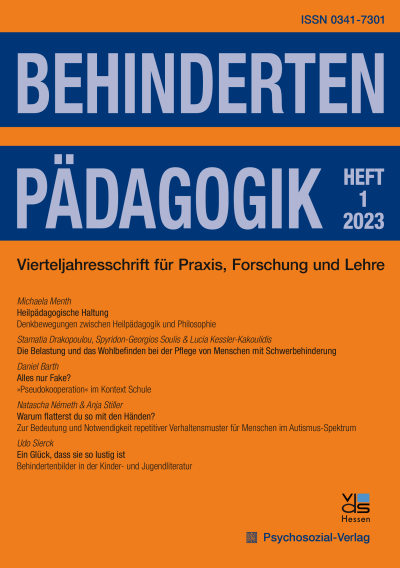
Vierteljahresschrift für Behindertenpädagogik und Integration Behinderter in Praxis, Forschung und Lehre
Jahrgang 62 (2023), Heft 1
- Autor:innen:
- , , , , , , , , , , , ,
- Verlag
- Psychosozial-Verlag, Gießen
- Erscheinungsjahr
- 2023
- ISSN-Online
- 0341-7301
- ISSN-Print
- 0341-7301
Kapitelinformationen
Jahrgang 62 (2023), Heft 1
Die Belastung und das Wohlbefinden bei der Pflege von Menschen mit Schwerbehinderung
- Autor:innen:
- , ,
- ISSN-Print
- 0341-7301
- ISSN-Online
- 0341-7301
- Kapitelvorschau:
Bei der Pflege schwerbehinderter Menschen sind die Angehörigen einer besonderen Belastung und Herausforderungen ausgesetzt. Ziel dieser Untersuchung war es, die subjektive Belastung pflegender Angehöriger von Menschen mit Schwerbehinderung sowie die Auswirkungen der Pflege auf ihr subjektives Wohlbefinden zu untersuchen. Insbesondere ging es darum, in Erfahrung zu bringen, ob, und inwieweit eine Pflegebelastung mit dem Erleben von Wohlbefinden vereinbar ist oder nicht. Die Stichprobe der Forschungsstudie bestand aus 549 »informell« pflegenden Angehörigen, davon waren 292 pflegende Angehörige von Menschen mit Behinderungen und 257 pflegende Angehörige von Menschen ohne Behinderungen. Die Ergebnisse der Studie zeigten die höheren bzw. niedrigeren Belastungsbzw. Wohlbefindlichkeitsniveaus von pflegenden Angehörigen von Menschen mit schweren Behinderungen, im Vergleich zu pflegenden Angehörigen von Menschen ohne Behinderungen. Die Begriffe »Belastung« und »Wohlbefinden« werden bei entsprechenden Untersuchungen pflegender Angehöriger meist als getrennte Konzepte behandelt. In dieser Studie wird die Belastung auch im Zusammenhang mit dem Gefühl des Wohlbefindens untersucht und analysiert. Die Ergebnisse zeigen, dass pflegende Angehörige zwar belastet sein können, jedoch gleichzeitig ebenso ein hohes Maß an Befriedigung erfahren. Schließlich ermöglicht die gemeinsame Bewertung der Belastungsund Wohlbefindlichkeitsdimensionen, die in der Erfahrung pflegender Angehöriger koexistieren, die Identifizierung persönlicher und sozialer Ressourcen, die in Interventionen, die sich an pflegende Angehörige richten, einbezogen werden können.
Literaturverzeichnis
Es wurden keine Treffer gefunden. Versuchen Sie einen anderen Begriff.
- Andrén, S. & Elmståhl, S. (2005). Family caregivers’ subjective experiences of satisfaction in dementia care: aspects of burden, subjective health and sense of coherence. Scandinavian journal of caring sciences, 19(2), 157–168. Google Scholar öffnen
- Arai, Y. (2004). Family caregiver burden in the context of the long-term care insurance system. Journal of epidemiology, 14(5), 139–142. Google Scholar öffnen
- Baker-Ericzén, M.J., Brookman-Frazee, L. & Stahmer, A. (2005). Stress levels and adaptability in parents of toddlers with and without autism spectrum disorders. Research and practice for persons with severe disabilities, 30(4), 194–204. Google Scholar öffnen
- Braun, M., Scholz, U., Hornung, R. & Martin, M. (2010). The burden of spousal caregiving: a preliminary psychometric evaluation of the German version of the Zarit burden interview. Aging & Mental Health, 14(2), 159–167. Google Scholar öffnen
- Burgener, S. & Twigg, P. (2002). Relationships among caregiver factors and quality of life in care recipients with irreversible dementia. Alzheimer Disease & Associated Disorders, 16(2), 88–102. Google Scholar öffnen
- Caplan, B., Bogner, J., Brenner, L., Manskow, U.S., Sigurdardottir, S., Røe, C. & Anke, A. (2015). Factors affecting caregiver burden 1 year after severe traumatic brain injury: a prospective nationwide multicenter study. Journal of Head Trauma Rehabilitation, 30(6), 411–423. Google Scholar öffnen
- Chappell, N.L. & Reid, R.C. (2002). Burden and well-being among caregivers: examining the distinction. The Gerontologist, 42(6), 772–780. Google Scholar öffnen
- Chen, F.P. & Greenberg, J.S. (2004). A positive aspect of caregiving: The influence of social support on caregiving gains for family members of relatives with schizophrenia. Community mental health journal,40(5), 423–435. Google Scholar öffnen
- Cho, E., Kim, E.Y. & Lee, N.J. (2013). Effects of informal caregivers on function of older adults in home health care. Western Journal of Nursing Research, 35(1), 57–75. Google Scholar öffnen
- Clyburn, L.D., Stones, M.J., Hadjistavropoulos, T. & Tuokko, H. (2000). Predicting caregiver burden and depression in Alzheimer’s disease. Journals of Gerontology series b, 55(1), 2–13. Google Scholar öffnen
- Dabrowska, A. & Pisula, E. (2010). Parenting stress and coping styles in mothers and fathers of pre-school children with autism and Down syndrome. Journal of Intellectual Disability Research, 54(3), 266–280. Google Scholar öffnen
- Davis, N.O. & Carter, A.S. (2008). Parenting stress in mothers and fathers of toddlers with autism spectrum disorders: Associations with child characteristics. Journal of autism and developmental disorders, 38(7), 1278–1291. http://doi.org/10.1007/s10803-007-0512-z Google Scholar öffnen
- Dhiman, S., Sahu, P.K., Reed, W.R., Ganesh, G.S., Goyal, R.K. & Jain, S. (2020). Impact of COVID-19 outbreak on mental health and perceived strain among caregivers tending children with special needs. Research in Developmental Disabilities, 107, 103790. Google Scholar öffnen
- Diener, E. (2000). Subjective well-being: The science of happiness and a proposal for a national index. American psychologist, 55(1), 34. Google Scholar öffnen
- Diener, E. & Seligman, M.E. (2002). Very happy people. Psychological science, 13(1), 81–84. Google Scholar öffnen
- Donovan, R., Williams, A., Stajduhar, K., Brazil, K. & Marshall, D. (2011). The influence of culture on home-based family caregiving at end-of-life: A case study of Dutch reformed family care givers in Ontario, Canada. Social Science & Medicine, 72(3), 338–346. Google Scholar öffnen
- Emerson, E., Hatton, C., Llewellyn, G., Blacher, J. & Graham, H. (2006). Socio-economic position, household composition, health status and indicators of the well-being of mothers of children with and without intellectual disabilities. Journal of Intellectual Disability Research, 50, 862–873. http://doi.org/10.1111/j.1365-2788.2006. 00900.x Google Scholar öffnen
- Fianco, A., Sartori, R.D., Negri, L., Lorini, S., Valle, G. & Delle Fave, A. (2015). The relationship between burden and well-being among caregivers of Italian people diagnosed with severe neuromotor and cognitive disorders. Research in developmental disabilities, 39, 43–54. Google Scholar öffnen
- Hastings, R.P., Allen, R., McDermott, K. & Still, D. (2002). Factors related to positive perceptions in mothers of children with intellectual disabilities. Journal of applied research in intellectual disabilities, 15(3), 269–275. Google Scholar öffnen
- Hills, P. & Argyle, M. (2002). The Oxford Happiness Questionnaire: A compact scale for the measurement of psychological well-being. Personality and Individual Differences, 33(7), 1071–1082. https://doi.org/10.1016/S0191-8869(01)00213-6 Google Scholar öffnen
- Khanna, R., Madhavan, S.S., Smith, M.J., Tworek, C., Patrick, J.H. & Becker-Cottrill, B. (2012). Psychometric properties of the Caregiver Strain Questionnaire (CGSQ) among caregivers of children with autism. Autism, 16(2), 179–199. Google Scholar öffnen
- Kim, J., Kim, H., Park, S., Yoo, J. & Gelegjamts, D. (2021). Mediating effects of family functioning on the relationship between care burden and family quality of life of caregivers of children with intellectual disabilities in Mongolia. Journal of Applied Research in Intellectual Disabilities, 34(2), 507–515. Google Scholar öffnen
- Lawton, M.P., Moss, M., Kleban, M.H., Glicksman, A. & Rovine, M. (1991). A two-factor model of caregiving appraisal and psychological well-being. Journal of gerontology, 46(4), 181–189. Google Scholar öffnen
- Lin, J.D., Lin, P.Y., & Wu, C.L. (2010). Wellbeing perception of institutional caregivers working for people with disabilities: Use of Subjective Happiness Scale and Satisfaction with Life Scale analyses. Research in developmental disabilities, 31(5), 1083–1090. Google Scholar öffnen
- Lopez, V., Clifford, T., Minnes, P. & Ouellette-Kuntz, H. (2008). Parental stress and coping in families of children with and without developmental delays. Journal on Developmental Disabilities, 14, 99–104. Google Scholar öffnen
- Lozano, P., Finkelstein, J.A., Hecht, J., Shulruff, R. & Weiss, K.B. (2003). Asthma medication use and disease burden in children in a primary care population. Archives of pediatrics & adolescent medicine, 157(1), 81–88. Google Scholar öffnen
- Lyons, K.S., Zarit, S.H., Sayer, A.G. & Whitlatch, C.J. (2002). Caregiving as a dyadic process: Perspectives from caregiver and receiver. The Journals of Gerontology Series B: Psychological Sciences and Social Sciences, 57(3), 195–204. Google Scholar öffnen
- Maes, B., Broekman, T.G., Došen, A. & Nauts, J. (2003). Caregiving burden of families looking after persons with intellectual disability and behavioural or psychiatric problems. Journal of Intellectual Disability Research, 47(6), 447–455. Google Scholar öffnen
- Magaña, S.M., Ramirez Garcia, J.I., Hernández, M.G. & Cortez, R. (2007). Psychological distress among Latino family caregivers of adults with schizophrenia: The roles of burden and stigma. Psychiatric services, 58(3), 378–384. Google Scholar öffnen
- McIntyre, L.L., Blacher, J. & Baker, B.L. (2002). Behaviour/mental health problems in young adults with intellectual disability: The impact on families. Journal of Intellectual Disability Research, 46(3), 239–249. Google Scholar öffnen
- Meyers, J.L. & Gray, L.N. (2001). The relationships between family primary caregiver characteristics and satisfaction with hospice care, quality of life, and burden. Oncology Nursing Forum, 28(1), 73–82. Google Scholar öffnen
- Molyneux, G.J., McCarthy, G.M., McEniff, S., Cryan, M. & Conroy, R.M. (2008). Prevalence and predictors of carer burden and depression in carers of patients referred to an old age psychiatric service. International Psychogeriatrics, 20(6), 1193–1202. Google Scholar öffnen
- Montgomery, R.J. & Borgatta, E.F. (1989). The effects of alternative support strategies on family caregiving. The Gerontologist, 29(4), 457–464. Google Scholar öffnen
- Montgomery, R.J., Gonyea, J.G. & Hooyman, N.R. (1985). Caregiving and the experience of subjective and objective burden. Family relations, 19–26. Google Scholar öffnen
- Mugno, D., Ruta, L., D’Arrigo, V.G. & Mazzone, L. (2007). Impairment of quality of life in parents of children and adolescents with pervasive developmental disorder. Health and quality of life outcomes, 5(1), 1–9. Google Scholar öffnen
- Murphy, N.A., Christian, B., Caplin, D.A. & Young, P.C. (2007). The health of caregivers for children with disabilities: caregiver perspectives. Child: care, health and development, 33(2), 180–187. Google Scholar öffnen
- Myers, B.J., Mackintosh, V.H. & Goin-Kochel, R.P. (2009). »My greatest joy and my greatest heart ache«. Parents’ own words on how having a child in the autism spectrum has affected their lives and their families’ lives. Research in Autism Spectrum Disorders, 3(3), 670–684. Google Scholar öffnen
- Nam, S.J. & Park, E.Y. (2017). Relationship between caregiving burden and depression in caregivers of individuals with intellectual disabilities in Korea. Journal of Mental Health, 26(1), 50–56. Google Scholar öffnen
- Nimbalkar, S., Raithatha, S., Shah, R. & Panchal, D.A. (2014). A qualitative study of psychosocial problems among parents of children with cerebral palsy attending two tertiary care hospitals in western India. International Scholarly Research Notices, 2014(769619). Google Scholar öffnen
- Noonan, A.E. & Tennstedt, S.L. (1997). Meaning in caregiving and its contribution to caregiver well-being. The Gerontologist, 37(6), 785–794. Google Scholar öffnen
- Oh, H. & Lee, E.K.O. (2009). Caregiver burden and social support among mothers raising children with developmental disabilities in South Korea. International Journal of Disability, Development and Education, 56(2), 149–167. Google Scholar öffnen
- Olsson, M.B. & Hwang, C.P. (2008). Socioeconomic and psychological variables as risk and protective factors for parental well-being in families of children with intellectual disabilities. Journal of Intellectual Disability Research, 52(12), 1102–1113. Google Scholar öffnen
- Pearlin, L.I., Mullan, J.T., Semple, S.J. & Skaff, M.M. (1990). Caregiving and the stress process: An overview of concepts and their measures. The gerontologist, 30(5), 583–594. Google Scholar öffnen
- Phipps, S., Dunavant, M., Lensing, S. & Rai, S.N. (2005). Psychosocial predictors of distress in parents of children undergoing stem cell or bone marrow transplantation. Journal of Pediatric Psychology, 30(2), 139–153. Google Scholar öffnen
- Pinquart, M. & Sörensen, S. (2003). Differences between caregivers and noncaregivers in psychological health and physical health: a meta-analysis. Psychology and aging, 18(2), 250–267. Google Scholar öffnen
- Raina, P., O’Donnell, M., Schwellnus, H., Rosenbaum, P., King, G., Brehaut, J. & Wood, E. (2004). Caregiving process and caregiver burden: conceptual models to guide research and practice. BMC pediatrics, 4(1), 1–13. Google Scholar öffnen
- Sales, E. (2003). Family burden and quality of life. Quality of life research, 12(1), 33–41. Google Scholar öffnen
- Sales, E., Greeno, C., Shear, M.K. & Anderson, C. (2004). Maternal caregiving strain as a mediator in the relationship between child and mother mental health problems. Social Work Research, 28(4), 211–223. Google Scholar öffnen
- Schablon, K.-U. (2009). Community Care: Spurensuche, Begriffsklärung und Realisierungsbedingungen einer behindertenpädagogischen Konzeption zur Gemeinwesenseinbindung erwachsener geistig behinderter Menschen. Vierteljahreszeitschrift für Heilpädagogik und ihre Nachbargebiete (VHN), 1, 34–45. Google Scholar öffnen
- Schulz, R. & Beach, S.R. (1999). Caregiving as a risk factor for mortality: the Caregiver Health Effects Study. Jama, 282(23), 2215–2219. Google Scholar öffnen
- Schulz, R. & Martire, L.M. (2004). Family caregiving of persons with dementia: prevalence, health effects, and support strategies. The American journal of geriatric psychiatry, 12(3), 240–249. Google Scholar öffnen
- Silver, E.J., Crain, E.F. & Weiss, K.B. (1998). Burden of wheezing illness among US children reported by parents not to have asthma. Journal of Asthma, 35(5), 437–443. Google Scholar öffnen
- Sloper, P. & Turner, S. (1993). Determinants of parental satisfaction with disclosure of disability. Developmental Medicine & Child Neurology, 35(9), 816–825. Google Scholar öffnen
- Soulis, S.-G. & Kessler-Kakoulidis, L. (2020). Inklusive Kulturschöpfung. Wie Menschen mit und ohne Behinderungen zur Entwicklung unserer Gesellschaft beitragen. Gießen: Psychosozial-Verlag. Google Scholar öffnen
- Stull, D.E., Kosloski, K. & Kercher, K. (1994). Caregiver burden and generic well-being: Opposite sides of the same coin? The Gerontologist, 34(1), 88–94. Google Scholar öffnen
- Sussman, T. & Regehr, C. (2009). The influence of community-based services on the burden of spouses caring for their partners with dementia. Health & Social Work, 34(1), 29–39. Google Scholar öffnen
- Thompson, A., Fan, M.Y., Unützer, J. & Katon, W. (2008). One extra month of depression: the effects of caregiving on depression outcomes in the IMPACT trial. International journal of geriatric psychiatry, 23(5), 511–516. Google Scholar öffnen
- Vagharseyyedin, S.A. & Molazem, Z. (2013). Burden, resilience, and happiness in family caregivers of spinal cord injured patients. Middle East Journal of Family Medicine, 7(10), 29–35. Google Scholar öffnen
- van Campen, J.S., Jansen, F.E., Steinbusch, L.C., Joëls, M. & Braun, K.P. (2012). Stress sensitivity of childhood epilepsy is related to experienced negative life events. Epilepsia, 53(9), 1554–1562. Google Scholar öffnen
- van Durme, T., Macq, J., Jeanmart, C. & Gobert, M. (2012). Tools for measuring the impact of informal caregiving of the elderly: a literature review. International journal of nursing studies, 49(4), 490–504. Google Scholar öffnen
- Veenhoven, R. (2007). Subjective measures of well-being. In M. McGillivray (Hrsg.), Human well-being (S. 214–239). London: Palgrave Macmillan. Google Scholar öffnen
- Verbakel, E. (2014). Informal caregiving and well-being in Europe: What can ease the negative consequences for caregivers? Journal of European Social Policy, 24(5), 424–441. Google Scholar öffnen
- Wang, M., Summers, J.A., Little, T., Turnbull, A., Poston, D. & Mannan, H. (2006). Perspectives of fathers and mothers of children in early intervention programmes in assessing family quality of life. Journal of Intellectual Disability Research, 50(12), 977–988. Google Scholar öffnen
- Yates, M.E., Tennstedt, S. & Chang, B.H. (1999). Contributors to and mediators of psychological well-being for informal caregivers. The Journals of Gerontology Series B: Psychological Sciences and Social Sciences, 54(1), 12–22. Google Scholar öffnen
- Yoon, S.O. & Kim, W.H. (2015). The effect of parenting burden on quality of life of parents of children with disabilities: Focusing on mediating effect of family resilience. The Korean Journal of Early Childhood Special Education, 15(2), 133–149. Google Scholar öffnen
- Zarit, S.H., Reever, K.E. & Bach-Peterson, J. (1980). Relatives of the impaired elderly: correlates of feelings of burden. The gerontologist, 20(6), 649–655. Google Scholar öffnen