Macht sich Gesundheitsmanagement bezahlt? Eine empirische Untersuchung des Einflusses von Informationen zu betrieblichem Gesundheitsmanagement auf konsumbezogene Reaktionen von VerbraucherInnen
Inhaltsverzeichnis
Bibliographische Infos
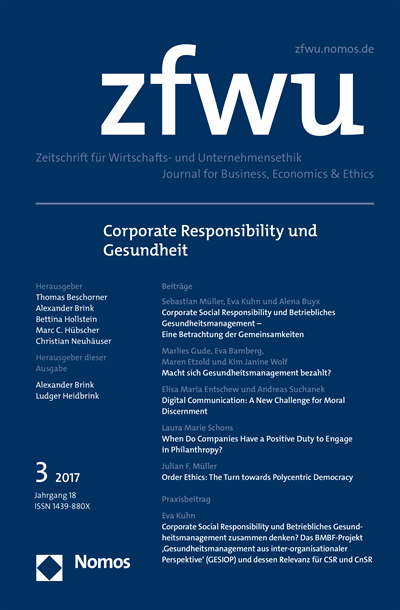
zfwu Zeitschrift für Wirtschafts- und Unternehmensethik
Jahrgang 18 (2017), Heft 3
- Autor:innen:
- Verlag
- Nomos, Baden-Baden
- Copyrightjahr
- 2017
- ISSN-Online
- 1862-0043
- ISSN-Print
- 1439-880X
Kapitelinformationen
Jahrgang 18 (2017), Heft 3
Macht sich Gesundheitsmanagement bezahlt? Eine empirische Untersuchung des Einflusses von Informationen zu betrieblichem Gesundheitsmanagement auf konsumbezogene Reaktionen von VerbraucherInnen
- Autor:innen:
- ISSN-Print
- 1439-880X
- ISSN-Online
- 1862-0043
- Kapitelvorschau:
Obwohl bereits vielfach gezeigt werden konnte, dass sich das Engagement von Unternehmen im Bereich Corporate Social Responsibility positiv auf die Reaktionen von VerbraucherInnen auswirkt, wurde bisher nicht untersucht, ob auch das Engagement im betrieblichen Gesundheitsmanagement die Kaufabsicht und die Zahlungsbereitschaft von VerbraucherInnen positiv beeinflusst. In zwei online-basierten quasi-experimentellen Studien sind wir dieser Frage nachgegangen und konnten erste Hinweise für einen existierenden Zusammenhang finden.
Literaturverzeichnis
Es wurden keine Treffer gefunden. Versuchen Sie einen anderen Begriff.
- Andorfer, V. A./Liebe, U. (2012): Research on Fair Trade Consumption-A Review, in: Journal of Business Ethics, Vol. 106/No. 4, 415–435. Google Scholar öffnen doi.org/10.5771/1439-880X-2017-3-328
- Aßländer, M. S. (2012): Shopping for Virtues. Corporate und Consumers’ Social Responsibility im Konzept geteilter sozialer Verantwortung, in: Zeitschrift für Wirtschafts- und Unternehmensethik, Jg. 13/H. 3, 255–277. Google Scholar öffnen doi.org/10.5771/1439-880X-2017-3-328
- Auger, P./Devinney, T. M./Louviere, J. J./Burke, P. F. (2008): Do Social Product Features Have Value to Consumers? In: International Journal of Research in Marketing, Vol. 25/No. 3, 183–191. Google Scholar öffnen doi.org/10.5771/1439-880X-2017-3-328
- Bamberg, E./Ducki, A./Metz, A.-M. (2011): Gesundheitsförderung – Gesundheitsmanagement: Wissenschaftliche Grundlagen, in: Bamberg, E./Ducki, A. /Metz, A.-M. (Hrsg.): Gesundheitsförderung und Gesundheitsmanagement in der Arbeitswelt, Göttingen: Hogrefe, 17–23. Google Scholar öffnen doi.org/10.5771/1439-880X-2017-3-328
- Basu, A. K./ Hicks, R. L. (2008): Label Performance and the Willingness to Pay for Fair Trade Coffee: A Cross-National Perspective, in: International Journal of Consumer Studies, Vol. 32/No. 5, 470–478. Google Scholar öffnen doi.org/10.5771/1439-880X-2017-3-328
- Belk, R. W./ Devinney, T./ Eckhardt, G. (2005): Consumer Ethics Across Cultures, in: Consumption, Markets, and Culture, Vol. 8/No. 3, 275–289. Google Scholar öffnen doi.org/10.5771/1439-880X-2017-3-328
- Bradu, C./ Orquin, J.vL./ Thøgersen, J. (2014): The Mediated Influence of a Traceability Label on Consumer’s Willingness to Buy the Labelled Product, in: Journal of Business Ethics, Vol. 124, 283–295. Google Scholar öffnen doi.org/10.5771/1439-880X-2017-3-328
- Brinkmann, J./Peattie, K. (2008): Consumer Ethics Research: Reframing the Debate about Consumption for Good, in: Electronic Journal of Business Ethics and Organization Studies, Vol. 13/No. 1, 22–31. Google Scholar öffnen doi.org/10.5771/1439-880X-2017-3-328
- Bundesministerium für Arbeit und Soziales (2016): Sicherheit und Gesundheit bei der Arbeit 2015: Unfallverhütungsbericht Arbeit, Dortmund: Bundesministerium für Arbeit und Soziales, Link: http://doi.org/10.21934/baua:bericht20161124 (zuletzt abgerufen am 1.2.2017). Google Scholar öffnen doi.org/10.5771/1439-880X-2017-3-328
- Carroll, A. B./Shabana, K. M. (2010): The Business Case for Corporate Social Responsibility: A Review of Concepts, Research and Practice, in: International Journal of Management Reviews, Vol. 12/No. 1, 85–105. Google Scholar öffnen doi.org/10.5771/1439-880X-2017-3-328
- Dahlsrud, A. (2008): How Corporate Social Responsibility is Defined: An Analysis of 37 Definitions, in: Corporate Social Responsibility and Environmental Management, Vol. 13, 1–13. Google Scholar öffnen doi.org/10.5771/1439-880X-2017-3-328
- De Pelsmacker, P./Driesen, L./Rayp, G. (2005): Do Consumers Care About Ethics? Willingness to Pay for Fair-Trade Coffee, in: The Journal of Consumer Affairs, Vol. 39/No. 2, 363–385. Google Scholar öffnen doi.org/10.5771/1439-880X-2017-3-328
- Devinney, T. M./Auger, P./Eckhardt, G. (2012): Can The Socially Responsible Consumer Be Mainstream? In: Zeitschrift für Wirtschafts- und Unternehmensethik, Vol. 13/No. 3, 227–235. Google Scholar öffnen doi.org/10.5771/1439-880X-2017-3-328
- Didier, T./ Lucie, S. (2008): Measuring Consumer’s Willingness to Pay for Organic and Fair Trade Products, in: International Journal of Consumer Studies, Vol. 32, 479–490. Google Scholar öffnen doi.org/10.5771/1439-880X-2017-3-328
- Du, S./Bhattacharya, C. B./Sen, S. (2010): Maximizing Business Returns to Corporate Social Responsibility (CSR): The Role of CSR Communication, in: International Journal of Management Reviews, Vol. 12/No. 1, 8–19. Google Scholar öffnen doi.org/10.5771/1439-880X-2017-3-328
- El Akremi, A./Gond, J.-P./Swaen, V./De Roeck, K./Igalens, J. (2015): How Do Employees Perceive Corporate Responsibility? Development and Validation of a Multidimensional Corporate Stakeholder Responsibility Scale, in: Journal of Management, doi: 10.1177/0149206315569311. Google Scholar öffnen doi.org/10.5771/1439-880X-2017-3-328
- Elkington, J. (1999): Cannibals with Forks: The Triple Bottom Line of the 21th Century Business, Oxford: Capstone Publishing. Google Scholar öffnen doi.org/10.5771/1439-880X-2017-3-328
- Elliott, K. A./Freeman, R. B. (2001): White Hats or Don Quixotes? Human Rights Vigilantes in the Global Economy, Cambridge: National Bureau of Economic Research. Google Scholar öffnen doi.org/10.5771/1439-880X-2017-3-328
- Enste, D./Knelsen, I./Neuman, M. (2012): Konsumenten- und Agentenethik: Zur Verantwortung für moralisches Handeln von und in Unternehmen, in: Zeitschrift für Wirtschafts- und Unternehmensethik, Jg. 13/H. 3, 236–254. Google Scholar öffnen doi.org/10.5771/1439-880X-2017-3-328
- Europäische Kommission. (2011): Mitteilung der Kommission an das Europäische Parlament, den Rat, den Europäischen Wirtschafts- und Sozialausschuss und den Ausschuss der Regionen: Eine neue EU-Strategie (2011-14) für die soziale Verantwortung der Unternehmen (CSR). Link: http://www.europarl.europa.eu/meetdocs/2009_2014/documents/com/com_com(2011)0681_/com_com(2011)0681_de.pdf (zuletzt abgerufen am 01.02.2017). Google Scholar öffnen doi.org/10.5771/1439-880X-2017-3-328
- Glavas, A. (2016): Corporate Social Responsibility and Organizational Psychology: An Integrative Review, in: Frontiers in Psychology, Vol. 7, 1–13. Google Scholar öffnen doi.org/10.5771/1439-880X-2017-3-328
- Gond, J.-P./El-Akremi, A./Igalens, J./Swaen, V. (2010): Corporate Social Responsibility Influence on Employees Corporate Social Responsibility Influence on Employees. Link: http://www.nottingham.ac.uk/business/ICCSR/assets/ibyucpdrvypr.pdf (zuletzt abgerufen am 03.02.2017). Google Scholar öffnen doi.org/10.5771/1439-880X-2017-3-328
- Gond, J.-P./Igalens, J./Swaen, V./Akremi, A. E. (2011): The Human Resources Contribution to Responsible Leadership: An Exploration of the CSR – HR Interface, in: Journal of Business Ethics, Vol. 98, 115–132. Google Scholar öffnen doi.org/10.5771/1439-880X-2017-3-328
- Gröneweg, C./Matiaske, W. (2012): Gullivers Fesseln – Corporate Social Responsibility als Normbildung, in: Werkstatt für Organisations- und Personalforschung e.V. (Hrsg.): Berichte der Werkstatt für Organisations- und Personalforschung e.V. 25. Link: http://www.ssoar.info/ssoar/handle/document/40870 (zuletzt abgerufen am 09.02.2017). Google Scholar öffnen doi.org/10.5771/1439-880X-2017-3-328
- Grunwald, A. (2012): Ende einer Illusion. Warum ökologisch korrekter Konsum die Umwelt nicht retten kann, München: oekom. Google Scholar öffnen doi.org/10.5771/1439-880X-2017-3-328
- Heidbrink, L. (2014): Consumer Social Responsibility: Die gesellschaftliche Verantwortung der Verbraucher, in: Forum Wirtschaftsethik, 2014/H. 2, 2–6. Google Scholar öffnen doi.org/10.5771/1439-880X-2017-3-328
- Heidbrink, L./Schmidt, I. (2011): Konsumenten als verantwortliche Marktakteure, in: Maring, M. (Hrsg.): Fallstudien zur Ethik in Wissenschaft, Wirtschaft, Technik und Gesellschaft, Karlsruhe: KIT Scientific Publishing. Google Scholar öffnen doi.org/10.5771/1439-880X-2017-3-328
- Howard, P.H./Allen, P. (2010): Beyond Organic and Fair Trade? An Analysis of Ecolabel Preferences in the United States, in: Rural Sociology, 75, 244–269. Google Scholar öffnen doi.org/10.5771/1439-880X-2017-3-328
- Hustvedt, G./ Bernard, J. C. (2010): Effects of Social Responsibility Labelling and Brand on Willingness to Pay for Apparel, in: International Journal of Consumer Studies, Vol. 34, 619–626. Google Scholar öffnen doi.org/10.5771/1439-880X-2017-3-328
- Jain, A./Leka, S./Zwetsloot, G. (2011): Corporate Social Responsibility and Psychosocial Risk Management in Europe, in: Journal of Business Ethics, Vol. 101/No. 4, 619–633. Google Scholar öffnen doi.org/10.5771/1439-880X-2017-3-328
- Krier, J.-M. (2008): Fair Trade 2007. New Facts and Figures from an Ongoing Success Story, Culemborg: DAWS. Google Scholar öffnen doi.org/10.5771/1439-880X-2017-3-328
- Lee, P. K. C./Lau, A. K. W./Cheng, T. C. E. (2013): Employee Rights Protection and Financial Performance, in: Journal of Business Research, Vol. 66/No. 10, 1861–1869. Google Scholar öffnen doi.org/10.5771/1439-880X-2017-3-328
- Monachino, M./Moreira, P. (2014): Corporate Social Responsibility and the Health Promotion Debate: An International Review on the Potential Role of Corporations, in: International Journal of Healthcare Management, Vol. 7/No. 1, 53–59. Google Scholar öffnen doi.org/10.5771/1439-880X-2017-3-328
- Ng, S. S. W./Burke, R. J. (2005): Person-Organization Fit and the War for Talent: Does Diversity Management Make a Difference? In: International Journal of Human Resource Management, Vol. 16/No. 7, 1195–1210. Google Scholar öffnen doi.org/10.5771/1439-880X-2017-3-328
- Öberseder, M./Schlegelmilch, B. B./Murphy, P. E./Gruber, V. (2013): Consumers’ Perceptions of Corporate Social Responsibility: Scale Development and Validation, in: Journal of Business Ethics, Vol. 124/No. 1, 101–115. Google Scholar öffnen doi.org/10.5771/1439-880X-2017-3-328
- Pérez, A./ García de los Salmones, M. d. M. (2017): Information and Knowledge as Antecedents of Consumer Attitudes and Intentions to Buy and Recommend Fair-Trade Products, in: Journal of Nonprofit & Public Sector Marketing, (online publiziert am 19.07.2017), 1–23. Google Scholar öffnen doi.org/10.5771/1439-880X-2017-3-328
- Satow, L. (2011): Skala zur Erfassung von Testverfälschung durch positive Selbstdarstellung und sozial erwünschte Antworttendenzen (SEA). Psychomeda Discussion Pape. Link: http://www.zpid.de/retrieval/PSYNDEXTests.php?id=9006446 (zuletzt abgerufen am 09.02.2017). Google Scholar öffnen doi.org/10.5771/1439-880X-2017-3-328
- Schmidt, I. (2014): Consumer Social Responsibility: Gemeinsame Verantwortung für nachhaltiges Konsumieren und Produzieren, Wiesbaden: Springer VS. Google Scholar öffnen doi.org/10.5771/1439-880X-2017-3-328
- Schreck, P. (2011): Reviewing the Business Case for Corporate Social Responsibility: New Evidence and Analysis, in: Journal of Business Ethics, Vol. 103, 167–188. Google Scholar öffnen doi.org/10.5771/1439-880X-2017-3-328
- Sen, S./Bhattacharya, C. (2001): Does Doing Good Always Lead to Doing Better ? Consumer Reactions to Corporate Social Responsibility, in: Journal of Marketing Research, Vol. 38, 225–243. Google Scholar öffnen doi.org/10.5771/1439-880X-2017-3-328
- Sen, S./Du, S./Bhattacharya, C. B. (2016): Corporate Social Responsibility: A Consumer Psychology Perspective, in: Current Opinion in Psychology, Vol. 10, 70–75. Google Scholar öffnen doi.org/10.5771/1439-880X-2017-3-328
- Shaw, D./ Hogg, G./ Wilson, E./ Shiu, E./ Hassan, L. (2006): Fashion Victim: The Impact of Fair Trade Concerns on Clothing Choice, in: Journal of Strategic Marketing, Vol. 14, 427–440. Google Scholar öffnen doi.org/10.5771/1439-880X-2017-3-328
- Smith, W. J./Wokutch, R. B./Harrington, V. K./Dennis, B. S. (2004): Organizational Attractiveness and Corporate Social Orientation: Do Our Values Influence Our Preferences for Affirmative Action or Managing Diversity?, in: Business and Society, Vol. 43/No. 1, 69–96. Google Scholar öffnen doi.org/10.5771/1439-880X-2017-3-328
- Taneja, S. S./Taneja, P. K./Gupta, R. K. (2011): Researches in Corporate Social Responsibility: A Review of Shifting Focus, Paradigms, and Methodologies, in: Journal of Business Ethics, Vol. 101/No. 3, 343–364. Google Scholar öffnen doi.org/10.5771/1439-880X-2017-3-328
- Turker, D. (2009): Measuring Corporate Social Responsibility: A Scale Development Study, in: Journal of Business Ethics, Vol. 85/No. 4, 411–427. Google Scholar öffnen doi.org/10.5771/1439-880X-2017-3-328
- Ulich, E./Wülser, M. (2015): Gesundheitsmanagement in Unternehmen: Arbeitspsychologische Perspektiven, Wiesbaden: Springer Gabler. Google Scholar öffnen doi.org/10.5771/1439-880X-2017-3-328
- Vitell, S. J. (2015): A Case for Consumer Social Responsibility (CnSR): Including a Selected Review of Consumer Ethics/Social Responsibility, in: Journal of Business Ethics, Vol. 130, 767–774. Google Scholar öffnen doi.org/10.5771/1439-880X-2017-3-328
- Voegtlin, C./Greenwood, M. (2016): Corporate Social Responsibility and Human Resource Management: A Systematic Review and Conceptual Analysis, in: Human Resource Management Review, Vol. 26/No. 3, 181–197. Google Scholar öffnen doi.org/10.5771/1439-880X-2017-3-328
- Yoon, Y./Gürhan-Canli, Z./Schwarz, N. (2006): The Effect of Corporate Social Responsibility (CSR) Activities on Companies With Bad Reputations, in: Journal of Consumer Psychology, Vol. 16/No. 4, 377–390. Google Scholar öffnen doi.org/10.5771/1439-880X-2017-3-328