Persian Poetry, Sufi Authority, and Ottoman Multilingualism: İsmāʿīl Ḥaḳḳī Bursevī’s Qurʾān Commentary, the Rūḥ al-bayān
Inhaltsverzeichnis
Bibliographische Infos
Vollzugriff
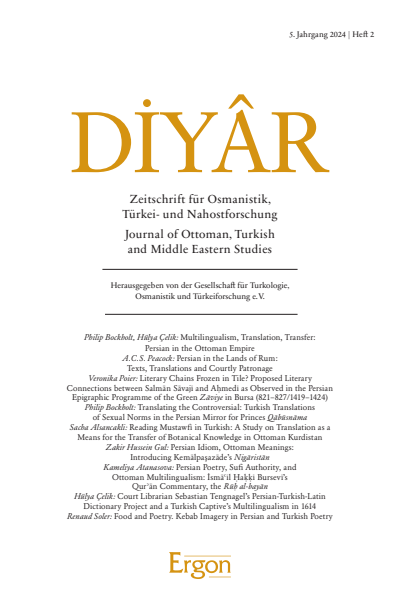
DIYÂR
Jahrgang 5 (2024), Heft 2
- Autor:innen:
- Verlag
- Ergon, Baden-Baden
- Copyrightjahr
- 2024
- ISSN-Online
- 2942-3155
- ISSN-Print
- 2625-9842
Kapitelinformationen
Vollzugriff
Jahrgang 5 (2024), Heft 2
Persian Poetry, Sufi Authority, and Ottoman Multilingualism: İsmāʿīl Ḥaḳḳī Bursevī’s Qurʾān Commentary, the Rūḥ al-bayān
- Autor:innen:
- ISSN-Print
- 2625-9842
- ISSN-Online
- 2942-3155
- Kapitelvorschau:
Literaturverzeichnis
Es wurden keine Treffer gefunden. Versuchen Sie einen anderen Begriff.
- Unpublished Primary Sources Google Scholar öffnen DOI: 10.5771/2625-9842-2024-2-237
- Bursevī, İsmāʿīl Ḥaḳḳī. Rūḥ al-bayān fī tafsīr al-Qurʾān, İnebey Yazma Eser Kütütphanesi, Genel 13 Google Scholar öffnen DOI: 10.5771/2625-9842-2024-2-237
- Published Primary Sources Google Scholar öffnen DOI: 10.5771/2625-9842-2024-2-237
- Ibn al-ʿArabi, Muhyī al-Dīn. 2004. The Ringstones of Wisdom (Fuṣūṣ al-ḥikam). Translated by Caner Dağlı. Kazi Publications. Google Scholar öffnen DOI: 10.5771/2625-9842-2024-2-237
- al-Burūsawī, Ismāʿīl Haqqī. 1330–1339 [1911–1920]. Tafsīr Rūh al-Bayān li-l-Shaykh Ismāʿīl Haqqī al-Burūsawī. Muḥammad Ṣāʾim ibn ʿUthmān Bay (ed.). 10 vols. Istanbul. Google Scholar öffnen DOI: 10.5771/2625-9842-2024-2-237
- al-Burūsawī, Ismāʿīl Haqqī and Ṣābūnī, Muḥammad ʻAlī. 1988–1989. Tanwīr al-adhhān min Tafsīr rūḥ al-bayān. 4 vols. Damascus: Dār al-Qalam. Google Scholar öffnen DOI: 10.5771/2625-9842-2024-2-237
- al-Burūsawī, Ismāʿīl Haqqī. 2003. Rūḥ al-bayān fī tafsīr al-Qurʾān. ʿAbd al-Laṭīf Ḥasan ʿAbd al-Raḥmān (ed.). 10 vols. Beirut: Dār al-Kutub al-ʿIlmīyah. Google Scholar öffnen DOI: 10.5771/2625-9842-2024-2-237
- al-Burūsawī, Ismāʿīl Haqqī, and Mawṣilī, Ramaḍān and Kūndiz, ʿIrfān. 2011. Tamām al-fayḍ fī bāb al-rijāl. Damascus: Dār al-nīnawa. Google Scholar öffnen DOI: 10.5771/2625-9842-2024-2-237
- Bursevi, İsmail Hakki, Yılmaz, H. Kamil, Çelik, Ömer, et al. 2012–2020. Rûhu’l-Beyân Kur’an Meâli Ve Tefsiri. 12 vols. İstanbul: Erkam Yayınları. Google Scholar öffnen DOI: 10.5771/2625-9842-2024-2-237
- al-Qushayri, Abu’l-Qasim. 2007. Al-Qushayri’s Epistle on Sufism. Al-Risala al-qushayriyya fi ‘ilm al-tasawwuf. Alexander Knysh (transl.), reviewed by Muhammad Eissa. Reading: Garnet Publishing. Google Scholar öffnen DOI: 10.5771/2625-9842-2024-2-237
- Rūmī, Jalal al-Din. 2004. The Masnavi. Book One. Jawid Mojaddedi (transl.). New York: Oxford University Press. Google Scholar öffnen DOI: 10.5771/2625-9842-2024-2-237
- Secondary Sources Google Scholar öffnen DOI: 10.5771/2625-9842-2024-2-237
- Ahmed, Shahab. 2016. What is Islam? The Importance of Being Islamic. Princeton: Princeton University Press. Google Scholar öffnen DOI: 10.5771/2625-9842-2024-2-237
- Anawati, G.C. 2012. ‘Fakhr al-dīn al-Rāzī’. In EI2. URL: http://dx.doi.org/10.1163/1573-3912_islam_COM_0206 (accessed 30 December 2023). Google Scholar öffnen DOI: 10.5771/2625-9842-2024-2-237
- Arberry, Arthur. 1955. The Holy Koran. Google Scholar öffnen DOI: 10.5771/2625-9842-2024-2-237
- Arnaldez, Roger. 2012. ‘Maʿrifa’. In EI2. URL: http://dx.doi.org/10.1163/1573-3912_islam_COM_0686 (accessed 02 January 2024). Google Scholar öffnen DOI: 10.5771/2625-9842-2024-2-237
- Atanasova, Kameliya. 2016. ‘The Sufi as the Axis of the World: Representations of Religious Authority in the Works of Ismail Hakki Bursevi (1653–1725)’. PhD Dissertation, University of Pennsylvania, Philadelphia. Google Scholar öffnen DOI: 10.5771/2625-9842-2024-2-237
- Ballanfat, Paul. 2003. ‘La prophétologie dans le ‘Ayn al-hayāt, tafsīr attribué à Najm al-dīn Kubrā et Najm-i Rāzī’. In Mystique musulmane, parcours en compagnie d’un chercheur Roger Deladrière. Paris: Editions Cariscript. Google Scholar öffnen DOI: 10.5771/2625-9842-2024-2-237
- –. 2004. ‘Reality and Image in the Tafsīr of Kubrā and Rāzī’. Translated from French by James Lees. The Journal of the Muhyiddin Ibn Arabi Society. Vol. XXXV (2004). URL: https://ibnarabisociety.org/reality-and-image-paul-ballanfat/ (accessed 3 January 2024). Google Scholar öffnen DOI: 10.5771/2625-9842-2024-2-237
- Baş, Erdoğan. 2010. ‘Şeyhzade’. In TDV İslâm Ansiklopedisi. URL: https://islamansiklopedisi.org.tr/seyhzade (accessed 31 July 2024). Google Scholar öffnen DOI: 10.5771/2625-9842-2024-2-237
- Bauer, Karen and Hamza, Feras. 2022. An Anthology of Qur’anic Commentaries. Vol. 2. On Women. Oxford: Oxford University Press. Google Scholar öffnen DOI: 10.5771/2625-9842-2024-2-237
- Brookshaw, Dominic Parviz. 2019. Hafiz and His Contemporaries: Poetry, Performance and Patronage in Fourteenth-century Iran. London: I.B. Tauris/Bloomsbury. Google Scholar öffnen DOI: 10.5771/2625-9842-2024-2-237
- de Bruijn, J. T. P. 2012. ‘Anwarī’. In Encyclopaedia Iranica. II.2. 141–143. URL http://www.iranicaonline.org/articles/anwari (accessed 1 August 2024). Google Scholar öffnen DOI: 10.5771/2625-9842-2024-2-237
- Chittick, William. 1998. The Self-Disclosure of God: Principles of Ibn ʿArabī’s Cosmology. Albany: SUNY Press. Google Scholar öffnen DOI: 10.5771/2625-9842-2024-2-237
- Cook, Hamilton. 2019. A Muslim Humanist of the Ottoman Empire: Ismail Hakki Bursevi and His Doctrine of the Perfect Man. Ph.D. Dissertation Emory University, Atlanta. Google Scholar öffnen DOI: 10.5771/2625-9842-2024-2-237
- Curry, John. 2010. The Transformation of Muslim Mystical Thought in the Ottoman Empire: The Rise of the Halveti Order, 1350–1650. Edinburgh: Edinburgh University Press. Google Scholar öffnen DOI: 10.5771/2625-9842-2024-2-237
- Elias, Jamal. 2022. ‘Commentary as Method vs Genre An Analysis of Ismaʿil Haqqi Bursawi’s Commentaries on the Qur’an and the Maṡnawī-yi maʿnawī’. In Tasar, Eren, Frank, Allen J. and Eden, Jeff (eds.). From the Khan’s Oven: Studies on the History of Central Asian Religions in Honor of Devin DeWeese. Leiden: Brill. 237–257. Google Scholar öffnen DOI: 10.5771/2625-9842-2024-2-237
- Görke, Andreas and Pink, Johanna. 2014. Tafsir and Islamic Intellectual History Exploring the Boundaries of a Genre. London: Oxford University Press in association with The Institute of Ismaili Studies. Google Scholar öffnen DOI: 10.5771/2625-9842-2024-2-237
- Gürbüzel, Aslıhan. 2023. Taming the Messiah: The Formation of an Ottoman Political Public Sphere, 1600–1700. Oakland: University of California Press. Google Scholar öffnen DOI: 10.5771/2625-9842-2024-2-237
- Hamza, Feras, Rizvi, Sajjad and Mayer, Farhana. 2010. An Anthology of Qur’anic Commentaries. Vol. 1: On the Nature of the Divine. New York: Oxford University Press in association with the Institute of Ismaili Studies. Google Scholar öffnen DOI: 10.5771/2625-9842-2024-2-237
- Ingenito, Domenico. 2021. Beholding beauty: Sa’di of Shiraz and the aesthetics of desire in medieval Persian poetry. Leiden and Boston: Brill. Google Scholar öffnen DOI: 10.5771/2625-9842-2024-2-237
- Karataş, Hasan. 2011. ‘The City as a Historical Actor: The Urbanization and Ottomanization of the Halvetiye Sufi Order by the City of Amasya in the Fifteenth and Sixteenth Centuries’. PhD Dissertation, University of California, Berkeley. Google Scholar öffnen DOI: 10.5771/2625-9842-2024-2-237
- Lewisohn, Leonard. (ed.) 2015. Hafiz and the Religion of Love in Classical Persian Poetry. London and New York: I.B. Tauris. Google Scholar öffnen DOI: 10.5771/2625-9842-2024-2-237
- Morrisey, Fitzroy. 2020. Sufism and the Scriptures. Metaphysics and Sacred History in the Thought of ‘Abd al-Karim al-Jili. London and New York: Bloomsbury Academic [I.B. Tauris]. Google Scholar öffnen DOI: 10.5771/2625-9842-2024-2-237
- Namlı, Ali. 2001. İsmāil Hakkı Bursevī. Hayatı, Eserleri, Tārikat Anlayışı. Istanbul: Insan Yayınları. Google Scholar öffnen DOI: 10.5771/2625-9842-2024-2-237
- Rippin, Andrew. 2012. ‘Tafsīr’. In EI2. URL: http://dx.doi.org/10.1163/1573-3912_islam_SIM_7294 (accessed 2 January 2024). Google Scholar öffnen DOI: 10.5771/2625-9842-2024-2-237
- Rizvi, Sajjad. 2006. ‘The Existential Breath of al-raḥmān and the Munificient Grace of al-raḥīm: The Tafsīr Aūrat al-Fāṭiha of Jāmī and the School of Ibn ʿArabī’. Journal of Qurʾanic Studies 8.1. 58–87. Google Scholar öffnen DOI: 10.5771/2625-9842-2024-2-237
- Şahin, İskender. 2021. ‘İsmail Hakkı Bursevî’nin Rûḥu’l-Beyân’ında Muʿtezile’ye Yönelttiği İtirazlar’. Şırnak Üniversitesi İlahiyat Fakültesi Dergisi – Şırnak University Journal of Divinity Faculty 26 (June 2021). 181–205. URL: https://doi.org/10.35415/sirnakifd.884784 (accessed 1 August 2024) . Google Scholar öffnen DOI: 10.5771/2625-9842-2024-2-237
- Saleh, Walid. 2004. The Formation of the Classical Tafsīr Tradition: The Qurʾān Commentary of al-Thaʿlabī (d. 427/1035). Leiden: Brill. Google Scholar öffnen DOI: 10.5771/2625-9842-2024-2-237
- Topyay, Yusuf. 2022. ‘Bursevî’nin Rûhu’l-Beyân’ında Sünnetin Değeri / The Value of Sunnah in Bursawî’s Rûh al-Bayân’. Gifad: Gümüşhane Üniversitesi İlahiyat Fakültesi Dergisi / The Journal of Gumushane University Faculty of Theology 11.22. 566–589. Google Scholar öffnen DOI: 10.5771/2625-9842-2024-2-237
- Tuttle, Kelly. 2013. ‘Expansion and Digression: A Study in Mamlūk Literary Commentary’. PhD Dissertation, University of Pennsylvania, Philadelphia. Google Scholar öffnen DOI: 10.5771/2625-9842-2024-2-237
- Vaglieri, Veccia L. 2012. ‘ʿAbd Allāh b. al-ʿAbbās’. In EI2. URL: http://dx.doi.org/10.1163/1573-3912_islam_SIM_0035 (accessed 30 December 2023). Google Scholar öffnen DOI: 10.5771/2625-9842-2024-2-237
- Yıldız, Sâkıb. 1975. ‘Türk Müfessiri İsma‘il Haḳḳı Burūsevi’nin Hayatı’. Atatürk Üniversitesi İlahiyat Fakültesi Dergisi 0.1. 103–26. Google Scholar öffnen DOI: 10.5771/2625-9842-2024-2-237
- Yousofi, Gholam Hosein. 2012. ‘Kāshifī’. In EI2. URL: http://dx.doi.org/10.1163/1573-3912_islam_SIM_3972 (accessed 30 December 2023). Google Scholar öffnen DOI: 10.5771/2625-9842-2024-2-237
