Introduction: illicit flows, criminal markets and geopolitics
Inhaltsverzeichnis
Bibliographische Infos
Open Access Vollzugriff
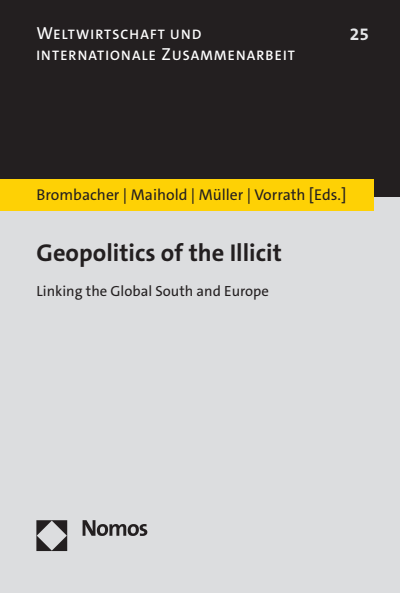
Geopolitics of the Illicit
Linking the Global South and Europe
- Autor:innen:
- Reihe
- Weltwirtschaft und internationale Zusammenarbeit
- Band
- 25
- Verlag
- Nomos, Baden-Baden
- Copyrightjahr
- 2022
- ISBN-Print
- 978-3-7560-0015-9
- ISBN-Online
- 978-3-7489-3594-0
Kapitelinformationen
Open Access Vollzugriff
Introduction: illicit flows, criminal markets and geopolitics
- Autor:innen:
- ISBN-Print
- 978-3-7560-0015-9
- ISBN-Online
- 978-3-7489-3594-0
- Kapitelvorschau:

Literaturverzeichnis
Es wurden keine Treffer gefunden. Versuchen Sie einen anderen Begriff.
- Albanese, Jay (2015): Organized crime. From the mob to Transnational Organized Crime. New York: Routledge. Google Scholar öffnen doi.org/10.5771/9783748935940-13
- Andreas, Peter/Greenhill, Kelly M. (eds.) (2010): Sex, drugs, and body counts. The politics of numbers in global crime and conflict. Ithaca: Cornell University Press. Google Scholar öffnen doi.org/10.5771/9783748935940-13
- Andreas, Peter (2011): “Illicit globalization. Myths, misconceptions, and historical lessons”. In: Political Science Quarterly, 126, 3, pp. 403-425. Google Scholar öffnen doi.org/10.5771/9783748935940-13
- Beckert, Jens/Dewey, Matías (2017): The architecture of illegal markets. Towards an economic sociology of illegality in the economy. Oxford: Oxford University Press. Google Scholar öffnen doi.org/10.5771/9783748935940-13
- Catino, Maurizio (2019): Mafia organizations. The visible hand of criminal enterprise. Cambridge: Cambridge University Press. Google Scholar öffnen doi.org/10.5771/9783748935940-13
- Collins, John (2018): “Rethinking ‘flexibilities’ in the international drug control system. Potential, precedents and models for reforms”. In: International Journal of Drug Policy, 60, pp. 107-114. Google Scholar öffnen doi.org/10.5771/9783748935940-13
- CoEU, Council of the European Union (2003): “A secure Europe in a better world. European security strategy. 15895/03, Brussels, 8 December 2003”. At: <https://data.consilium.europa.eu/doc/document/ST-15895-2003-INIT/en/pdf> (accessed 7 June 2022). Google Scholar öffnen doi.org/10.5771/9783748935940-13
- Dávila, Anayansi/Magliocca, Nicholas/McSweeney, Kendra/Rueda, Ximena (2021): “Spatialising illicit commodity chains. Comparing coffee and cocaine”. In: Area, 53, 3, pp. 501-510. Google Scholar öffnen doi.org/10.5771/9783748935940-13
- Dewey, Matías/Dohmen, Caspar/Engwicht, Nina/Hübschle, Annette (2019): Schattenwirtschaft. Die Macht der illegalen Märkte. Berlin: Wagenbach. Google Scholar öffnen doi.org/10.5771/9783748935940-13
- European Commission (2021): “Communication from the Commission to the European Parliament, the Council, the European Economic and Social Committee and the Committee of the Regions on the EU Strategy to tackle Organised Crime 2021-2025. COM/2021/170 final”. At: <https://eur-lex.europa.eu/legal-content/EN/TXT/?uri=CELEX:52021DC0170> (accessed 7 June 2022). Google Scholar öffnen doi.org/10.5771/9783748935940-13
- EU, European Union (2016): “Shared vision, common action: a stronger Europe. A global strategy for the European Union’s foreign and security policy”. At: <https://op.europa.eu/en/publication-detail/-/publication/3eaae2cf-9ac5-11e6-868c-01aa75ed71a1> (accessed 7 June 2022). Google Scholar öffnen doi.org/10.5771/9783748935940-13
- Europol (2021): European Union Serious and Organised Crime Threat Assessment (SOCTA). A corrupting influence: the infiltration and undermining of Europe’s economy and society by organised crime. Publications Office of the European Union, Luxembourg. Google Scholar öffnen doi.org/10.5771/9783748935940-13
- Galeotti, Mark (2001): „Underworld and upperworld. Transnational organized crime and global society”. In: Josselin, Daphné/Wallace/William (eds.): Non-state actors in world politics. London: Palgrave Macmillan, pp. 203-217. Google Scholar öffnen doi.org/10.5771/9783748935940-13
- Gilman, Nils/Goldhammer, Jesse/Weber, Steven (2013): “Deviant globalization”. In: Miklaucic, Michael/Brewer, Jacqueline (eds.): Convergence. Illicit networks and national security in the age of globalization. Washington, DC: National Defense University Press, pp. 3-14. Google Scholar öffnen doi.org/10.5771/9783748935940-13
- Hall, Tim (2013): “Geographies of the illicit. Globalization and organized crime”. In: Progress in Human Geography, 37, 3, pp. 366-385. Google Scholar öffnen doi.org/10.5771/9783748935940-13
- Hudson, Ray (2014): “Thinking through the relationships between legal and illegal activities and economies. Spaces, flows and pathways”. In: Journal of Economic Geography, 14, 4, pp. 775-795. Google Scholar öffnen doi.org/10.5771/9783748935940-13
- Mackenzie, Simon (2002): “Organised crime and common transit networks”. In: Trends & Issues in Crime and Criminal Justice No. 233. At: <https://traffickingculture.org/publications/mackenzie-s-2002-organised-crime-common-transit-networks-trends-issues-in-crime-and-criminal-justice-no-233-canberra-australian-institute-of-criminology/> (accessed 7 June 2022). Google Scholar öffnen doi.org/10.5771/9783748935940-13
- Magliocca, Nicholas/Torres, Aurora/Margulies, Jared/McSweeney, Kendra/Arroyo-Quiroz, Inés et al. (2021): “Comparative analysis of illicit supply network structure and operations. Cocaine, wildlife, and sand“. In: Journal of Illicit Economies and Development, 3, 1, pp. 50-73. Google Scholar öffnen doi.org/10.5771/9783748935940-13
- Pearce, Frank/Woodiwiss, Michael (eds.) (1993): Global crime connections. Dynamics and control. London: Palgrave. Google Scholar öffnen doi.org/10.5771/9783748935940-13
- Reuter, Peter (1983): Disorganized Crime <https://mitpress.mit.edu/books/disorganized-crime>. Illegal Markets and the Mafia. Cambridge, Mass: The MIT Press. Google Scholar öffnen doi.org/10.5771/9783748935940-13
- Stridsman, Mats/Østensen, Åse Gilje (2017): Shadow value chains. Tracing the link between corruption, illicit activity and lootable natural resources from West Africa. Bergen: U4 Anti-Corruption Resource Centre, Chr. Michelsen Institute. Google Scholar öffnen doi.org/10.5771/9783748935940-13
- UNGA, United Nations General Assembly (2015): Resolution adopted by the General Assembly on 25 September 2015. Transforming our world: the 2030 Agenda for Sustainable Development. A/RES/70/1, 21 October 2015. Google Scholar öffnen doi.org/10.5771/9783748935940-13
- Van Schendel, Willem/Abraham, Itty (eds.) (2005a): Illicit flows and criminal things: states, borders, and the other side of globalization. Bloomington: Indiana University Press. Google Scholar öffnen doi.org/10.5771/9783748935940-13
- Van Schendel, Willem/Abraham, Itty (2005b): „Introduction. The making of illicitness”. In: Van Schendel, Willem/Abraham, Itty (eds.): Illicit flows and criminal things: states, borders, and the other side of globalization. Bloomington: Indiana University Press, pp. 1-37. Google Scholar öffnen doi.org/10.5771/9783748935940-13
- Von Lampe, Klaus (2012): "Transnational organized crime challenges for future research". In: Crime, Law and Social Change, 58, pp. 179-194. Google Scholar öffnen doi.org/10.5771/9783748935940-13
- World Bank (2011): World Development Report 2011. Conflict, security, and development. Washington DC. Google Scholar öffnen doi.org/10.5771/9783748935940-13