Framing criminals in German regional newspapers: Does the perpetrator’s origin matter?
Inhaltsverzeichnis
Bibliographische Infos
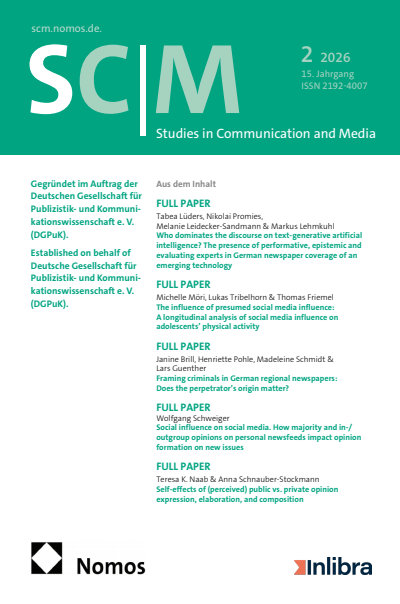
SCM Studies in Communication and Media
Jahrgang 15 (2026), Heft 2
- Autor:innen:
- Verlag
- Nomos, Baden-Baden
- Copyrightjahr
- 2026
- ISSN-Online
- 2192-4007
- ISSN-Print
- 2192-4007
Kapitelinformationen
Jahrgang 15 (2026), Heft 2
Framing criminals in German regional newspapers: Does the perpetrator’s origin matter?
- Autor:innen:
- ISSN-Print
- 2192-4007
- ISSN-Online
- 2192-4007
- Kapitelvorschau:
Die Diskrepanz zwischen (regionaler) Medienberichterstattung über Kriminalität und offiziellen Kriminalstatistiken, insbesondere im Hinblick auf die Darstellung von Täter*innen mit Migrationshintergrund, ist weithin bekannt. Das mediale Framing von Täter*innen mit Migrationshintergrund spielt eine entscheidende Rolle bei der öffentlichen Meinungsbildung und kann bestehende Stereotype verstärken. Um dieser Problematik entgegenzuwirken, überarbeitete der Deutsche Presserat 2017 die Richtlinie 12.1 des Pressekodex, indem er das weiter gefasste Kriterium des berechtigten öffentlichen Interesses für die Nennung der Herkunft eines Täters einführte. Um zu untersuchen, wie regionale Nachrichtenorganisationen die Richtlinien des Pressekodex umsetzen, analysiert die vorliegende Studie Täter*innen-Frames sowie die Nennung von Herkunftsbezügen in Berichterstattungen über Kriminalität. Methodisch wird ein Mixed-Methods-Ansatz verfolgt, der eine quantitative Inhaltsanalyse (n = 486) mit einer vertiefenden qualitativen Analyse (n = 27) von (Online-)Kriminalitätsberichten aus vier deutschen Regionalzeitungen kombiniert. Mithilfe einer Clusteranalyse konnten vier Täter*innen-Frames identifiziert werden: Schwerverbrecher*innen, Dieb*innen und Einbrecher*innen, Vandal*innen und Fahrlässige Verkehrssünder*innen. Täter*innen oder Verdächtige mit Migrationshintergrund werden in den untersuchten Artikeln fast fünfmal häufiger erwähnt als solche mit deutscher Herkunft. Zudem werden Tatverdächtige mit nicht-deutscher Herkunftsnennung oder -implikation in der Regel anders kontextualisiert. Die Ergebnisse deuten darauf hin, dass Journalist*innen deutscher Regionalmedien die im Pressekodex formulierten Richtlinien nicht konsequent befolgen, was Stereotype gegenüber Migrant*innen verfestigen könnte.
Literaturverzeichnis
Es wurden keine Treffer gefunden. Versuchen Sie einen anderen Begriff.
- Aldrete, M. (2023). Challenging the protest paradigm and winning legitimacy. Analysis of the representation of the social movement against femicide in the mainstream media in Mexico. Current Sociology, 1–12. https://doi.org/10.1177/00113921231211578 Google Scholar öffnen DOI: 10.5771/2192-4007-2026-2-009
- Altman, D. G. (1991). Practical statistics for medical research. Taylor & Francis Ltd. Google Scholar öffnen DOI: 10.5771/2192-4007-2026-2-009
- BDZV (2024). Market data. https://www.bdzv.de/alle-themen/marktdaten Google Scholar öffnen DOI: 10.5771/2192-4007-2026-2-009
- Betus, A., Kearns, E. M., & Lemieux, A. F. (2020). How perpetrator identity (sometimes) influences media framing attacks as “terrorism” or “mental illness”. Communication Research, 1–24. https://doi.org/10.1177/0093650220971142 Google Scholar öffnen DOI: 10.5771/2192-4007-2026-2-009
- Brill, J., Guenther, L., Ehrhardt, W., & Ruhrmann, G. (2021). Crime in television news: Do news factors predict the mentioning of a criminal’s country of origin? In J. B. Wiest (Ed.), Mass mediated representations of crime and criminality (pp. 31–48). Emerald Publishing. https://doi.org/10.1108/S2050-206020210000021008 Google Scholar öffnen DOI: 10.5771/2192-4007-2026-2-009
- Brill, J., Guenther, L., & Ruhrmann, G. (2025). Felons, right-wing extremists, foreign criminals, and Islamist terrorists: Frames of criminals in German television news. Journalism Practice, 19(4), 878–895. https://doi.org/10.1080/17512786.2023.2214127 Google Scholar öffnen DOI: 10.5771/2192-4007-2026-2-009
- Budde, N., Jandura, O., & Dohle, M. (2018). Das Framing der Flüchtlingskrise in Parlament und Parlamentsmagazinen [Framing of the refugee crisis in the parliament and parliament magazines]. Mitteilungen des Instituts für Deutsches und Internationales Parteienrecht und Parteienforschung (MIP), 24, 31–39. https://doi.org/10.25838/oaj-mip-201831-39 Google Scholar öffnen DOI: 10.5771/2192-4007-2026-2-009
- Conrey, S. C., & Haney, C. (2020). Framing of criminal justice and crime in the news: 2015–2017. Journal of Crime and Justice, 44(3), 297–315. https://doi.org/10.1080/0735648X.2020.1803102 Google Scholar öffnen DOI: 10.5771/2192-4007-2026-2-009
- Coleman, R. (2003). Race and ethical reasoning: The importance of race to journalistic decision making. Journalism & Mass Communication Quarterly, 80(2), 295–310. https://doi.org/10.1177/107769900308000205 Google Scholar öffnen DOI: 10.5771/2192-4007-2026-2-009
- Dan, V., & Ren, C. (2021). Understanding variations in the framing of people living with HIV: A mixed-methods study of photos in Chinese news. Journalism & Mass Communication Quarterly, 98(1), 200–220. https://doi.org/10.1177/1077699020984762 Google Scholar öffnen DOI: 10.5771/2192-4007-2026-2-009
- Dittrich, A., & Klimmt, C. (2020). Erwähnung der Täterherkunft in der Verbrechensberichterstattung: Welchen Effekt hat die populistische Medienschelte? [Mentioning the origin of perpetrators in crime reporting: What effect does populist media scolding have?]. Neue Kriminalpolitik, 33(1), 28–45. https://doi.org/10.5771/0934-9200-2021-1-28 Google Scholar öffnen DOI: 10.5771/2192-4007-2026-2-009
- Chong, D., & Druckman, J. N. (2007). Framing theory. Annual Review of Political Science, 10(10), 103–126. https://doi.org/10.1146/annurev.polisci.10.072805.103054 Google Scholar öffnen DOI: 10.5771/2192-4007-2026-2-009
- Eberl, J.-M., Meltzer, C. E., Heidenreich, T., Herrero, B., Theorin, N., Lind, F., Berganza, R., Boomgaarden, H. G., Schemer, C., & Strömbäck, J. (2018). The European media discourse on immigration and its effects: A literature review. Annals of the International Communication Association, 42(3), 207–223. https://doi.org/10.1080/ 23808985.2018. 1497452 Google Scholar öffnen DOI: 10.5771/2192-4007-2026-2-009
- Entman, R. (1993). Framing: Toward clarification of a fractured paradigm. Journal of Communication, 43(4), 51–58. https://doi.org/10.1111/j.1460-2466.1993.tb01304.x Google Scholar öffnen DOI: 10.5771/2192-4007-2026-2-009
- Federal Criminal Police Office (2025). Polizeiliche Kriminalstatistik 2024: Polizei registriert über 5,83 Millionen Straftaten im Jahr 2024 [Police crime statistics 2024: Over 5.83 million criminal offenses were recorded by the police in 2024]. https://www.bka.de/DE/AktuelleInformationen/StatistikenLagebilder/PolizeilicheKriminalstatistik/PKS2024/Polizeiliche_Kriminalstatistik_2024/Polizeiliche_Kriminalstatistik_2024_node.html Google Scholar öffnen DOI: 10.5771/2192-4007-2026-2-009
- Federal Ministry of the Interior and Community (2025). Polizeiliche Kriminalstatistik [Police crime statistics]. https://www.bmi.bund.de/SharedDocs/downloads/DE/publikationen/themen/sicherheit/BMI25028_pks-2024.pdf?blob=publicationFile&v=4#page=12 Google Scholar öffnen DOI: 10.5771/2192-4007-2026-2-009
- Fengler, S., & Kreutler, M. (2020). Migration coverage in Europe’s media. A comparative analysis of coverage in 17 countries. Otto Brenner Stiftung. Google Scholar öffnen DOI: 10.5771/2192-4007-2026-2-009
- Ferrer-Conill, R., & Tandoc, E. C. (2018). The audience-oriented editor: Making sense of the audience in the newsroom. Digital Journalism, 6(4), 436–453. https://doi.org/10.1080/21670811.2018.1440972 Google Scholar öffnen DOI: 10.5771/2192-4007-2026-2-009
- Fleras, A. (2016). Theorizing minority misrepresentations. Reframing mainstream newsmedia as if white ethnic media. In G. Ruhrmann, Y. Shooman, & P. Widmann (Eds.), Media and minorities: Questions on representation from an international perspective (pp. 21–39). Vandenhoeck. https://doi.org/10.13109/9783666300882.21 Google Scholar öffnen DOI: 10.5771/2192-4007-2026-2-009
- Früh, W. (2017). Inhaltsanalyse: Theorie und Praxis [Content analysis: Theory and practice]. UVK. Google Scholar öffnen DOI: 10.5771/2192-4007-2026-2-009
- Gaddis, S. (2017). How black are Lakisha and Jamal? Racial perceptions from names used in correspondence audit studies. Sociological Science, 4, 469–489. https://doi.org/10.15195/v4.a19 Google Scholar öffnen DOI: 10.5771/2192-4007-2026-2-009
- Galtung, J., & Ruge, M. H. (1965). The structure of foreign news. Journal of Peace Research, 2(1), 64–90. https://doi.org/10.1177/002234336500200104 Google Scholar öffnen DOI: 10.5771/2192-4007-2026-2-009
- German Press Council (2017). Publizistische Grundsätze (Pressekodex). Richtlinien für die publizistische Arbeit nach den Empfehlungen des Deutschen Presserats. Beschwerde-ordnung [Journalistic principles (Press Code). Guidelines for journalistic work as recommended by the German Press Council. complaints procedure]. https://www.presserat.de/fileadmin/user_upload/Downloads_Dateien/Pressekodex2017_web.pdf Google Scholar öffnen DOI: 10.5771/2192-4007-2026-2-009
- German Press Council (2024). Guiding principles for guideline 12.1. https://www.presserat.de/leitsaetze-zur-richtlinie-12-1.html Google Scholar öffnen DOI: 10.5771/2192-4007-2026-2-009
- Goedeke Tort, M., Guenther, L., & Ruhrmann, G. (2016). Von kriminell bis willkommen. Wie die Herkunft über das mediale Framing von Einwanderern entscheidet [From criminal to welcome: How origin determines the media framing of immigrants]. Medien & Kommunikationswissenschaft, 64(4), 497–517. http://doi.org/10.5771/1615-634X-2016-4-497 Google Scholar öffnen DOI: 10.5771/2192-4007-2026-2-009
- Greer, C., & Reiner, R. (2015). Mediated mayhem: Media, crime and criminal justice. In M. Maguire, R. Morgan, & R. Reiner (Eds.), Oxford Handbook of Criminology (pp. 245–278). Google Scholar öffnen DOI: 10.5771/2192-4007-2026-2-009
- Gruenewald, J., Chermak, S. M., & Pizarro, J. M. (2013). Covering victims in the news: What makes minority homicides newsworthy? Justice Quarterly, 30, 755–783. http://dx.doi.org/10.1080/07418825.2011.628945 Google Scholar öffnen DOI: 10.5771/2192-4007-2026-2-009
- Grygiel, J., & Lysak, S. (2020). Police social media and broadcast news: An investigation into the impact of police use of Facebook on journalists’ gatekeeping role. Journalism Practice, 15(7), 994–1011. https://doi.org/10.1080/17512786.2020.1759123 Google Scholar öffnen DOI: 10.5771/2192-4007-2026-2-009
- Jacobs, L. (2017). Patterns of criminal threat in television news coverage of ethnic minorities in Flanders (2003–2013), Journal of Ethnic and Migration Studies, 43(5), 809–829, https://doi.org/10.1080/1369183X.2016.1217152 Google Scholar öffnen DOI: 10.5771/2192-4007-2026-2-009
- Jewkes, Y. (2011). Media & Crime. Sage. http://doi.org/10.4236/jss.2019.74035 Google Scholar öffnen DOI: 10.5771/2192-4007-2026-2-009
- Klimmt, C., Dittrich, A., & Leuppert, R. (2024). Disclosure of perpetrator origin in crime news: Changing practices in journalism after populist accusations? Journalism, 26(2), 464–484. https://doi.org/10.1177/14648849241243191 Google Scholar öffnen DOI: 10.5771/2192-4007-2026-2-009
- Kort-Butler, L. A., & Habecker, P. (2018). Framing and cultivating the story of crime: The effects of media use, victimization, and social networks on attitudes about crime. Criminal Justice Review, 43(2), 127–146. https://doi.org/10.1177/0734016817710696 Google Scholar öffnen DOI: 10.5771/2192-4007-2026-2-009
- Krämer, B. (2017): Populist online practices: The function of the internet in right-wing populism. Information, Communication & Society, 20(9), 1293–1309. https://doi.org/10.1080/1369118X.2017.1328520 Google Scholar öffnen DOI: 10.5771/2192-4007-2026-2-009
- Kuhn, P., & Niewendick, M. (2024). Kriminalität in Deutschland. In diesen Regionen gibt es die meisten Straftaten [Crime in Germany. Most crime is committed in these regions]. https://www.welt.de/politik/deutschland/article196787711/Kriminalitaet-Im-Osten-auf-dem-Land-mehr-Straftaten-als-im-Westen.html Google Scholar öffnen DOI: 10.5771/2192-4007-2026-2-009
- Kuckartz, U., & Rädiker, S. (2023). Qualitative content analysis: Methods, practice and software (2nd edition). SAGE. Google Scholar öffnen DOI: 10.5771/2192-4007-2026-2-009
- Landeskriminalamt Nordrhein-Westfalen (2024). Polizeiliche Kriminalstatistik Nordrhein-Westfalen 2023 [Police crime statistics North Rhine-Westphalia 2023]. https://polizei.nrw/sites/default/files/2024-10/pks_jahrbuch_2023.pdf Google Scholar öffnen DOI: 10.5771/2192-4007-2026-2-009
- Landis, J. R., & Koch, G. G. (1977). The measurement of observer agreement for categorical data. Biometrics, 33(1), 159–174. https://doi.org/10.2307/2529310 Google Scholar öffnen DOI: 10.5771/2192-4007-2026-2-009
- LaRose, J., Torres, J., & Barton, M. (2021). Changing media framings of school shootings: A case study of the Parkland school shooting. Journal of Mass Violence Research, 1(1), 44–61. https://doi.org/10.53076/JMVR11874 Google Scholar öffnen DOI: 10.5771/2192-4007-2026-2-009
- Lavie-Dinur, A., Karniel, Y., & Samuel-Azran, T. (2013). “Our” criminals – Israeli press coverage of domestic political criminals. Journal of Intercultural Communication Research, 42(3), 275–299. https://doi.org/10.1080/17475759.2013.822821 Google Scholar öffnen DOI: 10.5771/2192-4007-2026-2-009
- Lawler, A., & Tolley, E. (2017). Deciding what’s legitimate: Canadian news media framing of refugee admissions and settlement. International Journal of Communication, 11(2), 967–991. Google Scholar öffnen DOI: 10.5771/2192-4007-2026-2-009
- Lewis, J., Williams, A., & Franklin, B. (2008). A compromised fourth estate? UK news journalism, public relations and news sources. Journalism Studies, 9(1), 1–20. https://doi.org/10.1080/14616700701767974 Google Scholar öffnen DOI: 10.5771/2192-4007-2026-2-009
- Maier, M., Retzbach, J., Glogger, I., & Stengel, K. (2018). Nachrichtenwerttheorie [News value theory] (Vol. 2). Nomos. https://doi.org/10.5771/9783845284934 Google Scholar öffnen DOI: 10.5771/2192-4007-2026-2-009
- Matthes, J., & Kohring, M. (2004). Die empirische Erfassung von Medien-Frames [The empirical analysis of media frames]. Medien & Kommunikationswissenschaft, 52, 56–75. Google Scholar öffnen DOI: 10.5771/2192-4007-2026-2-009
- Matthes, J., & Kohring, M. (2008). The content analysis of media frames: Toward improving reliability and validity. Journal of Communication, 58, 258–279. https://doi.org/10.1111/j.1460-2466.2008.00384.x Google Scholar öffnen DOI: 10.5771/2192-4007-2026-2-009
- Mayring, P. (2021). Qualitative content analysis: A step-by-step guide. SAGE Publications Ltd. Google Scholar öffnen DOI: 10.5771/2192-4007-2026-2-009
- Muncie, E. (2019). ‘Peaceful protesters’ and ‘dangerous criminals’: The framing and reframing of anti-fracking activists in the UK. Social Movement Studies, 19(4), 464–481. https://doi.org/10.1080/14742837.2019.1708309 Google Scholar öffnen DOI: 10.5771/2192-4007-2026-2-009
- O’Neill, D., & O’Connor, C. (2008). The passive journalist: How sources dominate local news. Journalism Practice, 2(3), 487–500. https://doi.org/10.1080/17512780802281248 Google Scholar öffnen DOI: 10.5771/2192-4007-2026-2-009
- Partain, L. P. B., & Weaver, A. J. (2022). (Un)Veiling our biases: Activating religious, emotional, and contextual cues in news media representations of Syrian refugees. International Journal of Communication, 16, 2410–2430. Google Scholar öffnen DOI: 10.5771/2192-4007-2026-2-009
- Polizeidirektion Osnabrück (2025). Polizeiliche Kriminalstatistik 2024 [Police crime statistics 2024]. https://www.pd-os.polizei-nds.de/startseite/kriminalitaet/statistik/polizeiliche-kriminalstatistik-2024-117999.html Google Scholar öffnen DOI: 10.5771/2192-4007-2026-2-009
- Polizeipräsidium Mittelfranken (2025). Sicherheitsbericht 2024 [Safety report 2024]. https://www.polizei.bayern.de/mam/pp-mittelfranken/sonstige/250324_ppmfr_sicherheitsbericht-2024.pdf Google Scholar öffnen DOI: 10.5771/2192-4007-2026-2-009
- Polizei Sachsen (2025). Polizeiliche Kriminalstatistik 2024 [Police crime statistics 2024]. https://www.polizei.sachsen.de/de/MI_2025_113172.html Google Scholar öffnen DOI: 10.5771/2192-4007-2026-2-009
- Rafiee, A., Spooren, W., & Sanders, J. (2021). Framing similar issues differently: A cross-cultural discourse analysis of news images. Social Semiotics, 33(3), 515–538. https://doi.org/10.1080/10350330.2021.1900719 Google Scholar öffnen DOI: 10.5771/2192-4007-2026-2-009
- Rahlf, L. (2024). Beyond healthy skepticism: Exploring German news media framing of terrorism-affiliated women returnees. Studies in Conflict & Terrorism, 47(10), 1200–1229. https://doi.org/10.1080/1057610X.2021.2017395 Google Scholar öffnen DOI: 10.5771/2192-4007-2026-2-009
- Reinemann, C., & Baugut, P. (2014). Alter Streit unter neuen Bedingungen. Einflüsse politischer Einstellungen von Journalisten auf ihre Arbeit [Old conflict under new conditions: The influence of journalists’ political attitudes on their work]. Zeitschrift Für Politik, 61(4), 480–505. http://www.jstor.org/stable/24229238 Google Scholar öffnen DOI: 10.5771/2192-4007-2026-2-009
- Rössler, P. (2017). Inhaltsanalyse [Content analysis]. UVK. https://doi.org/10.36198/ 9783838547060 Google Scholar öffnen DOI: 10.5771/2192-4007-2026-2-009
- Ryan, H., & Tonkiss, K. (2023). Loners, criminals, mothers: The gendered misrecognition of refugees in the British tabloid news media. Sociological Research Online, 28(4), 995–1013. https://doi.org/10.1177/13607804221100555 Google Scholar öffnen DOI: 10.5771/2192-4007-2026-2-009
- Sächsische Staatskanzlei (2025, April 30). Innenminister zum Staatsschutz-Einsatz in Chemnitz [Interior minister on the state security operation in Chemnitz]. https://medienservice.sachsen.de/medien/news/1086745 Google Scholar öffnen DOI: 10.5771/2192-4007-2026-2-009
- Schröder, J. (2024, April 29). Die Verkaufszahlen der 122 größten Regionalzeitungen [Sales figures for the 122 largest regional newspapers]. https://meedia.de/news/beitrag/2911-die- verkaufszahlen-der-122-groessten-regionalzeitungen.html Google Scholar öffnen DOI: 10.5771/2192-4007-2026-2-009
- Slakoff, D. C. (2020). The representation of women and girls of color in United States crime news. Sociology Compass, 14(1). https://doi.org/10.1111/soc4.12741 Google Scholar öffnen DOI: 10.5771/2192-4007-2026-2-009
- Slakoff, D. C., & Brennan, P. K. (2019). The differential representation of Latina and black female victims in front-page news stories: A qualitative document analysis. Feminist Criminology, 14(4), 488–516. https://doi.org/10.1177/1557085117747031 Google Scholar öffnen DOI: 10.5771/2192-4007-2026-2-009
- Threadcraft, S. (2017). North American necropolitics and gender: On #BlackLivesMatter and black femicide. South Atlantic Quarterly, 116(3), 553–579. https://doi.org/10.1215/00382876-3961483 Google Scholar öffnen DOI: 10.5771/2192-4007-2026-2-009
- Trebbe, J., & Schoenhagen, P. (2011). Ethnic minorities in the mass media: How migrants perceive their representation in Swiss public television. Journal of International Migration & Integration, 12, 411–428. https://doi.org/10.1007/s12134-011-0175-7 Google Scholar öffnen DOI: 10.5771/2192-4007-2026-2-009
- Wiesner, C. (2022). Doing qualitative and interpretative research: Reflecting principles and principled challenges. Political Research Exchange, 4(1). https://doi.org/10.1080/2474736X.2022.2127372 Google Scholar öffnen DOI: 10.5771/2192-4007-2026-2-009
- Yates, S. (2020). Gender, context and constraint: Framing family violence in Victoria. Women’s Studies International Forum, 78. https://doi.org/10.1016/j.wsif.2019.102321 Google Scholar öffnen DOI: 10.5771/2192-4007-2026-2-009
- Google Scholar öffnen DOI: 10.5771/2192-4007-2026-2-009
