Figurations of socio-ecological decline: The climate crisis as a process of de- civilisation
Inhaltsverzeichnis
Bibliographische Infos
Open Access Vollzugriff
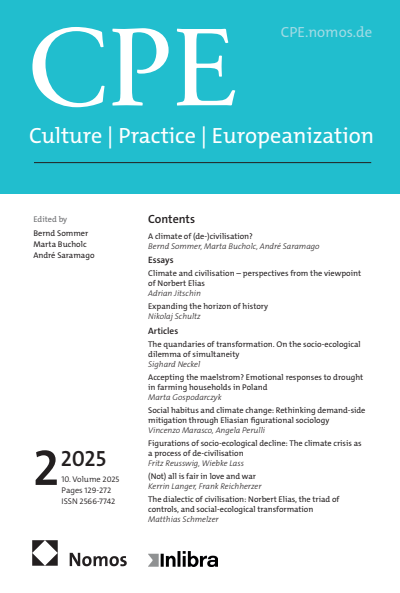
Culture, Practice & Europeanization
Jahrgang 10 (2025), Heft 2
- Autor:innen:
- Verlag
- Nomos, Baden-Baden
- Copyrightjahr
- 2026
- ISSN-Online
- 2566-7742
- ISSN-Print
- 2566-7742
Kapitelinformationen
Open Access Vollzugriff
Jahrgang 10 (2025), Heft 2
Figurations of socio-ecological decline: The climate crisis as a process of de- civilisation
- Autor:innen:
- ISSN-Print
- 2566-7742
- ISSN-Online
- 2566-7742
- Kapitelvorschau:
Literaturverzeichnis
Es wurden keine Treffer gefunden. Versuchen Sie einen anderen Begriff.
- Abellan, A. (2025). Performing the People: Affective and Discursive Strategies of Populist Proximity. Preprint. Research Square. https://doi.org/10.21203/rs.3.rs-6829941/v1. Google Scholar öffnen DOI: 10.5771/2566-7742-2025-2-193
- Acemoglu, D. & J. A. Robinson (2019). The Narrow Corridor: States, Societies, and the Fate of Liberty. London etc.: Penguin Press. Google Scholar öffnen DOI: 10.5771/2566-7742-2025-2-193
- Adamidis, V. (2021). Democracy, populism, and the rule of law: A reconsideration of their interconnectedness. Politics, 44(3), 386–399. https://doi.org/10.1177/02633957211041444 Google Scholar öffnen DOI: 10.5771/2566-7742-2025-2-193
- Albert, G. (2013). Figuration und Emergenz. Zur Ontologie und Methodologie des Ansatzes von Norbert Elias. Kölner Zeitschrift für Soziologie und Sozialpsychologie, 65(2), 193–222. Google Scholar öffnen DOI: 10.5771/2566-7742-2025-2-193
- Albrecht, G. A. (2019). Earth Emotions: New Words for a New World. Ithaca, NY: Cornell University Press. Google Scholar öffnen DOI: 10.5771/2566-7742-2025-2-193
- Alì, N. & Caranti, L. (2021). How much economic inequality is fair in liberal democracies? The approach of proportional justice. Philosophy & Social Criticism, 47(7), 769–788. https://doi.org/10.1177/0191453720987865. Google Scholar öffnen DOI: 10.5771/2566-7742-2025-2-193
- Anderson, E. N. (1996). Ecologies of the Heart. Emotion, Belief, and the Environment. Oxford: Oxford University Press. Google Scholar öffnen DOI: 10.5771/2566-7742-2025-2-193
- Archer, M. S. (Ed.) (2015). Generative Mechanisms Transforming the Social Order. Cham etc.: Springer. Google Scholar öffnen DOI: 10.5771/2566-7742-2025-2-193
- Arguedas, A. R., C. T. Robertson, R. Fletcher & R. K. Nielsen. (2022). Echo chambers, filter bubbles, and polarisation: a literature review. Oxford: Reuters Institute. DOI: 10.60625/risj-etxj-7k60. https://reutersinstitute.politics.ox.ac.uk/echo-chambers-filter-bubbles-and-polarisation-literature-review. Google Scholar öffnen DOI: 10.5771/2566-7742-2025-2-193
- Arnason, J. P. (2022). Civilisation, Culture and Power: Reflections on Norbert Elias’s Genealogy of the West. In A. Bogner & S. Mennell (Ed.), Civilisations, Civilising Processes and Modernity – A Debate. Palgrave Studies on Norbert Elias (175–201). Cham: Palgrave Macmillan. Google Scholar öffnen DOI: 10.5771/2566-7742-2025-2-193
- Barker, K. (2025). Anaesthetic Worlds of Denial: ‘Sleepwalking’ Through Climate Change. In J. Glückler, M. Garschagen & R. Panitz (Ed.), Placing the Future (75–96). Cham: Springer. Google Scholar öffnen DOI: 10.5771/2566-7742-2025-2-193
- Beard, S. J. et al. (2021). Assessing climate change’s contribution to global catastrophic risk. Futures 127, 102673. Google Scholar öffnen DOI: 10.5771/2566-7742-2025-2-193
- Biermann, F. (2022). The future of ‘environmental’ policy in the Anthropocene: time for a paradigm shift. In G. Hayes et al. (Ed.), Trajectories in Environmental Politics (68–88). London: Routledge Google Scholar öffnen DOI: 10.5771/2566-7742-2025-2-193
- Bingaman, K.A. (2022). The End of the World As We Have Known It? An Introduction to Collapsology. Pastoral Psychol, 71, 753–767. Google Scholar öffnen DOI: 10.5771/2566-7742-2025-2-193
- https://doi.org/10.1007/s11089-022-01026-y Google Scholar öffnen DOI: 10.5771/2566-7742-2025-2-193
- Blümel, W.D. (2009). Natural Climatic Variations in the Holocene: Past Impacts on Cultural History, Human Welfare and Crisis. In H.G. Brauch et al. (Ed.), Facing Global Environmental Change. Hexagon Series on Human and Environmental Security and Peace, (103–118), vol 4. Springer, Berlin, Heidelberg. https://doi.org/10.1007/978-3-540-68488-6_5. Google Scholar öffnen DOI: 10.5771/2566-7742-2025-2-193
- Böckenförde, W. (1976). Staat, Gesellschaft, Freiheit. Studien zur Staatstheorie und zum Verfassungsrecht. Frankfurt am Main: Suhrkamp. Google Scholar öffnen DOI: 10.5771/2566-7742-2025-2-193
- Bogner, A. (1989). Zivilisation und Rationalisierung. Die Zivilisationstheorien Max Webers, Norbert Elias' und der Frankfurter Schule im Vergleich. Opladen: Westdeutscher Verlag. Google Scholar öffnen DOI: 10.5771/2566-7742-2025-2-193
- Böhnert, M., Hornisch, M. & Rink, A. (Ed.) (2025). Apokalypse und Apathie. Handlungs(un)fähigkeiten in der Klimakrise. Bielefeld: transcript. Google Scholar öffnen DOI: 10.5771/2566-7742-2025-2-193
- Bösel, B. (2023). Die Plastizität der Gefühle. Das affektive Leben zwischen Psychotechnik und Ereignis. Frankfurt/New York: Campus. Google Scholar öffnen DOI: 10.5771/2566-7742-2025-2-193
- Bosetti, V., Colantone, I., De Vries, C.E. et al. (2025). Green backlash and right-wing populism. Nature Climate Change, 15, 822–828 (2025). https://doi.org/10.1038/s41558-025-02384-0 Google Scholar öffnen DOI: 10.5771/2566-7742-2025-2-193
- Bostrom, N. (2019). The vulnerable world hypothesis. Global Policy. 10, 455–476. Google Scholar öffnen DOI: 10.5771/2566-7742-2025-2-193
- Brand, U. et al. (2021). From planetary to societal boundaries: an argument for collectively defined self-limitation. Sustainability: Science, Practice and Policy, 17(1), 264–291. https://doi.org/10.1080/15487733.2021.1940754. Google Scholar öffnen DOI: 10.5771/2566-7742-2025-2-193
- Buhaug, H. & Uexkuell, N. v. (2021). Vicious Circles: Violence, Vulnerability, and Climate Change. Annual Review of Environment and Resources, 46, 545–568. https://doi.org/10.1146/annurev-environ-012220-014708. Google Scholar öffnen DOI: 10.5771/2566-7742-2025-2-193
- Buzogány, A. & Mohamad-Klotzbach, C. (2022). Environmental Populism. In M. Oswald (Ed.). The Palgrave Handbook of Populism. (321–340). Palgrave Macmillan, Cham. https://doi.org/10.1007/978-3-030-80803-7_19. Google Scholar öffnen DOI: 10.5771/2566-7742-2025-2-193
- Caiani, M. & Graziano, P. (2022). The Three Faces of Populism in Power: Polity, Policies and Politics. Government and Opposition, 57(4), 569–588. doi:10.1017/gov.2022.4 Google Scholar öffnen DOI: 10.5771/2566-7742-2025-2-193
- Caiani, M. & Graziano, P. (Ed.) (2021). Varieties of Populism in Europe in Times of Crisis. Abingdon/New York: Routledge. Google Scholar öffnen DOI: 10.5771/2566-7742-2025-2-193
- Callahan, C.W. (2025). Present and future limits to climate change adaptation. Nature Sustainability, 8, 336–342. https://doi.org/10.1038/s41893-025-01519-7. Google Scholar öffnen DOI: 10.5771/2566-7742-2025-2-193
- Carrión, J. F. (2022). A Dynamic Theory of Populism in Power. The Andes in Comparative Perspective. Oxford/New York: Oxford University Press. Google Scholar öffnen DOI: 10.5771/2566-7742-2025-2-193
- Catlin, J. (2022). Bauman, the Frankfurt School, and the tradition of enlightened catastrophism. In J. Palmer & D. Brzeziński (Eds.). Revisiting Modernity and the Holocaust: Heritage, Dilemmas, Extensions (199–218). London: Routledge. https://doi.org/10.4324/9781003120551 Google Scholar öffnen DOI: 10.5771/2566-7742-2025-2-193
- Chakrabarty, D. (2021). The Climate of History in a Planetary Age. Chicago, IL: University of Chicago Press. Google Scholar öffnen DOI: 10.5771/2566-7742-2025-2-193
- Clark, N. (2020). (Un)Earthing Civilization: Holocene Climate Crisis, City-State Origins and the Birth of Writing. Humanities, 9 (1), 1. https://doi.org/10.3390/h9010001 Google Scholar öffnen DOI: 10.5771/2566-7742-2025-2-193
- Clark, N. & Szerszynski, B. (2020). Planetary Social Thought: The Anthropocene Challenge to the Social Sciences. Cambridge etc.: Polity. Google Scholar öffnen DOI: 10.5771/2566-7742-2025-2-193
- Clausen, L. (1994). Krasser sozialer Wandel. Opladen: Leske + Budrich. Google Scholar öffnen DOI: 10.5771/2566-7742-2025-2-193
- Clayton, Susan (2020). Climate anxiety: Psychological responses to climate change. Journal of Anxiety Disorders, 74, 102263. https://doi.org/10.1016/j.janxdis.2020.102263. Google Scholar öffnen DOI: 10.5771/2566-7742-2025-2-193
- Clough, P. T. & Halley, J. (Eds.). (2007). The affective turn: Theorizing the social. Durham: Duke University Press. Google Scholar öffnen DOI: 10.5771/2566-7742-2025-2-193
- Colelli, F.P., Wing, I.S. & Cian, E.D. (2023). Air-conditioning adoption and electricity demand highlight climate change mitigation–adaptation tradeoffs. Scientific Reports 13, 4413. https://doi.org/10.1038/s41598-023-31469-z. Google Scholar öffnen DOI: 10.5771/2566-7742-2025-2-193
- Cox, R. W. (2001). Globalization and Civilizations and the twenty-first century. Some theoretical considerations. International Relations of the Asia-Pacific, 1(1), 105–130. https://doi.org/10.1093/irap/1.1.105 Google Scholar öffnen DOI: 10.5771/2566-7742-2025-2-193
- Crawford, N. C. (2022). The Pentagon, Climate Change, and War. Charting the Rise and Fall of U.S. Military Emissions. Cambridge, MA: The MIT Press. Google Scholar öffnen DOI: 10.5771/2566-7742-2025-2-193
- Dannemann, H. (2024). Populism and Anti-Populism in Climate Politics: Conflict Line, Contingent Relation, or Tacit Alliance in Climate Obstruction? Politische Vierteljahresschrift (PVZ) (2024). https://doi.org/10.1007/s11615-024-00581-8 Google Scholar öffnen DOI: 10.5771/2566-7742-2025-2-193
- Davidson, J.P.L. (2023). Two cheers for collapse? On the uses and abuses of the societal collapse thesis for imagining Anthropocene futures. Environmental Politics, 32(6), 969–987. https://doi.org/10.1080/09644016.2022.2164238. Google Scholar öffnen DOI: 10.5771/2566-7742-2025-2-193
- Davis, L. et al. (2021). Air conditioning and global inequality. Global Environmental Change, 69, 102299. https://doi.org/10.1016/j.gloenvcha.2021.102299. Google Scholar öffnen DOI: 10.5771/2566-7742-2025-2-193
- Dépelteau, F., Passiani, E. & Mariano, R. (2013). Ariel or Caliban? The Civilizing Process and Its Critiques. In F. Dépelteau, T. S. Landini (Ed.), Norbert Elias and Social Theory (41–59). Basingstoke: Palgrave. Google Scholar öffnen DOI: 10.5771/2566-7742-2025-2-193
- Diamond, J. (2005). Collapse: How Societies Choose to Fail or Succeed. New York: Viking Press. Google Scholar öffnen DOI: 10.5771/2566-7742-2025-2-193
- Diehl, P. & Bargetz, B. (Eds.) (2024). The Complexity of Populism New Approaches and Methods. London/New York: Routledge. Google Scholar öffnen DOI: 10.5771/2566-7742-2025-2-193
- Dreier, R. (1991). Recht – Staat – Vernunft. Studien zur Rechtstheorie 2. Frankfurt am Main: Suhrkamp. Google Scholar öffnen DOI: 10.5771/2566-7742-2025-2-193
- Drucks, S. (2011). Normativität bei Norbert Elias. In J. Ahrend, R. Beer, U.H. Bittligmeier & J. Gerdes (Ed.), Normativität. Über die Hintergründe sozialwissenschaftlicher Theoriebildung (157–187). Wiesbaden: VS Verlag. Google Scholar öffnen DOI: 10.5771/2566-7742-2025-2-193
- du Plessis, E. M. & Husted, E. (2024). Prepping as implicit activism: risk, danger, and post-capitalist imaginaries in prepper literature. Social Movement Studies, 1–25. https://doi.org/10.1080/14742837.2024.2349568 Google Scholar öffnen DOI: 10.5771/2566-7742-2025-2-193
- Eisenstadt, S. N. (Ed.) (2002). Multiple Modernities. London: Routledge. Google Scholar öffnen DOI: 10.5771/2566-7742-2025-2-193
- Ejsing, M. (2022). The arrival of the Anthropocene in social theory: From modernism and Marxism towards a new materialism. The Sociological Review, 71(1), 243–260. https://doi.org/10.1177/00380261221106905. Google Scholar öffnen DOI: 10.5771/2566-7742-2025-2-193
- Elias, N. (2000). The Civilizing Process. Malden & Victoria: Blackwell. Google Scholar öffnen DOI: 10.5771/2566-7742-2025-2-193
- Elias, N. (2001). The Society of Individuals. London & New York: Continuum. Google Scholar öffnen DOI: 10.5771/2566-7742-2025-2-193
- Elias, N. (2013). Studies on the Germans. Dublin: University College Dublin Press. Google Scholar öffnen DOI: 10.5771/2566-7742-2025-2-193
- Engels, A. et al. (2024). Hamburg Climate Futures Outlook 2024. Conditions for Sustainable Climate Change Adaptation. Bielefeld: Transcript. Google Scholar öffnen DOI: 10.5771/2566-7742-2025-2-193
- Eslen-Zyia, H. & Giorgi, A. (Ed.) (2022). Populism and Science in Europe. Cham: Palgrave Macmillan. Google Scholar öffnen DOI: 10.5771/2566-7742-2025-2-193
- Eversberg, D. et al. (2024). Der neue sozial-ökologische Klassenkonflikt. Mentalitäts- und Interessengegensätze im Streit um Transformation. Frankfurt/New York: Campus. Google Scholar öffnen DOI: 10.5771/2566-7742-2025-2-193
- Feenberg, A. (2011). The Liberation of Nature? In A. Biro (Ed.), Critical Ecologies. The Frankfurt School and Contemporary Environmental Crises (339–354). Toronto: University of Toronto Press. Google Scholar öffnen DOI: 10.5771/2566-7742-2025-2-193
- Flannery, F. (2024). Why We Must Stop Saying ‘Climate Apocalypse’: Symbols, Religious Social Memory, and Effective Climate Action. Zygon: Journal of Religion and Science, 59(1), 195–219. DOI: https://doi.org/10.16995/zygon.11610. Google Scholar öffnen DOI: 10.5771/2566-7742-2025-2-193
- Fletcher, J. (1995). Towards a Theory of Decivilizing Processes. Amsterdams Sociologisch Tijdschrift, 22(2), 283–296. Google Scholar öffnen DOI: 10.5771/2566-7742-2025-2-193
- Frankenberg, G. & Heitmeyer, W. (Ed.) (2025). Autoritäre Treiber eines Systemwechsels. Zur Destabilisierung von Institutionen durch die AfD. Frankfurt/New York: Campus. Google Scholar öffnen DOI: 10.5771/2566-7742-2025-2-193
- Friedlingstein, P. at al. (2025). Global Carbon Budget 2024. Earth System Science Data, 17, 965–1039. https://doi.org/10.5194/essd-17-965-2025. Google Scholar öffnen DOI: 10.5771/2566-7742-2025-2-193
- Fuchs, T. (2024). Verkörperte Gefühle. Zur Phänomenologie von Affektivität und Interaffektivität. Berlin: Suhrkamp. Google Scholar öffnen DOI: 10.5771/2566-7742-2025-2-193
- Gaufman, E. & Ganesh, B. (2024). The Trump Carnival. Populism, Transgression and the Far Right. Berlin/Boston: de Gruyter. Google Scholar öffnen DOI: 10.5771/2566-7742-2025-2-193
- Gerbaudo, P. (2024). Digital Populism. In Y. Stavrakakis & G. Katsambekis (Ed.), Research Handbook on Populism (506–515). Cheltenham: Edward Elgar. Google Scholar öffnen DOI: 10.5771/2566-7742-2025-2-193
- Gordon, D. (2017). ‘Civilization’ and the Self-Critical Tradition. Society, 54, 106–123. https://doi.org/10.1007/s12115-017-0110-4. Google Scholar öffnen DOI: 10.5771/2566-7742-2025-2-193
- Gradstein, M. (2024). Social Status Inequality and Populism. Journal of Comparative Economics, 52(2), 434–444. https://doi.org/10.1016/j.jce.2024.02.001. Google Scholar öffnen DOI: 10.5771/2566-7742-2025-2-193
- Graeber, D. & Wengrow, D. (2021). The Dawn of Everything: A New History of Humanity. New York: Farrar, Straus and Giroux. Google Scholar öffnen DOI: 10.5771/2566-7742-2025-2-193
- Greve, B. (Ed.) (2021). Handbook on Austerity, Populism and the Welfare State. Cheltenham & Northampton, MA: Edward Elgar. Google Scholar öffnen DOI: 10.5771/2566-7742-2025-2-193
- Gronenborn, D. et al. (2020). Inherent Catastrophes? Social Dynamics and External Forcing in Early Neolithic and Modern SW Germany. In F. Reide & P. Sheets (Ed.), Going Forward by Looking Back: Archaeological Perspectives on Socio-Ecological Crisis, Response, and Collapse (333–366). New York: Berghahn. Google Scholar öffnen DOI: 10.5771/2566-7742-2025-2-193
- Haas, T. (2024). On the links between climate scepticism and right-wing populism (RWP): an explanatory approach based on cultural political economy (CPE). New Political Economy, 29(3), 464–477. https://doi.org/10.1080/13563467.2023.2275017. Google Scholar öffnen DOI: 10.5771/2566-7742-2025-2-193
- Haasnoot. M.; Lawrence, J. & Magnan, A. K. (2021). Pathways to coastal retreat. The shrinking solution space for adaptation calls for long-term dynamic planning starting now. Science, 372(6548): 1287–1290. DOI: 10.1126/science.abi6594 Google Scholar öffnen DOI: 10.5771/2566-7742-2025-2-193
- Habermas, J. (1998). Between Facts and Norms. Contributions to a Discourse Theory of Law and Democracy. Cambridge, MA: The MIT Press. Google Scholar öffnen DOI: 10.5771/2566-7742-2025-2-193
- Hartwell, C. A. & Devinney, T. M. (2023). A Responsibility to Whom? Populism and Its Effects on Corporate Social Responsibility. Business & Society, 63(2), 300–340. https://doi.org/10.1177/00076503231163536. Google Scholar öffnen DOI: 10.5771/2566-7742-2025-2-193
- Hausfather, Z. (2025). State of the climate: 2025 on track to be second or third warmest year on record. Carbon Brief, 29 July 2025. https://www.carbonbrief.org/state-of-the-climate-2025-on-track-to-be-second-or-third-warmest-year-on-record/ (last accessed: 2025, July 22). Google Scholar öffnen DOI: 10.5771/2566-7742-2025-2-193
- Heidenreich, F. (2023). Nachhaltigkeit und Demokratie. Eine politische Theorie. Berlin: Suhrkamp. Google Scholar öffnen DOI: 10.5771/2566-7742-2025-2-193
- Heinisch, R. & V. Jansesberger (2024). Lacking control -analysing the demand side of populist party support. European Politics and Society, 25(2), 266–285. DOI: 10.1080/23745118.2022.2150027. Google Scholar öffnen DOI: 10.5771/2566-7742-2025-2-193
- Heinisch, R., Holtz-Bacha, C. & Mazzoleni, O. (Ed.). (2021). Political Populism. Handbook of Concepts, Questions and Strategies of Research. 2nd Edition. Baden-Baden: Nomos. Google Scholar öffnen DOI: 10.5771/2566-7742-2025-2-193
- Hickman, T. et al. (Eds.). (2018). The Anthropocene Debate and Political Science. London: Routledge. Google Scholar öffnen DOI: 10.5771/2566-7742-2025-2-193
- Hillje, J. (2025). Mehr Emotionen wagen. Wie wir Angst, Hoffnung und Wut nicht dem Populismus überlassen. Ein Plädoyer für eine demokratische Emotionskultur. Munich: Piper. Google Scholar öffnen DOI: 10.5771/2566-7742-2025-2-193
- Hochachka, G., Wise, M. & Regan, W. (2025). ‘Sensemaking’ climate change: navigating policy, polarization and the culture wars. npj Climate Action, 4, 43. https://doi.org/10.1038/s44168-025-00240-7. Google Scholar öffnen DOI: 10.5771/2566-7742-2025-2-193
- Huber, R. A., Maltby, T., Szulecki, K. & Ćetković, S. (2021). Is populism a challenge to European energy and climate policy? Empirical evidence across varieties of populism. Journal of European Public Policy, 28(7), 998–1017. https://doi.org/10.1080/13501763.2021.1918214. Google Scholar öffnen DOI: 10.5771/2566-7742-2025-2-193
- Ignatieff, M. (2022). Democracy Versus Democracy: The Populist Challenge to Liberal Democracy. In A. Velasco & I. Bucelli (Ed.), Populism. Origins and Alternative Policy Responses (35–52). London: LSE Press. Google Scholar öffnen DOI: 10.5771/2566-7742-2025-2-193
- IPCC (Intergovernmental Panel on Climate Change) (2023). Climate Change 2023: Synthesis Report. Contribution of Working Groups I, II and III to the Sixth Assessment Report of the Intergovernmental Panel on Climate Change. Geneva: IPCC. doi: 10.59327/IPCC/AR6–9789291691647. Google Scholar öffnen DOI: 10.5771/2566-7742-2025-2-193
- Jaeggi, R. (2018). Critique of Forms of Life. Cambridge, MA: Harvard University Press. Google Scholar öffnen DOI: 10.5771/2566-7742-2025-2-193
- Jaeggi, R. (2025). Progress and Regression. Cambridge, MA: Harvard University Press. Google Scholar öffnen DOI: 10.5771/2566-7742-2025-2-193
- Jones, P. & Menon, A. (2024). Varieties of Populists. Paths to Power and Implications for Regime Stability. In M. Bernhard, A. Kreppel & C. de la Torre (Ed.), Still the Age of Populism? Re-examining Theories and Concepts (68–89). London: Routledge. Google Scholar öffnen DOI: 10.5771/2566-7742-2025-2-193
- Jørgensen, P. S. et al. (2024). Evolution of the polycrisis: Anthropocene traps that challenge global sustainability. Philosophical Transactions of the Royal Society London (B), Biological Science, 379 (1893): 20220261. https://doi.org/10.1098/rstb.2022.0261. Google Scholar öffnen DOI: 10.5771/2566-7742-2025-2-193
- Kaidatzis, A. et al. (2024). How Populism Affects Constitutional Law. In: A. Kaidatzis et al. (Ed.), The People’s Constitution. The Populist Transformation of Constitutional Law? (3–28). Cham: Springer. doi: 10.1007/978–3–031–71889–2_1 Google Scholar öffnen DOI: 10.5771/2566-7742-2025-2-193
- Kallis, A. (2020). ‘Counter-spurt’ but not ‘de-civilization’: fascism, (un)civility, taboo, and the ‘civilizing process.’ Journal of Political Ideologies, 26(1), 3–22. doi.org/10.1080/13569317.2020.1825278. Google Scholar öffnen DOI: 10.5771/2566-7742-2025-2-193
- Kaltwasser, C. R. et al. (Ed.) (2017). The Oxford Handbook of Populism. Oxford: Oxford Academic. Google Scholar öffnen DOI: 10.5771/2566-7742-2025-2-193
- Kareiva, P. & V. Carranza (2018). Existential risk due to ecosystem collapse: Nature strikes back. Futures, 102, 39–50. Google Scholar öffnen DOI: 10.5771/2566-7742-2025-2-193
- Kaven, C. (2020). Die Ordnung des Zerfalls Verlaufsformen im Angesicht ökologischer Krisen. Soziologie und Nachhaltigkeit, 2, 49–64. Google Scholar öffnen DOI: 10.5771/2566-7742-2025-2-193
- Kemp, L.; Xu, C., Depledge, J.; Ebi, K. L.; Gibbins, G.; Kohler, T. A.; Rockström, J.; Scheffer, M.; Schellnhuber, H. J.; Steffen, W. & Lenton, T.M. (2022). Climate Endgame: Exploring catastrophic climate change scenarios. Proceedings of the National Academy of Sciences (PNAS), 119(34) e2108146119, https://doi.org/10.1073/pnas.2108146119. Google Scholar öffnen DOI: 10.5771/2566-7742-2025-2-193
- Ko, J., Lee, H. F. & Leung, C.K. (2024). War and warming: The effects of climate change on military conflicts in developing countries (1995–2020). Innovation and Green Development 3(4), 100175. https://doi.org/10.1016/j.igd.2024.100175. Google Scholar öffnen DOI: 10.5771/2566-7742-2025-2-193
- Koch, C. M. (2024). ‚The People’ vs. the Liberal International Order. Varieties of Populism & the International Politics of Democratic Legitimacy. Oxford: Oxford University Press. Google Scholar öffnen DOI: 10.5771/2566-7742-2025-2-193
- Kochi, T. (2023). Authoritarian Populism, Democracy and the Long Counter-Revolution of the Radical Right. Contemporary Political Theory, 22, 439–459. https://doi.org/10.1057/s41296-022-00611-3. Google Scholar öffnen DOI: 10.5771/2566-7742-2025-2-193
- Kornhuber, K., Coumou, D., Vogel, E. et al. (2020). Amplified Rossby waves enhance risk of concurrent heatwaves in major breadbasket regions. Nature Climate Change, 10, 48–53. https://doi.org/10.1038/s41558-019-0637-z. Google Scholar öffnen DOI: 10.5771/2566-7742-2025-2-193
- Kovalčík, M. (2022). The instrumental abuse of constitutional courts: how populists can use constitutional courts against the opposition. The International Journal of Human Rights, 26(7), 1160–1180. https://doi.org/10.1080/13642987.2022.2108017 Google Scholar öffnen DOI: 10.5771/2566-7742-2025-2-193
- Krekó, P. (2021). Populism in Power. The Tribal Challenge. In J. P. Forgas, W. D. Crano & K. Fiedler (Eds), The Psychology of Populism. The Tribal Challenge to Liberal Democracy. (251–269). London/New York: Routledge. Google Scholar öffnen DOI: 10.5771/2566-7742-2025-2-193
- Krygier, M., Czarnota, A. & Sadurski, W. (Ed.) (2022). Anti-Constitutional Populism. Cambridge/New York: Cambridge University Press. Google Scholar öffnen DOI: 10.5771/2566-7742-2025-2-193
- Küppers, A. (2022). ‘Climate-Soviets,’ ‘Alarmism,’ and ‘Eco-Dictatorship’: The Framing of Climate Change Scepticism by the Populist Radical Right Alternative for Germany. German Politics, 33(1), 1–21. https://doi.org/10.1080/09644008.2022.2056596 Google Scholar öffnen DOI: 10.5771/2566-7742-2025-2-193
- Lauer, A. et al. (2025). Beyond Green capitalism: Global scenarios for fast societal transitions toward sustainability. Environmental Innovation and Societal Transitions, 56, 100981. https://doi.org/10.1016/j.eist.2025.100981. Google Scholar öffnen DOI: 10.5771/2566-7742-2025-2-193
- Linklater, A. (2019). Process Sociology and Human Emancipation: Involvement and Detachment Reconsidered. Human Figurations Journal, 8(1). https://norbert-elias.com/wp-content/uploads/2023/11/HF_vol8-n1-3.pdf Google Scholar öffnen DOI: 10.5771/2566-7742-2025-2-193
- Linklater, A. (2020). The Idea of Civilization and the Making of the Global Order. Bristol, UK: Bristol University Press. Google Scholar öffnen DOI: 10.5771/2566-7742-2025-2-193
- Lucky, M. C. (2023). Knowledge-Making in Politics: Expertise in Democracy and Epistocracy. Political Theory, 52(3), 431–458. https://doi.org/10.1177/00905917231199495 Google Scholar öffnen DOI: 10.5771/2566-7742-2025-2-193
- Luhmann, N. (1996). Social Systems. Redwood City, CA: Stanford Press. Google Scholar öffnen DOI: 10.5771/2566-7742-2025-2-193
- Machin, A. (2022). Climates of democracy: Skeptical, rational, and radical imaginaries. WIREs Climate Change, 13(4), e773. https://doi.org/10.1002/wcc.774. Google Scholar öffnen DOI: 10.5771/2566-7742-2025-2-193
- MacKay, K. (2017). Radical Transformation: Oligarchy, Collapse, and the Crisis of Civilization. Toronto: Between The Lines Book. Google Scholar öffnen DOI: 10.5771/2566-7742-2025-2-193
- Mackenthun, G. (2021). Sustainable Stories: Managing Climate Change with Literature. Sustainability, 13, 4049. https://doi.org/10.3390/su13074049. Google Scholar öffnen DOI: 10.5771/2566-7742-2025-2-193
- Mackenthun, G. (2023). Planters of Doom and Playful Gardeners. Determinist and Possibilist Narratives of Mankind. In G. Mackenthun & J. Dosch (Ed.), Subversive Semantics in Political and Cultural Discourse (181–225). Bielefeld: transcript. Google Scholar öffnen DOI: 10.5771/2566-7742-2025-2-193
- Malmqvist, K. (2024). Avoiding the hope of avoiding collapse: collapsology and non-hope as an emotional practice of conviction. Social Movement Studies, 24(5), 554–571. https://doi.org/10.1080/14742837.2024.2321131. Google Scholar öffnen DOI: 10.5771/2566-7742-2025-2-193
- Mede, N. G., Schäfer, M. S. & Metag, J. (2024). Cognitio populi – Vox populi: Implications of science-related populism for communication behavior. Communications, 49(4), 645–668. https://doi.org/10.1515/commun-2022-0059 Google Scholar öffnen DOI: 10.5771/2566-7742-2025-2-193
- Mennell S. (2002). The Other Side of the Coin: Decivilizing Processes. In T. Salumets (Ed.), Norbert Elias and Human Interdependencies (32–49). Toronto: McGill-Queen’s University Press. Google Scholar öffnen DOI: 10.5771/2566-7742-2025-2-193
- Mennell S. & Goudsblom J. (Ed.) (1998). Norbert Elias: On Civilization, Power, and Knowledge. Chicago: University of Chicago Press. Google Scholar öffnen DOI: 10.5771/2566-7742-2025-2-193
- Miller, M. (2002). Some Theoretical Aspects of Systemic Learning. Sozialer Sinn, 3(3), 379–422. doi:10.1515/sosi-2002–0302. Google Scholar öffnen DOI: 10.5771/2566-7742-2025-2-193
- Milner, A. & Burgmann, J. R. (2020). Science Fiction & Climate Change. A Sociological Approach. Liverpool: Liverpool University Press. Google Scholar öffnen DOI: 10.5771/2566-7742-2025-2-193
- Monios, J. & Wilmsmeier, G. (2021). Deep adaptation and collapsology. In F. J. Carrillo & G. Koch (Ed.), Knowledge For The Anthropocene. Cheltenham, UK: Edward Elgar. https://doi.org/10.4337/9781800884298.00023 Google Scholar öffnen DOI: 10.5771/2566-7742-2025-2-193
- Moran, M., & Littler, J. (2020). Cultural populism in new populist times. European Journal of Cultural Studies, 23(6), 857–873. https://doi.org/10.1177/1367549420960477 Google Scholar öffnen DOI: 10.5771/2566-7742-2025-2-193
- Mouffe, C. (2013). Agonistics. Thinking the World Politically. London: Verso. Google Scholar öffnen DOI: 10.5771/2566-7742-2025-2-193
- Mounk, Y. (2018). The People vs Democracy: Why our Freedom is in Danger and How to save it. Cambridge, MA: Harvard University Press. Google Scholar öffnen DOI: 10.5771/2566-7742-2025-2-193
- Müller, J.-W. (2016). What is Populism? Philadelphia: University of Pennsylvania Press. Google Scholar öffnen DOI: 10.5771/2566-7742-2025-2-193
- Muno, W. & Pfeiffer, C. (2022). Populism in power – A comparative analysis of populist governance. International Area Studies Review, 25(4), 261–279. https://doi.org/10.1177/22338659221120067. Google Scholar öffnen DOI: 10.5771/2566-7742-2025-2-193
- Naylor, A. et al. (2020). Conceptualizing Climate Vulnerability in Complex Adaptive Systems. One Earth, 2(5), 444–454. https://doi.org/10.1016/j.oneear.2020.04.011. Google Scholar öffnen DOI: 10.5771/2566-7742-2025-2-193
- Nazir, M. et al. (2025). From conflict to a climate future: Unraveling the nexus between warfare and environmental degradation. Sustainable Futures, 9, 100525. https://doi.org/10.1016/j.sftr.2025.100525. Google Scholar öffnen DOI: 10.5771/2566-7742-2025-2-193
- Neal, T. et al. (2025). Reconsidering the macroeconomic damage of severe warming. Environmental Research Letters, 20(4), 044029. https://doi.org/10.1088/1748-9326/adbd58. Google Scholar öffnen DOI: 10.5771/2566-7742-2025-2-193
- Neckel, S. (2021). Im Angesicht der Katastrophe. Der nahende Zusammenbruch des Erdsystems und die sozial-ökologische Transformation. Blätter für deutsche und internationale Politik, 2, 51–58. Google Scholar öffnen DOI: 10.5771/2566-7742-2025-2-193
- O’Brien, K., et al. (2012). Global environmental change II: From adaptation to deliberate transformation. Progress in Human Geography, 36, 667–676. https://doi.org/10.1177/0309132511425767. Google Scholar öffnen DOI: 10.5771/2566-7742-2025-2-193
- Obringer, R. et al. (2022). Implications of increasing household air conditioning use across the United States under a warming climate. Earth's Future, 10, e2021EF002434. https://doi.org/10.1029/2021EF002434. Google Scholar öffnen DOI: 10.5771/2566-7742-2025-2-193
- Ofstehage, A., Wolford, W. & Borras, S. M. (2022). Contemporary Populism and the Environment. Annual Review of Environment and Resources, 47, 671–696. https://doi.org/10.1146/annurev-environ-012220-124635 Google Scholar öffnen DOI: 10.5771/2566-7742-2025-2-193
- Oswald, M. (Ed.) (2022). The Palgrave Handbook of Populism. Cham: Palgrave Macmillan. Google Scholar öffnen DOI: 10.5771/2566-7742-2025-2-193
- Pamuk, Z. (2021). Politics and Expertise. Princeton, NJ: Princeton University Press. Google Scholar öffnen DOI: 10.5771/2566-7742-2025-2-193
- Pepperell, N. (2016). The unease with civilization: Norbert Elias and the violence of the civilizing process. Thesis Eleven, 137(1), 3–21. https://doi.org/10.1177/0725513616638480. Google Scholar öffnen DOI: 10.5771/2566-7742-2025-2-193
- Peruzzotti, E. (2017). Populism as Democratization’s Nemesis: The Politics of Regime Hybridization. Chinese Political Science Review, 2, 314–327. https://doi.org/10.1007/s41111-017-0070-2. Google Scholar öffnen DOI: 10.5771/2566-7742-2025-2-193
- Quilley, S. (2020). Elias in the Anthropocene: Human Nature, Evolution and the Politics of the Great Acceleration. In J. Pereira & A. Saramago (Ed.), Non-Human Nature in World Politics. Frontiers in International Relations (111–139). Charm: Springer. https://doi.org/10.1007/978-3-030-49496-4_7. Google Scholar öffnen DOI: 10.5771/2566-7742-2025-2-193
- Reusswig, F. (2022). Ganz normale Katastrophen. Biodiversitätsverlust, Klimawandel und Covid-19-Pandemie als Anthropozän-Krisen. In L. Berger, H.-W. Frohn & C. Schell (Ed.), Biodiversitätsverlust, Klimawandel und Covid-19-Pandemie. Zum Verhältnis bestehender Krisenlagen (21–44). Bonn: Bundesamt für Naturschutz. Google Scholar öffnen DOI: 10.5771/2566-7742-2025-2-193
- Reusswig, F. et al. (2026). High-end climate change risks for Germany. Adaptive capacity between incrementalism and transformative adaptation. Accepted by GAIA. Google Scholar öffnen DOI: 10.5771/2566-7742-2025-2-193
- Reusswig, F., Lass, W. & Bock, S. (2022). Populistische Narrative der Energiewende und die Zukunft der Demokratie. In J. Zilles, E. Drewing & J. Janik (Ed.), Umkämpfte Zukunft. Zum Verhältnis von Nachhaltigkeit, Demokratie und Konflikt (183–202). Bielefeld: transcript. Google Scholar öffnen DOI: 10.5771/2566-7742-2025-2-193
- Richards, C.E., Lupton, R.C. & Allwood, J.M. (2021). Re-framing the threat of global warming: an empirical causal loop diagram of climate change, food insecurity and societal collapse. Climatic Change, 164, 49. https://doi.org/10.1007/s10584-021-02957-w. Google Scholar öffnen DOI: 10.5771/2566-7742-2025-2-193
- Richardson, K. et al. (2023). Earth beyond Six of Nine Planetary Boundaries. Science Advances, 9 (37): eadh2458. https://doi.org/10.1126/sciadv.adh2458. Google Scholar öffnen DOI: 10.5771/2566-7742-2025-2-193
- Rockström, J. (2025). Diagnosing earth’s tipping points: where we stand in the Anthropocene. Frontiers in Public Health, 13, 1653860. doi: 10.3389/fpubh.2025.1653860. Google Scholar öffnen DOI: 10.5771/2566-7742-2025-2-193
- Rosa, H. (2019). Resonance: A Sociology of Our Relationship to the World. Cambridge etc.: Polity. Google Scholar öffnen DOI: 10.5771/2566-7742-2025-2-193
- Runciman, D. (2018). How Democracy Ends. London: Profile Books. Google Scholar öffnen DOI: 10.5771/2566-7742-2025-2-193
- Sartori, G. (1987). The Theory of Democracy Revisited. Chatham, NJ: Chatham House. Google Scholar öffnen DOI: 10.5771/2566-7742-2025-2-193
- Schad, M. & Sommer, B. (2025): Socioecological transformation and conflict. Arenas, topics, and dimensions. In H. Knoblauch, V. Sommer & B. Pfetsch (Eds.), Spatial Conflicts and Conflictual Spaces (309–329). London/New York: Routledge. Google Scholar öffnen DOI: 10.5771/2566-7742-2025-2-193
- Scheffran, J. et al. (2025). Tipping cascades between conflict and cooperation in climate change. Earth System Dynamics, 16, 1197–1219. https://doi.org/10.5194/esd-16-1197-2025. Google Scholar öffnen DOI: 10.5771/2566-7742-2025-2-193
- Scherer, K. R. (2022). Emotions, social coordination, and the danger of affective polarization. Cognition and Emotion, 36(8), 1458–1463. DOI: 10.1080/02699931.2023.2181315 Google Scholar öffnen DOI: 10.5771/2566-7742-2025-2-193
- Schroer, M. (2022). Geosoziologie. Die Erde als Raum des Lebens. Berlin: Suhrkamp. Google Scholar öffnen DOI: 10.5771/2566-7742-2025-2-193
- Schumacher, G., Rooduijn, M. & Bakker, B.N. (2022). Hot Populism? Affective Responses to Antiestablishment Rhetoric. Political Psychology, 43, 851–871. https://doi.org/10.1111/pops.12832. Google Scholar öffnen DOI: 10.5771/2566-7742-2025-2-193
- Selk, V. & Kemmerzell, J. (2022). Retrogradism in context. Varieties of right-wing populist climate politics. Environmental Politics, 31(5), 755–776. https://doi.org/10.1080/09644016.2021.1999150 Google Scholar öffnen DOI: 10.5771/2566-7742-2025-2-193
- Senghaas, D. (2002). The Clash within Civilizations. Coming to Terms with Cultural Conflicts. London: Routledge. Google Scholar öffnen DOI: 10.5771/2566-7742-2025-2-193
- Senghaas, D. (2004). The Civilisation of Conflict: Constructive Pacifism as a Guiding Notion for Conflict Transformation. In A. Austin, M. Fischer & N. Ropers (Ed.), Transforming Ethnopolitical Conflict. (25–39). VS Wiesbaden: Verlag für Sozialwissenschaften (VS). Google Scholar öffnen DOI: 10.5771/2566-7742-2025-2-193
- Serdeczny, O. et al. (2024). Climatic risks to adaptive capacity. Mitigation and Adaptation Strategies for Global Change, 29, 10. https://doi.org/10.1007/s11027-023-10103-3. Google Scholar öffnen DOI: 10.5771/2566-7742-2025-2-193
- Sharma, D. C. (2023). Climate disasters challenge health infrastructures in India. The Lancet, 402, 279–280, https://doi.org/10.1016/S0140-6736(23)01512-X. Google Scholar öffnen DOI: 10.5771/2566-7742-2025-2-193
- Sherman, P., H. Lin & M. McElroy (2022). Projected global demand for air conditioning associated with extreme heat and implications for electricity grids in poorer countries. Energy and Buildings, 268, 112198. https://doi.org/10.1016/j.enbuild.2022.112198 Google Scholar öffnen DOI: 10.5771/2566-7742-2025-2-193
- Siders, A. R. (2019). Adaptive capacity to climate change: A synthesis of concepts, methods, and findings in a fragmented field. WIREs Climate Change, 10(3), 1–18. https://doi.org/10.1002/wcc.573. Google Scholar öffnen DOI: 10.5771/2566-7742-2025-2-193
- Singha, S. & Singha, R. (2024). Populism and Climate Change. In: Chennattuserry, J. C., Google Scholar öffnen DOI: 10.5771/2566-7742-2025-2-193
- Deshpande, M. & Hong, P. (Ed.), Encyclopedia of New Populism and Responses in the 21st Century (583–588), Springer, Singapore. https://doi.org/10.1007/978-981-99-7802-1_445 Google Scholar öffnen DOI: 10.5771/2566-7742-2025-2-193
- Slaby, J. (2023). Structural apathy, affective injustice, and the ecological crisis. Philosophical Topics, 51(1), 63–84. https://www.jstor.org/stable/48776804. Google Scholar öffnen DOI: 10.5771/2566-7742-2025-2-193
- Smirnov, O. et al. (2022). Climate Change, Drought, and Potential Environmental Migration Flows Under Different Policy Scenarios. International Migration Review, 57(1), 36–67. https://doi.org/10.1177/01979183221079850. Google Scholar öffnen DOI: 10.5771/2566-7742-2025-2-193
- Sommer, B. et al. (2022). Rechtspopulismus vs. Klimaschutz? Positionen, Einstellungen, Erklärungsansätze. München: Oekom. Google Scholar öffnen DOI: 10.5771/2566-7742-2025-2-193
- Spaiser, V. et al. (2024). Negative social tipping dynamics resulting from and reinforcing Earth system destabilization. Earth System Dynamics, 15, 1179–1206. https://doi.org/10.5194/esd-15-1179-2024. Google Scholar öffnen DOI: 10.5771/2566-7742-2025-2-193
- Spissinger, F. (2024). Die Gefühlsgemeinschaft der AfD. Narrative, Praktiken und Räume zum Wohlfühlen. Opladen etc.: Barbara Budrich. Google Scholar öffnen DOI: 10.5771/2566-7742-2025-2-193
- Stede, M. & R. Memminger. (2025). AfD-CCC: Analyzing the Climate Change Discourse of a German Right-wing Political Party, Proceedings of the Fourth Workshop on NLP for Positive Impact (NLP4PI), p.163 – 174. https://aclanthology.org/2025.nlp4pi-1.14.pdf Google Scholar öffnen DOI: 10.5771/2566-7742-2025-2-193
- Steel, D., DesRoches C. T. & K. Mintz-Woo (2022). Climate change and the threat to civilization. PNAS, 119(42), e2210525119. https://doi.org/10.1073/pnas.2210525119 Google Scholar öffnen DOI: 10.5771/2566-7742-2025-2-193
- Steffen, W. et al. (2018). Trajectories of the Earth System in the Anthropocene. Proc. Natl. Acad. Sci. U.S.A., 115, 8252–8259. Google Scholar öffnen DOI: 10.5771/2566-7742-2025-2-193
- Stockemer, D. (Ed.) (2019). Populism Around the World. A Comparative Perspective. Cham: Springer. Google Scholar öffnen DOI: 10.5771/2566-7742-2025-2-193
- Tainter, J. A. (1988): The Collapse of Complex Societies. Cambridge: Cambridge University Press. Google Scholar öffnen DOI: 10.5771/2566-7742-2025-2-193
- Tietjen, R. R. (2023). The Affects of Populism. Journal of the American Philosophical Association. 9(2), 284–302. doi:10.1017/apa.2021.56. Google Scholar öffnen DOI: 10.5771/2566-7742-2025-2-193
- Treibel, A., Blomert, R. & Kuzmics, H. (Ed.) (2000). Zivilisationstheorie in der Bilanz. Beiträge zum 100. Geburtstag von Norbert Elias. Wiesbaden: Springer. Google Scholar öffnen DOI: 10.5771/2566-7742-2025-2-193
- Tushnet, M. (2019). Varieties of populism. German Law Journal, 20, 382–389. doi: 10.1017/glj.2019.27. Google Scholar öffnen DOI: 10.5771/2566-7742-2025-2-193
- Tushnet, M. & Bugarič, B. (2021). Power to the People. Constitutionalism in the Age of Populism. Oxford/New York: Oxford University Press. Google Scholar öffnen DOI: 10.5771/2566-7742-2025-2-193
- UNEP (United Nations Environment Program) (2019). Global Environment Outlook 6. Nairobi: UNEP. Google Scholar öffnen DOI: 10.5771/2566-7742-2025-2-193
- van Krieken, R. (2024). The Age of Anger and Social Media: Elias, Technology, Civilizing/Decivilizing Processes and Ressentiment. Theory, Culture & Society, 41(7–8), 19–39. https://doi.org/10.1177/02632764241299767 Google Scholar öffnen DOI: 10.5771/2566-7742-2025-2-193
- Voelz, J. (2022). Reading Populism with Bourdieu and Elias. In A. Franke; S. Mueller; S. Sarkowsky, K. (Ed), Reading the Social in American Studies. Palgrave Macmillan, Cham. https://doi.org/10.1007/978-3-030-93551-1_10. Google Scholar öffnen DOI: 10.5771/2566-7742-2025-2-193
- Wallenhorst, N. (2023). A Critical Theory for the Anthropocene. Cham: Springer. https://doi.org/10.1007/978-3-031-37738-9. Google Scholar öffnen DOI: 10.5771/2566-7742-2025-2-193
- Warner, K. et al. (2019). Characteristics of transformational adaptation in climate-land-society interactions. Sustainability, 11, 356. DOI: 10.3390/su11020356. Google Scholar öffnen DOI: 10.5771/2566-7742-2025-2-193
- Wesche, T. (2014). Hegel und die Demokratie. In H. Rosa & K. Vieweg (Ed.), Zur Architektonik praktischer Vernunft – Hegel in Transformationen (135–156), Berlin: Duncker & Humblot. Google Scholar öffnen DOI: 10.5771/2566-7742-2025-2-193
- Wesche, T. (2023). Die Rechte der Natur. Vom nachhaltigen Eigentum. Berlin: Suhrkamp. Google Scholar öffnen DOI: 10.5771/2566-7742-2025-2-193
- Weyland, K. (2024). Populism as a political strategy. In Y. Stavarakis & G. Katsambekis (Ed.), Research Handbook on Populism (154–165). Cheltenham, UK: Edward Elgar. Google Scholar öffnen DOI: 10.5771/2566-7742-2025-2-193
- Winkelmann, R. et al. (2022). Social tipping processes towards climate action: A conceptual framework, Ecol. Econ., 192, 107242, https://doi.org/10.1016/j.ecolecon.2021.107242 Google Scholar öffnen DOI: 10.5771/2566-7742-2025-2-193
- Wunderling, N. et al. (2024). Climate tipping point interactions and cascades: a review, Earth Syst. Dynam., 15, 41–74, https://doi.org/10.5194/esd-15-41-2024 Google Scholar öffnen DOI: 10.5771/2566-7742-2025-2-193
- Xiao, R. et al. (2023). The development of ecological civilization in China based on the economic–social–natural complex system, Ambio, 52, 1910–1927. https://doi.org/10.1007/s13280-023-01937-x Google Scholar öffnen DOI: 10.5771/2566-7742-2025-2-193
- Xu, C., T. A. Kohler, T. M. Lenton, J. C. Svenning & M. Scheffer (2020). Future of the human climate niche. PNAS, 117, 11350–11355. Google Scholar öffnen DOI: 10.5771/2566-7742-2025-2-193
- Zaslove, A. & Meijers, M. (2023). Populist Democrats? Unpacking the Relationship Between Populist and Democratic Attitudes at the Citizen Level. Political Studies, 72(3), 1133–1159. https://doi.org/10.1177/00323217231173800. Google Scholar öffnen DOI: 10.5771/2566-7742-2025-2-193
- Zhang, J. & Fu, B. (2023). Eco-civilization: A complementary pathway rooted in theory and practice for global sustainable development. Ambio, 52, 1882–1894. https://doi.org/10.1007/s13280-023-01902-8. Google Scholar öffnen DOI: 10.5771/2566-7742-2025-2-193
- Ziblatt, D. & Levitsky S. (2018). How Democracies Die. New York: Crown Publishing. Google Scholar öffnen DOI: 10.5771/2566-7742-2025-2-193
- Zick, A., Küpper, B. & Mokros, N. (Ed.) (2023). Die distanzierte Mitte: Rechtsextreme und demokratiegefährdende Einstellungen in Deutschland. Bonn: J. H. W. Dietz Verlag. Google Scholar öffnen DOI: 10.5771/2566-7742-2025-2-193
