Never Off Duty – The Role of Supervisors in the Relationship Between Extended Availability, Subordinate Strain, and Job Performance
Inhaltsverzeichnis
Bibliographische Infos
Open Access Vollzugriff
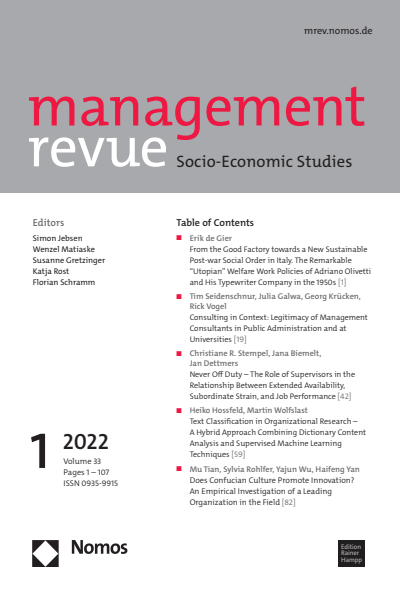
mrev management revue
Jahrgang 33 (2022), Heft 1
- Autor:innen:
- Verlag
- Nomos, Baden-Baden
- Copyrightjahr
- 2022
- ISSN-Online
- 1861-9908
- ISSN-Print
- 0935-9915
Kapitelinformationen
Open Access Vollzugriff
Jahrgang 33 (2022), Heft 1
Never Off Duty – The Role of Supervisors in the Relationship Between Extended Availability, Subordinate Strain, and Job Performance
- Autor:innen:
- ISSN-Print
- 0935-9915
- ISSN-Online
- 1861-9908
- Kapitelvorschau:
Literaturverzeichnis
Es wurden keine Treffer gefunden. Versuchen Sie einen anderen Begriff.
- Arlinghaus, A., & Nachreiner, F. (2013). When work calls – Associations between being contacted outside of regular working hours for work-related matters and health. Chronobiology International, 30(9), 1197–1202. https://doi.org/10.3109/07420528.2013.800089 Google Scholar öffnen DOI: 10.5771/0935-9915-2022-1-42
- Ashforth, B. E., Kreiner, G. E., & Fugate, M. (2000). All in a day’s work: Boundaries and micro role transitions. Academy of Management Review, 25(3), 472–491. https://doi.org/10.5465/AMR.2000.3363315 Google Scholar öffnen DOI: 10.5771/0935-9915-2022-1-42
- Bakker, A. B., & Demerouti, E. (2007). The job demands-resources model: State of the art. Journal of Managerial Psychology, 22(3), 309–328. https://doi.org/10.1108/02683940710733115 Google Scholar öffnen DOI: 10.5771/0935-9915-2022-1-42
- Bakker, A. B., & Demerouti, E. (2017). Job demands-resources theory: Taking stock and looking forward. Journal of Occupational Health Psychology, 22, 273–285. https://doi.org/10.1037/ocp0000056 Google Scholar öffnen DOI: 10.5771/0935-9915-2022-1-42
- Bamberg, E., Dettmers, J., Funck, H., Krähe, B., & Vahle-Hinz, T. (2012). Effects of on-call work on well-being: Results of a aaily survey. Applied Psychology: Health and Well-Being, 4(3), 299–320. https://doi.org/10.1111/j.1758-0854.2012.01075.x Google Scholar öffnen DOI: 10.5771/0935-9915-2022-1-42
- Bergman, A., & Gardiner, J. (2007). Employee availability for work and family: three Swedish case studies. Employee Relations, 29(4), 400–414. https://doi.org/10.1108/01425450710759226 Google Scholar öffnen DOI: 10.5771/0935-9915-2022-1-42
- Berkowsky, R. W. (2013). When you just cannot get away. Information, Communication & Society, 16(4), 519–541. https://doi.org/10.1080/1369118X.2013.772650 Google Scholar öffnen DOI: 10.5771/0935-9915-2022-1-42
- Binnewies, C., Sonnentag, S., & Mojza, E.J. (2009). Daily performance at work : feeling recovered in the morning as a predictor of day-level job performance. Journal of Organizational Behavior. 30(1), pp. 67–93. https://doi.org/10.1002/job.541 Google Scholar öffnen DOI: 10.5771/0935-9915-2022-1-42
- Carlson, D. S., Kacmar, K. M., & Williams, L. J. (2000). Construction and initial validation of a multidimensional measure of work-family conflict. Journal of Vocational Behavior, 56(2), 249–276. https://doi.org/10.1006/jvbe.1999.1713 Google Scholar öffnen DOI: 10.5771/0935-9915-2022-1-42
- Clark, S. C. (2000). Work/family border theory: A new theory of work/family balance. Human Relations, 53(6), 747–770. https://doi.org/10.1177/0018726700536001 Google Scholar öffnen DOI: 10.5771/0935-9915-2022-1-42
- Day, A., Paquet, S., Scott, N., & Hambley, L. (2012). Perceived information and communication technology (ICT) demands on employee outcomes: The moderating effect of organizational ICT support. Journal of Occupational Health Psychology, 17(4), 473–491. http://dx.doi.org/10.1037/a0029837 Google Scholar öffnen DOI: 10.5771/0935-9915-2022-1-42
- Derks, D., van Duin, D., Tims, M., & Bakker, A. B. (2015). Smartphone use and work-home interference: The moderating role of social norms and employee work engagement. Journal of Occupational and Organizational Psychology, 88(1), 155–177. https://doi.org/10.1111/joop.12083 Google Scholar öffnen DOI: 10.5771/0935-9915-2022-1-42
- Derks, D., Mierlo, H. van, & Schmitz, E. (2014). A diary study on work-related smartphone use, psychological detachment, and exhaustion: Examining the role of the perceived segmentation norm. Journal of Occupational Health Psychology, 19(1), 74–84. https://doi.org/10.1037/a0035076 Google Scholar öffnen DOI: 10.5771/0935-9915-2022-1-42
- Dettmers, J. (2017). How extended work availability affects well-being: The mediating roles of psychological detachment and work-family-conflict. Work & Stress, 31(1), 24–41. https://doi.org/10.1080/02678373.2017.1298164 Google Scholar öffnen DOI: 10.5771/0935-9915-2022-1-42
- Dettmers, J., Bamberg, E., & Seffzek, K. (2016a). Characteristics of extended availability for work: The role of demands and resources. International Journal of Stress Management. https://doi.org/dx.doi.org/10.1037/str0000014 Google Scholar öffnen DOI: 10.5771/0935-9915-2022-1-42
- Dettmers, J., & Biemelt, J. (2018). Always available – the role of perceived advantages and legitimacy. Journal of Managerial Psychology, 33, 497–510. https://doi.org/10.1108/JMP-02-2018-0095 Google Scholar öffnen DOI: 10.5771/0935-9915-2022-1-42
- Dettmers, J., Vahle-Hinz, T., Bamberg, E., Friedrich, N., & Keller, M. (2016b). Extended work availability and its relation with start-of-day mood and cortisol. Journal of Occupational Health Psychology, 21(1), 105–118. https://doi.org/10.1037/a0039602 Google Scholar öffnen DOI: 10.5771/0935-9915-2022-1-42
- Dewett, T., & Jones, G.R. (2001). The role of information technology in the organization: A review, model, and assessment. Journal of Management, 27, 313–346. https://doi.org/10.1177/014920630102700306 Google Scholar öffnen DOI: 10.5771/0935-9915-2022-1-42
- Diaz, I., Chiaburu, D., Zimmerman, R., & Boswell, W. (2012). Communication technology: Pros and cons of constant connection to work. Journal of Vocational Behavior, 80(2), 500–508. https://doi.org/10.1016/j.jvb.2011.08.007 Google Scholar öffnen DOI: 10.5771/0935-9915-2022-1-42
- Enzmann, D., & Kleiber, D. (1989). Helfer-Leiden. Asanger. Google Scholar öffnen DOI: 10.5771/0935-9915-2022-1-42
- Fahlén, S. (2014) Does gender matter? Policies, norms and the gender gap in work-to-home and home-to-work conflict across Europe. Community, Work & Family, 371–391, https://doi.org/10.1080/13668803.2014.899486 Google Scholar öffnen DOI: 10.5771/0935-9915-2022-1-42
- Glavin, P., & Schieman, S. (2012). Work-family role blurring and work-family conflict the moderating influence of job resources and job demands. Work and Occupations, 39(1), 71–98. https://doi.org/10.1177/0730888411406295 Google Scholar öffnen DOI: 10.5771/0935-9915-2022-1-42
- Golden, A. G., & Geisler, C. (2007). Work-life boundary management and the personal digital assistant. Human Relations, 60(3), 519–551. https://doi.org/10.1177/0018726707076698 Google Scholar öffnen DOI: 10.5771/0935-9915-2022-1-42
- Hammer, L. B., Kossek, E. E., Yragui, N. L., Bodner, T. E., & Hanson, G. C. (2009). Development and validation of a multidimensional measure of family-supportive supervisor behaviors (FSSB). Journal of Management, 35(4), 837–856. https://doi.org/10.1177/0149206308328510 Google Scholar öffnen DOI: 10.5771/0935-9915-2022-1-42
- Hecht, T. D., & Allen, N. J. (2009). A longitudinal examination of the work–nonwork boundary strength construct. Journal of Organizational Behavior, 30(7), 839–862. https://doi.org/10.1002/job Google Scholar öffnen DOI: 10.5771/0935-9915-2022-1-42
- Heißler, C.C. (2019). Working after hours, sharing availability expectations, and interrupting yourself: Extending perspectives on ICT-related concepts in research (doctorial dissertation). https://doi.org/10.17170/kobra-20190708588 Google Scholar öffnen DOI: 10.5771/0935-9915-2022-1-42
- Jex, S. M. (1998). Stress and job performance: Theory, research, and implications for managerial practice. Sage Publications Ltd. Google Scholar öffnen DOI: 10.5771/0935-9915-2022-1-42
- Koch, A. R., & Binnewies, C. (2015). Setting a good example: Supervisors as work-life-friendly role models within the context of boundary management. Journal of Occupational Health Psychology, 20(1), 82–92. https://doi.org/10.1037/a0037890 Google Scholar öffnen DOI: 10.5771/0935-9915-2022-1-42
- Kossek, E. E., Pichler, S., Bodner, T., & Hammer, L. B. (2011). Workplace social support and work-family conflict: A meta-analysis clarifying the influence of general and work-family-specific supervisor and organizational support. Personnel Psychology, 64(2), 289–313. https://doi.org/10.1111/j.1744-6570.2011.01211.x Google Scholar öffnen DOI: 10.5771/0935-9915-2022-1-42
- Kossek, E. E., Ruderman, M. N., Braddy, P. W., & Hannum, K. M. (2012). Work-nonwork boundary management profiles: A person-centered approach. Journal of Vocational Behavior, 81(1), 112–128. https://doi.org/10.1016/j.jvb.2012.04.003 Google Scholar öffnen DOI: 10.5771/0935-9915-2022-1-42
- Kranabetter, C., & Niessen, C. (2017). Managers as role models for health: Moderators of the relationship of transformational leadership with employee exhaustion and cynicism. Journal of Occupational Health Psychology, 22 (4). 492–502. http://dx.doi.org/10.1037/ocp0000044 Google Scholar öffnen DOI: 10.5771/0935-9915-2022-1-42
- Kuoppala, J., Lamminpää, A., Liira, J., & Vainio, H. (2008). Leadership, job well-being, and health effects—A systematic review and a meta-analysis. Journal of Occupational and Environmental Medicine, 50, 904–915. https://doi.org/10.1097/JOM.0b013e31817e918d Google Scholar öffnen DOI: 10.5771/0935-9915-2022-1-42
- Lapierre, L. M., & Allen, T. D. (2006). Work-supportive family, family-supportive supervision, use of organizational benefits, and problem-focused coping: implications for work-family conflict and employee well-being. Journal of Occupational Health Psychology, 11(2), 169–181. http://dx.doi.org/10.1037/1076-8998.11.2.169 Google Scholar öffnen DOI: 10.5771/0935-9915-2022-1-42
- Leung, L. (2011). Effects of ICT connectedness, permeability, flexibility, and negative spillovers on burnout and job and family satisfaction. Human Technology: An Interdisciplinary Journal on Humans in ICT Environments, 7(3), 250–267. https://doi.org/10.17011/ht/urn.2011112211714 Google Scholar öffnen DOI: 10.5771/0935-9915-2022-1-42
- Malhotra, N. K., Schaller, T. K., & Patil, A. (2017). Common Method Variance in Advertising Research: When to Be Concerned and How to Control for It. Journal of Advertising, 46(1), 193–212. https://doi.org/10.1080/00913367.2016.1252287 Google Scholar öffnen DOI: 10.5771/0935-9915-2022-1-42
- Maslach, C., & Jackson, S. E. (1986). Maslach Burnout Inventory. Manual (2nd ed.). Consulting Psychologists Press. Google Scholar öffnen DOI: 10.5771/0935-9915-2022-1-42
- Meijman, T. F., & Mulder, G. (1998). Psychological aspects of workload. In P. J. D. Drenth, H. Thierry, C. J. de Wolff, P. J. D. Drenth (Ed), H. Thierry (Ed), & C. J. de Wolff (Ed) (Eds.), Handbook of work and organizational: Work psychology. (pp. 5–33). Psychology Press/Erlbaum (UK) Taylor & Francis. Google Scholar öffnen DOI: 10.5771/0935-9915-2022-1-42
- Middleton, C. A. (2007). Illusions of balance and control in an always-on environment: A case study of BlackBerry users. Continuum, 21(2), 165–178. https://doi.org/10.1080/10304310701268695 Google Scholar öffnen DOI: 10.5771/0935-9915-2022-1-42
- Nohe, C., Michel, A., & Sonntag, K. (2013). Family–work conflict and job performance: A diary study of boundary conditions and mechanisms. Journal of Organizational Behavior, 35(3), 339–357. http://dx.doi.org/10.1002/job.1878 Google Scholar öffnen DOI: 10.5771/0935-9915-2022-1-42
- Nielsen, K., Randall, R., Yarker, J., & Brenner, S.-O. (2008). The effects of transformational leadership on followers’ perceived work characteristics and psychological well-being: A longitudinal study. Work & Stress, 22, 16–32. https://doi.org/10.1080/02678370801979430 Google Scholar öffnen DOI: 10.5771/0935-9915-2022-1-42
- Pangert, B., & Schüpbach, H. (2013). The effects of work-related extended availability on life-domain-balance and health. Bundesanstalt für Arbeitsschutz und Arbeitsmedizin. Google Scholar öffnen DOI: 10.5771/0935-9915-2022-1-42
- Piszczek, M. M. (2017). Boundary control and controlled boundaries: Organizational expectations for technology use at the work-family interface. Journal of Organizational Behavior, 38, 592–611. http://doi.wiley.com/10.1002/job.2153. Google Scholar öffnen DOI: 10.5771/0935-9915-2022-1-42
- Rau, R., & Göllner, M. (2019). Erreichbarkeit gestalten, oder doch besser die Arbeit? Zeitschrift für Arbeits- und Organisationspsychologie, 63 (1), 1–14. https://doi.org/10.1026/0932-4089/a000284 Google Scholar öffnen DOI: 10.5771/0935-9915-2022-1-42
- Siemsen, E., Roth, A., & Oliveira, P. (2010). Common method bias in regression models with linear, quadratic, and interaction effects. Organizational Research Methods, 13(3), 456–476. https://doi.org/10.1177/1094428109351241 Google Scholar öffnen DOI: 10.5771/0935-9915-2022-1-42
- Sonnentag, S., Kuttler, I., & Fritz, C. (2010). Job stressors, emotional exhaustion, and need for recovery: A multi-source study on the benefits of psychological detachment. Journal of Vocational Behavior, 76(3), 355–365. https://doi.org/10.1016/j.jvb.2009.06.005 Google Scholar öffnen DOI: 10.5771/0935-9915-2022-1-42
- Stein, M., Vincent-Höper, S., Deci, N., Gregersen, S., & Nienhaus, A. (2019). Compensatory coping through the extension of working hours: The buffering role of leader–member exchange. Zeitschrift für Arbeits- und Organisationspsychologie, 63(3), 115–128. https://doi.org/10.1026/0932-4089/a000285 Google Scholar öffnen DOI: 10.5771/0935-9915-2022-1-42
- Taris, T. W. (2006). Is there a relationship between burnout and objective performance? A critical review of 16 studies. Work & Stress, 20, 316–334. http://dx.doi.org/10.1080/02678370601065893 Google Scholar öffnen DOI: 10.5771/0935-9915-2022-1-42
- Trzcinski, E., & Holst, E. (2011). Gender differences in subjective well-being in and out of management positions. Social Indicators Research, 107, 449–463. https://doi.org/10.1007/s11205-011-9857-y Google Scholar öffnen DOI: 10.5771/0935-9915-2022-1-42
- Tuckey, M.R., Bakker, A.B. & Dollard, M.F. (2012). Empowering leaders optimize working conditions for engagement: A multilevel study. Journal of Occupational Health Psychology, 17, 15–27. https://doi.org/10.1037/a0025942 Google Scholar öffnen DOI: 10.5771/0935-9915-2022-1-42
- Vincent-Höper, S., & Stein, M.(2019). The role of leaders in designing employees’ work characteristics: Validation of the Health- and-Development-Promoting Leadership Behavior Questionnaire. Frontiers in Psychology, 10:1049. https://doi.org/10.3389/fpsyg.2019.01049 Google Scholar öffnen DOI: 10.5771/0935-9915-2022-1-42
- Voydanoff, P. (2005). Consequences of boundary-spanning demands and resources for work-to-family conflict and perceived stress. Journal of Occupational Health Psychology, 10(4), 491–503. https://doi.org/10.1037/1076-8998.10.4.491 Google Scholar öffnen DOI: 10.5771/0935-9915-2022-1-42
- Williams, L. J., & Anderson, S. E. (1991). Job satisfaction and organizational commitment as predictors of organizational citizenship and in-role behaviors. Journal of Management, 17(3), 601–617. https://doi.org/10.1177/014920639101700305 Google Scholar öffnen DOI: 10.5771/0935-9915-2022-1-42
- Wolff, H. G., & Höge, T. (2011). Konflikte zwischen Arbeit und Familie. Zeitschrift für Arbeits-und Organisationspsychologie A&O, 55, p. 143–152. https://doi.org/10.1026/0932-4089/a000053. Google Scholar öffnen DOI: 10.5771/0935-9915-2022-1-42
