Social Media als Katalysator oder als Ausweg aus der Krise? Einflüsse von Instagram auf die Psychische Gesund- heit Jugendlicher
Inhaltsverzeichnis
Bibliographische Infos
Vollzugriff
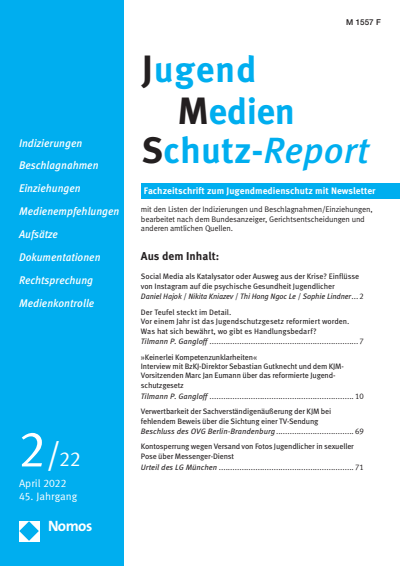
Fachzeitschrift zum Jugendmedienschutz mit Newsletter
Jahrgang 45 (2022), Heft 2
- Autor:innen:
- , , , ,
- Verlag
- Nomos, Baden-Baden
- Erscheinungsjahr
- 2022
- ISSN-Online
- 2942-3287
- ISSN-Print
- 0170-5067
Kapitelinformationen
Vollzugriff
Jahrgang 45 (2022), Heft 2
Social Media als Katalysator oder als Ausweg aus der Krise? Einflüsse von Instagram auf die Psychische Gesund- heit Jugendlicher
- Autor:innen:
- , , ,
- ISSN-Print
- 0170-5067
- ISSN-Online
- 2942-3287
- Kapitelvorschau:

Literaturverzeichnis
Es wurden keine Treffer gefunden. Versuchen Sie einen anderen Begriff.
- About.instagram (2022): Sicherheit. About. instagram. Online unter: https://about.insta- gram.com/de-de/safety Google Scholar öffnen doi.org/10.5771/0170-5067-2022-2-2
- Adeyanju, G. C. / Solfa, R. P. / Tran, T. L. / Wohlf- arth, S. / Büttner, J. / Osobajo, O. A. / Otitoju, A. (2021): Behavioural symptoms of mental health disorder such as depression among young peo- ple using Instagram: a systematic review. In: transl med commun 6 (1), S. 89. DOI: 10.1186/ s41231-021-00092-3 Google Scholar öffnen doi.org/10.5771/0170-5067-2022-2-2
- Baumgarten, J. (2021): Aneignung körperposi- tiver Accounts auf Instagram durch Jugendliche und junge Erwachsene. Masterarbeit im Studi- engang Kinder- und Jugendmedien. Uni Erfurt. Google Scholar öffnen doi.org/10.5771/0170-5067-2022-2-2
- Boepple, L. / Ata, R. N. / Rum, Ruba / Thomp- son, J. K. (2016): Strong is the new skinny: A content analysis of fitspiration websites. In: Body image 17, S. 132-135. DOI: 10.1016/j.bodyim.2016.03.001 Google Scholar öffnen doi.org/10.5771/0170-5067-2022-2-2
- Borzekowski, D. L. / Robinson, T. N. / Killen, J. D. (2000): Does the camera add 10 pounds? Media use, perceived importance of appearance, and weight concerns among teenage girls. In: Jour- nal of Adolescent Health 26 (1), S. 36-41. DOI: 10.1016/S1054-139X(99)00044-0 Google Scholar öffnen doi.org/10.5771/0170-5067-2022-2-2
- Business Wire (2014): Afraid to Be Your Sel- fie? Survey Reveals Most People Photoshop Their Images before Posting on Social Media Networks. Online unter https://www.business- wire.com/news/home/20140220006440/en/ Afraid-to-Be-Your-Selfie-Survey-Reveals-Most- People-Photoshop-Their-Images-before-Posting- on-Social-Media-Networks. Google Scholar öffnen doi.org/10.5771/0170-5067-2022-2-2
- Bujard, M./ von den Driesch, E./ Ruckdeschel, K./ Laß, I./ Thönnissen, C./ Schumann, A. / Schneider, N. (2021): BiB. Bevölkerungs.Studien 2/2021. Bun- desinstitut für Bevölkerungsforschung. Wies- baden. Google Scholar öffnen doi.org/10.5771/0170-5067-2022-2-2
- Calmbach, M. / Flaig, B. / Edwards, J. / Möller- Slawinski, H. / Borchard, I. / Schleer, C. (2020): SINUS-Jugendstudie 2020. Lebenswelten von Jugendlichen im Alter von 14 bis 17 Jahren in Deutschland. Bonn. Google Scholar öffnen doi.org/10.5771/0170-5067-2022-2-2
- Cohen, R. / Fardouly, J. / Newton-John, T. / Slater, Google Scholar öffnen doi.org/10.5771/0170-5067-2022-2-2
- A. (2019): #BoPo on Instagram: An experimen- tal investigation of the effects of viewing body positive content on young women’s mood and body image. In: New Media & Society 21 (7), S. 1546-1564. DOI: 10.1177/1461444819826530 Google Scholar öffnen doi.org/10.5771/0170-5067-2022-2-2
- DAK (2020) (Hrsg.): Mediensucht 2020 – Gaming und Social Media in Zeiten von Coro- na. Hamburg. Google Scholar öffnen doi.org/10.5771/0170-5067-2022-2-2
- DJI (Deutsches Jugendinstitut) (2020): DJI- Kinder- und Jugendmigrationsreport 2020. Datenanalyse zur Situation junger Menschen in Deutschland. Bielefeld. Google Scholar öffnen doi.org/10.5771/0170-5067-2022-2-2
- Dorrani, C. / Betz, A. / Philipp, A. / Redenz, C. / Waßmann, L. / Sukalla, F. (2021): Sick Style als digitaler Medientrend im Kontext von (Ent-) Stigmatisierung psychischer Erkrankungen. In: 6. Jahrestagung der DGPuK-Fachgruppe Gesundheitskommunikation. Tagungsabstracts, S. 50-56. Google Scholar öffnen doi.org/10.5771/0170-5067-2022-2-2
- González-Nuevo, C. / Cuesta, M. / Muñiz, J. (2021): Concern about appearance on Insta- gram and Facebook: Measurement and links with eating disorders. In: Cyberpsychology 15 (2). DOI: 10.5817/CP2021-2-9. Google Scholar öffnen doi.org/10.5771/0170-5067-2022-2-2
- Götz, M. (2019): Die Selbstinszenierung von Influencerinnen auf Instagram und ihre Bedeu- tung für Mädchen. In: TELEVIZION 32(1), S. 25-28. Google Scholar öffnen doi.org/10.5771/0170-5067-2022-2-2
- Götz, M. (2020): »Ein Kick fürs Selbstbewusst- sein« (Lilli, 15 Jahre) – Die Selbstinszenierung von Mädchen auf Instagram Selbstbewusstsein. In: A. Beranek / S. Ring / M. Schuegraf (Hrsg.), Zwischen Utopie und Dystopie. Medienpädago- gische Perspektiven für die digitale Gesellschaft. München. Google Scholar öffnen doi.org/10.5771/0170-5067-2022-2-2
- Gudjons, H. & Traub, S. (2020): Pädagogisches Grundwissen. Stuttgart. Google Scholar öffnen doi.org/10.5771/0170-5067-2022-2-2
- Fellmann, F. (2021): Facebook-Whistleblo- we-rin sagt vor dem US-Kongress aus. Süd- deutsche Zeitung. Online unter: https:// www.sueddeutsche.de/politik/facebook-usa- kongress-1.5431363 Google Scholar öffnen doi.org/10.5771/0170-5067-2022-2-2
- Haese, I. (2020): Das Gespenst der Digitali- sierung. In: Inga Haese (Hg.): Smartphonekids. Berlin, Heidelberg, S. 1-43. Google Scholar öffnen doi.org/10.5771/0170-5067-2022-2-2
- Hajok, D. (2021): In Social Media und digita- len Spielen gefangen? Gestiegene Prävalenzen einer Medienabhängigkeit unter Jugendlichen. In: JMS-Report 44 (2/21), S. 8-11. Google Scholar öffnen doi.org/10.5771/0170-5067-2022-2-2
- Han, B. (2018): Social Media Burnout: Defi- nition, Measurement Instrument, and Why We Care. In: Journal of Computer Infor- mation Systems 58 (2), S. 122-130. DOI: 10.1080/08874417.2016.1208064 Google Scholar öffnen doi.org/10.5771/0170-5067-2022-2-2
- Harren, N. / Walburg, V. / Chabrol, H. (2021): Studying Social Media Burnout and Problema- tic Social Media use: The implication of per- fectionism and metacognitions. In: Computers in Human Behavior Reports 4, S. 100117. DOI: 10.1016/j.chbr.2021.100117 Google Scholar öffnen doi.org/10.5771/0170-5067-2022-2-2
- Hendrickse, J. / Clayton, R. B. / Ray, E. C. / Ridgway, J. L. / Secharan, R. (2021): Experimental Effects of Viewing Thin and Plus-Size Models in Objectify- ing and Empowering Contexts on Instagram. In: Health communication 36 (11), S. 1417-1425. DOI: 10.1080/10410236.2020.1761077 Google Scholar öffnen doi.org/10.5771/0170-5067-2022-2-2
- Heron, K. E. / Smyth, J. M. (2013): Body Image Discrepancy and Negative Affect in Women‹s Everyday Lives: An Ecological Momentary Assessment Evaluation of Self-Discrepancy Theory. In: Journal of Social and Clinical Psychology 32 (3), S. 276-295. DOI: 10.1521/ jscp.2013.32.3.276 Google Scholar öffnen doi.org/10.5771/0170-5067-2022-2-2
- Jiang, Y. (2021): Problematic Social Media Usage and Anxiety Among University Students During the COVID-19 Pandemic: The Medi- ating Role of Psychological Capital and the Moderating Role of Academic Burnout. In: Fron- tiers in psychology 12, S. 612007. DOI: 10.3389/ fpsyg.2021.612007 Google Scholar öffnen doi.org/10.5771/0170-5067-2022-2-2
- Jin, S. / Ryu, E. / Muqaddam, A. (2018): Die- ting 2.0! Moderating effects of Instagrammers’ body image and Instafame on other Insta- grammers’ dieting intention. In: Computers in Human Behavior 87, S. 224-237. DOI: 10.1016/j. chb.2018.06.001 Google Scholar öffnen doi.org/10.5771/0170-5067-2022-2-2
- Jones, D. C. (2001): Social Comparison and Body Image: Attractiveness Comparisons to Models and Peers Among Adolescent Girls and Boys. In: Sex Roles 45 (9/10), S. 645-664. DOI: 10.1023/A:1014815725852 Google Scholar öffnen doi.org/10.5771/0170-5067-2022-2-2
- Keep, M. / Amon, K. L. (2017): Follow Me. In: International Journal of Virtual Communi- ties and Social Networking 9 (1), S. 1-16. DOI: 10.4018/IJVCSN.2017010101 Google Scholar öffnen doi.org/10.5771/0170-5067-2022-2-2
- Keles, B. / McCrae, N. / Grealish, A. (2020): A systematic review: the influence of social media on depression, anxiety and psychological dist- ress in adolescents. In: International Journal of Adolescence and Youth 25 (1), S. 79-93. DOI: 10.1080/02673843.2019.1590851 Google Scholar öffnen doi.org/10.5771/0170-5067-2022-2-2
- Kemp, S. (2020): Report: Most important data on digital audiences during coronavirus. In: The Next Web, 24.04.2020. Online unter https:// thenextweb.com/news/report-most-important- data-on-digital-audiences-during-coronavirus Google Scholar öffnen doi.org/10.5771/0170-5067-2022-2-2
- Kleemans, M. / Daalmans, S. / Carbaat, I. / Anschütz, D. (2018): Picture Perfect: The Direct Effect of Manipulated Instagram Pho- tos on Body Image in Adolescent Girls. In: Media Psychology 21 (1), S. 93-110. DOI: 10.1080/15213269.2016.1257392 Google Scholar öffnen doi.org/10.5771/0170-5067-2022-2-2
- Krayer, A. / Ingledew, D. K. / Iphofen, R. (2008): Social comparison and body image in adole- scence: a grounded theory approach. In: Health education research 23 (5), S. 892-903. DOI: 10.1093/her/cym076 Google Scholar öffnen doi.org/10.5771/0170-5067-2022-2-2
- Lackers, D. & Siepermann M. (2020): Web 2.0. Online unter https://www.enzyklopaedie-der- wirtschaftsinformatik.de/lexikon/technologien- methoden/Rechnernetz/Internet/Web-2-0/ Google Scholar öffnen doi.org/10.5771/0170-5067-2022-2-2
- Lee, J. A. / Bright, L. F. / Eastin, M. S. (2021): Fear of Missing Out and Consumer Happiness on Instagram: A Serial Mediation of Social Media Influencer-Related Activities. In: Cyberpsycho- logy, behavior and social networking 24 (11), S. 762-766. DOI: 10.1089/cyber.2020.0431 Google Scholar öffnen doi.org/10.5771/0170-5067-2022-2-2
- LfM (Landesanstalt für Medien NRW) (Hrsg.) (2021): Kinder und Jugendliche als Opfer von Cybergrooming. Hamburg. Online unter: https:// www.medienanstalt-nrw.de/fileadmin/user_upload/NeueWebsite_0120/Medienorientierung/Cybergrooming/211216_Cybergrooming-Zahlen_Praesentation_LFMNRW.pdf/ Google Scholar öffnen doi.org/10.5771/0170-5067-2022-2-2
- Liesching, M. & Zschammer, V. (2021): Das reformierte Jugendschutzgesetz. Wesentliche Neuerungen und zentrale Fragestellungen für die künftige Anwendungspraxis. In: JMS-Report 44 (3/21), S. 2-6. Google Scholar öffnen doi.org/10.5771/0170-5067-2022-2-2
- Liu, C. / Ma, J. (2020): Social media addic- tion and burnout: The mediating roles of envy and social media use anxiety. In: Curr Psychol 39 (6), S. 1883-1891. DOI: 10.1007/s12144-018-9998-0 Google Scholar öffnen doi.org/10.5771/0170-5067-2022-2-2
- Mackson, Samantha B.; Brochu, Paula M.; Schnei- der, Barry A. (2019): Instagram: Friend or foe? The application’s association with psychological well-being. In: New Media & Society 21 (10), S. 2160-2182. DOI: 10.1177/1461444819840021 Google Scholar öffnen doi.org/10.5771/0170-5067-2022-2-2
- MPFS (Medienpädagogischer Forschungsver- bund Südwest) (Hrsg.) (2021): JIM-Studie 2021. Basisuntersuchung zum Medienumgang 12- bis 19-Jähriger. Stuttgart. Google Scholar öffnen doi.org/10.5771/0170-5067-2022-2-2
- Myers, T. A. / Crowther, J. H. (2009): Social com- parison as a predictor of body dissatisfaction: A meta-analytic review. In: Journal of abnormal psychology 118 (4), S. 683-698. DOI: 10.1037/ a0016763 Google Scholar öffnen doi.org/10.5771/0170-5067-2022-2-2
- Nesi, J. / Prinstein, M. J. (2015): Using Social Media for Social Comparison and Feedback- Seeking: Gender and Popularity Moderate Associations with Depressive Symptoms. In: J Abnorm Child Psychol 43 (8), S. 1427-1438. DOI: 10.1007/s10802-015-0020-0 Google Scholar öffnen doi.org/10.5771/0170-5067-2022-2-2
- O‹Brien, K. (2015): The Cultivation of Eating Disorders through Instagram. In: Graduate Theses and Dissertations. Online unter https:// digitalcommons.usf.edu/etd/6004 Google Scholar öffnen doi.org/10.5771/0170-5067-2022-2-2
- O‹Keeffe, G. S. / Clarke-Pearson, K. (2011): The impact of social media on children, adolescents, and families. In: Pediatrics 127 (4), S. 800-804. DOI: 10.1542/peds.2011-0054 Google Scholar öffnen doi.org/10.5771/0170-5067-2022-2-2
- Paschke, K. / Austermann, M. I. / Simon-Kutscher, K. / Thomasius, R. (2021): Adolescent gaming and social media usage before and during the COVID-19 pandemic. In: SUCHT 67 (1), S. 13-22. DOI: 10.1024/0939-5911/a000694 Google Scholar öffnen doi.org/10.5771/0170-5067-2022-2-2
- Pilgrim, K. / Bohnet-Joschko, S. (2019): Selling health and happiness how influencers commu- nicate on Instagram about dieting and exercise: mixed methods research. In: BMC public health 19 (1), S. 1054. DOI: 10.1186/s12889-019-7387-8 Google Scholar öffnen doi.org/10.5771/0170-5067-2022-2-2
- Prichard, I. / McLachlan, A. C. / Lavis, T. / Tigge- mann, M. (2018): The Impact of Different Forms of #fitspiration Imagery on Body Image, Mood, and Self-Objectification among Young Women. In: Sex Roles 78 (11-12), S. 789-798. DOI: 10.1007/s11199-017-0830-3 Google Scholar öffnen doi.org/10.5771/0170-5067-2022-2-2
- Reinecke, L. / Hartmann, T. / Eden, A. (2014): The Guilty Couch Potato: The Role of Ego Deple- tion in Reducing Recovery Through Media Use. In: J Commun 64 (4), S. 569-589. DOI: 10.1111/jcom.12107 Google Scholar öffnen doi.org/10.5771/0170-5067-2022-2-2
- RSPH (Royal Society for Public Health) (2017): #StatusOfMind. Social media and young people‹s mental health and wellbeing. London. Online unter: https://www.rsph. org.uk/static/uploaded/e8779f9c-187c-4787- 8646f86a65520014.pdf Google Scholar öffnen doi.org/10.5771/0170-5067-2022-2-2
- Schuegraf, M. / Lütticke, E. M. / Börner, T. (2018): Influencing auf Instagram. In: tv diskurs 22 (4), S. 80-83. Google Scholar öffnen doi.org/10.5771/0170-5067-2022-2-2
- Seabrook, E. M. / Kern, M. L. / Rickard, N. S. (2016): Social Networking Sites, Depression, and Anxiety: A Systematic Review. In: JMIR mental health 3 (4), e50. DOI: 10.2196/mental.5842 Google Scholar öffnen doi.org/10.5771/0170-5067-2022-2-2
- Sharma, M. / Anand, N. / Ahuja, S. / Thakur, P. / Mondal, I. / Singh, Priya et al. (2020): Digital Burn- out: COVID-19 Lockdown Mediates Excessive Technology Use Stress. In: World Soc Psychiatry 2 (2), S. 171. DOI: 10.4103/WSP.WSP_21_20 Google Scholar öffnen doi.org/10.5771/0170-5067-2022-2-2
- Stehr, P. (2020): #bodypositivity zwischen eigener Betroffenheit, sozialer Unterstützung und Gesellschaftskritik. In: A. Kalch / A. Wagner (Hg.): Gesundheitskommunikation und Digi- talisierung. Baden-Baden, S. 133-148. Google Scholar öffnen doi.org/10.5771/0170-5067-2022-2-2
- Sturdevant, M. S. / Spear, B. A. (2002): Adole- scent Psychosocial Development. In: Journal of the American Dietetic Association 102 (3), S30-S31. DOI: 10.1016/S0002-8223(02)90419-0 Google Scholar öffnen doi.org/10.5771/0170-5067-2022-2-2
- Teo, A. R. / Choi, H. / Valenstein, M. (2013): Social relationships and depression: ten-year fol- low-up from a nationally representative study. In: PloS one 8 (4), e62396. DOI: 10.1371/journal. pone.0062396 Google Scholar öffnen doi.org/10.5771/0170-5067-2022-2-2
- Tiggemann, M. / Zaccardo, M. (2015): »Exercise to be fit, not skinny«: The effect of fitspiration imagery on women‹s body image. In: Body image 15, S. 61-67. DOI: 10.1016/j.bodyim.2015.06.003 Google Scholar öffnen doi.org/10.5771/0170-5067-2022-2-2
- Thomasius, R. (2021): Mediensucht während der Corona-Pandemie. Ergebnisse der Längs- schnittstudie von 2019 bis 2021 zu Gaming und Social Media mit dem UKE Hamburg. Google Scholar öffnen doi.org/10.5771/0170-5067-2022-2-2
- Turner, P. G. / Lefevre, C. E. (2017): Instagram use is linked to increased symptoms of orthore- xia nervosa. In: Eating and weight disorders: EWD 22 (2), S. 277-284. DOI: 10.1007/s40519-017-0364-2 Google Scholar öffnen doi.org/10.5771/0170-5067-2022-2-2
- UKE (2020): Psychische Gesundheit von Kin- dern hat sich während der Corona-Pandemie ver- schlechtert. Hamburg. Online unter: https://www. uke.de/allgemein/presse/pressemitteilungen/ detailseite_96962.html Google Scholar öffnen doi.org/10.5771/0170-5067-2022-2-2
- UKE (2021): COPSY-Studie: Kinder und Jugendliche leiden psychisch weiterhin stark unter Corona-Pandemie. Hamburg. Online unter: https://www.uke.de/allgemein/presse/ pressemitteilungen/detailseite_104081.html Google Scholar öffnen doi.org/10.5771/0170-5067-2022-2-2
- UKE (2022): Psychische Belastung von Ju- gendlichen und Kindern weiterhin hoch – aber leicht rückläufig. Hamburg. Online unter: https:// www.uke.de/allgemein/presse/pressemitteilungen/ detailseite_116483.html Google Scholar öffnen doi.org/10.5771/0170-5067-2022-2-2
- Valkenburg, P. M. / Peter, J. / Schouten, A. P. (2006): Friend networking sites and their relati- onship to adolescents‹ well-being and social self- esteem. In: Cyberpsychology & behavior 9 (5), S. 584-590. DOI: 10.1089/cpb.2006.9.584 Google Scholar öffnen doi.org/10.5771/0170-5067-2022-2-2
- Wagner, A. (2021). Zwischen Fomo und Selbst- optimierung: Unerwünschte gesundheitsrele- vante Folgen von (Medien-)Kommunikation im digitalen Medienalltag. In: F. Sukalla, & C. Voigt (Hrsg.), Risiken und Potenziale in der Gesund- heitskommunikation: Beiträge zur Jahrestagung der DGPuK-Fachgruppe Gesundheitskommuni- kation 2020. Leipzig, S. 54-64. Google Scholar öffnen doi.org/10.5771/0170-5067-2022-2-2
- Yurdagül, C. / Kircaburun, K. / Emirtekin, E. / Wang, P. / Griffiths, M. D. (2021): Psychopatholo- gical Consequences Related to Problematic Ins- tagram Use Among Adolescents: The Mediating Role of Body Image Dissatisfaction and Modera- ting Role of Gender. In: Int J Ment Health Addic- tion 19 (5), S. 1385-1397. DOI: 10.1007/s11469-019-00071-8 Google Scholar öffnen doi.org/10.5771/0170-5067-2022-2-2
- Zhang, S. / Zhao, L. / Lu, Yaobin / Yang, J. (2015): Get Tired of Socializing as Social Animal? An Empirical Explanation on Discontinuous Usage Behavior in Social Network Services. In: PACIS 2015 Proceedings. Online unter https://aisel. aisnet.org/pacis2015/125 Google Scholar öffnen doi.org/10.5771/0170-5067-2022-2-2