Austerität oder Abwertung? Warum Staaten unterschiedlich auf Zahlungsbilanzkrisen reagieren
Inhaltsverzeichnis
Bibliographische Infos
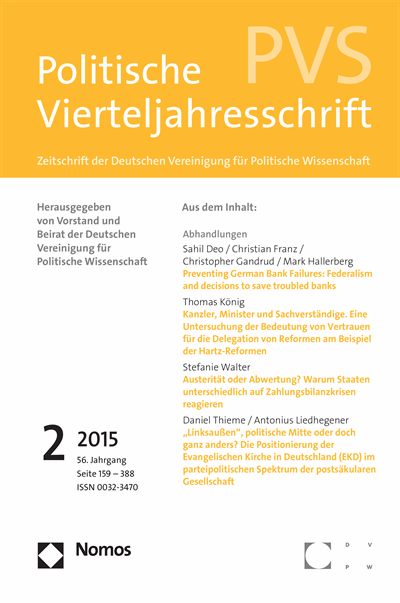
Zeitschrift der Deutschen Vereinigung für Politikwissenschaft
Jahrgang 56 (2015), Heft 2
- Autor:innen:
- Verlag
- Nomos, Baden-Baden
- Erscheinungsjahr
- 2015
- ISSN-Online
- 0032-3470
- ISSN-Print
- 0032-3470
Kapitelinformationen
Jahrgang 56 (2015), Heft 2
Austerität oder Abwertung? Warum Staaten unterschiedlich auf Zahlungsbilanzkrisen reagieren
- Autor:innen:
- ISSN-Print
- 0032-3470
- ISSN-Online
- 0032-3470
- Kapitelvorschau:
Warum gelingt es einigen Staaten, Zahlungsbilanzkrisen erfolgreich durch Austerität und Strukturreformen zu bekämpfen, anderen Staaten jedoch nicht? Dieser Artikel argumentiert, dass die Globalisierung der Finanzmärkte die Verwundbarkeit der Wähler gegenüber einer Wechselkursabwertung in manchen Staaten stark erhöht hat. Diese verwundbaren Wähler sind daher eher bereit, schmerzhafte interne Anpassungsstrategien mitzutragen, um eine Abwertung des Wechselkurses zu verhindern. Wo diese Verwundbarkeit gering ist, ist eine solche Strategie jedoch politisch kaum umzusetzen. Eine vergleichende Fallstudie von acht osteuropäischen Staaten zeigt, dass die Verwundbarkeitsprofile der dortigen Wählerschaften die sehr unterschiedlichen Reaktionen dieser Staaten auf die globale Finanzkrise 2008-10 erklären können.
Literaturverzeichnis
Es wurden keine Treffer gefunden. Versuchen Sie einen anderen Begriff.
- Alesina, Alberto, und Allan Drazen. 1991. Why are Stabilizations Delayed? American Economic Review 81: 1170-1188. Google Scholar öffnen
- Alesina, Alberto, Silvia Ardagna, und Francesco Trebbi. 2006. Who Adjusts and When? On the Political Economy of Reforms. NBER Working Paper No. 12049. Cambridge, MA: National Bureau of Economic Research. Google Scholar öffnen doi.org/10.3386/w12049
- Aslund, Anders. 2010. The Last Shall Be the First. The Eastern European Financial Crisis, 2008-10. Washington D. C.: The Peterson Institute. Google Scholar öffnen
- Aslund, Anders. 2011. Exchange Rate Policy and the Central and East European Financial Crisis. Eurasian Geography and Economics 52: 375-389. Google Scholar öffnen
- Bearce, David H., und Mark Hallerberg. 2011. Democracy and De Facto Exchange Rate Regimes. Economics & Politics 23: 172-194. DOI: 10.1111/j.1468-0343.2011.00381.x. Google Scholar öffnen doi.org/10.1111/j.1468-0343.2011.00381.x
- Bloom, Stephen. 2011. The 2010 Latvian parliamentary elections. Electoral Studies 30: 366-383. DOI: 10.1016/j.electstud.2011.03.003. Google Scholar öffnen doi.org/10.1016/j.electstud.2011.03.003
- Brown, Martin, Marcel Peter, und Simon Wehrmüller. 2009. Swiss Franc Lending in Europe. Aussenwirtschaft (Swiss Review of International Economics) 64: 167-182. Google Scholar öffnen
- CBOS Public Opinion. 2011. Final Evaluation of the Government of Donald Tusk. Polish Public Opinion October 2011. Warschau: Centrum Badania Opinii Społecznej. Google Scholar öffnen
- Chang, Roberto, und Andrés Velasco. 2001. A Model of Financial Crises in Emerging Markets. The Quarterly Journal of Economics 116: 489-517. DOI: 10.1162/ Google Scholar öffnen doi.org/10.1162/00335530151144087
- 00335530151144087. Google Scholar öffnen
- Connolly, Richard. 2012. The Determinants of the Economic Crisis in Post-Socialist Europe. Europe-Asia Studies 64: 35-67. DOI: 10.1080/09668136.2012.635474. Google Scholar öffnen doi.org/10.1080/09668136.2012.635474
- Copelovitch, Mark. 2010. The International Monetary Fund in the Global Economy. Cambridge: Cambridge University Press. Google Scholar öffnen doi.org/10.1017/CBO9780511712029.001
- Dorrussen, Han, und Michaell Taylor. 2002. Group economic voting: A comparison of the Netherlands and Germany. In dies: Economic Voting, 92-120. New York: Routledge. Google Scholar öffnen
- Dreher, Axel, und Stefanie Walter. 2010. Does the IMF Help or Hurt? The Effect of IMF programs on the Likelihood and Outcome of Currency Crises. World Development 38: 1-18. DOI: 10.1016/j.worlddev.2009.05.007. Google Scholar öffnen doi.org/10.1016/j.worlddev.2009.05.007
- European Bank for Reconstruction and Development (EBRD). 2010. Transition Report 2009. London: European Bank for Reconstruction and Development. Google Scholar öffnen
- Eichengreen, Barry. 1992. Golden Fetters. The Gold Standard and the Great Depression. New York: Oxford University Press. Google Scholar öffnen
- Eichengreen, Barry, und Ricardo Hausmann (Hrsg.). 2005. Other People’s Money. Debt Denomination and Financial Instability in Emerging Market Economies. Chicago: The University of Chicago Press. Google Scholar öffnen doi.org/10.7208/chicago/9780226194578.001.0001
- Economist Intelligence Unit (EIU). 2008. Czech Republic. Economist Intelligence Unit Country Report October 2008. London: Economist Intelligence Unit. Google Scholar öffnen
- Economist Intelligence Unit (EIU). 2009a. Hungary. Economist Intelligence Unit Country Report April 2009. London: Economist Intelligence Unit. Google Scholar öffnen
- Economist Intelligence Unit (EIU). 2009b. Bulgaria. Economist Intelligence Unit Country Report April 2009. London: Economist Intelligence Unit. Google Scholar öffnen
- Economist Intelligence Unit (EIU). 2009c. Latvia. Economist Intelligence Unit Country Report January 2009. London: Economist Intelligence Unit. Google Scholar öffnen
- Economist Intelligence Unit (EIU). 2009d. Bulgaria. Economist Intelligence Unit Country Report August 2009. London: Economist Intelligence Unit. Google Scholar öffnen
- European Commission. 2014. Statistical Annex of Alert Mechanism Report 2014. Brussels: European Commission. Google Scholar öffnen
- Eurostat. 2014. Government Finance Statistics (GFS). SW Online Database. http://ec.europa.eu/eurostat/web/government-finance-statistics/data/database. Zugegriffen: 13.08.2014. Google Scholar öffnen
- Fernandez, Raquel, und Dani Rodrik. 1991. Resistance to Reform: Status Quo Bias in the Presence of Individual-Specific Uncertainty. American Economic Review 81: 1146-1155. Google Scholar öffnen
- Fiorina, Morris. 1981. Retrospective Voting in American National Elections. New Haven: Yale University Press. Google Scholar öffnen
- Franzese, Robert J. 2002. Macroeconomic Policies of Developed Democracies. Cambridge: Cambridge University Press. Google Scholar öffnen doi.org/10.1017/CBO9780511810404
- Frieden, Jeffry. 1991. Debt, Development, and Democracy. Princeton: Princeton University Press. Google Scholar öffnen
- Frieden, Jeffry. 2014. Currency Politics. The Political Economy of Exchange Rate Policy. Princeton: Princeton University Press. Google Scholar öffnen
- Funke, Manuel, Moritz Schularick, und Christoph Trebesch. 2014. Hard Right Turns: Political Polarization after Financial Crises, 1870-2012. Konferenzpapier, Tagung „The Political Economy of the Euro Crisis” in Berlin, 18. Juni 2014. Google Scholar öffnen
- Garrett, Geoffrey. 1998. Partisan Politics in the Global Economy. New York: Cambridge University Press. Google Scholar öffnen doi.org/10.1017/CBO9780511625633
- Gourevitch, Peter. 1986. Politics in Hard Times: Comparative Responses to International Economic Crises. Ithaca, NY: Cornell University Press. Google Scholar öffnen
- Government of Romania. 2009. Letter of Intent and Technical Memorandum of Understanding. Bucharest: Government of Romania. Google Scholar öffnen
- Haggard, Stephan, und Robert R Kaufman (Hrsg.). 1992. The Politics of Economic Adjustment: International Constraints, Distributive Conflicts, and the State. Princeton: Princeton University Press. Google Scholar öffnen
- Hibbs, Douglas. 1977. Political Parties and Macroeconomic Policy. American Political Science Review 71: 1467-1487. Google Scholar öffnen doi.org/10.2307/1961490
- Ilonszki, Gabriella, und Sándor Kurtán. 2009. Hungary. European Journal of Political Research 48: 973-979. DOI: 10.1111/j.1475-6765.2009.01873.x. Google Scholar öffnen doi.org/10.1111/j.1475-6765.2009.01873.x
- International Monetary Fund (IMF). 2012a. Latvia’s Successful Recovery Not Easy to Replicate. IMF Survey online June 11, 2012. http://www.imf.org/external/pubs/ft/survey/so/2012/CAR061112A.htm. Zugegriffen: 05.03.2015 Google Scholar öffnen
- International Monetary Fund (IMF). 2012b. Republic of Latvia: Fifth Review Under the Stand-By Arrangement and Financing Assurances Review, Request for Waiver of Nonobservance of a Performance Criterion, and Proposal for Post-Program Monitoring. IMF Country Report No. 12/31. Washington, D. C.: International Monetary Fund. Google Scholar öffnen
- Johnston, Alison, Bob Hancké, und Suman Pant. 2014. Comparative institutional advantage in the European sovereign debt crisis. Comparative Political Studies 47: 1771-1800. Google Scholar öffnen doi.org/10.1177/0010414013516917
- Kahler, Miles. 1990. Orthodoxy and Its Alternatives: Explaining Approaches to Stabilization and Adjustment. In Economic Crisis and Policy Choice. The Politics of Adjustment in the Third World, Hrsg. Joan M. Nelson, 33-62. Princeton: Princeton University Press. Google Scholar öffnen
- Kahler, Miles, und David Lake (Hrsg.). 2003. Governance in a Global Economy. Political Authority in Transition. Princeton: Princeton University Press. Google Scholar öffnen
- Kahler, Miles, und David A Lake (Hrsg.). 2013. Politics in the New Hard Times: The Great Recession in Comparative Perspective. Cornell University Press. Google Scholar öffnen
- Keefer, Philip, und David Stasavage. 2002. Checks and Balances, Private Information, and the Credibility of Monetary Commitments. International Organization 56: 751-774. Google Scholar öffnen doi.org/10.1162/002081802760403766
- Keohane, Robert O, und Helen V. Milner. 1996. Internationalization and Domestic Politics. Cambridge: Cambridge University Press. Google Scholar öffnen doi.org/10.1017/CBO9780511664168
- Klein, Michael W., und Nancy P. Marion. 1997. Explaining the duration of exchange-rate pegs. Journal of Development Economics 54: 387-404. DOI: 10.1016/S0304-3878(97)00048-5. Google Scholar öffnen doi.org/10.1016/S0304-3878(97)00048-5
- Krugman, Paul. 1979. A Model of Balance of Payments Crises. Journal of Money, Credit and Banking 11: 311-325. Google Scholar öffnen doi.org/10.2307/1991793
- Krupavicus, Algis. 2010. Lithuania. European Journal of Political Research 49: 1058-1075. Google Scholar öffnen
- Kuokstis, Vyautas, und Ramunas Vilpisauskas. 2010. Economic Adjustment to the Crisis in the Baltic States in Comparative Perspective. Beitrag präsentiert bei der siebten Pan-European International Relations Conference, September, Stockholm. Google Scholar öffnen
- Lallement, Michel. 2011. Europe and the economic crisis: forms of labour market adjustment and varieties of capitalism. Work, employment & society 25: 627-641. DOI: 10.1177/0950017011419717. Google Scholar öffnen doi.org/10.1177/0950017011419717
- Leblang, David. 2003. To Devalue or to Defend? The Political Economy of Exchange Rate Policy. International Studies Quarterly 47: 533-559. DOI: 10.1046/j.0020-8833. Google Scholar öffnen
- 2003.00278.x. Google Scholar öffnen
- Leblang, David. 2005. Pegs and Politics. Beitrag präsentiert beim American Political Science Association Annual Meeting, Marriott Wardman Park, Omni Shoreham, Washington Hilton, Washington, D. C. Google Scholar öffnen
- Lewis-Beck, Michael S., und Mary Stegmaier. 2000. Economic Determinants of Electoral Outcomes. Annual Review of Political Science 3: 183-219. Google Scholar öffnen doi.org/10.1146/annurev.polisci.3.1.183
- Linek, Lukás, und Tomás Lacina. 2010. Czech Republic. European Journal of Political Research 49: 939-946. Google Scholar öffnen doi.org/10.1111/j.1475-6765.2010.01948.x
- Lütz, Susanne, and Matthias Kranke. 2014. The European rescue of the Washington Consensus? EU and IMF lending to Central and Eastern European countries. Review of International Political Economy 21: 310-338. DOI: 10.1080/09692290.2012.747104. Google Scholar öffnen doi.org/10.1080/09692290.2012.747104
- Mankiw, Gregory. 2000. Macroeconomics. New York: Worth Publishers. Google Scholar öffnen
- Marer, Paul. 2010. The Global Economic Crises: Impacts on Eastern Europe. Acta Oeconomica 60: 3-33. DOI: 10.1556/AOecon.60.2010.1.2. Google Scholar öffnen doi.org/10.1556/AOecon.60.2010.1.2
- Masso, Jaan, und Kerly Krillo. 2011. Labour Markets in the Baltic States During the crisis 2008-2009: The Effect on Different Labour Market Groups. FEBA Working Paper Series Nr. 79. Tartu: The University of Tartu. Google Scholar öffnen doi.org/10.2139/ssrn.1734378
- Mendoza, E. G., V. Quadrini, und J. V. Rios-Rull. 2009. Financial Integration, Financial Development, and Global Imbalances. Journal of Political Economy 117: 371-416. Google Scholar öffnen doi.org/10.1086/599706
- Nelson, Joan M. 1994. Linkages Between Politics and Economics. Journal of Democracy 5: 49-62. DOI: 10.1353/jod.1994.0060. Google Scholar öffnen doi.org/10.1353/jod.1994.0060
- Nölke, Andreas. 2012. Rettet Europa! Ohne den Euro? Blätter für deutsche und internationale Politik 3: 55-64. Google Scholar öffnen
- Oatley, Thomas H. 1997. Monetary Politics. Exchange Rate Cooperation in the European Union. Ann Arbour: University of Michigan Press. Google Scholar öffnen
- Oatley, Thomas. 2004. Why is Stabilization Sometimes Delayed? Reevaluating the Regime-Type Hypothesis. Comparative Political Studies 37: 286-312. DOI: 10.1177/ Google Scholar öffnen doi.org/10.1177/0010414003262072
- 0010414003262072. Google Scholar öffnen
- Obstfeld, Maurice, und Kenneth S. Rogoff. 2009. Global Imbalances and the Financial Crisis: Products of Common Causes. CEPR Discussion Papers Nr. 7606. Washington, D. C.: Center for Economic and Policy Research. Google Scholar öffnen
- Organisation for Economic Co-operation and Development (OECD). 2014. Structural Analysis Databases. Input-Output Imports content of Exports. OECD StatExtracts. Google Scholar öffnen
- http://stats.oecd.org/Index.aspx?DataSetCode=STAN_IO_M_X. Zugegriffen. 11.03.2014. Google Scholar öffnen
- Pacek, A. C. 1994. Macroeconomic Conditions and Electoral-Politics in East-Central-Europe. American Journal of Political Science 38: 723-744. Google Scholar öffnen doi.org/10.2307/2111604
- Purfield, Catriona, und Christoph Rosenberg. 2010. Adjustment under a Currency Peg: Estonia, Latvia and Lithuania during the Global Financial Crisis 2008-09. IMF Working Paper WP/10/213. Washington, D. C.: International Monetary Fund. Google Scholar öffnen doi.org/10.5089/9781455205448.001
- Remmer, Karen L. 1991. The Political Impact of Economic Crisis in Latin America in the 1980s. The American Political Science Review: 777-800. Google Scholar öffnen doi.org/10.2307/1963850
- Roubini, Nouriel. 2009. Latvia’s currency crisis is a rerun of Argentina’s. Financial Times. http://www.ft.com/cms/s/0/95df08fe-55f3-11de-ab7e-00144feabdc0.html#axzz3TWvKjdcY. Zugegriffen: 05.03.2015. Google Scholar öffnen
- Sattler, Thomas, und Stefanie Walter. 2010. Monetary Credibility vs. Voter Approval: Political Institutions and Exchange-Rate Stabilization during Crises. Economics and Politics 22: 392-418. DOI: 10.1111/j.1468-0343.2010.00367.x. Google Scholar öffnen doi.org/10.1111/j.1468-0343.2010.00367.x
- Scharpf, Fritz. 2013. Monetary Union, Fiscal Crisis and the Disabling of Democratic Accountability. In Politics in the Age of Austerity, Hrsg. Armin Schäfer und Wolfgang Streeck. Cambridge/Malden, MA: Polity Press. Google Scholar öffnen
- Schwab, Klaus, und Michael Porter. 2008. Global Competitiveness Report 2008-2009. Genf: World Economic Forum. Google Scholar öffnen
- Simmons, Beth. 1994. Who Adjusts? Domestic Sources of Foreign Economic Policy During the Interwar Years. Princeton, NJ: Princeton University Press. Google Scholar öffnen
- Singer, Matthew. 2010. Who Says “It’s the Economy”? Cross-National and Cross-Individual Variation in the salience of Economic Performance. Comparative Political Studies 44: 284-312. DOI: 10.1177/0010414010384371. Google Scholar öffnen doi.org/10.1177/0010414010384371
- Singer, Matthew, und Francois Gélineau. 2012. Heterogenous Economic Voting: Evidence from Latin America 1995-2005. Paper präsentiert auf der Midwest Political Science Association Annual Conference 2012. Chicago. Google Scholar öffnen
- Skidmore, Thomas E. 1977. The politics of economic stabilization in postwar Latin America. In Authoritarianism and Corporatism in Latin America, Hrsg. James Malloy, 149-190. Pittsburgh: University of Pittsburgh. Google Scholar öffnen
- Soroka, Stuart. 2006. Good News and Bad News: Asymmetric Responses to Economic Information. Journal of Politics 68: 372-385. DOI: 10.1111/j.1468-2508.2006.00413.x. Google Scholar öffnen doi.org/10.1111/j.1468-2508.2006.00413.x
- Stan, Lavinia, und Razvan Zaharia. 2010. Romania. European Journal of Political Research 49: 1139-1153. Google Scholar öffnen doi.org/10.1111/j.1475-6765.2010.01970.x
- Stegmaier, Mary, und Klára Vlachová. 2011. The parliamentary election in the Czech Republic, May 2010. Electoral Studies 30: 223-244. DOI: 10.1016/j.electstud.2014.03.001. Google Scholar öffnen doi.org/10.1016/j.electstud.2014.03.001
- Stiglitz, Joseph. 2002. Globalization and Its Discontents. London: Penguin Books. Google Scholar öffnen
- Tagkalakis, Athanasios. 2009. Fiscal adjustments: do labor and product market institutions matter? Public Choice 139: 389-411. DOI 10.1007/s11127-009-9400-8. Google Scholar öffnen doi.org/10.1007/s11127-009-9400-8
- Tepe, Markus, und Pieter Vanhuysse. 2010. Who Cuts Back and When? The Politics of Delays in Social Expenditure Cutbacks, 1980-2005. West European Politics 33: 1214-1240. Google Scholar öffnen doi.org/10.1080/01402382.2010.508903
- Tsebelis, George. 2002. Veto Players. How Political Institutions Work. Princeton: Princeton University Press. Google Scholar öffnen doi.org/10.1515/9781400831456
- Tworzecki, Hubert. 2012. The Polish Parliamentary Elections of October 2011. Electoral Studies 31: 617-621. Google Scholar öffnen doi.org/10.1016/j.electstud.2012.04.007
- Vreeland, James Raymond. 2003. The IMF and Economic Development. Cambridge: Cambridge University Press. Google Scholar öffnen doi.org/10.1017/CBO9780511615726
- Walter, Stefanie. 2009. The Limits and Rewards of Political Opportunism. How Electoral Timing Affects the Outcome of Currency Crises. European Journal of Political Research 48: 367-396. DOI: 10.1111/j.1475-6765.2008.00837.x. Google Scholar öffnen doi.org/10.1111/j.1475-6765.2008.00837.x
- Walter, Stefanie. 2012. Distributional Politics in Times of Crisis. Eastern European Policy Responses to the Global Financial and Economic Crisis 2008-10. Beitrag präsentiert auf der EPSA Annual Convention, 21-23.06. 2012, Berlin. Google Scholar öffnen
- Walter, Stefanie. 2013. Financial Crises and the Politics of Macroeconomic Adjustments. Cambridge: Cambridge University Press. Google Scholar öffnen doi.org/10.1017/CBO9781139236812
- Walter, Stefanie. 2014. Private actor exchange rate policy preferences. In Handbook of the International Political Economy of Monetary Relations, Hrsg. Thomas Oatley und W. Kindred Winecoff, 169-184. Cheltenham: Edward Elgar. Google Scholar öffnen doi.org/10.4337/9780857938374.00015
- Walter, Stefanie, und Thomas D. Willett. 2012. Delaying the Inevitable. A Political Economy Model of Currency Defenses and Capitulation. Review of International Political Economy 19: 114-139. Google Scholar öffnen doi.org/10.1080/09692290.2010.514524
- Wandschneider, Kirsten. 2008. The Stability of the Interwar Gold Exchange Standard: Did Politics Matter? Journal of Economic History 68: 151-181. DOI: http://dx.doi.org/10.1017/S0022050708000053. Google Scholar öffnen doi.org/10.1017/S0022050708000053
- Willett, Thomas D. 2006. Optimum Currency Area and Political Economy Approaches to Exchange Rate Regimes: Towards a Framework for Integration. Current Politics and Economics of Europe 17: 25-52. Google Scholar öffnen