Res Judicata in Criminal Matters and the European Courts – A Comparison Between Germany and Italy (Part I)
Inhaltsverzeichnis
Bibliographische Infos
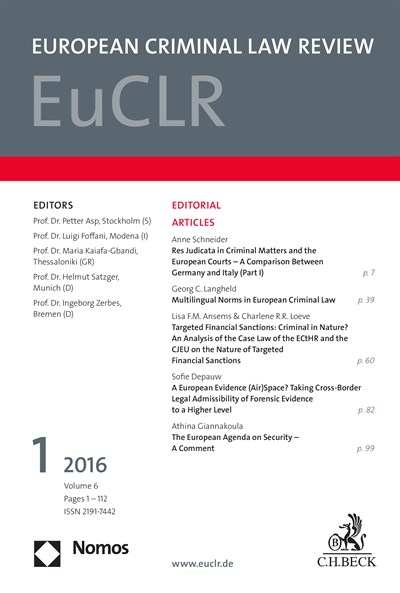
European Criminal Law Review
Jahrgang 6 (2016), Heft 1
- Autor:innen:
- Verlag
- Nomos, Baden-Baden
- Erscheinungsjahr
- 2016
- ISSN-Online
- 2193-5505
- ISSN-Print
- 2191-7442
Kapitelinformationen
Jahrgang 6 (2016), Heft 1
Res Judicata in Criminal Matters and the European Courts – A Comparison Between Germany and Italy (Part I)
- Autor:innen:
- ISSN-Print
- 2191-7442
- ISSN-Online
- 2193-5505
- Kapitelvorschau:
National criminal law is to a large extent influenced by European Law and especially by decisions of the European Courts. European Courts are the Court of Justice of the European Union (Art. 251 et seq. TFEU, in the following “ECJ”) and the European Court of Human Rights (in the following “ECtHR”). The myriad ways in which EU Law and the European Convention on Human Rights (in the following “ECHR”) have an impact on criminal law and criminal procedure have already been explained elsewhere and do not need to be discussed in general. However, European jurisprudence can also provide a challenge to the national principle of res judicata. Final judgements, i.e. those that cannot be challenged on appeal, are endowed with res judicata. Res judicata is a fundamental principle of the European legal systems, which provides legal certainty. It is well established in every Member State and High Contracting Party under national constitutional law. But what happens if a final judgement is contrary to the ECHR or EU law?