Rüstungsexportkontrolle durch den internationalen Waffenhandelsvertrag
Inhaltsverzeichnis
Bibliographische Infos
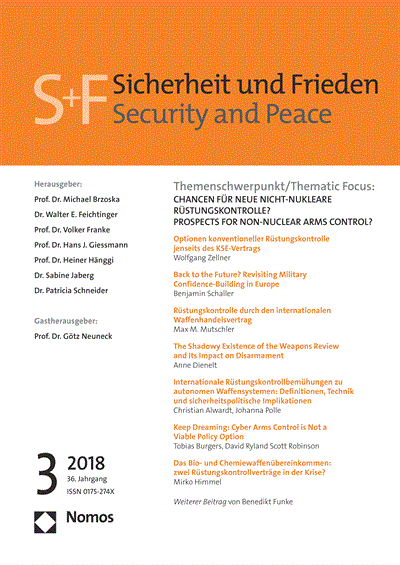
S&F Sicherheit und Frieden
Jahrgang 36 (2018), Heft 3
- Autor:innen:
- Verlag
- Nomos, Baden-Baden
- Copyrightjahr
- 2018
- ISSN-Online
- 0175-274x
- ISSN-Print
- 0175-274X
Kapitelinformationen
Jahrgang 36 (2018), Heft 3
Rüstungsexportkontrolle durch den internationalen Waffenhandelsvertrag
- Autor:innen:
- ISSN-Print
- 0175-274X
- ISSN-Online
- 0175-274x
- Kapitelvorschau:
The Arms Trade Treaty (ATT) sets, for the first time ever, legally binding, international rules for arms transfers. However, due to several problems, in particular the lack of clarity of some of its central concepts, the ATT is far from a significant contribution to the reduction of irresponsible arms transfers. This is highlighted by a look at the arms transfers to the states fighting in Yemen. Among several other measures this article suggests that ATT member states make use of the annual conferences of states parties to debate their interpretation of the central concepts and criteria, with the goal of agreeing in a step-by-step process on how to apply them.
Literaturverzeichnis
Es wurden keine Treffer gefunden. Versuchen Sie einen anderen Begriff.
- Borawski J (1986) Confidence-Building Measures: Rescuing Arms Control. The Fletcher Forum of World Affairs 10(1): 111-131. Google Scholar öffnen doi.org/10.5771/0175-274X-2018-3-115
- Çayirci E and Marinčič D (2009) Computer assisted exercises & training: A reference guide. Hoboken, N.J: John Wiley & Sons. Google Scholar öffnen doi.org/10.5771/0175-274X-2018-3-115
- German Federal Foreign Office Treaty on Conventional Armed Forces in Europe (CFE Treaty). Available at: https://www.auswaertiges-amt.de/en/aussenpolitik/themen/abruestung/uebersicht-konvalles-node/ruestungskontrolle/kse-vertrag-node (accessed 22 February 2018). Google Scholar öffnen doi.org/10.5771/0175-274X-2018-3-115
- Goldblat J (2002) Arms control: The new guide to negotiations and agreements. London, Thousand Oaks, Calif: Sage Publications. Google Scholar öffnen doi.org/10.5771/0175-274X-2018-3-115
- Grand C (2009) European Security and Conventional Arms Control: An Agenda for the 21st Century. In: Zellner W, Schmidt H-J and Neuneck G (eds) Die Zukunft konventioneller Rüstungskontrolle in Europa: The future of conventional arms control in Europe. Baden-Baden: Nomos, 144-151. Google Scholar öffnen doi.org/10.5771/0175-274X-2018-3-115
- Kapanadze S, Kühn U, Richter W and Zellner W (2017) Status-Neutral Security, Confidence-Building and Arms Control Measures in the Georgian Context. Hamburg. Google Scholar öffnen doi.org/10.5771/0175-274X-2018-3-115
- Koivula T (2017) Conventional Arms Control in Europe and its Current Challenges. In: Koivula T and Simonen K (eds) Arms control in Europe: Regimes, trends and threats. Helsinki: National Defence University, 113-132. Google Scholar öffnen doi.org/10.5771/0175-274X-2018-3-115
- Mearsheimer JJ (1990) Back to the Future: Instability in Europe after the Cold War. International Security 15(1): 5-56. Google Scholar öffnen doi.org/10.5771/0175-274X-2018-3-115
- NATO (1984) NATO and Warsaw Pact: Force Comparisons. Available at: https://www.nato.int/cps/en/natohq/declassified_138256.htm (accessed 22 February 2018). Google Scholar öffnen doi.org/10.5771/0175-274X-2018-3-115
- Neuneck G (2017) The US Missile Defense Systems, Europe and Russia. In: Koivula T and Simonen K (eds) Arms control in Europe: Regimes, trends and threats. Helsinki: National Defence University, pp. 35-55. Google Scholar öffnen doi.org/10.5771/0175-274X-2018-3-115
- OSCE – Ministerial Council (2016) From Lisbon to Hamburg: Declaration on the Twentieth Anniversary of the OSCE Framework for Arms Control. Google Scholar öffnen doi.org/10.5771/0175-274X-2018-3-115
- OSCE Lisbon Summit (1996) Lisbon Document 1996. Google Scholar öffnen doi.org/10.5771/0175-274X-2018-3-115
- Rittberger V, Efinger M and Mendler M (1990) Toward an East-West Security Regime: The Case of Confidence- and Security-Building Measures. Journal of Peace Research 27(1): 55-74. Google Scholar öffnen doi.org/10.5771/0175-274X-2018-3-115
- Schmidt H-J (2004) Der Wandel in der konventionellen Rüstungskontrolle 1989-1996. Frankfurt am Main, New York: Campus. Google Scholar öffnen doi.org/10.5771/0175-274X-2018-3-115
- Schmidt H-J (2013) Verified transparency: New conceptual ideas for conventional arms control in Europe. Frankfurt am Main, Germany. Google Scholar öffnen doi.org/10.5771/0175-274X-2018-3-115
- Schultz T (2017) NATO voices skepticism over size of Russia’s Zapad military exercise. Deutsche Welle, 14 September. Google Scholar öffnen doi.org/10.5771/0175-274X-2018-3-115
- Spitzer H (2009) News from Open Skies: A co-operative treaty maintaining military transparency. Google Scholar öffnen doi.org/10.5771/0175-274X-2018-3-115
- Sutyagin I (2017) Zapad-2017: Why Do the Numbers Matter? Available at: https://rusi.org/commentary/zapad-2017-why-do-numbers-matter (accessed 23 January 2018). Google Scholar öffnen doi.org/10.5771/0175-274X-2018-3-115
- Tiilikainen T (2015) Reviving co-operative security in Europe through the OSCE. Helsinki: The Finnish Institute of International Affairs. Google Scholar öffnen doi.org/10.5771/0175-274X-2018-3-115
- Vuorio M (2017) INF Treaty – Present State and Way Forward. In: Koivula T and Simonen K (eds) Arms control in Europe: Regimes, trends and threats. Helsinki: National Defence University, pp. 97-111. Google Scholar öffnen doi.org/10.5771/0175-274X-2018-3-115
- Williams I (2017) The Russia – NATO A2AD Environment. Available at: https://missilethreat.csis.org/russia-nato-a2ad-environment/ (accessed 25 February 2018). Google Scholar öffnen doi.org/10.5771/0175-274X-2018-3-115
- Boothby, Weapons and the Law of Armed Conflict, OUP (2009). Google Scholar öffnen doi.org/10.5771/0175-274X-2018-3-126
- Bothe et al. (eds), New Rules for Victims of Armed Conflicts Commentary on the two 1977 Protocols Additional to the Geneva Conventions of 1949, Martinus Nijhoff Publishers (2013). Google Scholar öffnen doi.org/10.5771/0175-274X-2018-3-126
- Boulanin/Verbruggen, SIPRI Compendium on Article 36 Reviews SIPRI Background Paper (2017), 1. Google Scholar öffnen doi.org/10.5771/0175-274X-2018-3-126
- Casey-Maslen (ed), Weapons under International Human Rights Law, CUP (2014). Google Scholar öffnen doi.org/10.5771/0175-274X-2018-3-126
- Coupland, Review of the legality of weapons: a new approach- The SIrUS Project, 835 IRRC (1999). Google Scholar öffnen doi.org/10.5771/0175-274X-2018-3-126
- Daoust et al., New Wars, New Weapons? The Obligation of States to Assess the Legality of Means and Methods of Warfare, 84 IRRC (2002), 345. Google Scholar öffnen doi.org/10.5771/0175-274X-2018-3-126
- d’Aspremont, Articulating International Human Rights and International Humanitarian Law: Conciliatory Interpretation Under the Guise of Conflict of Norms-Resolution, in: Malgosia Fitzmaurice (ed), The European Convention on Human Rights and the UK Human Rights Act, Brill, Martinus Nijhoff Publishers (2011). Google Scholar öffnen doi.org/10.5771/0175-274X-2018-3-126
- Diplomatic Conference on the/Development of International Humanitarian Law Applicable in Armed Conflicts, Protection of war victims : Protocol 1 to the 1949 Geneva conventions, Protection of war victims : Protocol 1 to the 1949 Geneva conventions. Google Scholar öffnen doi.org/10.5771/0175-274X-2018-3-126
- Droege, The Interplay Between International Humanitarian Law and International Human Rights Law in Situations of Armed Conflict, 40 Isr. L. Rev. (2007), 310. Google Scholar öffnen doi.org/10.5771/0175-274X-2018-3-126
- Fleck/Bothe, Handbook of International Humanitarian Law, OUP (2013). Google Scholar öffnen doi.org/10.5771/0175-274X-2018-3-126
- Germany Defence, Law of Armed Conflict Manual – Joint Service Regulation (ZDv) 15/2, May 2013, available at https://bit.ly/2Kl6U30 (last visited 25 March 2018). Google Scholar öffnen doi.org/10.5771/0175-274X-2018-3-126
- Henckaerts/Doswald-Beck, Customary International Humanitarian Law, CUP (2005). Google Scholar öffnen doi.org/10.5771/0175-274X-2018-3-126
- ICRC, A Guide to the legal review of new weapons, means and methods of warfare – Measures to implement Article 36 of Additional Protocol I of 1977, 2006, available at (last visited 25 March 2018). Google Scholar öffnen doi.org/10.5771/0175-274X-2018-3-126
- ILC, Draft Articles on the Effects of Armed Conflicts on Treaties with Commentaries, Yearbook of the IILC, 2011, Vol. II, Part Two, UN Doc A/66/10 from 2011, available at https://bit.ly/2MnTdNx (last visited 25 March 2018). Google Scholar öffnen doi.org/10.5771/0175-274X-2018-3-126
- Ipsen/Menzel (eds), Völkerrecht, C.H. Beck (2014). Google Scholar öffnen doi.org/10.5771/0175-274X-2018-3-126
- Kalshoven, Reaffirmation and development of international humanitarian law applicable in armed conflicts: the Diplomatic Conference, Geneva, 1974–1977, 9 Netherlands Yearbook of International Law (1978). Google Scholar öffnen doi.org/10.5771/0175-274X-2018-3-126
- Lubell, Challenges in Applying Human Rights Law to Armed Conflict, 87 IRRC (2005), 737. Google Scholar öffnen doi.org/10.5771/0175-274X-2018-3-126
- McClelland, The review of weapons in accordance with Article 36 of Additional Protocol I, 85 IRRC (2003), 397. Google Scholar öffnen doi.org/10.5771/0175-274X-2018-3-126
- Parks, Conventional Weapons and Weapons Reviews, 8 Yearbook of International Humanitarian Law (2007). Google Scholar öffnen doi.org/10.5771/0175-274X-2018-3-126
- Pilloud et al. (eds), Commentary on the Additional Protocols of 8 June 1977 to the Geneva Conventions of 12 August 1949, Martinus Nijhoff Publishers (1987). Google Scholar öffnen doi.org/10.5771/0175-274X-2018-3-126
- Pilloud, Commentary on the additional protocols of 8 June 1977 to the Geneva Conventions of 12 August 1949, International Committee of the Red Cross ; M. Nijhoff (1987). Google Scholar öffnen doi.org/10.5771/0175-274X-2018-3-126
- Vöneky, Die Fortgeltung des Umweltvölkerrechts in Internationalen Bewaffneten Konflikten, Springer (2001). Google Scholar öffnen doi.org/10.5771/0175-274X-2018-3-126
- Wolfrum (ed), Max Planck Encyclopedia of Public International Law, OUP (2013). Google Scholar öffnen doi.org/10.5771/0175-274X-2018-3-126
- Wolfrum, Obligation of Result Versus Obligation of Conduct: Some Thoughts About the Implementation of International Obligations, Looking to the Future, Brill (2010). Google Scholar öffnen doi.org/10.5771/0175-274X-2018-3-126
- Altmann, J. & Gubrud, M. (2013): Compliance Measures for an Autonomous Weapon Convention. ICRAC Working Paper #2. 05/2013. https://www.icrac.net/wp-content/uploads/2018/04/Gubrud-Altmann_Compliance-Measures-AWC_ICRAC-WP2.pdf [08.03.18]. Google Scholar öffnen doi.org/10.5771/0175-274X-2018-3-133
- Alwardt, C. & Krüger, M. (2016): Autonomy of Weapon Systems. IFAR Food for Fought Paper. Februar 2016. https://ifsh.de/file-IFAR/pdf_english/IFAR_FFT_1_final.pdf [08.03.18]. Google Scholar öffnen doi.org/10.5771/0175-274X-2018-3-133
- Arkin, R. C. (2009): Governing Lethal Behavior in Autonomous Robots. Boca Raton: CRC Press. Google Scholar öffnen doi.org/10.5771/0175-274X-2018-3-133
- Asaro, P. (2018): Why the world needs to regulate autonomous weapons, and soon. Bulletin of the Atomic Scientists. 27. April 2018. Google Scholar öffnen doi.org/10.5771/0175-274X-2018-3-133
- Beard, Jack M.B. (2014): Autonomous Weapons and Human Responsibilities. Georgetown Journal of International Law 45. https://thebulletin.org/military-applications-artificial-intelligence/why-world-needs-regulate-autonomous-weapons-and-soon [24.05.18]. Google Scholar öffnen doi.org/10.5771/0175-274X-2018-3-133
- Bekey, G. (2008): Autonomous Military Robotics: Risk, Ethics, and Design. Lin, P., Bekey, G. & Abney, K. (eds.). 2008. Google Scholar öffnen doi.org/10.5771/0175-274X-2018-3-133
- Boulanin, V. (2016): Mapping the Development of Autonomy in Weapons Systems – A Primer on Autonomy. SIPRI. Google Scholar öffnen doi.org/10.5771/0175-274X-2018-3-133
- Brundage, M. (2016): Limitations and Risks of Machine Ethics. In: Müller, V. C. (ed.), Risks of artificial intelligence. Boca Raton, FL London New York: CRC Press. Google Scholar öffnen doi.org/10.5771/0175-274X-2018-3-133
- Campaign to Stop Killer Robots (CtSKR) (2015): Artificial intelligence experts call for ban. stopkillerrobots.org Webseite. 28.07.2015. http://www.stopkillerrobots.org/2015/07/aicall/ [20.03.18]. Google Scholar öffnen doi.org/10.5771/0175-274X-2018-3-133
- CCW (2014): Report of the 2014 informal Meeting of Experts on Lethal Autonomous Weapons Systems (LAWS). Meeting of the High Contracting Parties to the Convention on Prohibitions or Restrictions on the Use of Certain Conventional Weapons Which May Be Deemed to Be Excessively Injurious or to Have Indiscriminate Effects. Genf 2014 CCW/MSP/2014/3. 11.06.2014. https://documents-dds-ny.un.org/doc/UNDOC/GEN/G14/048/96/pdf/G1404896.pdf?OpenElement [20.02.18]. Google Scholar öffnen doi.org/10.5771/0175-274X-2018-3-133
- CCW (2015): Report of the 2015 Informal Meeting of Experts on Lethal Autonomous Weapons Systems (LAWS). Meeting of the High Contracting Parties to the Convention on Prohibitions or Restrictions on the Use of Certain Conventional Weapons Which May Be Deemed to Be Excessively Injurious or to Have Indiscriminate Effects. CCW/MSP/2015/3. 02.06.2015. https://documents-dds-ny.un.org/doc/UNDOC/GEN/G15/111/60/pdf/G1511160.pdf?OpenElement [20.02.18]. Google Scholar öffnen doi.org/10.5771/0175-274X-2018-3-133
- CCW (2016a): Report of the 2016 Informal Meeting of Experts on Lethal Autonomous Weapons Systems (LAWS). 2016. https://documents-dds-ny.un.org/doc/UNDOC/GEN/G16/117/16/pdf/G1611716.pdf?OpenElement [20.02.18]. Google Scholar öffnen doi.org/10.5771/0175-274X-2018-3-133
- CCW (2016b): Recommendations to the 2016 Review Conference. Advanced Version. 2016. https://www.unog.ch/80256EDD006B8954/(httpAssets)/6BB8A498B0A12A03C1257FDB00382863/$file/Recommendations_LAWS_2016_AdvancedVersion+(4+paras)+.pdf [04.03.18]. Google Scholar öffnen doi.org/10.5771/0175-274X-2018-3-133
- CCW (2017): Report of the 2017 Group of Governmental Expert on Lethal Autonomous Weapons Systems (LAWS). Advanced Version. 2017. https://www.unog.ch/80256EDD006B8954/(httpAssets)/B5B99A4D2F8BADF4C12581DF0048E7D0/$file/2017_CCW_GGE.1_2017_CRP.1_Advanced_+corrected.pdf [24.05.18]. Google Scholar öffnen doi.org/10.5771/0175-274X-2018-3-133
- CCW (2018a): Chair’summary of the discussion […]. Zusammenfassung des Vorsitzenden der GGE-Diskussion zu LAWS vom 10-13. April 2018. Genf. https://www.unog.ch/80256EDD006B8954/(httpAssets)/DF486EE2B556C8A6C125827A00488B9E/$file/Summary+of+the+discussions+during+GGE+on+LAWS+April+2018.pdf [24.05.18]. Google Scholar öffnen doi.org/10.5771/0175-274X-2018-3-133
- CCW (2018b): Humanitarian benefits of emerging technologies in the area of lethal autonomous weapon systems, submitted by the United States of America, Group of Governmental Experts of the High Contracting Parties to the Convention on Prohibitions or Restrictions on the Use of Certain Conventional Weapons Which May Be Deemed to Be Excessively Injurious or to Have Indiscriminate Effects. Genf 2018 CCW/GGE.1/2018/WP.4. https://www.unog.ch/80256EDD006B8954/(httpAssets)/7C177AE5BC10B588C125825F004B06BE/$file/CCW_GGE.1_2018_WP.4.pdf [25.05.18]. Google Scholar öffnen doi.org/10.5771/0175-274X-2018-3-133
- Center for a New American Security (CNAS) (2017): Drone Proliferation: Policy Choices for the Trump Administration. Juni 2017. http://drones.cnas.org/wp-content/uploads/2017/06/CNASReport-DroneProliferation-Final.pdf [25.04.17]. Google Scholar öffnen doi.org/10.5771/0175-274X-2018-3-133
- Dickow, M., Dahlmann, A., Alwardt, C., Sauer, F. & Schörnig, N. (Dickow et al.) (2015): First Steps towards a Multidimensional Autonomy Risk Assessment (MARA) in Weapons Systems. IFAR Working Paper No. 20. Dezember 2015. Abrufbar unter: https://ifsh.de/file-IFAR/pdf_deutsch/IFAR-WP20.pdf [08.03.18] Google Scholar öffnen doi.org/10.5771/0175-274X-2018-3-133
- Dickow, M. (2015): Robotik: ein Game-Changer für Militär und Sicherheitspolitik?. SWP-Studie 14/2015. Google Scholar öffnen doi.org/10.5771/0175-274X-2018-3-133
- Dickow, M., Hansel, M. & Mutschler, M.M. (2015): Präventive Rüstungskontrolle – Möglichkeiten und Grenzen mit Blick auf die Digitalisierung und Automatisierung des Krieges. Sicherheit und Frieden (S+F). 33. Jg. 2/2015 Google Scholar öffnen doi.org/10.5771/0175-274X-2018-3-133
- Geiss, R. (2015): Die völkerrechtliche Dimension autonomer Waffensysteme, Friedrich-Ebert-Stiftung Studie. http://library.fes.de/pdf-files/id/ipa/11444-20150619.pdf [26.03.18]. Google Scholar öffnen doi.org/10.5771/0175-274X-2018-3-133
- Gibbs, S. (2017): Elon Musk leads 116 experts calling for outright ban of killer robots. The Guardian. 20.08.2017. https://www.theguardian.com/technology/2017/aug/20/elon-musk-killer-robots-experts-outright-ban-lethal-autonomous-weapons-war [27.03.18]. Google Scholar öffnen doi.org/10.5771/0175-274X-2018-3-133
- Guarini, M. (2011): Computational neural modeling and the philosophy of ethics. In: Anderson, M. & S. L. Anderson (eds.), Machine ethics. New York, NY: Cambridge Univ. Press. Google Scholar öffnen doi.org/10.5771/0175-274X-2018-3-133
- Henckaerts, J.-M. & Doswald-Beck, L. (2005): Customary International Humanitarian Law. Volume I: Rules, International Committee of the Red Cross. Cambridge: Cambridge Univ. Press. Google Scholar öffnen doi.org/10.5771/0175-274X-2018-3-133
- Heyns, C. (2013): Report of the Special Rapporteur on Extrajudicial, Summary or Arbitrary Executions. UN General Assembly. A/HRC/23/47. New York: United Nations. 09.04.2013. Google Scholar öffnen doi.org/10.5771/0175-274X-2018-3-133
- Human Rights Watch (HRW) (2012): Losing Humanity: The Case against Killer Robots. Human Rights Watch, International Human Rights Council, International Human Rights Clinic. 11/2012. https://www.hrw.org/sites/default/files/reports/arms1112_ForUpload.pdf [21.03.18]. Google Scholar öffnen doi.org/10.5771/0175-274X-2018-3-133
- Human Rights Watch (HRW) (2015): Mind the Gap: The Lack of Accountability for Killer Robots. Human Rights Watch, International Human Rights Clinic. 04/2015. https://www.hrw.org/sites/default/files/reports/arms0415_ForUpload_0.pdf [21.03.18]. Google Scholar öffnen doi.org/10.5771/0175-274X-2018-3-133
- ICRC (2014): ICRC Statement to Concluding Session CCW Expert Meeting on ”Lethal Autonomous Weapon Systems”. Genf 2014. 16.05.2014. https://www.unog.ch/80256EDD006B8954/(httpAssets)/8E6FED84C1D0308CC1257D1500522314/$file/ICRC_LAWS_FinalStatement_2014.pdf [04.03.18]. Google Scholar öffnen doi.org/10.5771/0175-274X-2018-3-133
- Jenks, C. (2016): The Distraction of Full Autonomy and the Need to Refocus the CCW/LAWS Discussion on Critical Functions. In: Geiß, R. & Lahmann, H. (2016): Lethal Autonomous Weapon Systems: Technology, Definition, Ethics, Law & Security. Expert opinions delivered at the CCW informal meeting of experts on lethal autonomous weapons systems. Division Conventional Arms Control (OR10). Auswärtiges Amt 2016. Google Scholar öffnen doi.org/10.5771/0175-274X-2018-3-133
- Kurz, C. (2017): Interview: Die UN-Waffenkonvention und die „Killer-Roboter“. Netzpolitik.org, 04.12.2017. Aktualisiert 05.12.2017. https://netzpolitik.org/2017/interview-die-un-waffenkonvention-und-die-killer-roboter/ [21.03.18]. Google Scholar öffnen doi.org/10.5771/0175-274X-2018-3-133
- Lewis, J. (2015): The Case for Regulating Fully Autonomous Weapons. Yale Law Journal 124(4). Jan.-Feb. 2015. Google Scholar öffnen doi.org/10.5771/0175-274X-2018-3-133
- Mackworth, A. (2011). Architectures and Ethics for Robots, in: M. Anderson & S. Anderson (eds.), Machine Ethics. Cambridge: Cambridge University Press. Google Scholar öffnen doi.org/10.5771/0175-274X-2018-3-133
- Open Letter to the United Nations Convention on Certain Conventional Weapons (2017), Future of Life Institute, 21.08.2017. https://futureoflife.org/autonomous-weapons-open-letter-2017/ [13.02.18]. Google Scholar öffnen doi.org/10.5771/0175-274X-2018-3-133
- Richter, W. (2013): Rüstungskontrolle für Kampfdrohnen. SWP-Aktuell 29/2013. Google Scholar öffnen doi.org/10.5771/0175-274X-2018-3-133
- Schörnig, N. (2015): From Quantitative to Qualitative Arms Control: The Challenges of Modern Weapons Development. In: Global Trends 2015. Prospects for World Society. Stiftung Entwicklung und Frieden, Bonn. Google Scholar öffnen doi.org/10.5771/0175-274X-2018-3-133
- Sharkey, N. (2016): Staying in the loop: human supervisory control of weapons. In: Bhuta, N. et. al. (ed.) (2016): Autonomous Weapons Systems: Law, Ethics, Policy, Cambridge Univ. Press. Cambridge 2016. Google Scholar öffnen doi.org/10.5771/0175-274X-2018-3-133
- Sparrow, R. (2007): Killer Robots. Journal of Applied Philosophy 24(1). 2007. Google Scholar öffnen doi.org/10.5771/0175-274X-2018-3-133
- U.S. Army (2017): The U.S. Army Robotic and Autonomous Systems Strategy. Maneuver, Aviation, and Soldier Division Army Capabilities Integration Center. 03/2017. http://www.tradoc.army.mil/FrontPageContent/Docs/RAS_Strategy.pdf [25.03.18]. Google Scholar öffnen doi.org/10.5771/0175-274X-2018-3-133
- U.S. Department of Defense (2012): Directive 3000.09, Subject: Autonomy in Weapon Systems. U.S. DoD, 21.11.2012. Aktualisiert: 08.05.2017. http://www.esd.whs.mil/Portals/54/Documents/DD/issuances/dodd/300009p.pdf [06.03.18]. Google Scholar öffnen doi.org/10.5771/0175-274X-2018-3-133
- U.S. Department of the Navy & U.S. Marine Corps (2016): Naval Aviation Vision 2016-2025. 06/2016. http://www.navy.mil/strategic/Naval_Aviation_Vision.pdf [23.03.18]. Google Scholar öffnen doi.org/10.5771/0175-274X-2018-3-133
- UK Ministry of Defence (2012): Joint Concept Note 3/2012 Future Air and Space Operating Concept, 09/2012. Google Scholar öffnen doi.org/10.5771/0175-274X-2018-3-133
- UNA-UK (2018): Minority of states block progress on regulating killer robots, 04.09.2018, https://www.una.org.uk/news/minority-states-block-progress-regulating-killer-robots [09.10.18]. Google Scholar öffnen doi.org/10.5771/0175-274X-2018-3-133
- UN Office at Geneva (2018): Background on Lethal Autonomous Weapons Systems. https://www.unog.ch/80256EE600585943/(httpPages)/8FA3C2562A60FF81C1257CE600393DF6?OpenDocument [20.02.18]. Google Scholar öffnen doi.org/10.5771/0175-274X-2018-3-133
- UN Office for Disarmament Affairs: Convention on Prohibitions or Restrictions on the Use of Certain Conventional Weapons Which May Be Deemed to Be Excessively Injurious or to Have Indiscriminate Effects. http://disarmament.un.org/treaties/t/ccwc 16.10.2018. Google Scholar öffnen doi.org/10.5771/0175-274X-2018-3-133
- Vignard, K. (2018): Manifestos and open letters: Back to the future? Bulletin of the Atomic Scientists, 26.04.2018. https://thebulletin.org/military-applications-artificial-intelligence/manifestos-and-open-letters-back-future [25.05.18]. Google Scholar öffnen doi.org/10.5771/0175-274X-2018-3-133
- Work, R. (2016): Remarks by Deputy Secretary Work on Third Offset Strategy. Rede gehalten in Brüssel, Belgien. U.S. Department of Defense. 28.04.2016. https://www.defense.gov/News/Speeches/Speech-View/Article/ 753482/remarks-by-deputy-secretary-work-on-third-offset-strategy/ [19.03.18]. Google Scholar öffnen doi.org/10.5771/0175-274X-2018-3-133
- Ablon, L., & Bogart, T. (2017) Zero Days, Thousands of Nights: The Life and Times of Zero-Day Vulnerabilities and Their Exploits. RAND Corporation. Retrieved from https://www.rand.org/pubs/research_reports/RR1751.html Google Scholar öffnen doi.org/10.5771/0175-274X-2018-3-140
- Amoroso, E. G. (2012). Cyber attacks: protecting national infrastructure. Elsevier. pp.4-33. Google Scholar öffnen doi.org/10.5771/0175-274X-2018-3-140
- Arkin, W. M. (1999, March 29). Sunrise, Sunset. Washington Post. Retrieved June 2, 2018, from https://www.washingtonpost.com/wp-srv/national/dotmil/arkin032999.htm Google Scholar öffnen doi.org/10.5771/0175-274X-2018-3-140
- Avgerinos, T., Cha, S. K., Rebert, A., Schwartz, E. J., Woo, M., & Brumley, D. (2014). Automatic exploit generation. Communications of the ACM, 57(2), 74-84. Google Scholar öffnen doi.org/10.5771/0175-274X-2018-3-140
- Bull, H. (1966). The control of the arms race: Disarmament and arms control in the missile age. New York: Praeger. Google Scholar öffnen doi.org/10.5771/0175-274X-2018-3-140
- Bumiller, E., & Shanker, T. (2012, October 11). Panetta Warns That U.S. Is Vulnerable to Cyber-Pearl Harbor. The New York Times. Retrieved February 26, 2018, from http://www.nytimes.com/2012/10/12/world/panetta-warns-of-dire-threat-of-cyberattack.html Google Scholar öffnen doi.org/10.5771/0175-274X-2018-3-140
- Burgers, T. & Robinson, D.R.S. (2016), Networked Authoritarianism Is on the Rise, in Sicherheit und Frieden/Security and Peace, 34(4), 248–252. Google Scholar öffnen doi.org/10.5771/0175-274X-2018-3-140
- Borghard, E. D., & Lonergan, S. W. (2018, January 16). Why Are There No Cyber Arms Control Agreements?, Retrieved March 1, 2018, from https://www.cfr.org/blog/why-are-there-no-cyber-arms-control-agreements Google Scholar öffnen doi.org/10.5771/0175-274X-2018-3-140
- Boulanin, V. (2013, May 30). Arms production goes cyber: a challenge for arms control Stockholm International Peace Research Institute. Retrieved from https://www.sipri.org/node/361 Google Scholar öffnen doi.org/10.5771/0175-274X-2018-3-140
- Bronk, C., & Wallach, D. (2013, March 26). Opinion: Cyber arms control? Forget about it. Retrieved June 2, 2018, from https://edition.cnn.com/2013/03/26/opinion/bronk-wallach-cyberwar/ Google Scholar öffnen doi.org/10.5771/0175-274X-2018-3-140
- Cavelty, M. D. (2013). From Cyber-Bombs to Political Fallout: Threat Representations with an Impact in the Cyber-Security Discourse, International Studies Review 15(1),105-122. Google Scholar öffnen doi.org/10.5771/0175-274X-2018-3-140
- Craig, A., & Valeriano, B. (2016). Conceptualising Cyber Arms Races. In 2016 8th International Conference on Cyber Conflict Cyber Power, Pissanidis, N., Rõigas, H. & Veenendaal M. (Eds.),141-158, Tallinn: NATO CCD COE Publications. Google Scholar öffnen doi.org/10.5771/0175-274X-2018-3-140
- Dittrich, P., & Boening, B. (2017). More security in cyberspace: The case for arms control. Security Policy Working Paper, (9), 1-5, BAKS Federal Academy for Security Policy, Berlin, Germany. Google Scholar öffnen doi.org/10.5771/0175-274X-2018-3-140
- Freedom House. (2017). Freedom on the Net 2017. Retrieved from https://freedomhouse.org/report/freedom-net/freedom-net-2017 Google Scholar öffnen doi.org/10.5771/0175-274X-2018-3-140
- Floridi, L. (2007). A Look into the Future Impact of ICT on Our Lives. The Information Society,23(1), 59-64. doi:10.1080/01972240601059094 Google Scholar öffnen doi.org/10.5771/0175-274X-2018-3-140
- Galeotti, M. (2018, January 31). Size Doesn’t Matter for Spies Anymore. Retrieved March 01, 2018, from https://foreignpolicy.com/2018/01/31/size-doesnt-matter-for-spies-anymore/ Google Scholar öffnen doi.org/10.5771/0175-274X-2018-3-140
- Galinec, D., Možnik, D., & Guberina, B. (2017). Cybersecurity and cyber defence: National level strategic approach. Automatika, 58(3), 273-286. doi:10.1080/00051144.2017.1407022 Google Scholar öffnen doi.org/10.5771/0175-274X-2018-3-140
- Glenny, M. (2011, October 12). The Cyber Arms Race Has Begun. Retrieved February 26, 2018, from https://www.thenation.com/article/cyber arms-race-has-begun/ Google Scholar öffnen doi.org/10.5771/0175-274X-2018-3-140
- Goodin, D. (2008, July 21). Researcher’s hypothesis may expose uber-secret DNS flaw. The Register. Retrieved from https://www.theregister.co.uk/2008/07/21/dns_flaw_speculation/ Google Scholar öffnen doi.org/10.5771/0175-274X-2018-3-140
- Healey, J. (2013a). A fierce domain: Conflict in cyberspace, 1986 to 2012. Vienna, VA: Cyber Conflict Studies Association. Google Scholar öffnen doi.org/10.5771/0175-274X-2018-3-140
- Healey, J. (2013b). The Lessons of Cyber Conflict History, So Far…. Atlantic Council. Excerpted from the introduction of A Fierce Domain: Cyber Conflict 1986 to 2012. Google Scholar öffnen doi.org/10.5771/0175-274X-2018-3-140
- Healey, J. (2016, November 1). The U.S. Government and Zero-Day Vulnerabilities: From Pre-Heartbleed to Shadow Brokers. Columbia University, School of International and Public Affairs, Journal of International Affairs. Retrieved from https://jia.sipa.columbia.edu/online-articles/healey_vulnerability_equities_process Google Scholar öffnen doi.org/10.5771/0175-274X-2018-3-140
- Hurwitz, R. (1999). Who Needs Politics? Who Needs People? The Ironies of Democracy in Cyberspace. Contemporary Sociology,28(6), 655-661. Retrieved from http://www.jstor.org/stable/2655536 Google Scholar öffnen doi.org/10.5771/0175-274X-2018-3-140
- International Data Corporation. (2017, March 29). Worldwide Spending on Security Technology Forecast to Reach $81.7 Billion in 2017, According to New IDC Spending Guide. Retrieved June 1, 2018, from https://www.idc.com/getdoc.jsp?containerId=prUS42425417 Google Scholar öffnen doi.org/10.5771/0175-274X-2018-3-140
- Jellenc, E. (2012). Explaining Politico-Strategic Cyber Security: The Feasibility of Applying Arms Race Theory. In 11th European Conference on Information warfare and security: ECIW2012, (20), 151-162). Reading: Academic Publishing. Google Scholar öffnen doi.org/10.5771/0175-274X-2018-3-140
- Jenkins, H., Thorburn, D. (2003). Introduction: Digital Revolution, Informed Citizen and the Culture of Democracy, in Democracy and new media, 1-17, Jenkins, H and Thorburn, D. (eds.). Google Scholar öffnen doi.org/10.5771/0175-274X-2018-3-140
- Jervis, R. (1976). Perception and misperception in international politics. New Jersey: Princeton University Press. Google Scholar öffnen doi.org/10.5771/0175-274X-2018-3-140
- Kaspersky, E. (2012, July 3). What Are The Top IT Security Threats? Retrieved March 01, 2018, from https://eugene.kaspersky.com/2012/07/03/worse-than-cheese-five-main-issues-of-it-security/ Google Scholar öffnen doi.org/10.5771/0175-274X-2018-3-140
- Kehler, C. R., Lin, H., & Sulmeyer, M. (2017). Rules of engagement for cyberspace operations: A view from the USA. Journal of Cybersecurity, 3(1), 69-80. doi:0.1093/cybsec/tyx003 Google Scholar öffnen doi.org/10.5771/0175-274X-2018-3-140
- Kung, L., Kröll, A., Ripken, B., & Walker, M. (1999). Impact of the Digital Revolution on the Media and Communications Industries. Javnost – The Public Journal of the European Institute for Communication and Culture, 6, 29-47. doi: https://doi.org/10.1080/13183222.1999.11008717 Google Scholar öffnen doi.org/10.5771/0175-274X-2018-3-140
- Kydd, A. (2000). Arms Races and Arms Control: Modeling the Hawk Perspective. American Journal of Political Science, 44(2), 228-244. doi:10.2307/2669307 Google Scholar öffnen doi.org/10.5771/0175-274X-2018-3-140
- Levy, S. (2001). Crypto: How the code rebels beat the government--saving privacy in the digital age. Penguin Press. Google Scholar öffnen doi.org/10.5771/0175-274X-2018-3-140
- Limnéll, J. (2016). The cyber arms race is accelerating – what are the consequences? Journal of Cyber Policy, 1(1), 50-60. doi:10.1080/23738871.2016.1158304 Google Scholar öffnen doi.org/10.5771/0175-274X-2018-3-140
- Litwak, R., & King, M. (2015). Arms Control in Cyberspace? (Wilson Briefs, pp. 1-8, Issue brief). Washington, DC: Woodrow Wilson International Center for Scholars. Google Scholar öffnen doi.org/10.5771/0175-274X-2018-3-140
- Macak, K. (2017, July 18). From Cyber Norms to Cyber Rules: Re-engaging States as Law-makers | Leiden Journal of International Law. Retrieved February 26, 2018, from https://www.cambridge.org/core/journals/leiden-journal-of-international-law/article/from-cyber-norms-to-cyber-rules-reengaging-states-as-lawmakers/63A45029B685C11BBD9512AC0459FAE5 Google Scholar öffnen doi.org/10.5771/0175-274X-2018-3-140
- Maybaum, M., & Tölle, J. (2016). Arms control in cyberspace – architecture for a trust-based implementation framework based on conventional arms control methods. Cyber Conflict (CyCon), 2016 8th International Conference on, 159-174. doi:10.1109/CYCON.2016.7529433 Google Scholar öffnen doi.org/10.5771/0175-274X-2018-3-140
- McAfee. (2012, January 30). 57% Believe a Cyber Arms Race is Currently Taking Place, Reveals McAfee-Sponsored Cyber Defense Report. Retrieved March 01, 2018, from https://www.mcafee.com/us/about/news/2012/q1/20120130-02.aspx Google Scholar öffnen doi.org/10.5771/0175-274X-2018-3-140
- Metz, C. (2016, June 03). Will Humans or Bots Rule Cybersecurity? The Answer Is Yes. Retrieved February 27, 2018, from https://www.wired.com/2016/08/will-humans-bots-rule-cybersecurity-answer-yes/ Google Scholar öffnen doi.org/10.5771/0175-274X-2018-3-140
- Meyer, P. (2012) Diplomatic Alternatives to Cyber-Warfare, The RUSI Journal, 157(1), 14-19, DOI: 10.1080/03071847.2012.664357 Google Scholar öffnen doi.org/10.5771/0175-274X-2018-3-140
- Mimran, D. (2017). The cyberspace arms race: artificial intelligence & cyber security (Issue brief). The Forum Network (OECD). Google Scholar öffnen doi.org/10.5771/0175-274X-2018-3-140
- Modderkolk, H. (2018, January 25). Dutch agencies provide crucial intel about Russia’s interference in US-elections. De Volkskrant. Retrieved from https://www.volkskrant.nl/tech/dutch-agencies-provide-crucial-intel-about-russia-s-interference-in-us-elections~a4561913/ Google Scholar öffnen doi.org/10.5771/0175-274X-2018-3-140
- Nakashima, E. (2017, November 15). Trump administration pulls back curtain on secretive cybersecurity process. The Washington Post. Retrieved from https://www.washingtonpost.com/world/national-security/trump-administration-pulls-back-curtain-on-secretive-cybersecurity-process/2017/11/15/f9a2e3ec-ca16-11e7-aa96-54417592cf72_story.html Google Scholar öffnen doi.org/10.5771/0175-274X-2018-3-140
- Netanyahu,, B. (2017, June 26). PM Netanyahu addresses TAU Cyber-Tech conference. Retrieved from http://mfa.gov.il/MFA/PressRoom/2017/Pages/PM-Netanyahu-addresses-TAU-Cyber-Tech-conference-26-June-2017.aspx Google Scholar öffnen doi.org/10.5771/0175-274X-2018-3-140
- Noor, E. (2015). Strategic Governance of Cyber Security: Implications for East Asia. In Navigating Change: ASEAN-Japan Strategic Partnership in East Asia and in Global Governance, 150-163, Rizal Sukma and Yoshihide Soeya (eds), Japan Center for International Exchange, Tokyo, Japan. Google Scholar öffnen doi.org/10.5771/0175-274X-2018-3-140
- Nye Jr., J. S. (2011a). Nuclear Lessons for Cyber Security? Strategic Studies Quarterly, 5(4), 18-38. Google Scholar öffnen doi.org/10.5771/0175-274X-2018-3-140
- Nye Jr., J. S. (2011b). The Future of Power, Public Affairs, NYC, New York Google Scholar öffnen doi.org/10.5771/0175-274X-2018-3-140
- Nye Jr., J. S. (2015, October 01). The world needs new norms on cyberwarfare. Retrieved February 26, 2018, from https://www.washingtonpost.com/opinions/the-world-needs-an-arms-control-treaty-for-cybersecurity/2015/10/01/20c3e970-66dd-11e5-9223-70cb36460919_story.html?utm_term=.0492eca3e247 Google Scholar öffnen doi.org/10.5771/0175-274X-2018-3-140
- Poulsen, K. (2001, June 15). Solar Sunrise hacker ‘Analyzer’ escapes jail. Retrieved from https://www.theregister.co.uk/2001/06/15/solar_sunrise_hacker_analyzer_escapes/ Google Scholar öffnen doi.org/10.5771/0175-274X-2018-3-140
- Rid, T. & Buchanan, B. (2014) Attributing Cyber Attacks, In Journal of Strategic Studies, 38(1-2) Google Scholar öffnen doi.org/10.5771/0175-274X-2018-3-140
- Rid, T., & McBurney, P. (February/March 2012). Cyber-Weapons. RUSI Journal, 157(1) 6–13.doi: 10.1080/03071847.2012.664354 Google Scholar öffnen doi.org/10.5771/0175-274X-2018-3-140
- Robinson, N., Gribbon, L., Horvath, V., & Robertson, K. (2013). Cyber-security threat characterisation A rapid comparative analysis (pp. 1-86, Rep.). Santa Monica, CA: RAND. Google Scholar öffnen doi.org/10.5771/0175-274X-2018-3-140
- Rosenzweig, P. (2015, February 26). Problems with Cyber Arms Control. Retrieved June 01, 2018, from https://lawfareblog.com/problems-cyber-arms-control Google Scholar öffnen doi.org/10.5771/0175-274X-2018-3-140
- Science and Technology Facilities Council. (2018). A BRIEF HISTORY OF THE DIGITAL REVOLUTION. Retrieved February 24, 2018, from https://www.stfc.ac.uk/files/digital-revolution-infographic/ Google Scholar öffnen doi.org/10.5771/0175-274X-2018-3-140
- Schelling, T. C., & Halperin, M. H. (1961). Strategy and arms control. New York: The twentieth century fund. Google Scholar öffnen doi.org/10.5771/0175-274X-2018-3-140
- Schwartz, A. & Knake, R. (2016) Government’s role in vulnerability disclosure: Creating a permanent and accountable vulnerability equities process, discussion paper 04, Belfer Center for International Affair Harvard Kennedy School. Google Scholar öffnen doi.org/10.5771/0175-274X-2018-3-140
- Singer, P. W., & Friedman, A. (2014). Cybersecurity and cyberwar: what everyone needs to know. New York: Oxford University Press. Google Scholar öffnen doi.org/10.5771/0175-274X-2018-3-140
- Slayton, R. (2017). What Is the Cyber Offense-Defense Balance? Conceptions, Causes, and Assessment. International Security, 41(3), 72-109. doi:10.1162/isec_a_00267https://doi.org/10.1162/ISEC_a_00267 Google Scholar öffnen doi.org/10.5771/0175-274X-2018-3-140
- Smith, B. (2017, March 09). The need for a Digital Geneva Convention. Retrieved March 01, 2018, from https://blogs.microsoft.com/on-the-issues/2017/02/14/need-digital-geneva-convention/ Google Scholar öffnen doi.org/10.5771/0175-274X-2018-3-140
- Stavridis, J. (2017, May 15). The United States Is Not Ready for a Cyber-Pearl Harbor. Retrieved February 26, 2018, from http://foreignpolicy.com/2017/05/15/the-united-states-is-not-ready-for-cyber-pearl-harbor-ransomware-hackers-wannacry/ Google Scholar öffnen doi.org/10.5771/0175-274X-2018-3-140
- Stecklow, S., & Fassihi, F. (2009, December 11). Thousands Flee Iran as Noose Tightens. Wall Street Journal. Retrieved from https://www.wsj.com/articles/SB126049484505086861 Google Scholar öffnen doi.org/10.5771/0175-274X-2018-3-140
- Stein, J. (2013). Threat Perception in International Relations. In the Oxford Handbook of Political Psychology.: Oxford University Press. Retrieved 26 Feb. 2018, from http://www.oxfordhandbooks.com/view/10.1093/oxfordhb/9780199760107.001.0001/oxfordhb-9780199760107-e-012. Google Scholar öffnen doi.org/10.5771/0175-274X-2018-3-140
- Tsipori, T. (2016, April 4). Israeli cybersecurity grabs 8% global market share. Retrieved May 31, 2018, from https://www.globes.co.il/en/article-israeli-cyber-industry-hits-the-big-time-1001114669 Google Scholar öffnen doi.org/10.5771/0175-274X-2018-3-140
- Tynkkynen, M. (2016). NEW TECHNOLOGIES – Risks and opportunities: Overview of the challenges and opportunities arising from new and developing technologies in risk management and workers’ compensation insurance., for The Finnish Workers’ Compensation Center, Analyses No 7E Google Scholar öffnen doi.org/10.5771/0175-274X-2018-3-140
- Ullrich, J. (2004). The Disappearing Patch Window. Observations from the Internet Storm Center, SANS. Google Scholar öffnen doi.org/10.5771/0175-274X-2018-3-140
- U.N. General Assembly, 50th Session. Verification in all its aspects, including the role of the United Nations in the field of verification (A/50/37). 22 September 1995. Google Scholar öffnen doi.org/10.5771/0175-274X-2018-3-140
- U.N. General Assembly, 79th Plenary Meeting. General and complete disarmament (A/RES/51/45). 10 December 1996. Google Scholar öffnen doi.org/10.5771/0175-274X-2018-3-140
- UN General Assembly (2013, June 24th) Group of Governmental Experts on Developments in the Field of Information and Telecommunications in the Context of International Security, A/68/98. Google Scholar öffnen doi.org/10.5771/0175-274X-2018-3-140
- Valeriano, B., & Maness, R. C. (2015). Cyber war versus cyber realities: cyber conflict in the international system. New York: Oxford University Press. Google Scholar öffnen doi.org/10.5771/0175-274X-2018-3-140
- Vacca, J. R. (2012). Computer and information security handbook. Newnes. Google Scholar öffnen doi.org/10.5771/0175-274X-2018-3-140
- Walt, S. (1985). Alliance Formation and the Balance of World Power. International Security, 9(4), 3-43. doi:10.2307/253854 Google Scholar öffnen doi.org/10.5771/0175-274X-2018-3-140
- Ward, D., & Morgus, R. (2016). Professor Cy Burr’s Graphic Guide to: International Cyber Norms, 1-26, New America. Google Scholar öffnen doi.org/10.5771/0175-274X-2018-3-140
- White House (2017) Vulnerabilities equities policy and process for the United States government, White House Report. Google Scholar öffnen doi.org/10.5771/0175-274X-2018-3-140
- Wirth, A. (2016) ‘The Cyber Arms Race Is On’: Lessons from the U.S. Presidential Election. Biomedical Instrumentation & Technology: 50 (6), 463-465. Google Scholar öffnen doi.org/10.5771/0175-274X-2018-3-140
- Wirtz, J. J. (2017). The Cyber Pearl Harbor. Intelligence and National Security, 32(6), 758-767. Doi: https://doi.org/10.1080/02684527.2017.1294379 Google Scholar öffnen doi.org/10.5771/0175-274X-2018-3-140
- Wolter, D. (2013, September). The UN Takes a Big Step Forward on Cybersecurity. Retrieved June 2, 2018, from https://www.armscontrol.org/act/2013_09/The-UN-Takes-a-Big-Step-Forward-on-Cybersecurity#source Google Scholar öffnen doi.org/10.5771/0175-274X-2018-3-140
- Zetter, K. (2015, May 15). Feds says that banned researcher commandeered a plane. Retrieved February 26, 2018, from https://www.wired.com/2015/05/feds-say-banned-researcher-commandeered-plane/ Google Scholar öffnen doi.org/10.5771/0175-274X-2018-3-140
- Anthony, Ian; Hart, John (2018): Strengthening the ban on chemical weapons: The case of Syria. Stockholm International Peace Research Institute (SIPRI). https://www.sipri.org/commentary/essay/2018/strengthening-ban-chemical-weapons-case-syria Google Scholar öffnen doi.org/10.5771/0175-274X-2018-3-146
- Barmet, Céline; Thränert, Oliver (2016): Syria and the Chemical Weapons Ban. ETH Zürich: Center for Security Studies (CSS) Policy Perspectives. Vol. 4 (8), S. 2. Google Scholar öffnen doi.org/10.5771/0175-274X-2018-3-146
- Barmet, Céline; Thränert, Oliver (2017): The Chemical Weapons Ban in Troubled Waters. ETH Zürich: Center for Security Studies (CSS) Analysis in Security Policy. Nr. 207. Google Scholar öffnen doi.org/10.5771/0175-274X-2018-3-146
- Becker-Jakob, Una (2013): Balanced minimalism: The biological weapons convention after its 7th review conference. Report, Peace Research Institute Frankfurt (PRIF). Google Scholar öffnen doi.org/10.5771/0175-274X-2018-3-146
- Bennett, Bruce W. (2013): The Challenge of North Korean Biological Weapons. Testimony presented before the United States House of Representatives; Committee on Armed Services, Subcommittee on Intelligence, Emerging Threats and Capabilities; October 11, 2013; RAND Cooperation, Santa Monica, USA. Google Scholar öffnen doi.org/10.5771/0175-274X-2018-3-146
- Biosecure Ltd. (2017): Genome Editing and biosecurity. Background paper. URL: http://nas-sites.org/dels/files/2017/05/Biosecure-GeneEditingBiosecurity-Report-170925.pdf Google Scholar öffnen doi.org/10.5771/0175-274X-2018-3-146
- Callaway, Ewen (2017): US defence agencies grapple with gene drives. Nature, 547(7664):388– 389. Google Scholar öffnen doi.org/10.5771/0175-274X-2018-3-146
- Chemical Abstract Service (CAS). Abgerufen am 26.02.2018. URL: http://support.cas.org Google Scholar öffnen doi.org/10.5771/0175-274X-2018-3-146
- Clapper, James R. (2016): Worldwide Threat Assessment of the U.S. Intelligence Community. Statement for the Record by James R. Clapper, Director of National Intelligence. Senate Armed Service Committee. https://www.dni.gov/files/documents/SASC_Unclassified_2016_ATA_SFR_FINAL.pdf. Google Scholar öffnen doi.org/10.5771/0175-274X-2018-3-146
- Clingendael report; van Ham, Peter; van der Meer, Sico; Ellahi, Maki (2017): Chemical Weapons Challenges Ahead: The Past and Future of the OPCW. Den Haag: Niederländisches Institut für Internationale Beziehungen Clingendael. Google Scholar öffnen doi.org/10.5771/0175-274X-2018-3-146
- Crowley, Michael (2016): Chemical Control. Palgrave Macmillan UK. Google Scholar öffnen doi.org/10.5771/0175-274X-2018-3-146
- Crowley, Michael; Dando, Malcolm (2015): The use of incapacitating chemical agent weapons in law enforcement. The International Journal of Human Rights, 19(4):465–487. Google Scholar öffnen doi.org/10.5771/0175-274X-2018-3-146
- Geissler, Erhard; Moon, John E. v. C. (1999): Biological and toxin weapons: research, development, and use from the Middle Ages to 1945. SIPRI. Oxford University Press, Oxford. Google Scholar öffnen doi.org/10.5771/0175-274X-2018-3-146
- Guillemin, Jeanne (2006): Scientists and the history of biological weapons. EMBO Reports. S. S45-49. Google Scholar öffnen doi.org/10.5771/0175-274X-2018-3-146
- Hammond, Andrew M. and Galizi, Roberto (2018): Gene drives to fight malaria: current state and future directions. Pathogens and Global Health, S. 1–12. Google Scholar öffnen doi.org/10.5771/0175-274X-2018-3-146
- Higgins, Andrew; New York Times vom 27.09.2017: Russia Destroys Chemical Weapons, and Faults U.S. for Not Doing So. https://www.nytimes.com/2017/09/27/world/europe/russia-putin-chemical-weapons.html Google Scholar öffnen doi.org/10.5771/0175-274X-2018-3-146
- Himmel, Mirko (2016): Das Biowaffenübereinkommen. Wissenschaft & Frieden. 3:42-45. Google Scholar öffnen doi.org/10.5771/0175-274X-2018-3-146
- Himmel, Mirko; Rempp, Gesine; Vill, Volkmar (2017): Eine Welt ohne Chemiewaffen? Wissenschaft & Frieden. 2:52-55. Google Scholar öffnen doi.org/10.5771/0175-274X-2018-3-146
- Holmes, Oliver; Phillips, Tom. The Guardian vom 24.02.2017: Kim Jong-nam killed by VX nerve agent, say Malaysian police. https://www.theguardian.com/world/2017/feb/24/kim-jong-nam-north-korea-killed-chemical-weapon-nerve-agent-mass-destruction-malaysian-police Google Scholar öffnen doi.org/10.5771/0175-274X-2018-3-146
- Leitenberg, Milton; Kuhn, Jens H.; Zilinskas, Raymond A. (2012): The Soviet Biological Weapons Program: A History. Harvard Univ. Press, Cambridge, Massachusetts. Google Scholar öffnen doi.org/10.5771/0175-274X-2018-3-146
- Lentzos, Filippa (2016a): Increasing transparency in biodefence: A 2016 visit to a German military medical biodefence facility. EU Non-Proliferation Papers, Nr. 52. Google Scholar öffnen doi.org/10.5771/0175-274X-2018-3-146
- Lentzos, Filippa [Hrg.] (2016b): Biological Threats in the 21st Century: The Politics, People, Science and Historical Roots. Imperial College Press, London. Google Scholar öffnen doi.org/10.5771/0175-274X-2018-3-146
- Martinetz, Dieter (1996): Vom Giftpfeil zum Chemiewaffenverbot. Frankfurt am Main: Harri Deutsch Thun. Google Scholar öffnen doi.org/10.5771/0175-274X-2018-3-146
- Meier, Oliver (2017): Nichtverbreitung in Räumen begrenzter Staatlichkeit. SWP Studie S9. Stiftung für Wissenschaft und Politik, Berlin. Google Scholar öffnen doi.org/10.5771/0175-274X-2018-3-146
- Meier, Oliver; Trapp, Ralf (2016): Russia’s Chemical Terrorism Proposal: Red Herring or Useful Tool? Bulletin of the Atomic Scientists, 7. Juni. Google Scholar öffnen doi.org/10.5771/0175-274X-2018-3-146
- Mirzayanov, Vil S. (2009): State Secrets: An Insider’s Chronicle of the Russian Chemical Weapons Program. Outskirts Press, Inc., Denver, Colorado. Google Scholar öffnen doi.org/10.5771/0175-274X-2018-3-146
- Müller-Färber, Thomas; Hiemann, Roland (2010): Das Verbot von Chemiewaffen: Fünf Hürden auf dem Weg zu einer chemiewaffenfreien Welt. Sicherheit und Frieden (S+F) / Security and Peace. 28. Jg., Nr. 1, S. 48-54. Google Scholar öffnen doi.org/10.5771/0175-274X-2018-3-146
- Revill, James (2013): A peer-review mechanism for the Biological and Toxin Weapons Convention. United Nations Institute for Disarmament Research (UNIDIR), New York and Geneva. Google Scholar öffnen doi.org/10.5771/0175-274X-2018-3-146
- Riches, James R.; Read, Robert W.; Black, Robin M.; Cooper, Nicholas J.; Timperley, Christopher M. (2012): Analysis of Clothing and Urine from Moscow Theatre Siege Casualties Reveals Carfentanil and Remifentanil Use. J Anal Toxicol, 36(9):647–56. Google Scholar öffnen doi.org/10.5771/0175-274X-2018-3-146
- Santoro, David (2017): Myanmar – A nonproliferation success story. Australian Strategic Policy Institute. URL: https://www.aspi.org.au/report/myanmar-nonproliferation-success-story Google Scholar öffnen doi.org/10.5771/0175-274X-2018-3-146
- Shaheen, Kareem. The Guardian vom 14. März 2016: ‘Almost 1,500 killed in chemical weapons attacks’ in Syria. Google Scholar öffnen doi.org/10.5771/0175-274X-2018-3-146
- Trapp, Ralf (2015): Lessons Learned from the OPCW Missions in Syria. https://www.opcw.org/fileadmin/OPCW/PDF/Lessons_learned_from_the_OPCW_Mission_in_Syria.pdf Google Scholar öffnen doi.org/10.5771/0175-274X-2018-3-146
- Tucker, Jonathan B. (2006): War of Nerves. New York. Anchor Books, Random House. Google Scholar öffnen doi.org/10.5771/0175-274X-2018-3-146
- VEREX (1993): Ad Hoc Group of Governmental Experts to Identify and Examine Potential Verification Measures from a Scientific and Technical Standpoint. Bericht der VEREX-Expertengruppe. Genf, 23. September 1993. https://www.unog.ch/bwcdocuments/1993-09-VEREX4/BWC_CONF.III_VEREX_09.pdf Google Scholar öffnen doi.org/10.5771/0175-274X-2018-3-146
- Warrick, John. Washington Post vom 10. Dezember 2017: Microbes by the ton: Officials see weapons threat as North Korea gains biotech expertise. https://www.washingtonpost.com/world/national-security/microbes-by-the-ton-officials-see-weapons-threat-as-north-korea-gains-biotech-expertise/2017/12/10/9b9d5f9e-d5f0-11e7-95bf-df7c19270879_story.html Google Scholar öffnen doi.org/10.5771/0175-274X-2018-3-146
- Zanders, Jean Pascal [Hrg.] (2013): The Future of the CWC in the Post-Destruction Phase. European Union Institute for Security Studies (EUISS), Report Nr. 15. Google Scholar öffnen doi.org/10.5771/0175-274X-2018-3-146
- Achilli, L., & Sanchez, G. (2017): What Does It Mean to Disrupt the Business Models of People Smugglers?, Retrieved May 25, 2018, from: http://cadmus.eui.eu/bitstream/handle/1814/46165/PB_2017_09_MPC.pdf?sequence=1 Google Scholar öffnen doi.org/10.5771/0175-274X-2018-3-159
- Bigo, D. (2006): Protection: Security, Territory and Population, in: J. Huysmans, A. Dobson, & R. Prokhovrik, The Politics of Protection: Sites of Insecurity and Political Agency. Routledge, pp. 84-100 Google Scholar öffnen doi.org/10.5771/0175-274X-2018-3-159
- Bob, C. (2010): The market for human rights, in: A. Prakash, & M. Gugerty, Advocacy Organizations and Collective Action (pp. 133-154). Cambridge: Cambridge University Press. Google Scholar öffnen doi.org/10.5771/0175-274X-2018-3-159
- Campana, P. (2016): Explaining Criminal Networks: Strategies and Potential Pitfalls, in: Methodological Innovations, 9, pp. 1-10. Google Scholar öffnen doi.org/10.5771/0175-274X-2018-3-159
- Carbone, M. (2015): Beyond the Telemachus complex: courses, discourses and the 2014 Italian Presidency of the Council of the European Union, in: Journal of Common Market Studies, 53, pp. 83-92. Google Scholar öffnen doi.org/10.5771/0175-274X-2018-3-159
- Cuttita, P. (2017): Repoliticization Through Search and Rescue? Humanitarian NGOs and Migration Management in the Central Mediterranean, in: Geopolitics, 22. Google Scholar öffnen doi.org/10.5771/0175-274X-2018-3-159
- efe (2018): Italy to accept 41 migrants rescued by US ship Trenton, Retrieved June 28, 2018, from: https://www.efe.com/efe/english/portada/italy-to-accept-41-migrants-rescued-by-us-ship-trenton/50000260-3651975 Google Scholar öffnen doi.org/10.5771/0175-274X-2018-3-159
- Euractiv (2018): Afrikanische Union lehnt EU-Migrationszentren in Afrika ab, Retrieved October 20, 2018, from: https://www.euractiv.de/section/eu-aussenpolitik/news/afrikanische-union-lehnt-eu-migrationszentren-in-afrika-ab/ Google Scholar öffnen doi.org/10.5771/0175-274X-2018-3-159
- European Political Strategy Centre (2017): EPSC Strategic Notes – Irregular Migration via the Central Mediterranean. From Emergency Responses to Systemic Solut, Retrieved May 25, 2018, from: https://ec.europa.eu/ epsc/sites/epsc/files/strategic_note_issue_22_0.pdf Google Scholar öffnen doi.org/10.5771/0175-274X-2018-3-159
- Fernández, F. V. (2016): The European operations in the Mediterranean Sea to deal with migration as a symptom. From the Italian operation Mare Nostrum to Frontex operations Triton and Posseidon, EUNAVFOR-MED and NATO’s assistance in the Aegean Sea, in: Spanish Yearbook of International Law (pp. 93-117). Google Scholar öffnen doi.org/10.5771/0175-274X-2018-3-159
- Giovinazzo, D. (2017): La Guardia costiera: “Le Ong non sono un fattore di attrazione per i migranti”, Retrieved May 25, 2018, from: http://www.eunews.it/2017/05/03/migranti-guardia-costiera-ong-non-sono-un-fattore-di-attrazione-per-i-migranti/84403 Google Scholar öffnen doi.org/10.5771/0175-274X-2018-3-159
- Guardia Costiera (2016): Search And Rescue Activity and Migratory flows in Central Mediterranean sea, Retrieved May 25, 2018, from: www.guardiacostiera.gov.it/en/Documents/search-and-rescue-activity/search-and-rescue-activity-and-migratory-flows-in-central-mediterranean-sea.pdf Google Scholar öffnen doi.org/10.5771/0175-274X-2018-3-159
- Guardia Costiera (2017): Report on Search And Rescue Activity and Migratory flows in Central Mediterranean sea, Retrieved May 23, 2018, from: www.guardiacostiera.gov.it/attivita/Documents/attivita-sar-immigrazione-2017/Rapporto_annuale_2017_ENG.pdf Google Scholar öffnen doi.org/10.5771/0175-274X-2018-3-159
- Harlan, C. (2018): The retreat of rescue ships from the Mediterranean is a sign of changing odds for migrants, Retrieved June 28, 2018, from: https://www.washingtonpost.com/world/europe/the-retreat-of-rescue-ships-from-the-mediterranean-is-a-sign-of-changing-odds-for-migrants/2018/06/15 /099b74f0-6e61-11e8-b4d8-eaf78d4c544c_story.html?noredirect=on&utm_ term=.fb2b0f8ca0ab Google Scholar öffnen doi.org/10.5771/0175-274X-2018-3-159
- Heller, C., & Pezzani, L. (2016): Death by Rescue: The Lethal Effects of the EU’s Policies of Non-Assistance, Retrieved May 8, 2018, from: https://deathbyrescue.org/report/narrative/ Google Scholar öffnen doi.org/10.5771/0175-274X-2018-3-159
- Heller, C., & Pezzani, L. (2018): The Iuventa Case, Retrieved June 20, 2018, from: https://blamingtherescuers.org/iuventa/ Google Scholar öffnen doi.org/10.5771/0175-274X-2018-3-159
- Human Rights Watch (2017): EU: Draft Code for Sea Rescues Threatens Lives. Leaked Document Would Tie Nongovernmental Groups’ Hands, Retrieved May 26, 2018, from: https://www.hrw.org/news/2017/07/12/eu-draft-code-sea-rescues-threatens-lives Google Scholar öffnen doi.org/10.5771/0175-274X-2018-3-159
- IMO, ICS, & UNHCR (2015): Rescue at Sea. A guide to principles and practice as applied to refugees and migrants. Google Scholar öffnen doi.org/10.5771/0175-274X-2018-3-159
- IOM (2017): New Study Concludes Europe’s Mediterranean Border Remains ‘World’s Deadliest’, Retrieved May 2, 2018, from: https://www.iom.int/news/new-study-concludes-europes-mediterranean -border-remains-worlds-deadliest Google Scholar öffnen doi.org/10.5771/0175-274X-2018-3-159
- IOM (2018): missingmigrants Dataset, Retrieved 05 30, 2018, from: https://missingmigrants.iom.int/global-figures/all/xls Google Scholar öffnen doi.org/10.5771/0175-274X-2018-3-159
- Irrera, D. (2016): Migrants, the EU and NGOs: The ‘Practice’ of Non-Governmental SAR Operations, in: Romanian Journal of European Affairs, 16(3), pp. 20-35. Google Scholar öffnen doi.org/10.5771/0175-274X-2018-3-159
- Jünemann, A. (2002): From the Bottom to the Top: Civil Society and Transnational Non-Governmental Organizations in the Euro-Mediterranean Partnership, in: Democratization, 9, pp. 86-105. Google Scholar öffnen doi.org/10.5771/0175-274X-2018-3-159
- NY Times (2017): Doctors Without Borders Suspends Migrant Rescue Patrols Off Libyan Coast, Retrieved May 22, 2018, from: https://www.nytimes.com/2017/08/12/world/europe/doctors-without-borders-suspends-migrant-rescue-patrols-off-libyan-coast.html Google Scholar öffnen doi.org/10.5771/0175-274X-2018-3-159
- Pallister-Wilkins, P. (2015): The Humanitarian Politics of European Border Policing: Frontex and Border Police in Evros, in: International Political Sociology, 9(1), pp. 53-69. Google Scholar öffnen doi.org/10.5771/0175-274X-2018-3-159
- Pallister-Wilkins, P. (2017): Médecins Avec Frontières and the making of a humanitarian borderscape, in: Environment and Planning D: Society and Space, 36(1/2018), pp. 114-138. Google Scholar öffnen doi.org/10.5771/0175-274X-2018-3-159
- Panebianco, S. (2016): The Mare Nostrum Operation and the SAR approach: the Italian response to address the Mediterranean migration crisis, EUMedEA Online Working Paper Series, Retrieved 04 25, 2018, from: http://www.dsps.unict.it/sites/default/files/files/panbianco_EUMedEA_JMWP_03_2016__.pdf Google Scholar öffnen doi.org/10.5771/0175-274X-2018-3-159
- Rah, S. (2009): Asylsuchende und Migranten auf See. Staatliche Rechte und Pflichten aus völkerrechtlicher Sicht, Berlin/Heidelberg: Springer-Verlag. Google Scholar öffnen doi.org/10.5771/0175-274X-2018-3-159
- Refai, A. (2017): When humanity is washed ashore of Europe: SAR operations in the Mediterranean, their challenges and roles in the context of the Refugee crisis, CERAH working paper, 48, Retrieved May 31, 2018, from: https://www.cerahgeneve.ch/files/4915/0841/8071/WP48-When-Humanity-Is-Washed-Ashore-Of-Europe.pdf Google Scholar öffnen doi.org/10.5771/0175-274X-2018-3-159
- Roos, C., & Orsini, G. (2015): How to reconcile the EU border paradox? The concurrence of refugee reception and deterrence, Retrieved June 5, 2018, from: https://www.ies.be/files/4:2015%20Policy%20Brief.pdf Google Scholar öffnen doi.org/10.5771/0175-274X-2018-3-159
- Schneider, P. (2016): Migranten und Flüchtlinge als Herausforderung für Deutschland und Europa, in: S+F Sicherheit und Frieden, 34(1), pp. 1-19. Google Scholar öffnen doi.org/10.5771/0175-274X-2018-3-159
- Schultz, T. (2017): EU backs Italy in stand-off with NGOs over refugee rescue, Retrieved June 6, 2018, from: http://www.dw.com/en/eu-backs-italy-in-stand-off-with-ngos-over-refugee-rescue/a-39546570 Google Scholar öffnen doi.org/10.5771/0175-274X-2018-3-159
- Seehase, J. (2013): Die Grenzschutzagentur FRONTEX. Chance oder Bedrohung für den Europäischen Flüchtlingsschutz, Baden-Baden: NOMOS Verlagsgesellschaft. Google Scholar öffnen doi.org/10.5771/0175-274X-2018-3-159
- Tagesschau.de (2018): Containerschiff darf nach Italien, Retrieved June 28, 2018, from: http://www.tagesschau.de/ausland/alexander-maersk-101.html Google Scholar öffnen doi.org/10.5771/0175-274X-2018-3-159
- Tazzioli, M. (2016): Border displacements: Challenging the politics of rescue between Mare Nostrum and Triton, in: Migration Studies, 4(1), pp. 1-19. Google Scholar öffnen doi.org/10.5771/0175-274X-2018-3-159
- UNHCR (2012): Mediterranean takes record as most deadly stretch of water for refugees and migrants in 2011, Retrieved Mai 7, 2018, from: http://www.unhcr.org/news/briefing/2012/1/4f27e01f9/mediterranean-takes-record-deadly-stretch-water-refugees-migrants-2011.html Google Scholar öffnen doi.org/10.5771/0175-274X-2018-3-159
- UNHCR (2013): Lampedusa boat tragedy – update, Retrieved May 23, 2018, from: http://www.unhcr.org/news/briefing/2013/10/524e8d2d9/lampedusa-boat-tragedy-update.html Google Scholar öffnen doi.org/10.5771/0175-274X-2018-3-159
- Vasta, E., & Vuddamalay, V. (2006): International Migration and the Social Sciences. Confronting National Experiences in Australia, France and Germany, New York: Palgrave Macmillan. Google Scholar öffnen doi.org/10.5771/0175-274X-2018-3-159
- Watson, S. (2009): The Securitization of Humanitarian Migration. Digging moats and sinking boats, Abingdon: Routledge. Google Scholar öffnen doi.org/10.5771/0175-274X-2018-3-159