Text Classification in Organizational Research – A Hybrid Approach Combining Dictionary Content Analysis and Supervised Machine Learning Techniques
Inhaltsverzeichnis
Bibliographische Infos
Open Access Vollzugriff
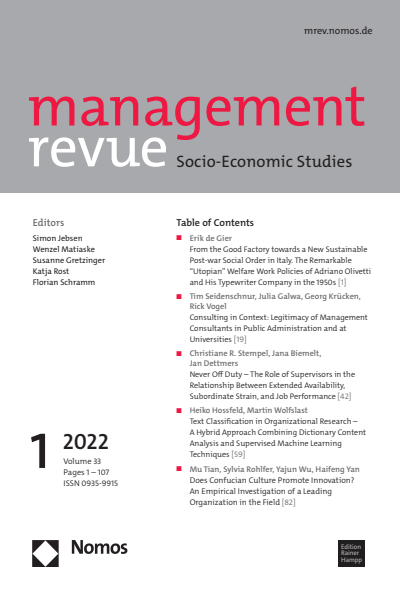
mrev management revue
Jahrgang 33 (2022), Heft 1
- Autor:innen:
- Verlag
- Nomos, Baden-Baden
- Copyrightjahr
- 2022
- ISSN-Online
- 1861-9908
- ISSN-Print
- 0935-9915
Kapitelinformationen
Open Access Vollzugriff
Jahrgang 33 (2022), Heft 1
Text Classification in Organizational Research – A Hybrid Approach Combining Dictionary Content Analysis and Supervised Machine Learning Techniques
- Autor:innen:
- ISSN-Print
- 0935-9915
- ISSN-Online
- 1861-9908
- Kapitelvorschau:
Literaturverzeichnis
Es wurden keine Treffer gefunden. Versuchen Sie einen anderen Begriff.
- Adelman, J. (2013). Worldly Philosopher. The Odyssey of Albert O. Hirschman. Princeton/Oxford: Princeton University Press. Google Scholar öffnen DOI: 10.5771/0935-9915-2022-1-1
- Berta, G. (1978a). Lavoro e capitale nella storia del Piemonte. Studi Storici, 19 (no.1), pp. 205-216. Google Scholar öffnen DOI: 10.5771/0935-9915-2022-1-1
- Berta, G. (19878b). Fra centrismo e centro sinistra: Olivetti e il Movimento di Comunità. Studi Storici, 19 (no. 3), pp. 545-587. Google Scholar öffnen DOI: 10.5771/0935-9915-2022-1-1
- Bigatti G. & Lupo, G. (2013). Fabbrica Di Carta. I libri che contano l’Italia industriale. Roma: Editori Laterza. Google Scholar öffnen DOI: 10.5771/0935-9915-2022-1-1
- Blanken I.J. (2002). Geschiedenis van Koninklijke Philips Electronics N.V. Een Industriële Wereldfederatie. Zaltbommel: Europese Bibliotheek. Google Scholar öffnen DOI: 10.5771/0935-9915-2022-1-1
- Bonifazio, P. & Scrivano, P. (2001). Olivetti Builds. Modern Architecture in Ivrea. Milano: Skira Editore. Google Scholar öffnen DOI: 10.5771/0935-9915-2022-1-1
- Bonura, G. (1972). Inivitto alla lettura di Calvino. Milano: Mursia Editore. Google Scholar öffnen DOI: 10.5771/0935-9915-2022-1-1
- Brandes, S.D. (1976). American Welfare Capitalism 1880-1940. Chicago and London: The University of Chicago Press. Google Scholar öffnen DOI: 10.5771/0935-9915-2022-1-1
- Brilliant, E. L. (1993). Theory and reality in the vision of Adriano Olivetti. Voluntas. International Journal of Voluntary and Nonprofit Organizations, 4 (no. 1), pp. 95-114. Google Scholar öffnen DOI: 10.5771/0935-9915-2022-1-1
- Caddedu, D. (2012). On the Political Project of Adriano Olivetti. New York: Springer Science and Business Media. Google Scholar öffnen DOI: 10.5771/0935-9915-2022-1-1
- Diazzi, A. & SforzaTarabochia, A. (eds.) (2019). The Years of Alienation in Italy. Factory and asylum between the economic miracle and the years of lead. Cham: Palgrave/Macmillan. Google Scholar öffnen DOI: 10.5771/0935-9915-2022-1-1
- Ferrarotti, F. (2015). Un imprenditore di idee. Milano: Edizioni di Comunità. Amazon: Kindle e-book. Google Scholar öffnen DOI: 10.5771/0935-9915-2022-1-1
- Ferrarotti, F. (2016). La concrteta utopia di Adriano Olivetti. Bologna: Edizioni Dehoniane. Amazon: e-book. Google Scholar öffnen DOI: 10.5771/0935-9915-2022-1-1
- Ferrarotti, F. & Gemelli, G. (2015). Un imprenditore di idee. Roma/Ivrea: Comunità Editrice. Google Scholar öffnen DOI: 10.5771/0935-9915-2022-1-1
- Fioretti, D. (2013). Carte di fabbrica. La narrativa industriale in Italia (1943-1989). Pescara: Edizioni Trace. Google Scholar öffnen DOI: 10.5771/0935-9915-2022-1-1
- Gier, E. de (2016). Capitalist Workingman’s Paradises Revisited. Corporate Welfare Work in Great Britain, the USA, Germany and France in the Golden Age of Capitalism 1880-1930. Amsterdam/Chicago: Amsterdam University Press. Google Scholar öffnen DOI: 10.5771/0935-9915-2022-1-1
- Gier, E. de (2018). Modernist industrial novels and industrial sociology. A comparison between Weimar Germany and Post-WWII Italy. Przeglad Socjologiczny, LXVII/67 (no. 3), pp. 179-196. Google Scholar öffnen DOI: 10.5771/0935-9915-2022-1-1
- Ginsborg, P. (1989). Storia d’Italia dal dopoguerra a oggi. Torino: Einaudi. Google Scholar öffnen DOI: 10.5771/0935-9915-2022-1-1
- Godin, J-B. A. (1871/2010). Solutions Sociales. Guise: Les Editions Du Familistère. Google Scholar öffnen DOI: 10.5771/0935-9915-2022-1-1
- Hall, P. A. & Soskice, D. (2003). Varieties of Capitalism. The Institutional Foundations of Comparative Advantage. New York: Oxford University Press. Google Scholar öffnen DOI: 10.5771/0935-9915-2022-1-1
- Howard, E. (1902). Garden Cities of To-Morrow. London: S. Sonnenschein & Co., Amazon Kindle e-book. Google Scholar öffnen DOI: 10.5771/0935-9915-2022-1-1
- Hughes, Th. P. (1989). American Genesis. A Century of Invention and Technological Enthusiasm. Harmondsworth: Penguin Books. Google Scholar öffnen DOI: 10.5771/0935-9915-2022-1-1
- Iversen, T. & Soskice. D. (2019). Democracy and Prosperity. Reinventing Capitalism through a Turbulent Century. Princeton: Princeton University Press. Google Scholar öffnen DOI: 10.5771/0935-9915-2022-1-1
- Lupo, G. (2016). La letteratura al tempo di Adriano Olivetti. Roma/Ivrea: Comunità Editrice. Google Scholar öffnen DOI: 10.5771/0935-9915-2022-1-1
- Maffioletti, Marco (2016). L’Impresa Ideale Tra Fabbrica E Comunità. Una biografia intelletuale di Adriano Olivetti. Roma/ Ivrea: Fondazione Adriano Olivetti (Collana Intangibili Tesi, no. 31). Google Scholar öffnen DOI: 10.5771/0935-9915-2022-1-1
- Maier, C.S. (1970). Between Taylorism and Technocracy: European ideologies and the vision of industrial productivity in the 1920s. Journal of Comparative History, no.1 (April), pp. 27-61. Google Scholar öffnen DOI: 10.5771/0935-9915-2022-1-1
- Marken, J.C. van (1881). La question ouvrière à la fabrique néerlandaise de levure et d’alcool: essai de solution pratique. Paris. Google Scholar öffnen DOI: 10.5771/0935-9915-2022-1-1
- Marken, J.C. (1900). Industrial Social Organisation. Delft: Van Marken Printing Company. Google Scholar öffnen DOI: 10.5771/0935-9915-2022-1-1
- Mast, J. van der (2019). Jacques van Marken. De eerste sociaal ondernemer van Nederland. Amsterdam: Nieuw-Amsterdam. Google Scholar öffnen DOI: 10.5771/0935-9915-2022-1-1
- Mintzberg, H. (1983). Power in and around organizations. Englewood Cliffs, Prentice Hall, Inc. Google Scholar öffnen DOI: 10.5771/0935-9915-2022-1-1
- Ochetto, V. (2015). Adriano Olivetti. La biografia. Roma: Edizioni di Comunità. Amazon: Kindle e-book. Google Scholar öffnen DOI: 10.5771/0935-9915-2022-1-1
- Olivetti, A. (1946). L’ordine politico delle Comunita. Le garanzie di liberta in uno stato socialista. Roma: Edizioni di Comunità. Google Scholar öffnen DOI: 10.5771/0935-9915-2022-1-1
- Olivetti, A. (1952). Societa Stato Comunita. Per una economia e politica comunitaria. Milano: Edizioni di Comunità. Google Scholar öffnen DOI: 10.5771/0935-9915-2022-1-1
- Olivetti, A. (1960). Citta dell’uomo. Milano: Edizioni di Comunità. Google Scholar öffnen DOI: 10.5771/0935-9915-2022-1-1
- Ottieri, O. (1959/2014). Donnaruma all’assalto. Milano: Garzanti. Amazon: Kindle e-book. Google Scholar öffnen DOI: 10.5771/0935-9915-2022-1-1
- Ottieri, O. (1963). La linea gotica. Amazon: Kindle e-book. Google Scholar öffnen DOI: 10.5771/0935-9915-2022-1-1
- Owen, R. (1991). A New View of Society and other Writings. Harmondsworth: Penguin Books. Google Scholar öffnen DOI: 10.5771/0935-9915-2022-1-1
- Peroni, M. (2018). Ivrea. Guida alla città di Adriano Olivetti. Roma/Ivrea: Comunità Editrice. Google Scholar öffnen DOI: 10.5771/0935-9915-2022-1-1
- Rathenau, W. (1914/1964). Von kommenden Dingen. In: Richter, H.W. (ed.), Walter Rathenau Schriften und Reden. Berlin: S. Fischer Verlag, pp. 7-233. Google Scholar öffnen DOI: 10.5771/0935-9915-2022-1-1
- Secrest, M. (2019). The Mysterious Affair at Olivetti. IBM, the CIA and the Cold War Conspiracy to Shut Down Production of the World’s First Desktop Computer. New York: Alfred Knopf. Google Scholar öffnen DOI: 10.5771/0935-9915-2022-1-1
- Segre, B. (2015). Adriano Olivetti: Un umanesimo dei nostri tempi. Reggio Emilia: Imprimatur. Amazon: Kindle e-book. Google Scholar öffnen DOI: 10.5771/0935-9915-2022-1-1
- Volponi, P. (1962/1974). Memoriale. Torino: Einaudi. Google Scholar öffnen DOI: 10.5771/0935-9915-2022-1-1
- Webber, D. (2018). The Rise of the Working-Class Shareholder: Labor’s Last Best Weapon. Cambridge/ London: Harvard University Press. Google Scholar öffnen DOI: 10.5771/0935-9915-2022-1-1
- Weil S. (1951). La condition ouvrierère. Paris: Gallimard. Google Scholar öffnen DOI: 10.5771/0935-9915-2022-1-1
- Alvesson, M., & Empson, L. (2008). The construction of organizational identity: Comparative case studies of consulting firms. Scandinavian Journal of Management, 24(1), 1-16. Google Scholar öffnen DOI: 10.5771/0935-9915-2022-1-19
- Alvesson, M., Kärreman, D., Sturdy, A., & Handley, K. (2009). Unpacking the client(s). Constructions, positions and client–consultant dynamics. Scandinavian Journal of Management, 25(3), 253-263. Google Scholar öffnen DOI: 10.5771/0935-9915-2022-1-19
- Atkinson, R., & Flint, J. (2001). Accessing hidden and hard-to-reach populations: Snowball research strategies. Social Research Update, 33, 1-4. Google Scholar öffnen DOI: 10.5771/0935-9915-2022-1-19
- Baumann, J., & Krücken, G. (2019). Debated legitimacy: Accreditation in German higher education. Higher Education Policy, 32(1), 29-48. Google Scholar öffnen DOI: 10.5771/0935-9915-2022-1-19
- Bryson, J. M., Crosby, B. C., & Bloomberg, L. (2014). Public value governance: Moving beyond traditional public administration and the New Public Management. Public Administration Review, 74(4), 445-456. Google Scholar öffnen DOI: 10.5771/0935-9915-2022-1-19
- Clegg, S. R., Kornberger, M., & Rhodes, C. (2004). Noise, parasites and translation: Theory and practice in management consulting. Management Learning, 35(1), 31-44. Google Scholar öffnen DOI: 10.5771/0935-9915-2022-1-19
- DiMaggio, P. J., & Powell, W. W. (1983). The iron cage revisited: Institutional isomorphism and collective rationality in organizational fields. American Sociological Review, 48(2), 147-160. Google Scholar öffnen DOI: 10.5771/0935-9915-2022-1-19
- Esping-Andersen, G. (1990). Three worlds of welfare capitalism. Princeton, NJ: Princeton University Press. Google Scholar öffnen DOI: 10.5771/0935-9915-2022-1-19
- FEACO (2019). Survey of the European management consultancy 2018/2019. Retrieved 20.03.2020, from www.feaco.org/sites/default/files/sitepagefiles/Feaco.Survey%202018-2019.pdf. Google Scholar öffnen DOI: 10.5771/0935-9915-2022-1-19
- Fincham, R. (2012). The client in the client-consultant relationship. In: M. Kipping & T. Clark (eds.), The Oxford handbook of management consulting (pp. 411-426). Oxford: Oxford University Press. Google Scholar öffnen DOI: 10.5771/0935-9915-2022-1-19
- Frost, J., Hattke, F., & Reihlen, M. (eds.) (2016). Multi-level governance in universities: Strategy, structure, control. Dordrecht: Springer. Google Scholar öffnen DOI: 10.5771/0935-9915-2022-1-19
- Goodrick, E., & Reay, T. (2010). Florence Nightingale endures: Legitimizing a new professional role identity. Journal of Management Studies, 47(1), 55-84. Google Scholar öffnen DOI: 10.5771/0935-9915-2022-1-19
- Hampel, C. E., Lawrence, T., & Tracey, P. (2017). Institutional work: Taking stock and making it matter. In: R. Greenwood, C. Oliver, T. B. Lawrence & R. E. Meyer (eds.), The SAGE handbook of organizational institutionalism (pp. 558-590). London: Sage Publications. Google Scholar öffnen DOI: 10.5771/0935-9915-2022-1-19
- Hodge, G., & Bowman, D. (2006). Privatization and market development: Global movements in public policy ideas. In: G. A. Hodge (ed.), Privatization and market development: Global movements in public policy ideas (pp. 97-126). Cheltenham, UK: Edward Elgar Publishing. Google Scholar öffnen DOI: 10.5771/0935-9915-2022-1-19
- Hüther, O., & Krücken, G. (2018). Higher education in Germany – recent developments in an international perspective (Higher Education Dynamics, 49). Cham: Springer International Publishing AG. Google Scholar öffnen DOI: 10.5771/0935-9915-2022-1-19
- Hwang, H., & Colyvas, J.A. (2011). Problematizing actors and institutions in institutional work. Journal of Management Inquiry, 20(1), 62-66. Google Scholar öffnen DOI: 10.5771/0935-9915-2022-1-19
- Jepperson, R. L., & Meyer, J. (2021). Institutional theory: The cultural construction of organizations, states, and identities. Cambridge: Cambridge University Press. Google Scholar öffnen DOI: 10.5771/0935-9915-2022-1-19
- Karantinou, K. M., & Hogg, M. K. (2009). An empirical investigation of relationship development in profes-sional business services. Journal of Services Marketing, 23(4), 249-260. Google Scholar öffnen DOI: 10.5771/0935-9915-2022-1-19
- Krücken, G., & Serrano-Velarde, K. (2016). Der Berater als Fremder. Eine soziologische Studie zur Managementberatung in Universitäten. Kölner Zeitschrift für Soziologie und Sozialpsychologie, 68, 29-51. Google Scholar öffnen DOI: 10.5771/0935-9915-2022-1-19
- Lawrence, T. B., & Suddaby. R. (2006). Institutions and institutional work. In: S. R. Clegg, C. Hardy, T. B. Lawrence & W. R. Nord (eds.), Handbook of organization studies (2nd ed., pp. 215-254). London, UK: SAGE. Google Scholar öffnen DOI: 10.5771/0935-9915-2022-1-19
- Lawrence, T. B., Suddaby, R., & Leca, B. (2011). Institutional work: Refocusing institutional studies of organization. Journal of Management Inquiry, 20(1), 52-58. Google Scholar öffnen DOI: 10.5771/0935-9915-2022-1-19
- Maguire S., Hardy, C., & Lawrence T. B. (2004). Institutional entrepreneurship in emerging fields: HIV/AIDS treatment advocacy in Canada. The Academy of Management Journal, 47(5), 657-679. Google Scholar öffnen DOI: 10.5771/0935-9915-2022-1-19
- Mayring, P. (2000). Qualitative content analysis. Forum: Qualitative Social Research, 1(2), Art. 20. http://nbn-resolving.de/urn:nbn:de:0114-fqs0002204. Google Scholar öffnen DOI: 10.5771/0935-9915-2022-1-19
- Meyer, J. W., & Rowan, B. (1977). Institutionalized organizations: Formal structure as myth and ceremony. American Journal of Sociology, 83(2), 340-363. Google Scholar öffnen DOI: 10.5771/0935-9915-2022-1-19
- Meyer, J. W., & Jepperson, R. L. (2000). The ‘actors’ of modern society: The cultural construction of social agency. Sociological Theory, 18(1), 100-120. Google Scholar öffnen DOI: 10.5771/0935-9915-2022-1-19
- Meyer, R. E., & Hammerschmid, G. (2006). Changing institutional logics and executive identities: A managerial challenge to public administration in Austria. The American Behavioral Scientist, 7(49), 1000-1014. Google Scholar öffnen DOI: 10.5771/0935-9915-2022-1-19
- Meyer, R. E., Egger-Peitler, I., Höllerer, M., & Hammerschmid, G. (2014). Of bureaucrats and passionate public managers: Institutional logics, executive identities, and public service motivation. Public Administration, 92(4), 861-885. Google Scholar öffnen DOI: 10.5771/0935-9915-2022-1-19
- Meyer, R. E., & Höllerer, M. A. (2016). Laying a smoke screen: Ambiguity and neutralization as strategic responses to intra-institutional complexity. Strategic Organization, 14(4), 373-406. Google Scholar öffnen DOI: 10.5771/0935-9915-2022-1-19
- Nikolova, N., Reihlen, M., & Schlapfner, J.-F. (2009). Client–consultant interaction: Capturing social practices of professional service production. Scandinavian Journal of Management, 25(3), 289-298. Google Scholar öffnen DOI: 10.5771/0935-9915-2022-1-19
- Pemer, F., & Werr, A. (2013). The uncertain management consulting services client. International Studies of Management & Organization, 43(3), 22-40. Google Scholar öffnen DOI: 10.5771/0935-9915-2022-1-19
- Pollitt, C., & Bouckaert, G. (2017). Public management reform: A comparative analysis – into the age of austerity (4th ed.). Oxford, NY: Oxford University Press. Google Scholar öffnen DOI: 10.5771/0935-9915-2022-1-19
- Reay, T., & Hinings, C. R. (2009). Managing the rivalry of competing institutional logics. Organization Studies, 30(6), 629-652. Google Scholar öffnen DOI: 10.5771/0935-9915-2022-1-19
- Saint-Martin, D. (2004): Building the new managerialists state: Consultants and the politics of public sector reform in comparative perspective. Oxford: Oxford University Press. Google Scholar öffnen DOI: 10.5771/0935-9915-2022-1-19
- Seawright, J., & Gerring, J. (2008). Case selection techniques in case study research: A menu of qualitative and quantitative options. Political Research Quarterly, 61(2), 294-308. DOI: 10.1177/1065912907313077. Google Scholar öffnen DOI: 10.5771/0935-9915-2022-1-19
- Seidenschnur, T., & Krücken, G. (2019). Constructing the consultant as a legitimate actor: The role of active clients in universities. In: H. Hwang, J. A. Colyvas & G. S. Drori (eds.), Agents, Actors, Actorhood: Institutional Perspectives on the Nature of Agency, Action, and Authority (Research in the Sociology of Organizations, 58, pp. 111-133). Bingley: Emerald Publishing Limited. Google Scholar öffnen DOI: 10.5771/0935-9915-2022-1-19
- Serrano-Velarde, K. (2010). A fish out of water? Management consultants in academia. Minerva, 48(2), 125-144. Google Scholar öffnen DOI: 10.5771/0935-9915-2022-1-19
- Slack, T. (2014). The commercial impact of sport, the role of sport management. European Sport Management Quarterly, 14(5), 454-463. Google Scholar öffnen DOI: 10.5771/0935-9915-2022-1-19
- Sturdy, A. (1997). The consultancy process – An insecure business? Journal of Management Studies, 34(3), 389-413. Google Scholar öffnen DOI: 10.5771/0935-9915-2022-1-19
- Sturdy, A., Werr, A., & Buono, A. F. (2009). The client in management consultancy research: Mapping the territory. Scandinavian Journal of Management, 25(3), 247-252. Google Scholar öffnen DOI: 10.5771/0935-9915-2022-1-19
- Sturdy, A., & Wright, C. (2011). The active client: The boundary-spanning roles of internal consultants as gatekeepers, brokers and partners of their external counterparts. Management Learning, 42(5), 485-503. Google Scholar öffnen DOI: 10.5771/0935-9915-2022-1-19
- Suchman, M. C. (1995). Managing legitimacy: Strategic and institutional approaches. The Academy of Management Review, 20(3), 571-610. Google Scholar öffnen DOI: 10.5771/0935-9915-2022-1-19
- Suddaby, R., Bitektine, A., & Haack, P. (2017). Legitimacy. Academy of Management Annals, 11(1), 451-478. Google Scholar öffnen DOI: 10.5771/0935-9915-2022-1-19
- Thurlow, A., & Mills, J. H. (2015). Telling tales out of school. Sensemaking and narratives of legitimacy in an organizational change process. Scandinavian Journal of Management, 31(2), 246-254. Google Scholar öffnen DOI: 10.5771/0935-9915-2022-1-19
- Tracey, P., Dalpiaz, E., & Phillips, N. (2018). Fish out of water: Translation, legitimation, and new venture creation. Academy of Management Journal, 61(5), 1627-1666. Google Scholar öffnen DOI: 10.5771/0935-9915-2022-1-19
- Trank, C. Q., & Washington, M. (2009). Maintaining an institution in a contested organizational field: The work of AACSB and its constituents. In: T. B. Lawrence, R. Suddaby & B. Leca (eds.), Institutional work: Actors and agency in institutional studies of organizations (pp. 236-261). Cambridge, UK: University of Cambridge Press. Google Scholar öffnen DOI: 10.5771/0935-9915-2022-1-19
- Vogel, R. (2012). Framing and counter‐framing New Public Management: The case of Germany. Public Administration, 90(2), 370-392. Google Scholar öffnen DOI: 10.5771/0935-9915-2022-1-19
- Whetten, D. A. (2009). Organizational comparative analysis: Investigating similarities and differences among organizations. In: B. G. King, T. Felin & D. A. Whetten (eds.), Studying differences between organizations: Comparative approaches to organizational research (Research in the Sociology of Organizations, 26, pp. 63-87). Bingley: Emerald Group Publishing. Google Scholar öffnen DOI: 10.5771/0935-9915-2022-1-19
- Arlinghaus, A., & Nachreiner, F. (2013). When work calls – Associations between being contacted outside of regular working hours for work-related matters and health. Chronobiology International, 30(9), 1197–1202. https://doi.org/10.3109/07420528.2013.800089 Google Scholar öffnen DOI: 10.5771/0935-9915-2022-1-42
- Ashforth, B. E., Kreiner, G. E., & Fugate, M. (2000). All in a day’s work: Boundaries and micro role transitions. Academy of Management Review, 25(3), 472–491. https://doi.org/10.5465/AMR.2000.3363315 Google Scholar öffnen DOI: 10.5771/0935-9915-2022-1-42
- Bakker, A. B., & Demerouti, E. (2007). The job demands-resources model: State of the art. Journal of Managerial Psychology, 22(3), 309–328. https://doi.org/10.1108/02683940710733115 Google Scholar öffnen DOI: 10.5771/0935-9915-2022-1-42
- Bakker, A. B., & Demerouti, E. (2017). Job demands-resources theory: Taking stock and looking forward. Journal of Occupational Health Psychology, 22, 273–285. https://doi.org/10.1037/ocp0000056 Google Scholar öffnen DOI: 10.5771/0935-9915-2022-1-42
- Bamberg, E., Dettmers, J., Funck, H., Krähe, B., & Vahle-Hinz, T. (2012). Effects of on-call work on well-being: Results of a aaily survey. Applied Psychology: Health and Well-Being, 4(3), 299–320. https://doi.org/10.1111/j.1758-0854.2012.01075.x Google Scholar öffnen DOI: 10.5771/0935-9915-2022-1-42
- Bergman, A., & Gardiner, J. (2007). Employee availability for work and family: three Swedish case studies. Employee Relations, 29(4), 400–414. https://doi.org/10.1108/01425450710759226 Google Scholar öffnen DOI: 10.5771/0935-9915-2022-1-42
- Berkowsky, R. W. (2013). When you just cannot get away. Information, Communication & Society, 16(4), 519–541. https://doi.org/10.1080/1369118X.2013.772650 Google Scholar öffnen DOI: 10.5771/0935-9915-2022-1-42
- Binnewies, C., Sonnentag, S., & Mojza, E.J. (2009). Daily performance at work : feeling recovered in the morning as a predictor of day-level job performance. Journal of Organizational Behavior. 30(1), pp. 67–93. https://doi.org/10.1002/job.541 Google Scholar öffnen DOI: 10.5771/0935-9915-2022-1-42
- Carlson, D. S., Kacmar, K. M., & Williams, L. J. (2000). Construction and initial validation of a multidimensional measure of work-family conflict. Journal of Vocational Behavior, 56(2), 249–276. https://doi.org/10.1006/jvbe.1999.1713 Google Scholar öffnen DOI: 10.5771/0935-9915-2022-1-42
- Clark, S. C. (2000). Work/family border theory: A new theory of work/family balance. Human Relations, 53(6), 747–770. https://doi.org/10.1177/0018726700536001 Google Scholar öffnen DOI: 10.5771/0935-9915-2022-1-42
- Day, A., Paquet, S., Scott, N., & Hambley, L. (2012). Perceived information and communication technology (ICT) demands on employee outcomes: The moderating effect of organizational ICT support. Journal of Occupational Health Psychology, 17(4), 473–491. http://dx.doi.org/10.1037/a0029837 Google Scholar öffnen DOI: 10.5771/0935-9915-2022-1-42
- Derks, D., van Duin, D., Tims, M., & Bakker, A. B. (2015). Smartphone use and work-home interference: The moderating role of social norms and employee work engagement. Journal of Occupational and Organizational Psychology, 88(1), 155–177. https://doi.org/10.1111/joop.12083 Google Scholar öffnen DOI: 10.5771/0935-9915-2022-1-42
- Derks, D., Mierlo, H. van, & Schmitz, E. (2014). A diary study on work-related smartphone use, psychological detachment, and exhaustion: Examining the role of the perceived segmentation norm. Journal of Occupational Health Psychology, 19(1), 74–84. https://doi.org/10.1037/a0035076 Google Scholar öffnen DOI: 10.5771/0935-9915-2022-1-42
- Dettmers, J. (2017). How extended work availability affects well-being: The mediating roles of psychological detachment and work-family-conflict. Work & Stress, 31(1), 24–41. https://doi.org/10.1080/02678373.2017.1298164 Google Scholar öffnen DOI: 10.5771/0935-9915-2022-1-42
- Dettmers, J., Bamberg, E., & Seffzek, K. (2016a). Characteristics of extended availability for work: The role of demands and resources. International Journal of Stress Management. https://doi.org/dx.doi.org/10.1037/str0000014 Google Scholar öffnen DOI: 10.5771/0935-9915-2022-1-42
- Dettmers, J., & Biemelt, J. (2018). Always available – the role of perceived advantages and legitimacy. Journal of Managerial Psychology, 33, 497–510. https://doi.org/10.1108/JMP-02-2018-0095 Google Scholar öffnen DOI: 10.5771/0935-9915-2022-1-42
- Dettmers, J., Vahle-Hinz, T., Bamberg, E., Friedrich, N., & Keller, M. (2016b). Extended work availability and its relation with start-of-day mood and cortisol. Journal of Occupational Health Psychology, 21(1), 105–118. https://doi.org/10.1037/a0039602 Google Scholar öffnen DOI: 10.5771/0935-9915-2022-1-42
- Dewett, T., & Jones, G.R. (2001). The role of information technology in the organization: A review, model, and assessment. Journal of Management, 27, 313–346. https://doi.org/10.1177/014920630102700306 Google Scholar öffnen DOI: 10.5771/0935-9915-2022-1-42
- Diaz, I., Chiaburu, D., Zimmerman, R., & Boswell, W. (2012). Communication technology: Pros and cons of constant connection to work. Journal of Vocational Behavior, 80(2), 500–508. https://doi.org/10.1016/j.jvb.2011.08.007 Google Scholar öffnen DOI: 10.5771/0935-9915-2022-1-42
- Enzmann, D., & Kleiber, D. (1989). Helfer-Leiden. Asanger. Google Scholar öffnen DOI: 10.5771/0935-9915-2022-1-42
- Fahlén, S. (2014) Does gender matter? Policies, norms and the gender gap in work-to-home and home-to-work conflict across Europe. Community, Work & Family, 371–391, https://doi.org/10.1080/13668803.2014.899486 Google Scholar öffnen DOI: 10.5771/0935-9915-2022-1-42
- Glavin, P., & Schieman, S. (2012). Work-family role blurring and work-family conflict the moderating influence of job resources and job demands. Work and Occupations, 39(1), 71–98. https://doi.org/10.1177/0730888411406295 Google Scholar öffnen DOI: 10.5771/0935-9915-2022-1-42
- Golden, A. G., & Geisler, C. (2007). Work-life boundary management and the personal digital assistant. Human Relations, 60(3), 519–551. https://doi.org/10.1177/0018726707076698 Google Scholar öffnen DOI: 10.5771/0935-9915-2022-1-42
- Hammer, L. B., Kossek, E. E., Yragui, N. L., Bodner, T. E., & Hanson, G. C. (2009). Development and validation of a multidimensional measure of family-supportive supervisor behaviors (FSSB). Journal of Management, 35(4), 837–856. https://doi.org/10.1177/0149206308328510 Google Scholar öffnen DOI: 10.5771/0935-9915-2022-1-42
- Hecht, T. D., & Allen, N. J. (2009). A longitudinal examination of the work–nonwork boundary strength construct. Journal of Organizational Behavior, 30(7), 839–862. https://doi.org/10.1002/job Google Scholar öffnen DOI: 10.5771/0935-9915-2022-1-42
- Heißler, C.C. (2019). Working after hours, sharing availability expectations, and interrupting yourself: Extending perspectives on ICT-related concepts in research (doctorial dissertation). https://doi.org/10.17170/kobra-20190708588 Google Scholar öffnen DOI: 10.5771/0935-9915-2022-1-42
- Jex, S. M. (1998). Stress and job performance: Theory, research, and implications for managerial practice. Sage Publications Ltd. Google Scholar öffnen DOI: 10.5771/0935-9915-2022-1-42
- Koch, A. R., & Binnewies, C. (2015). Setting a good example: Supervisors as work-life-friendly role models within the context of boundary management. Journal of Occupational Health Psychology, 20(1), 82–92. https://doi.org/10.1037/a0037890 Google Scholar öffnen DOI: 10.5771/0935-9915-2022-1-42
- Kossek, E. E., Pichler, S., Bodner, T., & Hammer, L. B. (2011). Workplace social support and work-family conflict: A meta-analysis clarifying the influence of general and work-family-specific supervisor and organizational support. Personnel Psychology, 64(2), 289–313. https://doi.org/10.1111/j.1744-6570.2011.01211.x Google Scholar öffnen DOI: 10.5771/0935-9915-2022-1-42
- Kossek, E. E., Ruderman, M. N., Braddy, P. W., & Hannum, K. M. (2012). Work-nonwork boundary management profiles: A person-centered approach. Journal of Vocational Behavior, 81(1), 112–128. https://doi.org/10.1016/j.jvb.2012.04.003 Google Scholar öffnen DOI: 10.5771/0935-9915-2022-1-42
- Kranabetter, C., & Niessen, C. (2017). Managers as role models for health: Moderators of the relationship of transformational leadership with employee exhaustion and cynicism. Journal of Occupational Health Psychology, 22 (4). 492–502. http://dx.doi.org/10.1037/ocp0000044 Google Scholar öffnen DOI: 10.5771/0935-9915-2022-1-42
- Kuoppala, J., Lamminpää, A., Liira, J., & Vainio, H. (2008). Leadership, job well-being, and health effects—A systematic review and a meta-analysis. Journal of Occupational and Environmental Medicine, 50, 904–915. https://doi.org/10.1097/JOM.0b013e31817e918d Google Scholar öffnen DOI: 10.5771/0935-9915-2022-1-42
- Lapierre, L. M., & Allen, T. D. (2006). Work-supportive family, family-supportive supervision, use of organizational benefits, and problem-focused coping: implications for work-family conflict and employee well-being. Journal of Occupational Health Psychology, 11(2), 169–181. http://dx.doi.org/10.1037/1076-8998.11.2.169 Google Scholar öffnen DOI: 10.5771/0935-9915-2022-1-42
- Leung, L. (2011). Effects of ICT connectedness, permeability, flexibility, and negative spillovers on burnout and job and family satisfaction. Human Technology: An Interdisciplinary Journal on Humans in ICT Environments, 7(3), 250–267. https://doi.org/10.17011/ht/urn.2011112211714 Google Scholar öffnen DOI: 10.5771/0935-9915-2022-1-42
- Malhotra, N. K., Schaller, T. K., & Patil, A. (2017). Common Method Variance in Advertising Research: When to Be Concerned and How to Control for It. Journal of Advertising, 46(1), 193–212. https://doi.org/10.1080/00913367.2016.1252287 Google Scholar öffnen DOI: 10.5771/0935-9915-2022-1-42
- Maslach, C., & Jackson, S. E. (1986). Maslach Burnout Inventory. Manual (2nd ed.). Consulting Psychologists Press. Google Scholar öffnen DOI: 10.5771/0935-9915-2022-1-42
- Meijman, T. F., & Mulder, G. (1998). Psychological aspects of workload. In P. J. D. Drenth, H. Thierry, C. J. de Wolff, P. J. D. Drenth (Ed), H. Thierry (Ed), & C. J. de Wolff (Ed) (Eds.), Handbook of work and organizational: Work psychology. (pp. 5–33). Psychology Press/Erlbaum (UK) Taylor & Francis. Google Scholar öffnen DOI: 10.5771/0935-9915-2022-1-42
- Middleton, C. A. (2007). Illusions of balance and control in an always-on environment: A case study of BlackBerry users. Continuum, 21(2), 165–178. https://doi.org/10.1080/10304310701268695 Google Scholar öffnen DOI: 10.5771/0935-9915-2022-1-42
- Nohe, C., Michel, A., & Sonntag, K. (2013). Family–work conflict and job performance: A diary study of boundary conditions and mechanisms. Journal of Organizational Behavior, 35(3), 339–357. http://dx.doi.org/10.1002/job.1878 Google Scholar öffnen DOI: 10.5771/0935-9915-2022-1-42
- Nielsen, K., Randall, R., Yarker, J., & Brenner, S.-O. (2008). The effects of transformational leadership on followers’ perceived work characteristics and psychological well-being: A longitudinal study. Work & Stress, 22, 16–32. https://doi.org/10.1080/02678370801979430 Google Scholar öffnen DOI: 10.5771/0935-9915-2022-1-42
- Pangert, B., & Schüpbach, H. (2013). The effects of work-related extended availability on life-domain-balance and health. Bundesanstalt für Arbeitsschutz und Arbeitsmedizin. Google Scholar öffnen DOI: 10.5771/0935-9915-2022-1-42
- Piszczek, M. M. (2017). Boundary control and controlled boundaries: Organizational expectations for technology use at the work-family interface. Journal of Organizational Behavior, 38, 592–611. http://doi.wiley.com/10.1002/job.2153. Google Scholar öffnen DOI: 10.5771/0935-9915-2022-1-42
- Rau, R., & Göllner, M. (2019). Erreichbarkeit gestalten, oder doch besser die Arbeit? Zeitschrift für Arbeits- und Organisationspsychologie, 63 (1), 1–14. https://doi.org/10.1026/0932-4089/a000284 Google Scholar öffnen DOI: 10.5771/0935-9915-2022-1-42
- Siemsen, E., Roth, A., & Oliveira, P. (2010). Common method bias in regression models with linear, quadratic, and interaction effects. Organizational Research Methods, 13(3), 456–476. https://doi.org/10.1177/1094428109351241 Google Scholar öffnen DOI: 10.5771/0935-9915-2022-1-42
- Sonnentag, S., Kuttler, I., & Fritz, C. (2010). Job stressors, emotional exhaustion, and need for recovery: A multi-source study on the benefits of psychological detachment. Journal of Vocational Behavior, 76(3), 355–365. https://doi.org/10.1016/j.jvb.2009.06.005 Google Scholar öffnen DOI: 10.5771/0935-9915-2022-1-42
- Stein, M., Vincent-Höper, S., Deci, N., Gregersen, S., & Nienhaus, A. (2019). Compensatory coping through the extension of working hours: The buffering role of leader–member exchange. Zeitschrift für Arbeits- und Organisationspsychologie, 63(3), 115–128. https://doi.org/10.1026/0932-4089/a000285 Google Scholar öffnen DOI: 10.5771/0935-9915-2022-1-42
- Taris, T. W. (2006). Is there a relationship between burnout and objective performance? A critical review of 16 studies. Work & Stress, 20, 316–334. http://dx.doi.org/10.1080/02678370601065893 Google Scholar öffnen DOI: 10.5771/0935-9915-2022-1-42
- Trzcinski, E., & Holst, E. (2011). Gender differences in subjective well-being in and out of management positions. Social Indicators Research, 107, 449–463. https://doi.org/10.1007/s11205-011-9857-y Google Scholar öffnen DOI: 10.5771/0935-9915-2022-1-42
- Tuckey, M.R., Bakker, A.B. & Dollard, M.F. (2012). Empowering leaders optimize working conditions for engagement: A multilevel study. Journal of Occupational Health Psychology, 17, 15–27. https://doi.org/10.1037/a0025942 Google Scholar öffnen DOI: 10.5771/0935-9915-2022-1-42
- Vincent-Höper, S., & Stein, M.(2019). The role of leaders in designing employees’ work characteristics: Validation of the Health- and-Development-Promoting Leadership Behavior Questionnaire. Frontiers in Psychology, 10:1049. https://doi.org/10.3389/fpsyg.2019.01049 Google Scholar öffnen DOI: 10.5771/0935-9915-2022-1-42
- Voydanoff, P. (2005). Consequences of boundary-spanning demands and resources for work-to-family conflict and perceived stress. Journal of Occupational Health Psychology, 10(4), 491–503. https://doi.org/10.1037/1076-8998.10.4.491 Google Scholar öffnen DOI: 10.5771/0935-9915-2022-1-42
- Williams, L. J., & Anderson, S. E. (1991). Job satisfaction and organizational commitment as predictors of organizational citizenship and in-role behaviors. Journal of Management, 17(3), 601–617. https://doi.org/10.1177/014920639101700305 Google Scholar öffnen DOI: 10.5771/0935-9915-2022-1-42
- Wolff, H. G., & Höge, T. (2011). Konflikte zwischen Arbeit und Familie. Zeitschrift für Arbeits-und Organisationspsychologie A&O, 55, p. 143–152. https://doi.org/10.1026/0932-4089/a000053. Google Scholar öffnen DOI: 10.5771/0935-9915-2022-1-42
- Agarwal, S., & Sureka, A. (2016). But i did not mean it!—intent classification of racist posts on tumblr. Paper presented at the 2016 European Intelligence and Security Informatics Conference (EISIC). Google Scholar öffnen DOI: 10.5771/0935-9915-2022-1-59
- Aggarwal, C. C. (2018). Machine learning for text. New York: Springer. Google Scholar öffnen DOI: 10.5771/0935-9915-2022-1-59
- Ahmad, K., Han, J., Hutson, E., Kearney, C., & Liu, S. (2016). Media-expressed negative tone and firm-level stock returns. Journal of Corporate Finance, 37, 152–172. Google Scholar öffnen DOI: 10.5771/0935-9915-2022-1-59
- Andal-Ancion, A., Cartwright, P. A., & Yip, G. S. (2003). The digital transformation of traditional business. MIT Sloan Management Review, 44(4), 34–41. Google Scholar öffnen DOI: 10.5771/0935-9915-2022-1-59
- Baccianella, S., Esuli, A., & Sebastiani, F. (2010). Sentiwordnet 3.0: an enhanced lexical resource for sentiment analysis and opinion mining. Paper presented at the Lrec. Google Scholar öffnen DOI: 10.5771/0935-9915-2022-1-59
- Bae, Y., & Lee, H. (2012). Sentiment analysis of twitter audiences: Measuring the positive or negative influence of popular twitterers. Journal of the American society for information science and technology, 63(12), 2521–2535. Google Scholar öffnen DOI: 10.5771/0935-9915-2022-1-59
- Bannier, C., Pauls, T., & Walter, A. (2019). Content analysis of business communication: introducing a German dictionary. Journal of Business Economics, 89(1), 79–123. Google Scholar öffnen DOI: 10.5771/0935-9915-2022-1-59
- Bansal, P., & Gao, J. (2006). Building the future by looking to the past: Examining research published on organizations and environment. Organization & environment, 19(4), 458–478. Google Scholar öffnen DOI: 10.5771/0935-9915-2022-1-59
- Bednar, M. K. (2012). Watchdog or lapdog? A behavioral view of the media as a corporate governance mechanism. Academy of Management Journal, 55(1), 131–150. Google Scholar öffnen DOI: 10.5771/0935-9915-2022-1-59
- Bernard, H. R., Wutich, A., & Ryan, G. W. (2016). Analyzing qualitative data: Systematic approaches: SAGE publications. Google Scholar öffnen DOI: 10.5771/0935-9915-2022-1-59
- Bonfiglioli, R., & Nanni, F. (2015). From close to distant and back: how to read with the help of machines. Paper presented at the 3rd International Conference on the History and Philosophy of Computing, Pisa, Italy. Google Scholar öffnen DOI: 10.5771/0935-9915-2022-1-59
- Caserio, C., Panaro, D., & Trucco, S. (2019). Management discussion and analysis: a tone analysis on US financial listed companies. Management Decision, 58(3), 510–525. Google Scholar öffnen DOI: 10.5771/0935-9915-2022-1-59
- Castelló, I., Etter, M., & Årup Nielsen, F. (2016). Strategies of legitimacy through social media: The networked strategy. Journal of management studies, 53(3), 402–432. Google Scholar öffnen DOI: 10.5771/0935-9915-2022-1-59
- Chan, S. W., & Chong, M. W. (2017). Sentiment analysis in financial texts. Decision Support Systems, 94(2), 53–64. Google Scholar öffnen DOI: 10.5771/0935-9915-2022-1-59
- Cogburn, D., & Hine, M. (2017). Introduction to Text Mining in Big Data Analytics Minitrack. Paper presented at the Proceedings of the 50th Hawaii International Conference on System Sciences, HICSS 2017. Google Scholar öffnen DOI: 10.5771/0935-9915-2022-1-59
- Durand, R., & Vergne, J. P. (2015). Asset divestment as a response to media attacks in stigmatized industries. Strategic Management Journal, 36(8), 1205–1223. Google Scholar öffnen DOI: 10.5771/0935-9915-2022-1-59
- Duriau, V. J., Reger, R. K., & Pfarrer, M. D. (2007). A content analysis of the content analysis literature in organization studies: Research themes, data sources, and methodological refinements. Organizational research methods, 10(1), 5–34. Google Scholar öffnen DOI: 10.5771/0935-9915-2022-1-59
- Evans, M., McIntosh, W., Lin, J., & Cates, C. (2007). Recounting the courts? Applying automated content analysis to enhance empirical legal research. Journal of Empirical Legal Studies, 4(4), 1007–1039. Google Scholar öffnen DOI: 10.5771/0935-9915-2022-1-59
- Feldman, R., & Sanger, J. (2007). The text mining handbook: advanced approaches in analyzing unstructured data: Cambridge university press. Google Scholar öffnen DOI: 10.5771/0935-9915-2022-1-59
- Garrad, M. W. (2003). Computer Aided Text Analysis in Personnel Selection. PhD-thesis, School of Applied Psychology, Griffith University, Google Scholar öffnen DOI: 10.5771/0935-9915-2022-1-59
- George, G., Osinga, E. C., Lavie, D., & Scott, B. A. (2016). Big data and data science methods for management research. Academy of Management Journal, 59(5), 1493–1507. Google Scholar öffnen DOI: 10.5771/0935-9915-2022-1-59
- Ghiassi, M., Skinner, J., & Zimbra, D. (2013). Twitter brand sentiment analysis: A hybrid system using n-gram analysis and dynamic artificial neural network. Expert Systems with applications, 40(16), 6266–6282. Google Scholar öffnen DOI: 10.5771/0935-9915-2022-1-59
- Guo, L., Vargo, C. J., Pan, Z., Ding, W., & Ishwar, P. (2016). Big social data analytics in journalism and mass communication: Comparing dictionary-based text analysis and unsupervised topic modeling. Journalism & Mass Communication Quarterly, 93(2), 332–359. Google Scholar öffnen DOI: 10.5771/0935-9915-2022-1-59
- HaCohen-Kerner, Y., Miller, D., & Yigal, Y. (2020). The influence of preprocessing on text classification using a bag-of-words representation. PloS one, 15(5), 1–22. Google Scholar öffnen DOI: 10.5771/0935-9915-2022-1-59
- Harish, B. S., Guru, D. S., & Manjunath, S. (2010). Representation and classification of text documents: A brief review. IJCA, Special Issue on RTIPPR (2), 110–119. Google Scholar öffnen DOI: 10.5771/0935-9915-2022-1-59
- Hausladen, C. I., Schubert, M. H., & Ash, E. (2020). Text classification of ideological direction in judicial opinions. International Review of Law and Economics, 62, 1–19. Google Scholar öffnen DOI: 10.5771/0935-9915-2022-1-59
- Heitmann, M., Siebert, C., Hartmann, J., & Schamp, C. (2020). More than a feeling: Benchmarks for sentiment analysis accuracy. Ssrn, Working Paper. Retrieved 29.3.2021, from https://dx.doi.org/10.2139/ssrn.3489963. Google Scholar öffnen DOI: 10.5771/0935-9915-2022-1-59
- Holsti, O. R. (1969). Content analysis for the social sciences and humanities. Reading, MA: Addison-Wesley Publishing Company. Google Scholar öffnen DOI: 10.5771/0935-9915-2022-1-59
- Holton, C. (2009). Identifying disgruntled employee systems fraud risk through text mining: A simple solution for a multi-billion dollar problem. Decision Support Systems, 46(4), 853–864. Google Scholar öffnen DOI: 10.5771/0935-9915-2022-1-59
- Hossfeld, H. (2013). Corporate dieting. Persuasive use of metaphors in downsizing. management revue, 24(1), 53–70. Google Scholar öffnen DOI: 10.5771/0935-9915-2022-1-59
- Hossfeld, H. (2018). Legitimation and institutionalization of managerial practices. The role of organizational rhetoric. Scandinavian Journal of Management, 34(1), 9–21. Google Scholar öffnen DOI: 10.5771/0935-9915-2022-1-59
- Huang, A. H., Zang, A. Y., & Zheng, R. (2014). Evidence on the information content of text in analyst reports. The Accounting Review, 89(6), 2151–2180. Google Scholar öffnen DOI: 10.5771/0935-9915-2022-1-59
- Humphreys, A., & Wang, R. J.-H. (2018). Automated text analysis for consumer research. Journal of Consumer Research, 44(6), 1274–1306. Google Scholar öffnen DOI: 10.5771/0935-9915-2022-1-59
- Ignatow, G., & Mihalcea, R. (2016). Text mining: A guidebook for the social sciences. Thousan Oaks, California: Sage Publications. Google Scholar öffnen DOI: 10.5771/0935-9915-2022-1-59
- Ikonomakis, M., Kotsiantis, S., & Tampakas, V. (2005). Text classification using machine learning techniques. WSEAS transactions on computers, 4(8), 966–974. Google Scholar öffnen DOI: 10.5771/0935-9915-2022-1-59
- Kabanoff, B. (1997). Introduction: computers can read as well as count: computer-aided text analysis in organizational research. Journal of Organizational behavior, 18, 507–511. Google Scholar öffnen DOI: 10.5771/0935-9915-2022-1-59
- Kobayashi, V. B., Mol, S. T., Berkers, H. A., Kismihók, G., & Den Hartog, D. N. (2018a). Text classification for organizational researchers: A tutorial. Organizational research methods, 21(3), 766–799. Google Scholar öffnen DOI: 10.5771/0935-9915-2022-1-59
- Kobayashi, V. B., Mol, S. T., Berkers, H. A., Kismihók, G., & Den Hartog, D. N. (2018b). Text mining in organizational research. Organizational research methods, 21(3), 733–765. Google Scholar öffnen DOI: 10.5771/0935-9915-2022-1-59
- Kothari, S. P., Li, X., & Short, J. E. (2009). The effect of disclosures by management, analysts, and business press on cost of capital, return volatility, and analyst forecasts: A study using content analysis. The Accounting Review, 84(5), 1639–1670. Google Scholar öffnen DOI: 10.5771/0935-9915-2022-1-59
- Laver, M., Benoit, K., & Garry, J. (2003). Extracting policy positions from political texts using words as data. American political science review, 97(2), 311–331. Google Scholar öffnen DOI: 10.5771/0935-9915-2022-1-59
- Laver, M., & Garry, J. (2000). Estimating policy positions from political texts. American Journal of Political Science, 619–634. Google Scholar öffnen DOI: 10.5771/0935-9915-2022-1-59
- Lewis, S. C., Zamith, R., & Hermida, A. (2013). Content analysis in an era of big data: A hybrid approach to computational and manual methods. Journal of broadcasting & electronic media, 57(1), 34–52. Google Scholar öffnen DOI: 10.5771/0935-9915-2022-1-59
- Loughran, T., & McDonald, B. (2015). The use of word lists in textual analysis. Journal of Behavioral Finance, 16(1), 1–11. Google Scholar öffnen DOI: 10.5771/0935-9915-2022-1-59
- Loughran, T., & McDonald, B. (2016). Textual analysis in accounting and finance: A survey. Journal of Accounting Research, 54(4), 1187–1230. Google Scholar öffnen DOI: 10.5771/0935-9915-2022-1-59
- Martin, A. D., Quinn, K. M., Ruger, T. W., & Kim, P. T. (2004). Competing approaches to predicting supreme court decision making. Perspectives on Politics, 2(4), 761–767. Google Scholar öffnen DOI: 10.5771/0935-9915-2022-1-59
- Park, J. r., Lu, C., & Marion, L. (2009). Cataloging professionals in the digital environment: A content analysis of job descriptions. Journal of the American society for information science and technology, 60(4), 844–857. Google Scholar öffnen DOI: 10.5771/0935-9915-2022-1-59
- Pencle, N., & Mălăescu, I. (2016). What's in the words? Development and validation of a multidimensional dictionary for CSR and application using prospectuses. Journal of Emerging Technologies in Accounting, 13(2), 109–127. Google Scholar öffnen DOI: 10.5771/0935-9915-2022-1-59
- Pennebaker, J. W., Boyd, R. L., Jordan, K., & Blackburn, K. (2015). The development and psychometric properties of LIWC2015. Retrieved 29.3.2021, from https://mcrc.journalism.wisc.edu/files/2018/04/Manual_LIWC.pdf. Google Scholar öffnen DOI: 10.5771/0935-9915-2022-1-59
- Pérez-Vera, S., Alfaro, R., & Allende-Cid, H. (2017). Intent classification of social media texts with machine learning for customer service improvement. Paper presented at the International Conference on Social Computing and Social Media. Google Scholar öffnen DOI: 10.5771/0935-9915-2022-1-59
- Pfeffer, J., & Gerald, R. (1978). The external control of organizations: A resource dependence perspective: New York: Harper & Row. Google Scholar öffnen DOI: 10.5771/0935-9915-2022-1-59
- Piccarozzi, M., Aquilani, B., & Gatti, C. (2018). Industry 4.0 in management studies: A systematic literature review. Sustainability, 10(10), 1–24. Google Scholar öffnen DOI: 10.5771/0935-9915-2022-1-59
- Platanou, K., Mäkelä, K., Beletskiy, A., & Colicev, A. (2018). Using online data and network-based text analysis in HRM research. Journal of Organizational Effectiveness: People and Performance. Google Scholar öffnen DOI: 10.5771/0935-9915-2022-1-59
- Pollach, I. (2012). Taming textual data: The contribution of corpus linguistics to computer-aided text analysis. Organizational research methods, 15(2), 263–287. Google Scholar öffnen DOI: 10.5771/0935-9915-2022-1-59
- Prüfer, J., & Prüfer, P. (2018). Data science for institutional and organizational economics. In C. a. M. M. S. Ménard (Ed.), A research agenda for new institutional economics (pp. 248–259). Cheltenham: Edward Elgar Publishing. Google Scholar öffnen DOI: 10.5771/0935-9915-2022-1-59
- Riffe, D., Lacy, S., Fico, F., & Watson, B. (2019). Analyzing media messages: Using quantitative content analysis in research: Routledge. Google Scholar öffnen DOI: 10.5771/0935-9915-2022-1-59
- Rudkowsky, E., Haselmayer, M., Wastian, M., Jenny, M., Emrich, Š., & Sedlmair, M. (2018). More than bags of words: Sentiment analysis with word embeddings. Communication Methods and Measures, 12(2–3), 140–157. Google Scholar öffnen DOI: 10.5771/0935-9915-2022-1-59
- Scherer, A. G., & Palazzo, G. (2011). The new political role of business in a globalized world: A review of a new perspective on CSR and its implications for the firm, governance, and democracy. Journal of management studies, 48(4), 899–931. Google Scholar öffnen DOI: 10.5771/0935-9915-2022-1-59
- Sheng, J., Amankwah-Amoah, J., & Wang, X. (2017). A multidisciplinary perspective of big data in management research. International Journal of Production Economics, 191, 97–112. Google Scholar öffnen DOI: 10.5771/0935-9915-2022-1-59
- Strycharz, J., Strauss, N., & Trilling, D. (2018). The role of media coverage in explaining stock market fluctuations: Insights for strategic financial communication. International Journal of Strategic Communication, 12(1), 67–85. Google Scholar öffnen DOI: 10.5771/0935-9915-2022-1-59
- Stulpe, A., & Lemke, M. (2016). Blended reading. In M. Lemke & G. Wiedemann (Eds.), Text Mining in den Sozialwissenschaften (pp. 17–61). Wiesbaden: Springer. Google Scholar öffnen DOI: 10.5771/0935-9915-2022-1-59
- Thomson Reuters (2017). Thomson Reuters ESG Scores. Retrieved 29.3.2021, from https://www.esade.edu/itemsweb/biblioteca/bbdd/inbbdd/archivos/Thomson_Reuters_ESG_Scores.pdf. Google Scholar öffnen DOI: 10.5771/0935-9915-2022-1-59
- Tonidandel, S., King, E. B., & Cortina, J. M. (2018). Big data methods: Leveraging modern data analytic techniques to build organizational science. Organizational research methods, 21(3), 525–547. Google Scholar öffnen DOI: 10.5771/0935-9915-2022-1-59
- Vaara, E., & Tienari, J. (2002). Justification, legitimization and naturalization of mergers and acquisitions: A critical discourse analysis of media texts. Organization, 9(2), 275–304. Google Scholar öffnen DOI: 10.5771/0935-9915-2022-1-59
- van Zoonen, W., & Toni, G. (2016). Social media research: The application of supervised machine learning in organizational communication research. Computers in Human Behavior, 63, 132–141. Google Scholar öffnen DOI: 10.5771/0935-9915-2022-1-59
- van Zoonen, W., Verhoeven, J. W., & Vliegenthart, R. (2016). How employees use Twitter to talk about work: A typology of work-related tweets. Computers in Human Behavior, 55, 329–339. Google Scholar öffnen DOI: 10.5771/0935-9915-2022-1-59
- Watanabe, K. (2016). Computer-aided dictionary making: An efficient dictionary construction technique for content analysis. Paper presented at the Proc. Int. Conf. on the Advances in Computational Analysis of Political Text. Google Scholar öffnen DOI: 10.5771/0935-9915-2022-1-59
- Watanabe, K. (2020). Latent Semantic Scaling: A Semisupervised Text Analysis Technique for New Domains and Languages. Communication Methods and Measures, 1–22. Retrieved 29.3.2021, from https://doi.org/10.1080/19312458.2020.1832976. Google Scholar öffnen DOI: 10.5771/0935-9915-2022-1-59
- Wenzel, R., & Van Quaquebeke, N. (2018). The double-edged sword of big data in organizational and management research: A review of opportunities and risks. Organizational research methods, 21(3), 548–591. Google Scholar öffnen DOI: 10.5771/0935-9915-2022-1-59
- Xie, P., & Xing, E. (2018). A neural architecture for automated icd coding. Paper presented at the Proceedings of the 56th Annual Meeting of the Association for Computational Linguistics (Volume 1: Long Papers). Google Scholar öffnen DOI: 10.5771/0935-9915-2022-1-59
- Yehia, A. M., Ibrahim, L. F., & Abulkhair, M. F. (2016). Text mining and knowledge discovery from big data: challenges and promise. International Journal of Computer Science Issues (IJCSI), 13(3), 54. Google Scholar öffnen DOI: 10.5771/0935-9915-2022-1-59
- Anderson, N., Potočnik, K., & Zhou, J. (2014). Innovation and creativity in organizations: A state-of-the-science review, prospective commentary, and guiding framework. Journal of Management, 40, 1297–1333. Google Scholar öffnen DOI: 10.5771/0935-9915-2022-1-82
- Aldulaimi, S. H. (2016). Relationship between personal values and innovation in academic sector in Iraq. European Journal of Business, Economics, and Accountancy, 4, 32–45. Google Scholar öffnen DOI: 10.5771/0935-9915-2022-1-82
- Ambos, B., & Schlegelmilch, B. B. (2008). Innovation in multinational firms: Does cultural fit enhance performance? Management International Review, 48, 189–206. Google Scholar öffnen DOI: 10.5771/0935-9915-2022-1-82
- Baxter, P., & Jack, S. (2008). Qualitative case study methodology: Study design and implementation for novice researchers. The Qualitative Report, 13, 544–559. Google Scholar öffnen DOI: 10.5771/0935-9915-2022-1-82
- Birkinshaw, J., Hamel, G., & Mol, M. J. (2008). Management innovation. The Academy of Management Review, 33(4), 825–845. Google Scholar öffnen DOI: 10.5771/0935-9915-2022-1-82
- Boslaugh, S. (2007). Secondary data sources for public health: A practical guide. Cambridge: Cambridge University Press. Google Scholar öffnen DOI: 10.5771/0935-9915-2022-1-82
- Chan, G. K. Y. (2008). The relevance and value of Confucianism in contemporary business ethics. Journal of Business Ethics, 77, 347–360. Google Scholar öffnen DOI: 10.5771/0935-9915-2022-1-82
- Chen, G. M., & Chung, J. (1994). The impact of Confucianism on organizational communication. Communication Quarterly, 42, 93–105. Google Scholar öffnen DOI: 10.5771/0935-9915-2022-1-82
- Cheung, C. K., & Chi-fai Chan, A. (2008). Benefits of Hong Kong Chinese CEOs' Confucian and Daoist leadership styles. Leadership & Organization Development Journal, 29, 474–503. Google Scholar öffnen DOI: 10.5771/0935-9915-2022-1-82
- Crowe, S., Cresswell, K., Robertson, A., Huby, G., Avery, A., & Sheikh, A. (2011). The case study approach. BMC Medical Research Methodology, 11, 100. Google Scholar öffnen DOI: 10.5771/0935-9915-2022-1-82
- Damanpour, F., Walker, R., & Avellaneda, C. (2009). Combinative effects of innovation types and organizational performance: a longitudinal study of service organizations. Journal of Management Studies, 46(4), 650–675. Google Scholar öffnen DOI: 10.5771/0935-9915-2022-1-82
- Deng, P. (2009). Why do Chinese firms tend to acquire strategic assets in international expansion? Journal of World Business, 44, 74–84. Google Scholar öffnen DOI: 10.5771/0935-9915-2022-1-82
- Deng, D., & Wang, L. (2019). Fotile: the business strategy of a top kitchen appliance grand rooted in China. London, Canada: IVEY Publishing. Google Scholar öffnen DOI: 10.5771/0935-9915-2022-1-82
- Eisenhardt, K. M. (1989). Building theories from case study research. Academy of Management Review, 14, 532–550. Google Scholar öffnen DOI: 10.5771/0935-9915-2022-1-82
- Eisenhardt, K. M., & Graebner, M. E. (2007). Theory building from cases: Opportunities and challenges. The Academy of Management Journal, 50, 25–32. Google Scholar öffnen DOI: 10.5771/0935-9915-2022-1-82
- Fan, Y. (1998). The transfer of Western management to China: Context, content and constraints. Management Learning, 29, 201–221. Google Scholar öffnen DOI: 10.5771/0935-9915-2022-1-82
- Farh, J. L., Liang, J., Chou, L. F., & Cheng, B. S. (2008). Paternalistic leadership in Chinese organizations: Research progress and future research directions. In: C. C. Chen, & Y. T. Lee (Eds.), Business leadership in China: Philosophies, theories, and practices (171–205). Cambridge: Cambridge University Press. Google Scholar öffnen DOI: 10.5771/0935-9915-2022-1-82
- Feng, X., Jin, Z., & Johansson, A.C. (2021). How beliefs influence behavior: Confucianism and innovation in China. Economics of Transition and Institutional Change, 29(3), 501–525. Google Scholar öffnen DOI: 10.5771/0935-9915-2022-1-82
- Fu, X., Li, Y., & Si, Y. (2013). The impact of paternalistic leadership on innovation: An integrated model. Nankai Business Review International, 4(1), 9–24. Google Scholar öffnen DOI: 10.5771/0935-9915-2022-1-82
- Fung, Y. M. (2008). Problematizing Contemporary Confucianism in East Asia. In: J. L. Richey (Eds.), Teaching Confucianism (p.157). Oxford: Oxford University Press. Google Scholar öffnen DOI: 10.5771/0935-9915-2022-1-82
- Gartner, D.K. (2014). Confucianism: A very short introduction. Oxford: Oxford University Press. Google Scholar öffnen DOI: 10.5771/0935-9915-2022-1-82
- Goldin, P.R. (2011). Confucianism. Stocksfield: Acumen Publishing. Google Scholar öffnen DOI: 10.5771/0935-9915-2022-1-82
- Gong, Y., & Jang, W. (1998). Culture and development: reassessing cultural explanations on Asian economic development. Development and Society, 21(7), 77–97. Google Scholar öffnen DOI: 10.5771/0935-9915-2022-1-82
- Hofstede, G., & Bond, M. H. (1988). The Confucius connection: From cultural roots to economic growth. Organizational Dynamics, 16, 5–21. Google Scholar öffnen DOI: 10.5771/0935-9915-2022-1-82
- Hong, J., Feng, B., & Wu, Y. (2016). Do government grants promote innovation efficiency in China´s high-tech industries? Technovation, 57, 4–13. Google Scholar öffnen DOI: 10.5771/0935-9915-2022-1-82
- Ip, P.K. (2009). Is Confucianism good for business ethics in China? Journal of Business Ethics, 88, 463–476. Google Scholar öffnen DOI: 10.5771/0935-9915-2022-1-82
- Jones, G. K., & Davis, H. J. (2000). National culture and innovation: Implications for locating global R& D operations. Management International Review, 40, 11–39. Google Scholar öffnen DOI: 10.5771/0935-9915-2022-1-82
- Kim, K. H. (2007). Exploring the interactions between Asian culture (Confucianism) and creativity. The Journal of Creative Behavior, 41, 28–53. Google Scholar öffnen DOI: 10.5771/0935-9915-2022-1-82
- Kim, K. H. (2009). Cultural influence on creativity: The relationship between Asian culture (Confucianism) and creativity among Korean educators. The Journal of Creative Behavior, 43, 73–93. Google Scholar öffnen DOI: 10.5771/0935-9915-2022-1-82
- Kawaguchi, M. (2019). A sociological approach to management philosophy of Chinese family businesses in a transition period: The case of Ningbo Fotile Group. In: I. Mitsui (Eds.). Cultural translation of management philosophy in Asian companies: Its emergence, transmission, and diffusion in the global era (pp.105 – 120). Berlin: Springer. Google Scholar öffnen DOI: 10.5771/0935-9915-2022-1-82
- Kwek, A., & Lee, Y. S. (2010). Chinese tourists and Confucianism. Asia Pacific Journal of Tourism Research, 15, 129–141. Google Scholar öffnen DOI: 10.5771/0935-9915-2022-1-82
- Lam, K. C. J. (2003). Confucian business ethics and the economy. Journal of Business Ethics, 43, 153–162. Google Scholar öffnen DOI: 10.5771/0935-9915-2022-1-82
- Li, J. (2015). Reducing the NPL ratio of button switch of dishwasher (in Chinese). 2015 National conference on quality technical awarding & the 13th national six sigma conference. Kaifeng, China. Google Scholar öffnen DOI: 10.5771/0935-9915-2022-1-82
- Li, J., & Mao, Z, Q. (2014). Confucian culture is nourishing Chinese companies (in Chinese). Sino Foreign Management, 02, 122. Google Scholar öffnen DOI: 10.5771/0935-9915-2022-1-82
- Li, J., Wang, J., & Fan, W. (2011). Yin yang and company growth: A case study of a coal company of Shanxi in China. Chinese Management Studies, 5, 380–393. Google Scholar öffnen DOI: 10.5771/0935-9915-2022-1-82
- Li, L., Zhu, Z., & Fu, P. (2020). FOTILE: Building a great company guided by Confucianism. London, Canada: IVEY Publishing. Google Scholar öffnen DOI: 10.5771/0935-9915-2022-1-82
- Lin, L., Li, P. P., & Roelfsema, H. (2018). The traditional Chinese philosophies in inter-cultural leadership: The case of Chinese expatriate managers in the Dutch context. Cross Cultural & Strategic Management, 25, 299–336. Google Scholar öffnen DOI: 10.5771/0935-9915-2022-1-82
- Lin, L. H. (2009). Effects of national culture on process management and technological innovation. Total Quality Management & Business Excellence, 20, 1287–1301. Google Scholar öffnen DOI: 10.5771/0935-9915-2022-1-82
- Lin, C. P. (2010). Modeling corporate citizenship, organizational trust, and work engagement based on attachment theory. Journal of Business Ethics, 94(4), 517–531. Google Scholar öffnen DOI: 10.5771/0935-9915-2022-1-82
- Liu, F.C., Simon, D.F., & Sun, Y. (2011). China´s innovation policies: Evolution, institutional structure, and trajectory. Research Policy, 40(7), 917–931. Google Scholar öffnen DOI: 10.5771/0935-9915-2022-1-82
- Liu, S.C. (2020). How can corporations adopt Confucianism in business practices? Two representative cases. Business Ethics: A European Review, 29(4), 796–809. Google Scholar öffnen DOI: 10.5771/0935-9915-2022-1-82
- Liu, T. Q., & Stening, B. W. (2016). The contextualization and de-contextualization of Confucian morality: Making Confucianism relevant to China’s contemporary challenges in business ethics. Asia Pacific Journal of Management, 33, 821–841. Google Scholar öffnen DOI: 10.5771/0935-9915-2022-1-82
- Luo, L, J. (1986). Discussing the relationship between “Li”, “Benevolence” and “Doctrine of Mean” of Confucius. Collected Papers of History Studie, 3, 14–19. Google Scholar öffnen DOI: 10.5771/0935-9915-2022-1-82
- Ma, L., & Tsui, A. S. (2015). Traditional Chinese philosophies and contemporary leadership. The Leadership Quarterly, 26, 13–24. Google Scholar öffnen DOI: 10.5771/0935-9915-2022-1-82
- Ma, C., Liu, H., Gu, J., & Dou, J. (2018). How entrepreneurs’ Zhong-yong thinking improves new venture performance: The mediating role of guanxi and the moderating role of environmental turbulence. Chinese Management Studies, 12, 323–345. Google Scholar öffnen DOI: 10.5771/0935-9915-2022-1-82
- McFarlan, F.W., Zheng, X., & Fang, Y. (2013). Ningbo FOTILE Kitchen Ware Co., Ltd. Retrieved from http://dx.doi.org/10.4135/9781473961579. Google Scholar öffnen DOI: 10.5771/0935-9915-2022-1-82
- Mayer, R. C., Davis, J. H., & Schoorman, F. D. (1995). An integrative model of organizational trust. Academy of Management Review, 20, 709–734. Google Scholar öffnen DOI: 10.5771/0935-9915-2022-1-82
- Mills, A. J., Durepos, G., & Wiebe, E. (Eds.). (2009). Encyclopedia of case study research: L-Z; index (Vol. 1). Thousand Oaks: Sage. Google Scholar öffnen DOI: 10.5771/0935-9915-2022-1-82
- Mol, M.J., & Birkinshaw, B. (2009). The sources of management innovation: when firms introduce new management practices. Journal of Business Research, 62(12), 1269–1280. Google Scholar öffnen DOI: 10.5771/0935-9915-2022-1-82
- Molina‐Morales, F. X., & Martínez‐Fernández, M. T. (2009). Too much love in the neighborhood can hurt: How an excess of intensity and trust in relationships may produce negative effects on firms. Strategic Management Journal, 30, 1013–1023. Google Scholar öffnen DOI: 10.5771/0935-9915-2022-1-82
- Needham, J. (1956). Science and civilisation in China. Volume II, History of Scientific Thought. Cambridge: Cambridge University Press. Google Scholar öffnen DOI: 10.5771/0935-9915-2022-1-82
- Ng, A. K. (2001). Why Asians are less creative than Westerners. New Jersey: Prentice Hall. Google Scholar öffnen DOI: 10.5771/0935-9915-2022-1-82
- Ogbeibu, S., Senadjki, A., & Gaskin, J. (2018). The moderating effect of benevolence on the impact of organizational culture on employee creativity. Journal of Business Research, 90, 334–346. Google Scholar öffnen DOI: 10.5771/0935-9915-2022-1-82
- Patton, M.Q. (2002). Qualitative research & evaluation method (3rd ed.). Thousand Oaks: Sage. Google Scholar öffnen DOI: 10.5771/0935-9915-2022-1-82
- Piper, C. (2008). Process innovation: the crucial facilitator of product innovation. Ivey Business Journal, 6, 429 – 432. Google Scholar öffnen DOI: 10.5771/0935-9915-2022-1-82
- Rowley, J. (2002). Using case studies in research. Management Research News, 25, 16–27. Google Scholar öffnen DOI: 10.5771/0935-9915-2022-1-82
- Ralston, D. A., Egri, C. P., Karam, C. M., Li, Y., & Fu, P. P. (2018). Changes in work values across the regions of China. Asia Pacific Journal of Management, 35, 145–179. Google Scholar öffnen DOI: 10.5771/0935-9915-2022-1-82
- Rohlfer, S., & Zhang, Y. (2016). Culture studies in international business: paradigmatic shifts. European Business Review, 28, 39–62. Google Scholar öffnen DOI: 10.5771/0935-9915-2022-1-82
- Rujirawanich, P., Addison, R., & Smallman, C. (2011). The effects of cultural factors on innovation in a Thai SME. Management Research Review, 34, 1264–1279. Google Scholar öffnen DOI: 10.5771/0935-9915-2022-1-82
- Ruppel, C. P., & Harrington, S. J. (2000). The relationship of communication, ethical work climate, and trust to commitment and innovation. Journal of Business Ethics, 25, 313–328. Google Scholar öffnen DOI: 10.5771/0935-9915-2022-1-82
- Saeki, N., Fan, X., & Van Dusen, L. (2001). A comparative study of creative thinking of American and Japanese college students. The Journal of Creative Behavior, 35, 24–36. Google Scholar öffnen DOI: 10.5771/0935-9915-2022-1-82
- Scapens, R. (2004). Doing study research. In: C. Humphrey & B. Lee (Eds.) The real-life guide to accounting research: A behind-the-scenes view of using qualitative research methods (pp. 257–279). Amsterdam: Elsevier. Google Scholar öffnen DOI: 10.5771/0935-9915-2022-1-82
- Sebenius, J. K., & Qian, J. (2008). Cultural notes on Chinese negotiating behavior. Cambridge, MA: Harvard Business School. Google Scholar öffnen DOI: 10.5771/0935-9915-2022-1-82
- Seow Wah, S. (2010). Confucianism and Chinese leadership. Chinese Management Studies, 4, 280–285. Google Scholar öffnen DOI: 10.5771/0935-9915-2022-1-82
- Shazi, R., Gillespie, N., & Steen, J. (2015). Trust as a predictor of innovation network ties in project teams. International Journal of Project Management, 33(1), 81–91. Google Scholar öffnen DOI: 10.5771/0935-9915-2022-1-82
- Su, S., & Baird, K. (2018). The role of leaders in generating management innovation. International Journal of Human Resource Management, 29(10), 2758–2779. Google Scholar öffnen DOI: 10.5771/0935-9915-2022-1-82
- Tan, S. H. (2013). Balancing conservatism and innovation: The pragmatic Analects. In: A. Olberding (Ed.), Dao companion to the Analects (pp. 335- 354). New York: Springer. Google Scholar öffnen DOI: 10.5771/0935-9915-2022-1-82
- Tian, M., Deng, P., Zhang, Y., & Salmador, M. P. (2018). How does culture influence innovation? A systematic literature review. Management Decision, 56, 1088–1107. Google Scholar öffnen DOI: 10.5771/0935-9915-2022-1-82
- Tsai, H.T., & Tsai, C.L. (2021). The influence of the five cardinal values of Confucianism on firm performance. Review of Managerial Science. Retrieved from https://doi.org/10.1007/s11846-021-00452-1. Google Scholar öffnen DOI: 10.5771/0935-9915-2022-1-82
- Tsui, A. S., Zhang, Y., & Chen, X. P. (2017). Leadership of Chinese private enterprises: Insights and interviews. Berlin: Springer. Google Scholar öffnen DOI: 10.5771/0935-9915-2022-1-82
- Vaccaro, I., Jansen, J., Van Den Bosch, F., & Volberda, H. (2012). Management innovation and leadership: moderating role of organizational size. Journal of Management Studies, 49(1), 28–51. Google Scholar öffnen DOI: 10.5771/0935-9915-2022-1-82
- Viengkham, D., Bauman, C., & Winzar, H. (2018). Confucianism: measurement and association with workforce performance. Cross Cultural & Strategic Management, 25, 337–374. Google Scholar öffnen DOI: 10.5771/0935-9915-2022-1-82
- Wah, S.S. (2010). Confucianism and Chinese leadership. Chinese Management Studies, 4, 280–285. Google Scholar öffnen DOI: 10.5771/0935-9915-2022-1-82
- Wan, F., Williamson, P., & Yin, E. (2015). Antecedents and implications of disruptive innovation: evidence from China. Technovation, 39–40, 94–104. Google Scholar öffnen DOI: 10.5771/0935-9915-2022-1-82
- Wang, A. C., & Cheng, B. S. (2010). When does benevolent leadership lead to creativity? The moderating role of creative role identity and job autonomy. Journal of Organizational Behavior, 31, 106–121. Google Scholar öffnen DOI: 10.5771/0935-9915-2022-1-82
- Wang, Q., & Jap, S. (2017). Benevolent dictatorship and buyer-supplier exchange. Journal of Business Research, 78, 204–216. Google Scholar öffnen DOI: 10.5771/0935-9915-2022-1-82
- Waarts, E., & Van Everdingen, Y. (2005). The Influence of national culture on the adoption status of innovations: An empirical study of firms across Europe. European Management Journal, 23, 601–610. Google Scholar öffnen DOI: 10.5771/0935-9915-2022-1-82
- Weber, M. (1951). The Religion of China; Confucianism and Taoism, translated by Hans H. Gerth, New York: Macmillan. Google Scholar öffnen DOI: 10.5771/0935-9915-2022-1-82
- WIPO. (2020). China becomes top filer of international Patents in 2019 amid robust growth for WIPO’s IP services, treaties anp finances. Retrieved from https://www.wipo.int/pressroom/en/articles/2020/article_0005.html. Google Scholar öffnen DOI: 10.5771/0935-9915-2022-1-82
- Xing, Y., & Starik, M. (2017). Taoist leadership and employee green behavior: A cultural and philosophical microfoundation of sustainability. Journal of Organizational Behavior, 38, 1302–1319. Google Scholar öffnen DOI: 10.5771/0935-9915-2022-1-82
- Yang, G. (2013). Fotile promotes the international standard of range hoods to adapting to China (Chinese). Journal of Appliance Science & Technology, 1, 17. Google Scholar öffnen DOI: 10.5771/0935-9915-2022-1-82
- Yang, J. Z., Yang, J. T., & Sun, Q. J. (2012). The effect of organizational culture types on employee innovational behavior (in Chinese). Science Research Management, 33(9), 123–129. Google Scholar öffnen DOI: 10.5771/0935-9915-2022-1-82
- Yao, X. (2000). An introduction to Confucianism. Cambridge: Cambridge University Press. Google Scholar öffnen DOI: 10.5771/0935-9915-2022-1-82
- Yao, X., Yang, Q., Dong, N., & Wang, L. (2010). Moderating effect of Zhong Yong on the relationship between creativity and innovation behavior. Asian Journal of Social Psychology, 13, 53–57. Google Scholar öffnen DOI: 10.5771/0935-9915-2022-1-82
- Yin, R. K. (2003). Case study research: Design and methods. London: Sage Publications. Google Scholar öffnen DOI: 10.5771/0935-9915-2022-1-82
- Yu, Y. T., & Wang, P. (2018). How does Zhongyong thinking affect employees’ innovative behavior? Retrieved from https://doi.org/10.2991/erss-18.2019.48. Google Scholar öffnen DOI: 10.5771/0935-9915-2022-1-82
- Zhang, Y., & Chua, K. C. (2009). Influential leadership: a Harvard model vs an I-Ching model. Chinese Management Studies, 3, 200–212. Google Scholar öffnen DOI: 10.5771/0935-9915-2022-1-82
- Zhao, Z. W. (2015). Strengthen the interactive experience to form a closed loop online and offline (Chinese). Modern Household Appliances, 11, 16–18. Google Scholar öffnen DOI: 10.5771/0935-9915-2022-1-82
- Zhou, J., & George, J. M. (2003). Awakening employee creativity: The role of leader emotional intelligence. The Leadership Quarterly, 14, 545–568. Google Scholar öffnen DOI: 10.5771/0935-9915-2022-1-82
- Zhou, Y. L., & Sun, H. G. (2019). The Confucianism Way of Fotile. Beijing: China Machine Press. Google Scholar öffnen DOI: 10.5771/0935-9915-2022-1-82
- Zhou, Y. L. (2019). Innovation comes from benevolence -Talking with Mao Zhongqun, Chairman of Fangtai Group (in Chinese). Business Management, 08, 45–46. Google Scholar öffnen DOI: 10.5771/0935-9915-2022-1-82
- Zhou, H., Xia, G., & Deng, S. (2017). The Effects of error management atmosphere on employees’ innovative behavior: An analysis based on mean thinking as moderating variable (in Chinese). Commercial Research, 4, 115–121. Google Scholar öffnen DOI: 10.5771/0935-9915-2022-1-82
- Yang, C. X., & Zhang, L. (2018). Zhongyong value orientation and employee innovation bBehavior: A moderated mediating model (in Chinese). Journal of Technical Economics & Management, 2, 54–58. Google Scholar öffnen DOI: 10.5771/0935-9915-2022-1-82
