Die Verbreitung von körperlicher Elterngewalt und Misshandlung im internationalen Vergleich: Ergebnisse der dritten International Self-Report Delinquency (ISRD‑3) Studie
Inhaltsverzeichnis
Bibliographische Infos
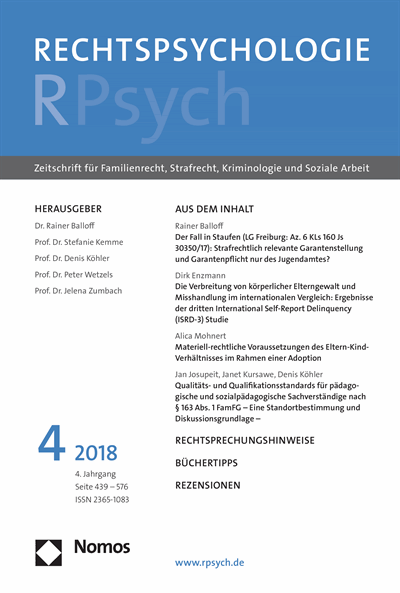
RPsych Rechtspsychologie
Jahrgang 4 (2018), Heft 4
- Autor:innen:
- Verlag
- Nomos, Baden-Baden
- Copyrightjahr
- 2018
- ISSN-Online
- 2942-335X
- ISSN-Print
- 2365-1083
Kapitelinformationen
Jahrgang 4 (2018), Heft 4
Die Verbreitung von körperlicher Elterngewalt und Misshandlung im internationalen Vergleich: Ergebnisse der dritten International Self-Report Delinquency (ISRD‑3) Studie
- Autor:innen:
- ISSN-Print
- 2365-1083
- ISSN-Online
- 2942-335X
- Kapitelvorschau:
Zahlreiche Studien haben die langfristigen negativen Folgen körperlicher Bestrafung durch Eltern und elterlicher Misshandlung für die Delinquenz und das Problemverhalten im späteren Leben nachgewiesen. Beginnend mit der Gesetzgebung in Schweden im Jahr 1979 wird in einer zunehmenden Anzahl von europäischen Ländern (und darüber hinaus) körperliche Züchtigung durch Eltern verboten. Nach einem kurzen Überblick über Studien, die die negativen Folgen körperlicher Bestrafung und Misshandlung aufgezeigt haben, wird anhand der Daten der dritten International Self-Report Delinquency (ISRD-3) Studie (n = 69,985), die in größeren Städten in 30 Ländern Amerikas, Asiens und Europas durchgeführt wurde, die Verbreitung von Elterngewalt bei 12- bis 16-jährigen Schülerinnen und Schülern beschrieben und zwischen den Ländern verglichen. Die Ergebnisse zeigen, dass die Verbreitung elterlicher Gewalt im Zusammenhang mit dem Verbot körperlicher Bestrafung steht. Des Weiteren unterschieden sich die Prävalenzraten anhand des Niveaus von "Human Development" (einem Index von Einkommen, Gesundheit und Bildung) auf der Ebene der Länder sowie anhand des individuellen Migrationshintergrunds der Befragten.
Literaturverzeichnis
Es wurden keine Treffer gefunden. Versuchen Sie einen anderen Begriff.
- Ångman, I. & Gustafsson, M. (2011). Combating Child Abuse and Neglect in Sweden (Daphne Report). Örebro (Sweden): Örebro Regional Council (Regionförbundet Örebro). https://www.dji.de/fileadmin/user_upload/bibs/Daphne_report_Sweden.pdf (letzter Zugriff: 15.10.2018). Google Scholar öffnen doi.org/10.5771/2365-1083-2018-4-456
- Aquilino, W. S., & Supple, A. J. (2001). Long-term effects of parenting practices during adolescence on well-being outcomes in young adulthood. Journal of Family Issues, 22, 289–308. Google Scholar öffnen doi.org/10.5771/2365-1083-2018-4-456
- Balloff, R. (2018). Kinder vor dem Familiengericht. 3. Auflage. Baden-Baden: Nomos, 317-325. Google Scholar öffnen doi.org/10.5771/2365-1083-2018-4-456
- Baumrind, D., Larzelere, R. E., & Cowan, P. A. (2002). Ordinary physical punishment: Is it harmful? Comment on Gershoff (2002). Psychological Bulletin, 128, 580–589. Google Scholar öffnen doi.org/10.5771/2365-1083-2018-4-456
- Bussmann, K.-D., Erthal, C., & Schroth (2008). Wirkung von Körperstrafenverboten: Erste Ergebnisse der europäischen Vergleichsstudie zu den "Auswirkungen eines gesetzlichen Verbots von Gewalt in der Erziehung". Recht der Jugend und des Bildungswesens, 56, 404–422. Google Scholar öffnen doi.org/10.5771/2365-1083-2018-4-456
- Council of Europe (2015). Progress towards prohibiting all corporal punishment in Council of Europe Member States. http://endcorporalpunishment.org/wp-content/uploads/regional/EU-briefing-2015.pdf (letzter Zugriff: 15.10.2018) Google Scholar öffnen doi.org/10.5771/2365-1083-2018-4-456
- Cumming, G., & Finch, S. (2005). Inference by eye: Confidence intervals and how to read pictures of data. American Psychologist, 60, 170–180. Google Scholar öffnen doi.org/10.5771/2365-1083-2018-4-456
- Currie, J., & Widom, C. S. (2010). Long-term consequences of child abuse and neglect on adult economic well-being. Child Maltreatment, 15, 111–120. Google Scholar öffnen doi.org/10.5771/2365-1083-2018-4-456
- Durrant, J. E. & Janson, S. (2005). Law reform, corporal punishment and child abuse: The case of Sweden. International Review of Victimology, 12, 139–158. Google Scholar öffnen doi.org/10.5771/2365-1083-2018-4-456
- Eisner, M. (2014). From swords to words: Does macro-level change in self-control predict long-term variation in levels of homicide? In M. Tonry (Ed.), Why Crime Rates Fall, and Why They Don’t (Crime and Justice, Vol. 43), (pp. 65–134). Chicago, IL: University of Chicago Press. Google Scholar öffnen doi.org/10.5771/2365-1083-2018-4-456
- Eisner, M., Murray, A. L., Ribeaud, D., Averdijk, M., & van Gelder, J.-L. (2017). From the Savannah to the magistrate’s court. In B. Jann, & W. Przepiorka (Eds.), Social Dilemmas, Institutions, and the Evolution of Cooperation (pp. 61–83). Berlin (Germany): de Gruyter. Google Scholar öffnen doi.org/10.5771/2365-1083-2018-4-456
- Elgar, F. J., Donnelly, P. D., Michaelson, V., Gariépy, G., Riehm, K. E., Walsh, S. D., & Pickett, W. (2018). Corporal punishment bans and physical fighting in adolescents: an ecological study of 88 countries. BMJ Open, 8, e021616. https://doi.org/10.1136/bmjopen-2018-021616 (letzter Zugriff: 15.10.2018) Google Scholar öffnen doi.org/10.5771/2365-1083-2018-4-456
- Elias, N. (1997). Über den Prozess der Zivilisation: Soziogenetische und psychogenetische Untersuchungen. Frankfurt am Main: Suhrkamp. Google Scholar öffnen doi.org/10.5771/2365-1083-2018-4-456
- Enzmann, D. & Wetzels, P. (2001). Das Ausmaß häuslicher Gewalt und die Bedeutung innerfamiliärer Gewalt für das Sozialverhalten von jungen Menschen aus kriminologischer Sicht. Familie, Partnerschaft, Recht, 7, 246–251. Google Scholar öffnen doi.org/10.5771/2365-1083-2018-4-456
- Enzmann, D. & Kammigan, I. (2018). Parental violence, deprivation and migration background. In S. Roché & M. Hough (Eds.), Minority Youth and Social Integration: The ISRD-3 Study in Europe and the US (pp. 81–101). Cham (Switzerland): Springer Nature. Google Scholar öffnen doi.org/10.5771/2365-1083-2018-4-456
- Enzmann, D., Kivivuori, J., Marshall, I.H., Steketee, M., Hough, M., & Killias, M. (2018). A Global Perspective on Young People as Offenders and Victims: First Results from the ISRD3 Study. Cham (Switzerland): Springer Nature. Google Scholar öffnen doi.org/10.5771/2365-1083-2018-4-456
- Fang, X. & Corso, P. S. (2007). Child maltreatment, youth violence, and intimate partner violence developmental relationships. American Journal of Preventive Medicine, 33, 281–290. Google Scholar öffnen doi.org/10.5771/2365-1083-2018-4-456
- Fang, X., Brown, D. S., Florence, C. S. & Mercy, J. A. (2012). The economic burden of child maltreatment in the United States and implications for prevention. Child Abuse & Neglect, 36, 156–165. Google Scholar öffnen doi.org/10.5771/2365-1083-2018-4-456
- Ferguson, C. J. (2013). Spanking, corporal punishment and negative long-term outcomes: A meta-analytic review of longitudinal studies. Clinical Psychological Review, 33, 196–208. Google Scholar öffnen doi.org/10.5771/2365-1083-2018-4-456
- Gelman, A. (2008). Scaling regression inputs by dividing by two standard deviations. Statistics in Medicine, 27, 2865-2873. Google Scholar öffnen doi.org/10.5771/2365-1083-2018-4-456
- Gershoff, E. T. (2010). More harm than good: A summary of scientific research on the intended and unintended effects of corporal punishment on children. Law and Contemporary Problems, 73, 31–56. Google Scholar öffnen doi.org/10.5771/2365-1083-2018-4-456
- Gershoff, E. T., & Grogan-Kaylor, A. (2016). Spanking and child outcomes: Old controversies and new meta-analyses. Journal of Family Psychology, 30, 453–469. Google Scholar öffnen doi.org/10.5771/2365-1083-2018-4-456
- Gilbert, R., Widom, C. S., Browne, K., Fergusson, D., Webb, E., & Janson, S. (2009). Burden and consequences of child maltreatment in high-income countries. The Lancet, 373, 68–81. Google Scholar öffnen doi.org/10.5771/2365-1083-2018-4-456
- Gilbert, R., Fluke, J., O’Donnell, M., Gonzales-Izquierdo, A., Brownell, M., Gulliver, P., Janson, S., & Sidebotham, P. (2012). Child maltreatment: variation in trends and policies in six developed countries. The Lancet, 379, 758–772. Google Scholar öffnen doi.org/10.5771/2365-1083-2018-4-456
- Halpenny, A. M., Nixon, E., & Watson, D. (2009). Parenting Styles and Discipline: Parents’ and Children’s Perspectives. Summary Report. Dublin (Ireland): Office of the Minister for Children and Youth Affairs. https://www.tcd.ie/tricc/assets/pdfs/crc-archive/2010-Halpenny-Nixon-Watson-Parenting-Styles-and-Discipline-Summary-Report.pdf (letzter Zugriff: 15.10.2018) Google Scholar öffnen doi.org/10.5771/2365-1083-2018-4-456
- Harding, D. J., & Hepburn, P. (2014). Cultural mechanisms in neighborhood effects research in the United States. Sociologia urbane e rurale, 103, 37–73. https://www.ncbi.nlm.nih.gov/pmc/articles/PMC4618664/pdf/nihms717645.pdf (Manuskript, letzter Zugriff: 15.10.2018) Google Scholar öffnen doi.org/10.5771/2365-1083-2018-4-456
- Hellmann, D. F. (2014). Repräsentativbefragung zu Viktimisierungserfahrungen in Deutschland (KFN-Forschungsbericht Nr. 122). Hannover: Kriminologisches Forschungsinstitut Hannover. Google Scholar öffnen doi.org/10.5771/2365-1083-2018-4-456
- Holden, G. W., Grogan-Kaylor, A., Durrant, J. E., & Gershoff, E. T. (2017). Researchers deserve a better critique: Response to Larzelere, Gunnoe, Roberts, and Ferguson (2017). Marriage & Family Review, 53, 465–490. Google Scholar öffnen doi.org/10.5771/2365-1083-2018-4-456
- ISRD3 Working Group. (2013). Questionnaire ISRD3: Standard Student Questionnaire (ISRD3 Technical Report Series #2). https://web.northeastern.edu/isrd/wp-content/uploads/2016/01/ISRD3_TechRep_2.pdf (letzter Zugriff: 15.10.2018) Google Scholar öffnen doi.org/10.5771/2365-1083-2018-4-456
- Janson, S., Langberg, B., & Svensson, B. (2010). Sweden: A 30 year ban on the physical punishment of children. In J. E. Durrant, & A. B. Smith (Eds.), Global Pathways to Abolishing Physical punishment: Realizing Children’s Rights (pp. 241-255). London (UK): Routledge. Google Scholar öffnen doi.org/10.5771/2365-1083-2018-4-456
- Kendall-Tackett, K. A., & Eckenrode, J. (1996). The effects of neglect on academic achievement and disciplinary problems: A developmental perspective. Child Abuse and Neglect, 20, 161–169. Google Scholar öffnen doi.org/10.5771/2365-1083-2018-4-456
- Larzelere, R. E., Gunnoe, M. L., Roberts, M. W., & Ferguson, C. J. (2017). Children and parents deserve better parental discipline research: Critiquing the evidence for exclusively "positive" parenting. Marriage & Family Review, 53, 24–35. Google Scholar öffnen doi.org/10.5771/2365-1083-2018-4-456
- Leeb, R.T., Paulozzi, L. J., Melanson C., Simon T. R., & Arias I. (2008). Child Maltreatment Surveillance: Uniform Definitions for Public Health and Recommended Data Elements. Atlanta, GA: Centers for Disease Control and Prevention. https://www.cdc.gov/violenceprevention/pdf/cm_surveillance-a.pdf (letzter Zugriff: 15.10. 2018). Google Scholar öffnen doi.org/10.5771/2365-1083-2018-4-456
- Nix, R. L., Pinderhughes, E. E., Dodge, K. A., Bates, J. E., Pettit, G. S., & McFadyen-Ketchum, S. A. (1999). The relation between mothers’ hostile attribution tendencies and children’s externalizing behavior problems: The mediating role of mothers’ harsh discipline practices. Child Development, 70, 896–909. Google Scholar öffnen doi.org/10.5771/2365-1083-2018-4-456
- Pickett, J. T. 2017. Methodological myths and the role of appeals in criminal justice journals: The case of response rates. Academy of Criminal Justice Sciences Today, 42(3), 61–69. Google Scholar öffnen doi.org/10.5771/2365-1083-2018-4-456
- Pinker, S. (2011). The Better Angels of our Nature: Why Violence has Declined. New York, NY: Viking. Google Scholar öffnen doi.org/10.5771/2365-1083-2018-4-456
- Sen, A., & Anand, S. (1994). Human Development Index: Methodology and Measurement. New York, NY: Human Development Report Office. http://hdr.undp.org/sites/default/files/oc12.pdf (letzter Zugriff: 15.10.2018) Google Scholar öffnen doi.org/10.5771/2365-1083-2018-4-456
- Straus, M. A. & Douglas, E. M. (2004). A short form of the revised Conflict Tactics Scales, and typologies for severity and mutuality. Violence and Victims, 19, 507–520. Google Scholar öffnen doi.org/10.5771/2365-1083-2018-4-456
- United Nations (1990). Convention on the rights of the child. http://www.ohchr.org/EN/ProfessionalInterest/Pages/CRC.aspx (letzter Zugriff: 15.10.2018) Google Scholar öffnen doi.org/10.5771/2365-1083-2018-4-456
- United Nations Development Programme (2015). Human development data 2015. http://hdr.undp.org/sites/default/fles/2015_statistical_annex_tables_all.xls (letzter Zugriff: 22.7.2016). Google Scholar öffnen doi.org/10.5771/2365-1083-2018-4-456
- Widom, C. S., & Maxfield, M. G. (2001). An update on the ‘cycle of violence’ research in brief. Washington, D.C.: National Institute of Justice, NCJ 184894. http://www.ncjrs.gov/pdffiles1/nij/184894.pdf (letzter Zugriff: 15.10.2018) Google Scholar öffnen doi.org/10.5771/2365-1083-2018-4-456
- Widom, C. S., Dumont, K. A., & Czaja, S. J. (2007). A prospective investigation of major depression disorder and comorbidity in abused and neglected children grown up. Archives of General Psychiatry, 64, 49–56. Google Scholar öffnen doi.org/10.5771/2365-1083-2018-4-456