‘Proxy States’ as Champions of the Common Interest? Implications and Opportunities
Inhaltsverzeichnis
Bibliographische Infos
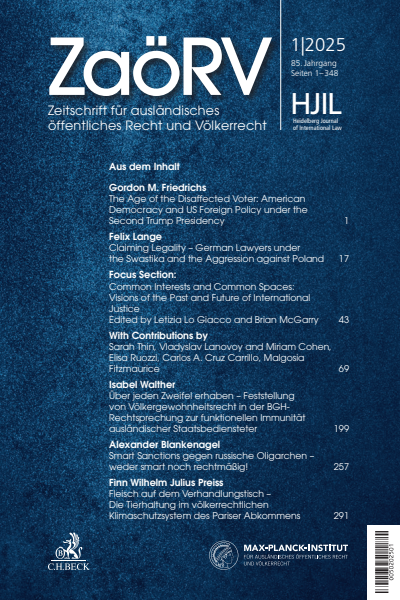
Zeitschrift für ausländisches öffentliches Recht und Völkerrecht / Heidelberg Journal of International Law
Jahrgang 85 (2025), Heft 1
- Autor:innen:
- Verlag
- C.H.BECK Recht - Wirtschaft - Steuern, München
- Copyrightjahr
- 2025
- ISSN-Online
- 2942-3562
- ISSN-Print
- 0044-2348
Kapitelinformationen
Jahrgang 85 (2025), Heft 1
‘Proxy States’ as Champions of the Common Interest? Implications and Opportunities
- Autor:innen:
- ISSN-Print
- 0044-2348
- ISSN-Online
- 2942-3562
- Kapitelvorschau:
During the 2022 preliminary objections proceedings in the case of Gambia v. Myanmar before the International Court of Justice (ICJ), Myanmar argued that the state initiating proceedings – the Gambia – was merely a ‘proxy state’, and that the ‘real’ applicant was the Organisation of Islamic Cooperation (OIC). The OIC had appointed the Gambia, had ‘tasked’ it to bring the case, and had provided all the necessary resources to do so. As a result, Myanmar contended, the case was inadmissible. This argument was summarily dismissed by the ICJ, yet the question of proxy statehood deserves further inquiry. The ICJ’s permissive approach has potentially important implications, including for the promotion of common interests through international adjudication. This article critically examines the phenomenon of ‘proxy states’ through the lens of the integration and furtherance of common interests in and through ICJ proceedings. First, it outlines and analyses Myanmar’s ‘proxy state’ argument and the ICJ’s response. This allows a picture to be painted of the ‘proxy-state model’ and the legal landscape in this regard, at least insofar as it has been interpreted by the ICJ. Section II. then delves into the potential of the proxy-state model to provide new routes for bringing issues of common interest before the ICJ. It critically examines the role of international organisations in furthering such interests, and highlights some key potential advantages that they can provide within this dynamic. Finally, section III. assesses three key concerns that have been raised in relation to cases being brought to by states acting as a proxy for an international organisation or other entity. Section IV. offers some conclusions on the implications and opportunities presented by the proxy-state phenomenon.
