Was Ratingagenturen von Staaten fordern
Inhaltsverzeichnis
Bibliographische Infos
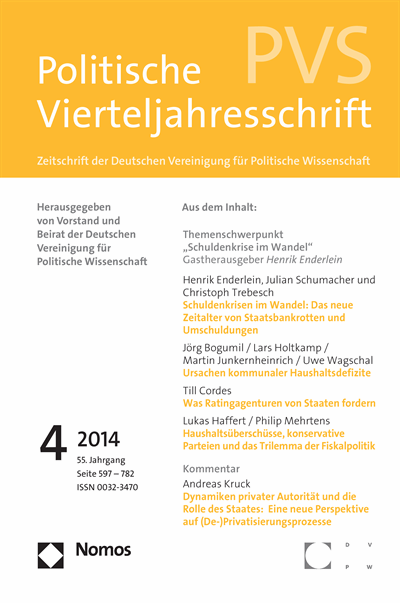
Zeitschrift der Deutschen Vereinigung für Politikwissenschaft
Jahrgang 55 (2014), Heft 4
- Autor:innen:
- Verlag
- Nomos, Baden-Baden
- Erscheinungsjahr
- 2014
- ISSN-Online
- 0032-3470
- ISSN-Print
- 0032-3470
Kapitelinformationen
Jahrgang 55 (2014), Heft 4
Was Ratingagenturen von Staaten fordern
- Autor:innen:
- ISSN-Print
- 0032-3470
- ISSN-Online
- 0032-3470
- Kapitelvorschau:
Ratingherabstufungen haben zu Kritik an den Bewertungsmaßstäben der drei großen -Ratingagenturen Standard & Poor’s, Moody’s und Fitch geführt. Doch was fordern diese Agenturen von Staaten? Die bisherige Literatur verweist auf nur einige wenige makroökomische Kennzahlen, auf denen Ratingagenturen ihre Länderratings basieren. Doch Ratingagenturen gehen darüber hinaus und fordern auch die Umsetzung konkreter Politikmaßnahmen von Staaten ein, wie dieser Beitrag in einer Textanalyse eines neuen Datensatzes mit mehr als 1200 Ratingentscheidungen seit 1995 zeigt. Für 72 Prozent aller Ratingänderungen führen die Agenturen politische Faktoren, wie Liberalisierungsmaßnahmen, internationale Abkommen sowie politische Stabilität und Wahlen, als zentrales Entscheidungskriterium in ihrer Begründung an.
Literaturverzeichnis
Es wurden keine Treffer gefunden. Versuchen Sie einen anderen Begriff.
- Afonso, António, Pedro Gomes, und Philipp Rother. 2011a. Short-and long-run determinants of sovereign debt credit ratings. International Journal of Finance & Economics 16: 1-15. DOI: 10.1002/ijfe.416. Google Scholar öffnen doi.org/10.1002/ijfe.416
- Afonso, António, Davide Furceri, und Pedro Gomes. 2011b. Sovereign credit ratings and financial markets linkages: application to European data. Technical University of Lisbon Economics Working Paper WP 14/2011/DE/UECE. Lissabon: Technical University of Lisbon. Google Scholar öffnen
- Arbatli, Elif, und Julio Escolano. 2012. Fiscal Transparency, Fiscal Performance and Credit Ratings. IMF Working Paper WP/12/156. Washington, D. C.: IWF. Google Scholar öffnen doi.org/10.5089/9781475504477.001
- Archer, Candace C., Glen Biglaiser, und Karl DeRouen Jr. 2007. Sovereign Bonds and the “Democratic Advantage”: Does Regime Type Affect Credit Rating Agency Ratings in the Developing World? International Organization 61 (Spring 2007): 341-365. DOI: 10.1017/S0020818307070129. Google Scholar öffnen doi.org/10.1017/S0020818307070129
- Bank of England. 2010. Bank of England Market Notice: Sterling Monetary Framework: Clarification on Collateral Eligibility and Haircuts, 10 May 2010. http://www.bankofengland.co.uk/markets/Documents/marketnotice100510a.pdf. Google Scholar öffnen
- Zugegriffen: 04.01.2014. Google Scholar öffnen
- Bank of Japan. 2013. Collateral Guidelines on Eligible Foreign Bonds. http://www.boj.or.jp/en/mopo/measures/term_cond/yoryo46.htm/#table. Zugegriffen: 04.01.2014. Google Scholar öffnen
- Basel Committee on Banking Supervision. 2004. Basel II: International Convergence of Capital Measurement and Capital Standards: a Revised Framework. http://www.bis.org/publ/bcbs107.htm. Zugegriffen: 04.01.2014. Google Scholar öffnen
- Beaulieu, Emily, Gary W. Cox, und Sebastian Saiegh. 2012. Sovereign Debt and Regime Type: Reconsidering the Democratic Advantage. International Organization 66: 709-738. DOI: 10.1017/S0020818312000288. Google Scholar öffnen doi.org/10.1017/S0020818312000288
- Bernhard, William, und David Leblang. 2006. Democratic Processes and Financial Markets. Cambridge: Cambridge University Press. Google Scholar öffnen doi.org/10.1017/CBO9780511607226.001
- Biglaiser, Glen, und Karl DeRouen. 2007. Sovereign Bond Ratings and Neoliberalism in Latin America. International Studies Quarterly 51: 121-138. DOI: 10.1111/j.1468- Google Scholar öffnen
- 2478.2007.00442.x. Google Scholar öffnen
- Biglaiser, Glen, und Joseph L. Staats. 2012. Finding the “Democratic Advantage” in Sovereign Bond Ratings: The Importance of Strong Courts, Property Rights Protection, and the Rule of Law. International Organization 66: 515-535. DOI: 10.1017/S0020818312000185. Google Scholar öffnen doi.org/10.1017/S0020818312000185
- Borensztein, Eduardo, und Ugo Panizza. 2008. The Costs of Sovereign Default. IMF Staff Papers 56: 683-741. Washington, D. C.: IWF. DOI: 10.1057/imfsp.2009.21. Google Scholar öffnen doi.org/10.1057/imfsp.2009.21
- Brune, Nancy, Geoffrey Garrett, und Bruce Kogut. 2004. The International Monetary Fund and the Global Spread of Privatization. IMF Staff Papers 51: 195-220. Washington, D. C.: IWF. Google Scholar öffnen doi.org/10.5089/9781451836806.002
- Bruner, Christopher M., und Rawi Abdelal. 2005. To Judge Leviathan: Sovereign Credit Ratings, National Law, and the World Economy. Journal of Public Policy 25: 191-217. Google Scholar öffnen
- Cantor, Richard, und Frank Packer. 1996. Determinants and Impact of Sovereign Credit Ratings. FRBNY Economic Policy Review 6: 37-54. Google Scholar öffnen doi.org/10.2139/ssrn.1028774
- Cantor, Richard. 2004. An Introduction to Recent Research on Credit Ratings. Journal of Banking and Finance 28: 2565-2573. Google Scholar öffnen doi.org/10.1016/j.jbankfin.2004.06.002
- Cantor, Richard, Owain Ap Gwilym, und Stephen Thomas. 2007. The Use of Credit Ratings in the U.S. and Europe. Journal of Fixed Income Fall: 13-26. DOI: 10.2139/ssrn.996133. Google Scholar öffnen doi.org/10.2139/ssrn.996133
- Caraway, Teri, Stephanie Rickard, und Mark Anner. 2012. International Negotiations and Domestic Politics: The Case of IMF Labor Market Conditionality. International Organization 66: 27-61. DOI: 10.1017/S0020818311000348. Google Scholar öffnen doi.org/10.1017/S0020818311000348
- Clegg, Liam. 2012. Global governance behind closed doors: The IMF boardroom, the Enhanced Structural Adjustment Facility, and the intersection of material power and norm stabilisation in global politics. The Review of International Organizations 7: 285-308. DOI: 10.1007/s11558-011-9133-6. Google Scholar öffnen doi.org/10.1007/s11558-011-9133-6
- Cordes, Till. 2014. The Political Economy of Sovereign Rating Criteria: What Rating Agencies Demand from National Governments. Dissertation. Berlin: Hertie School of Governance. Google Scholar öffnen
- Datz, Giselle. 2004. Reframing development and accountability: the influence of sovereign credit ratings on policy making in developing countries. Third World Quarterly 25: 303-318. DOI: 10.1080/0143659042000174824. Google Scholar öffnen doi.org/10.1080/0143659042000174824
- Dreher, Axel, und Stefan Voigt. 2011. Does Membership in International Organizations Increase Governments’ Credibility? Testing the Effects of Delegating Powers. Journal of Comparative Economics 39: 326-348. DOI: 10.1016/j.jce.2011.04.003. Google Scholar öffnen doi.org/10.1016/j.jce.2011.04.003
- DW World. 2011. EU criticizes role of US credit rating agencies in debt crisis. http://www.dw-world.de/dw/article/0,,15225330,00.html. Zugegriffen: 20.10.2011. Google Scholar öffnen
- Enderlein, Henrik, Christoph Trebesch, und Laura von Daniels. 2012. Sovereign debt disputes: A database on government coerciveness during debt crises. Journal of International Money and Finance 31: 250-266. DOI: 10.1016/j.jimonfin.2011.11.011. Google Scholar öffnen doi.org/10.1016/j.jimonfin.2011.11.011
- European Central Bank. 2013. Eurosystem credit assessment framework (ECAF). http://www.ecb.int/paym/coll/risk/ecaf/html/index.en.html. Zugegriffen: 04.01.2014. Google Scholar öffnen
- Federal Reserve. 2013. Federal Reserve Discount Window and Payment System Risk Collateral Margins Table. www.frbdiscountwindow.org/discountmargins.xls. Zugegriffen: 04.01.2014. Google Scholar öffnen
- Ferri, Giovanni, Li-Gang Liu, und Joseph E. Stiglitz, 1999. The Procyclical Role of Rating Agencies: Evidence from the East Asian Crisis. Economic Notes 28: 335-355. Google Scholar öffnen doi.org/10.1111/1468-0300.00016
- Financial Stability Board. 2012. Roadmap and workshop for reducing reliance on CRA ratings FSB report to G20 Finance Ministers and Central Bank Governors, 5 November 2012. http://www.financialstabilityboard.org/list/fsb_pa/tid_167/index.htm. Zugegriffen: 04.01.2014. Google Scholar öffnen
- Financial Times. 2012a. Greeks shift focus from debt to politics. http://www.ft.com/intl/cms/s/0/fcb20f6e-6b9d-11e1-8337-00144feab49a.html#axzz1qQJLtB00. Zugegriffen: 30.03.2012. Google Scholar öffnen
- Financial Times. 2012b. Dancing around Athens’ default. http://www.ft.com/intl/cms/s/0/0a2fb9f8-58a6-11e1-9f28-00144feabdc0.html#axzz1qQJLtB00. Zugegriffen: 30.03.2012. Google Scholar öffnen
- Financial Times. 2013. Gulf states bemoan lack of top-grade ratings. http://www.ft.com/intl/cms/s/0/5124033e-9c73-11e2-ba3c-00144feabdc0.html?ftcamp=published_links%2Frss%2Fmarkets%2Ffeed%2F%2Fproduct#axzz2PUPF34rA. Google Scholar öffnen
- Zugegriffen: 04.01.2014. Google Scholar öffnen
- Financial Times. 2014. Italy accuses S&P of not getting ‘la dolce vita’. http://www.ft.com/intl/cms/s/0/6ed9649e-8dab-11e3-bbe7-00144feab7de.html?siteedition=intl#axzz2sp0DdCuu. Zugegriffen: 22.02.2014. Google Scholar öffnen
- Fitch Ratings. 2012. Sovereign Rating Criteria, Master Criteria, 13 August 2012. http://www.fitchratings.com. Zugegriffen: 30.12.2013. Google Scholar öffnen
- Fitch Ratings. 2013. About Us. https://www.fitchratings.com/web/en/dynamic/about-us/about-us.jsp. Zugegriffen: 30.12.2013. Google Scholar öffnen
- Fitch Ratings. 2014. Sector: Sovereigns. https://www.fitchratings.com/gws/en/sector/overview/sovereigns. Zugegriffen: 04.01.2014. Google Scholar öffnen
- Fratzscher, Marcel, und Julien Reynaud. 2010. IMF Surveillance and Financial Markets - A Political Economy Analysis. CESIFO Working Paper 3089. München: Center for Economic Studies/ifo-Institut. DOI: 10.1016/j.ejpoleco.2011.01.002. Google Scholar öffnen doi.org/10.1016/j.ejpoleco.2011.01.002
- Fuchs, Andreas, und Kai Gehring. 2013. The Home Bias in Sovereign Ratings. University of Heidelberg Department of Economics Discussion Paper: 552. DOI: 10.2139/ssrn.2370374. Google Scholar öffnen doi.org/10.2139/ssrn.2370374
- Gaillard, Norbert. 2009. Fitch, Moody’s and S&P’s Sovereign Ratings and EMBI Global Spreads: Lessons from 1993-2007. International Research Journal of Finance and Economics: 41-59. Google Scholar öffnen
- Gaillard, Norbert. 2012. A Century of Sovereign Ratings. New York: Springer Science+Business Media. Google Scholar öffnen doi.org/10.1007/978-1-4614-0523-8_8
- Hameed, Farhan. 2005. Fiscal Transparency and Economic Outcomes. IMF Working Paper WP/05/225. Washington, D. C.: IWF. Google Scholar öffnen
- Heuser, Annette. 2013. (Non-) Profiting From Better Sovereign Ratings. http://www.bertelsmann-stiftung.de/cps/rde/xchg/bst_engl/hs.xsl/nachrichten_115958.htm. Zugegriffen: 05.09.2014. Google Scholar öffnen
- Internationaler Währungsfonds. 2003. Access to International Capital Markets for First-Time Sovereign Issuers. http://www.imf.org/external/np/icm/2003/eng/111703.pdf. Zugegriffen: 21.08.2010. Google Scholar öffnen
- Internationaler Währungsfonds. 2010. Global Financial Stability Report: Sovereigns, Funding, and Systemic Liquidity. http://www.imf.org/external/pubs/ft/gfsr/2010/02/. Zugegriffen: 03.06.2013. Google Scholar öffnen
- Internationaler Währungsfonds. 2013. Reports on the Observance of Standards and Codes (ROSCs). http://www.imf.org/external/NP/rosc/rosc.aspx. Zugegriffen: 03.06.2013. Google Scholar öffnen
- Jaramillo, Laura. 2010. Determinants of Investment Grade Status in Emerging Markets. IMF Working Paper WP/10/117. Washington, D. C.: IWF. Google Scholar öffnen doi.org/10.5089/9781455200764.001
- Jaramillo, Laura, und Catalina M. Tejada. 2011. Sovereign Credit Ratings and Spreads in Emerging Markets: Does Investment Grade Matter? IMF Working Paper WP/11/44. Washington, D. C.: IWF. Google Scholar öffnen
- Kaminsky, Graciela, und Sergio L. Schmukler. 2002. Emerging Market Instability: Do Sovereign Ratings Affect Country Risk and Stock Returns? World Bank Economic Review 16. Washington, D. C.: World Bank. Google Scholar öffnen
- Kapstein, Ethan B. 1994. Governing the Global Economy: International Finance and the State. Cambridge: Harvard University Press. Google Scholar öffnen
- Kerwer, Dieter. 2002. Standardizing as governance: the case of credit rating agencies. In Common Goods: Reinventing European and International Governance, Hrsg. Google Scholar öffnen
- Adrienne Héritier, 293-315. Oxford: Rowman & Littlefield Publishers. Google Scholar öffnen
- King, Michael R., und Timothy J. Sinclair. 2003. Private Actors and Public Policy: A Requiem for the New Basel Capital Accord. International Political Science Review 24: 345-362. DOI: 10.1177/0192512103024003004. Google Scholar öffnen doi.org/10.1177/0192512103024003004
- Krippendorff, Klaus. 2004. Content Analysis: An Introduction to Its Methodology. 2. Auflage. Thousand Oaks, CA: Sage Publications. Google Scholar öffnen
- Kruck, Andreas. 2013. The Regulatory Use of Credit Ratings in Germany and the US: A Resource Dependence View on the Transfer of (Quasi-) Regulatory Authority. German Policy Studies 9: 141-176. Google Scholar öffnen
- Larraín, Guillermo, Helmut Reisen, und Julia von Maltzan. 1997. Emerging Market Risks and Sovereign Credit Ratings. OECD Development Centre Working Papers (124). Paris: Organisation for Economic Co-operation and Development. Google Scholar öffnen
- Moody’s Investors Service. 2008. Rating Methodology, Moody’s Global Sovereign - Sovereign Bond Ratings. http://www.moodys.com. Zugegriffen: 21.08.2010. Google Scholar öffnen
- Moody’s Investors Service. 2013a. About Us, Moody’s Corporation. http://www.moodys.com/Pages/atc.aspx. Zugegriffen: 04.01.2014. Google Scholar öffnen
- Moody’s Investors Service. 2013b. Special Comment: Sovereign Default and Recovery Rates, 1983-2012. https://www.moodys.com/Pages/Sovereign-Default-Research.aspx. Zugegriffen: 04.01.2014. Google Scholar öffnen
- Moody’s Investors Service. 2014. Sovereign & Supranational. https://www.moodys.com/researchandratings/market-segment/sovereign-supranational/-/005005/4294966293/ Google Scholar öffnen
- 4294966623/0/0/-/0/rr. Zugegriffen: 04.01.2014 Google Scholar öffnen
- Mosley, Layna. 2003. Attempting Global Standards: National Governments, International Finance, and the IMF’s Data Regime. Review of International Political Economy 10: 331-362. Google Scholar öffnen
- Nelson, Stephen C. 2010. Does compliance matter? Assessing the relationship between sovereign risk and compliance with international monetary law. The Review of International Organizations 5: 107-139. DOI: 10.1007/s11558-010-9080-7. Google Scholar öffnen doi.org/10.1007/s11558-010-9080-7
- Nölke, Andreas, und James Perry. 2007. Coordination Service Firms and the Erosion of Rhenish Capitalism. In The Transnational Politics of Corporate Governance Regulation, Hrsg. Henk Overbeek, Bastiaan van Apeldoorn und Andreas Nölke, 121-136. London: Routledge. Google Scholar öffnen doi.org/10.2202/1469-3569.1185
- Panizza, Ugo, Federico Sturzenegger, und Jeromin Zettelmeyer. 2009. The Economics and Law of Sovereign Debt and Default. Journal of Economic Literature 47: 651-698. DOI: 10.1257/jel.47.3.651. Google Scholar öffnen doi.org/10.1257/jel.47.3.651
- Partnoy, Frank. 1999. The Siskel and Ebert of Financial Markets?: Two Thumbs Down for the Credit Rating Agencies. Washington University Law Quarterly 77: 619-715. DOI: 10.2139/ssrn.167412. Google Scholar öffnen doi.org/10.2139/ssrn.167412
- Petrie, Murray. 2003. Promoting Fiscal Transparency - The Complementary Roles of the IMF, Financial Markets and Civil Society. IMF Working Paper, WP/03/199. Washington, D. C.: IWF. Google Scholar öffnen doi.org/10.5089/9781451860139.001
- Political Risk Services Group. 2014. About Us. https://www.prsgroup.com/about-us/about-prs. Zugegriffen: 05.09.2014. Google Scholar öffnen
- Redak, Vanessa. 2006. Risks, Ratings, and Regulation: Toward a Reorganization of Credit via Basel II? In The Political Economy of Financial Market Regulation, Hrsg. Peter Mooslechner, Helene Schuberth und Beat Weber, 191-213. Cheltenham UK: Edward Elgar. Google Scholar öffnen doi.org/10.4337/9781781007549.00016
- Reinhart, Carmen. M., und Kenneth S. Rogoff. 2009. This Time is Different: Eight Centuries of Financial Folly. Princeton: Princeton University Press. Google Scholar öffnen
- Reisen, Helmut, und Julia von Maltzan. 1999. Boom and Bust and Sovereign Ratings. OECD Development Centre Working Papers (148). Paris: Organisation for Economic Co-operation and Development. Google Scholar öffnen doi.org/10.1111/1468-2362.00028
- Reserve Bank of Australia. 2013. Eligible Securities. http://www.rba.gov.au/mkt-operations/resources/tech-notes/eligible-securities.html#a$sec-fsgg. Zugegriffen: 04.01.2014. Google Scholar öffnen
- Sassen, Saskia. 1996. Losing Control? Sovereignty in an Age of Globalization. New York: Columbia University Press. Google Scholar öffnen
- Schultz, Kenneth A., und Barry R. Weingast. 2003. The Democratic Advantage: Institutional Foundations of Financial Power in International Competition. International Organization 57: 3-42. Google Scholar öffnen doi.org/10.1017/S0020818303571065
- Schumacher, Julian, Christoph Trebesch, und Henrik Enderlein. 2013. Sovereign Defaults in Court: The Rise of Creditor Litigation 1976-2010. http://ssrn.com/abstract= Google Scholar öffnen
- 2189997. Zugegriffen: 04.01.2014. Google Scholar öffnen
- Securities and Exchange Commission (SEC). 2012. Summary Report of Commission Staff’s Examinations of Each Nationally Recognized Statistical Rating Organization, November 2012. http://www.sec.gov/news/press/2012/2012-228.htm. Zugegriffen: 04.01.2014. Google Scholar öffnen
- Sinclair, Timothy J. 2005. The New Masters of Capital: American Bond Rating Agencies and the Politics of Creditworthiness. Ithaca: Cornell University Press. Google Scholar öffnen
- Standard & Poor’s (S&P). 2010. The Future of Sovereign Credit Ratings. http://www.standardandpoors.com/ratings/articles/en/us/?assetID=1245226449301. Zugegriffen: 04.01.2014. Google Scholar öffnen
- Standard & Poor’s (S&P). 2011. Sovereign Government Rating Methodology And Assumptions, 30 June 2011. www.standardandpoors.com/spf/upload/Ratings_EMEA/ Google Scholar öffnen
- 2011-06-30_CBEvent_CriteriaGovSovRatingMethodologyAndAssumptions.pdf. Zugegriffen: 22.10.2014. Google Scholar öffnen
- Standard & Poor’s (S&P). 2013a. About Us: A History of Standard & Poor’s. http://www.standardandpoors.com/about-sp/timeline/en/us/. Zugegriffen: 04.01.2013. Google Scholar öffnen
- Standard & Poor’s (S&P). 2013b. Sovereign Government Rating Methodology and Assumptions, 24 June 2013. http://www.standardandpoors.com/ratings/sovresearch/en/us. Zugegriffen: 04.01.2014. Google Scholar öffnen
- Standard & Poor’s (S&P). 2013c. Default Study: Sovereign Defaults And Rating Transition Data, 2012 Update, 29 March 2013. www.standardandpoors.com/ratingsdirect. Zugegriffen: 04.01.2014. Google Scholar öffnen
- Standard & Poor’s (S&P). 2013d. Sovereigns Rating List. http://www.standardandpoors.com/ratings/sovereigns/ratings-list/en/us/?subSectorCode=39§orId=1221186707758&subSectorId=1221187348494. Zugegriffen: 15.07.2013. Google Scholar öffnen
- Stone, Randall W. 2008. The Scope of IMF Conditionality. International Organization 62: 589-620. DOI: 10.1017/S0020818308080211. Google Scholar öffnen doi.org/10.1017/S0020818308080211
- Sturzenegger, Frederico, und Jeromin Zettelmeyer. 2006. Debt Defaults and Lessons from a Decade of Crises. Cambridge, M. A.: MIT Press. Google Scholar öffnen
- Swiss National Bank. 2009. Instruction sheet on collateral eligible for SNB repos. Instruction sheet 5, Appendix to the Guidelines of the Swiss National Bank (SNB) on Monetary Policy Instruments, Zurich, 5 October 2009. http://www.snb.ch/en/mmr/reference/repo_mb22/source. Zugegriffen: 04.01.2014. Google Scholar öffnen
- Sy, Amadou N. R. 2001. Emerging Market Bond Spreads and Sovereign Credit Ratings: Reconciling Market Views with Economic Fundamentals. IMF Working Paper WP/01/165. Washington, D. C.: IWF. Google Scholar öffnen doi.org/10.5089/9781451858051.001
- The Joint Forum. 2009. Stocktaking on the use of credit ratings, Basel Committee on Banking Supervision, International Organisation Of Securities Commissions & International Association of Insurance Supervisors. http://www.bis.org/publ/joint22.pdf?noframes=1. Zugegriffen: 21.08.2010. Google Scholar öffnen
- Tomz, Michael, und Mark L. J. Wright. 2007. Do Countries Default in “Bad Times”? Journal of the European Economic Association 5: 350-360. Google Scholar öffnen doi.org/10.1162/jeea.2007.5.2-3.352
- US Department of State. 2013. Sovereign Credit Rating for sub-Saharan Africa. http://www.state.gov/p/af/rt/scr/. Zugegriffen: 04.01.2014. Google Scholar öffnen
- Wall Street Journal. 2011. White House Challenges S&P Decision. http://online.wsj.com/news/articles/SB10001424053111903454504576492724028210348. Zugegriffen: 04.01.2014. Google Scholar öffnen
- White, Lawrence J. 2010. The Credit Rating Agencies. Journal of Economic Perspectives 24: 211-226. Google Scholar öffnen doi.org/10.1257/jep.24.2.211