Relationales Wirtschaften in Zeiten der Zwillingstransformation Perspektiven für aktuelle Entwicklungen
Inhaltsverzeichnis
Bibliographische Infos
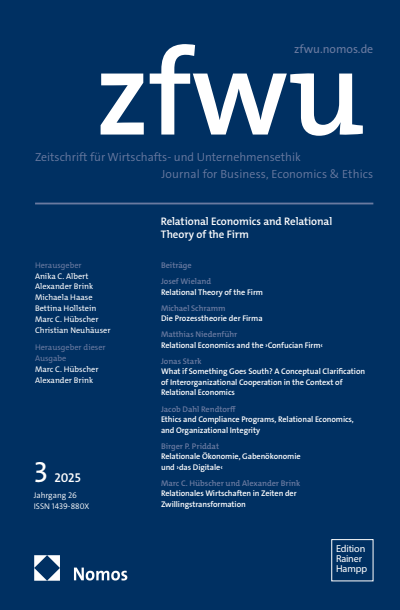
Journal for Business, Economics & Ethics
Jahrgang 26 (2025), Heft 3
- Autor:innen:
- , , , , , , ,
- Verlag
- Nomos, Baden-Baden
- Erscheinungsjahr
- 2025
- ISSN-Online
- 1862-0043
- ISSN-Print
- 1439-880X
Kapitelinformationen
Jahrgang 26 (2025), Heft 3
Relationales Wirtschaften in Zeiten der Zwillingstransformation Perspektiven für aktuelle Entwicklungen
- Autor:innen:
- ,
- ISSN-Print
- 1439-880X
- ISSN-Online
- 1862-0043
- Kapitelvorschau:
Der Beitrag rekonstruiert die von Josef Wieland simultan entwickelte Relational Economics (RE) und Relationale Theorie der Unternehmung (RTF) als Ansatz einer Kooperationsökonomie der Spätmoderne. Ziel ist es, den Stand dieses Forschungsprogramms zu erfassen und die theoretische Tragfähigkeit und normative Reichweite einer relationalen Ökonomie für gegenwärtige Transformationsprozesse auszuloten. Der Beitrag verbindet eine systematische Theoriefundierung mit einer praxisorientierten Perspektive auf die unternehmerische Verantwortung in relationalen Wertschöpfungssystemen. Mit diesem Beitrag wollen wir somit zeigen, dass eine relationale Perspektive auf die Unternehmung entscheidende Impulse für eine nachhaltige und digitale Zukunft der Wirtschaft liefert.
Literaturverzeichnis
Es wurden keine Treffer gefunden. Versuchen Sie einen anderen Begriff.
- Accenture (2021): The European Double Up. A Twin Strategy that Will Strengthen Competitiveness. Link: https://www.accenture.com/content/dam/accenture/final/a-com-migration/r3-3/pdf/pdf-144/accenture-the-european-double-up.pdf#zoom=50 (zuletzt abgerufen am 12.10.2025). Google Scholar öffnen
- Amis, J./Barney, J./Mahoney, J. T./Wang, H. (2020): From the Editors – Why We Need a Theory of Stakeholder Governance – And Why This is a Hard Problem, in: Academy of Management Review 202, Vol. 45/No. 3, 499–503. Google Scholar öffnen
- Asher, C. C./Mahoney, J. M./Mahoney, J. T. (2005): Towards a Property Rights Foundation for a Stakeholder Theory of the Firm, in: Journal of Management and Governance, Vol. 9/No. 1, 5–32. Google Scholar öffnen
- AXA (2025): Future Risk Report. Link: https://www-axa-com.cdn.axa-contento-118412.eu/www-axa-com/a1d16c4f-6c00-4fb8-967c-43170309aa5a_axa_futurerisksreport_2025_en_2.pdf (zuletzt abgeru-fen am 19.10.2025). Google Scholar öffnen
- Baier, A. C. (2009 [1997]): Dinge mit anderen tun. Die mentale Allmen-de, in: Schmid, H. B./Schweikard, D. P. (Hrsg.): Kollektive Intentionalität. Eine Debatte über die Grundlage des Sozialen, Frankfurt am Main: Suhrkamp, 230–265. Google Scholar öffnen
- Bathelt, H./Glückler, J. (2011): The Relational Economy. Geographies of Knowing and Learning, Oxford: Oxford University Press. Google Scholar öffnen
- Barby, C./Barker, R./Cohen, R./Eccles, R./Heller, C./Mayer, C./Roche, B./Serafeim, G./Stroehle, J./Younger, R./Zochowski, R. (2021): Measuring Purpose. An Integrated Framework. DOI: 10.2139/ssrn.3771892. Google Scholar öffnen
- Barney, J. B. (2018): Why Resource-Based Theory’s Model of Profit Ap-propriation Must Incorporate a Stakeholder Perspective, in: Strategic Management Journal, Vol. 39/No. 13, 3305–3325. Google Scholar öffnen
- Baumann Montecinos, J./Fischer, D./Heck, A. (Hrsg.) (2021): Kooperati-on, Governance, Wertschöpfung. Perspektiven auf eine Relationale Ökonomie, Marburg: Metropolis. Google Scholar öffnen
- Becker, G. S. (1976): The Economic Approach to Human Behavior, Chi-cago: University of Chicago Press. Google Scholar öffnen
- Beschorner, T./Blagoev, B. (2025): Im Wunderland des Win-win, in: Frankfurter Allgemeine Zeitung, Nr. 132/2025, 18. Google Scholar öffnen
- Beschorner, T./Hübscher, M. C. (2025): Digitalisierung ist Kultur. Per-spektiven der Kulturalen Ethik als K(D)E, in: Heidbrink, L./Priddat, B.P. (Hrsg.): Wirtschaftsphilosophische Perspektiven der Digitalisierung, Baden-Baden: Karl Alber, 105–137. Google Scholar öffnen
- Beschorner, T./Hübscher, M. C./Kettner M. (2021): Kulturalistische (Wirt-schafts)Ethik. Grundlagen eines Forschungsprogramms, in: Zeitschrift für Wirtschafts- und Unternehmensethik, Jg. 22/H. 3, 377–410. Google Scholar öffnen
- Biggiero, L./Wieland, J./de Jong, D./Priddat, B./Zicari, A./Fischer, D. (Eds.) (2022): The Relational View of Economics. A New Research Agenda for the Study of Relational Transactions, Cham: Springer Na-ture. Google Scholar öffnen
- Binswanger, M. (2024): Die Verselbstständigung des Kapitalismus: Wie KI Menschen und Wirtschaft steuert und für mehr Bürokratie sorgt, Weinheim: Wiley. Google Scholar öffnen
- Biondi, Y./Canziani, A./Kirat, T. (2009): The Firm as an Entity. Implica-tions for Economics, Accounting and the Law, London: Routledge. Google Scholar öffnen
- Blair, M. M. (1998): For Whom Should Corporations Be Run? An Eco-nomic Rationale for Stakeholder Management, in: Long Range Plan-ning, Vol. 31/No. 2, 195–200. Google Scholar öffnen
- Blair, M. M. (2005): Closing the Theory Gap. How the Economic Theory of Property Rights Can Help Bring ”Stakeholders« Back into Theories of the Firm, in: Journal of Management and Governance, Vol. 9, 33–39. Google Scholar öffnen
- Blühdorn, I. (2020): Nachhaltige Nicht-Nachhaltigkeit. Warum die öko-logische Transformation der Gesellschaft nicht stattfindet, Bielefeld: transcript. Google Scholar öffnen
- Boldt, B./Brink, A./Etterer, G./Gräßmann, L./ Rodde, N./Leupertz, S./Rodde, N. (Hrsg.) (2025): Transformation des Bauens, Baden-Baden: Nomos. Google Scholar öffnen
- Bowles, S. (2016): The Moral Economy. Why Good Incentives Are No Substitute for Good Citizens, New Haven: Yale University Press. Google Scholar öffnen
- Bowles, S./Gintis, H. A. (2011): Cooperative Species. Human Reciprocity and Its Evolution, New Jersey: Princeton University Press. Google Scholar öffnen
- Bridoux, F./Stoelhorst, J. W. (2022): Stakeholder Theory, Strategy, and Organization.: Past, Present, and Future, in: Strategic Organization, Vol. 20/No. 4, 797–809. Google Scholar öffnen
- Brink, A. (2009): Normatives Stakeholdermanagement. Eine gover-nancetheoretische Rekonstruktion, in: Wieland, J. (Hrsg.): CSR als Netzwerkgovernance – Theoretische Herausforderungen und prakti-sche Antworten. Über das Netzwerk von Wirtschaft, Politik und Zivilge-sellschaft, Marburg: Metropolis, 215–255. Google Scholar öffnen
- Brink, A. (2021): Relationale Führung. Werte als Motivator und Stabili-sator von Beziehungen, in: Baumann Montecinos, J./Fischer, D./Heck, A. (Hrsg.): Kooperation, Governance, Wertschöpfung. Perspektiven auf eine Relationale Ökonomie, Marburg: Metropolis, 43–60. Google Scholar öffnen
- Brink, A. (2022a): Die Zwillingstransformation. Vier Optionen, wie Nachhaltigkeit und Digitalisierung zusammengedacht werden können!, in: Schmidt, M. (Hrsg.): Kompendium Digitale Transformation. Perspek-tiven auf einen gesellschaftlichen Umbruch, Velbert: UVG Verlag. Link: https://kompendium.pressbooks.com/chapter/die-zwillingstransformation/ (zuletzt abgerufen am 17.10.2025). Google Scholar öffnen
- Brink, A. (2022b): Twin Transformation Management. Ethik als Schlüs-selfaktor für die erfolgreiche Zwillingstransformation!, iIn: Herberger, T. (Hrsg.): Digitale Transformation und Nachhaltigkeit in der globalen Fi-nanzwirtschaft, Baden-Baden: Nomos, 141–172. Google Scholar öffnen
- Brink, A. (Hrsg.) (2024): Corporate Digital Responsibility. Menschen-zentrierte Digitalisierung, Baden-Baden: Nomos. Google Scholar öffnen
- Brink, A. (Hrsg.) (2025): Fairness in Zeiten Künstlicher Intelligenz, Ba-den-Baden: Nomos. Google Scholar öffnen
- Brink, A. (2026): Responsible AI Governance. Das Drei-Ebenen-Modell erfolgreicher Zwillingstransformation, in: Schmidpeter, R./Schneider, A. (Hrsg.): Corporate Social Responsibility – Verantwortliche Unternehmens-führung in Theorie und Praxis, Wiesbaden: Springer (im Erscheinen). Google Scholar öffnen
- Brink, A./Esselmann, F./Henke, L. (2026): The CDR Maturity Model. Guid-ing Digital Responsibility in Turbulent Times, in: Christ, A.-S. (Ed.): Digital Responsibility. Form Principles to Practice, Berlin: Springer (im Erschei-nen). Google Scholar öffnen
- Buhmann, K./Fonseca, A./Andrews, N./Amatulli, G. (Eds.) (2025): The Routledge Handbook of Meaningful Stakeholder Engagement, New York: Routledge. Google Scholar öffnen
- Caspari, V./Scheffold, B. (Hrsg.) (2011): Wohin steuert die ökonomische Wissenschaft? Ein Methodenstreit in der Volkswirtschaftslehre, Frank-furt a. M./New York: Campus. Google Scholar öffnen
- Coff, W. (1999): When Competitive Advantage Doesn’t Lead to Perfor-mance. The Resource-Based View and Stakeholder Bargaining Power, in: Organization Science, Vol. 10/No. 2, 119–133. Google Scholar öffnen
- Cohen, M. (2023): Reconstructing the Moral Logic of the Stakeholder Approach, and Reconsidering the Participation Requirement, in: Phi-losophy of Management, Vol. 22/No. 2, 293–308. Google Scholar öffnen
- Commons, J. R. (1990 [1934]): Institutional Economics. Its Place in Po-litical Economy, New Brunswick/London: Transaction Publishers. Google Scholar öffnen
- Commons, J. R. (2012 [1924]): Legal Foundations of Capitalism, New York: MacMillan. Google Scholar öffnen
- Cornell, B./Shapiro, A. C. (1987): Corporate Stakeholders and Corporate Finance, in: Financial Management, Vol. 16/No. 1, 5–14. Google Scholar öffnen
- Costanza, R. (Ed.) (1991): Ecological Economics. The Science and Man-agement of Sustainability, New York: Columbia University Press. Google Scholar öffnen
- Daly, H. E. (1973): Toward a Steady-State Economy, San Francisco: W. H. Freeman. Google Scholar öffnen
- Daly, H. E. (1991): Steady-State Economics, Washington: Island Press. Google Scholar öffnen
- Deakin, S./Gindis, D./Hodgson, G. M./Huang, K./Pistor, K. (2017): Legal Institutionalism. Capitalism and the Constitutive Role of Law, in: Jour-nal of Comparative Economics, Vol. 45/No. 1, 188–200. Google Scholar öffnen
- De Lange, D. (2011): Cliques of Capitalism. A Modern Networked Theo-ry of the Firm, New York: Palgrave. Google Scholar öffnen
- Deutschland (2021): Lieferkettensorgfaltspflichtengesetz (LkSG) – Gesetz über die unternehmerischen Sorgfaltspflichten in Lieferketten vom 16. Juli 2021 (BGBl. I S. 2959). Link: https://www.bmas.de/DE/Service/Gesetze-und-Gesetzesvorhaben/Gesetz-Unternehmerische-Sorgfaltspflichten-Lieferketten/gesetz-unternehmerische-sorgfaltspflichten-lieferketten.html (zuletzt abgerufen am 18.10.2025). Google Scholar öffnen
- Diefenbacher, H. (2001): Gerechtigkeit und Nachhaltigkeit. Zum Verhält-nis von Ethik und Ökonomie, Darmstadt: Wissenschaftliche Buchgesell-schaft. Google Scholar öffnen
- Dobb, M. (1973): Theories of Value and Distribution Since Adam Smith. Ideology and Economic Theory, Cambridge: Cambridge University Press. Google Scholar öffnen
- Donaldson, T. (2021): How Values Ground Value Creation. The Practical Inference Framework, in: Organization Theory Vol. 2/No. 4, 1–27. Google Scholar öffnen
- Dörre, K./Rosa, H./Becker, K./Bose, S./Seyd, B. (Hrsg.) (2019): Große Transformation? Zur Zukunft moderner Gesellschaften, Sonderband des Berliner Journals für Soziologie, Wiesbaden: Springer VS. Google Scholar öffnen
- Dyer, J.H./Singh, H. (1998): The Relational View. Cooperative Strategy and Sources of Interorganizational Competitive Advantage, in: Acade-my of Management Review, Vol. 23/No. 4, 660–679. Google Scholar öffnen
- Ebner, A. (2014): Ökonomie als Geisteswissenschaft? Grundzüge der Erklären-Verstehen-Kontroverse in den deutschen Wirtschaftswissen-schaften, in: Kurz, H. D. (Hrsg.): Studien zur Entwicklung der ökonomi-schen Theorie XXVIII, Berlin: Duncker & Humblot, 73–106. Google Scholar öffnen
- Elkington, J. (1999): Cannibals with Forks. The Triple Bottom Line of 21st Century Business, Oxford: Capstone. Google Scholar öffnen
- Europäische Union (2022a): Data Governance Act (DGA) – Regulation (EU) 2022/868 of the European Parliament and of the Council of 30 May 2022 on European data governance and amending Regulation (EU) 2018/1724 (Data Governance Act). Link: https://eur-lex.europa.eu/legal-content/EN/TXT/PDF/?uri=CELEX:32022R0868 (zuletzt abgerufen am 18.10.2025). Google Scholar öffnen
- Europäische Union (2022b): Digital Operational Resilience Act (DORA) – Regulation (EU) 2022/2554 of the European Parliament and of the Council of 14 December 2022 on digital operational resilience for the financial sector and amending Regulations (EC) No 1060/2009, (EU) No 648/2012, (EU) No 600/2014, (EU) No 909/2014 and (EU) 2016/1011. Link: https://eur-lex.europa.eu/legal-content/EN/TXT/PDF/?uri=CELEX:32022R2554 (zuletzt abgerufen am 18.10.2025). Google Scholar öffnen
- Europäische Union (2022c): Corporate Sustainability Reporting Directive (CSRD) – Directive (EU) 2022/2464 of the European Parliament and of the Council of 14 December 2022 amending Regulation (EU) No 537/2014, Directive 2004/109/EC, Directive 2006/43/EC and Directive 2013/34/EU as regards corporate sustainability reporting. Link: https://eur-lex.europa.eu/legal-content/EN/TXT/PDF/?uri=CELEX:32022L2464 (zuletzt abgerufen am 18.10.2025). Google Scholar öffnen
- Europäische Union (2023a): Data Act – Regulation (EU) 2023/2854 of the European Parliament and of the Council of 13 December 2023 on harmonised rules on fair access to and use of data and amending Reg-ulation (EU) 2017/2394 and Directive (EU) 2020/1828 (Data Act). Link: https://eur-lex.europa.eu/legal-content/EN/TXT/PDF/?uri=OJ:L_202302854 (zuletzt abgerufen am 18.10.2025). Google Scholar öffnen
- Europäische Union (2023b): European Sustainability Reporting Stand-ards (ESRS) – Delegated Regulation (EU) 2023/2772 of the Commission of 31 July 2023 supplementing Directive 2013/34/EU of the European Parliament and of the Council as regards sustainability reporting standards. Link: https://eur-lex.europa.eu/legal-content/EN/TXT/PDF/?uri=OJ:L_202302772 (zuletzt abgerufen am 18.10.2025). Google Scholar öffnen
- Europäische Union (2024): Artificial Intelligence Act – Regulation (EU) 2024/1689 of the European Parliament and of the Council of 13 June 2024 laying down harmonised rules on artificial intelligence and amending Regulations (EC) No 300/2008, (EU) No 167/2013, (EU) No 168/2013, (EU) 2018/858, (EU) 2018/1139 and (EU) 2019/2144 and Di-rectives 2014/90/EU, (EU) 2016/797 and (EU) 2020/1828 (Artificial In-telligence Act). Link: https://eur-lex.europa.eu/legal-content/EN/TXT/PDF/?uri=OJ:L_202401689 (zuletzt abgerufen am 18.10.2025). Google Scholar öffnen
- Forst, R. (2007): Das Recht auf Rechtfertigung. Elemente einer kon-struktivistischen Theorie der Gerechtigkeit, Frankfurt a. M.: Suhrkamp. Google Scholar öffnen
- Freeman, R. E. (1984): Strategic Management. A Stakeholder Approach, Cambridge: University Press. Google Scholar öffnen
- Friedman, M. (1970): The Social Responsibility of Business is to In-crease its Profits. The New York Times Magazine, 13. September 1970. Google Scholar öffnen
- Ghoshal, S. (2005): Bad Management Theories are Destroying Good Management Practices, in: Academy of Management Learning & Edu-cation, Vol. 4/No. 1, 75–91. Google Scholar öffnen
- Gindis, D. (2013): The Nexus Paradox. Legal Personality and the Theory of the Firm, Doctoral thesis, University of Hertfordshire. Google Scholar öffnen
- Gintis, H./Bowles, S./Boyd, R./Fehr, E. (Eds.) (2005): Moral Sentiments and Material Interests. The Foundations of Cooperation in Economic Life, Cambridge: MIT Press. Google Scholar öffnen
- Goodland, R./Daly, H. E. (1996): Environmental Sustainability. Universal and Non-Negotiable, in: Ecological Applications, Vol. 6/No. 4, 1002–1017. Google Scholar öffnen
- Granovetter, M. (1985): Economic Action and Social Structure. The Problem of Embeddedness, in: American Journal of Sociology Vol. 91/No. 3, 481–510. Google Scholar öffnen
- Grunwald, A. (2016): Nachhaltigkeit verstehen. Arbeiten an der Bedeu-tung nachhaltiger Entwicklung, München: oekom. Google Scholar öffnen
- Gutenberg, E. (1957): Grundlagen der Betriebswirtschaftslehre, Erster Band. Die Produktion, Berlin: Springer. Google Scholar öffnen
- Haase, M./Schuessler, E./Schmiel, U./Ortmann, G./Suchanek, A./Schoeneborn, D. (2025): The Past, Present, and Future of the Corpo-rate Actor. Ontological, Epistemological and Theoretical Considera-tions, Schmalenbach Journal of Business Research. DOI: 10.1007/s41471–025–00213-w. Google Scholar öffnen
- Harcourt, B. E. (2024): Cooperation. A Political, Economic, and Social Theory, New York: Columbia University Press. Google Scholar öffnen
- Harrison, J. S./Barney, J. B. (2020): Stakeholder Theory at the Cross-roads, in: Business and Society, Vol. 59/No. 2, 203–212. Google Scholar öffnen
- Hauff, V. (1987): Unsere gemeinsame Zukunft. Brundtland-Bericht der Weltkommission für Umwelt und Entwicklung, Greven: Eggenkamp. Google Scholar öffnen
- Heck, A. E. H. (2016): Gesellschaftliche Wertschöpfung und ökonomi-sche Verantwortung. Genese, Form und Wesen der Verantwortung ökonomischer Akteure, Marburg: Metropolis. Google Scholar öffnen
- Hodgson, G. M. (2001): How Economics Forgot History, London: Routledge. Google Scholar öffnen
- Hodgson, G. M. (2004): The Evolution of Institutional Economics Agen-cy, Structure and Darwinism in American Institutionalism, London: Routledge. Google Scholar öffnen
- Horowitz, S. (2021): Mutualism. Building the Next Economy from the Ground Up, New York: Penguin. Google Scholar öffnen
- Hübscher, M. C. (2011): Die Firma als Nexus von Rechtfertigungskontex-ten. Eine normative Untersuchung zur rekursiven Simultanität von In-dividuen und Institutionen in der Governanceethik, Marburg: Metro-polis. Google Scholar öffnen
- Hübscher, M. C. (2019): Rethinking Economics. Rezension zur Josef Wie-land. Relational Economics. Ökonomische Theorie wirtschaftlicher Transaktionen, in: Zeitschrift für Wirtschafts- und Unternehmensethik, Jg. 20/H. 1, 108–111. Google Scholar öffnen
- Hübscher, M. C. (2021): Erkenntnis und Ideologie. Nicht nur epistemo-logische Überlegungen zur Relational Economics als Politische Ökono-mie, in: Baumann Montecinos, J./Fischer, D./Heck, A. (Hrsg.): Koopera-tion, Governance, Wertschöpfung. Perspektiven auf eine Relationale Ökonomie, Marburg: Metropolis, 133–159. Google Scholar öffnen
- Hübscher, M. C. (2023): ›Übergewinne‹ und Erklärungen des Gewinns im Kapitalismus – Ökonomie im Resonanzraum I, Diskussionspapier Nr. 2023–14 des Lehrstuhls für Wirtschaftsethik an der Martin-Luther-Universität Halle-Wittenberg. Google Scholar öffnen
- Hübscher, M. C. (2024a): Konsens versus Rechtfertigung. Integrative Wirtschaftsethik und die Unternehmung als moralischer Akteur, in: Zeitschrift für Wirtschafts- und Unternehmensethik, Jg. 25/H. 3, 401–427. Google Scholar öffnen
- Hübscher, M. C. (2024b): The Nature of the Firm as Corporate Actor. Relational Economics and the Challenge of Legal Personhood, in: Rendtorff, J. D./Belser, L./Geraldo Schwengber, J. (Eds.): Advances in Relational Economics. Theoretical, Methodological, Philosophical and Empirical Foundations, Cham: Springer Nature, 63–92. Google Scholar öffnen
- Hübscher, M. C. (2025): What if. Stakeholder-Kapitalismus, Finanzmärk-te und Wachstum. Ökonomie im Resonanzraum III, in: Vogel, T. (Hrsg.): Wirtschaftswachstum zwischen Fortschritt, Abhängigkeit und Zwang, Marburg: Metropolis, 499–530. Google Scholar öffnen
- Hübscher, M. C./Albert, A. C./Brink, A./Hollstein, B. (2025): Demokratie stärken – Haltung zeigen. Einleitende Überlegungen, in: Albert, A. C./Brink, A./Hollstein, B./Hübscher, M. C. (Hrsg.): Haltung zeigen – De-mokratie stärken, Baden-Baden: Nomos, 9–425 (im Erscheinen). Google Scholar öffnen
- Hübscher, M. C. (2026): Wirtschafts- und Unternehmensethik. Eine his-torisch sensible und zugleich systematische Einführung, Baden-Baden: Nomos (im Erscheinen). Google Scholar öffnen
- Hummel, K./Jobst, D. (2024): An Overview of Corporate Sustainability Reporting Legislation in the European Union, in: Accounting in Europe, Vol. 21/No. 2, 1–28. Google Scholar öffnen
- Jensen, M. C. (2001): Value Maximization, Stakeholder Theory, and the Corporate Objective Function, Tuck Business School Working Paper No. 01–09, Harvard NOM Research Paper No. 01–01, Harvard Business School Working Paper No. 00–058. Google Scholar öffnen
- Jensen, M. C./Meckling, W. (1976): Theory of the Firm. Managerial Be-havior, Agency Costs and Ownership Structure, in: Journal of Financial Economics, Vol. 3/No.4, 305–360. Google Scholar öffnen
- Kallis, G./Demaria, F./D‘Alisa, G. (Eds.) (2015): Degrowth. A Vocabulary for a New Era, London: Routledge. Google Scholar öffnen
- Kerscher, K.-J. (2013): Homo Oeconomicus und Menschenbild. Form und Wesen einer beachtenswerten Spannung, Marburg: Metropolis. Google Scholar öffnen
- Kirchgässner, G. (2013): Homo Oeconomicus. Das ökonomische Modell individuellen Verhaltens und seine Anwendung in den Wirtschafts- und Sozialwissenschaften, Tübingen: Mohr. Google Scholar öffnen
- Kirsch, W. (2001): Die Führung von Unternehmen, München: Kirsch. Google Scholar öffnen
- Korsgaard, C. (1996): Creating the Kingdom of Ends, Cambridge: Cam-bridge University Press. Google Scholar öffnen
- Kriegler, L. (2019): Die Sozialontologie ökonomischer Kooperationen. Warum die experimentelle Ökonomik und die Philosophie des Marktes einen Begriff der Gemeinschaftshandlung benötigen, Marburg: Metro-polis. Google Scholar öffnen
- Kuhn, T. (2025): What Do Corporations Want? Communicative Capital-ism, Corporate Purpose, and A New Theory of The Firm, Bristol: Bristol University Press. Google Scholar öffnen
- Kujala, J./Sachs, S./Leinonen, H./Heikkinen, A./Laude, D. (2022): Stake-holder Engagement. Past, Present, and Future, in: Business & Society, Vol. 61/No. 5, 1136–1196. Google Scholar öffnen
- Kurz, H. D. (Hrsg.) (2014): Studien zur Entwicklung der ökonomischen Theorie XXVIII. Die Ökonomik im Spannungsfeld zwischen Natur- und Geisteswissenschaften. Alte und neue Perspektiven im Licht des jüngs-ten Methodenstreits, Berlin: Duncker & Humblot. Google Scholar öffnen
- Larmore, C. (2012): Vernunft und Subjektivität. Frankfurter Vorlesun-gen, Berlin: Suhrkamp. Google Scholar öffnen
- Larmore, C. (2017): Das Selbst in seinem Verhältnis zu sich und zu an-deren, Frankfurt a. M.: Klostermann. Google Scholar öffnen
- Larmore, C. (2024): Was heißt Rechtfertigung, in: Bassiouni, M./Buddeberg, E./Iser, M./Karnein, A./Saar, M. (Hrsg.): Die Macht der Rechtfertigung. Perspektiven einer kritischen Theorie der Gerechtigkeit, Berlin: Suhrkamp, 31–47. Google Scholar öffnen
- Lavie, D. (2006): The Competitive Advantage of Interconnected Firms. An Extension of the Resource-Based View, in: Academy of Manage-ment Review, 31(3), 638–658. Google Scholar öffnen
- Leana, C.R./Rousseau, D. R. (Hrsg.) (2000): Relational Wealth. The Ad-vantages of Stability in a Changing Economy, New York: Oxford Univer-sity Press. Google Scholar öffnen
- Libecap, G. D. (1990): Contracting for Property Rights, New York: Cam-bridge University Press. Google Scholar öffnen
- Lovins, L. H./Wallis, S./Wijkman, A./Fullerton, J. (2018): A Finer Future. Creating an Economy in Service to Life, Gabriola Island: New Society. Google Scholar öffnen
- Mazzucato, M./Collins, R. R./Gouzoulis, G. (2023): Mapping Modern Economic Rents: The Good, the Bad, and the Grey Areas, in: Cam-bridge Journal of Economics, Vol. 47/No. 3, 507–533. Google Scholar öffnen
- Manstetten, R. (2004): Das Menschenbild der Ökonomie. Der homo oeconomicus und die Anthropologie von Adam Smith, Freiburg: Karl Alber. Google Scholar öffnen
- Marshall, A. (1961): Principles of Economics. An Introductory Volume, Cambridge: University Press. Google Scholar öffnen
- Mayer, C. (2023): Reflections on Corporate Purpose and Performance, in: European Management Journal, Vol. 20/No. 4, 719–724. Google Scholar öffnen
- McCloskey, D. N. (2021): Bettering Humanomics. A New, and Old, Ap-proach to Economic Science, Chicago: University Press. Google Scholar öffnen
- McGahan, A. (2023): The New Stakeholder Theory on Organizational Purpose, in: Strategy Science, Vol. 8/ No. 2, 245–255. Google Scholar öffnen
- McGuigan, N./Haustein, E./Kern, T./Lorson, P. (2021): Thinking Through the Integration of Corporate Reporting. Exploring the Interplay Be-tween Integrative and Integrated Thinking, in Meditari Accountancy Research, Vol. 29/No. 4, 775–804. Google Scholar öffnen
- Miles, S. (2019): Stakeholder Theory and Accounting; in: Harrison, J. S./Barney, J. B./Freemann, R. E./Phillips, R. A. (Eds.): The Cambridge Handbook of Stakeholder Theory, Cambridge: Cambridge University Press, 173–188. Google Scholar öffnen
- Möhrer, M. (2021): Shared Value-Rechnung. Konzeption und Messung betriebswirtschaftlicher Wertschöpfung, Marburg: Metropolis. Google Scholar öffnen
- Möhrer, M. (2022): Shared Value Statement. New Perspectives on Measuring Business Value Creation, in: Biggiero, L./Wieland, J./de Jong, D./Priddat, B./Zicari, A./Fischer, D. (Eds.): The Relational View of Economics. A New Research Agenda for the Study of Relational Trans-actions, Cham: Springer Nature, 111–132. Google Scholar öffnen
- Müller, M./Hübscher, M. C. (2025): Unternehmen und Wertschöpfung in einer Welt, die wir brauchen. Das Ulmer Modell Nachhaltiger Unter-nehmensführung (ULMNUF), Diskussionspapier, Ulm. Google Scholar öffnen
- Nagel, T. (1999): Das letzte Wort, Stuttgart: Reclam. Google Scholar öffnen
- Nalebuff, B. J./Brandenburger, A. M. (1997): Coopetition, London: Pro-file Books. Google Scholar öffnen
- Niedenführ, M. (2024): Relational and Transactional Rationalities in Chinese Thoughts and Social Practice, in: Rendtorff, J. D./Belser, L./Geraldo Schwengber, J. (Eds.): Advances in Relational Economics. Theoretical, Methodological, Philosophical and Empirical Foundations, Cham: Springer Nature, 213–244. Google Scholar öffnen
- Niedenführ, M. (2025): Relational Economics and the ›Confucian Firm‹. Stakeholder and Cooperative Rent in a Chinese Company, in: Zeitschrift für Wirtschafts- und Unternehmensethik, Vol. 26/H. 3, 412-441. Google Scholar öffnen
- Nida-Rümelin, J. (2020): Eine Theorie praktischer Vernunft, Berlin: De Gruyter. Google Scholar öffnen
- Nowak, M. A. (2013): Kooperative Intelligenz. Das Erfolgsgeheimnis der Evolution, München: Beck. Google Scholar öffnen
- Obrinsky, M. (1983): Profit Theory and Capitalism, Pennsylvania: Uni-versity of Pennsylvania Press. Google Scholar öffnen
- Ortmann, G. (2010): Organisation und Moral. Die dunkle Seite, Wei-lerswist: Velbrück. Google Scholar öffnen
- Ortmann, G. (2015): Noch nicht/Nicht mehr. Wir Virtuosen des ver-säumten Augenblicks, Weilerswist: Velbrück. Google Scholar öffnen
- Ott, K./Döring, R. (2008): Theorie und Praxis starker Nachhaltigkeit, Marburg: Metropolis. Google Scholar öffnen
- Paech, N. (2005): Nachhaltiges Wirtschaften jenseits von Innovationso-rientierung und Wachstum. Eine unternehmensbezogene Transfor-mationstheorie, Marburg: Metropolis. Google Scholar öffnen
- Penrose, E. T. (2009 [1959]): The Theory of the Growth of the Firm, Mansfield: Martino Publishing. Google Scholar öffnen
- Pies, I./Hübscher, M. C. (2024): ›Value added‹ für Theorie und Praxis. Systematische Anregungen zur Wirtschaftsphilosophie, in: Zeitschrift für Wirtschafts- und Unternehmensethik, Jg. 25/H. 2, 220–251. Google Scholar öffnen
- Pistor, K. (2019): The Code of Capital. How the Law Creates Wealth and Inequality, Princeton/Oxford: Princeton University Press. Google Scholar öffnen
- Porter, M. E./Kramer, M. R. (2011): Creating Shared Value, in: Harvard Business Review Vol. 89/No. 1/2, 62–77. Google Scholar öffnen
- Priddat, B. P. (2025): Relationale Ökonomie, Gabenökonomie und ›das Digitale‹, in: Zeitschrift für Wirtschafts- und Unternehmensethik, Jg. 26/H. 3, 480-500. Google Scholar öffnen
- Rappaport, A. (1986): Creating Shareholder Value. The New Standard for Business Performance. New York: Free Press. Google Scholar öffnen
- Rendtorff, J. D./Belser, L./Geraldo Schwengber, J. (Eds.) (2024): Advances in Relational Economics. Theoretical, Methodological, Philosophical and Empirical Foundations, Cham: Springer Nature. Google Scholar öffnen
- Rendtorff, J. D. (2025): Ethics and Compliance Programs, Relational Economics, and Organizational Integrity Researching Institutionaliza-tion of Governance Ethics Between Rules and Values, in: Zeitschrift für Wirtschafts- und Unternehmensethik, Jg. 26/H. 3, 461-479. Google Scholar öffnen
- Ricci, P./O`Sullivan, P./Fusco, F. (2024): The Meaning of Shared Value. New Perspectives on Creating Shared Value, Oxon: Routledge. Google Scholar öffnen
- Richard, J./Rambaud, A. (2022a): Economics, Accounting and the Nature of Capitalism. Capitalism, Ecology and Democracy, New York: Routledge. Google Scholar öffnen
- Richard, J./Rambaud, A. (2022b): Capitalism in the History of Ac-counting and Economic Thought. Capitalism, Ecology and Democracy, New York: Routledge. Google Scholar öffnen
- Richard, J./Rambaud, A. (2022c): Humanitarian Ecological Economics and Accounting. Capitalism, Ecology and Democracy, New York: Routledge. Google Scholar öffnen
- Robée, J.-P. (2012): Being Done with Milton Friedman, in: Accounting, Economics, Law, Vol. 2/No. 2, 1–23. Google Scholar öffnen
- Robée, J.-P. (2020): Property, Power and Politics. Why We Need to Think the World Power System, Bristol: Bristol University Press. Google Scholar öffnen
- Rolle, R. (2005): Homo oeconomicus. Wirtschaftsanthropologie in phi-losophischer Perspektive, Würzburg: Königshausen & Neumann. Google Scholar öffnen
- Rousseau, J. J. (2020 [1762]): Vom Gesellschaftsvertrag, Stuttgart: Rec-lam. Google Scholar öffnen
- Schaltegger, S./Bennett, M./Burritt, R. (Eds.) (2006): Sustainability Ac-counting and Reporting, Dorndrecht: Springer. Google Scholar öffnen
- Schmelzer, M./Veter, A./Vansintjan, A. (2022): The Future is Degrowth. A Guide to a World Beyond Capitalism. London/New York: Verso. Google Scholar öffnen
- Schmid, H. B. (2012): Wir-Intentionalität. Kritik des ontologischen Indi-vidualismus und Rekonstrukt der Gemeinschaft, Freiburg: Alber. Google Scholar öffnen
- Schneidewind, U. (2018): Die große Transformation. Eine Einführung in die Kunst gesellschaftlichen Wandels, Frankfurt am Main: Fischer. Google Scholar öffnen
- Schramm, M. (2016): Wie funktioniert die Geschäftswelt wirklich? Bu-siness Metaphysics und Theorie der Firma, in: Ethica, Vol. 24/No. 4, 311–360. Google Scholar öffnen
- Schramm, M. (2025): Die Prozesstheorie der Firma. Anregungen der ›Business Metaphysics‹ für die ›Relational Theory of the Firm‹, in: Zeit-schrift für Wirtschafts- und Unternehmensethik, Jg. 26/H. 3, 391–411. Google Scholar öffnen
- Schreyögg, G./Sydow, J. (Hrsg.) (2007): Kooperation und Konkurrenz, Wiesbaden: Gabler. Google Scholar öffnen
- Schumpeter, J. A. (2009 [1954]): Geschichte der ökonomischen Analyse, Band 2, Göttingen: Vandenhoeck & Ruprecht. Google Scholar öffnen
- Schwengber, J. G. (2024): Organizational Governance as Relational Gov-ernance, Cham: Springer. Google Scholar öffnen
- Sennett, R. (2012): Together. The Rituals, Pleasures and Politics of Co-operation, New Haven: Yale University Press. Google Scholar öffnen
- Simon, H. (2020): Am Gewinn ist noch keine Firma kaputt gegangen, Frankfurt/New York: Campus. Google Scholar öffnen
- Smith, V. (2008): Rationality in Economics. Constructivist and Ecological Forms, New York: Cambridge University Press. Google Scholar öffnen
- Smith, V./Wilson, B. J. (2019): Humanomics. Moral Sentiments and the Wealth of Nations for the Twenty-First Century, New York: Cambridge University Press. Google Scholar öffnen
- Staab, P. (2025): Systemkrise. Legitimationsprobleme im grünen Kapita-lismus, Berlin: Suhrkamp. Google Scholar öffnen
- Stark, J. (2025): What if Something goes South? A Conceptual Clarifica-tion of Cooperation Corridors in the Context of Relational Economics, in: Zeitschrift für Wirtschafts- und Unternehmensethik, Vol. 26/H. 3, 442-460. Google Scholar öffnen
- Stern, J. M./Stewart, G. B./Chew, D. H. (1995): The EVA Financial Man-agement System, in: Journal of Applied Corporate Finance, Vol. 8/No. 2, 32–46. Google Scholar öffnen
- Stevens, D. E. (2018): Social Norms and the Theory of the Firm. A Foundational Approach, Cambridge University Press. Google Scholar öffnen
- Stoelhorst, J. W. (2021): Value, Rent, and Profit. A Stakeholder Re-source-Based Theory, in: Strategic Management Journal, Vol. 44/No. 6, 1488–1513. Google Scholar öffnen
- Stroehle, J./Gümüşay, A. A./Edinger-Schons, L. M./Vogel, A./Ebrahim, A./Rasche, A./King, A./Pucker, K./Barker, R./Reinecke, J./Michelon, G./Cooper, S./Etzion, D./Harji, K./Besharov, M./Mayer, C./Hsieh, N./van den Terrell, E. (2025): A Critical Examination of Corporate Environmen-tal and Social Impact Measurement and Valuation, in: Journal of Man-agement Inquiry. DOI: 10.1177/10564926251330815. Google Scholar öffnen
- Stout, L. (2012): The Shareholder Value Myth. How Putting Sharehold-ers First Harms Investors, Corporations, Oakland: And the Public. Google Scholar öffnen
- Tingyang, Z. (2021): Alles unter dem Himmel. Vergangenheit und Zu-kunft der Weltordnung, Berlin: Suhrkamp. Google Scholar öffnen
- Tomasello, M. (2010): Warum wir kooperieren, Berlin: Suhrkamp. Google Scholar öffnen
- Tomasello, M. (2014): Eine Naturgeschichte des menschlichen Denkens, Berlin: Suhrkamp. Google Scholar öffnen
- Tuomela, R. (2015): Social Ontology. Collective Intentionality und Group Agents, New York: Oxford University Press. Google Scholar öffnen
- Turchin, P. (2016): Ultra Society. How 10,000 Years of War Made Hu-mans the Greatest Cooperators on Earth, Chaplin: Beresta. Google Scholar öffnen
- Uhl-Bien, M. (2006): Relational Leadership Theory. Exploring the Social Processes of Leadership and Organizing, in: Leadership Quarterly, Vol. 17/No. 6, 654–676. Google Scholar öffnen
- Ulrich, P. (1995): Betriebswirtschaftslehre als praktische Sozialökonomie – Programmatische Überlegungen, in: Wunderer, R. (Hrsg.): BWL als Management- und Führungslehre, Stuttgart: Schäffer-Poeschel, 179–204. Google Scholar öffnen
- Ulrich, P. (2003): Wirtschaftsethik als praktische Sozialökonomie. Zur kritischen Erneuerung der Politischen Ökonomie mit vernunftethischen Mitteln, in: Breuer, M./Brink, A./Schumann, O. J. (Hrsg.): Wirtschafts-ethik als kritische Sozialwissenschaft. St. Galler Beiträge zur Wirt-schaftsethik, Bd. 32, Bern u.a.: Haupt 2003, 141–165. Google Scholar öffnen
- United Nations (2015a): Sustainable Development Goals. Link: https://www.un.org/sustainabledevelopment/sustainable-development-goals/ (zuletzt abgerufen am 17.10.2025). Google Scholar öffnen
- United Nations (2015b): Transforming our World. The 2030 Agenda for Sustainable Development, New York: United Nations. Google Scholar öffnen
- WBGU – Wissenschaftlicher Beirat Globale Umweltveränderungen (2011): Welt im Wandel. Gesellschaftsvertrag für eine Große Transfor-mation, Hauptgutachten 2011, Berlin. Google Scholar öffnen
- WBGU – Wissenschaftlicher Beirat Globale Umweltveränderungen (2019): Unsere gemeinsame digitale Zukunft, Berlin: WBGU. Google Scholar öffnen
- Wieland, J. (1989): Die Entdeckung der Ökonomie. Kategorien, Gegen-standsbereiche und Rationalitätstypen der Ökonomie an ihrem Ur-sprung, Bern/Stuttgart: Haupt. Google Scholar öffnen
- Wieland, J. (1996): Ökonomische Organisation, Allokation und Status, Tübingen: Mohr. Google Scholar öffnen
- Wieland, J. (1998): Kooperationsökonomie. Die Ökonomie der Diversi-tät, Abhängigkeit und Atmosphäre, in: Wegner, G. and J. Wieland (Hrsg.): Formelle und informelle Institutionen der Ökonomie. Genese und Evolution, Marburg: Metropolis, 9–33. Google Scholar öffnen
- Wieland, J. (1999): Die Ethik der Governance, Marburg: Metropolis. Google Scholar öffnen
- Wieland, J. (2001): Eine Theorie der Governanceethik, in: Zeitschrift für Wirtschafts- und Unternehmensethik, Vol. 2/H. 1, 8–33 Google Scholar öffnen
- Wieland, J. (2005): Normativität und Governance, Marburg: Metropolis. Google Scholar öffnen
- Wieland, J. (2007): Idealistische, ideale und reale Diskurse. Gover-nanceformen des Diskurses, in: Wieland, J. (Hrsg.): Governanceethik und Diskursethik – ein zwangloser Diskurs, Marburg: Metropolis, 13–57. Google Scholar öffnen
- Wieland, J. (2008): Governanceökonomik: Die Firma als Nexus von Sta-keholdern. Eine Diskussionsanregung, in: Wieland, J. (Hrsg.): Die Stake-holder-Gesellschaft und ihre Governance. Marburg: Metropolis, 15–38. Google Scholar öffnen
- Wieland, J. (2009): Die Firma als Kooperationsprojekt der Gesellschaft, in: Wieland, J. (Hrsg.): CSR als Netzwerkgovernance – Theoretische Herausforderungen und praktische Antworten, Marburg: Metropolis, 257–288. Google Scholar öffnen
- Wieland, J. (2011): The Firm as a Nexus of Stakeholders. Stakeholder Management and Theory of the Firm, in: Brink, A. (Ed.): Corporate Governance and Business Ethics, Dordrecht: Springer, 225–244. Google Scholar öffnen
- Wieland, J./Heck, A. E. H. (2013): Shared Value durch Stakeholder Gov-ernance, Marburg: Metropolis. Google Scholar öffnen
- Wieland, J. (2014): Governance Ethics. Global Value Creation, Economic Organization and Normativity, Cham: Springer Nature. Google Scholar öffnen
- Wieland, J. (2016): Philosophie der Firma. Eine Skizze, in: Enkelmann, W.D./Priddat, B.P. (Hrsg.): Was ist? Wirtschaftsphilosophische Erkun-dungen. Definitionen Ansätze Methoden Erkenntnisse Wirkungen, Bd. 3.3, Marburg: Metropolis, 285–314. Google Scholar öffnen
- Wieland, J. (2017a): Shared Value – Theoretical Implications, Practical Challenges, in: Wieland, J. (Ed.): Creating Shared Value – Concepts, Experiences, Criticism, Cham: Springer, 9–26. Google Scholar öffnen
- Wieland, J. (2017b): Relationale Führung und intersektorale Gover-nance, in: Lehmann, M./Tyrell, M. (Hrsg.): Komplexe Freiheit. Wie ist Demokratie möglich?, Wiesbaden: VS Verlag, 237–257. Google Scholar öffnen
- Wieland, J./Baumann Montecinos, J./Heck, A. E. H./Jandeiseck, I./Möhrer, M. (2017): CSR Performance. managen und messen, Mar-burg: Metropolis. Google Scholar öffnen
- Wieland, J. (2018): Relational Economics. Ökonomische Theorie der Governance wirtschaftlicher Transaktionen, Marburg: Metropolis. Google Scholar öffnen
- Wieland, J. (2020): Relational Economics. A Political Economy, Cham: Springer Nature. Google Scholar öffnen
- Wieland, J. (2024): Towards a Relational Theory of the Firm, Cham: Springer Nature. Google Scholar öffnen
- Wieland, J. (2025): Relational Theory of the Firm – Cooperation as Val-ue Creation, in: Zeitschrift für Wirtschafts- und Unternehmensethik, Jg. 25/H. 3, 372–390. Google Scholar öffnen
- Williams, P. L. (1978): The Emergence of the Theory of the Firm. From Adam S Google Scholar öffnen