Assessing the specific sectoral and cross-sectoral green skills mismatch: evidence from North Macedonia
Inhaltsverzeichnis
Bibliographische Infos
Open Access Vollzugriff
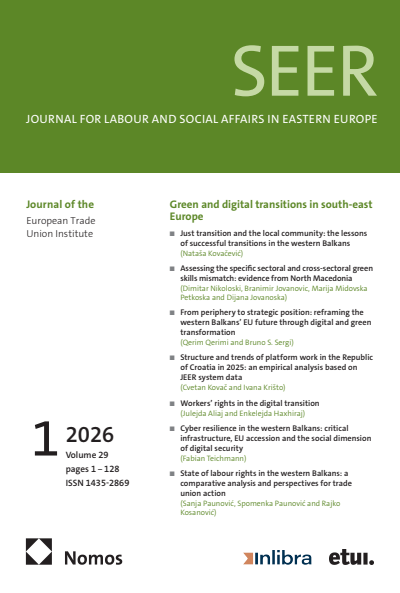
SEER Journal for Labour and Social Affairs in Eastern Europe
Jahrgang 29 (2026), Heft 1
- Autor:innen:
- Verlag
- Nomos, Baden-Baden
- Copyrightjahr
- 2026
- ISSN-Online
- 2942-3384
- ISSN-Print
- 1435-2869
Kapitelinformationen
Open Access Vollzugriff
Jahrgang 29 (2026), Heft 1
Assessing the specific sectoral and cross-sectoral green skills mismatch: evidence from North Macedonia
- Autor:innen:
- ISSN-Print
- 1435-2869
- ISSN-Online
- 2942-3384
- Kapitelvorschau:
Literaturverzeichnis
Es wurden keine Treffer gefunden. Versuchen Sie einen anderen Begriff.
- Arthur C (2021) ‘What are green skills?’ United Nations Industrial Development Organisation, accessed 25 May 2026 at: https://www.unido.org/stories/what-are-green-skills. Google Scholar öffnen DOI: 10.5771/1435-2869-2026-1-35
- Balata F, A Chapman, P Yunda and R Diski (2022) ‘Skills for a new economy, investing in workers and closing the green skill gap’ New Economy Foundation. Google Scholar öffnen DOI: 10.5771/1435-2869-2026-1-35
- Bishop P and R Herron (2015) ‘Use and misuse of the Likert item responses and other ordinal measures’ International Journal of Exercise Science 8(3): 297-301. Google Scholar öffnen DOI: 10.5771/1435-2869-2026-1-35
- Brunello G and P. Wruuck (2019) ‘Skill shortages and skill mismatch in Europe: a review of the literature’ EIB Working Paper 2019/05. Google Scholar öffnen DOI: 10.5771/1435-2869-2026-1-35
- Carminati L, A Lagorio, C Cimini, F Pirola, A Jurczuk and X Boucher (2025) ‘Integrative skills framework for Industry 5.0: insights from a systematic literature review and a European survey study’ Journal of Environmental Management 394: 127425. Google Scholar öffnen DOI: 10.5771/1435-2869-2026-1-35
- CEDEFOP (2021) ‘The green employment and skills transformation. Insights from a European Green Deal skills forecast scenario’. Google Scholar öffnen DOI: 10.5771/1435-2869-2026-1-35
- CEDEFOP (2023) ‘Tracking the green transition in labour markets. Using big data to identify the skills that make jobs greener’ Policy Brief. Google Scholar öffnen DOI: 10.5771/1435-2869-2026-1-35
- CEDEFOP (2025) ‘Meeting skill needs for the green transition. Skills anticipation and VET for a greener future’ Cedefop-UNEVOC Practical Guide 4. Google Scholar öffnen DOI: 10.5771/1435-2869-2026-1-35
- Consoli D, G Marin, R Marzucchi and F Vona (2015) ‘Do green jobs differ from non-green jobs in terms of skills and human capital?’ Science Policy Research Unit, Working Paper Series 2015-16 (May). Google Scholar öffnen DOI: 10.5771/1435-2869-2026-1-35
- Council of the European Union (2024) ‘Green transition: navigating social challenges for a sustainable future’ ART – Analysis and Research Team, Research Paper. Google Scholar öffnen DOI: 10.5771/1435-2869-2026-1-35
- EBRD (2020) ‘Green economy transition approach 2021-2025’ BDS20-082 (Final), 10 July, accessed 25 May 2026 at: Google Scholar öffnen DOI: 10.5771/1435-2869-2026-1-35
- https://www.ebrd.com/content/dam/ebrd_dxp/assets/pdfs/green-economy-transition/ebrds-green-economy-transition-approach/Green-Economy-Transition-Approach-2021-2025.pdf. Google Scholar öffnen DOI: 10.5771/1435-2869-2026-1-35
- Economist Impact (2024) ‘Green skills: driving the transition to a more sustainable future’ Economist Impact: London. Google Scholar öffnen DOI: 10.5771/1435-2869-2026-1-35
- ETF (2019) ‘Skills mismatch measurement in ETF partner countries’ European Training Foundation. Google Scholar öffnen DOI: 10.5771/1435-2869-2026-1-35
- ETF (2022) ‘Skilling for the green transition’ ETF Policy Briefing, European Training Foundation. Google Scholar öffnen DOI: 10.5771/1435-2869-2026-1-35
- ETF (2023) ‘Skills for the green transition, evidence from the EU neighbourhood’ European Training Foundation. Google Scholar öffnen DOI: 10.5771/1435-2869-2026-1-35
- European Commission (2020) ‘Guidelines for the implementation of the green agenda for the western Balkans’ Commission Staff Working Document, SWD(2020) 223 final, 6 October. Google Scholar öffnen DOI: 10.5771/1435-2869-2026-1-35
- Eurostat (2008) NACE Rev.2 Statistical classification of economic activities, 10 July, accessed 25 May 2026 at: https://ec.europa.eu/eurostat/web/products-manuals-and-guidelines/-/ks-ra-07-015. Google Scholar öffnen DOI: 10.5771/1435-2869-2026-1-35
- Fuchs M (2024) ‘Green skills for sustainability transition’ Geography Compass 18 (10): e70003. Google Scholar öffnen DOI: 10.5771/1435-2869-2026-1-35
- Gregg C, O Srietska-Ilina and C Bűdke (2015) ‘Anticipating skill needs for green jobs. A practical guide’ ILO Skills and Employability Branch Employment Policy Department. Google Scholar öffnen DOI: 10.5771/1435-2869-2026-1-35
- ILO (2019) ‘Skills for a greener future: a global view based on 32 country studies’ International Labour Office: Geneva. Google Scholar öffnen DOI: 10.5771/1435-2869-2026-1-35
- ILO (2022) ‘Promoting a just and inclusive green transition’ Joint ILO-OECD background paper prepared for the German G7 presidency, November, International Labour Office: Geneva. Google Scholar öffnen DOI: 10.5771/1435-2869-2026-1-35
- ILO (2024) ‘The business case for just transition: an overview of the economic benefits of the transition to a sustainable economy’ International Labour Organization, International Labour Office: Geneva. Google Scholar öffnen DOI: 10.5771/1435-2869-2026-1-35
- IOE (2023) ‘Not just transition without skills. Skills for climate change policies’ International Organisation of Employers: Geneva. Google Scholar öffnen DOI: 10.5771/1435-2869-2026-1-35
- Janta B, E Kritikos and T Clack (2023) ‘The green transition in the labour market: how to ensure equal access to green skills across education and training systems’ Publications Office of the European Union: Luxembourg. Google Scholar öffnen DOI: 10.5771/1435-2869-2026-1-35
- Keese M and L Marcolin (2023) ‘Labour and social policies for the green transition: a conceptual framework’ OECD Social, Employment and Migration Working Papers No. 295. Google Scholar öffnen DOI: 10.5771/1435-2869-2026-1-35
- Kwauk C and O Casey (2022) ‘A green skills framework for climate action, gender empowerment, and climate justice’ Development Policy Review 40(S2): e12624. Google Scholar öffnen DOI: 10.5771/1435-2869-2026-1-35
- Lamperty F, M Mazzucato, A Roventini and G Semieniuk (2019) ‘The green transition: public policy, finance, and the role of the state’ Vierteljahrshefte zur Wirtschaftsforschung 88(2): 73-88. Google Scholar öffnen DOI: 10.5771/1435-2869-2026-1-35
- Maclean R, S Jagannathan and B Panth (2018) Education and skills for inclusive growth, green jobs and the greening of economies in Asia, Springer Open: Singapore. Google Scholar öffnen DOI: 10.5771/1435-2869-2026-1-35
- Nedanovski P and N Daniloska (2022) ‘Analysis of the green skills situation in the Republic of North Macedonia. Research on green skills and their potential in secondary education in Republic of North Macedonia with a focus on secondary vocational education’ UNICEF North Macedonia. Google Scholar öffnen DOI: 10.5771/1435-2869-2026-1-35
- Nikoloski D, A Sulich, L Soloducho-Pelc, G Mancheski, M Angeleski and M Midovska Petkoska (2024) ‘Identifying green skills gaps through labour market intelligence’ Journal of Infrastructure, Policy and Development 8(6): 4868. Google Scholar öffnen DOI: 10.5771/1435-2869-2026-1-35
- Nikoloski D, B Jovanovic, M Midovska Petkoska and D Jovanoska (2026) ‘The impact of green skills mismatches on green job creation: evidence from North Macedonia’ South East European Journal of Economics and Business 21(2): 1-18. Google Scholar öffnen DOI: 10.5771/1435-2869-2026-1-35
- OECD (2022) ‘Multi-dimensional review of the western Balkans: from analysis to action’ OECD Publishing: Paris. Google Scholar öffnen DOI: 10.5771/1435-2869-2026-1-35
- OECD (2025) ‘Employment and skills policies for green transition: review of international good practices’ OECD Publishing: Paris. Google Scholar öffnen DOI: 10.5771/1435-2869-2026-1-35
- Sanchez D and M Yanez-Pagans (2024) ‘Navigating the green transition: building green skills for a sustainable workforce’ Skills4Dev, Issue 13, World Bank Group. Google Scholar öffnen DOI: 10.5771/1435-2869-2026-1-35
- Saussay A, M Sato, F Vona and L O’Kane (2022) ‘Who’s fit the low carbon transition? Emerging skills and wage gaps in job ad data’ Centre for Climate Change Economics and Policy Working Paper 406/Grantham Research Institute on Climate Change and the Environment Working Paper 381. Google Scholar öffnen DOI: 10.5771/1435-2869-2026-1-35
- Stroud D, L Antonazzo and M Weinel (2025) ‘“Green skills” and the emergent property of “greening”’ Policy Studies 46(3): 343-362. Google Scholar öffnen DOI: 10.5771/1435-2869-2026-1-35
- Sulich A and T Zema (2018) ‘Green jobs, a new measure of public management and sustainable development’ European Journal of Environmental Science 8(1): 69-75. Google Scholar öffnen DOI: 10.5771/1435-2869-2026-1-35
- Vona F, G Marin, D Consoli and D Popp (2015) ‘Green skills’ NBER Working Paper 21116. Google Scholar öffnen DOI: 10.5771/1435-2869-2026-1-35
- Wilts H (2022) ‘Green transition guidance note’ United Nations Issue-based Coalition on Environment and Climate Change for Europe and Central Asia. Google Scholar öffnen DOI: 10.5771/1435-2869-2026-1-35
