Intimate Machines, Disturbed Minds: Managing the Affective Cost of AI
Inhaltsverzeichnis
Bibliographische Infos
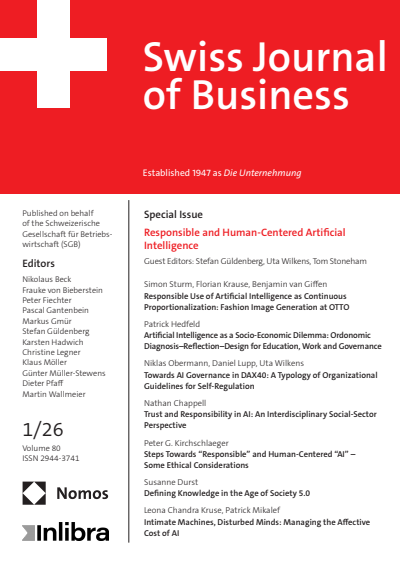
Swiss Journal of Business
Jahrgang 80 (2026), Heft 1
- Autor:innen:
- Verlag
- Nomos, Baden-Baden
- Copyrightjahr
- 2026
- ISSN-Online
- 2944-3741
- ISSN-Print
- 2944-3741
Kapitelinformationen
Jahrgang 80 (2026), Heft 1
Intimate Machines, Disturbed Minds: Managing the Affective Cost of AI
- Autor:innen:
- ISSN-Print
- 2944-3741
- ISSN-Online
- 2944-3741
- Kapitelvorschau:
Da künstliche Intelligenzsysteme (KI) zunehmend Empathie simulieren und mit Benutzern in Beziehung treten, beginnen sie, die affektive Struktur von Organisationen zu beeinflussen. Auf der Grundlage von Erkenntnissen aus der Informationssystemforschung, der Organisationswissenschaft und der Managementtheorie argumentieren wir, dass bestehende theoretische und Governance-Rahmenwerke nicht ausreichend sind, um diesen Entwicklungen Rechnung zu tragen. Wir unterscheiden zwischen externer Regulierung und interner Governance und schlagen einen präventiv-korrektiven Rahmen vor, um affektive Kosten in verschiedenen Arbeitskontexten anzugehen. Auf der Grundlage dieses Rahmens skizzieren wir eine Forschungsagenda, die gängige Annahmen in Management und Strategie in Frage stellt und eine erneute Aufmerksamkeit für Affekte, Beziehungsdynamiken und emotionale Architekturen in Organisationen fordert, die von affektiver KI geprägt sind.
Literaturverzeichnis
Es wurden keine Treffer gefunden. Versuchen Sie einen anderen Begriff.
- Baudrillard, J. (1981). Simulacra and simulation. University of Michigan Press. Google Scholar öffnen DOI: 10.5771/2944-3741-2026-1-89
- California Legislature. (2025). Senate Bill No. 243: Companion chatbots. https://leginfo.legislature.ca.gov/faces/billTextClient.xhtml?bill_id=202520260SB243 Google Scholar öffnen DOI: 10.5771/2944-3741-2026-1-89
- Chandra Kruse, L., Bergener, K., Conboy, K., Lundström, J. E., Maedche, A., Sarker, S., Seeber, I., Stein, A., & Tømte, C. E. (2023). Understanding the Digital Companions of Our Future Generation. Communications of the Association for Information Systems, 52, 465-479. Google Scholar öffnen DOI: 10.5771/2944-3741-2026-1-89
- European Parliament. (2025, October 16). New EU measures needed to make online services safer for minors. https://www.europarl.europa.eu/news/en/press-room/20251013IPR30892/new-eu-measures-needed-to-make-online-services-safer-for-minors Google Scholar öffnen DOI: 10.5771/2944-3741-2026-1-89
- Huang, S., Lai, X., Ke, L., Li, Y., Wang, H., Zhao, X., ... & Wang, Y. (2024). AI technology panic—is AI dependence bad for mental health? A cross-lagged panel model and the mediating roles of motivations for AI use among adolescents. Psychology Research and Behavior Management, 1087-1102. Google Scholar öffnen DOI: 10.5771/2944-3741-2026-1-89
- Langhof, J. G., & Güldenberg, S. (2022). The rise of the robot servant-leaders? Next generation leadership. The International Journal of Servant-Leadership, 16(1), 381–424. Google Scholar öffnen DOI: 10.5771/2944-3741-2026-1-89
- McKinsey (2025). Superagency in the workplace: Empowering people to unlock AI’s full potential (AI in the workplace: A report for 2025). https://www.mckinsey.com/capabilities/tech-and-ai/our-insights/superagency-in-the-workplace-empowering-people-to-unlock-ais-full-potential-at-work Google Scholar öffnen DOI: 10.5771/2944-3741-2026-1-89
- Naddaf, M. (2025). AI chatbots are sycophants – and it's harming science. Nature, 647, 13-14. Google Scholar öffnen DOI: 10.5771/2944-3741-2026-1-89
- Papagiannidis, E., Mikalef, P., & Conboy, K. (2025). Responsible artificial intelligence governance: A review and research framework. The Journal of Strategic Information Systems, 34(2), 101885. Google Scholar öffnen DOI: 10.5771/2944-3741-2026-1-89
- Richet, J. L. (2025). AI companionship or digital entrapment? Investigating the impact of anthropomorphic AI-based chatbots. Journal of Innovation & Knowledge, 10(6), 100835. Google Scholar öffnen DOI: 10.5771/2944-3741-2026-1-89
- Zao-Sanders, M. (2025, April 9) How People Are Really Using Gen AI in 2025, Harvard Business Review. https://hbr.org/2025/04/how-people-are-really-using-gen-ai-in-2025 Google Scholar öffnen DOI: 10.5771/2944-3741-2026-1-89
