Persian Idiom, Ottoman Meanings: Introducing Kemālpaşazāde’s Nigāristān
Inhaltsverzeichnis
Bibliographische Infos
Vollzugriff
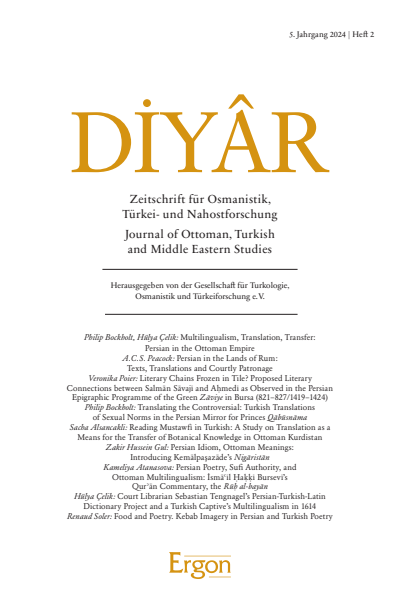
DIYÂR
Jahrgang 5 (2024), Heft 2
- Autor:innen:
- Verlag
- Ergon, Baden-Baden
- Copyrightjahr
- 2024
- ISSN-Online
- 2942-3155
- ISSN-Print
- 2625-9842
Kapitelinformationen
Vollzugriff
Jahrgang 5 (2024), Heft 2
Persian Idiom, Ottoman Meanings: Introducing Kemālpaşazāde’s Nigāristān
- Autor:innen:
- ISSN-Print
- 2625-9842
- ISSN-Online
- 2942-3155
- Kapitelvorschau:
Literaturverzeichnis
Es wurden keine Treffer gefunden. Versuchen Sie einen anderen Begriff.
- Published Primary Sources Google Scholar öffnen DOI: 10.5771/2625-9842-2024-2-212
- al-Ḥamawī, Yāqūt. 1993. Muʿjam al-Udabāʾ. Vol 1. Beirut: Dār al-Gharb al-Islāmī. Google Scholar öffnen DOI: 10.5771/2625-9842-2024-2-212
- Çelebi, ʿĀşıḳ. 2010. Meşāʾir ül-Şuʿarāʾ. Vol. 1. Kılıç, Filiz (ed.). Istanbul: İstanbul Araştırmaları Enstitüsü. Google Scholar öffnen DOI: 10.5771/2625-9842-2024-2-212
- Dūghlāt, Mīrzā Muḥammad Ḥaydar. 1383 [2004]. Tārīkh-i Rashīdī. Ghaffārī-Fard, ‘Abbās-Qulī (ed.). Tehran: Mirāỿ-i Maktūb. Google Scholar öffnen DOI: 10.5771/2625-9842-2024-2-212
- Gul, Zakir Hussein. 2022. The Nigāristān of Kamālpāshāzāda: A Critical Edition of an Early Modern Persian Language Speculum Principum from the Periphery of the Persianate World. MA dissertation. University of Tehran, Tehran. Google Scholar öffnen DOI: 10.5771/2625-9842-2024-2-212
- Jāmi, ʿAbd al-Raḥmān. 1379 [2000]. Bahāristān va Rasāʾil-i Jāmi. Afṣaḥzād, Aʿlākhān, ʿImrān, Muḥammad-Jān and Ẓuhūr al-Din, Abū Bakr (eds.). Tehran: Mirāỿ-i Maktūb. Google Scholar öffnen DOI: 10.5771/2625-9842-2024-2-212
- –. 1378 [1999]. Diwān. Afṣaḥzād, Aʿlākhān (ed.). Tehran: Mīrāỿ-i Maktūb. Google Scholar öffnen DOI: 10.5771/2625-9842-2024-2-212
- –. 1378 [1999]. Maỿnavī-yi Haft Awrang. Aḥrārī, Ṭāhir, Dādʿalīshāh, Jābulqā and Jānfidā, Asghar et al. (eds.). Tehran: Mirāỿ-i Maktūb. Google Scholar öffnen DOI: 10.5771/2625-9842-2024-2-212
- –. 1375 [1996]. Maỿnavī-yi Haft Awrang. Mudarris-Gilāni, Murtaḍā (ed.). Tehran: Mahtāb. Google Scholar öffnen DOI: 10.5771/2625-9842-2024-2-212
- Juwaynī, ʿAlāʾ al-Dīn ʿAṭāʾ Malik Muḥammad. 1391 [2012]. Tārīkh-i Jahāngushāy. Qazwīnī, Muḥammad (ed.). Tehran: Muʾassasa-yi Intishārāt-i Nigāh. Google Scholar öffnen DOI: 10.5771/2625-9842-2024-2-212
- Manūchihrī, Abū Najm Aḥmad ibn Qawṣ ibn Aḥmad. 1338 [1959]. Dīvān-i Ustād Manūchihrī-yi Dāmghānī. Dabīr-Siyāqī, Muḥammad (ed.). Tehran: Zavvār. Google Scholar öffnen DOI: 10.5771/2625-9842-2024-2-212
- Niẓāmī, Jamāl ad-Dīn Abū Muḥammad Ilyās Ibn Yūsuf Ibn Zakkī. 1390 [2011]. Haft Paykar. Dastgardī, Ḥasan-Vaḥīd. Tehran: Qaṭra. Google Scholar öffnen DOI: 10.5771/2625-9842-2024-2-212
- Saʿdī. 1386 [2007]. Būstān. Khaṭīb-Rahbar, Khalīl (ed.). Tehran: Ṣafī ʿAlī-Shāh. Google Scholar öffnen DOI: 10.5771/2625-9842-2024-2-212
- –. 1385 [2006–2007]. Kulliyāt-i Saʿdī. Furūghī, Muhḥammad-ʿAlī (ed.). Tehran: Hermes. Google Scholar öffnen DOI: 10.5771/2625-9842-2024-2-212
- Sāvajī, Salmān. 1348 [1959–1960]. Maỿnavī-yi Jamshīd va Khurshīd. Asmussen, J.P., Vahman, Ferīdūn (eds.). Tehran: Bungāh-i Tarjuma va Nashr-i Kitāb. Google Scholar öffnen DOI: 10.5771/2625-9842-2024-2-212
- Yāḥaqqī, Muḥammad Jaʿfar and Sayyidī, Mahdī (eds.). 1390 [2011]. Dībā-yi Dīdārī: Matn-i Kāmil-i Tārīkh-i Bayhaqī bā Muqaddama, Tawẓīhāt va Sharḥ-i Mushkilāt. Tehran: Sukhan. Google Scholar öffnen DOI: 10.5771/2625-9842-2024-2-212
- Secondary Sources Google Scholar öffnen DOI: 10.5771/2625-9842-2024-2-212
- Acar, Cafer. 2022. ‘İbn Kemal’in Şah İsmail’e Yönelik Tekfirinin Siyâsî Boyutları Üzerine’. Danişname Beşeri Ve Sosyal Bilimler Dergisi, 5. 105–131. Google Scholar öffnen DOI: 10.5771/2625-9842-2024-2-212
- Algar, Hamid. 2013. Jami. New Delhi: Oxford University Press. Google Scholar öffnen DOI: 10.5771/2625-9842-2024-2-212
- –. 2018. ‘Jāmī and the Ottomans’. In d’Hubert, Thibaut and Papas, Alexandre (eds.). Jāmī in Regional Contexts. Leiden: Brill. 63–135. Google Scholar öffnen DOI: 10.5771/2625-9842-2024-2-212
- Bekir, Özcan. 1992. ‘İnsana Verdiği Önem Yönünden İbn Kemal’in Nigâristân’ı’. Dokuz Eylül Üniversitesi İlahiyat Fakültesi Dergisi 7. 243–256. Google Scholar öffnen DOI: 10.5771/2625-9842-2024-2-212
- Browne, Edward G. 1928. A Literary History of Persia. Vol. 3. Cambridge: Cambridge University Press. Google Scholar öffnen DOI: 10.5771/2625-9842-2024-2-212
- Dankoff, Robert and Kim, Sooyong. 2011. An Ottoman Traveller: Selections from the Book of Travels of Evliya Celebi. London: Eland Publishing Ltd. Google Scholar öffnen DOI: 10.5771/2625-9842-2024-2-212
- Demirkol, Murat, Canikli, İlyas, and Kıyak, Sever (eds). 2022. Kemalpaşazâde Felsefe-Din-Edebiyat Araştırmaları. Vol 1. Ankara: Fecr Yayınları. Google Scholar öffnen DOI: 10.5771/2625-9842-2024-2-212
- d’Hubert, Thibaut and Papas, Alexandre. 2018. ‘Introduction’. In d’Hubert, Thibaut and Papas, Alexandre (eds.). Jāmī in Regional Contexts. Leiden, The Netherlands: Brill. 1–26. Google Scholar öffnen DOI: 10.5771/2625-9842-2024-2-212
- Edmund, Bosworth C.E. 2011. The History of Beyhaqi: The History of Sultan Mas‘ud of Ghazna, 1030–1041, Volume I: Introduction and Translation of Years 421–423 A.H. (1030–1032 A.D.). Cambridge: Harvard University Press. Google Scholar öffnen DOI: 10.5771/2625-9842-2024-2-212
- El-Rouayheb, Khaled. 2015. ‘Kurdish Scholars and the Reinvigoration of the Rational Sciences’. In Islamic Intellectual History in the Seventeenth Century: Scholarly Currents in the Ottoman Empire and the Maghreb. Cambridge: Cambridge University Press. 13–59. Google Scholar öffnen DOI: 10.5771/2625-9842-2024-2-212
- Erkal, Abdülkadir. 2021. ‘Klasik Türk Şiirinde Mazmunlaşan Mekanlar: Puthâneler’. Uluslararası Anadolu Sosyal Bilimler Dergisi 5.3. 1094–1108. Google Scholar öffnen DOI: 10.5771/2625-9842-2024-2-212
- Green, Nile. 2019. ‘Introduction: The Frontiers of the Persianate World (ca. 800–1900)’. In Green, Nile (ed.). The Persianate World: The Frontiers of a Eurasian Lingua Franca. Oakland: University of Carolina Press. 26–71. Google Scholar öffnen DOI: 10.5771/2625-9842-2024-2-212
- Gulácsi, Zsuzsanna. 2015. Mani’s Pictures. Leiden: Brill. Google Scholar öffnen DOI: 10.5771/2625-9842-2024-2-212
- Gürbüzel, Aslıhan. 2021. ‘Bilingual Heaven: Was There a Distinct Persianate Islam in the Early Modern Ottoman Empire?’. Philological Encounters 6.1–2. 214–241. Google Scholar öffnen DOI: 10.5771/2625-9842-2024-2-212
- Hagen, Gottfried. 2013. ‘The Order of Knowledge, the Knowledge of Order: Intellectual Life’. In Faroqhi, Suraiya and Fleet, Kate (eds.). The Cambridge History of Turkey. Cambridge: Cambridge University Press. 548–592. Google Scholar öffnen DOI: 10.5771/2625-9842-2024-2-212
- Hayyim, Sulayman. 1934–1936. New Persian-English dictionary, complete and modern, designed to give the English meanings of over 50,000 words, terms, idioms, and proverbs in the Persian language, as well as the transliteration of the words in English characters. Together with a sufficient treatment of all the grammatical features of the Persian Language. Vol. 2. Tehran: Librairie-imprimerie Béroukhim. Google Scholar öffnen DOI: 10.5771/2625-9842-2024-2-212
- İnan, Murat Umut. 2019. ‘Imperial Ambitions, Mystical Aspirations: Persian Learning in the Ottoman World’. In Green, Nile (ed.). The Persianate World: The Frontiers of a Eurasian Lingua Franca. Oakland: University of Carolina Press. 75–92. Google Scholar öffnen DOI: 10.5771/2625-9842-2024-2-212
- –. 2020. ‘Ottomans Reading Persian Classics: Readers and Reading in the Ottoman Empire, 1500–1700’ In Hammond, Mary (ed.). The Edinburgh History of Reading: Early Readers. Edinburgh: Edinburgh University Press. 160–181. Google Scholar öffnen DOI: 10.5771/2625-9842-2024-2-212
- –. 2017. ‘Rethinking the Ottoman Imitation of Persian Poetry’. Iranian Studies 505. 671–689. Google Scholar öffnen DOI: 10.5771/2625-9842-2024-2-212
- İzmirli, Betül. 2022. ‘Kemâlpaşazâde’nin Nigâristân’ında Sûfî Tipolojileri’. In Demirkol, Murat, Canikli, İlyas, and Kıyak, Sever (eds.). Kemalpaşazâde Felsefe-Din-Edebiyat Araştırmaları. Vol 1. Ankara: Fecr Yayınları. 393–411. Google Scholar öffnen DOI: 10.5771/2625-9842-2024-2-212
- Jackson, Peter. 2017. The Mongols and the Islamic World, from Conquest to Conversion. London: Yale University Press. Google Scholar öffnen DOI: 10.5771/2625-9842-2024-2-212
- Juwaynī, ʿAlāʾ al-Dīn ʿAṭāʾ Malik Muḥammad. 1958. The History of the World-Conqueror. Andrew Boyle, John (transl.). Cambridge: Harvard University Press. Google Scholar öffnen DOI: 10.5771/2625-9842-2024-2-212
- Kalın, İbrahim. 2015. ‘Ibn Kemal (873–940/ 1468–1534)’. In Leaman, Oliver (ed.). The Biographical Encyclopedia of Islamic Philosophy. London: Bloomsbury Publishing. 199. Google Scholar öffnen DOI: 10.5771/2625-9842-2024-2-212
- Kauz, Ralph. 2012. ‘Ḵeṭāy-nāma’. Encyclopædia Iranica Online. URL: https://www.iranicaonline.org/articles/ketay-nama (accessed 10 October 2023). Google Scholar öffnen DOI: 10.5771/2625-9842-2024-2-212
- Kirakosyan, Hasmik and Sargsyan, Ani. 2022. ‘On the Appropriation of Lexicographic Methods of Kemālpaşazāde’s (1468–1534) Glossary Daḳāyiḳu l-ḥaḳāyiḳ’. Diyâr: Journal of Ottoman, Turkish and Middle Eastern Studies 3.1. 14–26. Google Scholar öffnen DOI: 10.5771/2625-9842-2024-2-212
- Kuru, Selim Sırrı. 2013. ‘The Literature of Rum: The Making of a Literary Tradition (1400–1650)’. In Faroqhi, Suraiya and Fleet, Kate (eds.). The Cambridge History of Turkey. Cambridge: Cambridge University Press. 548–592. Google Scholar öffnen DOI: 10.5771/2625-9842-2024-2-212
- Kushner, David. 1997. ‘Self-Perception and Identity in Contemporary Turkey’. Journal of Contemporary History 32.2. 219–233. Google Scholar öffnen DOI: 10.5771/2625-9842-2024-2-212
- Lewis, Bernard. 1963. Istanbul and the Civilization of Empire. Norman: University of Oklahoma Press. Google Scholar öffnen DOI: 10.5771/2625-9842-2024-2-212
- Lewis, Franklin. 2018. ‘To Round and Rondeau the Canon’. In d’Hubert, Thibaut and Papas, Alexandre (eds.). Jāmī in Regional Contexts. Leiden: Brill. 463–567. Google Scholar öffnen DOI: 10.5771/2625-9842-2024-2-212
- Meisami, Julie Scott. 2015. The Haft Paykar: A Medieval Persian Romance. Oxford: Hackett Publishing. Google Scholar öffnen DOI: 10.5771/2625-9842-2024-2-212
- Miftāh, Ilhām and Valī, Vahhāb. 1374 [1995]. Nigāhī ba Ravand-i Nufūẓ va Gustarish-i Zabān va Adab-i Fārsī dar Turkiya. Tehran: Shūrā-yi Gustarish-i Zabān va Adabiyāt-i Fārsī. Google Scholar öffnen DOI: 10.5771/2625-9842-2024-2-212
- Mikhail, Alan. 2020. God’s Shadow, The Ottoman Sultan Who Shaped the Modern World. London: Faber & Faber. Google Scholar öffnen DOI: 10.5771/2625-9842-2024-2-212
- Morgan, David. 2012. ‘Persian as a Lingua Franca in the Mongol Empire’. In Hanaway, William L. and Spooner, Brian (eds.). Literacy in the Persianate World. Philadelphia: University of Pennsylvania Press. 171–195. Google Scholar öffnen DOI: 10.5771/2625-9842-2024-2-212
- Mursilvand, Ḥasan. 1379 [2000]. Zindagīnāma-yi Rijāl va Mashāhīr-i Īrān. Vol. 4. Tehran: Elham. Google Scholar öffnen DOI: 10.5771/2625-9842-2024-2-212
- Öztürk, Said. 2003. ‘İstanbul’un Fethinden Sonra Ayasofya’nın Camiye Çevrilişi’. Selçuk Üniversitesi Türkiyat Araştırmaları Dergisi 14. 133–142. Google Scholar öffnen DOI: 10.5771/2625-9842-2024-2-212
- Qazvīnī, Muḥammad. 1317 [1938]. Mamdūḥīn-i Shaykh Saʿdī. Tehran: Majalla-yi Taʿlīm va Tarbiyat. Google Scholar öffnen DOI: 10.5771/2625-9842-2024-2-212
- Quatremère, Étienne. 1844. Extrait de l’Histoire des Mongols de Raschid-Eldin. n.p. Firmin Didot Frères. Google Scholar öffnen DOI: 10.5771/2625-9842-2024-2-212
- Richard, Francis. 2018. ‘A Case of Literary Success’. In d’Hubert, Thibaut and Papas, Alexandre (eds.). Jāmī in Regional Contexts. Leiden: Brill. 27–41. Google Scholar öffnen DOI: 10.5771/2625-9842-2024-2-212
- Ṣafā, Ẕabīḥullāh. 1342–62 [1963–1983]. Tārīkh-i Adabiyāt dar Īrān. Tehran: Kitābfurūshī-yi Ibn-i Sīnā. Google Scholar öffnen DOI: 10.5771/2625-9842-2024-2-212
- Schmidt, Jan. 2014. ‘The Importance of Persian for Ottoman Literary Gentlemen: Two Turkish Treatises on Aspects of the Language by Kemal Pashazade (d. 1536)’. In Aynur, Hatice, Aydın, Bilgin, and Ülker, Mustafa Birol (eds.). Kitaplara Vakfedilen Bir Ömre Tuhfe: İsmail E. Erünsal’a Armağan. Istanbul: Ülke Armağan. 851–865. Google Scholar öffnen DOI: 10.5771/2625-9842-2024-2-212
- Steingass, Francis. 1892. A Comprehensive Persian-English dictionary, including the Arabic words and phrases to be met with in Persian literature. London: Routledge & K. Paul. Google Scholar öffnen DOI: 10.5771/2625-9842-2024-2-212
- Sundermann, Werner. 2009. ‘Mani’. Encyclopædia Iranica Online. URL: https://www.iranicaonline.org/articles/mani-founder-manicheism (accessed 10 October 2023). Google Scholar öffnen DOI: 10.5771/2625-9842-2024-2-212
- Thackston, Wheeler. 2018. The Gulistan of Saʿdī: Bilingual English and Persian Edition with Vocabulary. Bethesda: Ibex Publishers. Google Scholar öffnen DOI: 10.5771/2625-9842-2024-2-212
- Wethey, Harold Edwin. 1971. The Paintings of Titian: The Portraits. London: Phaidon Press. Google Scholar öffnen DOI: 10.5771/2625-9842-2024-2-212
- Winter, Stefan. 2010. The Shiites of Lebanon under Ottoman Rule, 1516–1788. Cambridge: Cambridge University Press. Google Scholar öffnen DOI: 10.5771/2625-9842-2024-2-212
- Winter, Timothy. 2007. ‘Ibn Kemāl (d. 940/1534) on Ibn ‘Arabī’s Hagiology’. In Shihadeh, Ayman (ed.). Sufism and Theology. Edinburgh: Edinburgh University Press. 137–157. Google Scholar öffnen DOI: 10.5771/2625-9842-2024-2-212
- Woodhead, Christine. 2021. ‘Kemalpaşazade’. In Fleet, Kate, Krämer, Gudrun and Matringe, Denis et al. (eds.). Encyclopaedia of Islam Online. Leiden: Brill. URL: http://dx.doi.org/10.1163/1573-3912_ei3_COM_35404 (accessed 10 October 2023). Google Scholar öffnen DOI: 10.5771/2625-9842-2024-2-212
- Yalama-hā, Aḥmad Riżā. 1390 [2011]. ‘Nigāhī ba Nigāristān-i Ibn Kamāl Pāshā: aỿarī nāshinākhta ba taqlīd az Gulistān-i Saʿdī’. Faṣlnāma-yi ʿilmī-yi zabān va adab-i Fārsī-yi Dānishgāh-i Āzād-i Islāmī-yi Sanandaj 3.8. 157–170. Google Scholar öffnen DOI: 10.5771/2625-9842-2024-2-212
- Yazıcı, Tahsin. 2010. ‘Persian Authors of Asia Minor’. Encyclopædia Iranica Online. URL: https://iranicaonline.org/articles/persian-authors–1 (accessed 10 October 2023). Google Scholar öffnen DOI: 10.5771/2625-9842-2024-2-212
- Zia-Ebrahimi, Reza. 2016. The Emergence of Iranian Nationalism: Race and the Politics of Dislocation. New York: Columbia University Press. Google Scholar öffnen DOI: 10.5771/2625-9842-2024-2-212
