Prerequisites of deliberative democracy: Inclusivity, publicity, and heterogeneity of German citizens’ everyday political talk
Inhaltsverzeichnis
Bibliographische Infos
Open Access Vollzugriff
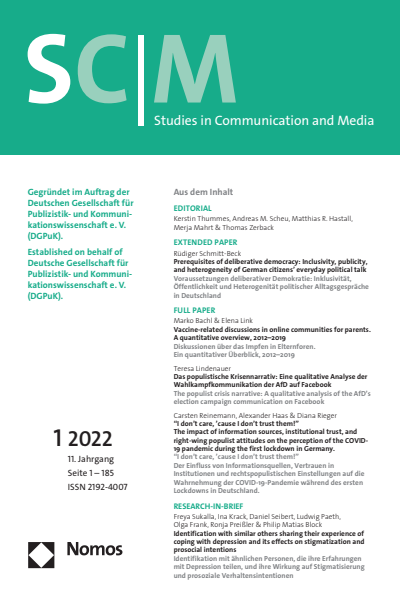
SCM Studies in Communication and Media
Jahrgang 11 (2022), Heft 1
- Autor:innen:
- Verlag
- Nomos, Baden-Baden
- Copyrightjahr
- 2022
- ISSN-Online
- 2192-4007
- ISSN-Print
- 2192-4007
Kapitelinformationen
Open Access Vollzugriff
Jahrgang 11 (2022), Heft 1
Prerequisites of deliberative democracy: Inclusivity, publicity, and heterogeneity of German citizens’ everyday political talk
- Autor:innen:
- ISSN-Print
- 2192-4007
- ISSN-Online
- 2192-4007
- Kapitelvorschau:
Literaturverzeichnis
Es wurden keine Treffer gefunden. Versuchen Sie einen anderen Begriff.
- Aalberg, T., & Curran, J. (Eds.) (2012). How media inform democracy. A comparative approach. Routledge. Google Scholar öffnen DOI: 10.5771/2192-4007-2022-1-7
- Ahn, T. K., Huckfeldt, R., Mayer, A. K., & Ryan, J. B. (2010). Politics, expertise, and interdependence within electorates. In J. E. Leighley (Ed.), The Oxford Handbook of American Elections and Political Behavior (pp. 278–299). Oxford University Press. Google Scholar öffnen DOI: 10.5771/2192-4007-2022-1-7
- Amsalem, E., & Nir, L. (2019). Does interpersonal discussion increase political knowledge? A meta-analysis. Communication Research. Advance online publication. https:// doi.org/10.1177/0093650219866357 Google Scholar öffnen DOI: 10.5771/2192-4007-2022-1-7
- Anderson, C. J., & Paskeviciute, A. (2005). Macro-politics and micro-behavior. Mainstream politics and the frequency of political discussion in contemporary democracies. In A. Zuckerman (Ed.), The Social Logic of Politics. Personal Networks as Contexts for Political Behavior (pp. 228–248). Temple University Press. Google Scholar öffnen DOI: 10.5771/2192-4007-2022-1-7
- Bächtiger, A. (2016). Empirische Deliberationsforschung [Empirical deliberation research]. In W. O. Lembcke, C. Ritzi, & S. G. Schaal (Eds.), Zeitgenössische Demokratietheorie, Band 2: Empirische Demokratietheorien (pp. 251–278). Springer. Google Scholar öffnen DOI: 10.5771/2192-4007-2022-1-7
- Bächtiger, A., & Parkinson, J. (2019). Mapping and measuring deliberation. Towards a new deliberative quality. Oxford University Press. Google Scholar öffnen DOI: 10.5771/2192-4007-2022-1-7
- Barber, B. R. (1984). Strong democracy. Participatory politics for a new age. University of California Press. Google Scholar öffnen DOI: 10.5771/2192-4007-2022-1-7
- Bassili, J. N. (1996). Meta-judgmental versus operative indexes of psychological attributes: The case of measures of attitude strength. Journal of Personality and Social Psychology, 71(4), 637–653. https://doi.org/10.1037/0022-3514.71.4.637 Google Scholar öffnen DOI: 10.5771/2192-4007-2022-1-7
- Baumeister, R. F. (2011). Need-to-belong theory. In P. A. M. van Lange, A. Kruglanski, & Google Scholar öffnen DOI: 10.5771/2192-4007-2022-1-7
- E. T. Higgins (Eds.), Handbook of Theories of Social Psychology (Vol. 2, pp. 121–140). SAGE. Google Scholar öffnen DOI: 10.5771/2192-4007-2022-1-7
- Beauvais, E. (2018). Deliberation and equality. In A. Bächtiger, J. S. Dryzek, J. Mansbridge, & M. Warren (Eds.), The Oxford Handbook of Deliberative Democracy (pp. 144– 155). Oxford University Press. Google Scholar öffnen DOI: 10.5771/2192-4007-2022-1-7
- Bennett, S. E., Lickinger, R. S., & Rhine, S. L. (2000). Political talk over here, over there, over time. British Journal of Political Science, 30, 99–119. Google Scholar öffnen DOI: 10.5771/2192-4007-2022-1-7
- Bessette, J. M. (1994). The mild voice of reason: Deliberative democracy and american national government. University of Chicago Press. Google Scholar öffnen DOI: 10.5771/2192-4007-2022-1-7
- Bohman, J. (1996). Public deliberation: Pluralism, complexity and democracy. MIT Press. Bohman, J. (2006). Deliberative democracy and the epistemic benefits of diversity. Epis- Google Scholar öffnen DOI: 10.5771/2192-4007-2022-1-7
- teme, 3, 175–191. Google Scholar öffnen DOI: 10.5771/2192-4007-2022-1-7
- Bourdieu, P. (1986). The forms of capital. In J. G. Richardson (Ed.), Handbook of Theory and Research for the Sociology of Education (pp. 241–258). Greenwood. Google Scholar öffnen DOI: 10.5771/2192-4007-2022-1-7
- Burkhalter, S., Gastil, J., & Kelshaw, T. (2002). A conceptual definition and theoretical model of public deliberation in small face-to-face groups. Communication Theory, 12(4), 398-422. https://doi.org/10.1111/j.1468-2885.2002.tb00276.x Google Scholar öffnen DOI: 10.5771/2192-4007-2022-1-7
- Cacioppo, J. T., & Petty, R. E. (1982). The need for cognition. Journal of Personality and Social Psychology, 42(1), 116–131. https://doi.org/10.1037/0022-3514.42.1.116 Google Scholar öffnen DOI: 10.5771/2192-4007-2022-1-7
- Caprara, G. V., & Vecchione, M. (2013). Personality approaches to political behavior. In L. Huddy, D. O. Sears, & J. S. Levy (Eds.), The Oxford Handbook of Political Psychology (2nd ed., pp. 23–58). Oxford University Press. Google Scholar öffnen DOI: 10.5771/2192-4007-2022-1-7
- Chambers, S. (2003). Deliberative democratic theory. Annual Review of Political Science, 6(1), 307–326. Google Scholar öffnen DOI: 10.5771/2192-4007-2022-1-7
- Chambers, S. (2009). Rhetoric and the public sphere: Has deliberative Democracy abandoned mass democracy? Political Theory, 37(3), 323–350. https://doi.org/10.1177/ 0090591709332336 Google Scholar öffnen DOI: 10.5771/2192-4007-2022-1-7
- Chambers, S. (2012). Deliberation and mass democracy. In J. Parkinson & J. Mansbridge (Eds.), Deliberative Systems. Deliberative Democracy at the Large Scale (pp. 52–71). Cambridge University Press. Google Scholar öffnen DOI: 10.5771/2192-4007-2022-1-7
- Cohen, J. (1989). Deliberation and democratic legitimacy. In A. P. Hamlin & P. N. Pettit (Eds.), The Good Polity. Normative Analysis of the State (pp. 18–34). Blackwell. Google Scholar öffnen DOI: 10.5771/2192-4007-2022-1-7
- Conover, P. J., & Miller, P. R. (2018). Taking everyday political talk seriously. In A. Bächtiger, J. S. Dryzek, J. Mansbridge, & M. Warren (Eds.), The Oxford Handbook of Deliberative Democracy (pp. 378–391). Oxford University Press. Google Scholar öffnen DOI: 10.5771/2192-4007-2022-1-7
- Conover, P. J., & Searing, D. D. (2005). Studying ‚Everyday political talk‘ in the deliberative system. Acta Politica, 40(3), 269-283. https://doi.org/10.1057/palgrave.ap.5500113 Conover, P. J., Searing, D. D., & Crewe, I. M. (2002). The deliberative potential of political Google Scholar öffnen DOI: 10.5771/2192-4007-2022-1-7
- discussion. British Journal of Political Science, 32, 21–62. Google Scholar öffnen DOI: 10.5771/2192-4007-2022-1-7
- Cowan, S. K., & Baldassarri, D. (2018). “It could turn ugly”: Selective disclosure of attitudes in political discussion networks. Social Networks, 52, 1–17. https://doi. org/10.1016/j.socnet.2017.04.002 Google Scholar öffnen DOI: 10.5771/2192-4007-2022-1-7
- Craig, S. C., & Maggiotto, M. A. (1982). Measuring political efficacy. Political Methodology, 8(3), 85–109. Google Scholar öffnen DOI: 10.5771/2192-4007-2022-1-7
- Dalton, R. J. (2017). The participation gap: Social status and political inequality. Oxford University Press. Google Scholar öffnen DOI: 10.5771/2192-4007-2022-1-7
- De Grada, E., Kruglanski, A. W., Mannetti, L., & Pierro, A. (1999). Motivated cognition and group interaction: Need for closure affects the contents and pocesses of collective negotiations. Journal of Experimental Social Psychology, 35(4), 346–365. https://doi. org/10.1006/jesp.1999.1376 Google Scholar öffnen DOI: 10.5771/2192-4007-2022-1-7
- Delli Carpini, M. X., & Keeter, S. (1996). What americans know about politics and why it matters. Yale University Press. Google Scholar öffnen DOI: 10.5771/2192-4007-2022-1-7
- Downs, A. (1957). An economic theory of democracy. Harper. Google Scholar öffnen DOI: 10.5771/2192-4007-2022-1-7
- Dryzek, J. S. (2000). Deliberative democracy and beyond: Liberals, critics, contestations. Google Scholar öffnen DOI: 10.5771/2192-4007-2022-1-7
- Oxford University Press. Google Scholar öffnen DOI: 10.5771/2192-4007-2022-1-7
- Dryzek, J. S. (2010). Foundations and frontiers of deliberative governance. Oxford University Press. Google Scholar öffnen DOI: 10.5771/2192-4007-2022-1-7
- Dryzek, J. S. (2016). Symposium commentary: Reflections on the theory of deliberative systems. Critical Policy Studies, 10(2), 209–215. https://doi.org/10.1080/19460171.20 16.1170620 Google Scholar öffnen DOI: 10.5771/2192-4007-2022-1-7
- Dunn, J. (2018). Setting the people free: The story of democracy (2nd ed.). Princeton University Press. Google Scholar öffnen DOI: 10.5771/2192-4007-2022-1-7
- Easton, D. (1965). A systems analysis of political life. Wiley. Google Scholar öffnen DOI: 10.5771/2192-4007-2022-1-7
- Eliasoph, N. (1998). Avoiding politics: How americans produce apathy in everyday life. Google Scholar öffnen DOI: 10.5771/2192-4007-2022-1-7
- Cambridge University Press. Google Scholar öffnen DOI: 10.5771/2192-4007-2022-1-7
- Ellerbrock, S. (2022). Partisan agreement and disagreement in voters’ discussant networks: Contextual constraints and partisan selectivity in a changing electorate. In R. Schmitt-Beck, S. Roßteutscher, H. Schoen, B. Weßels, & C. Wolf (Eds.), The Changing German Voter. Oxford University Press (forthcoming). Google Scholar öffnen DOI: 10.5771/2192-4007-2022-1-7
- Eveland, W. P., Hutchens, M. J., & Morey, A. (2012). Social networks and political knowledge. In H. A. Semetko & M. Scammell (Eds.), The SAGE Handbook of Political Communication (pp. 240–252). SAGE. Google Scholar öffnen DOI: 10.5771/2192-4007-2022-1-7
- Eveland, W. P., Hutchens, M. J., & Morey, A. C. (2013). Political network size and its antecedents and consequences. Political Communication, 30(3), 371–394. https://doi.org/1 0.1080/10584609.2012.737433 Google Scholar öffnen DOI: 10.5771/2192-4007-2022-1-7
- Eveland, W. P., Morey, A. C., & Hutchens, M. J. (2011). Beyond deliberation: New directions for the study of informal political conversation from a communication perspective. Journal of Communication, 61(6), 1082–1103. https://doi.org/10.1111/j.1460-2466.2011.01598.x Google Scholar öffnen DOI: 10.5771/2192-4007-2022-1-7
- Feld, S. L. (1981). The focused organization of social ties. American Journal of Sociology, 86(5), 1015–1035. https://doi.org/10.2307/2778746 Google Scholar öffnen DOI: 10.5771/2192-4007-2022-1-7
- Felicetti, A. (2014). Citizen forums in the deliberative system. Democratic Theory, 1(2), 95–103. https://doi.org/10.3167/dt.2014.010210 Google Scholar öffnen DOI: 10.5771/2192-4007-2022-1-7
- Fischer, C. S. (2011). Still connected. Family and friends in America since 1970. Russell Sage Foundation. Google Scholar öffnen DOI: 10.5771/2192-4007-2022-1-7
- Fishkin, J. S. (1991). Democracy and deliberation. New directions for democratic reform. Google Scholar öffnen DOI: 10.5771/2192-4007-2022-1-7
- Yale University Press. Google Scholar öffnen DOI: 10.5771/2192-4007-2022-1-7
- Fishkin, J. S. (2009). When the people speak. Deliberative democracy and public consultation. Oxford University Press. Google Scholar öffnen DOI: 10.5771/2192-4007-2022-1-7
- Fishkin, J. (2018). Democracy when the people are thinking. Revitalizing our politics through public deliberation. Oxford University Press. Google Scholar öffnen DOI: 10.5771/2192-4007-2022-1-7
- Fitzgerald, J. (2013). What does “political” mean to you? Political Behavior, 35(3), 453– Google Scholar öffnen DOI: 10.5771/2192-4007-2022-1-7
- 479. https://doi.org/10.1007/s11109-012-9212-2 Google Scholar öffnen DOI: 10.5771/2192-4007-2022-1-7
- Freelon, D. G. (2010). Analyzing online political discussion using three models of democratic communication. New Media & Society, 12(7), 1172–1190. https://doi. org/10.1177/1461444809357927 Google Scholar öffnen DOI: 10.5771/2192-4007-2022-1-7
- Friess, D., & Eilders, C. (2015). A systematic review of online deliberation research. Policy & Internet, 7(3), 319–339. https://doi.org/10.1002/poi3.95 Google Scholar öffnen DOI: 10.5771/2192-4007-2022-1-7
- Fuchs, D. (2014). Empirische Deliberationsforschung – eine kritische Diskussion [Empirical deliberation research – A critical discussion]. In C. Landwehr & R. Schmalz-Bruns (Eds.), Deliberative Demokratie in der Diskussion. Herausforderungen, Bewährungsprobleme, Kritik (pp. 169–201). Nomos. Google Scholar öffnen DOI: 10.5771/2192-4007-2022-1-7
- Gärtner, L., Wuttke, A., & Schoen, H. (2021). Who talks and who listens? How political involvement influences the potential for democratic deliberation in everyday political talk. Journal of Deliberative Democracy, 17(2), 13–30. https://doi.org/10.16997/ jdd.983 Google Scholar öffnen DOI: 10.5771/2192-4007-2022-1-7
- Gastil, J. (2000). By popular demand. Revitalizing representative democracy through deliberative elections. University of California Press. Google Scholar öffnen DOI: 10.5771/2192-4007-2022-1-7
- Gastil, J. (2008). Political communication and deliberation. Sage. Google Scholar öffnen DOI: 10.5771/2192-4007-2022-1-7
- Gentzkow, M., & Shapiro, J. M. (2011). Ideological segregation online and offline. Quarterly Journal of Economics, 126(4), 1799–1839. https://doi.org/10.1093/qje/qjr044 Gerber, M., Bächtiger, A., Shikano, S., Reber, S., & Rohr, S. (2018). Deliberative abilities Google Scholar öffnen DOI: 10.5771/2192-4007-2022-1-7
- and influence in a transnational deliberative poll (EuroPolis). British Journal of Political Science, 48(4), 1093–1118. https://doi.org/10.1017/S0007123416000144 Google Scholar öffnen DOI: 10.5771/2192-4007-2022-1-7
- GESIS (2019). Allgemeine Bevölkerungsumfrage der Sozialwissenschaften [General social survey] ALLBUS 2018 (ZA5270), data file version 2.0.0 (https://doi.org/10.4232/ 1.13250). GESIS. Google Scholar öffnen DOI: 10.5771/2192-4007-2022-1-7
- Glover, T. D. (2018). Ordinary political conversation in seemingly nonpolitical leisure: All talk and no action? Leisure Sciences, 40(7), 723–734. https://doi.org/10.1080/014904 00.2018.1534626 Google Scholar öffnen DOI: 10.5771/2192-4007-2022-1-7
- Goertz, G. (2006). Social science concepts. A user’s guide. Princeton University Press. Google Scholar öffnen DOI: 10.5771/2192-4007-2022-1-7
- Goodin, R. E. (2008). Innovating democracy: Democratic theory and practice after the deliberative turn. Oxford University Press. Google Scholar öffnen DOI: 10.5771/2192-4007-2022-1-7
- Granovetter, M. S. (1973). The strength of weak ties. American Journal of Sociology, 78(3), 1360–1380. Google Scholar öffnen DOI: 10.5771/2192-4007-2022-1-7
- Grill, C., Schmitt-Beck, R., & Metz, M. (2018). S‘udying the ‘Conversations ’f Democracy’: Research design and data collection. Working Paper 173. MZES. https://www.mzes. unimannheim.de/publications/wp/wp-173.pdf Google Scholar öffnen DOI: 10.5771/2192-4007-2022-1-7
- Gutmann, A., & Thompson, D. (1996). Democracy and disagreement. Harvard University Press. Google Scholar öffnen DOI: 10.5771/2192-4007-2022-1-7
- Gutmann, A., & Thompson, D. (1999). Democratic disagreement. In S. Macedo (Ed.), Deliberative Politics (pp. 243–279). Oxford University Press. Google Scholar öffnen DOI: 10.5771/2192-4007-2022-1-7
- Gutmann, A., & Thompson, D. (2004). Why deliberative democracy? Princeton University Press. Google Scholar öffnen DOI: 10.5771/2192-4007-2022-1-7
- Habermas, J. (1994). Three normative models of democracy. Constellations, 1(1), 1–10. Google Scholar öffnen DOI: 10.5771/2192-4007-2022-1-7
- https://doi.org/10.1111/j.1467-8675.1994.tb00001.x Google Scholar öffnen DOI: 10.5771/2192-4007-2022-1-7
- Habermas, J. (1996). Between facts and norms. Contributions to a discourse theory of law and democracy. MIT Press. Google Scholar öffnen DOI: 10.5771/2192-4007-2022-1-7
- Held, D. (2006). Models of democracy (3rd edition). Stanford University Press. Google Scholar öffnen DOI: 10.5771/2192-4007-2022-1-7
- Hendriks, C. M. (2006). Integrated deliberation: Reconciling civil society’s dual role in deliberative democracy. Political Studies, 54(3), 486–508. https://doi.org/10.1111/ j.1467-9248.2006.00612.x Google Scholar öffnen DOI: 10.5771/2192-4007-2022-1-7
- Hoffmeyer-Zlotnik, J. H. P. (2003). Stellung im Beruf als Ersatz für eine Berufsklassifikation zur Ermittlung von sozialem Prestige [Occupational position as proxy for a classification of occupational prestige]. ZUMA-Nachrichten, 27(53), 114–127. doi:https:// nbn-resolving.org/urn:nbn:de:0168-ssoar-207760 Google Scholar öffnen DOI: 10.5771/2192-4007-2022-1-7
- Huckfeldt, R. (2017). Taking interdependence seriously: Platforms for understanding political communication. In K. Kenski & K. H. Jamieson (Eds.), The Oxford Handbook of Political Communication (pp. 695–712). Oxford University Press. Google Scholar öffnen DOI: 10.5771/2192-4007-2022-1-7
- Huckfeldt, R., Beck, P. A., Dalton, R. J., & Levine, J. (1995). Political environments, cohesive social groups, and the communication of public opinion. American Journal of Political Science, 39(4), 1025–1054. Google Scholar öffnen DOI: 10.5771/2192-4007-2022-1-7
- Huckfeldt, R., Ikeda, K. i., & Pappi, F. U. (2005). Patterns of disagreement in democratic politics: Comparing Germany, Japan, and the United States. American Journal of Political Science, 49(3), 497–514. Google Scholar öffnen DOI: 10.5771/2192-4007-2022-1-7
- Huckfeldt, R., Johnson, P., & Sprague, J. (2004). Political disagreement. The survival of diverse opinions within communication networks. Cambridge University Press. Google Scholar öffnen DOI: 10.5771/2192-4007-2022-1-7
- Huckfeldt, R., & Morehouse Mendez, J. (2008). Moths, flames, and political engagement. Managing disagreement within communication networks. The Journal of Politics, 70(1), 83–96. Google Scholar öffnen DOI: 10.5771/2192-4007-2022-1-7
- Huckfeldt, R., & Sprague, J. (1995). Citizens, politics, and social communication. Information and influence in an election campaign. Cambridge University Press. Google Scholar öffnen DOI: 10.5771/2192-4007-2022-1-7
- Hutchens, M. J. (2017). How we talk and why it matters. In A. Dudo & L. Kahlor (Eds.), Google Scholar öffnen DOI: 10.5771/2192-4007-2022-1-7
- Strategic Communication: New Agendas in Communication (pp. 96–114). Routledge. Google Scholar öffnen DOI: 10.5771/2192-4007-2022-1-7
- Ikeda, K.I., & Richey, S. (2012). Social networks and Japanese democracy: The beneficial impact of interpersonal communication in East Asia. Routledge. Google Scholar öffnen DOI: 10.5771/2192-4007-2022-1-7
- Jacobs, L. R., Cook, F. L., & Delli Carpini, M. X. (2009). Talking together. Public deliberation and political participation in America. University of Chicago Press. Google Scholar öffnen DOI: 10.5771/2192-4007-2022-1-7
- Jarvis, W. B. G., & Petty, R. E. (1996). The need to evaluate. Journal of Personality and Social Psychology, 70(1), 172–194. https://doi.org/10.1037/0022-3514.70.1.172 Google Scholar öffnen DOI: 10.5771/2192-4007-2022-1-7
- Jennstål, J., Uba, K., & Öberg , P. (2021). Deliberative civic culture: Assessing the prevalence of deliberative conversational norms. Political Studies, 69(2), 366–389. https:// doi.org/10.1177/0032321719899036 Google Scholar öffnen DOI: 10.5771/2192-4007-2022-1-7
- Johnston, R., & Pattie, C. (2006). Putting voters in their place. Geography and elections in Great Britain. Oxford University Press. Google Scholar öffnen DOI: 10.5771/2192-4007-2022-1-7
- Kim, J., & Kim, E. J. (2008). Theorizing dialogic deliberation: Everyday political talk as communicative action and dialogue. Communication Theory, 18(1), 51–70. https://doi. org/10.1111/j.1468-2885.2007.00313.x Google Scholar öffnen DOI: 10.5771/2192-4007-2022-1-7
- Klofstad, C. A., McClurg, S. D., & Rolfe, M. (2009). Measurement of political discussion networks. Public Opinion Quarterly, 73(3), 462–483. https://doi.org/10.1093/poq/ nfp032 Google Scholar öffnen DOI: 10.5771/2192-4007-2022-1-7
- Klofstad, C. A., Sokhey, A., & McClurg, S. D. (2013). Disagreeing about disagreement: How conflict in social networks affects political behavior. American Journal of Political Science, 57(1), 120–134. Google Scholar öffnen DOI: 10.5771/2192-4007-2022-1-7
- Knight, J., & Johnson, J. (1997). What sort of equality does deliberative democracy require? In J. Bohman & W. Rehg (Eds.), Deliberative democracy. Essays on reason and politics (pp. 279-319). MIT Press. Google Scholar öffnen DOI: 10.5771/2192-4007-2022-1-7
- Knops, A. (2006). Delivering deliberation’s emancipatory potential. Political Theory, 34(5), 594–623. Google Scholar öffnen DOI: 10.5771/2192-4007-2022-1-7
- Kock, C., & Villadsen, L. S. (2017). Rhetorical citizenship: Studying the discursive crafting and enactment of citizenship. Citizenship Studies, 21(5), 570–586. https://doi.org/10.1 080/13621025.2017.1316360 Google Scholar öffnen DOI: 10.5771/2192-4007-2022-1-7
- Kratz, A. (2019). Politische Sachfragen [Political issues]. In S. Roßteutscher, R. Schmitt-Beck, H. Schoen, B. Weßels, & C. Wolf (Eds.), Zwischen Polarisierung und Beharrung: Die Bundestagswahl 2017 (pp. 229–245). Nomos. Google Scholar öffnen DOI: 10.5771/2192-4007-2022-1-7
- Kruglanski, A. W., & Fishman, S. (2009). The need for cognitive closure. In M. R. Leary & Google Scholar öffnen DOI: 10.5771/2192-4007-2022-1-7
- R. H. Hoyle (Eds.), Handbook of Individual Differences in Social Behavior (pp. 343– 353). Guilford Press. Google Scholar öffnen DOI: 10.5771/2192-4007-2022-1-7
- Lafont, C. (2020). Democracy without shortcuts. A participatory conception of deliberative democracy. Oxford University Press. Google Scholar öffnen DOI: 10.5771/2192-4007-2022-1-7
- Landwehr, C. (2020). Deliberative Beteiligungsverfahren [Deliberative participation methods]. In T. Faas, O. W. Gabriel, & J. Maier (Eds.), Politikwissenschaftliche Einstellungs- und Verhaltensforschung: Handbuch für Wissenschaft und Studium (pp. 413–434). Nomos. Google Scholar öffnen DOI: 10.5771/2192-4007-2022-1-7
- Lasswell, H. D. (1936). Politics: Who gets what, when, how. Whittlesey House. Google Scholar öffnen DOI: 10.5771/2192-4007-2022-1-7
- Lazarsfeld, P. F., Berelson, B., & Gaudet, H. (1968 [1944]). The people’s choice. How the voter makes up his mind in a presidential campaign (3rd ed.). Columbia University Press. Google Scholar öffnen DOI: 10.5771/2192-4007-2022-1-7
- Lazer, D., Rubineau, B., Chetkovich, C., Katz, N., & Neblo, M. (2010). The coevolution of networks and political attitudes. Political Communication, 27, 248–274. Google Scholar öffnen DOI: 10.5771/2192-4007-2022-1-7
- Linvill, D., Mazer, J. P., & Boatwright, B. C. (2016). Need for cognition as a mediating variable between aggressive communication traits and tolerance for disagreement. Communication Research Reports, 33(4), 363–369. https://doi.org/10.1080/08824096 Google Scholar öffnen DOI: 10.5771/2192-4007-2022-1-7
- .2016.1224160 Google Scholar öffnen DOI: 10.5771/2192-4007-2022-1-7
- Lup, O. (2011). The relevance of micro social contexts for individual political engagement: A comparative analysis. PhD thesis. Budapest: Central European University. Google Scholar öffnen DOI: 10.5771/2192-4007-2022-1-7
- Maia, R. C. (2012). Deliberation, the media and political talk. Hampton Press. Google Scholar öffnen DOI: 10.5771/2192-4007-2022-1-7
- Maia, R. C., Hauber, G., Choucair, T., & Crepalde, N. J. (2021). What kind of disagreement favors reason-giving? Analyzing online political discussions across the broader public sphere. Political Studies, 69(1), 108–128. https://doi.org/10.1177/0032321719894708 Google Scholar öffnen DOI: 10.5771/2192-4007-2022-1-7
- Manin, B. (1987). On legitimacy and political deliberation. Political Theory, 15(3), 338– Google Scholar öffnen DOI: 10.5771/2192-4007-2022-1-7
- 368. Google Scholar öffnen DOI: 10.5771/2192-4007-2022-1-7
- Manin, B. (1997). The principles of representative government. Cambridge University Press. Google Scholar öffnen DOI: 10.5771/2192-4007-2022-1-7
- Mansbridge, J. (1999). Everyday talk in the deliberative system. In S. Macedo (Ed.), Deliberative Politics: Essays on Democracy and Disagreement (pp. 211–242). Oxford University Press. Google Scholar öffnen DOI: 10.5771/2192-4007-2022-1-7
- Mansbridge, J. (2015). A minimalist definition of deliberation. In P. Heller & V. Rao (Eds.), Google Scholar öffnen DOI: 10.5771/2192-4007-2022-1-7
- Deliberation and Development (pp. 27–50). World Bank Group. Google Scholar öffnen DOI: 10.5771/2192-4007-2022-1-7
- Martí, J. L. (2017). Pluralism and consensus in deliberative democracy. Critical Review of International Social and Political Philosophy, 20(5), 556–579. https://doi.org/10.1080/ 13698230.2017.1328089 Google Scholar öffnen DOI: 10.5771/2192-4007-2022-1-7
- McClurg, S., Klofstad, C., & Sokhey, A. (2018). Discussion networks. In J. N. Victor, A. H. Montgomery, & M. Lubell (Eds.), The Oxford Handbook of Political Networks (pp. 515–533). Oxford University Press. Google Scholar öffnen DOI: 10.5771/2192-4007-2022-1-7
- McPherson, M., Smith-Lovin, L., & Cook, J. M. (2001). Birds of a feather: Homophily in social networks. Annual Review of Sociology, 27, 415–444. https://doi.org/10.2307/ 2678628 Google Scholar öffnen DOI: 10.5771/2192-4007-2022-1-7
- Mendelberg, T. (2002). The deliberative citizen: Theory and evidence. In M. Delli Carpini, Google Scholar öffnen DOI: 10.5771/2192-4007-2022-1-7
- L. Huddy, & R. Shapiro (Eds.), Research in Micropolitics: Political Decisionmaking, Deliberation and Participation (pp. 151–193). JAI Press. Google Scholar öffnen DOI: 10.5771/2192-4007-2022-1-7
- Mill, J. S. (1991 [1861]). Considerations on representative government. Prometheus Books. Morey, A. C., & Eveland, W. P. (2016). Measures of political talk frequency: Assessing reliability and meaning. Communication Methods and Measures, 10(1), 51–68. https:// Google Scholar öffnen DOI: 10.5771/2192-4007-2022-1-7
- doi.org/10.1080/19312458.2015.1118448 Google Scholar öffnen DOI: 10.5771/2192-4007-2022-1-7
- Morey, A. C., Eveland, W. P., & Hutchens, M. J. (2012). The “Who” matters: Types of interpersonal relationships and avoidance of political disagreement. Political Communication, 29(1), 86–103. https://doi.org/10.1080/10584609.2011.641070 Google Scholar öffnen DOI: 10.5771/2192-4007-2022-1-7
- Morrell, M. E. (2005). Deliberation, democratic decision-making and internal political efficacy. Political Behavior, 27, 49–69. Google Scholar öffnen DOI: 10.5771/2192-4007-2022-1-7
- Moscrop, D. R., & Warren, M. E. (2016). When is deliberation democratic? Journal of Public Deliberation, 12(2), Article 4. https://www.publicdeliberation.net/jpd/vol12/iss2/ art4 Google Scholar öffnen DOI: 10.5771/2192-4007-2022-1-7
- Moy, P., & Gastil, J. (2006). Predicting deliberative conversation: The impact of discussion networks, media use, and political cognitions. Political Communication, 23(4), 443– 460. Google Scholar öffnen DOI: 10.5771/2192-4007-2022-1-7
- Mutz, D. C. (2006). Hearing the other side. Deliberative versus participatory democracy. Google Scholar öffnen DOI: 10.5771/2192-4007-2022-1-7
- Cambridge University Press. Google Scholar öffnen DOI: 10.5771/2192-4007-2022-1-7
- Neblo, M. A. (2015). Deliberative democracy between theory and practice. Cambridge University Press. Google Scholar öffnen DOI: 10.5771/2192-4007-2022-1-7
- Newton, K., & Zmerli, S. (2011). Three forms of trust and their association. European Political Science Review, 3(02), 169–200. https://doi.org/110.1017/S1755773910000330 Google Scholar öffnen DOI: 10.5771/2192-4007-2022-1-7
- Nir, L. (2017). Disagreement in political discussion. In K. Kenski & K. H. Jamieson (Eds.), Google Scholar öffnen DOI: 10.5771/2192-4007-2022-1-7
- Oxford Handbook of Political Communication. Oxford University Press. Google Scholar öffnen DOI: 10.5771/2192-4007-2022-1-7
- Nolas, S.-M., Varvantakis, C., & Aruldoss, V. (2017). Talking politics in everyday family lives. Contemporary Social Science, 12(1-2), 68–83. https://doi.org/10.1080/21582041 Google Scholar öffnen DOI: 10.5771/2192-4007-2022-1-7
- .2017.1330965 Google Scholar öffnen DOI: 10.5771/2192-4007-2022-1-7
- Owen, D., & Smith, G. (2015). Survey article: Deliberation, democracy, and the dystemic turn. Journal of Political Philosophy, 23(2), 213–234. https://doi.org/10.1111/ jopp.12054 Google Scholar öffnen DOI: 10.5771/2192-4007-2022-1-7
- Parkinson, J. (2018). Deliberative systems. In A. Bächtiger, J. S. Dryzek, J. Mansbridge, & Google Scholar öffnen DOI: 10.5771/2192-4007-2022-1-7
- M. Warren (Eds.), The Oxford Handbook of Deliberative Democracy (pp. 432–446). Oxford University Press. Google Scholar öffnen DOI: 10.5771/2192-4007-2022-1-7
- Parkinson, J., & Mansbridge, J. (Eds.) (2012). Deliberative systems: Deliberative democracy at the large scale. Cambridge University Press. Google Scholar öffnen DOI: 10.5771/2192-4007-2022-1-7
- Perry, B. L., Pescosolido, B. A., & Borgatti, S. P. (2018). Egocentric network analysis. Foundations, methods, and models. Cambridge University Press. Google Scholar öffnen DOI: 10.5771/2192-4007-2022-1-7
- Phillips, A. (1995). The politics of presence. Oxford University Press. Google Scholar öffnen DOI: 10.5771/2192-4007-2022-1-7
- Podschuweit, N. (2017). Interpersonal communication: Media influence on. In P. Rössler, Google Scholar öffnen DOI: 10.5771/2192-4007-2022-1-7
- C. A. Hoffner, & L. van Zoonen (Eds.), The International Encyclopedia of Media Effects. Wiley. https://doi.org/10.1002/9781118783764.wbieme0137 Google Scholar öffnen DOI: 10.5771/2192-4007-2022-1-7
- Podschuweit, N., & Jakobs, I. (2017). “It’s about politics, stupid!”: Common understandings of interpersonal political communication. Communications, 42(4), 391–414. htt- ps://doi.org/10.1515/commun-2017-0021 Google Scholar öffnen DOI: 10.5771/2192-4007-2022-1-7
- Putnam, R. D. (1993). Making democracy work. Civic traditions in modern Italy. Princeton University Press. Google Scholar öffnen DOI: 10.5771/2192-4007-2022-1-7
- Quinlan, S., Shephard, M., & Paterson, L. (2015). Online discussion and the 2014 Scottish independence referendum: Flaming keyboards or forums for deliberation? Electoral Studies, 38, 192–205. http://dx.doi.org/10.1016/j.electstud.2015.02.009 Google Scholar öffnen DOI: 10.5771/2192-4007-2022-1-7
- Rawls, J. (1993). Political liberalism. Columbia University Press. Google Scholar öffnen DOI: 10.5771/2192-4007-2022-1-7
- Richardson, B., & Beck, P. A. (2007). The flow of political information: Personal discussants, the media, and partisans. In R. Gunther, J. R. Montero, & H.-J. Puhle (Eds.), Democracy, Intermediation, and Voting on Four Continents (pp. 183–207). Oxford University Press. Google Scholar öffnen DOI: 10.5771/2192-4007-2022-1-7
- Robinson, J. P. (1976). Interpersonal influence in election campaigns: Two-step-flow hypotheses. Public Opinion Quarterly, 40, 304–319. Google Scholar öffnen DOI: 10.5771/2192-4007-2022-1-7
- Rosenberg, S. W. (2014). Citizen competence and the psychology of deliberation. In S. Elstub & P. McLaverty (Eds.), Deliberative Democracy. Issues and Cases (pp. 98–117). Edinburgh University Press. Google Scholar öffnen DOI: 10.5771/2192-4007-2022-1-7
- Schäfer, A. (2019). Dissimilarity in interpersonal communication and political change. PhD Thesis. Mannheim: University of Mannheim. Google Scholar öffnen DOI: 10.5771/2192-4007-2022-1-7
- Scheuch, E. K. (1965). Die Sichtbarkeit politischer Einstellungen im alltäglichen Verhalten [The visibility of political attitudes in everyday behavior]. In E. K. Scheuch & R. Wil- denmann (Eds.), Zur Soziologie der Wahl (pp. 169–214). Westdeutscher Verlag. Google Scholar öffnen DOI: 10.5771/2192-4007-2022-1-7
- Schmitt-Beck, R. (2000). Politische Kommunikation und Wählerverhalten. Ein internationaler Vergleich [Political communication and electoral behavior. An international comparison]. VS Verlag. Google Scholar öffnen DOI: 10.5771/2192-4007-2022-1-7
- Schmitt-Beck, R., & Lup, O. (2013). Seeking the soul of democracy: A review of recent research into citizens’ political talk culture. Swiss Political Science Review, 19(4), 513– Google Scholar öffnen DOI: 10.5771/2192-4007-2022-1-7
- 538. https://doi.org/10.1111/spsr.12051 Google Scholar öffnen DOI: 10.5771/2192-4007-2022-1-7
- Schmitt-Beck, R., & Partheymüller, J. (2016). A two-stage theory of discussant influence on vote choice in multi-party systems. British Journal of Political Science, 46(2), 321–348. http://dx.doi.org/10.1017/S0007123414000301 Google Scholar öffnen DOI: 10.5771/2192-4007-2022-1-7
- Schmitt-Beck, R., Roßteutscher, S., Schoen, H., Weßels, B., & Wolf, C. (2022). A New Era of Electoral Instability, in: R. Schmitt-Beck, S. Roßteutscher, H. Schoen, B. Weßels & C. Wolf (Eds.), The Changing German Voter (pp. 3-24). Oxford University Press. Google Scholar öffnen DOI: 10.5771/2192-4007-2022-1-7
- Schmitt-Beck, R., & Schäfer, A. (2020). Interpersonale Kommunikation [Interpersonal communication]. In T. Faas, O. W. Gabriel, & J. Maier (Eds.), Politikwissenschaftliche Einstellungs- und Verhaltensforschung (pp. 121–140). Nomos. Google Scholar öffnen DOI: 10.5771/2192-4007-2022-1-7
- Schudson, M. (1997). Why conversation is not the soul of democracy. Critical Studies of Mass Communication, 14, 297-309. Google Scholar öffnen DOI: 10.5771/2192-4007-2022-1-7
- Settle, J. E., & Carlson, T. N. (2019). Opting Out of Political Discussions. Political Communication, 36(3), 476–496. https://doi.org/10.1080/10584609.2018.1561563 Google Scholar öffnen DOI: 10.5771/2192-4007-2022-1-7
- Song, H., & Boomgaarden, H. (2019). Personalities discussing politics: The effects of agreement and expertise on discussion frequency and the moderating role of personality traits. International Journal of Communication, 12, 92–115. https://ijoc.org/index. php/ijoc/article/view/8469 Google Scholar öffnen DOI: 10.5771/2192-4007-2022-1-7
- Spies, D. C., & Franzmann, S. T. (2019). Party competition and vote choice. Kölner Zeitschrift für Soziologie und Sozialpsychologie, 71(1), 313–342. https://doi. org/10.1007/s11577-019-00611-z Google Scholar öffnen DOI: 10.5771/2192-4007-2022-1-7
- Steiner, J., Bächtiger, A., Spörndli, M., & Steenbergen, M. R. (2004). Deliberative politics in action. Cambridge University Press. Google Scholar öffnen DOI: 10.5771/2192-4007-2022-1-7
- Steiner, J. (2012). The foundations of deliberative demoncracy. Cambridge University Press. Google Scholar öffnen DOI: 10.5771/2192-4007-2022-1-7
- Straits, B. C. (1991). Bringing strong ties back in. Interpersonal gateways to political information and influence. Public Opinion Quarterly, 55, 432–448. Google Scholar öffnen DOI: 10.5771/2192-4007-2022-1-7
- Strandberg, K., & Grönlund, K. (2018). Online deliberation. In A. Bächtiger, J. S. Dryzek, Google Scholar öffnen DOI: 10.5771/2192-4007-2022-1-7
- J. Mansbridge, & M. Warren (Eds.), The Oxford Handbook of Deliberative Democracy (pp. 365–377). Oxford University Press. Google Scholar öffnen DOI: 10.5771/2192-4007-2022-1-7
- Stromer-Galley, J. (2007). Measuring deliberation’s content: A coding scheme. Journal of Public Deliberation, 3(1), Article 12. http:/services.bepress.com/jpd/vol3/iss1/art12 Sullivan, J. L., & Transue, J. E. (1999). The psychological underpinnings of democracy: A Google Scholar öffnen DOI: 10.5771/2192-4007-2022-1-7
- selective review of research on political tolerance, interpersonal trust, and social capital. Annual Review of Psychology, 50(1), 625–650. Google Scholar öffnen DOI: 10.5771/2192-4007-2022-1-7
- Sunstein, C. R. (2002). The law of group polarization. Journal of Political Philosophy, 10(2), 175–195. https://doi.org/10.1111/1467-9760.00148 Google Scholar öffnen DOI: 10.5771/2192-4007-2022-1-7
- Talisse, R. B. (2012). Deliberation. In D. Estlund (Ed.), Oxford Handbook of Political Philosophy (pp. 204–222). Oxford University Press. Google Scholar öffnen DOI: 10.5771/2192-4007-2022-1-7
- Tanasoca, A (2020). Deliberation naturalized: Improving real existing deliberative democracy. Oxford University Press. Google Scholar öffnen DOI: 10.5771/2192-4007-2022-1-7
- Tarde, G. (1969 [1989]). Opinion and conversation. In T. N. Clark (Ed.), Gabriel Tarde – On Communication and Social Influence: Selected Papers (pp. 297–318). University of Chicago Press. Google Scholar öffnen DOI: 10.5771/2192-4007-2022-1-7
- Testa, P. F., Hibbing, M. V., & Ritchie, M. (2014). Orientations toward conflict and the conditional effects of political disagreement. The Journal of Politics, 76(03), 770–785. Thompson, D. F. (2008). Deliberative democratic theory and empirical political science. Annual Review of Political Science, 11, 497–520. https://doi.org/10.1146/annurev. Google Scholar öffnen DOI: 10.5771/2192-4007-2022-1-7
- polisci.11.081306.070555 Google Scholar öffnen DOI: 10.5771/2192-4007-2022-1-7
- Tönnies, F. (1963 [1887]). Gemeinschaft und Gesellschaft [Community and society]. Kohlhammer. Google Scholar öffnen DOI: 10.5771/2192-4007-2022-1-7
- Torcal, M., & Maldonado, G. (2014). Revisiting the dark side of political deliberation: The effects of media and political discussion on political interest. Public Opinion Quarterly, 78(3), 679–706. https://doi.org/10.1093/poq/nfu035 Google Scholar öffnen DOI: 10.5771/2192-4007-2022-1-7
- Tully, J. (2002). The unfreedom of the Moderns in comparison to their Ideals of constitutional democracy. Modern Law Review, 65(2), 204–228. https://doi.org/10.1111/1468- 2230.00375 Google Scholar öffnen DOI: 10.5771/2192-4007-2022-1-7
- Urbinati, N. (2010). Unpolitical democracy. Political Theory, 38(1), 65–92. https://doi. org/10.1177/0090591709348188 Google Scholar öffnen DOI: 10.5771/2192-4007-2022-1-7
- Van Deth, J. W. (1990). Interest in politics. In M. K. Jennings & J. W. van Deth (Eds.), Continuities in Political Action (pp. 275–312). de Gruyter. Google Scholar öffnen DOI: 10.5771/2192-4007-2022-1-7
- Verba, S., & Nie, N. H. (1972). Participation in America: Political democracy and social equality. Harper Row. Google Scholar öffnen DOI: 10.5771/2192-4007-2022-1-7
- Verba, S., Schlozman, K. L., Brady, H. E., Sidney, V., Kay Lehman, S., & Henry, E. B. (1995). Voice and equality: Civic voluntarism in American politics. Harvard University Press. Google Scholar öffnen DOI: 10.5771/2192-4007-2022-1-7
- Verba, S., Schlozman, K. L., & Burns, N. (2005). Family ties: Understanding the intergenerational transmission of political participation. In A. S. Zuckerman (Ed.), The Social Logic of Politics: Personal Networks as Contexts for Political Behavior (pp. 95–114). Temple University Press. Google Scholar öffnen DOI: 10.5771/2192-4007-2022-1-7
- Völker, B. (2016). Convivium (Who is friends with whom?). In G. Ritzer (Ed.) The Blackwell Encyclopedia of Sociology. https://doi.org/10.1002/9781405165518.wbeosc134. pub2 Google Scholar öffnen DOI: 10.5771/2192-4007-2022-1-7
- Von Kleist, H. (1951 [1805]). On the gradual construction of thoughts during speech. German Life and Letters, 5(1), 42–46. https://doi.org/10.1111/j.1468-0483.1951.tb01029.x Weber, M. (1988 [1922]). Gesammelte Aufsätze zur Wissenschaftslehre [Collected papers Google Scholar öffnen DOI: 10.5771/2192-4007-2022-1-7
- on the philosophy of science]. Mohr. Google Scholar öffnen DOI: 10.5771/2192-4007-2022-1-7
- Wessler, H. (2018). Habermas and the media. Polity. Google Scholar öffnen DOI: 10.5771/2192-4007-2022-1-7
- Young, I. M. (2000). Inclusion and democracy. Oxford University Press. Google Scholar öffnen DOI: 10.5771/2192-4007-2022-1-7
- Zaller, J. (1992). The nature and origins of mass opinion. Cambridge University Press. Google Scholar öffnen DOI: 10.5771/2192-4007-2022-1-7
- Zhuravskaya, E., Petrova, M., & Enikolopov, R. (2020). Political effects of the internet and social media. Annual Review of Economics, 12(1), 415–438. https://doi. org/10.1146/annurev-economics-081919-050239 Google Scholar öffnen DOI: 10.5771/2192-4007-2022-1-7
