Common Interests and Common Spaces: Visions of the Past and Future of International Justice
Inhaltsverzeichnis
Bibliographische Infos
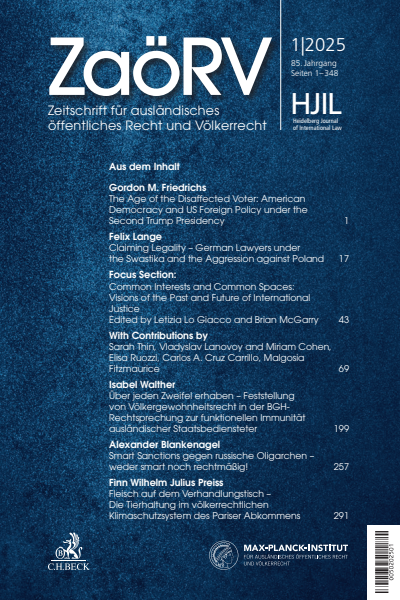
Zeitschrift für ausländisches öffentliches Recht und Völkerrecht / Heidelberg Journal of International Law
Jahrgang 85 (2025), Heft 1
- Autor:innen:
- Verlag
- C.H.BECK Recht - Wirtschaft - Steuern, München
- Copyrightjahr
- 2025
- ISSN-Online
- 2942-3562
- ISSN-Print
- 0044-2348
Kapitelinformationen
Jahrgang 85 (2025), Heft 1
Common Interests and Common Spaces: Visions of the Past and Future of International Justice
- Autor:innen:
- ISSN-Print
- 0044-2348
- ISSN-Online
- 2942-3562
- Kapitelvorschau:
From climate change to genocide, front page news is increasingly becoming the business of international courts. These cases are typically brought before the International Court of Justice on the basis of common interests in compliance with obligations owed to the international community or collective/shared responsibility associated with global challenges. Taking stock of recent developments, the present contribution considers how common-interest and common-space litigation has impacted the architecture of international justice in terms of legal interests, legal standing, third states’ interventions, and reparations, prompting the emergence of new institutional approaches to tackling these issues. In the attempt to sketch a narrative about the past and future of common-interest and common-space litigation (and the role of international judicial institutions therein), this article intends to provide a history-sensitive account of the ‘juridification’ process of common interests, and show the centrality of international courts and tribunals to the juridical life of common interests and common spaces. At the same time, it aims to illuminate how international justice has adapted to the challenges of international adjudication. Ultimately, it prompts reflections as to the evolving institutional dimensions of international justice in regard to common interests and common spaces.
