Organizational Ethical Cultures and Social Embeddedness – A Research Framework for Investigating Externally Anchored Organizational Worldviews
Inhaltsverzeichnis
Bibliographische Infos
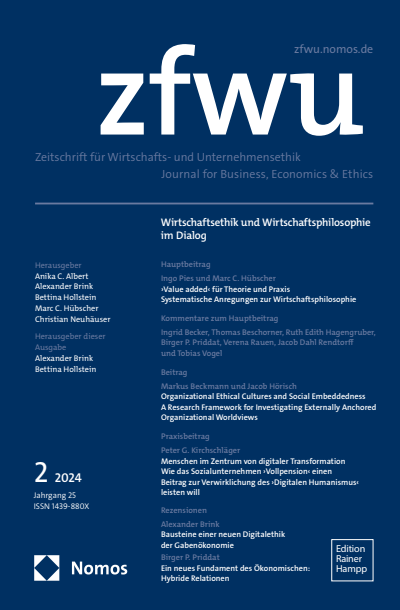
Journal for Business, Economics & Ethics
Jahrgang 25 (2024), Heft 2
- Autor:innen:
- , , , , , , , , , , , , , , , , ,
- Verlag
- Nomos, Baden-Baden
- Erscheinungsjahr
- 2024
- ISSN-Online
- 1862-0043
- ISSN-Print
- 1439-880X
Kapitelinformationen
Jahrgang 25 (2024), Heft 2
Organizational Ethical Cultures and Social Embeddedness – A Research Framework for Investigating Externally Anchored Organizational Worldviews
- Autor:innen:
- ,
- ISSN-Print
- 1439-880X
- ISSN-Online
- 1862-0043
- Kapitelvorschau:
Wie prägt die soziale Einbettung von Unternehmen deren ethische Organisationskultur? Dieser Artikel verbindet die Literatur zu sozialer Einbettung (social embeddedness) und Organisationskultur, um einen konzeptionellen Rahmen zu entwickeln, der Organisationen basierend auf dem Ursprung (extern oder intern) und der Anwendbarkeit (eng oder breit) ihrer Werte und Grundannahmen klassifiziert. Auf dieser Basis wird das Konzept der extern verankerten organisatorischen Weltanschauungen (externally anchored organizational worldviews; ExAnOW) eingeführt, die umfassend durch ein extern formuliertes Annahmengerüst geprägt sind. Der Artikel zeigt die empirische Relevanz dieses Phänomens in der unternehmensethischen Praxis auf und skizziert sodann eine Forschungsagenda zur Untersuchung von ExAnOWs und der weiteren sozialen Einbettung von Organisationskulturen.
Literaturverzeichnis
Es wurden keine Treffer gefunden. Versuchen Sie einen anderen Begriff.
- Acikgoz, Y. (2019): Employee Recruitment and Job Search. Towards a Multi-Level Integration, in: Human Resource Management Review, Vol. 29/No. 1, 1–13. Google Scholar öffnen
- Alvesson, M./Deetz, S. (2000): Doing Critical Management Research, London:. Sage, London, UK. Google Scholar öffnen
- Ardichvili, A./Mitchell, J. A./Jondle, D. (2009): Characteristics of Ethical Business Cultures, in: Journal of Business Ethics, Vol. 85/No. 4, 445–451. Google Scholar öffnen
- Argyris, C./Schön, D. A. (1978): Organizational Learning. A Theory of Action Perspective, Reading/, MA: Addison-Wesley Publishing Company. Google Scholar öffnen
- Baldo, M. Del. (2015): Beyond CSR. The Virtues-Based Approach to Corporate Responsibility and Sustainability in Italian SMEs, in: International Journal of Environment and Health, Vol. 7/No. 4, 394. Google Scholar öffnen
- Balmer, J. M. T./Fukukawa, K./Gray, E. R. (2007): The Nature and Management of Ethical Corporate Identity. A Commentary on Corporate Identity, Corporate Social Responsibility and Ethics, in: Journal of Business Ethics, Vol. 76/No. 1, 7–15. Google Scholar öffnen
- Beschorner, T. (2016): Wertlos. Anmerkungen zum »ehrbaren Kaufmann«, Zeitschrift Für Wirtschafts- und Unternehmensethik, VolJg. 17/NoH. 2, 232–235. Google Scholar öffnen
- Brosch, N. (2023): Corporate Purpose. From a ›Tower of Babel‹ Phenomenon Towards Construct Clarity, in: Journal of Business Economics, Vol. 93/No. 4, 567–595. Google Scholar öffnen
- Christensen, N. J./Lee, N. J. N./Bingham, J. B. (2022): Measuring And Developing an Ethical Organizational Climate, in: Handbook of Research Methods for Organisational Culture, Cheltenham: Edward Elgar Publishing, 205–229. Google Scholar öffnen
- Ciszek, E. L. (2016): Digital Activism. How Social Media and Dissensus Inform Theory and Practice, in: Public Relations Review, Vol. 42/No. 2, 314–321. Google Scholar öffnen
- Dacin, M. T./Ventresca, M. J./Beal, B. D. (1999): The Embeddedness of Organizations. Dialogue & Directions, in: Journal of Management, Vol. 25/No. 3, 317–356. Google Scholar öffnen
- Dekker, J./Hasso, T. (2016): Environmental Performance Focus in Private Family Firms. The Role of Social Embeddedness, in: Journal of Business Ethics, Vol. 136/No. 2, 293–309. Google Scholar öffnen
- Dempsey, J. (2015): Moral Responsibility, Shared Values, and Corporate Culture, in: Business Ethics Quarterly, Vol. 25/No. 3, 319–340. Google Scholar öffnen
- Denzau, A. T./North, D. C. (1994): Shared Mental Models, Ideologies and Institutions, in: Kyklos, Vol. 47/No. 1, 3–31. Google Scholar öffnen
- Dequech, D. (2003): Cognitive and Cultural Embeddedness. Combining Institutional Economics and Economic Sociology, in: Journal of Economic Issues, Vol. 37/No. 2, 461–470. Google Scholar öffnen
- DiMaggio, P. (1994): Culture and Economy, in: Handbook of economic sociology, Princeton, N.J: Princeton University Press and Russell Sage, 27–57. Google Scholar öffnen
- DiMaggio, P. (1997): Culture and Cognition, in: Annual Review of Sociology, Vol. 23/No. 1, 263–287. Google Scholar öffnen
- Dimaggio, P. J./Powell, W. W. (1983): The Iron Cage Revisited. Institutional Isomorphism and Collective Rationality in Organizational Fields, in: American Sociological Review, in: Vol. 48/No. 2, 147–160. Google Scholar öffnen
- Du, X./Jian, W./Zeng, Q./Du, Y. (2014): Corporate Environmental Responsibility in Polluting Industries. Does Religion Matter?, in: Journal of Business Ethics, Vol. 124/No. 3, 485–507. Google Scholar öffnen
- Frederick, W. C. (1994): From CSR1 to CSR2. The Maturing of Business-and-Society Thought, in: Business & Society, Vol. 33/No. 2, 150–164. Google Scholar öffnen
- Freeman, R. E./Harrison, J. S./Wicks, A. C./Parmar, B. L./De Colle, S. (2010): Stakeholder Theory. The State of the Art, Cambridge/UK: Cambridge University Press, Cambridge, UK. Google Scholar öffnen
- García‐Álvarez, E./López‐Sintas, J. (2001). A Taxonomy of Founders Based on Values. The Root of Family Business Heterogeneity, Family Business Review, Vol. 14/No. 3, 209–230. Google Scholar öffnen
- Gerhart, B. (2009): How Much Does National Culture Constrain Organizational Culture?, in: Management and Organization Review, Vol. 5/No. 2: 241–259. Google Scholar öffnen
- Graafland, J./Kaptein, M./Mazereeuw – van der Duijn Schouten, C. (2007): Conceptions of God, Normative Convictions, and Socially Responsible Business Conduct, in: Business & Society, Vol. 46/No. 3, 331–368. Google Scholar öffnen
- Graafland, J./ Smid, H. (2019): Decoupling Among CSR Policies, Programs, and Impacts. An Empirical Study, in: Business and Society, Vol. 58/No. 2, 231–267. Google Scholar öffnen
- Granovetter, M. (1985): Economic Action and Social Structure. The Problem of Embeddedness, in: American Journal of Sociology, Vol. 91/No. 3, 481–510. Google Scholar öffnen
- Greenwood, R./Hinings, C. R. (1996): Understanding Radical Organizational Change. Bringing Together The Old and The New Institutionalism, in: Academy of Management Review, Vol. 21/No. 4, 1022–1054. Google Scholar öffnen
- Grullon, G./Kanatas, G./Weston, J. (2009): Religion and Corporate (Mis)Behavior, SSRN. Link: https://ssrn.com/abstract=1472118 (last accessed on June 26, 2024). Google Scholar öffnen
- Guiso, L./Sapienza, P./Zingales, L. (2015). The Value of Corporate Culture, in: Journal of Financial Economics, Vol. 117/No. 1, 60–76. Google Scholar öffnen
- Gusmerotti, N. M./Testa, F./Macellari, M./Frey, M. (2020): Corporate Social Responsibility Embeddedness Through a Social Network Analysis. The Case of an Italian Multiutility Company, in: Corporate Social Responsibility and Environmental Management, Vol. 27/No. 2, 455–469. Google Scholar öffnen
- Hadavi Nejad, M./Naghi PourFar, V./Danaei Fard, H. (2020). Assumptions and Values of Islamic Organizational Culture. Commercial Strategies, Vol. 9/No. 47, 93–120. Google Scholar öffnen
- Harrison, S. H./Corley, K. G. (2011): Clean Climbing, Carabiners, and Cultural Cultivation. Developing an Open-Systems Perspective of Culture, in: Organization Science, Vol. 22/No. 2, 391–412. Google Scholar öffnen
- Hart, O. (2017). Incomplete Contracts and Control, in: American Economic Review, Vol. 107/No. 7, 1731–1752. Google Scholar öffnen
- Hilary, G./Hui, K. (2009): Does Religion Matter in Corporate Decision Making in America?, in: Journal of Financial Economics, Vol. 93/No. 3: 455–473. Google Scholar öffnen
- Hillman, A./Withers, M./Collins, J. (2009): Resource Dependence Theory. A Review, in: Journal of Management, Vol. 35/No. 6: 1404–1427. Google Scholar öffnen
- Hofstede, G. (1983): National Cultures in Four Dimensions. A Research-Based Theory of Cultural Differences Among Nations. International Studies of Management & Organization, Vol. 13/No. 1/2, 46–74. Google Scholar öffnen
- Hofmann, B. (2020). Merkmale diakonischer Unternehmenskultur in einer pluralen Gesellschaft, Stuttgart: Kohlhammer. Google Scholar öffnen
- Hollensbe, E./Wookey, C./Hickey, L./George, G./Nichols, C. V. (2014): Organizations with Purpose, in: Academy of Management Journal, Vol. 57/No. 5: 1227–1234. Google Scholar öffnen
- Hsieh, N.-H. (2015): The Social Contract Model of Corporate Purpose and Responsibility, in: Business Ethics Quarterly, Vol. 25/No. 4: 433–460. Google Scholar öffnen
- Huhtala, M./Kaptein, M./Muotka, J./Feldt, T. (2022): Longitudinal Patterns of Ethical Organisational Culture as a Context for Leaders’ Well-Being. Cumulative Effects Over 6 Years, in: Journal of Business Ethics, Vol. 177/No. 2: 421–442. Google Scholar öffnen
- Ismaeel, M./Blaim, K. (2012): Toward Applied Islamic Business Ethics: Responsible Halal Business, in: Journal of Management Development, Vol. 31/No. 10, 1090–1100. Google Scholar öffnen
- Jung, C./Morner, M. (2016): Das Glasperlenspiel der intrinsischen Motivation, in: Zeitschrift für Wirtschafts- und Unternehmensethik, Vol. 17/No. 2, 236–258. Google Scholar öffnen
- Karić, S. (2022). Das christliche Profil der Caritas und Diakonie aus Sicht ihrer Fachkräfte, in: Soziale Passagen, Vol. 14/No. 1, 59–76. Google Scholar öffnen
- Key, S. (1999): Organizational Ethical Culture. Real or Imagined?, in: Journal of Business Ethics, Vol. 20/No. 3, 217–225. Google Scholar öffnen
- Kirkbesoglu, E./Sargut, A. S. (2016): Transformation of Islamic Work Ethic and Social Networks. The Role of Religious Social Embeddedness in Organizational Networks, in: Journal of Business Ethics, Vol. 139/No. 2, 313–331. Google Scholar öffnen
- Kish-Gephart, J. J./Harrison, D. A./Treviño, L. K. (2010): Bad Apples, Bad Cases, and Bad Barrels. Meta-Analytic Evidence About Sources of Unethical Decisions at Work, in: Journal of Applied Psychology, Vol. 95/No. 1, 1–31. Google Scholar öffnen
- Knoben, J./Goessling, T. (2009): Proximity in Temporary Organizations, in: Temporary Organizations, Cheltenham: Edward Elgar Publishing. Google Scholar öffnen
- Knoben, J./Oerlemans, L. (2006): Proximity and Inter‐Organizational Collaboration. A Literature Review, in: International Journal of Management Reviews, Vol. 8/No. 2, 71–89. Google Scholar öffnen
- Lashitew, A. A./Bals, L./van Tulder, R. (2020): Inclusive Business At the Base of the Pyramid. The Role of Embeddedness for Enabling Social Innovations, in: Journal of Business Ethics, Vol. 162/No. 2, 421–448. Google Scholar öffnen
- Loughry, M. L./Tosi, H. L. (2008): Performance Implications of Peer Monitoring, in: Organization Science, Vol. 19/No. 6, 876–890. Google Scholar öffnen
- Mangelsdorf, M. E. (2018). The Trouble With Homogeneous Teams, in: MIT Sloan Management Review, Vol. 59/No. 2, 43–47. Google Scholar öffnen
- Martin, K. D./Cullen, J. B. (2006): Continuities and Extensions of Ethical Climate Theory. A Meta-Analytic Review, in: Journal of Business Ethics, Vol. 69/No. 2: 175–194. Google Scholar öffnen
- Mayer, C. (2021): The Future of the Corporation and the Economics of Purpose. Journal of Management Studies, Vol. 58/ No. 3: 887–901. Google Scholar öffnen
- McGuire, S. T./Omer, T. C./Sharp, N. Y. (2012): The Impact of Religion on Financial Reporting Irregularities, in: Accounting Review, Vol. 87/No. 2, 645–673. Google Scholar öffnen
- Mintzberg, H. (1989): Ideology and the Missionary Organization. In Mintzberg on Management. Inside Our Strange World of Organizations, New York: The Free Press, 221–235 Google Scholar öffnen
- Mitchell, R. K./Van Buren, H. J./Greenwood, M./Freeman, R. E. (2015): Stakeholder Inclusion and Accounting for Stakeholders, in: Journal of Management Studies, Vol. 52/No. 7, 851–877. Google Scholar öffnen
- Moran, P. (2005): Structural vs. Relational Embeddedness. Social Capital and Managerial Performance. Strategic Management Journal, Vol. 26/No. 12, 1129–1151. Google Scholar öffnen
- Naugle, D. K. (2002): Worldview. The History of A Concept, Grand Rapids, Eerdmans Publishing. Google Scholar öffnen
- Nelson, R. E./Gopalan, S. (2003): Do Organizational Cultures Replicate National Cultures? Isomorphism, Rejection and Reciprocal Opposition in the Corporate Values of Three Countries. Organization Studies, Vol. 24/No. 7: 1115–1151. Google Scholar öffnen
- Newman, A./Round, H./Bhattacharya, S./Roy, A. (2017): Ethical Climates in Organizations. A Review and Research Agenda, in: Business Ethics Quarterly, Vol. 27/No. 4: 475–512. Google Scholar öffnen
- Nozick, R. (1974): Anarchy, State, and Utopia (Vol. 5038). New York: Basic Books. Google Scholar öffnen
- Ocasio, W./Kraatz, M./Chandler, D. (2023). Making Sense of Corporate Purpose, in: Strategy Science, Vol. 8/No. 2, 123–138. Google Scholar öffnen
- Paine, S. L. (1994): Managing for Organizational Integrity, in: Harvard Business Review, Vol. 72/No. 2, 106–117. Google Scholar öffnen
- Pies, I./Hielscher, S./Beckmann, M. (2009): Moral Commitments and the Societal Role of Business. An Ordonomic Approach to Corporate Citizenship, in: Business Ethics Quarterly, Vol. 19/No. 3, 375–401. Google Scholar öffnen
- Powell, W. W. (1996): On the Nature of Institutional Embeddedness. Labels vs Explanation, in: Advances in Strategic Management, Vol. 13, 293–300. Google Scholar öffnen
- Rokeach, M. (1973): The Nature of Human Values, New York: Free Press. Google Scholar öffnen
- Ruiz-Palomino, P./Martínez-Cañas, R./Fontrodona, J. (2013): Ethical Culture and Employee Outcomes. The Mediating Role of Person-Organization Fit, in: Journal of Business Ethics, Vol. 116/No. 1, 173–188. Google Scholar öffnen
- Sauser, W. I. (2005): Ethics in Business. Answering the Call, in: Journal of Business Ethics, Vol. 58/No. 4, 345–357. Google Scholar öffnen
- Schein, E. H. (1984): Coming to a New Awareness of Organizational Culture, in: Sloan Management Review, Vol. 25/No. 2, 3–16. Google Scholar öffnen
- Schein, E. H. (1990): Organizational Culture, in: American Psychologist, Vol. 45/No. 2, 109–119. Google Scholar öffnen
- Schein, E. H. (1995): The Role of the Founder in Creating Organisational Culture, in: Family Business Review, Vol. 8/No. 3, 221–238. Google Scholar öffnen
- Schneiders, B./Anklin, F. (2014): The Social Impact of a Cosmetics Company, in: Sahota, A. (Ed.): Sustainability. How the Cosmetics Industry is Greening Up, Hoboken/New Jersey: Wiley, 47–68. Google Scholar öffnen
- Schreck, P./Aaken, D. v./Donaldson, T. (2013): Positive Economics and the Normativistic Fallacy. Bridging the Two Sides of CSR, in: Business Ethics Quarterly, Vol. 23/No. 2, 297–329. Google Scholar öffnen
- Schüßler, M./Straub, D. (eds.) (2022): Seelsorgliche Ressourcen der Caritas. Ein Forschungsbeitrag zur Theologie christlicher Sozialunternehmen, Stuttgart: Kohlhammer Verlag. Google Scholar öffnen
- Schwalbach, J. (2016): Ehrbare Kaufleute als Leitbild verantwortungsvoller Unternehmensführung, in: Zeitschrift für Wirtschafts- und Unternehmensethik, Vol. 17/No. 2, 216–231. Google Scholar öffnen
- Seelos, C./Mair, J. (2005): Social Entrepreneurship. Creating New Business Models to Serve the Poor, in: Business Horizons, Vol. 48/No. 3, 241–246. Google Scholar öffnen
- Sen, A. (2000): Consequential Evaluation and Practical Reason, in: The Journal of Philosophy, Vol. 97/No. 9, 477–502. Google Scholar öffnen
- Steffen, A./Doppler, S. (2019): Building Consumer Trust and Satisfaction Through Sustainable Business Practices with Organic Supermarkets. The Case of Alnatura, in:. Case Studies in Food Retailing and Distribution: 205–228). Woodhead Publishing. Google Scholar öffnen
- Swanson, D. (2012): Corporate Social Responsiveness, in: SAGE Brief Guide to Corporate Social Responsibility, in: Sage Publications, 152–154. Google Scholar öffnen
- Tober, C./Dittrich, S./Hammer, F./Baumann, L./Dittrich, S./Hammer, F. … Gloger, A. (2020): Marktbericht Nachhaltige Geldanlagen 2020. Forum Nachhaltige Geldanlagen e.V. Link: https://fng-marktbericht.org/fileadmin/Marktbericht/archiv/FNG-Marktbericht-2020.pdf (zuletzt abgerufen am 09.07.2024) Google Scholar öffnen
- Trevino, L. K. (1986): Ethical Decision Making in Organizations. A Person-Situation Interactionist Model. Academy of Management Review, Vol. 11/No. 3, 601–617. Google Scholar öffnen
- Trevino, L. K./Butterfield, K. D./McCabe, D. L. (1998): Business Ethics / Business Ethics Quarterly, in: Business Ethics Quarterly, Vol. 8/No. 3, 447–476. Google Scholar öffnen
- Ullah, S./Harwood, I. A./Jamali, D. (2018): ›Fatwa Repositioning‹. The Hidden Struggle for Shari’a Compliance Within Islamic Financial Institutions, in: Journal of Business Ethics, Vol. 149/No. 4: 895–917. Google Scholar öffnen
- Van Buren, H. J./Syed, J./Mir, R. (2019): Religion as a Macro Social Force Affecting Business. Concepts, Questions, and Future Research, in: Business & Society, Vol. 59/No. 5: 799–822. Google Scholar öffnen
- Warren, D. E./Gaspar, J. P./Laufer, W. S. (2014): Is Formal Ethics Training Merely Cosmetic? A Study of Ethics Training and Ethical Organizational Culture, in: Business Ethics Quarterly, Vol. 24/No. 1: 85–117. Google Scholar öffnen
- Weber, M. (2013 [1904]): The Protestant Ethic and the Spirit of Capitalism, New York: Routledge. Google Scholar öffnen
- Wolf, M./Mair, J. (2019): Purpose, Commitment and Coordination around Small Wins. A Proactive Approach to Governance in Integrated Hybrid Organizations, in: VOLUNTAS: International Journal of Voluntary and Nonprofit Organizations, Vol. 30/No. 3: 535–548. Google Scholar öffnen
- Zeyen, A./Beckmann, M. (2018a): Refining Our Ethical Perspective on the Light and Shadows in Social Entrepreneurship. The Concept of Normative Ambivalence, in: Zeyen, A./Beckmann, M. (Eds.): Social Entrepreneurship and Business Ethics, New York: Routledge, 35–65. Google Scholar öffnen
- Zeyen, A./Beckmann, M. (2018b): Social Mission, Agency, and Calling, in: Zeyen, A./Beckmann, M. (Eds.): Social Entrepreneurship and Business Ethics, New York: Routledge, 201–216. Google Scholar öffnen
- Zukin, S./DiMaggio, P. (1990): Structures of Capital. The Social Organization of the Economy, Cambridge/ MA: Cambridge University Press. Google Scholar öffnen