Gazprom und andere – force majeure für Staatsunternehmen? Das Zusammenspiel von völkerrechtlicher Staatenverantwortlichkeit, internationalem Wirtschaftsrecht und privatem Handelsrecht
Inhaltsverzeichnis
Bibliographische Infos
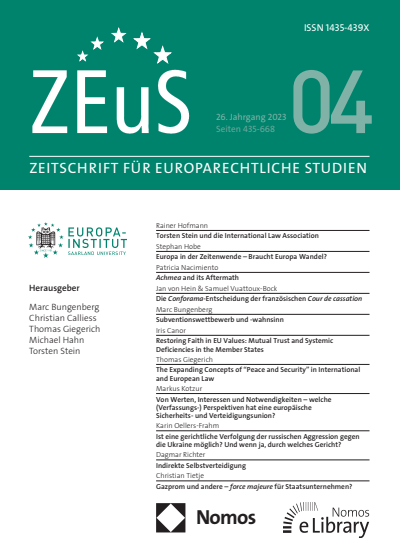
ZEuS Zeitschrift für Europarechtliche Studien
Jahrgang 26 (2023), Heft 4
- Autor:innen:
- Verlag
- Nomos, Baden-Baden
- Copyrightjahr
- 2023
- ISSN-Online
- 2942-3589
- ISSN-Print
- 1435-439X
Kapitelinformationen
Jahrgang 26 (2023), Heft 4
Gazprom und andere – force majeure für Staatsunternehmen? Das Zusammenspiel von völkerrechtlicher Staatenverantwortlichkeit, internationalem Wirtschaftsrecht und privatem Handelsrecht
- Autor:innen:
- ISSN-Print
- 1435-439X
- ISSN-Online
- 2942-3589
- Kapitelvorschau:
Force majeure, auch als höhere Gewalt bezeichnet, ist ein anerkanntes Leistungshindernis in nationalen Rechtsordnungen und im UN-Kaufrecht sowie regelmäßiger Bestandteil internationaler privatrechtlicher Handels-/Lieferverträge. Auch Energielieferverträge enthalten oftmals solche Klauseln. Gegenwärtig sind entsprechende Vertragsklauseln mit Blick auf die Aussetzung von Gaslieferungen aus Russland durch das russische Staatsunternehmen Gazprom von Interesse. In der nationalen Gerichts- und internationalen Schiedsgerichtspraxis ist anerkannt, dass sich von besonderen Ausnahmesituationen abgesehen auch Staatsunternehmen auf force majeure berufen können, selbst wenn das die höhere Gewalt auslösende Ereignis vom Staat, der Allein- oder Mehrheitseigner des Staatsunternehmens ist, zu verantworten ist. Diese Rechtsprechung entspricht der strikten Trennung von Staat und Staatsunternehmen, wie sie u.a. im völkerrechtlichen Recht der Staatenverantwortlichkeit, im internationalen Investitionsschutzrecht und im WTO-Recht anerkannt ist. Allerdings gibt es zunehmend Kritik an diesem Ansatz und immer mehr internationale regulatorische Anstrengungen, die die strikte Trennungsthese relativieren. Das kann auch Auswirkungen auf die Auslegung von force majeure-Klauseln haben.
Literaturverzeichnis
Es wurden keine Treffer gefunden. Versuchen Sie einen anderen Begriff.
- BERNARDI, FRANK J., Der Ukraine-Krieg als Fall der Force Majeure im deutschen Recht, UKuR 2022, Heft 12, S. 435–437 Google Scholar öffnen DOI: 10.5771/1435-439X-2023-4-654
- BÖCKSTIEGEL, KARL-HEINZ, Arbitration and State Enterprises, Den Haag, 1984 Google Scholar öffnen DOI: 10.5771/1435-439X-2023-4-654
- BÖCKSTIEGEL, KARL-HEINZ, The Legal Rules Applicable in International Commercial Arbitration Involving States or State-Controlled Entities, in: 60 Years of ICC Arbitration – A Look at the Future Paris, 1984, S. 117–140 Google Scholar öffnen DOI: 10.5771/1435-439X-2023-4-654
- BORLINI, LEONARDO, The Leviathan goes to the market: A critical evaluation of the rules governing state-owned enterprises in trade agreements, Leiden Journal of International Law, 2022, Jg. 33, Heft 2, S. 313–334 Google Scholar öffnen DOI: 10.5771/1435-439X-2023-4-654
- BROCHES, ARON, Selected Essays: World Bank, ICSID, and Other Subjects of Public and Private International Law, Dordrecht, 1995 Google Scholar öffnen DOI: 10.5771/1435-439X-2023-4-654
- CRAWFORD, JAMES, The International Law Commission’s Articles on State Responsibility: Introduction, Text and Commentaries, Cambridge, 2002 Google Scholar öffnen DOI: 10.5771/1435-439X-2023-4-654
- DENISON, M. J., Force majeure clauses in LNG sales and purchase agreements: how do they stand up during the Covid-19 pandemic?, Journal of World Energy Law, 2011, Jg. 14, Heft 2, S. 88–99 Google Scholar öffnen DOI: 10.5771/1435-439X-2023-4-654
- DISHEV, MIHAIL/HOFFMANN, PHILIPP, Ukraine-Krieg, EU-Sanktionen und Inflation als Act of God/Force Majeure/Höhere Gewalt?, Neue Juristische Online Zeitung, 2022, Heft 48, S. 1473–1478 Google Scholar öffnen DOI: 10.5771/1435-439X-2023-4-654
- GAO, HENRY S., A Rule-based Solution to the Appellate Body Crisis, and Why the MPIA Would Not Work, 2021, verfügbar auf: SSRN: https://ssrn.com/abstract=3767926 (27.9.2023) Google Scholar öffnen DOI: 10.5771/1435-439X-2023-4-654
- HAYWOOD, KIRK, The Treatment of State Enterprises in the WTO & Plurilateral Trade Agreements, Emerging Issues Briefing Note (3), The Commonwealth Secretariat, März 2016, verfügbar unter: https://production-new-commonwealth-files.s3.eu-west-2.amazonaws.com/migrated/inline/StateOwned%20EnterprisesTPP1008.pdf (27.9.2023) Google Scholar öffnen DOI: 10.5771/1435-439X-2023-4-654
- MARAVILLA, CHRISTOPHER S., The Ability of a State-Owned Enterprise to Declare Force Majeure Based Upon Actions of the State, The Journal of International and Comparative Law at Chicago-Kent, 2022, Jg. 2, S. 82–90, verfügbar auch auf SSRN: https://ssrn.com/abstract=2924185 (27.9.2023) Google Scholar öffnen DOI: 10.5771/1435-439X-2023-4-654
- MATSUSHITA, MITSUO, Interplay of Competition Law and Free Trade Agreements in Regulating State-Owned Enterprises, German Law Journal, 2023, Jg. 24, Heft 1, S. 243–268, verfügbar unter: doi:10.1017/glj.2023.8 Google Scholar öffnen DOI: 10.5771/1435-439X-2023-4-654
- NAKAGAWA, JUNJI, Regulatory Harmonization Through FTAs and BITs: Regulation of State Owned Enterprises (SOEs), July 10, 2012, Society of International Economic Law (SIEL), 3rd Biennial Global Conference, verfügbar auf SSRN: https://ssrn.com/abstract=2103237 (27.9.2023) Google Scholar öffnen DOI: 10.5771/1435-439X-2023-4-654
- SU, XUEJI, From Effect to Behaviour: Regulating State-Owned Enterprises as Competitors in Trade Agreements, Journal of World Trade, 2023, Jg. 57, Heft 3, S. 531–554 Google Scholar öffnen DOI: 10.5771/1435-439X-2023-4-654
- TIETJE, CHRISTIAN, Investment Law and Sovereign Wealth Funds, in: Bungenberg, Marc; Griebel, Jörn; Hobe, Stephan; Reinisch, August (eds.), International Investment Law, Baden-Baden/München/Oxford 2015, S. 1802–1816 Google Scholar öffnen DOI: 10.5771/1435-439X-2023-4-654
- TIETJE, CHRISTIAN, Transnationales Wirtschaftsrecht aus öffentlich-rechtlicher Perspektive, Zeitschrift für Vergleichende Rechtswissenschaft – Archiv für Internationales Wirtschaftsrecht, 2022, Jg. 101, Heft 4, S. 404–420 Google Scholar öffnen DOI: 10.5771/1435-439X-2023-4-654
- TIETJE, CHRISTIAN/SACHER, VINCENT, The New Anti-Dumping Methodology of the European Union: A Breach of WTO Law?, in: Bungenberg, Marc; Hahn, Michael; Herrmann, Christoph; Müller-Ibold, Till (Hrsg.) The Future of Trade Defence Instruments. European Yearbook of International Economic Law, Berlin u.a., 2018, S. 89–105 Google Scholar öffnen DOI: 10.5771/1435-439X-2023-4-654
- VIDIGAL, GERALDO, Attribution in the WTO: the Limits of “Sufficient Government Involvement”, Journal of International Trade and Arbitration Law, Special Issue, 2017, Jg. 6, S. 133–160 Google Scholar öffnen DOI: 10.5771/1435-439X-2023-4-654
- WILLEMYNS, INES, Disciplines on State-Owned Enterprises in International Economic Law: Are We Moving in the Right Direction?, Journal of International Economic Law, 2016, Jg. 19, Heft 3, S. 657–680 Google Scholar öffnen DOI: 10.5771/1435-439X-2023-4-654
- ZHOU, WEIHUAN, Rethinking the (CP)TPP as a Model for Regulation of Chinese State-Owned Enterprises, Journal of International Economic Law, 2021, Jg. 24, Heft 3, S. 572–590 Google Scholar öffnen DOI: 10.5771/1435-439X-2023-4-654
