Digitale Methoden: Zur Positionierung eines Ansatzes
Inhaltsverzeichnis
Bibliographische Infos
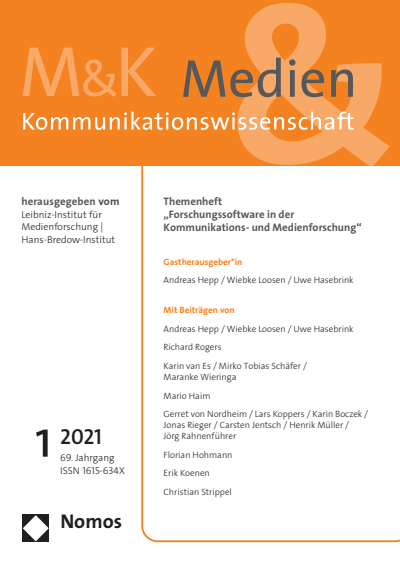
M&K Medien & Kommunikationswissenschaft
Jahrgang 69 (2021), Heft 1
- Autor:innen:
- Verlag
- Nomos, Baden-Baden
- Copyrightjahr
- 2021
- ISSN-Online
- 2942-3317
- ISSN-Print
- 1615-634X
Kapitelinformationen
Jahrgang 69 (2021), Heft 1
Digitale Methoden: Zur Positionierung eines Ansatzes
- Autor:innen:
- ISSN-Print
- 1615-634X
- ISSN-Online
- 2942-3317
- Kapitelvorschau:
Ziel dieses Aufsatzes ist es, ein Grundverständnis von digitalen Methoden und ihrer Anwendung zu vermitteln, insbesondere im Hinblick auf die Nutzung von Software bei dieser Art der Forschung. Dazu wird in einem ersten Schritt argumentiert, warum es bei einer Forschung mittels digitaler Methoden nicht darum geht, Webdaten im Vergleich mit der sozialen Welt jenseits des Webs zu „überprüfen“. Vielmehr geht es darum, das Web in seiner eigenen Spezifik für die Forschung nutzbar zu machen. Entsprechend setzen digitale Methoden bei „nativ“, d. h. originär digitalen Daten an und unterscheiden sich so von anderen Methoden des Computational Turn in den Sozial- und Geisteswissenschaften. Dies konkretisiert sich in der Forschungspraxis der digitalen Methoden, die anhand der Nutzung des Internet Archive, der Google Websuche, von Wikipedia, Facebook, Twitter und YouTube sowie plattformübergreifenden Studien veranschaulicht wird. Solche Beispiele machen deutlich, dass es bei digitalen Methoden um eine spezifische „Wiederverwendung“ von Online-Daten geht, ähnlich wie bei anderen non-responsiven Methoden.
Literaturverzeichnis
Es wurden keine Treffer gefunden. Versuchen Sie einen anderen Begriff.
- Albright, J. (2017). Itemized posts and historical engagement. Six now-closed Facebook pages. Data set, Tableau Public, 5. Google Scholar öffnen doi.org/10.5771/1615-634X-2021-1-25
- Bartlett, J., Birdwell, J., & Littler, M. (2011). The new face of digital populism. https://demo suk.wpengine.com/files/Demos_OSIPOP_Book-web_03.pdf?1320601634 [08.02.2021]. Google Scholar öffnen doi.org/10.5771/1615-634X-2021-1-25
- Borgman, C. L. (2009). The digital future is now: A call to action for the humanities. Digital Humanities Quarterly, 3(4), 1–30. Google Scholar öffnen doi.org/10.5771/1615-634X-2021-1-25
- boyd, D., & Crawford, K. (2012). Critical questions for big data: Provocations for a cultural, technological, and scholarly phenomenon. Information, Communication & Society, 15(5), 662–679. doi:10.1080/1369118X.2012.678878. Google Scholar öffnen doi.org/10.5771/1615-634X-2021-1-25
- Brügger, N. (2012). When the present web is later than the past: Web historiography, digital history and internet studies. Historical Social Research, 37(4), 102–117. Google Scholar öffnen doi.org/10.5771/1615-634X-2021-1-25
- Callahan, E. S., & Herring, S. C. (2011). Cultural bias in Wikipedia content on famous persons. Journal of the American Society for Information Science and Technology, 62(10), 1899–1915. Google Scholar öffnen doi.org/10.5771/1615-634X-2021-1-25
- Campbell, M. T. (2003). Generic names for soft drinks by county. The Pop vs. Soda page. http://www.popvssoda.com/countystats/total-county.html [08.02.2021]. Google Scholar öffnen doi.org/10.5771/1615-634X-2021-1-25
- Chen, E. (2012). ‘Soda vs. pop’, blog posting, Edwin Chen’s Blog., 6. Juli 2012. Retrieved from http://blog.echen.me/2012/07/06/soda-vs-pop-with-twitter [08.02.2021]. Google Scholar öffnen doi.org/10.5771/1615-634X-2021-1-25
- Chikofsky, E. J., & Cross, J. H. (1990). Reverse engineering and design recovery: A taxonomy. IEEE Software, 7(1), 13–17. Google Scholar öffnen doi.org/10.5771/1615-634X-2021-1-25
- Dean, J. (1998). Aliens in America: Conspiracy cultures from outerspace to cyberspace. Ithaca: Cornell University Press. Google Scholar öffnen doi.org/10.5771/1615-634X-2021-1-25
- Dohmen, J. (2007). Opkomst en ondergang van extreemrechtse sites. NRC Handelsblad, 25. August 2007. Google Scholar öffnen doi.org/10.5771/1615-634X-2021-1-25
- Ericson, M., & Cox, A. (2009). What’s cooking on Thanksgiving. New York Times, 26. November 2009. Google Scholar öffnen doi.org/10.5771/1615-634X-2021-1-25
- Ginsberg, J., Mohebbi, M. H., Patel, R. S., Brammer, L., Smolinski, M. S., & Brilliant, L. (2009). Detecting influenza epidemics using search engine query data. Nature, 457, 1012–1014. https://www.nature.com/articles/nature07634?report=reader&fbclid=IwAR2Hi-EJK2FvjytCu6QQzY0vTsL5JN8Dg6pIBGxreI6Oj_Zv6GgdH9n6Uos [08.02.2021]. Google Scholar öffnen doi.org/10.5771/1615-634X-2021-1-25
- Hine, C. (Ed.) (2005). Virtual methods: Issues in social research on the internet. Oxford: Berg. Google Scholar öffnen doi.org/10.5771/1615-634X-2021-1-25
- Jenkins, H. (2006). Convergence culture: Where old and new media collide. New York: New York University Press. Google Scholar öffnen doi.org/10.5771/1615-634X-2021-1-25
- Jenkins, H., Ito, M., & boyd, d. (2016). Participatory culture in a networked era. Cambridge, Malden: Polity. Google Scholar öffnen doi.org/10.5771/1615-634X-2021-1-25
- Johansson, A., Eriksson, M., Vonderau, P., Snickars, P., & Fleischer, R. (2019). Spotify teardown. Cambridge, MA: MIT Press. Google Scholar öffnen doi.org/10.5771/1615-634X-2021-1-25
- Keen, A. (2007). The cult of the amateur. New York: Doubleday. Google Scholar öffnen doi.org/10.5771/1615-634X-2021-1-25
- Lazer, D., Pentland, A., Adamic, L., Aral, S., Barabasi, A.-L., Brewer, D., … Gutmann, M. (2009). Life in the network: The coming age of computational social science. Science, 323(5915), 721–723. https://europepmc.org/articles/pmc2745217 [08.02.2021]. Google Scholar öffnen doi.org/10.5771/1615-634X-2021-1-25
- Lessig, L. (2004). Free culture. New York: Penguin. Google Scholar öffnen doi.org/10.5771/1615-634X-2021-1-25
- Lewis, K., Kaufman, J., & Christakis, N. (2008a). The taste for privacy: An analysis of college student privacy settings in an online social network. Journal of Computer-Mediated Communication, 14(1), 79–100. Google Scholar öffnen doi.org/10.5771/1615-634X-2021-1-25
- Lewis, K., Kaufman, J., Gonzalez, M., Wimmer, A., & Christakis, N. (2008b). Tastes, ties, and time: A new social network dataset using Facebook.com. Social Networks, 30(4), 330–342. Google Scholar öffnen doi.org/10.5771/1615-634X-2021-1-25
- Manovich, L. (2020). Cultural analytics. Cambridge MA, London: MIT Press. Google Scholar öffnen doi.org/10.5771/1615-634X-2021-1-25
- Michel, J.-B., Shen, Y. K., Aiden, A. P., Veres, A., Gray, M. K., Team, T. G. B., … Aiden, E. L. (2011). Quantitative analysis of culture using millions of digitized books. Science, 331(6014), 176–182. Google Scholar öffnen doi.org/10.5771/1615-634X-2021-1-25
- Moretti, F. (2005). Graphs, maps, trees: Abstract models for a literary history. London: Verso. Google Scholar öffnen doi.org/10.5771/1615-634X-2021-1-25
- Morozov, E. (2012). The net delusion: How not to liberate the world. Harmondsworth: Penguin. Google Scholar öffnen doi.org/10.5771/1615-634X-2021-1-25
- Osterberg, G. (2013). Update on the Twitter archive at the Library of Congress. Library of Congress blog, 26. Dezember 2013. https://blogs.loc.gov/loc/2013/01/update-on-the-twitter-archive-at-the-library-of-congress/ [08.02.2021]. Google Scholar öffnen doi.org/10.5771/1615-634X-2021-1-25
- Raehsler, L. (2012). What people search for. Search Engine Watch, 18. April 2012. https://www.searchenginewatch.com/2013/03/02/what-people-search-for-most-popular-keywords/ [08.02.2021]. Google Scholar öffnen doi.org/10.5771/1615-634X-2021-1-25
- Rieder, B. (2012). What is in PageRank? A historical and conceptual investigation of a recursive status index. Computational Culture, 2, September 2012. http://computationalculture.net/what_is_in_pagerank [08.02.2021]. Google Scholar öffnen doi.org/10.5771/1615-634X-2021-1-25
- Rieder, B. (2015). The end of Netvizz (?). The Politics of Systems Blog, 23 January. http://thepoli ticsofsystems.net/2015/01/the-end-of-netvizz/ [08.02.2021]. Google Scholar öffnen doi.org/10.5771/1615-634X-2021-1-25
- Rogers, R. (2009). The end of the virtual: Digital methods. Inaugural Lecture. Amsterdam: Amsterdam University Press. Google Scholar öffnen doi.org/10.5771/1615-634X-2021-1-25
- Rogers, R. (2013a). Debanalizing Twitter: The transformation of an object of study. Proceedings from Proceedings of WebSci13, New York. Google Scholar öffnen doi.org/10.5771/1615-634X-2021-1-25
- Rogers, R. (2013b). Digital methods. Cambridge, MA: MIT Press. Google Scholar öffnen doi.org/10.5771/1615-634X-2021-1-25
- Rogers, R. (2014). Political research in the digital age. International Public Policy Review, 8(1), 73–87. Google Scholar öffnen doi.org/10.5771/1615-634X-2021-1-25
- Rogers, R. (2019). Doing digital methods. London: Sage. Google Scholar öffnen doi.org/10.5771/1615-634X-2021-1-25
- Rogers, R., & Govcom.org. (2008). ‘Google and the politics of tabs’, screencast documentary. https://movies.digitalmethods.net/google.html [08.02.2021]. Google Scholar öffnen doi.org/10.5771/1615-634X-2021-1-25
- Rogers, R., & Sendijarevic, E. (2012). Neutral or national point of view? A comparison of Srebrenica articles across Wikipedia’s language versions. Proceedings from Paper presented at Wikipedia Academy 2012, Berlin. Google Scholar öffnen doi.org/10.5771/1615-634X-2021-1-25
- Sarno, D. (2009). Twitter creator Jack Dorsey illuminates the site’s founding document. Part II. Los Angeles Times, 19 February. https://latimesblogs.latimes.com/technology/2009/02/jack-dorsey-on.html [08.02.2021]. Google Scholar öffnen doi.org/10.5771/1615-634X-2021-1-25
- Shelton, T. (2011). The (expanded) pop vs. soda debate. Floating Sheep blog, 3. October 2011. http://www.floatingsheep.org/2011/10/expanded-pop-vs-soda-debate.html [08.02.2021]. Google Scholar öffnen doi.org/10.5771/1615-634X-2021-1-25
- Thelwall, M., Vaughan, L., & Björneborn, L. (2005). Webometrics. Annual review of information science and technology, 39(1), 81–135. http://www.researchgate.net/profile/Lennart_Bjo erneborn/publication/220141962_Webometrics/links/552013e80cf2a2d9e14334e1.pdf [08.02.2021]. Google Scholar öffnen doi.org/10.5771/1615-634X-2021-1-25
- Udell, J. (2005). ‘Heavy metal umlaut’, screencast documentary. http://jonudell.net/udell/2005-01-22-heavy-metal-umlaut-the-movie.html [08.02.2021]. Google Scholar öffnen doi.org/10.5771/1615-634X-2021-1-25
- US Centers for Disease Control and Prevention (2014). CDC announces winners of the ‚Pedict the influence season challenge’, press release, 18. Juni 2014. Google Scholar öffnen doi.org/10.5771/1615-634X-2021-1-25
- Watts, D. J. (2007). A twenty-first century science. Nature, 445, 489-489. https://www.nature.com/articles/445489a [08.02.2021]. Google Scholar öffnen doi.org/10.5771/1615-634X-2021-1-25
- Webb, E. J., Campbell, D. T., Schwartz, R. D., & Sechrest, L. (1966). Unobtrusive measures: Nonreactive research in the social sciences. Skokie, Ill.; Rand McNally & Co. Google Scholar öffnen doi.org/10.5771/1615-634X-2021-1-25
- Woodruff, A. (2011). Web cartography, or putting things on top of other things. andywoodruff.com, 9. Juni. http://andywoodruff.com/blog/web-cartography-or-putting-things-on-top-of-other-things/ [08.02.2021]. Google Scholar öffnen doi.org/10.5771/1615-634X-2021-1-25
- Woolgar, S. (Ed.) (2003). Virtual society: Technology, cyberbole, reality. New York: Oxford University Press. Google Scholar öffnen doi.org/10.5771/1615-634X-2021-1-25
- Zimmer, M. (2010). ‘But the data is already public’: On the ethics of research in Facebook. Ethics and Information Technology, 12(4), 313–325. Google Scholar öffnen doi.org/10.5771/1615-634X-2021-1-25