Zyklische Scherprüfung metallischer Folien/Cyclic shear testing for metallic foils

Inhaltsverzeichnis

Bibliographische Infos
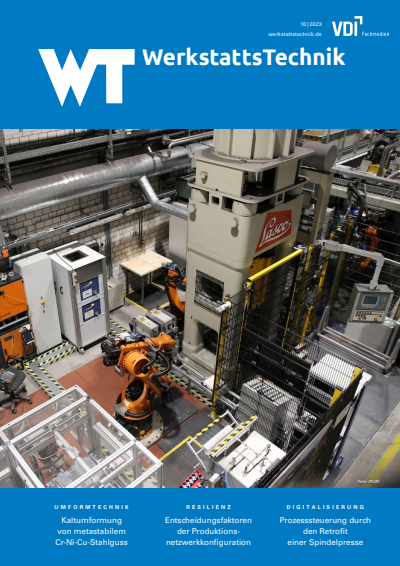

Cover der Ausgabe: wt Werkstattstechnik online Jahrgang 113 (2023), Heft 10
Open Access Vollzugriff

wt Werkstattstechnik online

Jahrgang 113 (2023), Heft 10


Autor:innen:
Verlag
VDI fachmedien, Düsseldorf
Copyrightjahr
2023
ISSN-Online
1436-4980
ISSN-Print
1436-4980

Kapitelinformationen


Open Access Vollzugriff

Jahrgang 113 (2023), Heft 10

Zyklische Scherprüfung metallischer Folien/Cyclic shear testing for metallic foils


Autor:innen:
ISSN-Print
1436-4980
ISSN-Online
1436-4980


Kapitelvorschau:

Die Bemühungen zur Emissionsreduktion in den Bereichen Energie und Mobilität führen zu einer steigenden Nachfrage nach geformten Bauteilen aus dünnen Metallfolien. Die Herstellung und Auslegung solcher Komponenten gestalten sich als äußerst anspruchsvoll. Herkömmliche Charakterisierungsversuche für die digitale Auslegung dieser Bauteile stoßen an ihre Grenzen. Daher wird in diesem Kontext ein innovativer Versuchsaufbau für den zyklischen Scherversuch vorgestellt, der die strukturelle Stabilität der Probe erhöht und eine Modellierung des Verfestigungsverhaltens ermöglicht.


Efforts to reduce emissions in the fields of energy and mobility lead to an increasing demand for shaped components made from thin metal foils. Manufacturing and designing such components is highly challenging. Conventional characterization tests for designing these components digitally are reaching their limits. In this context, an innovative setup for cyclic shear testing is introduced, enhancing the structural stability of the specimen and enabling modeling of the material‘s strengthening behavior.

Literaturverzeichnis


  1. [1] Lange, K. (Hrsg.): Umformtechnik Handbuch für Industrie und Wissenschaft. Band 3: Blechbearbeitung. Heidelberg: Springer-Verlag 1990 Google Scholar öffnen DOI: 10.37544/1436-4980-2023-10-6
  2. [2] Souza, T. de; Rolfe, B. F.: Characterising material and process variation effects on springback robustness for a semi-cylindrical sheet metal forming process. International Journal of Mechanical Sciences 52 (2010) 12, pp. 1756–1766 Google Scholar öffnen DOI: 10.37544/1436-4980-2023-10-6
  3. [3] Sturm, V.: Einfluss von Chargenschwankungen auf die Verarbeitungsgrenzen von Stahlwerkstoffen. Dissertation, Friedrich-Alexander-Universität Erlangen-Nürnberg, 2014 Google Scholar öffnen DOI: 10.37544/1436-4980-2023-10-6
  4. [4] Maier, S. J.: Inline-Qualitätsprüfung im Presswerk durch intelligente Nachfolgewerkzeuge. Dissertation, Technische Universität München, 2017 Google Scholar öffnen DOI: 10.37544/1436-4980-2023-10-6
  5. [5] Faaß, I.: Prozessregelung für die Fertigung von Karosserieteilen in Presswerken. Dissertation, Technische Universität München, 2009 Google Scholar öffnen DOI: 10.37544/1436-4980-2023-10-6
  6. [6] Held, C.; Liewald, M.; Sindel, M.: Untersuchungen zum Einfluss werkstofflicher Schwankungen innerhalb eines Coils auf die Umformbarkeit. wt Werkstattstechnik online 99 (2009) 10, S. 732–739. Internet: www.werkstattstechnik.de. Düsseldorf: Springer-VDI-Verlag Google Scholar öffnen DOI: 10.37544/1436-4980-2023-10-6
  7. [7] Ružovič, M.: Die zerstörungsfreie Ermittlung von genauen Zugversuchsdaten mit dem Wirbelstromverfahren. Dissertation, Eidgenössische Technische Hochschule Zürich, 2004 Google Scholar öffnen DOI: 10.37544/1436-4980-2023-10-6
  8. [8] Wiesenmayer, S.; Frey, P.; Lechner, M. et al.: Determination of the properties of semi-finished parts in blanking processes. IOP Conference Series: Materials Science and Engineering 967 (2020) 1, #12009 Google Scholar öffnen DOI: 10.37544/1436-4980-2023-10-6
  9. [9] Schenek, A.; Görz, M.; Liewald, M. et al.: Data-Driven Derivation of Sheet Metal Properties Gained from Punching Forces Using an Artificial Neural Network. Key Engineering Materials 926 (2022), pp. 2174–2182 Google Scholar öffnen DOI: 10.37544/1436-4980-2023-10-6
  10. [10] Görz, M.; Schenek, A.; Liewald, M. et al.: Evaluation of Feature Engineering Methods for the Prediction of Sheet Metal Properties from Punching Force Curves by an Artificial Neural Network. In: Zhang, M.; Peng, Z.; Li, B. et al. (Hrsg.): Characterization of Minerals, Metals, and Materials 2023. Cham: Springer Nature 2023, pp. 75–85 Google Scholar öffnen DOI: 10.37544/1436-4980-2023-10-6
  11. [11] Molitor, D. A.; Kubik, C.; Knoll, M. et al.: Ableitung eines Vorgehensmodells zur systematischen Wissensgenerierung aus Sensordaten. Zeitschrift für wirtschaftlichen Fabrikbetrieb 116 (2021) 5, S. 352–357 Google Scholar öffnen DOI: 10.37544/1436-4980-2023-10-6
  12. [12] Kubik, C.; Molitor, D. A.; Becker, M. et al.: Knowledge Discovery in Engineering Applications Using Machine Learning Techniques. Journal of Manufacturing Science and Engineering 144 (2022) 9, #091003, doi.org/10.1115/1.4054158 Google Scholar öffnen DOI: 10.37544/1436-4980-2023-10-6
  13. [13] HBM GmbH: Datenblatt – SLB700A/06VA. Dehnungsaufnehmer. Internet: www.hbm.com/fileadmin/mediapool/hbmdoc/technical/b3254.pdf. Zugriff am 25.09.2023 Google Scholar öffnen DOI: 10.37544/1436-4980-2023-10-6
  14. [14] Jolliffe, I. T.: Principal Component Analysis. New York: Springer-Verlag 2002 Google Scholar öffnen DOI: 10.37544/1436-4980-2023-10-6
  15. [15] Haykin, S.: Neural networks. A comprehensive foundation. Delhi: Pearson Education 1999 Google Scholar öffnen DOI: 10.37544/1436-4980-2023-10-6
  16. [16] Hornik, K.: Approximation capabilities of multilayer feedforward networks. Neural Networks 4 (1991) 2, pp. 251–257 Google Scholar öffnen DOI: 10.37544/1436-4980-2023-10-6
  17. [17] Li, L.; Jamieson, K.; DeSalvo, G. et al.: Hyperband: A Novel Bandit-Based Approach to Hyperparameter Optimization. Journal of Machine Learning Research (2018) 18, pp. 1–52 Google Scholar öffnen DOI: 10.37544/1436-4980-2023-10-6
  18. [18] Fahrmeir, L.; Heumann, C.; Künstler, R. et al.: Statistik. Der Weg zur Datenanalyse. Heidelberg: Springer Spektrum 2016 Google Scholar öffnen DOI: 10.37544/1436-4980-2023-10-6
  19. [1] Lange, K.; Kammerer, M.: Fließpressen. Heidelberg: Springer-Verlag 2008 Google Scholar öffnen DOI: 10.37544/1436-4980-2023-10-11
  20. [2] Euroforge: EUROFORGE Production 2018–2019. 2018–2019 European survey – preliminary report . Internet:/www.euroforge.org/wp-content/uploads/2022/05/International-Statistics.pdf. Zugriff am: 22.09.2023 Google Scholar öffnen DOI: 10.37544/1436-4980-2023-10-11
  21. [3] Industrieverband Massivumformung e. V. (Hrsg.): Kaltmassivumformung: Präzision in Serie. Stand: 2012. Internet: www.massivumformung.de/fileadmin/user_upload/6_Presse_und_Medien/Veroeffentlichungen/Extra-Info/Kaltmassivumformung_Druckversion_12–10–04.pdf. Zugriff am 19.09.2023 Google Scholar öffnen DOI: 10.37544/1436-4980-2023-10-11
  22. [4] Qin, Y.; Balendra, R.; Chodnikiewicz, K.: Method for the simulation of temperature stabilisation in the tools during multi-cycle cold-forging operations. Journal of Materials Processing Technology 107 (2000), 1–3, pp. 252–259 Google Scholar öffnen DOI: 10.37544/1436-4980-2023-10-11
  23. [5] Terzyk, T.; Locher, O.; Mc Brain, G. et al: Failure detection and tool optimization based on force sensors and FEM simulation to improve part quality. Proceedings of the 49th Plenary Meeting of the International Cold Forging Group (2016), pp. 4–7 Google Scholar öffnen DOI: 10.37544/1436-4980-2023-10-11
  24. [6] Leibe, B.; Matas, J.; Sebe, N. et al: Computer Vision-ECCV 2026. Proceedings of the 14th European Conference, Amsterdam/The Netherlands, 2016, Part I Google Scholar öffnen DOI: 10.37544/1436-4980-2023-10-11
  25. [7] Nguyen, D. T.; Ngo, T.-P.-N.; Lou, Z. et al.: Robust Learning Under Label Noise With Iterative Noise-Filtering- arXiv preprint (2019), arXiv:1906.00216 Google Scholar öffnen DOI: 10.37544/1436-4980-2023-10-11
  26. [8] Liewald, M.; Karadogan, C.; Lindemann, B. et al: On the tracking of individual workpieces in hot forging plants. CIRP Journal of Manufacturing Science and Technology 22 (2018), pp. 116–120 Google Scholar öffnen DOI: 10.37544/1436-4980-2023-10-11
  27. [9] Förste, A; Schmid-Schirling, T.; Körber, T.: Bauteile per Fingerabdruck im Sekundentakt zurückverfolgen. JOT – Journal für Oberflächentechnik 62 (2022) 5, S. 40–42 Google Scholar öffnen DOI: 10.37544/1436-4980-2023-10-11
  28. [1] Yilkrian, T.; Behrens, B.-A.; Buchmayr, B.: Maßnahmen zur Reparatur und Lebensdauererhöhung von Schmiedewerkzeugen. Schmiede-Journal (März 2012), S. 52–57 Google Scholar öffnen DOI: 10.37544/1436-4980-2023-10-17
  29. [2] Dietrich, J.: Praxis der Umformtechnik. Wiesbaden: Springer-Verlag 2018, S. 321 ff. Google Scholar öffnen DOI: 10.37544/1436-4980-2023-10-17
  30. [3] Lange, K.; Meyer-Nolkemper, H.: Gesenkschmieden. Berlin: Springer-Verlag 1977, S. 277–278 Google Scholar öffnen DOI: 10.37544/1436-4980-2023-10-17
  31. [4] Doege, E.; Behrens, B.-A.: Handbuch Umformtechnik. Heidelberg: Springer-Verlag 2016 Google Scholar öffnen DOI: 10.37544/1436-4980-2023-10-17
  32. [5] Buck. H.; Kistler, E.; Mendius, H.: Demographischer Wandel in der Arbeitswelt: Chancen für eine innovative Arbeitsgestaltung. Stuttgart: Fraunhofer IRB Verlag 2002 Google Scholar öffnen DOI: 10.37544/1436-4980-2023-10-17
  33. [6] Muniraj, S.; Xu, X.: An Implementation of OPC UA for Machine-to-Machine Communications in a Smart Factory. Procedia Manufacturing 53 (2021), pp. 52–58 Google Scholar öffnen DOI: 10.37544/1436-4980-2023-10-17
  34. [7] Ay, C.: Arbeits- und Funktionsweise einer SPS. Internet: www.sps-lehrgang.de/funktionsweise-arbeitsweise-sps. Zugriff am 20.09.2023 Google Scholar öffnen DOI: 10.37544/1436-4980-2023-10-17
  35. [8] Schleinitz, A.; Sewohl, A.; Schlegel, H.: Detection of the Force Distribution Close to the Effective Site in Forming Machines for a Force Control. IEEE 7th International Conference on Control, Mechatronics and Automation ICCMA, 2019, pp. 216–220 Google Scholar öffnen DOI: 10.37544/1436-4980-2023-10-17
  36. [9] Wesnigk, T.: Sensorlose Prozessüberwaschung beim Gesenkschmieden. Garbsen: PZH Produktionstechnisches Zentrum GmbH 2004 Google Scholar öffnen DOI: 10.37544/1436-4980-2023-10-17
  37. [10] Wigger, S.: Charakterisierung von Öl- und Kraftstoffschichten in der Kolbengruppe mittels laserinduzierter Fluoreszenz. Universität Duisburg-Essen 2014 Google Scholar öffnen DOI: 10.37544/1436-4980-2023-10-17
  38. [11] Schellenberg, D. et al.: Reststandmenge von Schmiedewerkzeugen punktgenau prognostizieren. Stahl + Eisen (2021) 08, S. 51 Google Scholar öffnen DOI: 10.37544/1436-4980-2023-10-17
  39. [12] Krause, A.; Langner, J.; Nemitz, M. et al.: Überwachung von Schmiedeprozessen mit elektrischem Strom. Schmiede-Journal (September 2013) 2, S. 54–57 Google Scholar öffnen DOI: 10.37544/1436-4980-2023-10-17
  40. [13] Niayesh, K.; Runde, M.: Power Switching Components. Wiesbaden: Springer-Verlag 2017 Google Scholar öffnen DOI: 10.37544/1436-4980-2023-10-17
  41. [1] Nägli Swiss AG: Tiefziehen – Effiziente Teileherstellung im Folgeverbund-Streifen. Stand: 2023. Internet. www.naegeli.ch/de/umformtechnik/tiefziehen. Zugriff am 20.09.2023 Google Scholar öffnen DOI: 10.37544/1436-4980-2023-10-23
  42. [2] Platarg Ltd.: UK Based Global Suppliers. Company Brochure. Internet: www.pharosgroup.co.uk/wp-content/uploads/2021/12/Pharos-Platarg-Company-Product-Brochure-v2-FINAL.pdf. Zugriff am 20.09.2023 Google Scholar öffnen DOI: 10.37544/1436-4980-2023-10-23
  43. [3] Dietrich, J.: Werkstück- bzw. Werkstoffzuführungssystem. Praxis der Umformtechnik. Wiesbaden: Springer Vieweg, 2018 Google Scholar öffnen DOI: 10.37544/1436-4980-2023-10-23
  44. [4] Herlan, T.: Optimaler Energieeinsatz bei der Fertigung durch Massivumformung. Dissertation, Universität Stuttgart, 1989 Google Scholar öffnen DOI: 10.37544/1436-4980-2023-10-23
  45. [5] Endelt, B.; Nielsen, K. B.; Danckert, J.: Adaptive shimming control for the ultimate deep drawing process. Proceedings of the IDDRG 2008 International Conference, Olofström, Schweden, 2008, pp. 569–580 Google Scholar öffnen DOI: 10.37544/1436-4980-2023-10-23
  46. [6] Krimm, R.: Berechnung der lastabhängigen Maschinenauffederung zur Verkürzung der Anlaufzeit neuer Transferwerkzeugsätze, Dissertation, Universität Hannover, 2006 Google Scholar öffnen DOI: 10.37544/1436-4980-2023-10-23
  47. [7] Krimm, R.: Einfluss der mechanischen Bearbeitung von Tiefziehwerkzeugen auf Messgrößen an der Einarbeitungspresse. Internet: umformtechnik.net/Whitepaper/Einfluss-der-mechanischen-Bearbeitung-von-Tiefziehwerkzeugen-auf-Messgroessen-an-der-Einarbeitungspresse. Zugriff am 28.09.2023 Google Scholar öffnen DOI: 10.37544/1436-4980-2023-10-23
  48. [8] Behrens, B.-A.; Doege, E.; Krimm, R.: System zur Verkürzung des Rüstvorganges auf Transferpressen. EFB Abschlussbericht 281. Hannover: Europäische Forschungsgesellschaft für Blechverarbeitung e.V., 2004 Google Scholar öffnen DOI: 10.37544/1436-4980-2023-10-23
  49. [9] Gräbener, L.: Umformwerkzeuge schneller einarbeiten. WB Werkzeug und Betrieb 132 (1999) 10, S. 46–48 Google Scholar öffnen DOI: 10.37544/1436-4980-2023-10-23
  50. [10] Doege, E.; Derenthal, M.-J.; Straßer, D.: Zusammenwirken von Maschine und Werkzeug – Instabilitäten bei Pressen für den Karosseriebau, Tagungsband zur EFB-Tagung 23, 2003, S. 6.1–6.18 Google Scholar öffnen DOI: 10.37544/1436-4980-2023-10-23
  51. [11] DGUV Berufsgenossenschaft Holz und Metall (Hrsg.): DGUV Information 209–008: Presseneinrichter. Mainz: DGUV 2013 Google Scholar öffnen DOI: 10.37544/1436-4980-2023-10-23
  52. [12] Humpert, R.: Stufenbezogene Überwachung der absoluten Kräfte an Pressen zur Kaltmassivumformung. Draht und Kabel Panorama 9 (1992) 2/3, S. 66–67 Google Scholar öffnen DOI: 10.37544/1436-4980-2023-10-23
  53. [13] Wagener, H.-W.; Korf, S.: On-Line-Messungen an einem Mehrstufen-Werkzeug der Kaltmassivumformung. Stahl (1994) 6, S. 50–52 Google Scholar öffnen DOI: 10.37544/1436-4980-2023-10-23
  54. [14] Zhang, H. G.; Dean, T. A.: Computer Modelling of Tool Loads and Press/Tool Deflections in Multistage Forging. International Journal of Tools and Manufacturing 35 (1995) 1, pp. 61–69 Google Scholar öffnen DOI: 10.37544/1436-4980-2023-10-23
  55. [15] Neugebauer, R.; Thamm, U.: Maßnahmenkatalog für den Wiederanlauf von Pressen. Blech Rohre und Profile 43 (1996) 4, S. 178–183 Google Scholar öffnen DOI: 10.37544/1436-4980-2023-10-23
  56. [1] Lin, J.; Bao, X.; Hou, Y. et al.: Investigation on Yield Behavior of 7075-T6 Aluminum Alloy at Elevated Temperatures. Chinese Journal of Mechanical Engineering 33 (2020) 1, p. 76 Google Scholar öffnen DOI: 10.37544/1436-4980-2023-10-29
  57. [2] Pandya, K. S.; Roth, C. C.; Mohr, D.: Strain Rate and Temperature Dependent Plastic Response of AA7075 during Hot Forming. IOP Conference Series: Materials Science and Engineering 651 (2019) 1, p. 12100 Google Scholar öffnen DOI: 10.37544/1436-4980-2023-10-29
  58. [3] Kohar, C. P.; Greve, L.; Eller, T. K. et al.: A machine learning framework for accelerating the design process using CAE simulations: An application to finite element analysis in structural crashworthiness. Computer Methods in Applied Mechanics and Engineering 385 (2021), #114008 Google Scholar öffnen DOI: 10.37544/1436-4980-2023-10-29
  59. [4] Maysam B. G.; Dirk M.: Towards neural network models for describing the large deformation behavior of sheet metal. IOP Conference Series: Materials Science and Engineering 651 (2019) 1, #12102 Google Scholar öffnen DOI: 10.37544/1436-4980-2023-10-29
  60. [5] Decke, J.; Engelhardt, A.; Rauch, L. et al.: Predicting Flow Stress Behavior of an AA7075 Alloy Using Machine Learning Methods. Crystals 12 (2022) 9, doi.org/10.17170/kobra-202304217875 Google Scholar öffnen DOI: 10.37544/1436-4980-2023-10-29
  61. [6] Lin, Y. C.; Zhang, J.; Zhong, J.: Application of neural networks to predict the elevated temperature flow behavior of a low alloy steel. Computational Materials Science 43 (2008) 4, pp. 752–758 Google Scholar öffnen DOI: 10.37544/1436-4980-2023-10-29
  62. [7] Kingma, D. P.; Ba, J.: Adam: A method for stochastic optimization. arXiv preprint arXiv:1412 (2014), #6980, doi.org/10.48550/arXiv.1412.6980 Google Scholar öffnen DOI: 10.37544/1436-4980-2023-10-29
  63. [8] Behrens, B.-A.; Vogt, H.; Jalanesh, D. M. et al.: Warmumformung von 7xxx-Aluminiumlegierungen. EFB-Forschungsbericht Nr. 501. Stand: 2018. Internet: www.gbv.de/dms/tib-ub-hannover/1049514572.pdf. Zugriff am 22.09.2023 Google Scholar öffnen DOI: 10.37544/1436-4980-2023-10-29
  64. [9] Wangtu H.; Longgang H.; Yusheng Z. et al.: Warm formability and post-forming microstructure/property of high-strength AA 7075-T6 Al alloy. Materials Science and Engineering: A 675 (2016), pp. 44–54 Google Scholar öffnen DOI: 10.37544/1436-4980-2023-10-29
  65. [1] Kroll, L.: Technologiefusion für multifunktionale Leichtbaustrukturen. Heidelberg: Springer-Verlag, 2019 Google Scholar öffnen DOI: 10.37544/1436-4980-2023-10-35
  66. [2] Groche, P.; Wohletz, S.; Brenneis, M. et al.: Joining by forming – A review on joint mechanisms, applications and future trends. Journal of Materials Processing Technology 214 (2014) 10, pp. 1972–1994 Google Scholar öffnen DOI: 10.37544/1436-4980-2023-10-35
  67. [3] Behrens, B.-A.; Uhe, J.: Introduction to tailored forming. Production Engineering 15 (2021) 2, pp. 133–136 Google Scholar öffnen DOI: 10.37544/1436-4980-2023-10-35
  68. [4] Wiendahl, H.-P.; Hegenscheidt, M.: Produktivität komplexer Produktionsanlagen: Systematische Erhöhung durch Unterscheidung von lokalen und effektiven Stillständen. Zeitschrift für wirtschaftlichen Fabrikbetrieb 96 (2001) 4, S. 160–163, doi.org/10.3139/104.100400 Google Scholar öffnen DOI: 10.37544/1436-4980-2023-10-35
  69. [5] Volk, W.: Auf dem Weg zur intelligenten Fabrik. Zeitschrift für wirtschaftlichen Fabrikbetrieb 118 (2023) 5, S. 281–281, doi.org/10.1515/zwf-2023–2007 Google Scholar öffnen DOI: 10.37544/1436-4980-2023-10-35
  70. [6] Denkena, B.; Klemme, H.; Stiehl, T.: Überwachung von Werkzeugverschleiß: Maschinenübergreifende Nutzung von Prozessdaten mithilfe von Maschinellem Lernen. Zeitschrift für wirtschaftlichen Fabrikbetrie, 118 (2023) 5, S. 298–301, doi.org/10.1515/zwf-2023–1059 Google Scholar öffnen DOI: 10.37544/1436-4980-2023-10-35
  71. [7] Behrens, B.-A.; Brunotte, K.; Wester, H. et al.: Hardness Assessment Considering Nitrided Layers Based on Tempering Tests for Numerical Wear Prediction for Forging Processes. Materials 15 (2022) 20, ‘7105, doi.org/10.3390/ma15207105 Google Scholar öffnen DOI: 10.37544/1436-4980-2023-10-35
  72. [8] Beermann, R.; Quentin, L.; Kästner, M. et al.: Calibration routine for a telecentric stereo vision system considering affine mirror ambiguity. Optical Engineering 59 (2020) 5, 054104 doi.org/10.1117/1.OE.59.5.054104 Google Scholar öffnen DOI: 10.37544/1436-4980-2023-10-35
  73. [9] Beermann, R.; Bossemeyer, H.; Diekmann, R. et al.: Model-based calibration routine for a triangulation sensor for inner radius measurements of cylindrical components. Proceedings SPIE 11352 Optics and Photonics for Advanced Dimensional Metrology (2020), 113520S, doi.org/10.1117/12.2552729 Google Scholar öffnen DOI: 10.37544/1436-4980-2023-10-35
  74. [10] Middendorf, P.; Blümel, R.; Hinz, L. et al.: Pose Estimation and Damage Characterization of Turbine Blades during Inspection Cycles and component-protective Disassembly Processes. Sensors 22 (2022) 14, #5191, doi.org/10.3390/s22145191 Google Scholar öffnen DOI: 10.37544/1436-4980-2023-10-35
  75. [11] Hinz, L.; Metzner, S.; Müller, P. et al.: Fringe Projection Profilometry in Production Metrology: A Multi-Scale Comparison in Sheet-Bulk Metal Forming. Sensors 21 (2020) 7, #2389, doi.org/10.3390/s21072389 Google Scholar öffnen DOI: 10.37544/1436-4980-2023-10-35
  76. [12] Hinz, L.: In-situ 3D endoscopy based on fiber-optic fringe projection profilometry in production metrology. Dissertation, Gottfried Wilhelm Hannover Leibniz Universität, 2022, doi.org/https://doi.org/10.15488/12757 Google Scholar öffnen DOI: 10.37544/1436-4980-2023-10-35
  77. [1] Müller, F.; Malik, I.; Wester, H. et al.: Experimental Characterisation of Tool Hardness Evolution Under Consideration of Process Relevant Cyclic Thermal and Mechanical Loading During Industrial Forging. In: Behrens, B. A.; Brosius, A.; Hintze, W. et al. (eds.): Production at the Leading Edge of Technology. WGP 2020. Lecture Notes in Production Engineering Heidelberg: Springer-Verlag, S. 3–12 Google Scholar öffnen DOI: 10.37544/1436-4980-2023-10-41
  78. [2] Rahn, R.; Schruff, I.: The Selection of Tool Steels for Hot-Stamping Tools with Respect to Increased Loads. 5th International Conference CHS²: Hot Sheet Metal Forming of High-Performance Steel. Toronto, Canada 2015, pp. 659–668 Google Scholar öffnen DOI: 10.37544/1436-4980-2023-10-41
  79. [3] Jarfors, A. E. W.; Castagne, S. J.; Danno, A. et al.: Tool wear and life span variations in cold forming operations and their implications in microforming. Technologies 5 (2017) 3, pp. 2227–7080 Google Scholar öffnen DOI: 10.37544/1436-4980-2023-10-41
  80. [4] Raedt, H.-W.: Forging and the Climate Path – Routes to CO2-free Components. ATZ worldwide 124 (2022) 2–3, pp. 26–31 Google Scholar öffnen DOI: 10.37544/1436-4980-2023-10-41
  81. [5] DIN EN ISO 14067:2019–02: Treibhausgase – Carbon Footprint von Produkten – Anforderungen an und Leitlinien für Quantifizierung (ISO_14067:2018); Deutsche und Englische Fassung EN_ISO_14067:2018. Berlin: Beuth Verlag Google Scholar öffnen DOI: 10.37544/1436-4980-2023-10-41
  82. [6] Liewald, M.; Bergs, T.; Groche, P. et al.: Perspectives on data-driven models and its potentials in metal forming and blanking technologies. Production Engineering 16 (2022), pp. 607–625 Google Scholar öffnen DOI: 10.37544/1436-4980-2023-10-41
  83. [7] Yin, S.; Kaynak, O.: Big Data for Modern Industry: Challenges and Trends [Point of View]. Proceedings of the IEEE 103 (2015) 2, pp. 143–146 Google Scholar öffnen DOI: 10.37544/1436-4980-2023-10-41
  84. [8] Xu, K.; Li, Y.; Liu, C. et al.: Advanced Data Collection and Analysis in Data-Driven Manufacturing Process. Chinese Journal of Mechanical Engineering 33 (2020) 43 Google Scholar öffnen DOI: 10.37544/1436-4980-2023-10-41
  85. [9] Volk, W.; Groche, P.; Brosius, A. et al.: Models and modelling for process limits in metal forming. CIRP Annals – Manufacturing Technology 68 (2019) 2, pp. 775–798 Google Scholar öffnen DOI: 10.37544/1436-4980-2023-10-41
  86. [10] Kilkenny, M. F; Robinson, K. M: Data quality: “Garbage in – garbage out”. Health Information Management Journal 47 (2018) 3, pp. 103–105 Google Scholar öffnen DOI: 10.37544/1436-4980-2023-10-41
  87. [11] Keogh, E.; Chu, S.; Hart, D. et al.: Segmenting Time Series: A Survey and Novel Approach. Data Mining in Time Series Databases 57 (2004), pp. 1–21 Google Scholar öffnen DOI: 10.37544/1436-4980-2023-10-41
  88. [12] Behrens, B.-A.; Maier, H. J.; Klose, C. et al.: Characterization and Modeling of Intermetallic Phase Formation during the Joining of Aluminum and Steel in Analogy to Co-Extrusion. Metals 10 (2020) 12, pp. 1582 Google Scholar öffnen DOI: 10.37544/1436-4980-2023-10-41
  89. [13] Bartl, J.; Baranek, M.: Emissivity of aluminium and its importance for radiometric measurement. Measurement science review 4 (2004) 3, pp. 31–36 Google Scholar öffnen DOI: 10.37544/1436-4980-2023-10-41
  90. [14] Doege, E.; Behrens, B.-A.: Handbuch Umformtechnik. Heidelberg: Springer-Verlag 2016 Google Scholar öffnen DOI: 10.37544/1436-4980-2023-10-41
  91. [1] Wagener, H.W.; Schlott, C.: Influence of die guidance systems on the angular deflection of press slide and die under eccentric loading. Journal of Mechanical Working Technology 20 (1989), pp. 463–475 Google Scholar öffnen DOI: 10.37544/1436-4980-2023-10-47
  92. [2] Li, P.; Hong, G.: On the stiffness of screw presses. International Journal of Machine Tools and Manufacture 37 (1997) 1, pp. 93–100 Google Scholar öffnen DOI: 10.37544/1436-4980-2023-10-47
  93. [3] Krušič, V.; Arentoft, M.; Mašera, S. et al.: A combined approach to determine workpiece-tool-press deflections and tool loads in multistage cold-forging. Journal of Materials Processing Technology 211 (2011) 1, pp. 35–42 Google Scholar öffnen DOI: 10.37544/1436-4980-2023-10-47
  94. [4] Engel, U.; Kroiß, T.; Völkl, R: Berechnung der Wechselwirkungen zwischen Umformmaschine und -prozess auf Basis der Integration eines Pressenmodells in die FE-Fließpresssimulation. Proceedings of 12th Dresdner Werkzeugmaschinen-Fachseminar: Simulation von Umformprozessen unter Einbeziehung der Maschinen-und Werkzeugeinflüsse, Dresden, 2007 Google Scholar öffnen DOI: 10.37544/1436-4980-2023-10-47
  95. [5] Brecher, C.; Esser, M.; Witt, S.: Interaction of manufacturing process and machine tool. CIRP Annals 58 (2009) 2, pp. 588–607 Google Scholar öffnen DOI: 10.37544/1436-4980-2023-10-47
  96. [6] Mull, J.; Durand, C.; Baudouin, C. et al.: Validation of a purely elastic model and a finite element model for a screw press. Proceedings of the 22nd international esaform conference on material forming: ESAFORM 2019, Vitoria-Gasteiz, Spain, 2019, p. 040002 Google Scholar öffnen DOI: 10.37544/1436-4980-2023-10-47
  97. [7] Sánchez Egea, A.; Deferrari, N.; Abate, G. et al: Short-Cut Method to Assess a Gross Available Energy in a Medium-Load Screw Friction Press. Metals – Open Access Metallurgy Journal 8 (2018), p. 173 Google Scholar öffnen DOI: 10.37544/1436-4980-2023-10-47
  98. [8] Doege, E.: Static and Dynamic Stiffness of Presses and some Effects on the Accuracy of Workpieces. CIRP Annals 29 (1980) 1, pp. 167–171 Google Scholar öffnen DOI: 10.37544/1436-4980-2023-10-47
  99. [9] Doege, E.; Silberbach, G.: Influence of Various Machine Tool Components on Workpiece Quality. CIRP Annals 39 (1990) 1, pp. 209–213 Google Scholar öffnen DOI: 10.37544/1436-4980-2023-10-47
  100. [10] Arentoft, M.; Wanheim, T.: A new approach to determine press stiffness. CIRP Annals 54 (2005) 1, pp. 265–268 Google Scholar öffnen DOI: 10.37544/1436-4980-2023-10-47
  101. [11] Behrens, B.; Brecher, C.; Hork, M. et al.: New standardized procedure for the measurement of the static and dynamic properties of forming machines. Production Engineering 1 (2007) 1, pp. 31–36 Google Scholar öffnen DOI: 10.37544/1436-4980-2023-10-47
  102. [12] Chodnikiewicz, K.; Balendra, R.; Wanheim,T.: A new concept for the measurement of press stiffness. Journal of Materials Processing Technology 44 (1994) 3–4, pp. 293–299 Google Scholar öffnen DOI: 10.37544/1436-4980-2023-10-47
  103. [13] Chen, R.; Li, Z.; Zhong, K. et al.: A Stereo-Vision System for Measuring the Ram Speed of Steam Hammers in an Environment with a Large Field of View and Strong Vibrations. Sensors 19 (2019) 5, p. 996 Google Scholar öffnen DOI: 10.37544/1436-4980-2023-10-47
  104. [14] Waldschmidt, C.; Hasch, J.; Menzel, W.: Automotive Radar — From First Efforts to Future Systems. IEEE Journal of Microwaves 1 (2021) 1, pp. 135–148 Google Scholar öffnen DOI: 10.37544/1436-4980-2023-10-47
  105. [15] Piotrowsky, L.; Pohl, N.: Spatially Resolved Fast-Time Vibrometry Using Ultrawideband FMCW Radar Systems. . IEEE Transactions on Microwave Theory and Techniques 69 (2021) 1, pp. 1082–1095 Google Scholar öffnen DOI: 10.37544/1436-4980-2023-10-47
  106. [16] Rodriguez, D.; Li, C.: Sensitivity and Distortion Analysis of a 125-GHz Interferometry Radar for Submicrometer Motion Sensing Applications. IEEE Transactions on Microwave Theory and Techniques 67 (2019), pp. 1–12 Google Scholar öffnen DOI: 10.37544/1436-4980-2023-10-47
  107. [17] Zeintl, C.; Eibensteiner, F.; Langer, J.: Evaluation of FMCW Radar for Vibration Sensing in Industrial Environments. 29th International Conference Radioelektronika (RADIOELEKTRONIKA), Pardubice, Czech Republic, 2019, pp. 1–5 Google Scholar öffnen DOI: 10.37544/1436-4980-2023-10-47
  108. [18] Ayhan, S.; Thomas, S.; Kong, N. et al.: Millimeter-Wave Radar Distance Measurements in Micro Machining. 2015 IEEE Topical Conference on Wireless Sensors and Sensor Networks, WiSNet 2015, San Diego, USA (2015), p. 65 Google Scholar öffnen DOI: 10.37544/1436-4980-2023-10-47
  109. [19] Van Delden, M.; Guzy, C.; Musch, T.: Investigation on a System for Positioning of Industrial Robots Based on Ultra-Broadband Millimeter Wave FMCW Radar. 2019 IEEE Asia-Pacific Microwave Conference (APMC). Singapore, 2019, pp. 744–746 Google Scholar öffnen DOI: 10.37544/1436-4980-2023-10-47
  110. [1] Stringfellow, R. G.; Parks, D. M.; Olson, G.B.: A constitutive model for transformation plasticity accompanying strain-induced martensitic transformations in metastable austenitic steels. Acta Metallurgica et Materialia 40 (1992) 7, pp. 1703–1716 Google Scholar öffnen DOI: 10.37544/1436-4980-2023-10-54
  111. [2] Wendler, M.; Ullrich, C.; Hauser, M. et al.: Quenching and partitioning (Q&P) processing of fully austenitic stainless steels. Acta Materialia 133 (2017), pp. 346–355 Google Scholar öffnen DOI: 10.37544/1436-4980-2023-10-54
  112. [3] Fahr ,D.: Stress-and Strain-Induced Formation of Martensite and its Effects on Strength and Ductility of Metastable Austenitic Stainless Steels. Metallurgical Transactions 2 (1971), pp. 1883–1892 Google Scholar öffnen DOI: 10.37544/1436-4980-2023-10-54
  113. [4] Hauser, M.; Nitzsche, P.; Weidner, A. et al.: Effect of Cu addition on solidification, precipitation behavior and mechanical properties in austenitic CrNi–N stainless steel. Materials Science and Engineering A 862 (2023), #144422 Google Scholar öffnen DOI: 10.37544/1436-4980-2023-10-54
  114. [5] Weiß, A.; Wendler, M.; Lehmann, G. et al.: Hochfester kaltumformbarer austenitischer Stahlguss mit TRIP/ TWIP-Eigenschaften. Konstruktion 64 (2012) 7/8, S. 63–66 Google Scholar öffnen DOI: 10.37544/1436-4980-2023-10-54
  115. [6] Biermann, H.; Aneziris, C. G. (eds.): Austenitic TRIP/TWIP Steels and Steel-Zirconia Composites: Design of Tough, Transformation-Strengthened Composites and Structures. Cham: Springer International Publishing 2020 Google Scholar öffnen DOI: 10.37544/1436-4980-2023-10-54
  116. [7] Grüner, P.: Das Walzen von Hohlkörpern und Kalibrieren von Werkzeugen zur Herstellung nahtloser Rohre. Heidelberg: Springer-Verlag 1959 Google Scholar öffnen DOI: 10.37544/1436-4980-2023-10-54
  117. [8] Spittel, T.; Hensel, A.: Rationeller Energieeinsatz bei Umformprozessen. München: Deutscher Taschenbuch Verlag 1983 Google Scholar öffnen DOI: 10.37544/1436-4980-2023-10-54
  118. [9] Der Spiegel: Der Nickelpreis steigt auf über 100.000 Dollar pro Tonne. Stand: 08.03.2022. Internet: https://www.spiegel.de/wirtschaft/nickel-preis-steigt-auf-rekordhoch-a-93b0053e-efb3–404a-adf6–15a001afe827. Zugriff am 18.09.2023 Google Scholar öffnen DOI: 10.37544/1436-4980-2023-10-54
  119. [1] Vollertsen, F.; Biermann, D.; Hansen, H.N. et al.: Size effects in manufacturing of metallic components. CIRP Ann Manuf Technol 58 (2009) 2, pp. 566–587 Google Scholar öffnen DOI: 10.37544/1436-4980-2023-10-60
  120. [2] Neto, D. M.; Oliveira, M. C.; Alves, J. L. et al.: Numerical study on the formability of metallic bipolar plates for proton exchange membrane (PEM) fuel cells. Metals 9 (2019) 7, # 810 Google Scholar öffnen DOI: 10.37544/1436-4980-2023-10-60
  121. [3] Hu, Q.; Zhang, D.; Fu, H. et al.: Investigation of stamping process of metallic bipolar plates in PEM fuel cell – numerical simulation and experiments. International Journal of Hydrogen Energy 39 (2014) 25, pp. 13770–13776 Google Scholar öffnen DOI: 10.37544/1436-4980-2023-10-60
  122. [4] Beck, M.; Riedmüller, K. R.; Liewald, M. et al.: Investigation on the influence of geometric parameters on the dimensional accuracy of high-precision embossed metallic bipolar plates. In: Liewald, M. (Hrsg.): Production at the Leading Edge of Technology. Proceedings of the 12th Congress of the German Academic Association for Production Technology (WGP), Stuttgart, 2022 pp. 427–438 Google Scholar öffnen DOI: 10.37544/1436-4980-2023-10-60
  123. [5] Bauer, A.: Experimentelle und numerische Untersuchungen zur Analyse der umform-technischen Herstellung metallischer Bipolarplatten. Dissertation, TU Chemnitz, 2020 Google Scholar öffnen DOI: 10.37544/1436-4980-2023-10-60
  124. [6] Adzima, F.; Balan, T.; Manach, P. Y.: Springback prediction for a mechanical micro connector using CPFEM based numerical simulations. International Journal of Material Forming 13 (2020) pp. 649–659 Google Scholar öffnen DOI: 10.37544/1436-4980-2023-10-60
  125. [7] Porstmann, S.; Wannemacher, T.; Drossel, W. G.: A comprehensive comparison of state-of-the-art manufacturing methods for fuel cell bipolar plates including anticipated future industry trends. Journal of Manufacturing Processes 60 (2020) pp. 366–383 Google Scholar öffnen DOI: 10.37544/1436-4980-2023-10-60
  126. [8] Vollertsen, F.; Schulze Niehoff, H.; Hu, Z.: State of the art in micro forming. I International Journal of Machine Tools and Manufacture 46 (2006) 11, pp. 1172–1179 Google Scholar öffnen DOI: 10.37544/1436-4980-2023-10-60
  127. [9] Pham, C.; Adzima, F.; Coër, J. et al.: Anti-buckling device for ultra-thin metallic sheets under large and reversed shear strain paths. Experimental Mechanics 57 (2017) pp. 593–602 Google Scholar öffnen DOI: 10.37544/1436-4980-2023-10-60
  128. [10] Yoshida, F.; Uemori, T.: A model of large-strain cyclic plasticity and its application to springback simulation. International Journal of Mechanical Sciences 45 (2003) 10, pp. 1687–1702 Google Scholar öffnen DOI: 10.37544/1436-4980-2023-10-60
  129. [11] Chaboche, J.L.: Time-independent constitutive theories for cyclic plasticity. International Journal of Plasticity 2 (1986) 2, pp. 149–188 Google Scholar öffnen DOI: 10.37544/1436-4980-2023-10-60
  130. [12] Chaboche, J.L.: Constitutive equations for cyclic plasticity and cyclic viscoplasticity. International Journal of Plasticity 5 (1989) 3, pp. 247–302 Google Scholar öffnen DOI: 10.37544/1436-4980-2023-10-60
  131. [13] Bouvier, S.; Haddadi, H.; Levée, P. et al.: Simple shear test: experimental techniques and characterization of the plastic anisotropy of rolled sheets at large strains. Journal of Materials Technology 172 (2006) pp. 96–103 Google Scholar öffnen DOI: 10.37544/1436-4980-2023-10-60
  132. [14] Yin, Q.; Zillmann, B.; Suttner, S. et al.: An experimental and numerical investigation of different shear test configurations for sheet metal characterization. International Journal of Solids and Structures 51 (2014) 5, pp. 1066–1074 Google Scholar öffnen DOI: 10.37544/1436-4980-2023-10-60
  133. [15] Brosius, A.; Yin, Q.; Güner, A. et al.: A new shear test for sheet metal characterization. Steel Research International 82 (2011) 4, pp. 323–328 Google Scholar öffnen DOI: 10.37544/1436-4980-2023-10-60
  134. [16] Zhang, P.; Pereira, M. P.; Abeyrathna, B. et al.: Improving the shear test to determine shear fracture limits for thin stainless steel sheet by shape optimisation. International Journal of Mechanical Sciences 164 (2019), #105116 Google Scholar öffnen DOI: 10.37544/1436-4980-2023-10-60

  135. [1] Immarigeon, J-P.; Holt, R.T.; Koul, A.K. et al.: Lightweight materials for aircraft applications. Materials Characterization 35 (1995) 1, pp. 41–67 Google Scholar öffnen DOI: 10.37544/1436-4980-2023-10-66
  136. [2] Dursun, T.; Soutis, C.: Recent developments in advanced aircraft aluminium alloys. Materials & Design (1980–2015 )56 (2014) , pp. 862–871 Google Scholar öffnen DOI: 10.37544/1436-4980-2023-10-66
  137. [3] Behrens, B.-A.; Hübner, S.; Vogt, H.: Formability of 7000 aluminum alloys in warm and hot forming condition. IOP Conference Series: Materials Science and Engineering 418 (2018) #012027 Google Scholar öffnen DOI: 10.37544/1436-4980-2023-10-66
  138. [4] Uffelmann, D.: Take-Off für hochfestes Aluminium im Automobilbau. ATZ extra Karosserie Werkstoffe 15 (2010) 10, S. 22–27 Google Scholar öffnen DOI: 10.37544/1436-4980-2023-10-66
  139. [5] Koehler, W.; Plege, B.; Sahm, K.F. et al.: Metal Forming: Specialized Procedures for the Aircraft Industry. Reference Module in Materials Science and Materials Engineering (2017), doi.org/10.1016/B978–0–12–803581–8.01939–1 Google Scholar öffnen DOI: 10.37544/1436-4980-2023-10-66
  140. [6] Vollertsen, F., Sprenger, A., Kraus, J. et al.: Extrusion, channel, and profil bending: a review. Journal of Materials Processing Technology 87 (1999) 1–3, pp. 1–27 Google Scholar öffnen DOI: 10.37544/1436-4980-2023-10-66
  141. [7] Heller, B.; Chatti, S.; Schikorra, M. et al.: Blechbiegen. In: Siegert, K. (Hrsg.): Blechumformung. Heidelberg: VDI-Buch Springer 2015, S. 141–221 Google Scholar öffnen DOI: 10.37544/1436-4980-2023-10-66
  142. [8] Wilken, E.; Lautenbach, S.; Frerichs, H. et al.: Verfahren und Anordnung zur Formänderung eines Plattenartigen Werkstücks. Patent WO2020/147935A1, 2020 Google Scholar öffnen DOI: 10.37544/1436-4980-2023-10-66
  143. [9] DIN 8586:2003–09: Fertigungsverfahren Biegeumformen – Einordnung, Unterteilung, Begriffe. Berlin: Beuth Verlag 2003 Google Scholar öffnen DOI: 10.37544/1436-4980-2023-10-66
  144. [10] Doege, E.; Behrens, B.-A.: Handbuch Umformtechnik. Heidelberg: Springer Verlag 2010 Google Scholar öffnen DOI: 10.37544/1436-4980-2023-10-66
  145. [11] Müller, P.; Behrens, B.-A.; Hübner, S. et al.: Development of polygon forming processes for aerospace engineering, Materials Research Proceedings. 25 (2023), pp. 69–76 Google Scholar öffnen DOI: 10.37544/1436-4980-2023-10-66
  146. [1] Bundesministerium für Umwelt, Naturschutz, nukleare Sicherheit und Verbraucherschutz: Energie- und Umwelträte stellen die Weichen für eine klimaneutrale europäische Wirtschaft. Stand: 29.06.2022. Internet: www.bmuv.de/pressemitteilung/energie-und-umweltraete-stellen-die-weichen-fuer-eine-klimaneutrale-europaeische-wirtschaft. Zugriff am 13.10.2023 Google Scholar öffnen DOI: 10.37544/1436-4980-2023-10-72
  147. [2] Die Bundesregierung: EU-Klimaschutzpaket: Fit For 55. Mehr Emissionshandel und erneuerbare Energie. Stand: 11.10.2023. Internet: www.bundesregierung.de/breg-de/aktuelles/fit-for-55-eu-1942402. Zugriff am 13.10.2023 Google Scholar öffnen DOI: 10.37544/1436-4980-2023-10-72
  148. [3] Europäisches Parlament: EU-Verkaufsverbot für neue Benzin- und Dieselfahrzeuge ab 2035 – Was bedeutet das? Stand: 03.07.2023. Internet: www.europarl.europa.eu/pdfs/news/expert/2022/11/story/20221019STO44572/20221019STO44572_de.pdf. Zugriff am 13.10.2023 Google Scholar öffnen DOI: 10.37544/1436-4980-2023-10-72
  149. [4] Kellner, P.; Klaiber, D.; Biegerl, M. et al.: Funktionsintegrierter Leichtbau-Hinterwagen für sportliche Elektro-Pkw. ATZ – Automobiltechnische Zeitschrift 123 (2021) 11, S. 66–70 Google Scholar öffnen DOI: 10.37544/1436-4980-2023-10-72
  150. [5] Köth, C.-P.; Günnel, T.: Volkswagen: „Wir investieren in bezahlbaren Leichtbau statt in teure Batteriezellen“ Stand: 13.02.2020. Internet: /www.automobil-industrie.vogel.de/volkswagen-wir-investieren-in-bezahlbaren-leichtbau-statt-in-teure-batteriezellen-a-904626/. Zugriff am 13.10.2023 Google Scholar öffnen DOI: 10.37544/1436-4980-2023-10-72
  151. [6] Gude, M.; Lieberwirth, H.; Meschut, G. et al. (Hrsg.): FOREL-Studie Chancen und Herausforderungen im ressourceneffizienten Leichtbau für die Elektromobilität. Stand: 2015. Internet: https://www.plattform-forel.de/wp-content/uploads/2015/05/FOREL-Studie.pdf. Zugriff am 13.10.2023 Google Scholar öffnen DOI: 10.37544/1436-4980-2023-10-72
  152. [7] Friedrich, H. E.: Leichtbau in der Fahrzeugtechnik. Wiesbaden: Springer Fachmedien 2013 Google Scholar öffnen DOI: 10.37544/1436-4980-2023-10-72
  153. [8] Beck, F. U.: Verbindungstechnik strukturell tragender CFK-Al-Mischverbindungen im Automobilbau. Göttingen: Cuvillier Verlag 2013 Google Scholar öffnen DOI: 10.37544/1436-4980-2023-10-72
  154. [9] Klose, P.: Ein ganzheitlicher Ansatz. Lightweight Design 1 (2008) 4, S. 28–33 Google Scholar öffnen DOI: 10.37544/1436-4980-2023-10-72
  155. [10] Prüß, H.; Stechert, C.; Vietor, T.: Methodik zur Auswahl von Fügetechnologien in Multimaterialsystemen. DFX 2010: Proceedings of the 21st Symposium on Design for X (2010), Buchholz/Hamburg, S. 131–142 Google Scholar öffnen DOI: 10.37544/1436-4980-2023-10-72
  156. [11] Sahr, C.; Berger, L.; Lesemann, M. et al.: Systematische Werkstoffauswahl für die Karosserie des Superlight-Car. ATZ – Automobiltechnische Zeitschrift 112 (2010) 5, S. 340–347 Google Scholar öffnen DOI: 10.37544/1436-4980-2023-10-72
  157. [12] Hoßfeld, M.; Ackermann, C.: Leichtbau durch Funktionsintegration. Heidelberg: Springer-Verlag 2020 Google Scholar öffnen DOI: 10.37544/1436-4980-2023-10-72
  158. [13] Büter, A.: Forum 6: Funktionsintegrierter Leichtbau. Vortrag Nationale Bildungskonferenz Elektromobilität 2011, Ulm. Internet: www.uni-ulm.de/fileadmin/website_uni_ulm/iui.proelek/Dokumente/vortraege/f06-bueter.pdf. Zugriff am 13.10.2023 Google Scholar öffnen DOI: 10.37544/1436-4980-2023-10-72
  159. [14] Götz, T.; Schneider, M.: Geeignete Fügeverfahren für Multimaterialbauweisen ermitteln. Konstruktionspraxis: Stand: 27.03.2020. Internet: www.konstruktionspraxis.vogel.de/geeignete-fuegeverfahren-fuer-multimaterialbauweisen-ermitteln-a-1c330393d243b7c7249fbfb0ef75365f/. Zugriff am 13.10.2023 Google Scholar öffnen DOI: 10.37544/1436-4980-2023-10-72
  160. [15] Nördinger, S.: So fügen sich Composites. Fügetechniken bei CFK. Stand: 23.02.2017. Internet: www.produktion.de/technik/so-fuegen-sich-composites-121.html. Zugriff am 13.10.2023 Google Scholar öffnen DOI: 10.37544/1436-4980-2023-10-72
  161. [16] Droege, M.: Ultraschall-Schweißen kleiner Kunststoffteile. Stand: 02.01.2019. Internet: www.kunststoff-magazin.de/automatisierung/ultraschall-schweissen-kleiner-kunststoffteile.htm. Zugriff am 13.10.2023 Google Scholar öffnen DOI: 10.37544/1436-4980-2023-10-72
  162. [17] Fritz, A. H. (Hrsg.): Fertigungstechnik. Heidelberg: Springer Vieweg Verlag 2018 Google Scholar öffnen DOI: 10.37544/1436-4980-2023-10-72
  163. [18] Klocke, F.: Fertigungsverfahren 4. Umformen. Berlin: Springer Vieweg Verlag 2017 Google Scholar öffnen DOI: 10.37544/1436-4980-2023-10-72
  164. [19] Szlosarek, R.; Karall, T.; Enzinger, N. et al.: Fließformschrauben von Aluminium & CFK – Charakterisierung einer Verbindungstechnik. Fortschritte in der Werkstoffprüfung für Forschung und Praxis. Tagung Werkstoffprüfung 2013, Neu-Ulm 2013. Düsseldorf: Verlag Stahleisen 2013, S. 274–252 Google Scholar öffnen DOI: 10.37544/1436-4980-2023-10-72
  165. [20] Quitter, D.: CFK und Aluminium ohne Kontaktkorrosion fügen. Konstruktionspraxis. Stand: 16.01.2019. Internet: www.konstruktionspraxis.vogel.de/cfk-und-aluminium-ohne-kontaktkorrosion-fuegen-a-790308/. Zugriff am 13.10.2023 Google Scholar öffnen DOI: 10.37544/1436-4980-2023-10-72
  166. [21] Reis Robotics: ACE: Bolzen auf CFK-Leichtbauteilen automatisch fixieren. Stand: 02.09.2014. Internet: www.k-aktuell.de/produkte-im-einsatz/ace-bolzen-auf-cfk-leichtbauteilen-automatisch-fixieren/. Zugriff am 13.10.2023 Google Scholar öffnen DOI: 10.37544/1436-4980-2023-10-72
  167. [22] PROLEI: Prozesskette für das Fügen endlosfaserverstärkter Kunststoffe mit Metallen in Leichtbaustrukturen. Internet: plattform-forel.de/prolei/. Zugriff am 13.10.2023 Google Scholar öffnen DOI: 10.37544/1436-4980-2023-10-72
  168. [23] Wippo, V.: Fügen im Leichtbau: Laserschweißen von Faserverbundbauteilen. Internet: phi-hannover.de/fuegen-im-leichtbau-laserschweissen-von-faserverbundbauteilen/. Zugriff am 13.10.2023 Google Scholar öffnen DOI: 10.37544/1436-4980-2023-10-72
  169. [24] Stroka, M.; Götz, T.; Gebhardt, A.: Adhesive bonding: Opportunities for cutting tool manufacturers. The journal of hp tooling 2 (2020) 3, pp. 24–27 Google Scholar öffnen DOI: 10.37544/1436-4980-2023-10-72
  170. [25] Henning, F.: Fügeverfahren für den Leichtbau. Präsentation. Internet: www.fast.kit.edu/download/DownloadsLeichtbautechnologie/5_F%C3%BCgetechnik_WS18_19.pdf. Zugriff am 13.10.2023 Google Scholar öffnen DOI: 10.37544/1436-4980-2023-10-72
  171. [26] Stöger Automtion GmbH: Die fließlochformende Verschraubung – ein innovatives Fügeverfahren von Blechen. Internet: www.stoeger.com/de/schraubautomaten-fuer-fliesslochformende-schrauben.html. Zugriff am 13.10.2023 Google Scholar öffnen DOI: 10.37544/1436-4980-2023-10-72
  172. [1] Lanza, G.; Ferdows, K.; Kara, S. et al.: Global production networks: Design and operation. CIRP Annals 68 (2019) 2, pp. 823–841 Google Scholar öffnen DOI: 10.37544/1436-4980-2023-10-79
  173. [2] Neuner, C.: Konfiguration internationaler Produktionsnetzwerke unter Berücksichtigung von Unsicherheit. Dissertation, Universität Bayreuth, 2009 Google Scholar öffnen DOI: 10.37544/1436-4980-2023-10-79
  174. [3] Steier, G. L.; Silbernagel, R.; Maier, T. et al.: The Role of Intangible Influencing Factors in Strategic Network Decision-Making. Book of Proceedings of 29th International EurOMA Conference 2022, Berlin, 2022, doi.org/10.5445/IR/1000149698 Google Scholar öffnen DOI: 10.37544/1436-4980-2023-10-79
  175. [4] Steier, G. L.; Lanza, G.; Benfer, M. et al.: Decision support models for strategic production network configuration – A systematic literature analysis. Procedia CIRP 107 (2022), pp. 1433–1438 Google Scholar öffnen DOI: 10.37544/1436-4980-2023-10-79
  176. [5] Brennan, L.; Vecchi, A.: International Manufacturing Strategy in a Time of Great Flux. Cham: Springer International Publishing 2017 Google Scholar öffnen DOI: 10.37544/1436-4980-2023-10-79
  177. [6] Shi, Y.; Gregory, M.: International manufacturing networks-to develop global competitive capabilities. Journal of Operations Management 16 (1998) 2–3, pp. 195–214 Google Scholar öffnen DOI: 10.37544/1436-4980-2023-10-79
  178. [7] Miltenburg, J.: Setting manufacturing strategy for a company’s international manufacturing network. International Journal of Production Research 47 (2009) 22, pp. 6179–6203 Google Scholar öffnen DOI: 10.37544/1436-4980-2023-10-79
  179. [8] Ferdows, K.; Meyer, A. de: Lasting improvements in manufacturing performance: In search of a new theory. Journal of Operations Management 9 (1990) 2, pp. 168–184 Google Scholar öffnen DOI: 10.37544/1436-4980-2023-10-79
  180. [9] Friedli, T.; Mundt, A.; Thomas, S.: Strategic Management of Global Manufacturing Networks. Heidelberg: Springer-Verlag 2014 Google Scholar öffnen DOI: 10.37544/1436-4980-2023-10-79
  181. [10] Steier, G. L.; Gleich, K.; Peukert, S. et al.: A Fuzzy Inference System-Based Approach For Assessing Strategic Capabilities In Global Production Networks. In: Herberger, D.; Hübner, M.; Stich, V. (Eds.): Proceedings of the Conference on Production Systems and Logistics: CPSL 2023 – 1, 2023, pp. 698–707, doi.org/10.15488/13489 Google Scholar öffnen DOI: 10.37544/1436-4980-2023-10-79
  182. [11] Henriques, A.; Richardson, J.: The triple bottom line, does it all add up? Assessing the sustainability of business and CSR. Hoboken: Earthscan 2012 Google Scholar öffnen DOI: 10.37544/1436-4980-2023-10-79
  183. [12] Erlach, K.; Berchtold, M.-A.; Kaucher, C. et al.: Gestaltung resilienter Produktionsnetzwerke mit Agilitätsbefähigern. Zeitschrift für wirtschaftlichen Fabrikbetrieb 118 (2023) 4, S. 217–221 Google Scholar öffnen DOI: 10.37544/1436-4980-2023-10-79
  184. [13] Wiendahl, H.-P.; Reichardt, J.; Nyhuis, P.: Handbook Factory Planning and Design. Heidelberg: Springer-Verlag 2015 Google Scholar öffnen DOI: 10.37544/1436-4980-2023-10-79
  185. [14] Nyhuis, P. (Hrsg.): Wandlungsfähige Produktionssysteme. Heute die Industrie von morgen gestalten. Garbsen: PZH Produktionstechnisches Zentrum 2008 Google Scholar öffnen DOI: 10.37544/1436-4980-2023-10-79
  186. [15] Hagedorn, A.: Modellgestützte Planung und Kontrolle von Produktionsstandorten. Wiesbaden: Deutscher Universitätsverlag 1994 Google Scholar öffnen DOI: 10.37544/1436-4980-2023-10-79
  187. [16] Yin, R. K.: Case study research. Design and methods. Los Angeles: Sage 2009 Google Scholar öffnen DOI: 10.37544/1436-4980-2023-10-79
  188. [17] Bogner, A.; Littig, B.; Menz, W.: Interviews mit Experten. Wiesbaden: Springer Fachmedien 2014 Google Scholar öffnen DOI: 10.37544/1436-4980-2023-10-79
  189. [18] Mayring, P.; Fenzl, T.: Qualitative Inhaltsanalyse. In: Baur, N.; Blasius, J. (Hrsg.): Handbuch Methoden der empirischen Sozialforschung, S. 633–648. Wiesbaden: Springer Fachmedien 2019 Google Scholar öffnen DOI: 10.37544/1436-4980-2023-10-79
  190. [1] Seiter, M.; Autenrieth, P.; Haas, J. et al.: Innovation und Kooperation in zukünftigen Wertschöpfungsnetzwerken. Stuttgart: Impuls-Stiftung 2020 Google Scholar öffnen DOI: 10.37544/1436-4980-2023-10-85
  191. [2] Wirtz, B. W.: Business model management. Design - instruments - success factors. Cham: Springer International Publishing AG 2020 Google Scholar öffnen DOI: 10.37544/1436-4980-2023-10-85
  192. [3] Osterwalder, A.; Pigneur, Y.: Business Model Generation: Ein Handbuch für Visionäre Spielveränderer und Herausforderer. Frankfurt: Campus Verlag 2011 Google Scholar öffnen DOI: 10.37544/1436-4980-2023-10-85
  193. [4] Gassmann, O.; Frankenberger, K.; Choudury, M.: Geschäftsmodelle entwickeln. 55 innovative Konzepte mit dem St. Galler Business Model Navigator. München: Carl Hanser Verlag 2013 Google Scholar öffnen DOI: 10.37544/1436-4980-2023-10-85
  194. [5] Stojkovski, I.; Achleitner, A.-K.; Lange, T.: Equipment as a Service: The Transition Towards Usage-Based Business Models. Stand: 2021 Internet: papers.ssrn.com/sol3/papers.cfm?abstract_id=3763004. Zugriff am 25.10.2023 Google Scholar öffnen DOI: 10.37544/1436-4980-2023-10-85
  195. [6] Ries, E.: The lean startup. How Today‘s Entrepreneurs Use Continuous Innovation to Create Radically Successful Businesses. New York: Crown Business 2011 Google Scholar öffnen DOI: 10.37544/1436-4980-2023-10-85
  196. [7] Blank, S.: Why the lean start-up changes everything. Harvard Business Review 91 (2013), pp. 63–72 Google Scholar öffnen DOI: 10.37544/1436-4980-2023-10-85
  197. [8] Hoffmeister, C.: Digitale Geschäftsmodelle richtig einschätzen. München: Carl Hanser Verlag 2013 Google Scholar öffnen DOI: 10.37544/1436-4980-2023-10-85
  198. [9] Ghezzi, A.: How Entrepreneurs make sense of Lean Startup Approaches: Business Models as cognitive lenses to generate fast and frugal Heuristics. Technological Forecasting and Social Change 161 (2020), pp. 1205–324 Google Scholar öffnen DOI: 10.37544/1436-4980-2023-10-85
  199. [10] Chesbrough, H.; Schwartz, K.: Innovating Business Models with Co-Development Partnerships. Research-Technology Management 50 (2007) 1, pp. 55–59 Google Scholar öffnen DOI: 10.37544/1436-4980-2023-10-85

Zitation


Download RIS Download BibTex