Ernährung auf TikTok. Eine inhaltsanalytische Untersuchung zu Vielfalt, Ernährungskompetenz-Dimensionen und Werbung
Inhaltsverzeichnis
Bibliographische Infos
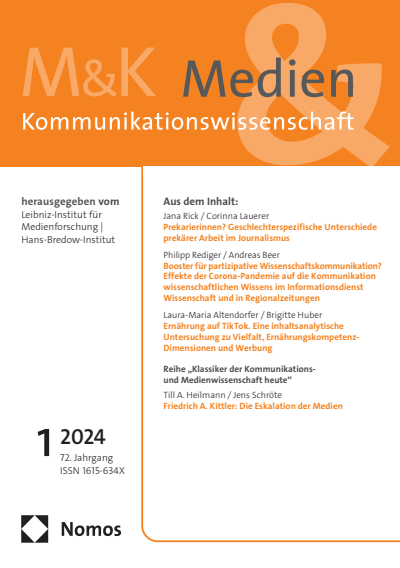
M&K Medien & Kommunikationswissenschaft
Jahrgang 72 (2024), Heft 1
- Autor:innen:
- Verlag
- Nomos, Baden-Baden
- Copyrightjahr
- 2024
- ISSN-Online
- 2942-3317
- ISSN-Print
- 1615-634X
Kapitelinformationen
Jahrgang 72 (2024), Heft 1
Ernährung auf TikTok. Eine inhaltsanalytische Untersuchung zu Vielfalt, Ernährungskompetenz-Dimensionen und Werbung
- Autor:innen:
- ISSN-Print
- 1615-634X
- ISSN-Online
- 2942-3317
- Kapitelvorschau:
Soziale Medien stellen eine wichtige Informationsquelle zu Ernährungsthemen dar. Bisherige Studien zeigen, dass sich auf TikTok zahlreiche Videos dazu finden, jedoch mit variierender Qualität. Entsprechend ist die Entwicklung von Ernährungskompetenz von hoher Bedeutung. Hier setzt die vorliegende Studie an und untersucht mittels einer quantitativen Inhaltsanalyse (n = 150) TikTok-Videos mit Ernährungsinhalten. Konkret wird erhoben, welche Kommunikator:innen zu welchen Themen posten und inwiefern Werbung erkennbar ist. Besonders ausgeprägt sind die Ernährungskompetenz-Dimensionen „Fähigkeiten in der Lebensmittelzubereitung“, „Snacken“ und „soziales bzw. bewusstes Essen“. Thematisch stehen Rezept- und Kochvideos sowie Ernährungstipps im Vordergrund. Inhalte werden überwiegend von fachlichen Laien kommuniziert, Expert:innen geben jedoch signifikant mehr Ernährungstipps. Es zeigt sich eine ausgewogene Darstellung von frischen und verarbeiteten Lebensmitteln, wenngleich deren Qualität kaum thematisiert wird. Selten behandelt werden auch die Haushaltsplanung oder Vorratshaltung von Lebensmitteln. Es wird überwiegend gesundes Snack-Verhalten gezeigt; bei ungesunden Snacks findet sich jedoch signifikant häufiger Werbung. Abschließend diskutiert der Beitrag, welche Potenziale und Herausforderungen die Plattform TikTok Ernährungsexpert:innen bietet, um relevante Inhalte für die Entwicklung von Ernährungskompetenzen zu vermitteln, und weist auf die Gefahr von Fehlinformationen hin.
Literaturverzeichnis
Es wurden keine Treffer gefunden. Versuchen Sie einen anderen Begriff.
- Alatorre, S., Schwarz, A. G., Egan, K. A., Feldman, A. R., Rosa, M., & Wang, M. L. (2023). Exploring social media preferences for healthy weight management interventions among adolescents of color: Mixed methods study. JMIR Pediatrics and Parenting, 6, e43961. https://doi.org/10.2196/43961 Google Scholar öffnen DOI: 10.5771/1615-634X-2024-1-49
- Alkan, Z., & Ulas, S. (2023). Trust in social media influencers and purchase intention: An empirical analysis. Online Journal of Communication and Media Technologies, 13(1), e202301. https://doi.org/10.30935/ojcmt/12783 Google Scholar öffnen DOI: 10.5771/1615-634X-2024-1-49
- Allgaier, J. (2023). A hard nut to crack? Explorative Forschung zum Thema Essen und Ernährung auf TikTok. Vortrag im Rahmen der #TikTok Tagung Memefication und Performance. Interdisziplinäre Zugänge zur Videoplattform TikTok. 30.–31. März 2023 [YouTube]. Dresden. https://www.youtube.com/watch?v=_a5stIBCraA [27.12.2023]. Google Scholar öffnen DOI: 10.5771/1615-634X-2024-1-49
- Alruwaily, A., Mangold, C., Greene, T., Arshonsky, J., Cassidy, O., Pomeranz, J. L., & Bragg, M. (2020). Child social media influencers and unhealthy food product placement. Pediatrics, 146(5). https://doi.org/10.1542/peds.2019-4057 Google Scholar öffnen DOI: 10.5771/1615-634X-2024-1-49
- Altendorfer, L.‑M. (2019). Influencer in der digitalen Gesundheitskommunikation. Nomos Universitätsschriften – Medien und Kommunikation: Bd. 7. Nomos. Google Scholar öffnen DOI: 10.5771/1615-634X-2024-1-49
- Aparicio-Martinez, P., Perea-Moreno, A.‑J., Martinez-Jimenez, M. P., Redel-Macías, M. D., Pagliari, C., & Vaquero-Abellan, M. (2019). Social Media, thin-ideal, body dissatisfaction and disordered eating attitudes: An exploratory analysis. International Journal of Environmental Research and Public Health, 16(21), 4177. https://doi.org/10.3390/ijerph16214177 Google Scholar öffnen DOI: 10.5771/1615-634X-2024-1-49
- ARD-/ZDF-Onlinestudie (2023). Social-Media-Nutzung 2019 bis 2022. https://www.ard-zdf-onlinestudie.de/tabellen-onlinenutzung/social-media-und-messenger/social-media/ [27.12.2023]. Google Scholar öffnen DOI: 10.5771/1615-634X-2024-1-49
- Bartelmeß, T., & Godemann, J. (2021). Ernährungskommunikation auf Social-Media-Plattformen und Ernährungshandeln der Nutzer*innen. DGEwissen, 5, 70–73. Google Scholar öffnen DOI: 10.5771/1615-634X-2024-1-49
- Bitkom (2023). Facebook und Instagram dominieren. Welches soziale Netzwerk haben Sie in den vergangenen 12 Monaten genutzt? https://www.bitkom.org/sites/main/files/2023-02/BitkomChartsSocialMedia2023.pdf [27.12.2023]. Google Scholar öffnen DOI: 10.5771/1615-634X-2024-1-49
- BMEL (2023). Kinder, Kita und Schule – Mehr Kinderschutz in der Werbung: Pläne für klare Regeln zu an Kinder gerichteter Lebensmittelwerbung. https://www.bmel.de/DE/themen/ernaehrung/gesunde-ernaehrung/kita-und-schule/lebensmittelwerbung-kinder.html [27.12.2023]. Google Scholar öffnen DOI: 10.5771/1615-634X-2024-1-49
- Cavallo, D. N., Sisneros, J. A., Ronay, A. A., Robbins, C. L., Jilcott Pitts, S. B., Keyserling, T. C., Ni, A., Morrow, J., Vu, M. B., Johnston, L. F., & Samuel-Hodge, C. D. (2016). Assessing the feasibility of a web-based weight loss intervention for low-income women of reproductive age: A pilot study. JMIR Research Protocols, 5(1), e30. https://doi.org/10.2196/resprot.4865 Google Scholar öffnen DOI: 10.5771/1615-634X-2024-1-49
- Clark, L., Lopez, E.‑I. D., Woods, L., Yockey, A., Butler, R., & Barroso, C. S. (2023). Nutrition-related information shared by Latine influencers: A YouTube content analysis. Health Promotion Practice, 24(4), 713–722. https://doi.org/10.1177/15248399221083302 Google Scholar öffnen DOI: 10.5771/1615-634X-2024-1-49
- Coates, A. E., Hardman, C. A., Halford, J. C. G., Christiansen, P., & Boyland, E. J. (2019). Food and beverage cues featured in YouTube videos of social media influencers popular with children: An exploratory study. Frontiers in Psychology, 10, 2142. https://doi.org/10.3389/fpsyg.2019.02142 Google Scholar öffnen DOI: 10.5771/1615-634X-2024-1-49
- Davis, H. A., Kells, M. R., Roske, C., Holzman, S., & Wildes, J. E. (2023). A reflexive thematic analysis of #WhatIEatInADay on TikTok. Eating Behaviors, 50, 101759. https://doi.org/10.1016/j.eatbeh.2023.101759 Google Scholar öffnen DOI: 10.5771/1615-634X-2024-1-49
- De Jans, S. de, Spielvogel, I., Naderer, B., & Hudders, L. (2021). Digital food marketing to children: How an influencer’s lifestyle can stimulate healthy food choices among children. Appetite, 162, 105182. https://doi.org/10.1016/j.appet.2021.105182 Google Scholar öffnen DOI: 10.5771/1615-634X-2024-1-49
- Domanska, O. M., Loer, A.‑K. M., Stock, C., & Jordan, S. (2022). Gesundheitskompetenz und Gesundheitsverhalten im Jugendalter: Ergebnisse einer bundesweiten Online-Befragung Jugendlicher. Prävention und Gesundheitsförderung, 17(4), 479–487. https://doi.org/10.1007/s11553-021-00913-1 Google Scholar öffnen DOI: 10.5771/1615-634X-2024-1-49
- Döring, N. (2019). Die Bedeutung von Videoplattformen für die Gesundheitskommunikation. In C. Rossmann & M. R. Hastall (Hrsg.), Handbuch der Gesundheitskommunikation: Kommunikationswissenschaftliche Perspektiven (S. 171–183). Springer VS. https://doi.org/10.1007/978-3-658-10727-7_14 Google Scholar öffnen DOI: 10.5771/1615-634X-2024-1-49
- Döring, N., & Bortz, J. (2016). Forschungsmethoden und Evaluation in den Sozial- und Humanwissenschaften (5. Aufl.). Springer-Lehrbuch. Springer Berlin Heidelberg. https://doi.org/10.1007/978-3-642-41089-5 Google Scholar öffnen DOI: 10.5771/1615-634X-2024-1-49
- Duran, M. B., & Kizilkan, Y. (2021). Quality analysis of testicular cancer videos on YouTube. Andrologia, 53(8), e14118. https://doi.org/10.1111/and.14118 Google Scholar öffnen DOI: 10.5771/1615-634X-2024-1-49
- Edgerly, S., & Vraga, E. K. (2020). Deciding what’s news: News-ness as an audience concept for the hybrid media environment. Journalism & Mass Communication Quarterly, 97(2), 416–434. https://doi.org/10.1177/1077699020916808 Google Scholar öffnen DOI: 10.5771/1615-634X-2024-1-49
- Eickhoff, M. (12. November 2022). Wie wissenschaftlich ist More Nutrition? MedWatch. https://medwatch.de/ernaehrung/more-nutrition-wie-wissenschaftlich/ [27.12.2023]. Google Scholar öffnen DOI: 10.5771/1615-634X-2024-1-49
- Elliott, C., Truman, E., & Black, J. E. (2023). Tracking teen food marketing: Participatory research to examine persuasive power and platforms of exposure. Appetite, 186, 106550. https://doi.org/10.1016/j.appet.2023.106550 Google Scholar öffnen DOI: 10.5771/1615-634X-2024-1-49
- Endres, E.‑M. (2018). Ernährung in Sozialen Medien: Inszenierung, Demokratisierung, Trivialisierung. Springer Fachmedien Wiesbaden GmbH. https://doi.org/10.1007/978-3-658-21988-8 Google Scholar öffnen DOI: 10.5771/1615-634X-2024-1-49
- Endres, E.‑M. (2022). Ernährungsbildung durch Social Media. In A. Bush & J. Birke (Hrsg.), Nachhaltigkeit und Social Media: Bildung für eine nachhaltige Entwicklung in der digitalen Welt (S. 223–239). Springer VS. https://doi.org/10.1007/978-3-658-35660-6_11 Google Scholar öffnen DOI: 10.5771/1615-634X-2024-1-49
- Folkvord, F., Roes, E., & Bevelander, K. (2020). Promoting healthy foods in the new digital era on Instagram: an experimental study on the effect of a popular real versus fictitious fit influencer on brand attitude and purchase intentions. BMC Public Health, 20(1), 1677. https://doi.org/10.1186/s12889-020-09779-y Google Scholar öffnen DOI: 10.5771/1615-634X-2024-1-49
- Früh, W., & Früh, H. (2015). Empirische Methoden in den Sozialwissenschaften und die Rolle der Inhaltsanalyse. Eine Analyse deutscher und internationaler Fachzeitschriften 2000–2009. In W. Wirth, K. Sommer, M. Wettstein & J. Matthes (Hrsg.), Methoden und Forschungslogik der Kommunikationswissenschaft: Bd. 12. Qualitätskriterien in der Inhaltsanalyse (S. 15–77). Herbert von Halem Verlag. Google Scholar öffnen DOI: 10.5771/1615-634X-2024-1-49
- Gianni, M., Reitano, A., Fazio, M., Gkimperiti, A., Karanasios, N., & Taylor, D. W. (2023). Food literacy as a resilience factor in response to health-related uncertainty. British Food Journal, 125(3), 1067–1093. https://doi.org/10.1108/BFJ-10-2021-1145 Google Scholar öffnen DOI: 10.5771/1615-634X-2024-1-49
- Gibbs, H. D., Ellerbeck, E. F., Gajewski, B., Zhang, C., & Sullivan, D. K. (2018). The nutrition literacy assessment instrument is a valid and reliable measure of nutrition literacy in adults with chronic disease. Journal of Nutrition Education and Behavior, 50(3), 247–257.e1. https://doi.org/10.1016/j.jneb.2017.10.008 Google Scholar öffnen DOI: 10.5771/1615-634X-2024-1-49
- Gose, M., Storcksdieck, S., & Hoffmann, I. (2021). Ernährungskompetenz in Deutschland ‒ vertiefende Auswertungen: Ergebnisbericht Stand: April 2021. https://www.mri.bund.de/fileadmin/MRI/Institute/EV/210428_Bericht_Ernaehrungskompetenz.pdf. https://doi.org/10.25826/20210305-174808 Google Scholar öffnen DOI: 10.5771/1615-634X-2024-1-49
- Granow, V. C., & Scolari, J. (2022). TikTok – Nutzung und Potenziale der Kurzvideo-Plattform. Media Perspektiven, 4, 166–176. Google Scholar öffnen DOI: 10.5771/1615-634X-2024-1-49
- Höhn, T. D. (2021). Gut informiert is(s)t besser: Ernährungskommunikation als gesellschaftliche Aufgabe – valide Informationen verständlich vermitteln und Handlungsempfehlungen geben. TransferPlus Aktuelle Beiträge zur Medienbildung, 01/2021. https://doi.org/10.25366/2021.51 Google Scholar öffnen DOI: 10.5771/1615-634X-2024-1-49
- Horch, K. (2021). Suche von Gesundheitsinformationen im Internet – Ergebnisse der KomPaS-Studie. Journal of Health Monitoring, 2(6). https://doi.org/10.25646/7143 Google Scholar öffnen DOI: 10.5771/1615-634X-2024-1-49
- Jarreau, P. B., Cancellare, I. A., Carmichael, B. J., Porter, L., Toker, D., & Yammine, S. Z. (2019). Using selfies to challenge public stereotypes of scientists. PloS One, 14(5), e0216625. https://doi.org/10.1371/journal.pone.0216625 Google Scholar öffnen DOI: 10.5771/1615-634X-2024-1-49
- Keenan, C. (2022). Für mehr Sicherheit und ein gutes Gefühl auf TikTok: Wir verschärfen unsere Community-Richtlinien. https://newsroom.tiktok.com/de-de/fuer-mehr-sicherheit-und-ein-gutes-gefuehl-auf-tiktok-wir-verschaerfen-unsere-community-richtlinien [27.12.2023]. Google Scholar öffnen DOI: 10.5771/1615-634X-2024-1-49
- Kilb, M., Giese, H., & Mata, J. (2023). How eating-related social media postings influence healthy eating in senders and network members: Two field experiments with intensive longitudinal data. Appetite, 182, 106430. https://doi.org/10.1016/j.appet.2022.106430 Google Scholar öffnen DOI: 10.5771/1615-634X-2024-1-49
- Kilian, K., & Rudmann, D. (2020). Does size matter? Der Einfluss der Followerzahl auf die Glaubwürdigkeit von Influencern. Transfer: Zeitschrift für Kommunikation & Markenmanagement, 66(4), 30–36. Google Scholar öffnen DOI: 10.5771/1615-634X-2024-1-49
- Kim, B. R., & Mackert, M. (2022). Social media use and binge eating: An integrative review. Public Health Nursing, 39(5), 1134–1141. https://doi.org/10.1111/phn.13069 Google Scholar öffnen DOI: 10.5771/1615-634X-2024-1-49
- Klassen, K. M., Douglass, C. H., Brennan, L., Truby, H., & Lim, M. S. C. (2018). Social media use for nutrition outcomes in young adults: A mixed-methods systematic review. The International Journal of Behavioral Nutrition and Physical Activity, 15(1), 70. https://doi.org/10.1186/s12966-018-0696-y Google Scholar öffnen DOI: 10.5771/1615-634X-2024-1-49
- Kolpatzik, K., & Zaunbrecher, R. (Hrsg.) (2020). Ernährungskompetenz in Deutschland. KomPart. Google Scholar öffnen DOI: 10.5771/1615-634X-2024-1-49
- Kong, W., Song, S., Zhao, Y. C., Zhu, Q., & Sha, L. (2021). TikTok as a health information source: Assessment of the quality of information in diabetes-related videos. Journal of Medical Internet Research, 23(9), e30409. https://doi.org/10.2196/30409 Google Scholar öffnen DOI: 10.5771/1615-634X-2024-1-49
- Krause, G. C., Beer-Borst, S., Sommerhalder, K., Hayoz, S., & Abel, T. (2018). A short food literacy questionnaire (SFLQ) for adults: Findings from a Swiss validation study. Appetite, 120, 275–280. https://doi.org/10.1016/j.appet.2017.08.039 Google Scholar öffnen DOI: 10.5771/1615-634X-2024-1-49
- Landis, J. R., & Koch, G. G. (1977). The measurement of observer agreement for categorical data. Biometrics, 33(1), 159–174. https://doi.org/10.2307/2529310 Google Scholar öffnen DOI: 10.5771/1615-634X-2024-1-49
- Lee, Y., Kim, T. & Jung, H. (2022). The relationships between food literacy, health promotion literacy and healthy eating habits among young adults in South Korea. Foods, 11(16), 2467. https://doi.org/10.3390/foods11162467 Google Scholar öffnen DOI: 10.5771/1615-634X-2024-1-49
- Li, S., Zhu, Y., Zeng, M., Li, Z., Zeng, H., Shi, Z., & Zhao, Y. (2022). Association between nutrition literacy and overweight/obesity of adolescents: A cross-sectional study in Chongqing, China. Frontiers in Nutrition, 9, 893267. https://doi.org/10.3389/fnut.2022.893267 Google Scholar öffnen DOI: 10.5771/1615-634X-2024-1-49
- Lindgren, S., & Johansson, A. (2023). Getting better? Hegemonic, negotiated and oppositional uses of Instagram for mental health support. Journal of Communication Inquiry, 47(3), 268–290. https://doi.org/10.1177/01968599211042581 Google Scholar öffnen DOI: 10.5771/1615-634X-2024-1-49
- Link, E., & Baumann, E. (2022). Erratum zu: Nutzung von Gesundheitsinformationen im Internet: personenbezogene und motivationale Einflussfaktoren. Bundesgesundheitsblatt, Gesundheitsforschung, Gesundheitsschutz, 65(3), 396. https://doi.org/10.1007/s00103-021-03447-1 Google Scholar öffnen DOI: 10.5771/1615-634X-2024-1-49
- Looi, J., Kemp, D., & Song, Y. W. G. (2023). Instagram influencers in health communication: Examining the roles of influencer tier and message construal in COVID-19-prevention public service announcements. Journal of Interactive Advertising, 23(1), 14–32. https://doi.org/10.1080/15252019.2022.2140316 Google Scholar öffnen DOI: 10.5771/1615-634X-2024-1-49
- Lörcher, I., & Taddicken, M. (2017). Discussing climate change online. Topics and perceptions in online climate change communication in different online public arenas. Journal of Science Communication, 16(02), A03. https://doi.org/10.22323/2.16020203 Google Scholar öffnen DOI: 10.5771/1615-634X-2024-1-49
- Martínez-Sanz, R., Buitrago, Á., & Martín-García, A. (2023). Comunicación para la salud a través de TikTok. Estudio de influencers de temática farmacéutica y conexión con su audiencia. Revista Mediterránea de Comunicación, 14(1), 83–98. https://doi.org/10.14198/MEDCOM.23435 Google Scholar öffnen DOI: 10.5771/1615-634X-2024-1-49
- McCashin, D., & Murphy, C. M. (2023). Using TikTok for public and youth mental health. A systematic review and content analysis. Clinical Child Psychology and Psychiatry, 28(1), 279–306. https://doi.org/10.1177/13591045221106608 Google Scholar öffnen DOI: 10.5771/1615-634X-2024-1-49
- Die Medienanstalten (2023). Leitfaden der Medienanstalten. Werbekennzeichnung bei Online-Medien. https://www.die-medienanstalten.de/fileadmin/user_upload/die_medienanstalten/Service/Merkblaetter_Leitfaeden/Leitfaden_Werbekennzeichnung_Online-Medien_vers_23.pdf [27.12.2023]. Google Scholar öffnen DOI: 10.5771/1615-634X-2024-1-49
- Minadeo, M., & Pope, L. (2022). Weight-normative messaging predominates on TikTok – A qualitative content analysis. PloS One, 17(11), e0267997. https://doi.org/10.1371/journal.pone.0267997 Google Scholar öffnen DOI: 10.5771/1615-634X-2024-1-49
- Ming, S., Han, J., Li, M., Liu, Y., Xie, K., & Lei, B. (2023). TikTok and adolescent vision health: Content and information quality assessment of the top short videos related to myopia. Frontiers in Public Health, 10, 1068582. https://doi.org/10.3389/fpubh.2022.1068582 Google Scholar öffnen DOI: 10.5771/1615-634X-2024-1-49
- Montag, C., Yang, H., & Elhai, J. D. (2021). On the psychology of TikTok Use: A first glimpse from empirical findings. Frontiers in Public Health, 9, 641673. https://doi.org/10.3389/fpubh.2021.641673 Google Scholar öffnen DOI: 10.5771/1615-634X-2024-1-49
- Ng, A. H., ElGhattis, Y., Biesiekierski, J. R., & Moschonis, G. (2022). Assessing the effectiveness of a 4-week online intervention on food literacy and fruit and vegetable consumption in Australian adults: The online MedDiet challenge. Health & Social Care in the Community, 30(6), e4975-e4981. https://doi.org/10.1111/hsc.13909 Google Scholar öffnen DOI: 10.5771/1615-634X-2024-1-49
- Obermayr, R., Yildiz, J., & Godemann, S. (2022). Ernährungskommunikation auf TikTok. Ernährungs Umschau, 10, M546–M557. https://www.ernaehrungs-umschau.de/print-artikel/12-10-2022-ernaehrungskommunikation-auf-tiktok/ [27.12.2023]. Google Scholar öffnen DOI: 10.5771/1615-634X-2024-1-49
- Packer, J., Russell, S. J., Siovolgyi, G., McLaren, K., Stansfield, C., Viner, R. M., & Croker, H. (2022). The impact on dietary outcomes of celebrities and influencers in marketing unhealthy foods to children: A systematic review and meta-analysis. Nutrients, 14(3). https://doi.org/10.3390/nu14030434 Google Scholar öffnen DOI: 10.5771/1615-634X-2024-1-49
- Peterson, E. B., Gaysynsky, A., Chou, W.‑Y. S., & Rising, C. (2019). The role and impact of health literacy on peer-to-peer health communication. Information Services & Use, 39(1–2), 37–49. https://doi.org/10.3233/ISU-180039 Google Scholar öffnen DOI: 10.5771/1615-634X-2024-1-49
- Petkovic, J., Duench, S., Trawin, J., Dewidar, O., Pardo Pardo, J., Simeon, R., DesMeules, M., Gagnon, D., Hatcher Roberts, J., Hossain, A., Pottie, K., Rader, T., Tugwell, P., Yoganathan, M., Presseau, J., & Welch, V. (2021). Behavioural interventions delivered through interactive social media for health behaviour change, health outcomes, and health equity in the adult population. The Cochrane Database of Systematic Reviews, 5(5), CD012932. https://doi.org/10.1002/14651858.CD012932.pub2 Google Scholar öffnen DOI: 10.5771/1615-634X-2024-1-49
- Poelman, M. P., Dijkstra, S. C., Sponselee, H., Kamphuis, C. B. M., Battjes-Fries, M. C. E., Gillebaart, M., & Seidell, J. C. (2018). Towards the measurement of food literacy with respect to healthy eating: The development and validation of the self perceived food literacy scale among an adult sample in the Netherlands. The International Journal of Behavioral Nutrition and Physical Activity, 15(1), 54. https://doi.org/10.1186/s12966-018-0687-z Google Scholar öffnen DOI: 10.5771/1615-634X-2024-1-49
- Quarks (12. November 2022). Science-Cops Folge 44 – More Nutrition. Quarks. https://www.quarks.de/podcast/science-cops-folge-44/ [27.12.2023]. Google Scholar öffnen DOI: 10.5771/1615-634X-2024-1-49
- Qutteina, Y., Hallez, L., Mennes, N., Backer, C. de, & Smits, T. (2019). What do adolescents see on social media? A diary study of food marketing images on social media. Frontiers in Psychology, 10, 2637. https://doi.org/10.3389/fpsyg.2019.02637 Google Scholar öffnen DOI: 10.5771/1615-634X-2024-1-49
- Qutteina, Y., Hallez, L., Raedschelders, M., Backer, C. de, & Smits, T. (2022). Food for teens: How social media is associated with adolescent eating outcomes. Public Health Nutrition, 25(2), 290–302. https://doi.org/10.1017/S1368980021003116 Google Scholar öffnen DOI: 10.5771/1615-634X-2024-1-49
- Raber, M., Allen, H., Huang, S., & Thompson, D. (2022). #mediterraneandiet: A Content analysis of mediterranean diet-related information on TikTok. Current Developments in Nutrition, 6, 391. https://doi.org/10.1093/cdn/nzac054.046 Google Scholar öffnen DOI: 10.5771/1615-634X-2024-1-49
- Raiter, N., Husnudinov, R., Mazza, K., & Lamarche, L. (2023). TikTok promotes diet culture and negative body image rhetoric: A content analysis. Journal of Nutrition Education and Behavior, 55(10), 755–760. https://doi.org/10.1016/j.jneb.2023.08.001 Google Scholar öffnen DOI: 10.5771/1615-634X-2024-1-49
- Rao, M. (2022). Medfluencing: A new role for physicians in the age of Tiktok. Georgetown Medical Review, 6(1). https://doi.org/10.52504/001c.34633 Google Scholar öffnen DOI: 10.5771/1615-634X-2024-1-49
- Reinhardt, L., Steeb, T., Mifka, A., Berking, C., & Meier, F. (2023). Quality, understandability and reliability of YouTube videos on skin cancer screening. Journal of Cancer Education (38), 1667–1674. https://link.springer.com/article/10.1007/s13187-023-02320-w Google Scholar öffnen DOI: 10.5771/1615-634X-2024-1-49
- Riesmeyer, C., Hauswald, J., & Mergen, M. (2019). (Un)Healthy behavior? The relationship between media literacy, nutritional behavior, and self-representation on Instagram. Media and Communication, 7(2), 160–168. https://doi.org/10.17645/mac.v7i2.1871 Google Scholar öffnen DOI: 10.5771/1615-634X-2024-1-49
- Roberts, J. A., & David, M. E. (2023). Instagram and TikTok flow states and their association with psychological well-being. Cyberpsychology, Behavior and Social Networking, 26(2), 80–89. https://doi.org/10.1089/cyber.2022.0117 Google Scholar öffnen DOI: 10.5771/1615-634X-2024-1-49
- Rogers, A., Wilkinson, S., Downie, O., & Truby, H. (2022). Communication of nutrition information by influencers on social media: A scoping review. Health Promotion Journal of Australia, 33(3), 657–676. https://doi.org/10.1002/hpja.563 Google Scholar öffnen DOI: 10.5771/1615-634X-2024-1-49
- Rössler, P. (2017). Inhaltsanalyse (3. überarbeitete Auflage, Online-Ausgabe). utb-studi-e-book: Bd. 2671. UVK. https://elibrary.utb.de/doi/book/10.36198/9783838547060. https://doi.org/10.36198/9783838547060 Google Scholar öffnen DOI: 10.5771/1615-634X-2024-1-49
- Roth, L., Yildiz, J., & Godemann, J. (2022). Soziale Medien und Ernährung – Fluch oder Segen? Online-Befragung von älteren Jugendlichen. Ernährung im Fokus, 01, 22–27. Google Scholar öffnen DOI: 10.5771/1615-634X-2024-1-49
- Rounsefell, K., Gibson, S., McLean, S., Blair, M., Molenaar, A., Brennan, L., Truby, H., & McCaffrey, T. A. (2020). Social media, body image and food choices in healthy young adults: A mixed methods systematic review. Nutrition & Dietetics: The Journal of the Dietitians Association of Australia, 77(1), 19–40. https://doi.org/10.1111/1747-0080.12581 Google Scholar öffnen DOI: 10.5771/1615-634X-2024-1-49
- Ruddock, H. K., Brunstrom, J. M., Vartanian, L. R., & Higgs, S. (2019). A systematic review and meta-analysis of the social facilitation of eating. The American Journal of Clinical Nutrition, 110(4), 842–861. https://doi.org/10.1093/ajcn/nqz155 Google Scholar öffnen DOI: 10.5771/1615-634X-2024-1-49
- Sandberg, K., Banerjee, O., Harris, C., & Averill, M. (2022). P160 healthy food, as told by TikTok: A thematic analysis of the most liked #healthyrecipes on TikTok. Journal of Nutrition Education and Behavior, 54(7), S94. https://doi.org/10.1016/j.jneb.2022.04.201 Google Scholar öffnen DOI: 10.5771/1615-634X-2024-1-49
- Scheiber, R., Karmasin, M., & Diehl, S. (2023). Exploring the Dunning-Kruger effect in health communication: How perceived food and media literacy and actual knowledge drift apart when evaluating misleading food advertising. Journal of Health Communication, 28(11), 707–727. https://doi.org/10.1080/10810730.2023.2258085 Google Scholar öffnen DOI: 10.5771/1615-634X-2024-1-49
- Siegal, A. R., Ferrer, F. A., Baldisserotto, E., & Malhotra, N. R. (2023). The assessment of TikTok as a source of quality health information on varicoceles. Urology, 175, 170–174. https://doi.org/10.1016/j.urology.2022.12.016 Google Scholar öffnen DOI: 10.5771/1615-634X-2024-1-49
- Sokolova, K., & Perez, C. (2021). You follow fitness influencers on YouTube. But do you actually exercise? How parasocial relationships, and watching fitness influencers, relate to intentions to exercise. Journal of Retailing and Consumer Services, 58, 102276. https://doi.org/10.1016/j.jretconser.2020.102276 Google Scholar öffnen DOI: 10.5771/1615-634X-2024-1-49
- Song, S., Zhao, Y. C., Yao, X., Ba, Z., & Zhu, Q. (2022). Serious information in hedonic social applications: Affordances, self-determination and health information adoption in TikTok. Journal of Documentation, 78(4), 890–911. https://doi.org/10.1108/JD-08-2021-0158 Google Scholar öffnen DOI: 10.5771/1615-634X-2024-1-49
- Staudamm, L., Borsai, A. M. B., & Burroughs, B. (2023). (Over)Eating with our eyes: An examination of Mukbang influencer marketing and consumer engagement with food brands. Journal of Promotion Management, 1–25. https://doi.org/10.1080/10496491.2023.2253244 Google Scholar öffnen DOI: 10.5771/1615-634X-2024-1-49
- Steils, N., & Obaidalahe, Z. (2020). „Social food”: Food literacy co-construction and distortion on social media. Food Policy, 95, 101932. https://doi.org/10.1016/j.foodpol.2020.101932 Google Scholar öffnen DOI: 10.5771/1615-634X-2024-1-49
- Stürmer, B., Ouyang, G., Palazova, M., Schacht, A., Martín-Loeches, M., Rausch, P., & Sommer, W. (2018). Lunching for relaxation or cognitive control? After-effects of social and solitary meals. Advances in Cognitive Psychology, 14(1), 14–20. https://doi.org/10.5709/acp-0234-3 Google Scholar öffnen DOI: 10.5771/1615-634X-2024-1-49
- Taddicken, M., & Schmidt, J.‑H. (2022). Soziale Medien und Öffentlichkeit(en). Springer VS. https://doi.org/10.1007/978-3-658-03895-3_22-1 Google Scholar öffnen DOI: 10.5771/1615-634X-2024-1-49
- TikTok (2020). How TikTok recommends videos #ForYou. https://newsroom.tiktok.com/en-us/how-tiktok-recommends-videos-for-you [27.12.2023]. Google Scholar öffnen DOI: 10.5771/1615-634X-2024-1-49
- TikTok Werbung (2020). Was ist Tiktok? https://www.tiktok-werbung.com/was-ist-tiktok/ [27.12.2023]. Google Scholar öffnen DOI: 10.5771/1615-634X-2024-1-49
- Trieste, L., Bazzani, A., Amato, A., Faraguna, U., & Turchetti, G. (2021). Food literacy and food choice – a survey-based psychometric profiling of consumer behaviour. British Food Journal, 123(13), 124–141. https://doi.org/10.1108/BFJ-09-2020-0845 Google Scholar öffnen DOI: 10.5771/1615-634X-2024-1-49
- Vaitkeviciute, R., Ball, L. E., & Harris, N. (2015). The relationship between food literacy and dietary intake in adolescents: a systematic review. Public Health Nutrition, 18(4), 649–658. https://doi.org/10.1017/S1368980014000962 Google Scholar öffnen DOI: 10.5771/1615-634X-2024-1-49
- Vassallo, A., Jones, A., & Freeman, B. (2022). Social media: frenemy of public health? Public Health Nutrition, 25(1), 61–64. https://doi.org/10.1017/S136898002100269X Google Scholar öffnen DOI: 10.5771/1615-634X-2024-1-49
- Vidgen, H. A., & Gallegos, D. (2014). Defining food literacy and its components. Appetite, 76, 50–59. https://doi.org/10.1016/j.appet.2014.01.010 Google Scholar öffnen DOI: 10.5771/1615-634X-2024-1-49
- Voigt, C., & Höhn, T. D (2021). Nutrition-related coverage in German press. A content analysis of regional and national newspapers. Ernährungs Umschau, 68(7), 134–143. https://doi.org/10.4455/eu.2021.028 Google Scholar öffnen DOI: 10.5771/1615-634X-2024-1-49
- Wang, C., Sher, S. T., Salman, I., Janek, K., & Chung, C. (2022). “TikTok made me do it”: Teenagers’ perception and use of food content on TikTok. Proceedings of the 21st Annual ACM Interaction Design and Children Conference. https://doi.org/10.1145/3501712.3535290 Google Scholar öffnen DOI: 10.5771/1615-634X-2024-1-49
- Waring, M. E., Jake-Schoffman, D. E., Holovatska, M. M., Mejia, C., Williams, J. C., & Pagoto, S. L. (2018). Social media and obesity in adults: A review of recent research and future directions. Current Diabetes Reports, 18(6), 34. https://doi.org/10.1007/s11892-018-1001-9 Google Scholar öffnen DOI: 10.5771/1615-634X-2024-1-49
- Wilksch, S. M., O’Shea, A., Ho, P., Byrne, S., & Wade, T. D. (2020). The relationship between social media use and disordered eating in young adolescents. The International Journal of Eating Disorders, 53(1), 96–106. https://doi.org/10.1002/eat.23198 Google Scholar öffnen DOI: 10.5771/1615-634X-2024-1-49
- Winzer, E., Naderer, B., Klein, S., Lercher, L., & Wakolbinger, M. (2022). Promotion of food and beverages by German-speaking influencers popular with adolescents on TikTok, YouTube and Instagram. International Journal of Environmental Research and Public Health, 19(17), 10911. https://doi.org/10.3390/ijerph191710911 Google Scholar öffnen DOI: 10.5771/1615-634X-2024-1-49
- Yeung, A., Ng, E., & Abi-Jaoude, E. (2022). TikTok and attention-deficit/hyperactivity disorder: A cross-sectional study of social media content quality. Canadian Journal of Psychiatry. Revue Canadienne de Psychiatrie, 67(12), 899–906. https://doi.org/10.1177/07067437221082854 Google Scholar öffnen DOI: 10.5771/1615-634X-2024-1-49
- Zahra, M. F., Qazi, T., A., Ali, A., S., Hayat, N., & ul Hassan, T. (2022). How Tiktok addiction leads to mental health illness? Examining the mediating role of academic performance using structural equation modeling. Journal of Positive School Psychology, 6(10), 1490–1502. Google Scholar öffnen DOI: 10.5771/1615-634X-2024-1-49