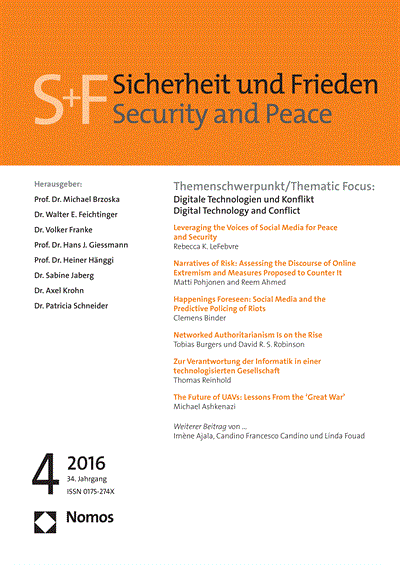
Narratives of Risk: Assessing the Discourse of Online Extremism and Measures Proposed to Counter It
Inhaltsverzeichnis
Bibliographische Infos
Vollzugriff
S&F Sicherheit und Frieden
Jahrgang 34 (2016), Heft 4
- Autor:innen:
- Verlag
- Nomos, Baden-Baden
- Copyrightjahr
- 2016
- ISSN-Online
- 0175-274x
- ISSN-Print
- 0175-274X
Kapitelinformationen
Vollzugriff
Jahrgang 34 (2016), Heft 4
Narratives of Risk: Assessing the Discourse of Online Extremism and Measures Proposed to Counter It
- Autor:innen:
- ISSN-Print
- 0175-274X
- ISSN-Online
- 0175-274x
- Kapitelvorschau:
Literaturverzeichnis
Es wurden keine Treffer gefunden. Versuchen Sie einen anderen Begriff.
- Amoore, L. (2008). “Consulting, Culture, the Camp: On the Economies of Exception.” In Risk and the War on Terror, edited by L. Amoore and M. de Goede, 112–129. London: Routledge Google Scholar öffnen doi.org/10.5771/0175-274X-2016-4-236
- Amoore, L. and M. de Goede. (2008). Risk and the War on Terror. New York: Routledge. Google Scholar öffnen doi.org/10.5771/0175-274X-2016-4-236
- Aradau, C., and R. van Munster. (2008). “Taming the Future: The Dispositif of Risk in the War on Terror.” In Risk and the War on Terror, edited by L. Amoore and M. de Goede, 23–40. London: Routledge Google Scholar öffnen doi.org/10.5771/0175-274X-2016-4-236
- Archetti , C. (2013). Understanding Terrorism in the Age of Global Media: A Communication Approach, Basingstoke: Palgrave Google Scholar öffnen doi.org/10.5771/0175-274X-2016-4-236
- Argomaniz, J. (2015). European Union responses to terrorist use of the Internet. Cooperation and Conflict, 50(2), 250-268. Google Scholar öffnen doi.org/10.5771/0175-274X-2016-4-236
- Bartlett, J. and A. Krasodomski-Jones. (2015). “Counter-speech: examining content that challenges extremism online.” Demos. Google Scholar öffnen doi.org/10.5771/0175-274X-2016-4-236
- Beck, U. (1992). Risk Society: Towards a New Modernity. New Delhi: Sage. Google Scholar öffnen doi.org/10.5771/0175-274X-2016-4-236
- Benson, D. (2014). “Why the Internet is Not Increasing Terrorism,” Security Studies 23(2), 293–328 Google Scholar öffnen doi.org/10.5771/0175-274X-2016-4-236
- Briggs, R. (2011). “Radicalisation: The Role of the Internet”, Institute for Strategic Dialogue: A working paper of the PPN Google Scholar öffnen doi.org/10.5771/0175-274X-2016-4-236
- Bruns, A. et al. (2016). The Routledge Companion to Social Media and Politics. New York: Routledge Google Scholar öffnen doi.org/10.5771/0175-274X-2016-4-236
- Carter, J., S. Maher, P. Neumann. (2014). #Greenbirds: Measuring Importance and Influence in Syrian Foreign Fighter Networks. London: ICSR Google Scholar öffnen doi.org/10.5771/0175-274X-2016-4-236
- Castells, M. (2013). Networks of outrage and Hope. London: Polity Google Scholar öffnen doi.org/10.5771/0175-274X-2016-4-236
- Christensen, C. (2011). “Twitter Revolutions? Addressing Social Media and Dissent”, Google Scholar öffnen doi.org/10.5771/0175-274X-2016-4-236
- The Communication Review. 14: 155-157 Google Scholar öffnen doi.org/10.5771/0175-274X-2016-4-236
- Coleman, P.T. (2003). ‘Characteristics of Protracted, Intractable Conflict: Toward the Development of Metaframework-1’, Peace and Conflict: Journal of Peace Psychology 9:1: 1-37. Google Scholar öffnen doi.org/10.5771/0175-274X-2016-4-236
- Coleman, P.T. (2004). ‘Paradigmatic Framing of Protracted Intractable Conflict: Toward the Development of a Meta Framework-ii’, Peace and Conflict: Journal of Peace Psychology 10(3): 197-235. Google Scholar öffnen doi.org/10.5771/0175-274X-2016-4-236
- Coleman, P.T. (2006). ‘Characteristics of Protracted, Intractable Conflict: Toward the Development of Metaframework-1’, Peace and Conflict: Journal of Peace Psychology 12(4): 325-348. Google Scholar öffnen doi.org/10.5771/0175-274X-2016-4-236
- Conway, M. (2016). ‘Determining the Role of the Internet in Violent Extremism and Terrorism: Six Suggestions for Progressing Research, Studies in Conflict & Terrorism,’, Studies in Conflict and Terrorism. Google Scholar öffnen doi.org/10.5771/0175-274X-2016-4-236
- Couldry, N. (2010). ‘Theorising Media as Practice’, in B. Bräuchler and J. Postill) Theorising Media and Practice. New York: Berghann Google Scholar öffnen doi.org/10.5771/0175-274X-2016-4-236
- Council of the European Union. (2015a). Europol to Standing Committee on operational cooperation on internal security, EU Internet Referral Unit at Europol – Concept note, 7266/15, Brussels, 16 March Google Scholar öffnen doi.org/10.5771/0175-274X-2016-4-236
- Council of the European Union. (2015b). EU Counter-Terrorism Coordinator to Delegations, EU CTC input for the preparation of the informal meeting of Justice and Home Affairs Ministers in Riga on 29 January 2015, DS 1035/15, Brussels, 17 January Google Scholar öffnen doi.org/10.5771/0175-274X-2016-4-236
- Council of the European Union. (2005). Presidency and CT Coordinator to Council/European Council, The European Union Counter-Terrorism Strategy, 144469/4/05, Brussels, 30 November Google Scholar öffnen doi.org/10.5771/0175-274X-2016-4-236
- De Goede, M., and S. Simon. (2013). “Governing Future Radicals in Europe.” Antipode 45 (2): 315–335 Google Scholar öffnen doi.org/10.5771/0175-274X-2016-4-236
- Edwards, C., and L. Gribbon. (2013). “Pathways to violent extremism in the digital era.” The RUSI Journal 158(5), 40-47 Google Scholar öffnen doi.org/10.5771/0175-274X-2016-4-236
- Ericson, R. (2008). “The state of preemption: Managing terrorism risk through counter law” in Risk and the War on Terror. New York: Routledge Google Scholar öffnen doi.org/10.5771/0175-274X-2016-4-236
- Europol. (2015). TE-SAT 2015: EU Terrorism Situation and Trend Report. Europol Google Scholar öffnen doi.org/10.5771/0175-274X-2016-4-236
- Europol. (2014). TE-SAT 2014: EU Terrorism Situation and Trend Report. Europol Google Scholar öffnen doi.org/10.5771/0175-274X-2016-4-236
- Europol. (2013). TE-SAT 2013: EU Terrorism Situation and Trend Report. Europol Google Scholar öffnen doi.org/10.5771/0175-274X-2016-4-236
- Ferguson, K. (2016). “Countering violent extremism through media and communication strategies: a review of the evidence.” Partnership for Conflict, Crime and Security Research Report. Google Scholar öffnen doi.org/10.5771/0175-274X-2016-4-236
- Gerbaudo, P. (2012). Tweets and Streets: Social Media and Contemporary Acitivism. London: Pluto Press. Google Scholar öffnen doi.org/10.5771/0175-274X-2016-4-236
- Grusin, R. (2010). Premediation: Affect and Mediality After 9/11. New York: Palgrave McMillan. Google Scholar öffnen doi.org/10.5771/0175-274X-2016-4-236
- Ghonim, W. (2012). Revolution 2.0: the Power of the People is Greater Than the People in Power: a Memoir. New York: Houghton Mifflin Harcourt Google Scholar öffnen doi.org/10.5771/0175-274X-2016-4-236
- Giddens, A. (1999). “Risk and Responsibility” Modern Law Review 62(1): 1-10 Google Scholar öffnen doi.org/10.5771/0175-274X-2016-4-236
- Gill, P. et al. (2015). What Are the Roles of the Internet in Terrorism. VOX-Pol Network of Excellence. Google Scholar öffnen doi.org/10.5771/0175-274X-2016-4-236
- Gray, D and A. Head. (2009). “The Importance of the Internet to the Post-modern Terrorist and its Role as a Form of Safe Haven,” European Journal of Scientific Research 25(3) Google Scholar öffnen doi.org/10.5771/0175-274X-2016-4-236
- Grusin, R. (2010). Premediation: Affect and Mediality After 9/11. New York: Palgrave McMillan. Google Scholar öffnen doi.org/10.5771/0175-274X-2016-4-236
- Hobart, M. (2010). ‘What Do We Mean By Media Practices?’, p. 55-77 in B. Bräuchler and J. Postill (s) Theorising Media and Practice. New York: Bergham Books Google Scholar öffnen doi.org/10.5771/0175-274X-2016-4-236
- Johnson, A.G, B. Tudor, H. Nuserbeigh. (2013). “140 Characters or Less: How is the Twitter Medisacape Influencing the Egyptian Revolution.” Middle East Journal of Culture and Communication. 6. 126-148 Google Scholar öffnen doi.org/10.5771/0175-274X-2016-4-236
- Laclau, E. and C. Mouffe. (1985). Hegemony & Socialist Strategy. London: Routledge. Google Scholar öffnen doi.org/10.5771/0175-274X-2016-4-236
- Macquire, T. (2011). ‘New Media and Islamism in the Arab Winter: a Case Study of Huda Tv in Pre-revolutionary Egypt’, Journal of Arab and Muslim Media Research Volume 4, No 2&3: 237-252 Google Scholar öffnen doi.org/10.5771/0175-274X-2016-4-236
- Massumi, B. (2007). “Potential Politics and the Primacy of Pre-Emption.” Theory & Event 10 (2) Google Scholar öffnen doi.org/10.5771/0175-274X-2016-4-236
- Martin, T. (2014). ‘Governing an Unknowable Future: the Politics of Britain’s Prevent Policy’, Critical Studies on Terrorism 7:1: 62-78. Google Scholar öffnen doi.org/10.5771/0175-274X-2016-4-236
- Morozov, E. (2012). The Net Delusion: the Dark Side of Internet Freedom. Reprint. edition. PublicAffairs Google Scholar öffnen doi.org/10.5771/0175-274X-2016-4-236
- Mosco, V. (2005). The Digital Sublime: Myth, Power, and Cyberspace. The MIT Press Google Scholar öffnen doi.org/10.5771/0175-274X-2016-4-236
- Neumann, P. (2012). “Countering Online Radicalization in America”, Bipartisan Policy Center, Homeland Security Project, USA Google Scholar öffnen doi.org/10.5771/0175-274X-2016-4-236
- Nouri, L. and A. Whiting. (2014). ‘Prevent and the internet’. In: Baker-Beall, C., C. Heath-Kelly, and L. Jarvis (eds.). Counter-radicalisation: Critical perspectives. London: Routledge, 175-189.Oh, O., Eom, C., and H. R. Rao, (2015). “Research note – Role of social media in social change: An analysis of collective sensemaking during the 2011 Egypt revolution.” Information Systems Research, 26(1), 210–223 Google Scholar öffnen doi.org/10.5771/0175-274X-2016-4-236
- Pauwels, L., and N. Schils. (2016). “Differential online exposure to extremist content and political violence: testing the relative strength of social learning and competing perspectives.” Terrorism and Political Violence 28(1), 1-29 Google Scholar öffnen doi.org/10.5771/0175-274X-2016-4-236
- Wojcieszak, M. (2010). “‘Don’t talk to me’: effects of ideologically homogeneous online groups and politically dissimilar offline ties on extremism”, New Media and Society Google Scholar öffnen doi.org/10.5771/0175-274X-2016-4-236
- Von Behr, I., A. Reding, C. Edwards, and L. Gribbon. (2013). Radicalisation in the digital era: The use of the Internet in 15 cases of terrorism and extremism. Brussels: Rand Google Scholar öffnen doi.org/10.5771/0175-274X-2016-4-236
- Bachner, Jennifer; Lynch, Jennifer (2016): Is Predictive Policing the Law-Enforcement Tactic of the Future? Wall Street Journal Online http://www.wsj.com/articles/is-predictive-policing-the-law-enforcement-tactic-of-the-future-1461550190 (retrieved August 15th, 2016) Google Scholar öffnen doi.org/10.5771/0175-274X-2016-4-242
- Bijker, Wiebe (2001): Understanding Technological Culture through a Constructivist View of Science, Technology and Society. In: Cutliffe, Stephen; Mitcham, Carl (eds.):Visions of STS: Counterpoints in Science, Technology, and Society Studies, State University of New York Press, Albany, pp.19-34 Google Scholar öffnen doi.org/10.5771/0175-274X-2016-4-242
- Boyd, Danah, Crawford, K. (2012) Critical Questions for Big Data. Information, Communication & Society 15:5, 662-679 Google Scholar öffnen doi.org/10.5771/0175-274X-2016-4-242
- Brooks, David (2013): The Philosophy of Data. New York Times Onlinehttp://www.nytimes.com/2013/02/05/opinion/brooks-the-philosophy-of-data.html?_r=0 (retrieved August 18th, 2016) Google Scholar öffnen doi.org/10.5771/0175-274X-2016-4-242
- Buzan, Barry, Wæver, Ole, de Wilde, Jaap(1998): Security. A new framework for Analysis. Rienner, Boulder Google Scholar öffnen doi.org/10.5771/0175-274X-2016-4-242
- Ceyhan, Ayse (2008): Technologization of Security: Management of Uncertainty and Risk in the Age of Biometrics. In: Surveillance & Society 5(2): 102-123 Google Scholar öffnen doi.org/10.5771/0175-274X-2016-4-242
- COPS (2013): Social Media and Tactical Considerations for Law Enforcement. Washington, D.C. http://www.policeforum.org/assets/docs/Free_Online_Documents/Technology/social%20media%20and%20tactical%20considerations%20for%20law%20enforcement%202013.pdf (retrieved May 21st, 2016) Google Scholar öffnen doi.org/10.5771/0175-274X-2016-4-242
- COPS(2015): After-Action Assessment of the Police Response to the August 2014 Demonstrations in Ferguson, Missouri. COPS Office Critical Response Initiative. Washington, DC: Office of Community Oriented Policing Services. Google Scholar öffnen doi.org/10.5771/0175-274X-2016-4-242
- Couch, Neil/ Robins, Bill (2013): Big Data for Defence and Security. RUSI Occasional Paper Google Scholar öffnen doi.org/10.5771/0175-274X-2016-4-242
- Cukier, Kenneth; Mayer-Schoenberger, Viktor (2013a): The Rise of Big Data. How It’s Changing the Way We Think About the World. In: Foreign Affairs 92(3), pp. 28-40 Google Scholar öffnen doi.org/10.5771/0175-274X-2016-4-242
- Cukier, Kenneth; Mayer-Schoenberger, Viktor (2013b): Big Data. A Revolution That Will Transform How We Live, Work and Think. John Murray, London Google Scholar öffnen doi.org/10.5771/0175-274X-2016-4-242
- Davis III, Edward; Alves, Alejandro; Sklansky, David (2014): Social Media and Police Leadership: Lessons from Boston. New Perspectives in Policing Bulletin, U.S. Department of Justice Google Scholar öffnen doi.org/10.5771/0175-274X-2016-4-242
- Earl, Jennifer/ Soule, Sarah A./ McCarthy, John D. (2003): Protest under Fire? Explaining the Policing of Protest. In: American Sociological Review 68(4), pp. 581-606 Google Scholar öffnen doi.org/10.5771/0175-274X-2016-4-242
- Fenton, Natalie (2016): Left out? Digital media, radical politics and social change. In: Information, Communication and Society 19(3), pp. 346-361 Google Scholar öffnen doi.org/10.5771/0175-274X-2016-4-242
- Freelon, Deen/ Mcilwain, Charlton/ Clark, Meredith (2016): Beyond the Hashtag. Ferguson, Black Lives Matter and the Struggle for Online Justice. Center for Media and Social Impact.http://archive.cmsimpact.org/sites/default/files/beyond_the_hashtags_2016.pdf (retrieved May 24th, 2016) Google Scholar öffnen doi.org/10.5771/0175-274X-2016-4-242
- HM Government (2014): Emerging Technologies: Big Data. HM Government Horizon Scanning Programme https://www.gov.uk/government/uploads/system/uploads/attachment_data/file/389095/Horizon_Scanning_-_Emerging_Technologies_Big_Data_report_1.pdf (retrieved August 15th, 2016) Google Scholar öffnen doi.org/10.5771/0175-274X-2016-4-242
- HMIC (2011): The rules of engagement. A review of the August 2011 disorders. https://www.justiceinspectorates.gov.uk/hmic/media/a-review-of-the-august-2011-disorders-20111220.pdf (retrieved May 20th, 2016) Google Scholar öffnen doi.org/10.5771/0175-274X-2016-4-242
- Joh, Elizabeth (2014): Policing by Numbers: Big Data and the Fourth Amendment. In: Washington Law Review 89(35), pp. 35-68 Google Scholar öffnen doi.org/10.5771/0175-274X-2016-4-242
- Lim, Kevjn (2016): Big Data and Strategic Intelligence. In: Intelligence and National Security 31(4), pp. 619-635 Google Scholar öffnen doi.org/10.5771/0175-274X-2016-4-242
- McPhail, Clark/ Schweingruber, David/ McCarthy, John (1998): Policing Protest in the United States: 1960-1995 In: della Porta, Donatella/ Reiter, Herbert (eds.): Policing Protest: The Control of Mass Demonstrations in Western Democracies. University of Minnesota Press, Minneapolis, pp. 49-69 Google Scholar öffnen doi.org/10.5771/0175-274X-2016-4-242
- Omand, Sir David/ Bartlett, Jamie/ Miller, Carl (2012): Introducing Social Media Intelligence (SOCMINT). In: Intelligence and National Security 27(6), pp. 801-823 Google Scholar öffnen doi.org/10.5771/0175-274X-2016-4-242
- Panagiotopolous, Panagiotis/ Bigdeli, Alinaghi Ziaee/ Sams, Steven (2014): Citizen-government collaboration on social media: The case of Twitter in the 2011 riots in England. In: Government Information Quaterly 31, pp. 349-357 Google Scholar öffnen doi.org/10.5771/0175-274X-2016-4-242
- Perry, Walter et al. (2013): Predictive Policing: The Role of Crime Forecasting in Law Enforcement Operations. RAND Corporation Google Scholar öffnen doi.org/10.5771/0175-274X-2016-4-242
- Scott, Len/ Jackson, Peter (2008): The Study of Intelligence in Theory and Practice. In: Johnson, Loch/ Wirtz, James (eds.): Intelligence and National Security. Oxford University Press, Oxford, pp. 21-37 Google Scholar öffnen doi.org/10.5771/0175-274X-2016-4-242
- Shirky, Clay (2011): The Political Power of Social Media. In: Foreign Affairs January/February 2011 Google Scholar öffnen doi.org/10.5771/0175-274X-2016-4-242
- Trottier, Daniel (2012): Policing Social Media. In: Canadian Review of Sociology 49(4), pp. 411-425 Google Scholar öffnen doi.org/10.5771/0175-274X-2016-4-242
- Trottier, Daniel (2015): Open Source Intelligence, social media and law enforcement: Visions, constraints and critiques. In: European Journal of Cultural Studies 18(4-5), pp. 530-547 Google Scholar öffnen doi.org/10.5771/0175-274X-2016-4-242
- Tucker, Joshua (2014): Tweeting Ferguson: how social media can (and cannot) facilitate protest. Washington Post <https://www.washingtonpost.com/blogs/monkey-cage/wp/2014/11/25/tweeting-ferguson-how-social-media-can-and-can-not-facilitate-protest/”> (retrieved May 22nd, 2016) Google Scholar öffnen doi.org/10.5771/0175-274X-2016-4-242
- Tufekci, Zeynep/ Wilson, Christopher (2012): Social Media and the Decision to Participate in Political Protest: Observations from Tahrir Square. In: Journal of Communication 62, pp. 363-379 Google Scholar öffnen doi.org/10.5771/0175-274X-2016-4-242
- Ulbricht, Lena; von Grafenstein, Maximilian (2016): Big Data: Big Power Shifts? In: Internet Policy Review 5:1 Google Scholar öffnen doi.org/10.5771/0175-274X-2016-4-242
- Wæver, Ole (1995): Securitization and Desecuritization. In: Lipschutz, Ronnie (ed.): On Security, Columbia University Press, New York, pp. 46-86 Google Scholar öffnen doi.org/10.5771/0175-274X-2016-4-242
- Williams, Matthew L. et al. (2013): Policing cyber-neighbourhoods: Tension monitoring and social media networks. In: Policing and Society 23(4), pp. 461-481 Google Scholar öffnen doi.org/10.5771/0175-274X-2016-4-242
- Williams, Michael (2003): Words, Images, Enemies: Securitization and International Politics. International Studies Quarterly 47, pp. 511-531 Google Scholar öffnen doi.org/10.5771/0175-274X-2016-4-242
- Advisory Council on International Affairs, 1st Initial. (2014). The Internet. A global free space with limited state control, Advisory Council on International Affairs to the Royal Dutch Foreign Ministery, report 92, available at http://www.ivir.nl/syscontent/pdfs/83. [Accessed: May 5th 2016] Google Scholar öffnen doi.org/10.5771/0175-274X-2016-4-248
- American Civil Liberties Union. (2013). You are being track. How License Plate Readers Are Being Used To Record Americans’ Movements, available at https://www.aclu.org/files/assets/071613-aclu-alprreport-opt-v05.pdf, [Accessed: May 7th 2016] Google Scholar öffnen doi.org/10.5771/0175-274X-2016-4-248
- Anceschi, L. (2015).The Persistence of Media Control Under Consolidated Authoritarianism: Containing Kazakhstan’s Digital Media., Demokratizatsiya: The Journal of Post-Soviet Democratization, vol. 23 no 3, pp. 277-295 Google Scholar öffnen doi.org/10.5771/0175-274X-2016-4-248
- Bailly, J. (2012). The impact of Social Media on Social Movements: A Case Study of the 2009 Iranian Green Movement and the 2011 Egyptian Revolution , MA thesis, Washington State University. Google Scholar öffnen doi.org/10.5771/0175-274X-2016-4-248
- Bankston, K.S. and Soltani, A. (2014). Tiny Constables and the Cost of Surveillance: Making Cents Out of United States v. Jones, in The Yale Law Journal, Volume 123, available at http://www.yalelawjournal.org/forum/tiny-constables-and-the-cost-of-surveillance-making-cents-out-of-united-states-v-jones, [Accessed: May 9th 2016] Google Scholar öffnen doi.org/10.5771/0175-274X-2016-4-248
- Benjamin, C. (2002). Shot Spotter and FaceIt: The Tools of Mass Monitoring. , UCLA Journal of Law and Technology, vol. 6. , pp.1-24. Google Scholar öffnen doi.org/10.5771/0175-274X-2016-4-248
- Best, R. & Begg, R. (2006). Overview of Movement Analysis and Gait Features. In Begg, Rezaul, Palaniswami & Marimuthu, Computational Intelligence for Movement Sciences: Neural Networks and Other Emerging Techniques. Idea Group Google Scholar öffnen doi.org/10.5771/0175-274X-2016-4-248
- Brey, P. (2004). Ethical Aspects of Face Recognition Systems in Public Places, Journal of Information, Communication & Ethics in Society, 2:2, 97-109. Google Scholar öffnen doi.org/10.5771/0175-274X-2016-4-248
- Burel, G.; Quinquis, A.; Azou, S. (2002). Interception and furtivity of digital transmissions, Paper presented at the IEEE Communications conference, December 5-7, Bucharest, Romania Google Scholar öffnen doi.org/10.5771/0175-274X-2016-4-248
- Caragliano , D. (2013). Why China’s ‘Real Name’ Internet Policy Doesn’t Work, The Atlantic. Available at http://www.theatlantic.com/china/archive/2013/03/why-chinas-real-name-internet-policy-doesnt-work/274373/ [Accessed: Jun 1st, 2016]. Google Scholar öffnen doi.org/10.5771/0175-274X-2016-4-248
- Chen, B.; Liao, D.; Wu, H. (2014). The Logic of Communitive1 Action: A Case Study of Taiwan’s Sunflower Movement, Available at http://ipp.oii.ox.ac.uk/sites/ipp/files/documents/IPP2014_Chen.pdf Google Scholar öffnen doi.org/10.5771/0175-274X-2016-4-248
- China ipr sme helpdesk. (2015). Registering and Protecting Chinese Domain Names, Available at http://www.china-iprhelpdesk.eu/sites/all/docs/publications/China_IPR_SME_Helpdesk-domain_name_Guide.pdf [Accessed: May 12th, 2016] Google Scholar öffnen doi.org/10.5771/0175-274X-2016-4-248
- Cohen, D.F. (2014). It Costs the Government Just 6.5 Cents an Hour to Spy on You, Politico (online), available at http://www.politico.com/magazine/story/2014/02/nsa-surveillance-cheap-103335 [Accessed: Sept 12th, 2016] Google Scholar öffnen doi.org/10.5771/0175-274X-2016-4-248
- Creemers, R. (2014). Planning Outline for the Construction of a Social Credit System (2014-2020), Available at https://chinacopyrightandmedia.wordpress.com/2014/06/14/planning-outline-for-the-construction-of-a-social-credit-system-2014-2020 [Accessed: Jun 6th, 2016]. Google Scholar öffnen doi.org/10.5771/0175-274X-2016-4-248
- Diamond, L. (2010). Liberation Technology, Journal of Democracy, vol. 21, issue3, pp.69-83. Google Scholar öffnen doi.org/10.5771/0175-274X-2016-4-248
- Denyer, S. (2016). China’s scary lesson to the world: Censoring the Internet works, Washington Post, May 23th, available at https://www.washingtonpost.com/world/asia_pacific/chinas-scary-lesson-to-the-world-censoring-the-internet-works/2016/05/23/413afe78-fff3-11e5-8bb1-f124a43f84dc_story.html [Accessed: Jul 11th, 2016] Google Scholar öffnen doi.org/10.5771/0175-274X-2016-4-248
- Dutta, A.; Hasan, R., 1st Initial. (2013). How Much Does Storage Really Cost? – Towards a Full Cost Accounting Model for Data Storage , pp. 29-43., in Proceedings of the 10th International Conference, GECON 2013, Zaragoza, Spain, September 18-20. Google Scholar öffnen doi.org/10.5771/0175-274X-2016-4-248
- Eltahawy, M. (2010). Facebook, YouTube, and Twitter Are the New Tools of Protest in the Arab World, The Washington Post, available at http://www.washingtonpost.com/wpdyn/content/article/2010/08/06/AR2010080605094.html [Accessed: Nov 15th, 2015] Google Scholar öffnen doi.org/10.5771/0175-274X-2016-4-248
- Freedom House, Silencing the Messenger: Communication Apps Under Pressure, online report, available at https://www.freedomhouse.org/report/freedom-net/freedom-net-2016, (accessed 7th December 2016) Google Scholar öffnen doi.org/10.5771/0175-274X-2016-4-248
- Fielder, J. (2012). Dissent in digital: the Internet and dissent in authoritarian states, PhD (Doctor of Philosophy) thesis, University of Iowa, Iowa Research Online. Google Scholar öffnen doi.org/10.5771/0175-274X-2016-4-248
- Freedom house. (2015). Freedom of the Net 2015: Privatizing Censorship, Eroding Privacy, Available at https://freedomhouse.org/sites/default/files/FOTN%202015%20Full%20Report.pdf [Accessed: Jun 1st, 2016] Google Scholar öffnen doi.org/10.5771/0175-274X-2016-4-248
- Gallagher, R. (2013), NSA Can Reportedly Track Phones Even When They’re Turned Off, report for Slate magazine, online, available at http://www.slate.com/blogs/future_tense/2013/07/22/nsa_can_reportedly_track_cellphones_even_when_they_re_turned_off.html [Accessed: 7th December 2016] Google Scholar öffnen doi.org/10.5771/0175-274X-2016-4-248
- GSMA. (2013). The Mandatory Registration of Prepaid SIM Card Users, White Paper, available at http://www.gsma.com/publicpolicy/wp-content/uploads/2013/11/GSMA_White-Paper_Mandatory-Registration-of-Prepaid-SIM-Users_32pgWEBv3.pdf, [Accessed: May 10th 2016] Google Scholar öffnen doi.org/10.5771/0175-274X-2016-4-248
- Goldstein, J. (2007). The Role of Digital Networked Technologies in the Ukrainian Orange Revolution, Berkman Center Research Publication 14. Google Scholar öffnen doi.org/10.5771/0175-274X-2016-4-248
- Howard, P.; Agarwal, S.; Hussain, M. ( 2011). The Dictators’ Digital Dilemma: When Do States Disconnect Their Digital Networks?, Issues in Technology Innovation, Issue 13 The Center for Technology Innovation at Brookings. Google Scholar öffnen doi.org/10.5771/0175-274X-2016-4-248
- Hsu, S. (2015). China’s New Social Credit System, The Diplomat. Available at http://thediplomat.com/2015/05/chinas-new-social-credit-system/ [Accessed: Jun 2, 2016] Google Scholar öffnen doi.org/10.5771/0175-274X-2016-4-248
- Introna, L.; Wood, D. (2004). Picturing Algorithmic Surveillance: The Politics of Facial Recognition Systems , Surveillance & Society, vol. 2. 3, pp. 177-198. Google Scholar öffnen doi.org/10.5771/0175-274X-2016-4-248
- International Telecommunications Union. (2015). ICT facts and figures 2015, available at https://www.itu.int/en/ITU-D/Statistics/Documents/facts/ICTFactsFigures2015.pdf, [Accessed: May 8th 2016] Google Scholar öffnen doi.org/10.5771/0175-274X-2016-4-248
- Jiang, M. (2016). The co-evolution of the Internet, (un)civil society and authoritarianism in China, In deLisle, J. ,Goldstein A. & Yang, G. (eds.), The Internet, Social Media, and a Changing China (pp. 28-48). Philadelphia, PA: University of Pennsylvania Press. Google Scholar öffnen doi.org/10.5771/0175-274X-2016-4-248
- Kalathil,S & Boas. T.C. (2001). The Internet and state control in authoritarian regimes: China, Cuba, and the counterrevolution, First Monday, Volume 6, Number 8, available at http://firstmonday.org/ojs/index.php/fm/article/view/876/785, [Accessed: May 18th 2016] Google Scholar öffnen doi.org/10.5771/0175-274X-2016-4-248
- Kalathil, S. & Boas, C. (2003). Open Networks Closed Regimes The Impact of the Internet on Authoritarian Rule, Carnegie Endowment for International Peace,Washington D.C. Google Scholar öffnen doi.org/10.5771/0175-274X-2016-4-248
- Kavanaugh, A.; Yang, S.; Sheetz, S.; Li, L.T.; Fox, E.A. (2011). Between a rock and a cell phone: Social Media Use during Mass Protests in Iran, Tunisia and Egypt. Google Scholar öffnen doi.org/10.5771/0175-274X-2016-4-248
- Kenney, M. (2001). The Growth and Development of the Internet in the United States. Brie Working Paper 145, available at https://escholarship.org/uc/item/05z7r9mt, [Accessed: May 25th 2016] Google Scholar öffnen doi.org/10.5771/0175-274X-2016-4-248
- King, G.; Pan, J.; Roberts, M.E. (2013). How Censorship in China Allows Government Criticism but Silences Collective Expression, in American Political Science Review, Volume 107, Issue 2, pages 1-18. Google Scholar öffnen doi.org/10.5771/0175-274X-2016-4-248
- Klitou, D. (2014). Privacy-Invading Technologies and Privacy by Design: Safeguarding Privacy, Liberty and Security in the 21st Century, Springer. Google Scholar öffnen doi.org/10.5771/0175-274X-2016-4-248
- Kushner, D. (2016). Fear this man, Foreign Policy (online), available at https://foreignpolicy.com/2016/04/26/fear-this-man-cyber-warfare-hacking-team-david-vincenzetti/ [Accessed: Jun 3rd, 2016]. Google Scholar öffnen doi.org/10.5771/0175-274X-2016-4-248
- Langfitt, F. (2013). In China, Beware: A Camera May Be Watching You. Available at http://www.npr.org/2013/01/29/170469038/in-china-beware-a-camera-may-be-watching-you [Accessed: Jun 6th, 2016]. Google Scholar öffnen doi.org/10.5771/0175-274X-2016-4-248
- Lee, J.; Liu, C., 1st Initial. (2016). Real-Name Registration Rules and the Fading Digital Anonymity in China, Washington International Law Journal,, vol. 25. 1, pp. 1-35. Google Scholar öffnen doi.org/10.5771/0175-274X-2016-4-248
- Mackinnon, R. (2011). China’ s Networked Authoritarianism., Journal of Democarcy, vol. 2. 2, pp.32-46. Google Scholar öffnen doi.org/10.5771/0175-274X-2016-4-248
- MacKinnon, R. (2012). Consent of the Networked: The Worldwide Struggle for Internet Freedom, Basic Books Press, New York City, USA. Google Scholar öffnen doi.org/10.5771/0175-274X-2016-4-248
- Meyer, R. (2015). How the Government Surveils Cellphones: A Primer. The Atlantic (online). Available at http://www.theatlantic.com/technology/archive/2015/09/how-the-government-surveils-cell-phones-a-primer/404818/, [Accessed: Sep 28th, 2016] Google Scholar öffnen doi.org/10.5771/0175-274X-2016-4-248
- Mornin, J.D. (2014). NSA Metadata Collection and the Fourth Amendment, in Berkeley Technology Law Journal, Volume 29, Issue 4, Pages 985-1006. Google Scholar öffnen doi.org/10.5771/0175-274X-2016-4-248
- Owsley, B. (2015). Spies in the skies: Dirtboxes and airplane surveillance, Michigan Law Review First Impressions, vol. 113. 75, pp. 75-84. Google Scholar öffnen doi.org/10.5771/0175-274X-2016-4-248
- Pearce, K. E. & Guliyev, F. (2016). Digital knives are still knives: The affordances of social media for a repressed opposition against an entrenched authoritarian regime in Azerbaijan on panel Opposition 2.0: Challenging authoritarianism in the 21st century. Paper presented to the Association for the Study of Nationalities Conference, New York, NY. Google Scholar öffnen doi.org/10.5771/0175-274X-2016-4-248
- Pearce , K. & Kendzior, S. (2012). Networked Authoritarianism and Social Media in Azerbaijan, Journal of Communication , vol. 62. , pp.283–298. Google Scholar öffnen doi.org/10.5771/0175-274X-2016-4-248
- Rushkoff, Douglas, (2002). Renaissance Now! Media Ecology and the New Global Narrative. Hampton Press. pp. 26–28. Google Scholar öffnen doi.org/10.5771/0175-274X-2016-4-248
- Steiner-Threlkeld, Z.; Mocanu, D.; Vespignani, A. & Fowler, A. (2015). Online social networks and offline protest, EPJ Data Science, vol. 4. 19, pp. 1-9. Google Scholar öffnen doi.org/10.5771/0175-274X-2016-4-248
- Suh-Young , Y. (2012). Online real-name system unconstitutional, Korea Times, Aug 23, available at http://www.koreatimes.co.kr/www/news/nation/2012/08/117_118115.html [Accessed: May 7th 2016] Google Scholar öffnen doi.org/10.5771/0175-274X-2016-4-248
- Tkacheva, T.; Schwartz, L.; Libicki, M. (2013). Internet freedom and political space, RAND research report, available at https://www.rand.org/content/dam/rand/pubs/research_reports/RR200/RR295/RAND_RR295.sum.pdf, [Accessed: May 19th 2016] Google Scholar öffnen doi.org/10.5771/0175-274X-2016-4-248
- Van dijk, J. (2013). Digital Democracy: Vision and Reality, in I. Snellen & W. van de Donk Public Administration in the Information Age: Revisited. Google Scholar öffnen doi.org/10.5771/0175-274X-2016-4-248
- Villasenor, J. (2011). Recording Everything: Digital Storage as an Enabler of Authoritarian Governments, Center for Technology Innovation at Brookings research paper, available at ttp://www.brookings.edu/~/media/research/files/papers/2011/12/14-digital-storage-illasenor/1214_digital_storage_villasenor.pdf, [Accessed: May 12th 2016] Google Scholar öffnen doi.org/10.5771/0175-274X-2016-4-248
- Zheng, Y. (2007). Technological Empowerment The Internet, State, and Society in China, Edition of book, Stanford University Press, Stanford, CA. Google Scholar öffnen doi.org/10.5771/0175-274X-2016-4-248
- Allenby, Braden R. “Are New Technologies Undermining the Laws of War?” Bulletin of the Atomic Scientists 70.1 (2014): 21-31. Google Scholar öffnen doi.org/10.5771/0175-274X-2016-4-257
- Blom, John David. Unmanned Aerial Systems: A Historical Perspective. Vol. 45 Citeseer, 2010. Google Scholar öffnen doi.org/10.5771/0175-274X-2016-4-257
- Brukman, Olga, Shlomi Dolev et al. “Self-* Programming: Run-Time Parallel Control Search for Reflection Box.” Evolving Systems 6.1 (2015): 23-40. Google Scholar öffnen doi.org/10.5771/0175-274X-2016-4-257
- Bunker, Robert J. “Terrorist and Insurgent Unmanned Aerial Vehicles: Use, Potentials, and Military Implications.” (2015) Google Scholar öffnen doi.org/10.5771/0175-274X-2016-4-257
- Cartwright, Jon. “Rise of the Robots and the Future of War.” The Observer 2010, sec 21. Google Scholar öffnen doi.org/10.5771/0175-274X-2016-4-257
- Cavoukian, Ann. Privacy and Drones: Unmanned Aerial Vehicles. Ontario, Canada: Information and Privacy Commissioner of Ontario, Canada, 2012. Google Scholar öffnen doi.org/10.5771/0175-274X-2016-4-257
- Cevik, Polat, Ibrahim Kocaman et al. “The Small and Silent Force Multiplier: A Swarm Uav—electronic Attack.” Journal of Intelligent & Robotic Systems 70.1-4 (2013): 595-608. Google Scholar öffnen doi.org/10.5771/0175-274X-2016-4-257
- Chlestil, Ch., E. Leitgeb et al. “Reliable Optical Wireless Links Within Uav Swarms.” 2006 International Conference on Transparent Optical Networks 4 IEEE, 2006. 39-42. Google Scholar öffnen doi.org/10.5771/0175-274X-2016-4-257
- Clouet, Louis-Marie. “Drones as Future Air Power Assets: The Dawn of Aviation 2.0.” Power in the 21st Century. Springer, 2012. 177-92. Google Scholar öffnen doi.org/10.5771/0175-274X-2016-4-257
- Earley, Jason W. “The Effect of Adversary Unmanned Aerial Systems on the Us Concept of Air Superiority.” (2014) Google Scholar öffnen doi.org/10.5771/0175-274X-2016-4-257
- Garcia, Denise. Small Arms and Security: New Emerging International Norms. Abingdon: Routledge, 2006. Google Scholar öffnen doi.org/10.5771/0175-274X-2016-4-257
- Gilam, A. “The Technology of Air Power During the Great War.” Computers Mathematical Applications 26.6 (1993): 149-52. Google Scholar öffnen doi.org/10.5771/0175-274X-2016-4-257
- Gilli, Andrea, and Mauro Gilli. “The Diffusion of Drone Warfare? Industrial, Organizational, and Infrastructural Constraints.” Security Studies 25.1 (2016): 50-84. Google Scholar öffnen doi.org/10.5771/0175-274X-2016-4-257
- Libel, Tamir, and Emily Boulter. “Unmanned Aerial Vehicles in the Israel Defense Forces: A Precursor to a Military Robotic Revolution.” The RUSI Journal 160.2 (2015): 68-75. Google Scholar öffnen doi.org/10.5771/0175-274X-2016-4-257
- Miasnikov, Eugene. Threat of Terrorism Using Unmanned Aerial Vehicles: Technical Aspects. Moscow, Russia: Center for Arms Control, Energy, and Environmental Studies, Moscow Institute of Physics and Technology, 2005. Google Scholar öffnen doi.org/10.5771/0175-274X-2016-4-257
- Moreno, Jacqueline Hellman, and Raquel Regueiro Dubra. “Targeted Killings of Suspected Terrorists in the Light of the Right of Self-Defence.” Paix et sécurité internationales: revue maroco-espagnole de droit international et relations internationales 3 (2015): 143-64. Google Scholar öffnen doi.org/10.5771/0175-274X-2016-4-257
- Newdick, Thomas. 2014. “Israel Swaps Killer Copters for Killer Drones” War is Boring. https://warisboring.com/israel-swaps-killer-copters-for-killer-drones-ff55a5db9a17#.4sbea41ga. Accessed 8 October 2016. Google Scholar öffnen doi.org/10.5771/0175-274X-2016-4-257
- O’Gorman, Rob, and Chris Abbott. Remote Control War: Unmanned Combat Air Vehicles in China, India, Iran, Israel, Russia and Turkey. London: Open Briefing, 2013. Google Scholar öffnen doi.org/10.5771/0175-274X-2016-4-257
- Oudes, Cor, and Wim Zwijnenburg. “Does Unmanned Make Unacceptable.” Exploring the Debate on Using Drones and Robots in Warfare. Utrecht: IKV Pax Christi (2011). Google Scholar öffnen doi.org/10.5771/0175-274X-2016-4-257
- Peabody, Charles, and Jennifer Seitzer. “Gef: A Self-Programming Robot Using Grammatical Evolution.” AAAI (2015): 4194-95. Google Scholar öffnen doi.org/10.5771/0175-274X-2016-4-257
- Phythian, Mark. “Ethics and Intelligence: The Implications of the Rise of the Armed Drone.” 7th Global Conference on War and Peace, Prague, 30 April 2010. Google Scholar öffnen doi.org/10.5771/0175-274X-2016-4-257
- Ruegamer, Alexander, and Dirk Kowalewski (2015): 17-21. “Jamming and Spoofing of GNSS Signals – An Underestimated Risk?” The Wisdom of the Ages to the Challenges of the Modern World. Sophia, Bulgaria: 2015. 17-21. Google Scholar öffnen doi.org/10.5771/0175-274X-2016-4-257
- Sagranoso, Domitilla. “The Proliferation of Small Arms and Light Weapons in and Around the European Union: Instability, Organized Crime and Terrorist Groups.” Small arms and security in EU Associate countries (2001): 1-55. Google Scholar öffnen doi.org/10.5771/0175-274X-2016-4-257
- Schmitt, Michael N. “Unmanned Combat Aircraft Systems (Armed Drones) and International Humanitarian Law: Simplifying the Oft Benighted Debate.” (2012) Google Scholar öffnen doi.org/10.5771/0175-274X-2016-4-257
- Shashank, Joshi, and Aaron Stein. “Emerging Drone Nations.” Survival 55(5) (2013): 53-78. Google Scholar öffnen doi.org/10.5771/0175-274X-2016-4-257
- Sheckley, Robert. 1953. “Watchbird”, Galaxy February 1953. Google Scholar öffnen doi.org/10.5771/0175-274X-2016-4-257
- Strawser, Bradley Jay. Killing By Remote Control: The Ethics of an Unmanned Military. Oxford: Oxford University Press, 2013. Google Scholar öffnen doi.org/10.5771/0175-274X-2016-4-257
- Thompson, Mark. 2013. “Costly Flight Hours” Time.com. April 02, 2013. http://nation.time.com/2013/04/02/costly-flight-hours/. Accessed 10 October 2016. Google Scholar öffnen doi.org/10.5771/0175-274X-2016-4-257
- Zhou, Guoqing, and Deyan Zang. “Civil UAV System for Earth Observation.” 2007 IEEE International Geoscience and Remote Sensing Symposium IEEE, 2007. 5319-22. Google Scholar öffnen doi.org/10.5771/0175-274X-2016-4-257
- Aggestam, Lisbeth & Christopher Hill. 2008. The Challenge of Multiculturalism in European Foreign Policy. International Affairs 84 (1): 97-114. Google Scholar öffnen doi.org/10.5771/0175-274X-2016-4-263
- Amghar, Samir. 2009. “L’Europe, terre d’influence des Frères Musulmans”. Politique Etrangère 2: 377-388. Google Scholar öffnen doi.org/10.5771/0175-274X-2016-4-263
- Archer, Toby. 2009. « Welcome to the Ummah: The British State and its Muslim Citizens Since 9/11 ». Cooperation and Conflict 44: 329- 347. Google Scholar öffnen doi.org/10.5771/0175-274X-2016-4-263
- Assemblée Nationale. 2015. Rapport fait au nom de la Commission d’Enquete sur la surveillance des filières et des individus jihadistes. N. 2828. 2 June. Google Scholar öffnen doi.org/10.5771/0175-274X-2016-4-263
- Atwan, Abdel Bari. 2015. Islamic State: The Digital Caliphate. University of California Press. Google Scholar öffnen doi.org/10.5771/0175-274X-2016-4-263
- Bakker, Edwin and Seran de Leede. 2015. European Female Jihadists in Syria: Exploring an Under-researched Topic. International Center for Counter-Terrorism (ICCT)- The Hague. April. Google Scholar öffnen doi.org/10.5771/0175-274X-2016-4-263
- BBC. 2014. “Analysis: Deradicalising Brits in Syria”, 21 August. Google Scholar öffnen doi.org/10.5771/0175-274X-2016-4-263
- Al Monitor. 2014. “Syria Pulse, Islamic State’s female bloggers draw European women to Syria”, 23 December. Google Scholar öffnen doi.org/10.5771/0175-274X-2016-4-263
- BBC. 2014. “Syria: Can UK learn from deradicalisation scheme?”, 9 August. Google Scholar öffnen doi.org/10.5771/0175-274X-2016-4-263
- BBC.com. 2015. “Prevent Strategy: Is it failing to stop radicalisation?” 6 March. Google Scholar öffnen doi.org/10.5771/0175-274X-2016-4-263
- Birt, Yahya. 2006. “Between Nation and Umma: Muslim Loyalty in a Globalizing World”. Islam 21 40: 6-11. Google Scholar öffnen doi.org/10.5771/0175-274X-2016-4-263
- Bonner, Michael. 2006. Jihad in Islamic History. Princeton University Press. Google Scholar öffnen doi.org/10.5771/0175-274X-2016-4-263
- Briggs Obe and Silverman. 2014. Western Foreign Fighters-Innovations in Responding to the Threat. Institute for Strategic Dialogue. Google Scholar öffnen doi.org/10.5771/0175-274X-2016-4-263
- Bunzel, Cole. 2015. From Paper State to Caliphate: The Ideology of the Islamic State. The Brookings Project on U.S. Relations with the Islamic World. Analysis Paper No. 19, March. Google Scholar öffnen doi.org/10.5771/0175-274X-2016-4-263
- Carter, Joseph A., Shiraz Maher and Peter R. Neumann. 2014. Green Birds: Measuring Importance and Influence in Syrian Foreign Fighter Networks. International Centre for the Study of Radicalization. King’s College, London. Google Scholar öffnen doi.org/10.5771/0175-274X-2016-4-263
- Césari, Jocelyne. 2009. « Islam in the West: From Immigration to Global Islam ». Harvard Middle Eastern and Islamic Review 8: 148-175. Google Scholar öffnen doi.org/10.5771/0175-274X-2016-4-263
- CNN. 2014. “Why are so many young french people turning to Jihad?”, 2 October. Google Scholar öffnen doi.org/10.5771/0175-274X-2016-4-263
- The Daily Beast. “The ISIS online campaign luring western girls to jihad”, 6 August. Google Scholar öffnen doi.org/10.5771/0175-274X-2016-4-263
- Les Echos. 2014. « État Islamique en Irak : comment un groupe terroriste est devenu une organisation militaire ». 8 August. Google Scholar öffnen doi.org/10.5771/0175-274X-2016-4-263
- Evans Peter B., Harold K. Jacobson & Robert Putnam. 1992. Double-edged Diplomacy: Domestic Politics and International Relations. Berkeley: University of California Press. Google Scholar öffnen doi.org/10.5771/0175-274X-2016-4-263
- L’Express. 2014. « Humour de djihadistes: la guerre sainte a aussi ses lolcats », 17 June. Google Scholar öffnen doi.org/10.5771/0175-274X-2016-4-263
- L’Express. 2014. « Le djihad 3.0 des Français partis en Syrie », 21 June. Google Scholar öffnen doi.org/10.5771/0175-274X-2016-4-263
- Fait-religieux.com. 2014. « Grande-Bretagne : appels aux musulmanes pour empêcher le djihad en Syrie », 5 May. Google Scholar öffnen doi.org/10.5771/0175-274X-2016-4-263
- Frégosi, Franck. 2009. « Formes de mobilisation collective des musulmans en France et en Europe ». Revue internationale de politique comparée 16 (1) : 41-61. Google Scholar öffnen doi.org/10.5771/0175-274X-2016-4-263
- France 24. 2015. «‘Djihadistan’ syrien, une bombe à retardement pour l’Europe », 18 January. Google Scholar öffnen doi.org/10.5771/0175-274X-2016-4-263
- France 24. 2014. « France’s ‘anti-jihad’ hotline gets results », 8 May. Google Scholar öffnen doi.org/10.5771/0175-274X-2016-4-263
- France 24. 2014. « Mourir affamé ou tué par les djihadstes, l’impossible chois des Yazidis » 6 August. Google Scholar öffnen doi.org/10.5771/0175-274X-2016-4-263
- Geneva Academy of International Humanitarian Law and Human Rights. 2014. Foreign Fighters under International Law. Academy Briefing n. 7- October. Google Scholar öffnen doi.org/10.5771/0175-274X-2016-4-263
- Le Figaro. 2014. « Des recrues de Daech demandent à leur avocats de préparer leur retour en France », 30 November. Google Scholar öffnen doi.org/10.5771/0175-274X-2016-4-263
- Fiscal Times. 2014. “ISIS is growing its terror army of global Jihadists”, 4 December. Google Scholar öffnen doi.org/10.5771/0175-274X-2016-4-263
- Gallup. 2009. The Gallup Coexist Index 2009: A Global Study of Interfaith Relations. Google Scholar öffnen doi.org/10.5771/0175-274X-2016-4-263
- Gulf News. 2014. “Militants attacks in Iraq kill 5,042 in November”, 11 December. Google Scholar öffnen doi.org/10.5771/0175-274X-2016-4-263
- The Guardian. 2014. “ISIS: a portrait of the menace that is sweeping my homeland”, 16 August. Google Scholar öffnen doi.org/10.5771/0175-274X-2016-4-263
- The Guardian. 2014. “Jihad in a social media age: how can the west win an online war?”, 23 August. Google Scholar öffnen doi.org/10.5771/0175-274X-2016-4-263
- The Guardian. 2014. “When Schoolgirls dream of Jihad, society has a problem. Look at France”, 3 October. Google Scholar öffnen doi.org/10.5771/0175-274X-2016-4-263
- Hegghammer, Thomas. 2010. “The Rise of Muslim Foreign Fighters”. International Security 35(3): 53-94. Google Scholar öffnen doi.org/10.5771/0175-274X-2016-4-263
- Hill, Christopher. 2007. Bringing War Home: Foreign-Policy making in Multicultural Societies. International Relations 21 (3): 259-283. Google Scholar öffnen doi.org/10.5771/0175-274X-2016-4-263
- Home Office. 2011. Prevent Strategy. June. Google Scholar öffnen doi.org/10.5771/0175-274X-2016-4-263
- Home Office. 2015. Prevent Duty Guidance. Google Scholar öffnen doi.org/10.5771/0175-274X-2016-4-263
- Hoyle, Carolyn, Alexandra Bradford and Ross Frenett. 2014. Becoming Mulan? Female Western Migrants to ISIS. Institute for Strategic Dialogue. October. Google Scholar öffnen doi.org/10.5771/0175-274X-2016-4-263
- Hussain, Ghaffar and Erin Saltman. 2014. Jihad Trending. Quilliam Foundation. Google Scholar öffnen doi.org/10.5771/0175-274X-2016-4-263
- I 24 news. 2014. « Syrie : les djihadistes de Daech bouclent Raqqa », 30 June. Google Scholar öffnen doi.org/10.5771/0175-274X-2016-4-263
- The Independent. 2014. “Jihad isn’t all it’s cracked up to be, say disgrunteled Isis recruits”,1 December. Google Scholar öffnen doi.org/10.5771/0175-274X-2016-4-263
- Jacinto, Leela. 2014. “The Regretful Jihadists of the Islamic State”, Foreign Policy Journal. 23 October. Google Scholar öffnen doi.org/10.5771/0175-274X-2016-4-263
- Le Journal du Dimanche. 2014. « Djihad en Syrie : sept Strasbourgeois incarcérés », 18 May. Google Scholar öffnen doi.org/10.5771/0175-274X-2016-4-263
- Johnston & al. 2016. Foundations of the Islamic State. RAND. Google Scholar öffnen doi.org/10.5771/0175-274X-2016-4-263
- Kastoryano, Riva. 2006. French Secularism and Islam: France’s Headscarf Affair in Modood, Tariq, Anna Triandafyllidou & Ricard Zapata-Barrero (Eds). 2006. Mulituclturalism, Muslims and Citizenship. London,/ New York: Routledge: 57-69. Google Scholar öffnen doi.org/10.5771/0175-274X-2016-4-263
- Khosrokhavar, Farhad. 2004. L’Islam dans les prisons. Jacob Duvernet Editions. Google Scholar öffnen doi.org/10.5771/0175-274X-2016-4-263
- Klausen, Jytte. 2015. “Tweeting the Jihad: Social Media Networks of Western Foreign Fighters in Syria and Iraq”. Studies in Conflict & Terrorism 38(1): 1-22. Google Scholar öffnen doi.org/10.5771/0175-274X-2016-4-263
- Laurence, Jonathan & Justin Vaïsse. 2006. Integrating Islam. Washington DC: Brookings Institution Press. Google Scholar öffnen doi.org/10.5771/0175-274X-2016-4-263
- LINFO.RE. 2015. « Entre 3000 et 5000 Européens sont partis pour le djihad ». 18 January. Google Scholar öffnen doi.org/10.5771/0175-274X-2016-4-263
- Lister, Charles. 2015. Returning Foreign Fighters: Criminalization or Reintegration. Brookings Doha Center. Google Scholar öffnen doi.org/10.5771/0175-274X-2016-4-263
- Maréchal, Brigitte. 2009. Les Frères musulmans en Europe, Racines et discours. Presses Universitaires de France. Google Scholar öffnen doi.org/10.5771/0175-274X-2016-4-263
- MCB. 2007. The Conservative Party’s Group on National and International Security –‘Uniting the Country: Interim Report on National Cohesion’, A response from the MCB, Annex 1. 2 May. Google Scholar öffnen doi.org/10.5771/0175-274X-2016-4-263
- MCB. 2014. Alan Henning’s Murder a Despicable Act, Offensive to Muslim.10 March. Google Scholar öffnen doi.org/10.5771/0175-274X-2016-4-263
- MCB. 2014. British Muslims Hope for Peace in Iraq and Syria. 26 September. Google Scholar öffnen doi.org/10.5771/0175-274X-2016-4-263
- MCB. 2014. Islam Channel: Discussion on British Muslims and the Islamic State. 14 August. Google Scholar öffnen doi.org/10.5771/0175-274X-2016-4-263
- MCB. 2014. Muslims condemn muder of David Haines. 14 September. Google Scholar öffnen doi.org/10.5771/0175-274X-2016-4-263
- MCB. 2014. Not in our Name: British Muslims Condemn the Barbarity of ISIS. 20 August. Google Scholar öffnen doi.org/10.5771/0175-274X-2016-4-263
- MCB. 2014. Talha Ahmad Speaks to Channel 5 News about New Terror Powers.17 November. Google Scholar öffnen doi.org/10.5771/0175-274X-2016-4-263
- Milton, Daniel. 2016. Communication Breakdown: Unraveling the Islamic State’s Media Efforts. West Point Combating Terrorism Center. October. Google Scholar öffnen doi.org/10.5771/0175-274X-2016-4-263
- Modood Tariq, Anna Triandafyllidou & Ricard Zapata-Barrero (Eds). 2006. Mulituclturalism, Muslims and Citizenship. London/New York: Routledge. Google Scholar öffnen doi.org/10.5771/0175-274X-2016-4-263
- Le Monde. 2014. « Comment le djihad recrute des jeunes Européens », 11 December. Google Scholar öffnen doi.org/10.5771/0175-274X-2016-4-263
- Le Monde. 2014. « Djihad en Syrie : Nos enfants sont des adolescents manipulés, sous le joug de prédateurs terroristes », 2 May. Google Scholar öffnen doi.org/10.5771/0175-274X-2016-4-263
- Le Monde. 2014. « Twitter, l’outil de prédilection du djihad 2.0 de l’EIIL », 18 June. Google Scholar öffnen doi.org/10.5771/0175-274X-2016-4-263
- Le Monde. 2015. « Ce que l’on sait sur la radicalisation des frères Kouachi », 9 January. Google Scholar öffnen doi.org/10.5771/0175-274X-2016-4-263
- Neumann, Peter. 2014. The New Jihadism, A Global Snapshot. The International Centre for the Study of Radicalisation and Political Violence (ICSR). Google Scholar öffnen doi.org/10.5771/0175-274X-2016-4-263
- Le Nouvel Observateur. 2014. « Plan anti-jihad : numéro vert activé, 285 Français en Syrie selon Cazeneuve », 30 April. Google Scholar öffnen doi.org/10.5771/0175-274X-2016-4-263
- La Presse. 2014. « Danemark : tendre la main aux jeunes radicaux », 14 December. Google Scholar öffnen doi.org/10.5771/0175-274X-2016-4-263
- Pedziwiatr, Konrad. 2007. Muslims in Europe: Demography and Organisations. In: Samad, Yunas & Katsuri Sen (Eds). Islam in the European Union Transnationalism, Youth and the War on Terror. Oxford: Oxford University Press. 26-59. Google Scholar öffnen doi.org/10.5771/0175-274X-2016-4-263
- Putnam, Robert. 1988. Diplomacy and Domestic Politics: the Logic of Two-Level Games. International Organisation 42 (3): 427-460. Google Scholar öffnen doi.org/10.5771/0175-274X-2016-4-263
- RTSInfo. 2014. « Des djihadistes lourdement condamés en Angleterre et en Allemagne », 5 December. Google Scholar öffnen doi.org/10.5771/0175-274X-2016-4-263
- Saltman, Erin and Charlie Winter. 2014. The Changing Face of Modern Jihadism. Quilliam Foundation. Google Scholar öffnen doi.org/10.5771/0175-274X-2016-4-263
- Salvatore, Armando. 2004. « Making Public Space: Opportunities and Limits of Collective Action Among Muslims in Europe ». Journal of Ethnic and Migration Studies 30 (5): 1013-1031. Google Scholar öffnen doi.org/10.5771/0175-274X-2016-4-263
- Savage Timothy M. 2004. « Europe and Islam: Crescent Waxing, Cultures Clashing ». The Washington Quarterly 27 (3): 25-50. Google Scholar öffnen doi.org/10.5771/0175-274X-2016-4-263
- Schmid, A. P. and J. Tinnes “Foreign (Terrorist) Fighters with IS: A European Perspective”, The International Centre for Counter-Terrorism – The Hague 6, no. 8 (2015). Google Scholar öffnen doi.org/10.5771/0175-274X-2016-4-263
- Schoppa, Leonard J. 1993. « Two-Level Games and Bargaining Outcomes: Why Gaiatsu Succeeds in Japan in some cases but not others ». International Organization 47 (3): 353-386. Google Scholar öffnen doi.org/10.5771/0175-274X-2016-4-263
- Stern, Eric K. 2003. « Crisis Studies and Foreign Policy Analysis: Insights, Synergies, and Challenge ». International Studies Review 5 (2): 183-191. Google Scholar öffnen doi.org/10.5771/0175-274X-2016-4-263
- Triandafyllidou, Anna. 2015. European Muslins: Caught between Local integration challenges and Global Terrorism Discourses. Instituto Affari Internazionali. Google Scholar öffnen doi.org/10.5771/0175-274X-2016-4-263
- UN News Centre. 2015. « Foreign terrorist fighters pose ‘significant and evolving’ global threat, warns new UN report ». 6 October. Google Scholar öffnen doi.org/10.5771/0175-274X-2016-4-263
- United Nations. 2015. Report of the Office of the United Nations High Commissioner for Human Rights on the human rights situation in Iraq in the light of abuses committed by the so-called Islamic State in Iraq and the Levant and associated groups. A/HRC/28/18. 13 March. Google Scholar öffnen doi.org/10.5771/0175-274X-2016-4-263
- UOIF. 2014. Appel des musulmans de France. 15 September. Google Scholar öffnen doi.org/10.5771/0175-274X-2016-4-263
- UOIF. 2014. Le discours de l EI ne peut prendre que chez ceux aui n ont aucune culture musulmane-interview de JP Filiu. 19 November. Google Scholar öffnen doi.org/10.5771/0175-274X-2016-4-263
- UOIF. 2014. Tous unis contre la barbarie. 26 September. Google Scholar öffnen doi.org/10.5771/0175-274X-2016-4-263
- UOIF. 2015. Assassinat ignoble d’un humanitaire. 15 September. Google Scholar öffnen doi.org/10.5771/0175-274X-2016-4-263
- UOIF. 2015. Destruction d’un patrimoine exceptionnel. 28 February. Google Scholar öffnen doi.org/10.5771/0175-274X-2016-4-263
- UOIF. 2015. Exécution de deux otages japonais. 2 March. Google Scholar öffnen doi.org/10.5771/0175-274X-2016-4-263
- USA Today. 2014. “Jihadist Jane: Islamic State seeking out women”, 1 November. Google Scholar öffnen doi.org/10.5771/0175-274X-2016-4-263
- Van Ginkel, Bibi and Eva Entenmann (Eds.). 2016. The Foreign Fighters Phenomenon in the European Union. International Centre for Counter-Terrorism (IICT)- The Hague. Google Scholar öffnen doi.org/10.5771/0175-274X-2016-4-263
- Vidino, Lorenzo. 2010. The New Muslim Brotherhood in the West. Columbia University Press. Google Scholar öffnen doi.org/10.5771/0175-274X-2016-4-263
- La Vie. 2014. « Comment le goût du djihad vient aux filles », 3 June. Google Scholar öffnen doi.org/10.5771/0175-274X-2016-4-263
- Vowles Erica. 2015. What history teaches us about foreign fighters. 31 July. http://www.abc.net.au/radionational/programs/rearvision/what-we-can-learn-from-history-about-foreign-fighters/6662712 Google Scholar öffnen doi.org/10.5771/0175-274X-2016-4-263
- Washington Post. 2014. “How ISIS persuaded thousands of westerners to fight its war of extremism”, 17 June. Google Scholar öffnen doi.org/10.5771/0175-274X-2016-4-263
- Zehgal, Malika. 2005. « La constitution du Conseil Français du Culte Musulman : reconnaissance politique d’un Islam français ? » Archives de sciences sociales des religions 129 (janvier-mars): 97-113. Google Scholar öffnen doi.org/10.5771/0175-274X-2016-4-263