Beyond Derogation: Context-Driven Interpretation of Migrants’ Rights as a Novel Justification under the ECHR
Inhaltsverzeichnis
Bibliographische Infos
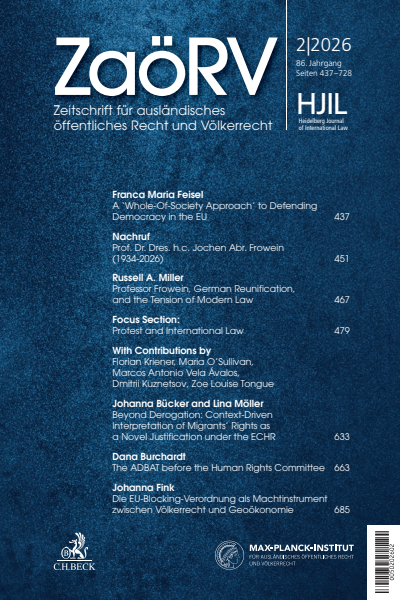
Zeitschrift für ausländisches öffentliches Recht und Völkerrecht / Heidelberg Journal of International Law
Jahrgang 86 (2026), Heft 2
- Autor:innen:
- Verlag
- C.H.Beck, München
- Copyrightjahr
- 2026
- ISSN-Online
- 2942-3562
- ISSN-Print
- 0044-2348
Kapitelinformationen
Jahrgang 86 (2026), Heft 2
Beyond Derogation: Context-Driven Interpretation of Migrants’ Rights as a Novel Justification under the ECHR
- Autor:innen:
- ISSN-Print
- 0044-2348
- ISSN-Online
- 2942-3562
- Kapitelvorschau:
This article examines how European states have responded to the so-called ‘instrumentalisation’ of migration at the Belarus-European Union border by advancing a novel, context-driven justification for restricting migrants’ rights under the European Court of Human Rights. Rather than formally derogating under Art. 15 European Convention on Human Rights (ECHR), Poland, Latvia, and Lithuania contend that exceptional geopolitical circumstances justify balancing national security against human rights obligations. The article analyses whether such reasoning – which, if accepted by the Court, could extend to other alleged crisis situations – can be grounded in existing ECHR doctrines, particularly the Hassan ruling and the living instrument doctrine, and finds that neither supports this approach. Accepting an unwritten, context-based justification would erode the Convention’s limitation and derogation framework, weaken legal safeguards, and enable states to dilute human rights protection under the guise of necessity.
