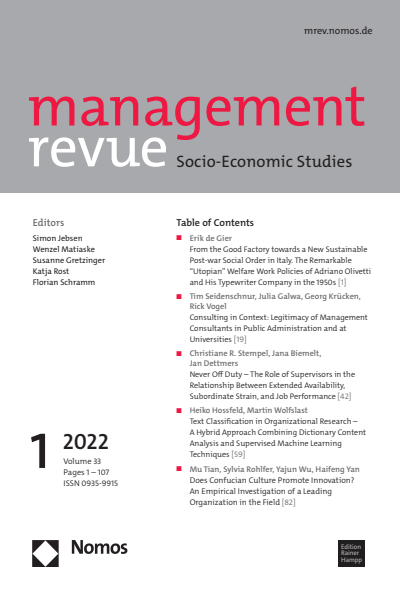
From the Good Factory towards a New Sustainable Post-war Social Order in Italy. The Remarkable “Utopian” Welfare Work Policies of Adriano Olivetti and His Typewriter Company in the 1950s
Inhaltsverzeichnis
Bibliographische Infos
Open Access Vollzugriff
mrev management revue
Jahrgang 33 (2022), Heft 1
- Autor:innen:
- Verlag
- Nomos, Baden-Baden
- Copyrightjahr
- 2022
- ISSN-Online
- 1861-9908
- ISSN-Print
- 0935-9915
Kapitelinformationen
Open Access Vollzugriff
Jahrgang 33 (2022), Heft 1
From the Good Factory towards a New Sustainable Post-war Social Order in Italy. The Remarkable “Utopian” Welfare Work Policies of Adriano Olivetti and His Typewriter Company in the 1950s
- Autor:innen:
- ISSN-Print
- 0935-9915
- ISSN-Online
- 1861-9908
- Kapitelvorschau:
Literaturverzeichnis
Es wurden keine Treffer gefunden. Versuchen Sie einen anderen Begriff.
- Adelman, J. (2013). Worldly Philosopher. The Odyssey of Albert O. Hirschman. Princeton/Oxford: Princeton University Press. Google Scholar öffnen DOI: 10.5771/0935-9915-2022-1-1
- Berta, G. (1978a). Lavoro e capitale nella storia del Piemonte. Studi Storici, 19 (no.1), pp. 205-216. Google Scholar öffnen DOI: 10.5771/0935-9915-2022-1-1
- Berta, G. (19878b). Fra centrismo e centro sinistra: Olivetti e il Movimento di Comunità. Studi Storici, 19 (no. 3), pp. 545-587. Google Scholar öffnen DOI: 10.5771/0935-9915-2022-1-1
- Bigatti G. & Lupo, G. (2013). Fabbrica Di Carta. I libri che contano l’Italia industriale. Roma: Editori Laterza. Google Scholar öffnen DOI: 10.5771/0935-9915-2022-1-1
- Blanken I.J. (2002). Geschiedenis van Koninklijke Philips Electronics N.V. Een Industriële Wereldfederatie. Zaltbommel: Europese Bibliotheek. Google Scholar öffnen DOI: 10.5771/0935-9915-2022-1-1
- Bonifazio, P. & Scrivano, P. (2001). Olivetti Builds. Modern Architecture in Ivrea. Milano: Skira Editore. Google Scholar öffnen DOI: 10.5771/0935-9915-2022-1-1
- Bonura, G. (1972). Inivitto alla lettura di Calvino. Milano: Mursia Editore. Google Scholar öffnen DOI: 10.5771/0935-9915-2022-1-1
- Brandes, S.D. (1976). American Welfare Capitalism 1880-1940. Chicago and London: The University of Chicago Press. Google Scholar öffnen DOI: 10.5771/0935-9915-2022-1-1
- Brilliant, E. L. (1993). Theory and reality in the vision of Adriano Olivetti. Voluntas. International Journal of Voluntary and Nonprofit Organizations, 4 (no. 1), pp. 95-114. Google Scholar öffnen DOI: 10.5771/0935-9915-2022-1-1
- Caddedu, D. (2012). On the Political Project of Adriano Olivetti. New York: Springer Science and Business Media. Google Scholar öffnen DOI: 10.5771/0935-9915-2022-1-1
- Diazzi, A. & SforzaTarabochia, A. (eds.) (2019). The Years of Alienation in Italy. Factory and asylum between the economic miracle and the years of lead. Cham: Palgrave/Macmillan. Google Scholar öffnen DOI: 10.5771/0935-9915-2022-1-1
- Ferrarotti, F. (2015). Un imprenditore di idee. Milano: Edizioni di Comunità. Amazon: Kindle e-book. Google Scholar öffnen DOI: 10.5771/0935-9915-2022-1-1
- Ferrarotti, F. (2016). La concrteta utopia di Adriano Olivetti. Bologna: Edizioni Dehoniane. Amazon: e-book. Google Scholar öffnen DOI: 10.5771/0935-9915-2022-1-1
- Ferrarotti, F. & Gemelli, G. (2015). Un imprenditore di idee. Roma/Ivrea: Comunità Editrice. Google Scholar öffnen DOI: 10.5771/0935-9915-2022-1-1
- Fioretti, D. (2013). Carte di fabbrica. La narrativa industriale in Italia (1943-1989). Pescara: Edizioni Trace. Google Scholar öffnen DOI: 10.5771/0935-9915-2022-1-1
- Gier, E. de (2016). Capitalist Workingman’s Paradises Revisited. Corporate Welfare Work in Great Britain, the USA, Germany and France in the Golden Age of Capitalism 1880-1930. Amsterdam/Chicago: Amsterdam University Press. Google Scholar öffnen DOI: 10.5771/0935-9915-2022-1-1
- Gier, E. de (2018). Modernist industrial novels and industrial sociology. A comparison between Weimar Germany and Post-WWII Italy. Przeglad Socjologiczny, LXVII/67 (no. 3), pp. 179-196. Google Scholar öffnen DOI: 10.5771/0935-9915-2022-1-1
- Ginsborg, P. (1989). Storia d’Italia dal dopoguerra a oggi. Torino: Einaudi. Google Scholar öffnen DOI: 10.5771/0935-9915-2022-1-1
- Godin, J-B. A. (1871/2010). Solutions Sociales. Guise: Les Editions Du Familistère. Google Scholar öffnen DOI: 10.5771/0935-9915-2022-1-1
- Hall, P. A. & Soskice, D. (2003). Varieties of Capitalism. The Institutional Foundations of Comparative Advantage. New York: Oxford University Press. Google Scholar öffnen DOI: 10.5771/0935-9915-2022-1-1
- Howard, E. (1902). Garden Cities of To-Morrow. London: S. Sonnenschein & Co., Amazon Kindle e-book. Google Scholar öffnen DOI: 10.5771/0935-9915-2022-1-1
- Hughes, Th. P. (1989). American Genesis. A Century of Invention and Technological Enthusiasm. Harmondsworth: Penguin Books. Google Scholar öffnen DOI: 10.5771/0935-9915-2022-1-1
- Iversen, T. & Soskice. D. (2019). Democracy and Prosperity. Reinventing Capitalism through a Turbulent Century. Princeton: Princeton University Press. Google Scholar öffnen DOI: 10.5771/0935-9915-2022-1-1
- Lupo, G. (2016). La letteratura al tempo di Adriano Olivetti. Roma/Ivrea: Comunità Editrice. Google Scholar öffnen DOI: 10.5771/0935-9915-2022-1-1
- Maffioletti, Marco (2016). L’Impresa Ideale Tra Fabbrica E Comunità. Una biografia intelletuale di Adriano Olivetti. Roma/ Ivrea: Fondazione Adriano Olivetti (Collana Intangibili Tesi, no. 31). Google Scholar öffnen DOI: 10.5771/0935-9915-2022-1-1
- Maier, C.S. (1970). Between Taylorism and Technocracy: European ideologies and the vision of industrial productivity in the 1920s. Journal of Comparative History, no.1 (April), pp. 27-61. Google Scholar öffnen DOI: 10.5771/0935-9915-2022-1-1
- Marken, J.C. van (1881). La question ouvrière à la fabrique néerlandaise de levure et d’alcool: essai de solution pratique. Paris. Google Scholar öffnen DOI: 10.5771/0935-9915-2022-1-1
- Marken, J.C. (1900). Industrial Social Organisation. Delft: Van Marken Printing Company. Google Scholar öffnen DOI: 10.5771/0935-9915-2022-1-1
- Mast, J. van der (2019). Jacques van Marken. De eerste sociaal ondernemer van Nederland. Amsterdam: Nieuw-Amsterdam. Google Scholar öffnen DOI: 10.5771/0935-9915-2022-1-1
- Mintzberg, H. (1983). Power in and around organizations. Englewood Cliffs, Prentice Hall, Inc. Google Scholar öffnen DOI: 10.5771/0935-9915-2022-1-1
- Ochetto, V. (2015). Adriano Olivetti. La biografia. Roma: Edizioni di Comunità. Amazon: Kindle e-book. Google Scholar öffnen DOI: 10.5771/0935-9915-2022-1-1
- Olivetti, A. (1946). L’ordine politico delle Comunita. Le garanzie di liberta in uno stato socialista. Roma: Edizioni di Comunità. Google Scholar öffnen DOI: 10.5771/0935-9915-2022-1-1
- Olivetti, A. (1952). Societa Stato Comunita. Per una economia e politica comunitaria. Milano: Edizioni di Comunità. Google Scholar öffnen DOI: 10.5771/0935-9915-2022-1-1
- Olivetti, A. (1960). Citta dell’uomo. Milano: Edizioni di Comunità. Google Scholar öffnen DOI: 10.5771/0935-9915-2022-1-1
- Ottieri, O. (1959/2014). Donnaruma all’assalto. Milano: Garzanti. Amazon: Kindle e-book. Google Scholar öffnen DOI: 10.5771/0935-9915-2022-1-1
- Ottieri, O. (1963). La linea gotica. Amazon: Kindle e-book. Google Scholar öffnen DOI: 10.5771/0935-9915-2022-1-1
- Owen, R. (1991). A New View of Society and other Writings. Harmondsworth: Penguin Books. Google Scholar öffnen DOI: 10.5771/0935-9915-2022-1-1
- Peroni, M. (2018). Ivrea. Guida alla città di Adriano Olivetti. Roma/Ivrea: Comunità Editrice. Google Scholar öffnen DOI: 10.5771/0935-9915-2022-1-1
- Rathenau, W. (1914/1964). Von kommenden Dingen. In: Richter, H.W. (ed.), Walter Rathenau Schriften und Reden. Berlin: S. Fischer Verlag, pp. 7-233. Google Scholar öffnen DOI: 10.5771/0935-9915-2022-1-1
- Secrest, M. (2019). The Mysterious Affair at Olivetti. IBM, the CIA and the Cold War Conspiracy to Shut Down Production of the World’s First Desktop Computer. New York: Alfred Knopf. Google Scholar öffnen DOI: 10.5771/0935-9915-2022-1-1
- Segre, B. (2015). Adriano Olivetti: Un umanesimo dei nostri tempi. Reggio Emilia: Imprimatur. Amazon: Kindle e-book. Google Scholar öffnen DOI: 10.5771/0935-9915-2022-1-1
- Volponi, P. (1962/1974). Memoriale. Torino: Einaudi. Google Scholar öffnen DOI: 10.5771/0935-9915-2022-1-1
- Webber, D. (2018). The Rise of the Working-Class Shareholder: Labor’s Last Best Weapon. Cambridge/ London: Harvard University Press. Google Scholar öffnen DOI: 10.5771/0935-9915-2022-1-1
- Weil S. (1951). La condition ouvrierère. Paris: Gallimard. Google Scholar öffnen DOI: 10.5771/0935-9915-2022-1-1
- Alvesson, M., & Empson, L. (2008). The construction of organizational identity: Comparative case studies of consulting firms. Scandinavian Journal of Management, 24(1), 1-16. Google Scholar öffnen DOI: 10.5771/0935-9915-2022-1-19
- Alvesson, M., Kärreman, D., Sturdy, A., & Handley, K. (2009). Unpacking the client(s). Constructions, positions and client–consultant dynamics. Scandinavian Journal of Management, 25(3), 253-263. Google Scholar öffnen DOI: 10.5771/0935-9915-2022-1-19
- Atkinson, R., & Flint, J. (2001). Accessing hidden and hard-to-reach populations: Snowball research strategies. Social Research Update, 33, 1-4. Google Scholar öffnen DOI: 10.5771/0935-9915-2022-1-19
- Baumann, J., & Krücken, G. (2019). Debated legitimacy: Accreditation in German higher education. Higher Education Policy, 32(1), 29-48. Google Scholar öffnen DOI: 10.5771/0935-9915-2022-1-19
- Bryson, J. M., Crosby, B. C., & Bloomberg, L. (2014). Public value governance: Moving beyond traditional public administration and the New Public Management. Public Administration Review, 74(4), 445-456. Google Scholar öffnen DOI: 10.5771/0935-9915-2022-1-19
- Clegg, S. R., Kornberger, M., & Rhodes, C. (2004). Noise, parasites and translation: Theory and practice in management consulting. Management Learning, 35(1), 31-44. Google Scholar öffnen DOI: 10.5771/0935-9915-2022-1-19
- DiMaggio, P. J., & Powell, W. W. (1983). The iron cage revisited: Institutional isomorphism and collective rationality in organizational fields. American Sociological Review, 48(2), 147-160. Google Scholar öffnen DOI: 10.5771/0935-9915-2022-1-19
- Esping-Andersen, G. (1990). Three worlds of welfare capitalism. Princeton, NJ: Princeton University Press. Google Scholar öffnen DOI: 10.5771/0935-9915-2022-1-19
- FEACO (2019). Survey of the European management consultancy 2018/2019. Retrieved 20.03.2020, from www.feaco.org/sites/default/files/sitepagefiles/Feaco.Survey%202018-2019.pdf. Google Scholar öffnen DOI: 10.5771/0935-9915-2022-1-19
- Fincham, R. (2012). The client in the client-consultant relationship. In: M. Kipping & T. Clark (eds.), The Oxford handbook of management consulting (pp. 411-426). Oxford: Oxford University Press. Google Scholar öffnen DOI: 10.5771/0935-9915-2022-1-19
- Frost, J., Hattke, F., & Reihlen, M. (eds.) (2016). Multi-level governance in universities: Strategy, structure, control. Dordrecht: Springer. Google Scholar öffnen DOI: 10.5771/0935-9915-2022-1-19
- Goodrick, E., & Reay, T. (2010). Florence Nightingale endures: Legitimizing a new professional role identity. Journal of Management Studies, 47(1), 55-84. Google Scholar öffnen DOI: 10.5771/0935-9915-2022-1-19
- Hampel, C. E., Lawrence, T., & Tracey, P. (2017). Institutional work: Taking stock and making it matter. In: R. Greenwood, C. Oliver, T. B. Lawrence & R. E. Meyer (eds.), The SAGE handbook of organizational institutionalism (pp. 558-590). London: Sage Publications. Google Scholar öffnen DOI: 10.5771/0935-9915-2022-1-19
- Hodge, G., & Bowman, D. (2006). Privatization and market development: Global movements in public policy ideas. In: G. A. Hodge (ed.), Privatization and market development: Global movements in public policy ideas (pp. 97-126). Cheltenham, UK: Edward Elgar Publishing. Google Scholar öffnen DOI: 10.5771/0935-9915-2022-1-19
- Hüther, O., & Krücken, G. (2018). Higher education in Germany – recent developments in an international perspective (Higher Education Dynamics, 49). Cham: Springer International Publishing AG. Google Scholar öffnen DOI: 10.5771/0935-9915-2022-1-19
- Hwang, H., & Colyvas, J.A. (2011). Problematizing actors and institutions in institutional work. Journal of Management Inquiry, 20(1), 62-66. Google Scholar öffnen DOI: 10.5771/0935-9915-2022-1-19
- Jepperson, R. L., & Meyer, J. (2021). Institutional theory: The cultural construction of organizations, states, and identities. Cambridge: Cambridge University Press. Google Scholar öffnen DOI: 10.5771/0935-9915-2022-1-19
- Karantinou, K. M., & Hogg, M. K. (2009). An empirical investigation of relationship development in profes-sional business services. Journal of Services Marketing, 23(4), 249-260. Google Scholar öffnen DOI: 10.5771/0935-9915-2022-1-19
- Krücken, G., & Serrano-Velarde, K. (2016). Der Berater als Fremder. Eine soziologische Studie zur Managementberatung in Universitäten. Kölner Zeitschrift für Soziologie und Sozialpsychologie, 68, 29-51. Google Scholar öffnen DOI: 10.5771/0935-9915-2022-1-19
- Lawrence, T. B., & Suddaby. R. (2006). Institutions and institutional work. In: S. R. Clegg, C. Hardy, T. B. Lawrence & W. R. Nord (eds.), Handbook of organization studies (2nd ed., pp. 215-254). London, UK: SAGE. Google Scholar öffnen DOI: 10.5771/0935-9915-2022-1-19
- Lawrence, T. B., Suddaby, R., & Leca, B. (2011). Institutional work: Refocusing institutional studies of organization. Journal of Management Inquiry, 20(1), 52-58. Google Scholar öffnen DOI: 10.5771/0935-9915-2022-1-19
- Maguire S., Hardy, C., & Lawrence T. B. (2004). Institutional entrepreneurship in emerging fields: HIV/AIDS treatment advocacy in Canada. The Academy of Management Journal, 47(5), 657-679. Google Scholar öffnen DOI: 10.5771/0935-9915-2022-1-19
- Mayring, P. (2000). Qualitative content analysis. Forum: Qualitative Social Research, 1(2), Art. 20. http://nbn-resolving.de/urn:nbn:de:0114-fqs0002204. Google Scholar öffnen DOI: 10.5771/0935-9915-2022-1-19
- Meyer, J. W., & Rowan, B. (1977). Institutionalized organizations: Formal structure as myth and ceremony. American Journal of Sociology, 83(2), 340-363. Google Scholar öffnen DOI: 10.5771/0935-9915-2022-1-19
- Meyer, J. W., & Jepperson, R. L. (2000). The ‘actors’ of modern society: The cultural construction of social agency. Sociological Theory, 18(1), 100-120. Google Scholar öffnen DOI: 10.5771/0935-9915-2022-1-19
- Meyer, R. E., & Hammerschmid, G. (2006). Changing institutional logics and executive identities: A managerial challenge to public administration in Austria. The American Behavioral Scientist, 7(49), 1000-1014. Google Scholar öffnen DOI: 10.5771/0935-9915-2022-1-19
- Meyer, R. E., Egger-Peitler, I., Höllerer, M., & Hammerschmid, G. (2014). Of bureaucrats and passionate public managers: Institutional logics, executive identities, and public service motivation. Public Administration, 92(4), 861-885. Google Scholar öffnen DOI: 10.5771/0935-9915-2022-1-19
- Meyer, R. E., & Höllerer, M. A. (2016). Laying a smoke screen: Ambiguity and neutralization as strategic responses to intra-institutional complexity. Strategic Organization, 14(4), 373-406. Google Scholar öffnen DOI: 10.5771/0935-9915-2022-1-19
- Nikolova, N., Reihlen, M., & Schlapfner, J.-F. (2009). Client–consultant interaction: Capturing social practices of professional service production. Scandinavian Journal of Management, 25(3), 289-298. Google Scholar öffnen DOI: 10.5771/0935-9915-2022-1-19
- Pemer, F., & Werr, A. (2013). The uncertain management consulting services client. International Studies of Management & Organization, 43(3), 22-40. Google Scholar öffnen DOI: 10.5771/0935-9915-2022-1-19
- Pollitt, C., & Bouckaert, G. (2017). Public management reform: A comparative analysis – into the age of austerity (4th ed.). Oxford, NY: Oxford University Press. Google Scholar öffnen DOI: 10.5771/0935-9915-2022-1-19
- Reay, T., & Hinings, C. R. (2009). Managing the rivalry of competing institutional logics. Organization Studies, 30(6), 629-652. Google Scholar öffnen DOI: 10.5771/0935-9915-2022-1-19
- Saint-Martin, D. (2004): Building the new managerialists state: Consultants and the politics of public sector reform in comparative perspective. Oxford: Oxford University Press. Google Scholar öffnen DOI: 10.5771/0935-9915-2022-1-19
- Seawright, J., & Gerring, J. (2008). Case selection techniques in case study research: A menu of qualitative and quantitative options. Political Research Quarterly, 61(2), 294-308. DOI: 10.1177/1065912907313077. Google Scholar öffnen DOI: 10.5771/0935-9915-2022-1-19
- Seidenschnur, T., & Krücken, G. (2019). Constructing the consultant as a legitimate actor: The role of active clients in universities. In: H. Hwang, J. A. Colyvas & G. S. Drori (eds.), Agents, Actors, Actorhood: Institutional Perspectives on the Nature of Agency, Action, and Authority (Research in the Sociology of Organizations, 58, pp. 111-133). Bingley: Emerald Publishing Limited. Google Scholar öffnen DOI: 10.5771/0935-9915-2022-1-19
- Serrano-Velarde, K. (2010). A fish out of water? Management consultants in academia. Minerva, 48(2), 125-144. Google Scholar öffnen DOI: 10.5771/0935-9915-2022-1-19
- Slack, T. (2014). The commercial impact of sport, the role of sport management. European Sport Management Quarterly, 14(5), 454-463. Google Scholar öffnen DOI: 10.5771/0935-9915-2022-1-19
- Sturdy, A. (1997). The consultancy process – An insecure business? Journal of Management Studies, 34(3), 389-413. Google Scholar öffnen DOI: 10.5771/0935-9915-2022-1-19
- Sturdy, A., Werr, A., & Buono, A. F. (2009). The client in management consultancy research: Mapping the territory. Scandinavian Journal of Management, 25(3), 247-252. Google Scholar öffnen DOI: 10.5771/0935-9915-2022-1-19
- Sturdy, A., & Wright, C. (2011). The active client: The boundary-spanning roles of internal consultants as gatekeepers, brokers and partners of their external counterparts. Management Learning, 42(5), 485-503. Google Scholar öffnen DOI: 10.5771/0935-9915-2022-1-19
- Suchman, M. C. (1995). Managing legitimacy: Strategic and institutional approaches. The Academy of Management Review, 20(3), 571-610. Google Scholar öffnen DOI: 10.5771/0935-9915-2022-1-19
- Suddaby, R., Bitektine, A., & Haack, P. (2017). Legitimacy. Academy of Management Annals, 11(1), 451-478. Google Scholar öffnen DOI: 10.5771/0935-9915-2022-1-19
- Thurlow, A., & Mills, J. H. (2015). Telling tales out of school. Sensemaking and narratives of legitimacy in an organizational change process. Scandinavian Journal of Management, 31(2), 246-254. Google Scholar öffnen DOI: 10.5771/0935-9915-2022-1-19
- Tracey, P., Dalpiaz, E., & Phillips, N. (2018). Fish out of water: Translation, legitimation, and new venture creation. Academy of Management Journal, 61(5), 1627-1666. Google Scholar öffnen DOI: 10.5771/0935-9915-2022-1-19
- Trank, C. Q., & Washington, M. (2009). Maintaining an institution in a contested organizational field: The work of AACSB and its constituents. In: T. B. Lawrence, R. Suddaby & B. Leca (eds.), Institutional work: Actors and agency in institutional studies of organizations (pp. 236-261). Cambridge, UK: University of Cambridge Press. Google Scholar öffnen DOI: 10.5771/0935-9915-2022-1-19
- Vogel, R. (2012). Framing and counter‐framing New Public Management: The case of Germany. Public Administration, 90(2), 370-392. Google Scholar öffnen DOI: 10.5771/0935-9915-2022-1-19
- Whetten, D. A. (2009). Organizational comparative analysis: Investigating similarities and differences among organizations. In: B. G. King, T. Felin & D. A. Whetten (eds.), Studying differences between organizations: Comparative approaches to organizational research (Research in the Sociology of Organizations, 26, pp. 63-87). Bingley: Emerald Group Publishing. Google Scholar öffnen DOI: 10.5771/0935-9915-2022-1-19
- Arlinghaus, A., & Nachreiner, F. (2013). When work calls – Associations between being contacted outside of regular working hours for work-related matters and health. Chronobiology International, 30(9), 1197–1202. https://doi.org/10.3109/07420528.2013.800089 Google Scholar öffnen DOI: 10.5771/0935-9915-2022-1-42
- Ashforth, B. E., Kreiner, G. E., & Fugate, M. (2000). All in a day’s work: Boundaries and micro role transitions. Academy of Management Review, 25(3), 472–491. https://doi.org/10.5465/AMR.2000.3363315 Google Scholar öffnen DOI: 10.5771/0935-9915-2022-1-42
- Bakker, A. B., & Demerouti, E. (2007). The job demands-resources model: State of the art. Journal of Managerial Psychology, 22(3), 309–328. https://doi.org/10.1108/02683940710733115 Google Scholar öffnen DOI: 10.5771/0935-9915-2022-1-42
- Bakker, A. B., & Demerouti, E. (2017). Job demands-resources theory: Taking stock and looking forward. Journal of Occupational Health Psychology, 22, 273–285. https://doi.org/10.1037/ocp0000056 Google Scholar öffnen DOI: 10.5771/0935-9915-2022-1-42
- Bamberg, E., Dettmers, J., Funck, H., Krähe, B., & Vahle-Hinz, T. (2012). Effects of on-call work on well-being: Results of a aaily survey. Applied Psychology: Health and Well-Being, 4(3), 299–320. https://doi.org/10.1111/j.1758-0854.2012.01075.x Google Scholar öffnen DOI: 10.5771/0935-9915-2022-1-42
- Bergman, A., & Gardiner, J. (2007). Employee availability for work and family: three Swedish case studies. Employee Relations, 29(4), 400–414. https://doi.org/10.1108/01425450710759226 Google Scholar öffnen DOI: 10.5771/0935-9915-2022-1-42
- Berkowsky, R. W. (2013). When you just cannot get away. Information, Communication & Society, 16(4), 519–541. https://doi.org/10.1080/1369118X.2013.772650 Google Scholar öffnen DOI: 10.5771/0935-9915-2022-1-42
- Binnewies, C., Sonnentag, S., & Mojza, E.J. (2009). Daily performance at work : feeling recovered in the morning as a predictor of day-level job performance. Journal of Organizational Behavior. 30(1), pp. 67–93. https://doi.org/10.1002/job.541 Google Scholar öffnen DOI: 10.5771/0935-9915-2022-1-42
- Carlson, D. S., Kacmar, K. M., & Williams, L. J. (2000). Construction and initial validation of a multidimensional measure of work-family conflict. Journal of Vocational Behavior, 56(2), 249–276. https://doi.org/10.1006/jvbe.1999.1713 Google Scholar öffnen DOI: 10.5771/0935-9915-2022-1-42
- Clark, S. C. (2000). Work/family border theory: A new theory of work/family balance. Human Relations, 53(6), 747–770. https://doi.org/10.1177/0018726700536001 Google Scholar öffnen DOI: 10.5771/0935-9915-2022-1-42
- Day, A., Paquet, S., Scott, N., & Hambley, L. (2012). Perceived information and communication technology (ICT) demands on employee outcomes: The moderating effect of organizational ICT support. Journal of Occupational Health Psychology, 17(4), 473–491. http://dx.doi.org/10.1037/a0029837 Google Scholar öffnen DOI: 10.5771/0935-9915-2022-1-42
- Derks, D., van Duin, D., Tims, M., & Bakker, A. B. (2015). Smartphone use and work-home interference: The moderating role of social norms and employee work engagement. Journal of Occupational and Organizational Psychology, 88(1), 155–177. https://doi.org/10.1111/joop.12083 Google Scholar öffnen DOI: 10.5771/0935-9915-2022-1-42
- Derks, D., Mierlo, H. van, & Schmitz, E. (2014). A diary study on work-related smartphone use, psychological detachment, and exhaustion: Examining the role of the perceived segmentation norm. Journal of Occupational Health Psychology, 19(1), 74–84. https://doi.org/10.1037/a0035076 Google Scholar öffnen DOI: 10.5771/0935-9915-2022-1-42
- Dettmers, J. (2017). How extended work availability affects well-being: The mediating roles of psychological detachment and work-family-conflict. Work & Stress, 31(1), 24–41. https://doi.org/10.1080/02678373.2017.1298164 Google Scholar öffnen DOI: 10.5771/0935-9915-2022-1-42
- Dettmers, J., Bamberg, E., & Seffzek, K. (2016a). Characteristics of extended availability for work: The role of demands and resources. International Journal of Stress Management. https://doi.org/dx.doi.org/10.1037/str0000014 Google Scholar öffnen DOI: 10.5771/0935-9915-2022-1-42
- Dettmers, J., & Biemelt, J. (2018). Always available – the role of perceived advantages and legitimacy. Journal of Managerial Psychology, 33, 497–510. https://doi.org/10.1108/JMP-02-2018-0095 Google Scholar öffnen DOI: 10.5771/0935-9915-2022-1-42
- Dettmers, J., Vahle-Hinz, T., Bamberg, E., Friedrich, N., & Keller, M. (2016b). Extended work availability and its relation with start-of-day mood and cortisol. Journal of Occupational Health Psychology, 21(1), 105–118. https://doi.org/10.1037/a0039602 Google Scholar öffnen DOI: 10.5771/0935-9915-2022-1-42
- Dewett, T., & Jones, G.R. (2001). The role of information technology in the organization: A review, model, and assessment. Journal of Management, 27, 313–346. https://doi.org/10.1177/014920630102700306 Google Scholar öffnen DOI: 10.5771/0935-9915-2022-1-42
- Diaz, I., Chiaburu, D., Zimmerman, R., & Boswell, W. (2012). Communication technology: Pros and cons of constant connection to work. Journal of Vocational Behavior, 80(2), 500–508. https://doi.org/10.1016/j.jvb.2011.08.007 Google Scholar öffnen DOI: 10.5771/0935-9915-2022-1-42
- Enzmann, D., & Kleiber, D. (1989). Helfer-Leiden. Asanger. Google Scholar öffnen DOI: 10.5771/0935-9915-2022-1-42
- Fahlén, S. (2014) Does gender matter? Policies, norms and the gender gap in work-to-home and home-to-work conflict across Europe. Community, Work & Family, 371–391, https://doi.org/10.1080/13668803.2014.899486 Google Scholar öffnen DOI: 10.5771/0935-9915-2022-1-42
- Glavin, P., & Schieman, S. (2012). Work-family role blurring and work-family conflict the moderating influence of job resources and job demands. Work and Occupations, 39(1), 71–98. https://doi.org/10.1177/0730888411406295 Google Scholar öffnen DOI: 10.5771/0935-9915-2022-1-42
- Golden, A. G., & Geisler, C. (2007). Work-life boundary management and the personal digital assistant. Human Relations, 60(3), 519–551. https://doi.org/10.1177/0018726707076698 Google Scholar öffnen DOI: 10.5771/0935-9915-2022-1-42
- Hammer, L. B., Kossek, E. E., Yragui, N. L., Bodner, T. E., & Hanson, G. C. (2009). Development and validation of a multidimensional measure of family-supportive supervisor behaviors (FSSB). Journal of Management, 35(4), 837–856. https://doi.org/10.1177/0149206308328510 Google Scholar öffnen DOI: 10.5771/0935-9915-2022-1-42
- Hecht, T. D., & Allen, N. J. (2009). A longitudinal examination of the work–nonwork boundary strength construct. Journal of Organizational Behavior, 30(7), 839–862. https://doi.org/10.1002/job Google Scholar öffnen DOI: 10.5771/0935-9915-2022-1-42
- Heißler, C.C. (2019). Working after hours, sharing availability expectations, and interrupting yourself: Extending perspectives on ICT-related concepts in research (doctorial dissertation). https://doi.org/10.17170/kobra-20190708588 Google Scholar öffnen DOI: 10.5771/0935-9915-2022-1-42
- Jex, S. M. (1998). Stress and job performance: Theory, research, and implications for managerial practice. Sage Publications Ltd. Google Scholar öffnen DOI: 10.5771/0935-9915-2022-1-42
- Koch, A. R., & Binnewies, C. (2015). Setting a good example: Supervisors as work-life-friendly role models within the context of boundary management. Journal of Occupational Health Psychology, 20(1), 82–92. https://doi.org/10.1037/a0037890 Google Scholar öffnen DOI: 10.5771/0935-9915-2022-1-42
- Kossek, E. E., Pichler, S., Bodner, T., & Hammer, L. B. (2011). Workplace social support and work-family conflict: A meta-analysis clarifying the influence of general and work-family-specific supervisor and organizational support. Personnel Psychology, 64(2), 289–313. https://doi.org/10.1111/j.1744-6570.2011.01211.x Google Scholar öffnen DOI: 10.5771/0935-9915-2022-1-42
- Kossek, E. E., Ruderman, M. N., Braddy, P. W., & Hannum, K. M. (2012). Work-nonwork boundary management profiles: A person-centered approach. Journal of Vocational Behavior, 81(1), 112–128. https://doi.org/10.1016/j.jvb.2012.04.003 Google Scholar öffnen DOI: 10.5771/0935-9915-2022-1-42
- Kranabetter, C., & Niessen, C. (2017). Managers as role models for health: Moderators of the relationship of transformational leadership with employee exhaustion and cynicism. Journal of Occupational Health Psychology, 22 (4). 492–502. http://dx.doi.org/10.1037/ocp0000044 Google Scholar öffnen DOI: 10.5771/0935-9915-2022-1-42
- Kuoppala, J., Lamminpää, A., Liira, J., & Vainio, H. (2008). Leadership, job well-being, and health effects—A systematic review and a meta-analysis. Journal of Occupational and Environmental Medicine, 50, 904–915. https://doi.org/10.1097/JOM.0b013e31817e918d Google Scholar öffnen DOI: 10.5771/0935-9915-2022-1-42
- Lapierre, L. M., & Allen, T. D. (2006). Work-supportive family, family-supportive supervision, use of organizational benefits, and problem-focused coping: implications for work-family conflict and employee well-being. Journal of Occupational Health Psychology, 11(2), 169–181. http://dx.doi.org/10.1037/1076-8998.11.2.169 Google Scholar öffnen DOI: 10.5771/0935-9915-2022-1-42
- Leung, L. (2011). Effects of ICT connectedness, permeability, flexibility, and negative spillovers on burnout and job and family satisfaction. Human Technology: An Interdisciplinary Journal on Humans in ICT Environments, 7(3), 250–267. https://doi.org/10.17011/ht/urn.2011112211714 Google Scholar öffnen DOI: 10.5771/0935-9915-2022-1-42
- Malhotra, N. K., Schaller, T. K., & Patil, A. (2017). Common Method Variance in Advertising Research: When to Be Concerned and How to Control for It. Journal of Advertising, 46(1), 193–212. https://doi.org/10.1080/00913367.2016.1252287 Google Scholar öffnen DOI: 10.5771/0935-9915-2022-1-42
- Maslach, C., & Jackson, S. E. (1986). Maslach Burnout Inventory. Manual (2nd ed.). Consulting Psychologists Press. Google Scholar öffnen DOI: 10.5771/0935-9915-2022-1-42
- Meijman, T. F., & Mulder, G. (1998). Psychological aspects of workload. In P. J. D. Drenth, H. Thierry, C. J. de Wolff, P. J. D. Drenth (Ed), H. Thierry (Ed), & C. J. de Wolff (Ed) (Eds.), Handbook of work and organizational: Work psychology. (pp. 5–33). Psychology Press/Erlbaum (UK) Taylor & Francis. Google Scholar öffnen DOI: 10.5771/0935-9915-2022-1-42
- Middleton, C. A. (2007). Illusions of balance and control in an always-on environment: A case study of BlackBerry users. Continuum, 21(2), 165–178. https://doi.org/10.1080/10304310701268695 Google Scholar öffnen DOI: 10.5771/0935-9915-2022-1-42
- Nohe, C., Michel, A., & Sonntag, K. (2013). Family–work conflict and job performance: A diary study of boundary conditions and mechanisms. Journal of Organizational Behavior, 35(3), 339–357. http://dx.doi.org/10.1002/job.1878 Google Scholar öffnen DOI: 10.5771/0935-9915-2022-1-42
- Nielsen, K., Randall, R., Yarker, J., & Brenner, S.-O. (2008). The effects of transformational leadership on followers’ perceived work characteristics and psychological well-being: A longitudinal study. Work & Stress, 22, 16–32. https://doi.org/10.1080/02678370801979430 Google Scholar öffnen DOI: 10.5771/0935-9915-2022-1-42
- Pangert, B., & Schüpbach, H. (2013). The effects of work-related extended availability on life-domain-balance and health. Bundesanstalt für Arbeitsschutz und Arbeitsmedizin. Google Scholar öffnen DOI: 10.5771/0935-9915-2022-1-42
- Piszczek, M. M. (2017). Boundary control and controlled boundaries: Organizational expectations for technology use at the work-family interface. Journal of Organizational Behavior, 38, 592–611. http://doi.wiley.com/10.1002/job.2153. Google Scholar öffnen DOI: 10.5771/0935-9915-2022-1-42
- Rau, R., & Göllner, M. (2019). Erreichbarkeit gestalten, oder doch besser die Arbeit? Zeitschrift für Arbeits- und Organisationspsychologie, 63 (1), 1–14. https://doi.org/10.1026/0932-4089/a000284 Google Scholar öffnen DOI: 10.5771/0935-9915-2022-1-42
- Siemsen, E., Roth, A., & Oliveira, P. (2010). Common method bias in regression models with linear, quadratic, and interaction effects. Organizational Research Methods, 13(3), 456–476. https://doi.org/10.1177/1094428109351241 Google Scholar öffnen DOI: 10.5771/0935-9915-2022-1-42
- Sonnentag, S., Kuttler, I., & Fritz, C. (2010). Job stressors, emotional exhaustion, and need for recovery: A multi-source study on the benefits of psychological detachment. Journal of Vocational Behavior, 76(3), 355–365. https://doi.org/10.1016/j.jvb.2009.06.005 Google Scholar öffnen DOI: 10.5771/0935-9915-2022-1-42
- Stein, M., Vincent-Höper, S., Deci, N., Gregersen, S., & Nienhaus, A. (2019). Compensatory coping through the extension of working hours: The buffering role of leader–member exchange. Zeitschrift für Arbeits- und Organisationspsychologie, 63(3), 115–128. https://doi.org/10.1026/0932-4089/a000285 Google Scholar öffnen DOI: 10.5771/0935-9915-2022-1-42
- Taris, T. W. (2006). Is there a relationship between burnout and objective performance? A critical review of 16 studies. Work & Stress, 20, 316–334. http://dx.doi.org/10.1080/02678370601065893 Google Scholar öffnen DOI: 10.5771/0935-9915-2022-1-42
- Trzcinski, E., & Holst, E. (2011). Gender differences in subjective well-being in and out of management positions. Social Indicators Research, 107, 449–463. https://doi.org/10.1007/s11205-011-9857-y Google Scholar öffnen DOI: 10.5771/0935-9915-2022-1-42
- Tuckey, M.R., Bakker, A.B. & Dollard, M.F. (2012). Empowering leaders optimize working conditions for engagement: A multilevel study. Journal of Occupational Health Psychology, 17, 15–27. https://doi.org/10.1037/a0025942 Google Scholar öffnen DOI: 10.5771/0935-9915-2022-1-42
- Vincent-Höper, S., & Stein, M.(2019). The role of leaders in designing employees’ work characteristics: Validation of the Health- and-Development-Promoting Leadership Behavior Questionnaire. Frontiers in Psychology, 10:1049. https://doi.org/10.3389/fpsyg.2019.01049 Google Scholar öffnen DOI: 10.5771/0935-9915-2022-1-42
- Voydanoff, P. (2005). Consequences of boundary-spanning demands and resources for work-to-family conflict and perceived stress. Journal of Occupational Health Psychology, 10(4), 491–503. https://doi.org/10.1037/1076-8998.10.4.491 Google Scholar öffnen DOI: 10.5771/0935-9915-2022-1-42
- Williams, L. J., & Anderson, S. E. (1991). Job satisfaction and organizational commitment as predictors of organizational citizenship and in-role behaviors. Journal of Management, 17(3), 601–617. https://doi.org/10.1177/014920639101700305 Google Scholar öffnen DOI: 10.5771/0935-9915-2022-1-42
- Wolff, H. G., & Höge, T. (2011). Konflikte zwischen Arbeit und Familie. Zeitschrift für Arbeits-und Organisationspsychologie A&O, 55, p. 143–152. https://doi.org/10.1026/0932-4089/a000053. Google Scholar öffnen DOI: 10.5771/0935-9915-2022-1-42
- Agarwal, S., & Sureka, A. (2016). But i did not mean it!—intent classification of racist posts on tumblr. Paper presented at the 2016 European Intelligence and Security Informatics Conference (EISIC). Google Scholar öffnen DOI: 10.5771/0935-9915-2022-1-59
- Aggarwal, C. C. (2018). Machine learning for text. New York: Springer. Google Scholar öffnen DOI: 10.5771/0935-9915-2022-1-59
- Ahmad, K., Han, J., Hutson, E., Kearney, C., & Liu, S. (2016). Media-expressed negative tone and firm-level stock returns. Journal of Corporate Finance, 37, 152–172. Google Scholar öffnen DOI: 10.5771/0935-9915-2022-1-59
- Andal-Ancion, A., Cartwright, P. A., & Yip, G. S. (2003). The digital transformation of traditional business. MIT Sloan Management Review, 44(4), 34–41. Google Scholar öffnen DOI: 10.5771/0935-9915-2022-1-59
- Baccianella, S., Esuli, A., & Sebastiani, F. (2010). Sentiwordnet 3.0: an enhanced lexical resource for sentiment analysis and opinion mining. Paper presented at the Lrec. Google Scholar öffnen DOI: 10.5771/0935-9915-2022-1-59
- Bae, Y., & Lee, H. (2012). Sentiment analysis of twitter audiences: Measuring the positive or negative influence of popular twitterers. Journal of the American society for information science and technology, 63(12), 2521–2535. Google Scholar öffnen DOI: 10.5771/0935-9915-2022-1-59
- Bannier, C., Pauls, T., & Walter, A. (2019). Content analysis of business communication: introducing a German dictionary. Journal of Business Economics, 89(1), 79–123. Google Scholar öffnen DOI: 10.5771/0935-9915-2022-1-59
- Bansal, P., & Gao, J. (2006). Building the future by looking to the past: Examining research published on organizations and environment. Organization & environment, 19(4), 458–478. Google Scholar öffnen DOI: 10.5771/0935-9915-2022-1-59
- Bednar, M. K. (2012). Watchdog or lapdog? A behavioral view of the media as a corporate governance mechanism. Academy of Management Journal, 55(1), 131–150. Google Scholar öffnen DOI: 10.5771/0935-9915-2022-1-59
- Bernard, H. R., Wutich, A., & Ryan, G. W. (2016). Analyzing qualitative data: Systematic approaches: SAGE publications. Google Scholar öffnen DOI: 10.5771/0935-9915-2022-1-59
- Bonfiglioli, R., & Nanni, F. (2015). From close to distant and back: how to read with the help of machines. Paper presented at the 3rd International Conference on the History and Philosophy of Computing, Pisa, Italy. Google Scholar öffnen DOI: 10.5771/0935-9915-2022-1-59
- Caserio, C., Panaro, D., & Trucco, S. (2019). Management discussion and analysis: a tone analysis on US financial listed companies. Management Decision, 58(3), 510–525. Google Scholar öffnen DOI: 10.5771/0935-9915-2022-1-59
- Castelló, I., Etter, M., & Årup Nielsen, F. (2016). Strategies of legitimacy through social media: The networked strategy. Journal of management studies, 53(3), 402–432. Google Scholar öffnen DOI: 10.5771/0935-9915-2022-1-59
- Chan, S. W., & Chong, M. W. (2017). Sentiment analysis in financial texts. Decision Support Systems, 94(2), 53–64. Google Scholar öffnen DOI: 10.5771/0935-9915-2022-1-59
- Cogburn, D., & Hine, M. (2017). Introduction to Text Mining in Big Data Analytics Minitrack. Paper presented at the Proceedings of the 50th Hawaii International Conference on System Sciences, HICSS 2017. Google Scholar öffnen DOI: 10.5771/0935-9915-2022-1-59
- Durand, R., & Vergne, J. P. (2015). Asset divestment as a response to media attacks in stigmatized industries. Strategic Management Journal, 36(8), 1205–1223. Google Scholar öffnen DOI: 10.5771/0935-9915-2022-1-59
- Duriau, V. J., Reger, R. K., & Pfarrer, M. D. (2007). A content analysis of the content analysis literature in organization studies: Research themes, data sources, and methodological refinements. Organizational research methods, 10(1), 5–34. Google Scholar öffnen DOI: 10.5771/0935-9915-2022-1-59
- Evans, M., McIntosh, W., Lin, J., & Cates, C. (2007). Recounting the courts? Applying automated content analysis to enhance empirical legal research. Journal of Empirical Legal Studies, 4(4), 1007–1039. Google Scholar öffnen DOI: 10.5771/0935-9915-2022-1-59
- Feldman, R., & Sanger, J. (2007). The text mining handbook: advanced approaches in analyzing unstructured data: Cambridge university press. Google Scholar öffnen DOI: 10.5771/0935-9915-2022-1-59
- Garrad, M. W. (2003). Computer Aided Text Analysis in Personnel Selection. PhD-thesis, School of Applied Psychology, Griffith University, Google Scholar öffnen DOI: 10.5771/0935-9915-2022-1-59
- George, G., Osinga, E. C., Lavie, D., & Scott, B. A. (2016). Big data and data science methods for management research. Academy of Management Journal, 59(5), 1493–1507. Google Scholar öffnen DOI: 10.5771/0935-9915-2022-1-59
- Ghiassi, M., Skinner, J., & Zimbra, D. (2013). Twitter brand sentiment analysis: A hybrid system using n-gram analysis and dynamic artificial neural network. Expert Systems with applications, 40(16), 6266–6282. Google Scholar öffnen DOI: 10.5771/0935-9915-2022-1-59
- Guo, L., Vargo, C. J., Pan, Z., Ding, W., & Ishwar, P. (2016). Big social data analytics in journalism and mass communication: Comparing dictionary-based text analysis and unsupervised topic modeling. Journalism & Mass Communication Quarterly, 93(2), 332–359. Google Scholar öffnen DOI: 10.5771/0935-9915-2022-1-59
- HaCohen-Kerner, Y., Miller, D., & Yigal, Y. (2020). The influence of preprocessing on text classification using a bag-of-words representation. PloS one, 15(5), 1–22. Google Scholar öffnen DOI: 10.5771/0935-9915-2022-1-59
- Harish, B. S., Guru, D. S., & Manjunath, S. (2010). Representation and classification of text documents: A brief review. IJCA, Special Issue on RTIPPR (2), 110–119. Google Scholar öffnen DOI: 10.5771/0935-9915-2022-1-59
- Hausladen, C. I., Schubert, M. H., & Ash, E. (2020). Text classification of ideological direction in judicial opinions. International Review of Law and Economics, 62, 1–19. Google Scholar öffnen DOI: 10.5771/0935-9915-2022-1-59
- Heitmann, M., Siebert, C., Hartmann, J., & Schamp, C. (2020). More than a feeling: Benchmarks for sentiment analysis accuracy. Ssrn, Working Paper. Retrieved 29.3.2021, from https://dx.doi.org/10.2139/ssrn.3489963. Google Scholar öffnen DOI: 10.5771/0935-9915-2022-1-59
- Holsti, O. R. (1969). Content analysis for the social sciences and humanities. Reading, MA: Addison-Wesley Publishing Company. Google Scholar öffnen DOI: 10.5771/0935-9915-2022-1-59
- Holton, C. (2009). Identifying disgruntled employee systems fraud risk through text mining: A simple solution for a multi-billion dollar problem. Decision Support Systems, 46(4), 853–864. Google Scholar öffnen DOI: 10.5771/0935-9915-2022-1-59
- Hossfeld, H. (2013). Corporate dieting. Persuasive use of metaphors in downsizing. management revue, 24(1), 53–70. Google Scholar öffnen DOI: 10.5771/0935-9915-2022-1-59
- Hossfeld, H. (2018). Legitimation and institutionalization of managerial practices. The role of organizational rhetoric. Scandinavian Journal of Management, 34(1), 9–21. Google Scholar öffnen DOI: 10.5771/0935-9915-2022-1-59
- Huang, A. H., Zang, A. Y., & Zheng, R. (2014). Evidence on the information content of text in analyst reports. The Accounting Review, 89(6), 2151–2180. Google Scholar öffnen DOI: 10.5771/0935-9915-2022-1-59
- Humphreys, A., & Wang, R. J.-H. (2018). Automated text analysis for consumer research. Journal of Consumer Research, 44(6), 1274–1306. Google Scholar öffnen DOI: 10.5771/0935-9915-2022-1-59
- Ignatow, G., & Mihalcea, R. (2016). Text mining: A guidebook for the social sciences. Thousan Oaks, California: Sage Publications. Google Scholar öffnen DOI: 10.5771/0935-9915-2022-1-59
- Ikonomakis, M., Kotsiantis, S., & Tampakas, V. (2005). Text classification using machine learning techniques. WSEAS transactions on computers, 4(8), 966–974. Google Scholar öffnen DOI: 10.5771/0935-9915-2022-1-59
- Kabanoff, B. (1997). Introduction: computers can read as well as count: computer-aided text analysis in organizational research. Journal of Organizational behavior, 18, 507–511. Google Scholar öffnen DOI: 10.5771/0935-9915-2022-1-59
- Kobayashi, V. B., Mol, S. T., Berkers, H. A., Kismihók, G., & Den Hartog, D. N. (2018a). Text classification for organizational researchers: A tutorial. Organizational research methods, 21(3), 766–799. Google Scholar öffnen DOI: 10.5771/0935-9915-2022-1-59
- Kobayashi, V. B., Mol, S. T., Berkers, H. A., Kismihók, G., & Den Hartog, D. N. (2018b). Text mining in organizational research. Organizational research methods, 21(3), 733–765. Google Scholar öffnen DOI: 10.5771/0935-9915-2022-1-59
- Kothari, S. P., Li, X., & Short, J. E. (2009). The effect of disclosures by management, analysts, and business press on cost of capital, return volatility, and analyst forecasts: A study using content analysis. The Accounting Review, 84(5), 1639–1670. Google Scholar öffnen DOI: 10.5771/0935-9915-2022-1-59
- Laver, M., Benoit, K., & Garry, J. (2003). Extracting policy positions from political texts using words as data. American political science review, 97(2), 311–331. Google Scholar öffnen DOI: 10.5771/0935-9915-2022-1-59
- Laver, M., & Garry, J. (2000). Estimating policy positions from political texts. American Journal of Political Science, 619–634. Google Scholar öffnen DOI: 10.5771/0935-9915-2022-1-59
- Lewis, S. C., Zamith, R., & Hermida, A. (2013). Content analysis in an era of big data: A hybrid approach to computational and manual methods. Journal of broadcasting & electronic media, 57(1), 34–52. Google Scholar öffnen DOI: 10.5771/0935-9915-2022-1-59
- Loughran, T., & McDonald, B. (2015). The use of word lists in textual analysis. Journal of Behavioral Finance, 16(1), 1–11. Google Scholar öffnen DOI: 10.5771/0935-9915-2022-1-59
- Loughran, T., & McDonald, B. (2016). Textual analysis in accounting and finance: A survey. Journal of Accounting Research, 54(4), 1187–1230. Google Scholar öffnen DOI: 10.5771/0935-9915-2022-1-59
- Martin, A. D., Quinn, K. M., Ruger, T. W., & Kim, P. T. (2004). Competing approaches to predicting supreme court decision making. Perspectives on Politics, 2(4), 761–767. Google Scholar öffnen DOI: 10.5771/0935-9915-2022-1-59
- Park, J. r., Lu, C., & Marion, L. (2009). Cataloging professionals in the digital environment: A content analysis of job descriptions. Journal of the American society for information science and technology, 60(4), 844–857. Google Scholar öffnen DOI: 10.5771/0935-9915-2022-1-59
- Pencle, N., & Mălăescu, I. (2016). What's in the words? Development and validation of a multidimensional dictionary for CSR and application using prospectuses. Journal of Emerging Technologies in Accounting, 13(2), 109–127. Google Scholar öffnen DOI: 10.5771/0935-9915-2022-1-59
- Pennebaker, J. W., Boyd, R. L., Jordan, K., & Blackburn, K. (2015). The development and psychometric properties of LIWC2015. Retrieved 29.3.2021, from https://mcrc.journalism.wisc.edu/files/2018/04/Manual_LIWC.pdf. Google Scholar öffnen DOI: 10.5771/0935-9915-2022-1-59
- Pérez-Vera, S., Alfaro, R., & Allende-Cid, H. (2017). Intent classification of social media texts with machine learning for customer service improvement. Paper presented at the International Conference on Social Computing and Social Media. Google Scholar öffnen DOI: 10.5771/0935-9915-2022-1-59
- Pfeffer, J., & Gerald, R. (1978). The external control of organizations: A resource dependence perspective: New York: Harper & Row. Google Scholar öffnen DOI: 10.5771/0935-9915-2022-1-59
- Piccarozzi, M., Aquilani, B., & Gatti, C. (2018). Industry 4.0 in management studies: A systematic literature review. Sustainability, 10(10), 1–24. Google Scholar öffnen DOI: 10.5771/0935-9915-2022-1-59
- Platanou, K., Mäkelä, K., Beletskiy, A., & Colicev, A. (2018). Using online data and network-based text analysis in HRM research. Journal of Organizational Effectiveness: People and Performance. Google Scholar öffnen DOI: 10.5771/0935-9915-2022-1-59
- Pollach, I. (2012). Taming textual data: The contribution of corpus linguistics to computer-aided text analysis. Organizational research methods, 15(2), 263–287. Google Scholar öffnen DOI: 10.5771/0935-9915-2022-1-59
- Prüfer, J., & Prüfer, P. (2018). Data science for institutional and organizational economics. In C. a. M. M. S. Ménard (Ed.), A research agenda for new institutional economics (pp. 248–259). Cheltenham: Edward Elgar Publishing. Google Scholar öffnen DOI: 10.5771/0935-9915-2022-1-59
- Riffe, D., Lacy, S., Fico, F., & Watson, B. (2019). Analyzing media messages: Using quantitative content analysis in research: Routledge. Google Scholar öffnen DOI: 10.5771/0935-9915-2022-1-59
- Rudkowsky, E., Haselmayer, M., Wastian, M., Jenny, M., Emrich, Š., & Sedlmair, M. (2018). More than bags of words: Sentiment analysis with word embeddings. Communication Methods and Measures, 12(2–3), 140–157. Google Scholar öffnen DOI: 10.5771/0935-9915-2022-1-59
- Scherer, A. G., & Palazzo, G. (2011). The new political role of business in a globalized world: A review of a new perspective on CSR and its implications for the firm, governance, and democracy. Journal of management studies, 48(4), 899–931. Google Scholar öffnen DOI: 10.5771/0935-9915-2022-1-59
- Sheng, J., Amankwah-Amoah, J., & Wang, X. (2017). A multidisciplinary perspective of big data in management research. International Journal of Production Economics, 191, 97–112. Google Scholar öffnen DOI: 10.5771/0935-9915-2022-1-59
- Strycharz, J., Strauss, N., & Trilling, D. (2018). The role of media coverage in explaining stock market fluctuations: Insights for strategic financial communication. International Journal of Strategic Communication, 12(1), 67–85. Google Scholar öffnen DOI: 10.5771/0935-9915-2022-1-59
- Stulpe, A., & Lemke, M. (2016). Blended reading. In M. Lemke & G. Wiedemann (Eds.), Text Mining in den Sozialwissenschaften (pp. 17–61). Wiesbaden: Springer. Google Scholar öffnen DOI: 10.5771/0935-9915-2022-1-59
- Thomson Reuters (2017). Thomson Reuters ESG Scores. Retrieved 29.3.2021, from https://www.esade.edu/itemsweb/biblioteca/bbdd/inbbdd/archivos/Thomson_Reuters_ESG_Scores.pdf. Google Scholar öffnen DOI: 10.5771/0935-9915-2022-1-59
- Tonidandel, S., King, E. B., & Cortina, J. M. (2018). Big data methods: Leveraging modern data analytic techniques to build organizational science. Organizational research methods, 21(3), 525–547. Google Scholar öffnen DOI: 10.5771/0935-9915-2022-1-59
- Vaara, E., & Tienari, J. (2002). Justification, legitimization and naturalization of mergers and acquisitions: A critical discourse analysis of media texts. Organization, 9(2), 275–304. Google Scholar öffnen DOI: 10.5771/0935-9915-2022-1-59
- van Zoonen, W., & Toni, G. (2016). Social media research: The application of supervised machine learning in organizational communication research. Computers in Human Behavior, 63, 132–141. Google Scholar öffnen DOI: 10.5771/0935-9915-2022-1-59
- van Zoonen, W., Verhoeven, J. W., & Vliegenthart, R. (2016). How employees use Twitter to talk about work: A typology of work-related tweets. Computers in Human Behavior, 55, 329–339. Google Scholar öffnen DOI: 10.5771/0935-9915-2022-1-59
- Watanabe, K. (2016). Computer-aided dictionary making: An efficient dictionary construction technique for content analysis. Paper presented at the Proc. Int. Conf. on the Advances in Computational Analysis of Political Text. Google Scholar öffnen DOI: 10.5771/0935-9915-2022-1-59
- Watanabe, K. (2020). Latent Semantic Scaling: A Semisupervised Text Analysis Technique for New Domains and Languages. Communication Methods and Measures, 1–22. Retrieved 29.3.2021, from https://doi.org/10.1080/19312458.2020.1832976. Google Scholar öffnen DOI: 10.5771/0935-9915-2022-1-59
- Wenzel, R., & Van Quaquebeke, N. (2018). The double-edged sword of big data in organizational and management research: A review of opportunities and risks. Organizational research methods, 21(3), 548–591. Google Scholar öffnen DOI: 10.5771/0935-9915-2022-1-59
- Xie, P., & Xing, E. (2018). A neural architecture for automated icd coding. Paper presented at the Proceedings of the 56th Annual Meeting of the Association for Computational Linguistics (Volume 1: Long Papers). Google Scholar öffnen DOI: 10.5771/0935-9915-2022-1-59
- Yehia, A. M., Ibrahim, L. F., & Abulkhair, M. F. (2016). Text mining and knowledge discovery from big data: challenges and promise. International Journal of Computer Science Issues (IJCSI), 13(3), 54. Google Scholar öffnen DOI: 10.5771/0935-9915-2022-1-59
- Anderson, N., Potočnik, K., & Zhou, J. (2014). Innovation and creativity in organizations: A state-of-the-science review, prospective commentary, and guiding framework. Journal of Management, 40, 1297–1333. Google Scholar öffnen DOI: 10.5771/0935-9915-2022-1-82
- Aldulaimi, S. H. (2016). Relationship between personal values and innovation in academic sector in Iraq. European Journal of Business, Economics, and Accountancy, 4, 32–45. Google Scholar öffnen DOI: 10.5771/0935-9915-2022-1-82
- Ambos, B., & Schlegelmilch, B. B. (2008). Innovation in multinational firms: Does cultural fit enhance performance? Management International Review, 48, 189–206. Google Scholar öffnen DOI: 10.5771/0935-9915-2022-1-82
- Baxter, P., & Jack, S. (2008). Qualitative case study methodology: Study design and implementation for novice researchers. The Qualitative Report, 13, 544–559. Google Scholar öffnen DOI: 10.5771/0935-9915-2022-1-82
- Birkinshaw, J., Hamel, G., & Mol, M. J. (2008). Management innovation. The Academy of Management Review, 33(4), 825–845. Google Scholar öffnen DOI: 10.5771/0935-9915-2022-1-82
- Boslaugh, S. (2007). Secondary data sources for public health: A practical guide. Cambridge: Cambridge University Press. Google Scholar öffnen DOI: 10.5771/0935-9915-2022-1-82
- Chan, G. K. Y. (2008). The relevance and value of Confucianism in contemporary business ethics. Journal of Business Ethics, 77, 347–360. Google Scholar öffnen DOI: 10.5771/0935-9915-2022-1-82
- Chen, G. M., & Chung, J. (1994). The impact of Confucianism on organizational communication. Communication Quarterly, 42, 93–105. Google Scholar öffnen DOI: 10.5771/0935-9915-2022-1-82
- Cheung, C. K., & Chi-fai Chan, A. (2008). Benefits of Hong Kong Chinese CEOs' Confucian and Daoist leadership styles. Leadership & Organization Development Journal, 29, 474–503. Google Scholar öffnen DOI: 10.5771/0935-9915-2022-1-82
- Crowe, S., Cresswell, K., Robertson, A., Huby, G., Avery, A., & Sheikh, A. (2011). The case study approach. BMC Medical Research Methodology, 11, 100. Google Scholar öffnen DOI: 10.5771/0935-9915-2022-1-82
- Damanpour, F., Walker, R., & Avellaneda, C. (2009). Combinative effects of innovation types and organizational performance: a longitudinal study of service organizations. Journal of Management Studies, 46(4), 650–675. Google Scholar öffnen DOI: 10.5771/0935-9915-2022-1-82
- Deng, P. (2009). Why do Chinese firms tend to acquire strategic assets in international expansion? Journal of World Business, 44, 74–84. Google Scholar öffnen DOI: 10.5771/0935-9915-2022-1-82
- Deng, D., & Wang, L. (2019). Fotile: the business strategy of a top kitchen appliance grand rooted in China. London, Canada: IVEY Publishing. Google Scholar öffnen DOI: 10.5771/0935-9915-2022-1-82
- Eisenhardt, K. M. (1989). Building theories from case study research. Academy of Management Review, 14, 532–550. Google Scholar öffnen DOI: 10.5771/0935-9915-2022-1-82
- Eisenhardt, K. M., & Graebner, M. E. (2007). Theory building from cases: Opportunities and challenges. The Academy of Management Journal, 50, 25–32. Google Scholar öffnen DOI: 10.5771/0935-9915-2022-1-82
- Fan, Y. (1998). The transfer of Western management to China: Context, content and constraints. Management Learning, 29, 201–221. Google Scholar öffnen DOI: 10.5771/0935-9915-2022-1-82
- Farh, J. L., Liang, J., Chou, L. F., & Cheng, B. S. (2008). Paternalistic leadership in Chinese organizations: Research progress and future research directions. In: C. C. Chen, & Y. T. Lee (Eds.), Business leadership in China: Philosophies, theories, and practices (171–205). Cambridge: Cambridge University Press. Google Scholar öffnen DOI: 10.5771/0935-9915-2022-1-82
- Feng, X., Jin, Z., & Johansson, A.C. (2021). How beliefs influence behavior: Confucianism and innovation in China. Economics of Transition and Institutional Change, 29(3), 501–525. Google Scholar öffnen DOI: 10.5771/0935-9915-2022-1-82
- Fu, X., Li, Y., & Si, Y. (2013). The impact of paternalistic leadership on innovation: An integrated model. Nankai Business Review International, 4(1), 9–24. Google Scholar öffnen DOI: 10.5771/0935-9915-2022-1-82
- Fung, Y. M. (2008). Problematizing Contemporary Confucianism in East Asia. In: J. L. Richey (Eds.), Teaching Confucianism (p.157). Oxford: Oxford University Press. Google Scholar öffnen DOI: 10.5771/0935-9915-2022-1-82
- Gartner, D.K. (2014). Confucianism: A very short introduction. Oxford: Oxford University Press. Google Scholar öffnen DOI: 10.5771/0935-9915-2022-1-82
- Goldin, P.R. (2011). Confucianism. Stocksfield: Acumen Publishing. Google Scholar öffnen DOI: 10.5771/0935-9915-2022-1-82
- Gong, Y., & Jang, W. (1998). Culture and development: reassessing cultural explanations on Asian economic development. Development and Society, 21(7), 77–97. Google Scholar öffnen DOI: 10.5771/0935-9915-2022-1-82
- Hofstede, G., & Bond, M. H. (1988). The Confucius connection: From cultural roots to economic growth. Organizational Dynamics, 16, 5–21. Google Scholar öffnen DOI: 10.5771/0935-9915-2022-1-82
- Hong, J., Feng, B., & Wu, Y. (2016). Do government grants promote innovation efficiency in China´s high-tech industries? Technovation, 57, 4–13. Google Scholar öffnen DOI: 10.5771/0935-9915-2022-1-82
- Ip, P.K. (2009). Is Confucianism good for business ethics in China? Journal of Business Ethics, 88, 463–476. Google Scholar öffnen DOI: 10.5771/0935-9915-2022-1-82
- Jones, G. K., & Davis, H. J. (2000). National culture and innovation: Implications for locating global R& D operations. Management International Review, 40, 11–39. Google Scholar öffnen DOI: 10.5771/0935-9915-2022-1-82
- Kim, K. H. (2007). Exploring the interactions between Asian culture (Confucianism) and creativity. The Journal of Creative Behavior, 41, 28–53. Google Scholar öffnen DOI: 10.5771/0935-9915-2022-1-82
- Kim, K. H. (2009). Cultural influence on creativity: The relationship between Asian culture (Confucianism) and creativity among Korean educators. The Journal of Creative Behavior, 43, 73–93. Google Scholar öffnen DOI: 10.5771/0935-9915-2022-1-82
- Kawaguchi, M. (2019). A sociological approach to management philosophy of Chinese family businesses in a transition period: The case of Ningbo Fotile Group. In: I. Mitsui (Eds.). Cultural translation of management philosophy in Asian companies: Its emergence, transmission, and diffusion in the global era (pp.105 – 120). Berlin: Springer. Google Scholar öffnen DOI: 10.5771/0935-9915-2022-1-82
- Kwek, A., & Lee, Y. S. (2010). Chinese tourists and Confucianism. Asia Pacific Journal of Tourism Research, 15, 129–141. Google Scholar öffnen DOI: 10.5771/0935-9915-2022-1-82
- Lam, K. C. J. (2003). Confucian business ethics and the economy. Journal of Business Ethics, 43, 153–162. Google Scholar öffnen DOI: 10.5771/0935-9915-2022-1-82
- Li, J. (2015). Reducing the NPL ratio of button switch of dishwasher (in Chinese). 2015 National conference on quality technical awarding & the 13th national six sigma conference. Kaifeng, China. Google Scholar öffnen DOI: 10.5771/0935-9915-2022-1-82
- Li, J., & Mao, Z, Q. (2014). Confucian culture is nourishing Chinese companies (in Chinese). Sino Foreign Management, 02, 122. Google Scholar öffnen DOI: 10.5771/0935-9915-2022-1-82
- Li, J., Wang, J., & Fan, W. (2011). Yin yang and company growth: A case study of a coal company of Shanxi in China. Chinese Management Studies, 5, 380–393. Google Scholar öffnen DOI: 10.5771/0935-9915-2022-1-82
- Li, L., Zhu, Z., & Fu, P. (2020). FOTILE: Building a great company guided by Confucianism. London, Canada: IVEY Publishing. Google Scholar öffnen DOI: 10.5771/0935-9915-2022-1-82
- Lin, L., Li, P. P., & Roelfsema, H. (2018). The traditional Chinese philosophies in inter-cultural leadership: The case of Chinese expatriate managers in the Dutch context. Cross Cultural & Strategic Management, 25, 299–336. Google Scholar öffnen DOI: 10.5771/0935-9915-2022-1-82
- Lin, L. H. (2009). Effects of national culture on process management and technological innovation. Total Quality Management & Business Excellence, 20, 1287–1301. Google Scholar öffnen DOI: 10.5771/0935-9915-2022-1-82
- Lin, C. P. (2010). Modeling corporate citizenship, organizational trust, and work engagement based on attachment theory. Journal of Business Ethics, 94(4), 517–531. Google Scholar öffnen DOI: 10.5771/0935-9915-2022-1-82
- Liu, F.C., Simon, D.F., & Sun, Y. (2011). China´s innovation policies: Evolution, institutional structure, and trajectory. Research Policy, 40(7), 917–931. Google Scholar öffnen DOI: 10.5771/0935-9915-2022-1-82
- Liu, S.C. (2020). How can corporations adopt Confucianism in business practices? Two representative cases. Business Ethics: A European Review, 29(4), 796–809. Google Scholar öffnen DOI: 10.5771/0935-9915-2022-1-82
- Liu, T. Q., & Stening, B. W. (2016). The contextualization and de-contextualization of Confucian morality: Making Confucianism relevant to China’s contemporary challenges in business ethics. Asia Pacific Journal of Management, 33, 821–841. Google Scholar öffnen DOI: 10.5771/0935-9915-2022-1-82
- Luo, L, J. (1986). Discussing the relationship between “Li”, “Benevolence” and “Doctrine of Mean” of Confucius. Collected Papers of History Studie, 3, 14–19. Google Scholar öffnen DOI: 10.5771/0935-9915-2022-1-82
- Ma, L., & Tsui, A. S. (2015). Traditional Chinese philosophies and contemporary leadership. The Leadership Quarterly, 26, 13–24. Google Scholar öffnen DOI: 10.5771/0935-9915-2022-1-82
- Ma, C., Liu, H., Gu, J., & Dou, J. (2018). How entrepreneurs’ Zhong-yong thinking improves new venture performance: The mediating role of guanxi and the moderating role of environmental turbulence. Chinese Management Studies, 12, 323–345. Google Scholar öffnen DOI: 10.5771/0935-9915-2022-1-82
- McFarlan, F.W., Zheng, X., & Fang, Y. (2013). Ningbo FOTILE Kitchen Ware Co., Ltd. Retrieved from http://dx.doi.org/10.4135/9781473961579. Google Scholar öffnen DOI: 10.5771/0935-9915-2022-1-82
- Mayer, R. C., Davis, J. H., & Schoorman, F. D. (1995). An integrative model of organizational trust. Academy of Management Review, 20, 709–734. Google Scholar öffnen DOI: 10.5771/0935-9915-2022-1-82
- Mills, A. J., Durepos, G., & Wiebe, E. (Eds.). (2009). Encyclopedia of case study research: L-Z; index (Vol. 1). Thousand Oaks: Sage. Google Scholar öffnen DOI: 10.5771/0935-9915-2022-1-82
- Mol, M.J., & Birkinshaw, B. (2009). The sources of management innovation: when firms introduce new management practices. Journal of Business Research, 62(12), 1269–1280. Google Scholar öffnen DOI: 10.5771/0935-9915-2022-1-82
- Molina‐Morales, F. X., & Martínez‐Fernández, M. T. (2009). Too much love in the neighborhood can hurt: How an excess of intensity and trust in relationships may produce negative effects on firms. Strategic Management Journal, 30, 1013–1023. Google Scholar öffnen DOI: 10.5771/0935-9915-2022-1-82
- Needham, J. (1956). Science and civilisation in China. Volume II, History of Scientific Thought. Cambridge: Cambridge University Press. Google Scholar öffnen DOI: 10.5771/0935-9915-2022-1-82
- Ng, A. K. (2001). Why Asians are less creative than Westerners. New Jersey: Prentice Hall. Google Scholar öffnen DOI: 10.5771/0935-9915-2022-1-82
- Ogbeibu, S., Senadjki, A., & Gaskin, J. (2018). The moderating effect of benevolence on the impact of organizational culture on employee creativity. Journal of Business Research, 90, 334–346. Google Scholar öffnen DOI: 10.5771/0935-9915-2022-1-82
- Patton, M.Q. (2002). Qualitative research & evaluation method (3rd ed.). Thousand Oaks: Sage. Google Scholar öffnen DOI: 10.5771/0935-9915-2022-1-82
- Piper, C. (2008). Process innovation: the crucial facilitator of product innovation. Ivey Business Journal, 6, 429 – 432. Google Scholar öffnen DOI: 10.5771/0935-9915-2022-1-82
- Rowley, J. (2002). Using case studies in research. Management Research News, 25, 16–27. Google Scholar öffnen DOI: 10.5771/0935-9915-2022-1-82
- Ralston, D. A., Egri, C. P., Karam, C. M., Li, Y., & Fu, P. P. (2018). Changes in work values across the regions of China. Asia Pacific Journal of Management, 35, 145–179. Google Scholar öffnen DOI: 10.5771/0935-9915-2022-1-82
- Rohlfer, S., & Zhang, Y. (2016). Culture studies in international business: paradigmatic shifts. European Business Review, 28, 39–62. Google Scholar öffnen DOI: 10.5771/0935-9915-2022-1-82
- Rujirawanich, P., Addison, R., & Smallman, C. (2011). The effects of cultural factors on innovation in a Thai SME. Management Research Review, 34, 1264–1279. Google Scholar öffnen DOI: 10.5771/0935-9915-2022-1-82
- Ruppel, C. P., & Harrington, S. J. (2000). The relationship of communication, ethical work climate, and trust to commitment and innovation. Journal of Business Ethics, 25, 313–328. Google Scholar öffnen DOI: 10.5771/0935-9915-2022-1-82
- Saeki, N., Fan, X., & Van Dusen, L. (2001). A comparative study of creative thinking of American and Japanese college students. The Journal of Creative Behavior, 35, 24–36. Google Scholar öffnen DOI: 10.5771/0935-9915-2022-1-82
- Scapens, R. (2004). Doing study research. In: C. Humphrey & B. Lee (Eds.) The real-life guide to accounting research: A behind-the-scenes view of using qualitative research methods (pp. 257–279). Amsterdam: Elsevier. Google Scholar öffnen DOI: 10.5771/0935-9915-2022-1-82
- Sebenius, J. K., & Qian, J. (2008). Cultural notes on Chinese negotiating behavior. Cambridge, MA: Harvard Business School. Google Scholar öffnen DOI: 10.5771/0935-9915-2022-1-82
- Seow Wah, S. (2010). Confucianism and Chinese leadership. Chinese Management Studies, 4, 280–285. Google Scholar öffnen DOI: 10.5771/0935-9915-2022-1-82
- Shazi, R., Gillespie, N., & Steen, J. (2015). Trust as a predictor of innovation network ties in project teams. International Journal of Project Management, 33(1), 81–91. Google Scholar öffnen DOI: 10.5771/0935-9915-2022-1-82
- Su, S., & Baird, K. (2018). The role of leaders in generating management innovation. International Journal of Human Resource Management, 29(10), 2758–2779. Google Scholar öffnen DOI: 10.5771/0935-9915-2022-1-82
- Tan, S. H. (2013). Balancing conservatism and innovation: The pragmatic Analects. In: A. Olberding (Ed.), Dao companion to the Analects (pp. 335- 354). New York: Springer. Google Scholar öffnen DOI: 10.5771/0935-9915-2022-1-82
- Tian, M., Deng, P., Zhang, Y., & Salmador, M. P. (2018). How does culture influence innovation? A systematic literature review. Management Decision, 56, 1088–1107. Google Scholar öffnen DOI: 10.5771/0935-9915-2022-1-82
- Tsai, H.T., & Tsai, C.L. (2021). The influence of the five cardinal values of Confucianism on firm performance. Review of Managerial Science. Retrieved from https://doi.org/10.1007/s11846-021-00452-1. Google Scholar öffnen DOI: 10.5771/0935-9915-2022-1-82
- Tsui, A. S., Zhang, Y., & Chen, X. P. (2017). Leadership of Chinese private enterprises: Insights and interviews. Berlin: Springer. Google Scholar öffnen DOI: 10.5771/0935-9915-2022-1-82
- Vaccaro, I., Jansen, J., Van Den Bosch, F., & Volberda, H. (2012). Management innovation and leadership: moderating role of organizational size. Journal of Management Studies, 49(1), 28–51. Google Scholar öffnen DOI: 10.5771/0935-9915-2022-1-82
- Viengkham, D., Bauman, C., & Winzar, H. (2018). Confucianism: measurement and association with workforce performance. Cross Cultural & Strategic Management, 25, 337–374. Google Scholar öffnen DOI: 10.5771/0935-9915-2022-1-82
- Wah, S.S. (2010). Confucianism and Chinese leadership. Chinese Management Studies, 4, 280–285. Google Scholar öffnen DOI: 10.5771/0935-9915-2022-1-82
- Wan, F., Williamson, P., & Yin, E. (2015). Antecedents and implications of disruptive innovation: evidence from China. Technovation, 39–40, 94–104. Google Scholar öffnen DOI: 10.5771/0935-9915-2022-1-82
- Wang, A. C., & Cheng, B. S. (2010). When does benevolent leadership lead to creativity? The moderating role of creative role identity and job autonomy. Journal of Organizational Behavior, 31, 106–121. Google Scholar öffnen DOI: 10.5771/0935-9915-2022-1-82
- Wang, Q., & Jap, S. (2017). Benevolent dictatorship and buyer-supplier exchange. Journal of Business Research, 78, 204–216. Google Scholar öffnen DOI: 10.5771/0935-9915-2022-1-82
- Waarts, E., & Van Everdingen, Y. (2005). The Influence of national culture on the adoption status of innovations: An empirical study of firms across Europe. European Management Journal, 23, 601–610. Google Scholar öffnen DOI: 10.5771/0935-9915-2022-1-82
- Weber, M. (1951). The Religion of China; Confucianism and Taoism, translated by Hans H. Gerth, New York: Macmillan. Google Scholar öffnen DOI: 10.5771/0935-9915-2022-1-82
- WIPO. (2020). China becomes top filer of international Patents in 2019 amid robust growth for WIPO’s IP services, treaties anp finances. Retrieved from https://www.wipo.int/pressroom/en/articles/2020/article_0005.html. Google Scholar öffnen DOI: 10.5771/0935-9915-2022-1-82
- Xing, Y., & Starik, M. (2017). Taoist leadership and employee green behavior: A cultural and philosophical microfoundation of sustainability. Journal of Organizational Behavior, 38, 1302–1319. Google Scholar öffnen DOI: 10.5771/0935-9915-2022-1-82
- Yang, G. (2013). Fotile promotes the international standard of range hoods to adapting to China (Chinese). Journal of Appliance Science & Technology, 1, 17. Google Scholar öffnen DOI: 10.5771/0935-9915-2022-1-82
- Yang, J. Z., Yang, J. T., & Sun, Q. J. (2012). The effect of organizational culture types on employee innovational behavior (in Chinese). Science Research Management, 33(9), 123–129. Google Scholar öffnen DOI: 10.5771/0935-9915-2022-1-82
- Yao, X. (2000). An introduction to Confucianism. Cambridge: Cambridge University Press. Google Scholar öffnen DOI: 10.5771/0935-9915-2022-1-82
- Yao, X., Yang, Q., Dong, N., & Wang, L. (2010). Moderating effect of Zhong Yong on the relationship between creativity and innovation behavior. Asian Journal of Social Psychology, 13, 53–57. Google Scholar öffnen DOI: 10.5771/0935-9915-2022-1-82
- Yin, R. K. (2003). Case study research: Design and methods. London: Sage Publications. Google Scholar öffnen DOI: 10.5771/0935-9915-2022-1-82
- Yu, Y. T., & Wang, P. (2018). How does Zhongyong thinking affect employees’ innovative behavior? Retrieved from https://doi.org/10.2991/erss-18.2019.48. Google Scholar öffnen DOI: 10.5771/0935-9915-2022-1-82
- Zhang, Y., & Chua, K. C. (2009). Influential leadership: a Harvard model vs an I-Ching model. Chinese Management Studies, 3, 200–212. Google Scholar öffnen DOI: 10.5771/0935-9915-2022-1-82
- Zhao, Z. W. (2015). Strengthen the interactive experience to form a closed loop online and offline (Chinese). Modern Household Appliances, 11, 16–18. Google Scholar öffnen DOI: 10.5771/0935-9915-2022-1-82
- Zhou, J., & George, J. M. (2003). Awakening employee creativity: The role of leader emotional intelligence. The Leadership Quarterly, 14, 545–568. Google Scholar öffnen DOI: 10.5771/0935-9915-2022-1-82
- Zhou, Y. L., & Sun, H. G. (2019). The Confucianism Way of Fotile. Beijing: China Machine Press. Google Scholar öffnen DOI: 10.5771/0935-9915-2022-1-82
- Zhou, Y. L. (2019). Innovation comes from benevolence -Talking with Mao Zhongqun, Chairman of Fangtai Group (in Chinese). Business Management, 08, 45–46. Google Scholar öffnen DOI: 10.5771/0935-9915-2022-1-82
- Zhou, H., Xia, G., & Deng, S. (2017). The Effects of error management atmosphere on employees’ innovative behavior: An analysis based on mean thinking as moderating variable (in Chinese). Commercial Research, 4, 115–121. Google Scholar öffnen DOI: 10.5771/0935-9915-2022-1-82
- Yang, C. X., & Zhang, L. (2018). Zhongyong value orientation and employee innovation bBehavior: A moderated mediating model (in Chinese). Journal of Technical Economics & Management, 2, 54–58. Google Scholar öffnen DOI: 10.5771/0935-9915-2022-1-82
