Öffentliche Unterstützung von Reformen und ihre Stabilität in Zeiten der Eurokrise – eine experimentelle Untersuchung der Wirksamkeit von Gegenargumenten
Inhaltsverzeichnis
Bibliographische Infos
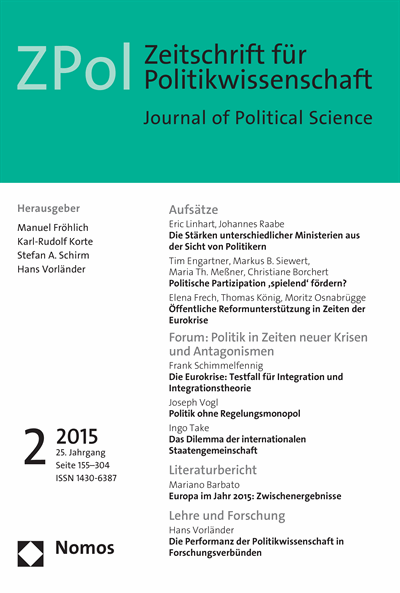
Journal of Political Science
Jahrgang 25 (2015), Heft 2
- Autor:innen:
- Verlag
- Nomos, Baden-Baden
- Erscheinungsjahr
- 2015
- ISSN-Online
- 1430-6387
- ISSN-Print
- 1430-6387
Kapitelinformationen
Jahrgang 25 (2015), Heft 2
Öffentliche Unterstützung von Reformen und ihre Stabilität in Zeiten der Eurokrise – eine experimentelle Untersuchung der Wirksamkeit von Gegenargumenten
- Autor:innen:
- ISSN-Print
- 1430-6387
- ISSN-Online
- 1430-6387
- Kapitelvorschau:
In demokratischen Systemen hat sich die Unterstützung der Bevölkerung von Reformen als notwenige Voraussetzung, jedoch besonders in Zeiten der Eurokrise als instabil erwiesen. Unklar ist bislang, ob und welche Argumente die Bevölkerungsmeinung ins Wanken bringen. In dieser Studie untersuchen wir in einer repräsentativen Befragung mit einem experimentellen Design die Wirksamkeit von zwei Argumenten auf die Stabilität der Bevölkerungsmeinung zur Unterstützung von Reformen, die im wissenschaftlichen und öffentlichen Diskurs verbreitet sind: das Disparitäten- und das Fairnessargument gegen Reformen in Deutschland. Unsere Ergebnisse zeigen, dass die öffentliche Unterstützung signifikant sinkt, wenn Reformen als unfair begründet werden. Dies gilt insbesondere für Frauen sowie für Personen mit geringerem Einkommen.
Literaturverzeichnis
Es wurden keine Treffer gefunden. Versuchen Sie einen anderen Begriff.
- Alesina, Alberto/Giavazzi, Francesco, 2008: The Future of Europe: Reform or Decline, Cambridge. Google Scholar öffnen
- Bechtel, Michael/Hainmueller, Jens/Margalit, Yotam, 2015: Policy Design and Domestic Support for International Bailouts, http://ssrn.com/abstract=2163594 (Stand: 7.6.2015). Google Scholar öffnen
- Beetsma, Roel/Giuliodori, Massimo, 2010: The Macroeconomic Costs and Benefits of the EMU and other Monetary Unions: An Overview of Recent Research, in: Journal of Economic Literature (3), 603-641. Google Scholar öffnen doi.org/10.1257/jel.48.3.603
- Blom, Annelies/Bossert, Dayana/Funke, Frederik/Gebhard, Franziska/Holthausen, Annette/Krieger, Ulrich, 2014a: SFB 884 ´Political Economy of Reforms´ Universität Mannheim German Internet Panel (Welle 1 - Core Study). GESIS Datenarchiv, Köln. ZA5866 Datenfile Version 1.0.0, doi: 10.4232/1.12107. Google Scholar öffnen
- Blom, Annelies/Bossert, Dayana/Funke, Frederik/Gebhard, Franziska/Holthausen, Annette/Krieger, Ulrich, 2014b: SFB 884 ´Political Economy of Reforms´ Universität Mannheim German Internet Panel (Welle 6). GESIS Datenarchiv, Köln. ZA5871 Datenfile Version 1.0.0, doi: 10.4232/1.12112. Google Scholar öffnen
- Blom, Annelies/Gathmann, Christina/Krieger, Ulrich, 2015: Setting Up an Online Panel Representative of the General Population: The German Internet Panel, in: Field Methods (4) (im Erscheinen). Google Scholar öffnen doi.org/10.1177/1525822X15574494
- Böhme, Bela/Mohr, Manuel/Plottka, Julia, 2010: Zur Zukunft der Wirtschafts- und Währungsunion: Integrationsschub wider Willen?, in: integration (4), 358-363. Google Scholar öffnen doi.org/10.5771/0720-5120-2010-4-358
- Brettschneider, Frank, 2000: Demoskopie im Wahlkampf - Leitstern oder Irrlicht?, in: Markus Klein/Wolfgang Jagodzinski/Ekkehard Mochmann/Dieter Ohr (Hrsg.), 50 Jahre Empirische Wahlforschung in Deutschland, Wiesbaden, 477-505. Google Scholar öffnen doi.org/10.1007/978-3-322-90180-4_20
- Canzoneri, Matthew B./Rogers, Carol A., 1990: Is the European Community an Optimal Currency Area? Optimal Taxation Versus the Cost of Multiple Currencies, in: American Economic Review (3), 419-433. Google Scholar öffnen
- Chaudoin, Stephen, 2014: Promises or Policies? An Experimental Analysis of International Agreements and Audience Reactions, in: International Organization (1), 235-256. Google Scholar öffnen doi.org/10.1017/S0020818313000386
- Converse, Philip E., 1987: Changing Conceptions of Public Opinion in the Political Process, in: The Public Opinion Quarterly (2), 12-24. Google Scholar öffnen doi.org/10.1086/269067
- Croson, Rachel/Gneezy, Uri, 2009: Gender Differences in Preferences, in: Journal of Economic Literature (2), 448-474. Google Scholar öffnen doi.org/10.1257/jel.47.2.448
- De Grauwe, Paul/Vanhaverbeke, Wim, 1993: Is Europe an Optimum Currency Area?. Evidence from Regional Data, in: Paul R. Masson/Mark P. Taylor (Hrsg.), Policy Issues in the Operation of Currency Unions, Cambridge, 111-129. Google Scholar öffnen doi.org/10.1017/CBO9780511599194.006
- Dörfeld, Kathrin, 2013: Eurokrise: Kann Konjunkturlokomotive Deutschland Rezession beenden?, in: Insider Daily, http://www.investor-verlag.de/finanzkrise-thema/euro-krise/kann-die-konjunkturlokomotive-deutschland-die-rezession-beenden/103173481/ (Stand: 16.9.2013). Google Scholar öffnen
- Dreger, Christian, 2012: Der ökonomische Wert der Währungsunion: eine positive Bilanz aus deutscher Sicht, integration (2), 110-115. Google Scholar öffnen doi.org/10.5771/0720-5120-2012-2-110
- Evans, Joel R./Manthur, Anil, 2005: The Value of Online Surveys, in: Internet Research (2), 195-219. Google Scholar öffnen doi.org/10.1108/10662240510590360
- Faas, Thorsten/Schmitt-Beck, Rüdiger, 2007: Wahrnehmung und Wirkungen politischer Meinungsumfragen. Eine Exploration zur Bundestagswahl 2005, in: Frank Brettschneider/Oskar Niedermayer/Bernhard Weßels (Hrsg.), Die Bundestagswahl 2005, Wiesbaden, 233-267. Google Scholar öffnen doi.org/10.1007/978-3-531-90536-5_11
- Falk, Armin/Fischbacher, Urs, 2006: A theory of reciprocity, in: Games and Economic Behavior (2), 293-315. Google Scholar öffnen doi.org/10.1016/j.geb.2005.03.001
- Fearon, James D., 1994: Domestic Political Audiences and the Escalation of International Disputes, in: American Political Science Review (3), 577-592. Google Scholar öffnen doi.org/10.2307/2944796
- Fehr, Ernst/Gächter, Simon, 2000: Fairness and Retaliation: The Economics of Reciprocity, in: The Journal of Economic Perspectives (3), 159-181. Google Scholar öffnen doi.org/10.1257/jep.14.3.159
- Feldstein, Martin, 1998: The Political Economy of the European Economic and Monetary Union: Political Sources of an Economic Liability, in: Journal of Economic Perspectives (4), 23-42. Google Scholar öffnen doi.org/10.3386/w6150
- Gabel, Matthew, 1998: Public Support for European Integration: An Empirical Test of Five Theories, in: The Journal of Politics (2), 333-354. Google Scholar öffnen doi.org/10.2307/2647912
- Gaines, Brian/Kuklinski, James H./Quirk, Paul J., 2007: The Logic of the Survey Experiment Reexamined, in: Political Analysis (15), 1-20. Google Scholar öffnen doi.org/10.1093/pan/mpl008
- Hainmueller, Jens/Hiscox, Michael, 2006: Learning to Love Globalization: Education and Individual Attitudes Toward International Trade, in: International Organization (2), 469-498. Google Scholar öffnen doi.org/10.1017/S0020818306060140
- Hellmann, Kai-Uwe, 1998: Paradigmen der Bewegungsforschung, in: Kai-Uwe Hellmann/Ruud Koopmans (Hrsg.), Paradigmen der Bewegungsforschung, Wiesbaden, 9-30. Google Scholar öffnen doi.org/10.1007/978-3-663-10990-7_1
- Hufeld, Ulrich, 2012: Zwischen Notrettung und Rütlischwur: der Umbau der Wirtschafts- und Währungsunion in der Krise, in: integration (2), 117-131. Google Scholar öffnen
- Hug, Simon/König, Thomas, 2002: In View of Ratification: Governmental Preferences and Domestic Constraints at the Amsterdam Intergovernmental Conference, in: International Organization 56 (2), 447-476. Google Scholar öffnen doi.org/10.1162/002081802320005531
- Jacobi, Lena/Kluve, Jochen, 2006: Before and After the Hartz Reforms: the Performance of Active Labour Market Policy in Germany, IZA Discussion Papers No. 2100. Google Scholar öffnen
- Krause, Michael U./Uhlig, Harald, 2012: Transitions in the German Labor Market: Structure and Crisis, in: Journal of Monetary Economics (1), 64-79. Google Scholar öffnen doi.org/10.1016/j.jmoneco.2011.10.003
- Kriesi, Hanspeter, 2001: Die Rolle der Öffentlichkeit im politischen Entscheidungsprozess, Wissenschaftszentrum Berlin für Sozialforschung (WZB) Discussion Paper P 01-701. Google Scholar öffnen
- Krosnick, Jon A./Alwin, Duane F., 1987: An Evaluation of a Cognitive Theory of Response-Order Effects in Survey Measurement, in: Public Opinion Quarterly (2), 201-219. Google Scholar öffnen doi.org/10.1086/269029
- Leuffen, Dirk, 2013: Keine Arroganz, aber auch keine falsche Bescheidenheit!, in: Zeitschrift für Politikwissenschaft (3), 445-452. Google Scholar öffnen
- Mahnkopf, Birgit, 2012: The euro crisis: German politics of blame and austerity - A neoliberal nightmare, in: International Critical Thought (2), 472-485. Google Scholar öffnen doi.org/10.1080/21598282.2012.730374
- Mallien, Jan/Niesmann, Andreas, 2014: Abrechnung mit dem Euro, in: Handelsblatt, 1.1.2012, http://www.handelsblatt.com/politik/ international/happy-birthday-abrechnung-mit-dem euro/6008528.html (Stand: 25.9.2014). Google Scholar öffnen
- Mayhew, David R., 1974: Congress: The Electoral Connection, New Haven (CT). Google Scholar öffnen
- Moore, Frederick, 1959: Economies of Scale: Some Statistical Evidence, in: Quarterly Journal of Economics (2), 232-245. Google Scholar öffnen doi.org/10.2307/1883722
- Mundell, Robert, 1961: A Theory of Optimum Currency Areas, in: The American Economic Review (4), 657-665. Google Scholar öffnen
- Risse, Thomas (Hrsg.), 2015: European Public Spheres. Politics is Back, Cambridge. Google Scholar öffnen
- Saunders, Phillip, 1980: The lasting effects of introductory economics courses, in: The Journal of Economic Education (1), 1-14. Google Scholar öffnen doi.org/10.1080/00220485.1980.10844960
- Schmidt, André, 2009: Die Wirtschafts- und Finanzkrise 2008/09 - die erste Bewährungsprobe für die Europäische Wirtschafts- und Währungsunion, in: integration (4), 388-397. Google Scholar öffnen doi.org/10.5771/0720-5120-2009-4-388
- Schwieren, Christiane/Sutter, Matthias, 2008: Trust in Cooperation or Ability? An Experimental Study on Gender Differences, in: Economic Letters (3), 494-497. Google Scholar öffnen doi.org/10.1016/j.econlet.2007.09.033
- Seidel, Martin, 2010: Aktuelle Probleme der europäischen Währungsunion, in: integration (4), 334-349. Google Scholar öffnen doi.org/10.5771/0720-5120-2010-4-334
- Siegrist, Michael/Visschers, Vivianne, 2013: Acceptance of nuclear power: The Fukushima effect, in: Energy Policy, 112-119. Google Scholar öffnen doi.org/10.1016/j.enpol.2012.07.051
- Sinn, Hans-Werner, 2012: Die Target-Falle: Gefahren für unser Geld und unsere Kinder, München. Google Scholar öffnen doi.org/10.3139/9783446433915
- Sinn, Hans-Werner, 2013: Verantwortung der Staaten und Notenbanken in der Eurokrise, in: Wirtschaftsdienst (7), 452-454. Google Scholar öffnen
- Stelter, Daniel, 2014: Deutschlands Zukunftsfähigkeit ist in Gefahr, in: Cicero, 19.2.2014, http://www.cicero.de/kapital/wirtschaft-deutschlands-wirtschaft-in-gefahr/57070 (Stand: 20.9.2014). Google Scholar öffnen
- Stigler, George, 1958: The Economies of Scale, in: Journal of Law and Economics (1), 54-71. Google Scholar öffnen doi.org/10.1086/466541
- Stimson, James, 1991: Public Opinion in America: Moods, Cycles, and Swings, Boulder (Col). Google Scholar öffnen
- Thimann, Christian, 2013: Die Bedeutung der Wettbewerbsfähigkeit auf dem Weg aus der Krise im Eurogebiet, in: Perspektiven der Wirtschaftspolitik (3-4), 240-261. Google Scholar öffnen doi.org/10.1111/pers.12016
- Truger, Achim, 2013: Austerity in the Euro Area: The Sad State of Economic Policy in Germany and the EU, in: Journal of Economics and Economic Policies: Intervention (2), 158-174. Google Scholar öffnen doi.org/10.4337/ejeep.2013.02.02
- Vaubel, Roland, 2012: Die Politische Ökonomie der Staatsschuldenkrise und die Zukunft des Euro, in: Dirk Meyer (Hrsg.), Die Zukunft der Währungsunion. Chancen und Risiken des Euros, Münster, 83-102. Google Scholar öffnen
- Walstad, William, 1997: The Effect of Economic Knowledge on Public Opinion of Economic Issues, in: The Journal of Economic Education (3), 195-205. Google Scholar öffnen doi.org/10.1080/00220489709596744