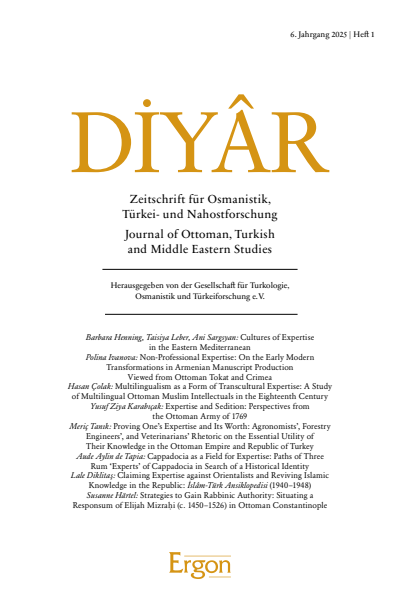
Strategies to Gain Rabbinic Authority: Situating a Responsum of Elijah Mizraḥi (c. 1450–1526) in Ottoman Constantinople
Inhaltsverzeichnis
Bibliographische Infos
Open Access Vollzugriff
DIYÂR
Jahrgang 6 (2025), Heft 1
- Autor:innen:
- Verlag
- Ergon, Baden-Baden
- Copyrightjahr
- 2025
- ISSN-Online
- 2942-3155
- ISSN-Print
- 2625-9842
Kapitelinformationen
Open Access Vollzugriff
Jahrgang 6 (2025), Heft 1
Strategies to Gain Rabbinic Authority: Situating a Responsum of Elijah Mizraḥi (c. 1450–1526) in Ottoman Constantinople
- Autor:innen:
- ISSN-Print
- 2625-9842
- ISSN-Online
- 2942-3155
- Kapitelvorschau:
Literaturverzeichnis
Es wurden keine Treffer gefunden. Versuchen Sie einen anderen Begriff.
- – 2023. ‘The Authority to Define a Jew. The Controversy about Levirate Marriage between Jacob Ibn Ḥabib and Elijah Mizraḥi at the Beginning of the Sixteenth Century’. European Judaism. 56.2. 63–74. Google Scholar öffnen doi.org/10.5771/2625-9842-2025-1-162
- Polliack, Meira (ed.). 2003. Karaite Judaism. A Guide to its History and Literary Sources. Leiden: Brill. Google Scholar öffnen doi.org/10.5771/2625-9842-2025-1-162
- Paudice, Aleida. 2010. Between Several Worlds: the Life and Writings of Elia Capsali. The Historical Works of a 16th-century Cretan Rabbi. München: Meidenbauer. Google Scholar öffnen doi.org/10.5771/2625-9842-2025-1-162
- Papademetriou, Tom. 2015. Render unto the Sultan. Power, Authority, and the Greek Orthodox Church in the early Ottoman Centuries. Oxford: Oxford University Press. Google Scholar öffnen doi.org/10.5771/2625-9842-2025-1-162
- Morgenstern, Matthias. 2007. ‘Zwischen Lehrverbot und Lehrerlaubnis: Anmerkungen zu den rabbinisch-karäischen Beziehungen im Konstantinopel des 15. und 16. Jahrhunderts’. In Kuyt, Annelies and Necker, Gerold (eds.). Orient als Grenzbereich? Rabbinisches und außerrabbinisches Judentum. Wiesbaden: Harrassowitz. 105–114. Google Scholar öffnen doi.org/10.5771/2625-9842-2025-1-162
- Levy, Avigdor. 2010. ‘Haham Başı (Chief Rabbi)‘. In Stillman, Norman (ed.). Encyclopedia of Jews in the Islamic World. Vol. 2. London and Boston, Massachusetts: Brill. 323–326. Google Scholar öffnen doi.org/10.5771/2625-9842-2025-1-162
- – 2022. Karaism. An Introduction to the Oldest Surviving Alternative Judaism. London: The Littmann Library of Jewish Civilization. Google Scholar öffnen doi.org/10.5771/2625-9842-2025-1-162
- – 2008. From Judah Hadassi to Elijah Bashyatchi. Studies in Late Medieval Karaite Philosophy. Leiden: Brill. Google Scholar öffnen doi.org/10.5771/2625-9842-2025-1-162
- Lasker, Daniel J. 2007. ‘Maimonides and the Karaites: From Critic to Cultural Hero’. In Valle, Carlos del, García-Jalón, Santiago and Monferrer, Juan Pedro (eds.). Maimónides et su época. Madrid: Sociedad Estatal de Conmemoraciones Culturales. 311–325. Google Scholar öffnen doi.org/10.5771/2625-9842-2025-1-162
- Imber, Colin. 2019. The Ottoman Empire, 1300–1650: the Structure of Power. London: Red Globe Press. Google Scholar öffnen doi.org/10.5771/2625-9842-2025-1-162
- Heller, Marvin J. 2011. The Seventeenth Century Hebrew Book. An Abridged Thesaurus. Vol. 1. Leiden: Brill. Google Scholar öffnen doi.org/10.5771/2625-9842-2025-1-162
- Heller, Marvin J. 2004. The Sixteenth Century Hebrew Book. An Abridged Thesaurus. Vol. 1. Leiden: Brill. Google Scholar öffnen doi.org/10.5771/2625-9842-2025-1-162
- – 2024. ‘Beyond the Master Narrative of Sephardic Triumph. The Romaniote Rabbi Elijah Mizraḥi (c. 1450–1526) and the Negotiation of Rabbinic Authority in Ottoman Constantinople’. In Bitunjac, Martina (ed.). Jüdische Lebenswelten im Osmanischen Reich. Berlin: De Gruyter. 69–96. Google Scholar öffnen doi.org/10.5771/2625-9842-2025-1-162
- Rabinowicz, Harry. 1957. ‘Joseph Colon and Moses Capsali’. The Jewish Quarterly Review. 47.4. 336–344. Google Scholar öffnen doi.org/10.5771/2625-9842-2025-1-162
- Härtel, Susanne. 2022. ‘A Question of Competition? How to Deal with Inner-Jewish Diversity in Cities of the Ottoman Empire at the Turn of the 16th Century’. Hamsa. Journal for Judaic and Islamic Studies. 8. URL: https://doi.org/10.4000/hamsa.2775 (last accessed 9 January 2025). Google Scholar öffnen doi.org/10.5771/2625-9842-2025-1-162
- – 2018. ‘The Rise of Ottoman Jewry’. In Karp, Jonathan and Sutcliffe, Adam (eds.). The Cambridge History of Judaism. Vol. 7: The Early Modern World, 1500–1815. Cambridge: Cambridge University Press. 77–112. Google Scholar öffnen doi.org/10.5771/2625-9842-2025-1-162
- – 2007. ‘Mizraḥi, Elijah’. In Skolnik, Fred (ed.). Encyclopaedia Judaica. Vol. 14. Detroit, Michigan: Macmillan Reference USA. 393–395. Google Scholar öffnen doi.org/10.5771/2625-9842-2025-1-162
- – 1992. ‘The Sürgün System and Jewish Society in the Ottoman Empire During the Fifteenth to the Seventeenth Centuries’. In Rodrigue, Aron (ed.). Ottoman and Turkish Jewry. Community and Leadership. Bloomington, Indiana: Indiana University Press. 1–65. Google Scholar öffnen doi.org/10.5771/2625-9842-2025-1-162
- Hacker, Joseph R. 1984. ‘The “Chief Rabbinate” in the Ottoman Empire in the 15th and 16th Centuries’ (Hebrew). Zion. 49.3. 225–263. Google Scholar öffnen doi.org/10.5771/2625-9842-2025-1-162
- Gardette, Philippe. 2013. Les juifs byzantins aux racines de l’histoire juive Ottomane: Essai de réflexions spéculaires ou tentative d’habillage d’une absence de représentation. Istanbul: Éditions Isis. Google Scholar öffnen doi.org/10.5771/2625-9842-2025-1-162
- Friedmann, Jehosua. 1974. Elijah Mizrachi: The Man and the Period (Hebrew). PhD Dissertation, Yeshiva University, New York. Google Scholar öffnen doi.org/10.5771/2625-9842-2025-1-162
- Epstein, Mark Alan. 1980. The Ottoman Jewish Communities and their Role in the Fifteenth and Sixteenth Centuries. Freiburg: Klaus Schwarz Verlag. Google Scholar öffnen doi.org/10.5771/2625-9842-2025-1-162
- – 1994(b). Jewish Law. History, Sources, Principles. Ha-Mishpat Ha-Ivri. Vol. 3. Philadelphia, Pennsylvania: Jewish Publication Society. Google Scholar öffnen doi.org/10.5771/2625-9842-2025-1-162
- Elon, Menachem. 1994(a). Jewish Law. History, Sources, Principles. Ha-Mishpat Ha-Ivri. Vol. 2. Philadelphia, Pennsylvania: Jewish Publication Society. Google Scholar öffnen doi.org/10.5771/2625-9842-2025-1-162
- Elior, Ofer. 2018. ‘Attitudes toward Science in the Karaite Community of Istanbul: The Case of Joseph Beghi’. The Jewish Quarterly Review. 108.3. 295–315. Google Scholar öffnen doi.org/10.5771/2625-9842-2025-1-162
- – 2019. ‘In Search of Early Ottoman Edirne’. In Krawietz, Birgit and Riedler, Florian (eds.). The Heritage of Edirne in Ottoman and Turkish Times. Continuities, Disruptions and Reconnections. Berlin: De Gruyter. 25–43. Google Scholar öffnen doi.org/10.5771/2625-9842-2025-1-162
- – 2012. ‘Halacha’. In: Diner, Dan (ed.). Enzyklopädie jüdischer Geschichte und Kultur. Vol. 2. Stuttgart: Metzler. 507–518. Google Scholar öffnen doi.org/10.5771/2625-9842-2025-1-162
- Zohar, Zvi. 2007. ‘The Sephardic Halakhic Tradition in the 20th Century’. In Medding, Peter Y. (ed.). Sephardic Jewry and Mizrahi Jews. Oxford: Oxford University Press. 119–149. Google Scholar öffnen doi.org/10.5771/2625-9842-2025-1-162
- – 2009. ‘Les déportés et leur statut dans l’empire ottoman (XVe-XVIe siècles)’. In Moatti, Claudia, Kaiser, Wolfgang and Prébarthe, Christophe (eds.). Le monde de l’itinérance en méditerranée de l’antiquité à l’époque moderne. Bourdeaux: Ausonius. 515–531. Google Scholar öffnen doi.org/10.5771/2625-9842-2025-1-162
- Yerasimos, Stéphane. 1995. ‘La communauté juive d’Istanbul à la fin du XVIe siècle’. Turcica. 27. 101–130. Google Scholar öffnen doi.org/10.5771/2625-9842-2025-1-162
- – 2022. Joseph Karo and Shaping of Modern Jewish Law. The Early Modern Ottoman and Global Settings. London: Anthem Press. Google Scholar öffnen doi.org/10.5771/2625-9842-2025-1-162
- Weinstein, Roni. 2020. ‘Jewish Modern Law and Legalism in a Global Age: The Case of Rabbi Joseph Karo’. Modern Intellectual History. 17.2. 561–578. Google Scholar öffnen doi.org/10.5771/2625-9842-2025-1-162
- Weber, Max. 2019. Economy and Society. Cambridge, Massachusetts: Harvard University Press. Google Scholar öffnen doi.org/10.5771/2625-9842-2025-1-162
- Walzer, Michael, Lorberbaum, Menachem and Zohar, Noam J. (eds.). 2000. The Jewish Political Tradition. Vol. 1: Authority. New Haven, Connecticut: Yale University Press. Google Scholar öffnen doi.org/10.5771/2625-9842-2025-1-162
- Taub, Eliav. 2015. Rabbis in Politics. The Leadership Approaches of Rabbis Ovadia Yosef & Elazar Shach. Mamaroneck, New York: Israel Academic Press. Google Scholar öffnen doi.org/10.5771/2625-9842-2025-1-162
- Ta-Shma, Israel M. 2002. ‘Rabbinic Literature in the Late Byzantine and Early Ottoman Periods’. In Levy, Avigdor (ed.). Jews, Turks, Ottomans. A Shared History, Fifteenth Through the Twentieth Century. Syracuse, New York: Syracuse University Press. 52–60. Google Scholar öffnen doi.org/10.5771/2625-9842-2025-1-162
- Slepoy, Vlaidslav Zeev. 2018. ‘Form und Funktion rabbinischer Responsen – eine rechtsvergleichende Perspektive/Form and Function of Rabbinic Responsa – Comparative Law Perspectives’. Ancilla Iuris. 123. 124–149. Google Scholar öffnen doi.org/10.5771/2625-9842-2025-1-162
- Dönitz, Saskia and Hollender, Elisabeth. 2016. ‘Knotenpunkt Byzanz: Aharon ben Yosef und die Vermittlung sefardisch-andalusischer Traditionen nach Byzanz’. Frankfurter Judaistische Beiträge. 41. 19–36. Google Scholar öffnen doi.org/10.5771/2625-9842-2025-1-162
- Singer, Amy. 2018. ‘Edirne/Adrianople: The Best City in Greece’. In Schmidtke, Sabine (ed.), Near and Middle Eastern Studies at the Institute for Advanced Study. Princeton: 1935–2018. Piscataway, New Jersey: Gorgias Press. 390–398. Google Scholar öffnen doi.org/10.5771/2625-9842-2025-1-162
- Sinai, Yuval. 2008. ‘Maimonides’ Contradictory Positions Regarding the Karaites: A Study in Maimonidean Jurisprudence’. Review of Rabbinic Judaism. 11.2. 277–291. Google Scholar öffnen doi.org/10.5771/2625-9842-2025-1-162
- Simmel, Georg. 2009. Sociology. Inquiries into the Construction of Social Forms. Vol. 1. Leiden: Brill 2009. Google Scholar öffnen doi.org/10.5771/2625-9842-2025-1-162
- Shmuelevitz, Aryeh. 1984. The Jews of the Ottoman Empire in the Late Fifteenth and the Sixteenth Centuries. Administrative, Economic, Legal and Social Relations as Reflected in the Responsa. Leiden: Brill. Google Scholar öffnen doi.org/10.5771/2625-9842-2025-1-162
- Saperstein, Marc. 2014. Leadership and Conflict. Tensions in Medieval and Early Modern Jewish History and Culture. Oxford: The Littman Library of Jewish Civilization. Google Scholar öffnen doi.org/10.5771/2625-9842-2025-1-162
- Sagi, Avi. 2005. ‘The Controversy about Secular Studies in the Responsa Literature’ (Hebrew). In Corinaldi, Michael et al. (eds.). Studies in Memory of Professor Zeʾev Falk. Jerusalem: Mesharim. 231–253. Google Scholar öffnen doi.org/10.5771/2625-9842-2025-1-162
- Rustow, Marina. 2010. The Qaraites as Sect: The Tyranny of a Construct. In Stern, Sacha (ed.). Sects and Sectarianism in Jewish History. Leiden: Brill. 149–186. Google Scholar öffnen doi.org/10.5771/2625-9842-2025-1-162
- Ruderman, David B. 2010. Early Modern Jewry. A New Cultural History. Princeton, New Jersey: Princeton University Press. Google Scholar öffnen doi.org/10.5771/2625-9842-2025-1-162
- – 2015. The Jews of Istanbul in the Ottoman Era (1453–1923) from a Romaniot Perspective. In Rozen, Minna (ed.). Studies in the History of Istanbul Jewry, 1453–1923. A Journey through Civilizations. Turnhout: Brepols. 7–50. Google Scholar öffnen doi.org/10.5771/2625-9842-2025-1-162
- – 2010. A History of the Jewish Community in Istanbul. The Formative Years, 1453–1566. Leiden: Brill. Google Scholar öffnen doi.org/10.5771/2625-9842-2025-1-162
- Rozen, Minna. 1992. ‘A Survey of Jewish Cemeteries in Western Turkey’. The Jewish Quarterly Review. 83.1/2. 71–125. Google Scholar öffnen doi.org/10.5771/2625-9842-2025-1-162
- Mizraḥi, Elijah. 1938. Sheʾelot u-teshuvot. Jerusalem: Darom (1st ed. 1559–1561, Constantinople). Google Scholar öffnen doi.org/10.5771/2625-9842-2025-1-162
- ‘Extracts from Joseph B. Moses Beghi’s iggeret qiryah neʾemanah’. 1972. In Mann, Jacob (ed.). Text and Studies in Jewish History and Literature. Vol. 2: Ḳaraitica. New York: Ktav Publishing House. 294–315. Google Scholar öffnen doi.org/10.5771/2625-9842-2025-1-162
- The Code of Maimonides. Vol. 14: The Book of Judges. 1949. Translated by Hershman, Abraham M. New Haven, Connecticut: Yale University Press. Google Scholar öffnen doi.org/10.5771/2625-9842-2025-1-162
- Primary Sources Google Scholar öffnen doi.org/10.5771/2625-9842-2025-1-162
- Mizraḥi, Elijah and Ibn Ḥayyim, Elijah. 1778. Mayim ʿamuqqim. Vol. 1. Berlin: n. p. (1st ed. 1647, Venice). Google Scholar öffnen doi.org/10.5771/2625-9842-2025-1-162
- – 1983. Rabbi Eliyahu Capsali of Crete (Hebrew). Tel Aviv: The Diaspora Research Institute. Google Scholar öffnen doi.org/10.5771/2625-9842-2025-1-162
- Danon, Abraham. 1927. ‘Documents Relating to the History of the Karaites in European Turkey’. The Jewish Quarterly Review. 17.3. 239–322. Google Scholar öffnen doi.org/10.5771/2625-9842-2025-1-162
- Corinaldi, Michael. 1984. The Personal Status of the Karaites (Hebrew). Jerusalem: Rubin Mass. Google Scholar öffnen doi.org/10.5771/2625-9842-2025-1-162
- Cohn, Haim Hermann and Greenberg, Moshe. 2007. ‘Ḥerem’. In Skolnik, Fred (ed.). Encyclopaedia Judaica. Vol. 9. Detroit, Michigan: Macmillan Reference USA. 10–16. Google Scholar öffnen doi.org/10.5771/2625-9842-2025-1-162
- Cohen, Aaron. 1993. ‘The Parameters of Rabbinic Authority. A Study of Three Sources’. Tradition. A Journal of Orthodox Jewish Thought. 27.4. 100–130. Google Scholar öffnen doi.org/10.5771/2625-9842-2025-1-162
- Čejka, Marek and Kořan, Roman (eds.). 2016. Rabbis of our Time. Authorities in Judaism in the Religious and Political Ferment of Modern Times. London: Routledge. Google Scholar öffnen doi.org/10.5771/2625-9842-2025-1-162
- Burak, Guy. 2015. The Second Formation of Islamic Law. The Ḥanafī School in the Early Modern Ottoman Empire. Cambridge: Cambridge University Press. Google Scholar öffnen doi.org/10.5771/2625-9842-2025-1-162
- Bowman, Steven B. 1985. The Jews of Byzantium, 1204–1453. Alabama: The University of Alabama Press. Google Scholar öffnen doi.org/10.5771/2625-9842-2025-1-162
- Bonfil, Robert et al. (eds.). 2012. Jews in Byzantium. Dialectics of Minority and Majority Cultures. Leiden: Brill. Google Scholar öffnen doi.org/10.5771/2625-9842-2025-1-162
- Blidstein, Gerald J. 2004. ‘The “Other” in Maimonidean Law’. Jewish History. 18.2/3. 173–195. Google Scholar öffnen doi.org/10.5771/2625-9842-2025-1-162
- Ben-Naeh, Yaron. 2008. Jews in the Realm of the Sultans. Tübingen: Mohr Siebeck. Google Scholar öffnen doi.org/10.5771/2625-9842-2025-1-162
- Benbassa, Esther and Rodrigue, Aron. 2000. Sephardi Jewry. A History of the Judeo-Spanish Community, 14th–20th Centuries. Berkeley, California: University of California Press. Google Scholar öffnen doi.org/10.5771/2625-9842-2025-1-162
- Benayahu, Meir. 1980. Relation between Greek and Italian Jewry (Hebrew). Tel Aviv: The Diaspora Research Institute. Google Scholar öffnen doi.org/10.5771/2625-9842-2025-1-162
- Barkey, Karen. 2008. Empire of Difference. The Ottomans in Comparative Perspective. Cambridge: Cambridge University Press. Google Scholar öffnen doi.org/10.5771/2625-9842-2025-1-162
- Ayalon, Yaron. 2017. ‘Rethinking Rabbinical Leadership in Ottoman Jewish Communities’. The Jewish Quarterly Review. 107.3. 323–353. Google Scholar öffnen doi.org/10.5771/2625-9842-2025-1-162
- – 1991. Le commentaire biblique. Mordekhai Komtino ou l’herméneutique du dialogue. Paris: Éditions du Cerf. Google Scholar öffnen doi.org/10.5771/2625-9842-2025-1-162
- Attias, Jean-Christophe. 1989. ‘Un temps pour enseigner, un temps pour apprendre: karaïtes et rabbanites à Constantinople au XVe siècle’. In Tollet, Daniel (ed.). Politique et religion dans le judaïsme ancien et médiéval. Paris: Desclée. 187–198. Google Scholar öffnen doi.org/10.5771/2625-9842-2025-1-162
- Assaf, Simḥa. 1935. ‘New Material to the History of the Karaites in the Orient’ (Hebrew). Zion. 1.2. 208–251. Google Scholar öffnen doi.org/10.5771/2625-9842-2025-1-162
- – 2018. Historical Consciousness, Haskalah, and Nationalism among the Karaites of Eastern Europe. Leiden: Brill. Google Scholar öffnen doi.org/10.5771/2625-9842-2025-1-162
- Akhiezer, Golda. 2012. ‘Byzantine Karaism in the Eleventh to Fifteenth Centuries’. In Bonfil, Robert et al. (eds.). Jews in Byzantium. Dialectics of Minority and Majority Cultures. Leiden: Brill. 723–758. Google Scholar öffnen doi.org/10.5771/2625-9842-2025-1-162
- Secondary Sources Google Scholar öffnen doi.org/10.5771/2625-9842-2025-1-162
- Moses ben Maimon. 1987. Letters and Essays of Moses Maimonides. A Critical Edition of the Hebrew and Arabic Letters (including responsa on beliefs and attitudes) based on all extant manuscripts, translated and annotated, with introductions and cross-references. Vol. 2. Edited by Isaac Shailat. Jerusalem: Maaliyot Press of Yeshivat Birkat Moshe. Google Scholar öffnen doi.org/10.5771/2625-9842-2025-1-162
- Moses ben Maimon. 1960. Responsa. Vol. 2. Edited by Jehoshua Blau. Jerusalem: Mekize Nirdamim. Google Scholar öffnen doi.org/10.5771/2625-9842-2025-1-162