Persian in the Lands of Rum: Texts, Translations and Courtly Patronage
Inhaltsverzeichnis
Bibliographische Infos
Vollzugriff
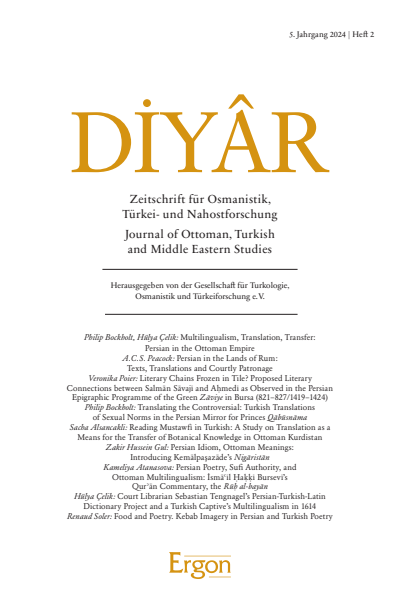
DIYÂR
Jahrgang 5 (2024), Heft 2
- Autor:innen:
- Verlag
- Ergon, Baden-Baden
- Copyrightjahr
- 2024
- ISSN-Online
- 2942-3155
- ISSN-Print
- 2625-9842
Kapitelinformationen
Vollzugriff
Jahrgang 5 (2024), Heft 2
Persian in the Lands of Rum: Texts, Translations and Courtly Patronage
- Autor:innen:
- ISSN-Print
- 2625-9842
- ISSN-Online
- 2942-3155
- Kapitelvorschau:
Literaturverzeichnis
Es wurden keine Treffer gefunden. Versuchen Sie einen anderen Begriff.
- Unpublished Primary Sources Google Scholar öffnen doi.org/10.5771/2625-9842-2024-2-124
- Aḥmad b. Aḥmad al-Jilyānī al-Munshī. Qalʿa-yi Qusṭanṭiniyya va Binā-yi Ayāṣufyā. Istanbul, Süleymaniye Library, MS Ayasofya 3024. Google Scholar öffnen doi.org/10.5771/2625-9842-2024-2-124
- Darvīsh Shams-i Dīn. Tārīkh-i Ayāṣufyā. Istanbul, Süleymaniye Library, MSS Ayasofya 3025 and 3336. Google Scholar öffnen doi.org/10.5771/2625-9842-2024-2-124
- Lāmiʿī Çelebi. Dīvān. Istanbul, Millet Library, MSS Ali Emin Manzum 380. Google Scholar öffnen doi.org/10.5771/2625-9842-2024-2-124
- Sultan Selīm. Dīvān-i Salīmī. Istanbul, Süleymaniye Library, MSS Esad Efendi 3422; Atif Efendi 2078; Nuruosmaniye 3827. Google Scholar öffnen doi.org/10.5771/2625-9842-2024-2-124
- Zāhid b. ʿĀrif. Maḫzenü’l-Esrār. Istanbul, Süleymaniye Library, MSS Ayasofya 3456 (Turkish translation of Aflākī’s Manāqib al-ʿĀrifīn). Google Scholar öffnen doi.org/10.5771/2625-9842-2024-2-124
- Published Primary Sources Google Scholar öffnen doi.org/10.5771/2625-9842-2024-2-124
- Jāmī, Abdarrahmān. 1980. Nefehâtü’l-Üns min Hadarâti’l-Kuds; tercüme ve şerh: Lâmi‘î Çelebi. Istanbul: Marifet [reprint of lithograph of 1289 AH]. Google Scholar öffnen doi.org/10.5771/2625-9842-2024-2-124
- Karateke, Hakan T. (ed.). 1995. İşkodra Şairleri ve Ali Emiri’nin Diğer Eserleri. Istanbul: Enderun Kitabevi. Google Scholar öffnen doi.org/10.5771/2625-9842-2024-2-124
- Kastritsis, Dimitri J. (trans). 2017. An Early Ottoman History: The Oxford Anonymous Chronicle (Bodleian Library, MS Marsh 313). Liverpool: Liverpool University Press. Google Scholar öffnen doi.org/10.5771/2625-9842-2024-2-124
- Laṭīfī. 2000. Tezkiretü’ş-Şu’arâ ve Tabsiratü’n-Nuzamâ (İnceleme-Metin). Rıdvan Canım (ed.). Ankara: Atatürk Merkezi Başkanlığı. Google Scholar öffnen doi.org/10.5771/2625-9842-2024-2-124
- Lāmiʿī Çelebi. 2015. Latîfeler Kitabı/Letâif-i Lâmi’î. Yaşar Çalışkan (ed.). Istanbul: Büyüyen Ay. Google Scholar öffnen doi.org/10.5771/2625-9842-2024-2-124
- Macit, Muhsin. 2002. Karakoyunlu Hükümdarı Cihanşah ve Türkçe Şiirleri. Istanbul: Grafiker. Google Scholar öffnen doi.org/10.5771/2625-9842-2024-2-124
- Nef ʿī. 2019. Farsça Divan: Metin-Çeviri. Mehmet Atalay (ed.). Istanbul: Demavend. Google Scholar öffnen doi.org/10.5771/2625-9842-2024-2-124
- Niğdeli Ḳādī Aḥmed. 2015. Niğdeli Kadı Ahmed’in El-Veledü’s-Sefîk Ve’l-Hâfidü’l-Halîk’i (Anadolu Selçuklularına Dair Bir Kaynak). Ali Ertuğrul (ed.). Ankara: Türk Tarih Kurumu. Google Scholar öffnen doi.org/10.5771/2625-9842-2024-2-124
- Okuyucu, Cihan and Uluoğlu, Belkıs. 2022. Ayasofya Risâleleri: Derviş Şemseddin Karamanî, Târîh-i Beyân-ı Binâ-yi Ayayasofya-yı Kebir; Yusuf bin Musa El-Balıkesrî, Târîh-i Ayasofya. Istanbul: Ketebe. Google Scholar öffnen doi.org/10.5771/2625-9842-2024-2-124
- Qāżīzāda-yi Ardabīlī. 2021. Ghazavāt-i Sulṭān Salīm (Guzārish-i Asīr-i Īrānī-yi Jang-i Chāldirān az Fatḥ-i Miṣr va Shām ba-dast-i Sulṭān Salīm-i Avval-i ʿUsmānī). Ṭāhir Bābāʾī (ed.). Tehran: Mīrāỿ-i Maktūb. Google Scholar öffnen doi.org/10.5771/2625-9842-2024-2-124
- Turan, Osman. 1958. Türkiye Selçukluları Hakkında Resmî Vesikalar: Metin, Tercüme ve Araştırmalar. Ankara: Türk Tarih Kurumu. Google Scholar öffnen doi.org/10.5771/2625-9842-2024-2-124
- Yeñişehirli ʿAvnī Bey. 2005. Divan. Mehmet Atalay (ed.). Istanbul. Google Scholar öffnen doi.org/10.5771/2625-9842-2024-2-124
- Secondary Sources Google Scholar öffnen doi.org/10.5771/2625-9842-2024-2-124
- Ateş, Ahmet, 1945. ‘Hicri VI-VIII. (XII.-XIV.) Asırlarda Anadolu’da Farsça Eserler’. Türkiyat Mecmuası 8. 94–135. Google Scholar öffnen doi.org/10.5771/2625-9842-2024-2-124
- Aydüz, Selim. 1997. ‘Lâle Devri’nde Yapılan İlmî Faaliyetler’. Divan 1. 143–170. Google Scholar öffnen doi.org/10.5771/2625-9842-2024-2-124
- Bihnāmī, Aḥmad. 1398. ‘Ashʿār-i Fārsī-gūyān-i sada-yi hashtum-i Anātūlī dar jung-i Aqshahr (nuskha-yi 1094 Kitābkhāna-yi Laydan)’. Guzārish-i Mirāỿ 88–89. 161–169. Google Scholar öffnen doi.org/10.5771/2625-9842-2024-2-124
- Burguière, Paul and Mantran, Robert. 1952. ‘Quelques vers grecs du XIIIe siècle en caractères arabes’. Byzantion 22. 63–80. Google Scholar öffnen doi.org/10.5771/2625-9842-2024-2-124
- Çelebioğlu, Âmil. 1994. Kanûnî Sultân Süleymân Devri Türk Edebiyatı. Ankara: Milli Eğitim Bakanlığı. Google Scholar öffnen doi.org/10.5771/2625-9842-2024-2-124
- Csirkés, Ferenc. 2019. ‘Turkish/Turkic Books of Poetry, Turkish and Persian Lexicography: The Politics of Language under Bayezid II’. In Necipoğlu, Gülru, Kafadar, Cemal and Fleischer, Cornell H. (eds.). Treasures of Knowledge: An Inventory of the Ottoman Palace Library (1502/3–1503/4). Vol. 1. Leiden: Brill. 673–733. Google Scholar öffnen doi.org/10.5771/2625-9842-2024-2-124
- De Nicola, Bruno. 2024. The Chobanids of Kastamonu: Politics, Patronage and Religion in Thirteenth-Century Anatolia. London: Routledge. Google Scholar öffnen doi.org/10.5771/2625-9842-2024-2-124
- Drkić, Munir. 2021. ‘Caught between Two Empires: The Teaching of Persian in Bosnia at the Time of Transition from Ottoman to Austro-Hungarian Rule’. Diyār 2. 186–207. Google Scholar öffnen doi.org/10.5771/2625-9842-2024-2-124
- Fidan, Ayşe Gül. 2023. Şah Kasım Süleymannâmesi: Kenzu’l Cevâhiri’s Seniyye Fi Futühât’s-Süleymâniyye. Istanbul: Yeditepe. Google Scholar öffnen doi.org/10.5771/2625-9842-2024-2-124
- Genç, Vural. 2019. Acem’den Rum’a bir Bürokrat ve Tarihçi: İdris-i Bîdlîsî, 1457–1520. Ankara: Türk Tarih Kurumu. Google Scholar öffnen doi.org/10.5771/2625-9842-2024-2-124
- Gürbüzel, Aslıhan. 2023. Taming the Messiah: The Formation of an Ottoman Political Public Sphere, 1600–1700. Berkeley: University of California Press. Google Scholar öffnen doi.org/10.5771/2625-9842-2024-2-124
- Gutas, Dimitri. 1998. Greek Thought, Arabic Culture: The Graeco-Arabic Translation Movement in Baghdad and Early ‘Abbāsid Society (2nd–4th/8th–10th Centuries). London: Routledge. Google Scholar öffnen doi.org/10.5771/2625-9842-2024-2-124
- Hagen, Gottfried. 2003. ‘Translations and Translators in a Multilingual Society: A Case Study of Persian-Ottoman Translations, Late 15th to Early 17th Century’. Eurasian Studies 2.1. 95–134. Google Scholar öffnen doi.org/10.5771/2625-9842-2024-2-124
- Hillenbrand, Carole. 2005. ‘Ravandi, the Seljuq court at Konya and the Persianisation of Anatolian Cities’. Mesogeios 25–26. 157–169. Google Scholar öffnen doi.org/10.5771/2625-9842-2024-2-124
- İnan, Murat Umut. 2019. ‘Imperial Ambitions, Mystical Aspirations: Persian Learning in the Ottoman World’. In Green, Nile (ed.). The Persianate World: The Frontiers of a Eurasian Lingua Franca. Berkeley: University of California Press. 75–92. Google Scholar öffnen doi.org/10.5771/2625-9842-2024-2-124
- İpşirli, Mehmet. 1987. ‘Lâle Devri’nde Teşkil Edilen Tercüme Heyetine Dâir Bazı Gözlemler’. In İhsanoğlu, Ekmeleddin (ed.). Osmanlı İlmî ve Meslekî Cemiyetleri. Istanbul: IRCICA. 33–42. Google Scholar öffnen doi.org/10.5771/2625-9842-2024-2-124
- Jackson, Cailah. 2017. ‘An Illuminated Manuscript of Early Fourteenth-Century Konya? Anīs al-Qulūb (MS Ayasofya 2984, Süleymaniye Kütüphanesi, Istanbul)’. Journal of Islamic Manuscripts 8. 85–122. Google Scholar öffnen doi.org/10.5771/2625-9842-2024-2-124
- –. 2020. Islamic Manuscripts of Late Medieval Rūm, 1270s–1370s: Production, Patronage and the Arts of the Book. Edinburgh: Edinburgh University Press. Google Scholar öffnen doi.org/10.5771/2625-9842-2024-2-124
- Karjoo-Ravary, Ali. 2022. ‘Adorning the King of Islam: Weaving and Unraveling History in Astarābādī’s Feasting and Fighting’. MAVCOR Journal. 6.2. URL: https://doi.org/10.22332/mav.ess.2022.3 (accessed 1 July 2024). Google Scholar öffnen doi.org/10.5771/2625-9842-2024-2-124
- Kim, Sooyong. 2018. ‘Persian Literature in Anatolia and the Ottoman Realms’. In Perry, John R. (ed.). Persian Literature from Outside Iran: The Indian Subcontinent, Anatolia, Central Asia, and in Judaeo-Persian. Vol. IX. A History of Persian Literature. London: I.B. Tauris. 221–239. Google Scholar öffnen doi.org/10.5771/2625-9842-2024-2-124
- –. 2019. ‘An Ottoman Order of Persian Verse’. In Necipoğlu, Gülru, Kafadar, Cemal and Fleischer, Cornell H. (eds.). Treasures of Knowledge: An Inventory of the Ottoman Palace Library (1502/3–1503/4). Vol. 1. Leiden: Brill. 635–636. Google Scholar öffnen doi.org/10.5771/2625-9842-2024-2-124
- Kut Alpay, Günay. 1976. ‘Lami‘i Chelebi and His Works’. Journal of Near Eastern Studies 35. 73–93. Google Scholar öffnen doi.org/10.5771/2625-9842-2024-2-124
- Losensky, Paul. 2008. ‘Jāmī. Life and Works’. Encyclopaedia Iranica. 14. 469–475. Google Scholar öffnen doi.org/10.5771/2625-9842-2024-2-124
- Markiewicz, Christopher. 2019. The Crisis of Kingship in Late Medieval Islam: Persian Emigres and the Making of Ottoman Sovereignty. Cambridge: Cambridge University Press. Google Scholar öffnen doi.org/10.5771/2625-9842-2024-2-124
- Melville, Charles. 2006. ‘The Early Persian Historiography of Anatolia’. In Pfeiffer, Judith and Quinn, Sholeh A. (eds.). History and Historiography of Post-Mongol Central Asia and the Middle East. Studies in Honor of John E. Woods. Wiesbaden: Harrassowitz. 135–166. Google Scholar öffnen doi.org/10.5771/2625-9842-2024-2-124
- Peacock, A.C.S. 2004. ‘Ahmad of Niğde’s al-Walad al-Shafiq and the Seljuk past’. Anatolian Studies 54. 95–107. Google Scholar öffnen doi.org/10.5771/2625-9842-2024-2-124
- —. 2007. Mediaeval Islamic Historiography and Political Legitimacy: Balʿamī’s Tārīkhnāma. London: Routledge. Google Scholar öffnen doi.org/10.5771/2625-9842-2024-2-124
- —. 2015. ‘An Interfaith Polemic of Medieval Anatolia: Qadi Burhan al-Din al-Anawi on the Armenians and their Heresies’. In Peacock, A.C.S., De Nicola, Bruno and Yıldız, Sara Nur (eds.). Islam and Christianity in Medieval Anatolia. Farnham: Ashgate. 233–261. Google Scholar öffnen doi.org/10.5771/2625-9842-2024-2-124
- —. 2016. ‘Rulership and Metaphysics in Late Medieval Central Anatolia: Qadi Burhān al-Dīn of Sivas and his Iksīr al-Sa’ādat’. In Peacock, A.C.S. and Yıldız, Sara Nur (eds.). Islamic Literature and Intellectual Life in Fourteenth- and Fifteenth-Century Anatolia. Würzburg: Ergon Verlag. 101–136. Google Scholar öffnen doi.org/10.5771/2625-9842-2024-2-124
- —. 2019. Islam, Literature and Society in Mongol Anatolia. Cambridge: Cambridge University Press. Google Scholar öffnen doi.org/10.5771/2625-9842-2024-2-124
- Pfifer, Michael. 2021. Kindred Voices: A Literary History of Medieval Anatolia. New Haven: Yale University Press. Google Scholar öffnen doi.org/10.5771/2625-9842-2024-2-124
- Riyāḥī, Muḥammad Amīn. 1990. Zabān va Adab-i Fārsī dar Qalamraw-i ʿUỿmānī. Tehran: Pazhang. Google Scholar öffnen doi.org/10.5771/2625-9842-2024-2-124
- Şahin, Kaya. 2023. Peerless Among Princes: The Life and Times of Sultan Süleyman. New York: Oxford University Press. Google Scholar öffnen doi.org/10.5771/2625-9842-2024-2-124
- Shukurov, Rustam. 2013. ‘Harem Christianity: The Byzantine Identity of Seljuk Princes’. In Peacock, A.C.S. and Yıldız, Sara Nur (eds.). The Seljuks of Anatolia: Court and Society in the Medieval Middle East. London: I.B. Tauris. Google Scholar öffnen doi.org/10.5771/2625-9842-2024-2-124
- Sohrweide, Hanna. 1970. ‘Dichter und Gelehrte aus dem Osten im Osmanischen Reich (1453–1600): Ein Beitrag zur türkisch-persischen Kulturgeschichte’. Der Islam 46. 263–302. Google Scholar öffnen doi.org/10.5771/2625-9842-2024-2-124
- Uğur, Ahmet. 2009. ‘Selimname’. TDV İslam Ansiklopedisi. 36. 440–441. Google Scholar öffnen doi.org/10.5771/2625-9842-2024-2-124
- Yerasimos, Stéphane. 1990. La fondation de Constantinople et de Sainte-Sophie dans les traditions turques. Istanbul: IFEA. Google Scholar öffnen doi.org/10.5771/2625-9842-2024-2-124
- Yıldırım, Serpil. 2024. Sâ’ilî-i Şîrâzî ve Târîh-i Âl-i Osmânî’si: İnceleme, Metin, Çeviri. Ankara: Türk Tarih Kurumu. Google Scholar öffnen doi.org/10.5771/2625-9842-2024-2-124
- Yıldız, Sara Nur. 2010. ‘Şükrullah’. TDV İslâm Ansiklopedisi. 39. 257–258. Google Scholar öffnen doi.org/10.5771/2625-9842-2024-2-124
- –. 2012. ‘Ottoman Historical Writing in Persian, 1400–1600’. In Melville, Charles (ed.). Persian Historiography. London: I.B. Tauris. 436–502. Google Scholar öffnen doi.org/10.5771/2625-9842-2024-2-124
- –. 2016. ‘Aydınid Court Literature in the Formation of an Islamic Identity in Fourteenth-Century Western Anatolia’. In Peacock, A.C.S. and Yıldız, Sara Nur (eds.). Islamic Literature and Intellectual Life in Fourteenth- and Fifteenth-Century Anatolia. Würzburg: Ergon Verlag. 197–241. Google Scholar öffnen doi.org/10.5771/2625-9842-2024-2-124