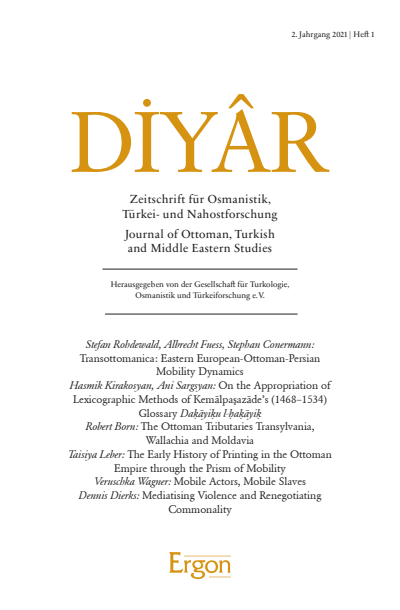
Transottomanica: Eastern European-Ottoman-Persian Mobility Dynamics
Inhaltsverzeichnis
Bibliographische Infos
Vollzugriff
DIYÂR
Jahrgang 2 (2021), Heft 1
- Autor:innen:
- Verlag
- Ergon, Baden-Baden
- Copyrightjahr
- 2021
- ISSN-Online
- 2942-3155
- ISSN-Print
- 2625-9842
Kapitelinformationen
Vollzugriff
Jahrgang 2 (2021), Heft 1
Transottomanica: Eastern European-Ottoman-Persian Mobility Dynamics
- Autor:innen:
- ISSN-Print
- 2625-9842
- ISSN-Online
- 2942-3155
- Kapitelvorschau:

Literaturverzeichnis
Es wurden keine Treffer gefunden. Versuchen Sie einen anderen Begriff.
- Adam, Volker. 2002. Rußlandmuslime in Istanbul am Vorabend des Ersten Weltkrieges. Die Berichterstattung osmanischer Periodika über Rußland und Zentralasien. Frankfurt a. M.: Lang. Google Scholar öffnen DOI: 10.5771/2625-9842-2021-1-5
- Aslanian, Sebouh David. 2011. From the Indian Ocean to the Mediterranean. The Global Trade Networks of Armenian Merchants from New Julfa. Berkeley: University of California Press. Google Scholar öffnen DOI: 10.5771/2625-9842-2021-1-5
- Babaie, Sussan et al. 2004. Slaves of the Shah. New Elites of Safavid Iran. London: I.B. Tauris. Google Scholar öffnen DOI: 10.5771/2625-9842-2021-1-5
- Babayan, Kathryn. 2002. Mystics, Monarchs, and Messiahs. Cultural Landscapes of Early Modern Iran. Cambridge: Harvard University Press. Google Scholar öffnen DOI: 10.5771/2625-9842-2021-1-5
- Bachmann-Medick, Doris. 2014 (ed.). The Trans/National Study of Culture. A Translational Perspective. Berlin, Boston: DeGruyter. Google Scholar öffnen DOI: 10.5771/2625-9842-2021-1-5
- Baumbach, Sibylle; Michaelis, Beatrice, and Nünning, Ansgar (eds.). 2012. Travelling Concepts, Metaphors, and Narratives. Literary and Cultural Studies in an Age of Interdisciplinary Research. Trier: Wissenschaftlicher Verlag Trier. Google Scholar öffnen DOI: 10.5771/2625-9842-2021-1-5
- Darwin, John. 2007. After Tamerlane. The Global History of Empire since 1405. London: Allen Lane. Google Scholar öffnen DOI: 10.5771/2625-9842-2021-1-5
- Diogo, Maria Paula and van Laak, Dirk. 2016. Europeans Globalizing. Mapping, Exploiting, Exchanging. London: Palgrave Macmillan. Google Scholar öffnen DOI: 10.5771/2625-9842-2021-1-5
- Droz, Yvan and Sottas, Beat. 1997. ‘Partir ou Rester? Partir et Rester. Migrations des Kikuyu au Kenya’. L’Homme. 142. 69–88. Google Scholar öffnen DOI: 10.5771/2625-9842-2021-1-5
- Faroqhi, Suraiya. 2004. The Ottoman Empire and the World Around it. 1540s to 1774. London: I.B. Tauris. Google Scholar öffnen DOI: 10.5771/2625-9842-2021-1-5
- Faroqhi, Suraiya. 2019. The Ottoman and Mughal Empires. Social History in the Early Modern World. London: I.B. Tauris. Google Scholar öffnen DOI: 10.5771/2625-9842-2021-1-5
- Fuess, Albrecht and Hartung, Jan-Peter (eds.). 2011. Court Cultures in the Muslim World (7th–19th Centuries). London: Routledge. Google Scholar öffnen DOI: 10.5771/2625-9842-2021-1-5
- Hahn, Hans Peter and Klute, Georg. 2007. ‘Cultures of Migration. Introduction’. In Hahn, Hans Peter and Klute, Georg (eds.). Cultures of Migration. Berlin: Lit. 9–27. Google Scholar öffnen DOI: 10.5771/2625-9842-2021-1-5
- Harpviken, Kristian Berg. 2009. Social Networks and Migration in Wartime Afghanistan. London: Palgrave Macmillan. Google Scholar öffnen DOI: 10.5771/2625-9842-2021-1-5
- Helmedach, Andreas et al. (eds). 2014. Das osmanische Europa. Methoden und Perspektiven der Frühneuzeitforschung zu Südosteuropa. Leipzig: Eudora. Google Scholar öffnen DOI: 10.5771/2625-9842-2021-1-5
- Högselius, Per; Kaijser, Arne, and van der Vleuten, Erik. 2015. Europe’s Infrastructure Transition. Economy, War, Nature. London: Palgrave Macmillan. Google Scholar öffnen DOI: 10.5771/2625-9842-2021-1-5
- Jobst, Kerstin. 2007. Die Perle des Imperiums. Der russische Krim-Diskurs im Zarenreich. Konstanz: UVK. Google Scholar öffnen DOI: 10.5771/2625-9842-2021-1-5
- Kappeler, Andreas. 1982. Rußlands erste Nationalitäten. Das Zarenreich und die Völker der Mittleren Wolga vom 16. bis 19. Jahrhundert. Köln, Wien: Böhlau. Google Scholar öffnen DOI: 10.5771/2625-9842-2021-1-5
- Kasaba, Reşat. 2009. The Moveable Empires. Ottoman Nomads, Migrants, and Refugees. Seattle: University of Washington Press. Google Scholar öffnen DOI: 10.5771/2625-9842-2021-1-5
- Kizilov, Mikhail. 2007. ‘Slave Trade in the Early Modern Crimea From the Perspective of Christian, Muslim, and Jewish Sources’. Journal of Early Modern History 11.1. 1–31. Google Scholar öffnen DOI: 10.5771/2625-9842-2021-1-5
- Kołodziejczyk, Dariusz. 2012. ‘Between Universalistic Claims and Reality. Ottoman Frontiers in the Early Modern Period’. In Woodhead, Christine. (ed.). The Ottoman World. London, New York: Routledge. 205–219. Google Scholar öffnen DOI: 10.5771/2625-9842-2021-1-5
- Kreiser, Klaus. 2011. ‘Wissenschaftswandel im Osmanischen Reich des 18. Jahrhunderts?’. In Schmidt-Haberkamp, Barbara (ed.). Europa und die Türkei im 18. Jahrhundert. Bonn: V&R Unipress, Bonn University Press. 433–446. Google Scholar öffnen DOI: 10.5771/2625-9842-2021-1-5
- Kunt, Metin. 1975. ‘Kulların Kulları’. Boğaziçi Üniversitesi Dergisi. Hümaniter Bilimler. 3. 27–59. Google Scholar öffnen DOI: 10.5771/2625-9842-2021-1-5
- Neumann, Birgit and Nünning, Ansgar (eds.). 2012. Travelling Concepts for the Study of Culture. Berlin: De Gruyter. Google Scholar öffnen DOI: 10.5771/2625-9842-2021-1-5
- Podskalsky, Gerhard. 1988. Griechische Theologie in der Zeit der Türkenherrschaft 1453-1821. Die Orthodoxie im Spannungsfeld der Nachreformatorischen Konfessionen des Westens. München: Beck. Google Scholar öffnen DOI: 10.5771/2625-9842-2021-1-5
- Poros, Maritsa V. 2011. Modern Migrations. Gujarati Indian Networks in New York and London. Stanford: Stanford University Press. Google Scholar öffnen DOI: 10.5771/2625-9842-2021-1-5
- Rohdewald, Stefan; Conermann, Stephan, and Fuess, Albrecht (eds.). 2019. Transottomanica. Osteu¬ropäisch-osmanisch-persische Mobilitätsdynamiken. Perspektiven und Forschungsstand. Göttingen: Van¬denhoeck & Ruprecht. https://www.vandenhoeck-ruprecht-verlage.com/themen-entdecken/geschichte/geschichte-der-fruehen-neuzeit/27422/transottomanica-osteuropaeisch-osmanisch-persische-mobilitaetsdynamiken (accessed: 25 January 2021). Google Scholar öffnen DOI: 10.5771/2625-9842-2021-1-5
- Sarıkaya, Yaşar. 2005. Abū Saīd Muhammad al-Hādimī (1701–1762). Netzwerke, Karriere und Einfluss eines Osmanischen Provinzgelehrten. Hamburg: Kovač. Google Scholar öffnen DOI: 10.5771/2625-9842-2021-1-5
- Seegel, Steven. 2012. Mapping Europe’s Borderlands. Russian Cartography in the Age of Empire. Chicago: The University of Chicago Press. Google Scholar öffnen DOI: 10.5771/2625-9842-2021-1-5
- Tapper, Richard. 1997. Frontier Nomads of Iran. A Political and Social History of the Shahsevan. Cambridge: Cambridge University Press. Google Scholar öffnen DOI: 10.5771/2625-9842-2021-1-5
- Tolz, Vera. 2011. Russia’s Own Orient. The Politics of Identity and Oriental Studies in the Late Imperial and Early Soviet Periods. Oxford: Oxford University Press. Google Scholar öffnen DOI: 10.5771/2625-9842-2021-1-5
- Witzenrath, Christoph. 2015. ‘Sklavenbefreiung, Loskauf und Religion im Moskauer Reich’. In Grieser, Heike and Priesching, Nicole (eds.). Gefangenenloskauf im Mittelmeerraum. Ein interreligiöser Vergleich. Hildesheim: Olms. 287–310. Google Scholar öffnen DOI: 10.5771/2625-9842-2021-1-5
