Karl Hadank (1882–1945) and the Kurdisch-Persische Forschungen: Ambitions, Achievements, and Ideological Entanglements
Inhaltsverzeichnis
Bibliographische Infos
Vollzugriff
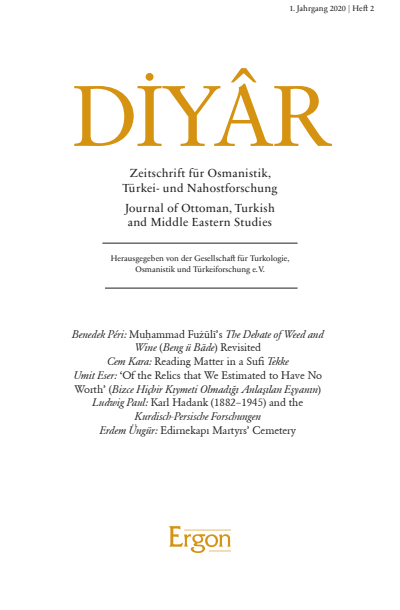
DIYÂR
Jahrgang 1 (2020), Heft 2
- Autor:innen:
- Verlag
- Ergon, Baden-Baden
- Copyrightjahr
- 2020
- ISSN-Online
- 2942-3155
- ISSN-Print
- 2625-9842
Kapitelinformationen
Vollzugriff
Jahrgang 1 (2020), Heft 2
Karl Hadank (1882–1945) and the Kurdisch-Persische Forschungen: Ambitions, Achievements, and Ideological Entanglements
- Autor:innen:
- ISSN-Print
- 2625-9842
- ISSN-Online
- 2942-3155
- Kapitelvorschau:
Literaturverzeichnis
Es wurden keine Treffer gefunden. Versuchen Sie einen anderen Begriff.
- Primary Sources: Google Scholar öffnen doi.org/10.5771/2625-9842-2020-2-219
- Alpay, Gönül. 1972. ‘Yusuf Emiri’nin Beng ü Çagır Adlı Münazarası’. Türk Dili ve Edebiyatı Araştırmaları Yıllığı–Belleten. 103–125. Google Scholar öffnen doi.org/10.5771/2625-9842-2020-2-219
- Araslı, Hǝmid. 2005. Fuzuli ǝsǝrleri. Altı cilddǝ. Volume II. Bakı: Şǝrq–Qǝrb. Google Scholar öffnen doi.org/10.5771/2625-9842-2020-2-219
- Atābakī, Parvīz (ed.). 1384 [2005]. Kulliyāt-i ʿUbayd-i Zākānī. Tihrān: Kitāb-furūšī-yi Zavvār. Google Scholar öffnen doi.org/10.5771/2625-9842-2020-2-219
- ʿAṭṭār, Farīd al-Dīn. 1365 [1986]. Manṭiq al-Ṭayr. Bi-ihtimām u taṣḥīḥ-i Ṣādiq Gauharīn. Tihrān: Intišārāt-i ʿIlmī u Farhangī. Google Scholar öffnen doi.org/10.5771/2625-9842-2020-2-219
- Babur Mirza, Zahiruddin Muhammad. 1993. Bâburnâma. Part Two. Chaghatay Turkish Text with Abdul-Rahim Khankhanan’s Persian Translation. Turkish Transcription, Persian Edition and English Translation by W. M. Thackston, Jr. Cambridge, Massachusetts: Department of Near Eastern Languages and Civilizations, Harvard University. Google Scholar öffnen doi.org/10.5771/2625-9842-2020-2-219
- Ciğa, Özkan. 2013. Süheyl ü Nev-bahâr. Metin–Aktarma, Art Zamanlı Anlam Değişmeleri Dizin. Master Thesis. Dicle Üniversitesi, Diyarbakır. Google Scholar öffnen doi.org/10.5771/2625-9842-2020-2-219
- Doğan, Ahmet Turan. 2015. Kitāb-i Ṭibb-i Ḥikmet. İnceleme–Metin–Dizin. PhD Dissertation. Cumhuriyet Üniversitesi, Sivas. Google Scholar öffnen doi.org/10.5771/2625-9842-2020-2-219
- Ergin, Muharrem. 1980. Kadı Burhaneddin divanı. İstanbul: İstanbul Üniversitesi. Google Scholar öffnen doi.org/10.5771/2625-9842-2020-2-219
- Esrār-nāme. Staatsbibliothek Berlin, Diez A oct. 144. Google Scholar öffnen doi.org/10.5771/2625-9842-2020-2-219
- Evliyâ Çelebi b. Derviş Mehemmde Zıllî. 1996. Evliya Çelebi Seyâhatnâmesi. 1. Kitap. Topkapı Sarayı Bağdat 304 Yazmasının Transkripsiyonu – Dizini. Edited by Robert Dankoff, Seyit Ali Kahraman, Yücel Dağlı. İstanbul: Yapı Kredi Yayınları. Google Scholar öffnen doi.org/10.5771/2625-9842-2020-2-219
- Ferīdūn Bey. 1265 [1848]. Mecmūʿa-i münşeʾât al-selāṭīn. Volume I. İstanbul. Google Scholar öffnen doi.org/10.5771/2625-9842-2020-2-219
- Fużūlī, Hekīm Mullā Muḥammad. 1389 [2010]. Beng ü Bāde. Muḳaddime, taṣḥīh, taşhiye Ḥüseyn Meḥmedzāde Ṣadīḳ. Tihrān: Takdiraḫt. Google Scholar öffnen doi.org/10.5771/2625-9842-2020-2-219
- Fuzúlí, Muhammad. 2016a. A Fű és a Bor vitája. Budapest: Jaffa–MTAK. Google Scholar öffnen doi.org/10.5771/2625-9842-2020-2-219
- Fuzûlî. 1955. Beng ü Bâde. Edited by Kemal Edib Kürkçüoğlu. İstanbul: Maarif Basımevi. Google Scholar öffnen doi.org/10.5771/2625-9842-2020-2-219
- Fuzûlî. 2016. Beng ü Bâde. Edited by Murat Kaymaz. İstanbul: Ötüken. Google Scholar öffnen doi.org/10.5771/2625-9842-2020-2-219
- Nevayî, Ali Şir. 1995. Lisānü’ṭ-Ṭayr. Edited by Mustafa Canpolat. Ankara: Türk Dil Kurumu. Google Scholar öffnen doi.org/10.5771/2625-9842-2020-2-219
- Niẓāmī Ganjavī. 1370 [1991]. Kulliyāt-i Ḫamsa. Bi-ihtimām-i M. Darvīš. Tihrān: Intišārāt-i Jāvidān. Google Scholar öffnen doi.org/10.5771/2625-9842-2020-2-219
- Şener, Mümin. 2010. Muhammed Hanefî Cengi. Metin-Muhteva-Tahlil. Master Thesis. Dokuz Eylül Üniversitesi, İzmir. Google Scholar öffnen doi.org/10.5771/2625-9842-2020-2-219
- Tabîb ibn Şerîf. 2017. Yâdigâr. 15. Yüzyıl Türkçe Tıp Kitabı. İstanbul: Merkezefendi Geleneksel Tıp Derneği. Google Scholar öffnen doi.org/10.5771/2625-9842-2020-2-219
- The Qur’ān. 2010. With Sūrah Introductions and Indices. Edited by A. B. al-Mehri. Birmingham: Maktabah Booksellers and Publishers. Google Scholar öffnen doi.org/10.5771/2625-9842-2020-2-219
- Üst, Sibel. 2011. Edirneli Nazmî dîvânı. İnceleme-tenkitli metin. PhD Dissertation. Atatürk Üniversitesi, Erzurum. Google Scholar öffnen doi.org/10.5771/2625-9842-2020-2-219
- Zülfe, Ömer (ed.). 2018. Fużūlī, Beng ü Bāde. İnceleme – Tenkitli Metin – Çeviri – Seçme Sözlük – Dizin – Tıpkıbasım. Cambirdge, Massachusetts: Department of Near Eastern Languages and Civilization, Harvard University. Google Scholar öffnen doi.org/10.5771/2625-9842-2020-2-219
- Secondary Sources: Google Scholar öffnen doi.org/10.5771/2625-9842-2020-2-219
- ʿAşkī, İbrāhīm. 1338 [1919]. Fużūlī Haḳḳında Bir İki Söz [A Few Words on Fużūlī]. İstanbul: Der-i Saʿādet–ʿAlī Şükrī Matbaʿası. Google Scholar öffnen doi.org/10.5771/2625-9842-2020-2-219
- Aynur, Hatice. 2012. ‘Türkî-i basît’ [The Türkī-i Basīṭ movement]. Türkiye Diyanet Vakfı İslâm Ansiklopedisi. 41. 555–556. Google Scholar öffnen doi.org/10.5771/2625-9842-2020-2-219
- Ayverdi, Samiha. 1953. Edebî ve manevî dünyası içinde Fatih [Fātiḥ in His Literary and Spiritual World]. İstanbul: Halk Basımevi. Google Scholar öffnen doi.org/10.5771/2625-9842-2020-2-219
- Babacan, Meryem. 2017. ‘Berlin Devlet Kütüphanesinde Bulunan Bir Mecmûa ve Müellifi Bilinmeyen Bir Eser: Esrâr-nâme’ [A Collected Volume Preserved in the State Library of Berlin and a Work by an Unknown Author: Esrār-nāme]. Amasya Sosyal Bilimler Dergisi. 1.2. 1–34. Google Scholar öffnen doi.org/10.5771/2625-9842-2020-2-219
- Bahadır, Savaşkan Cem. 2013. Divan edebiyatında şarap ve şarapla ilgili unsurlar [Wine and Elements Connected to Wine in Classical Literature]. İstanbul: Kitabevi. Google Scholar öffnen doi.org/10.5771/2625-9842-2020-2-219
- Budak, Ali and Kanar, Mehmet. 2017. Fuzûlî’nin Yaşadıgı Çağa Eleştirel Tanıklığı. Beng ü Bâde [Beng ü Bāde: A Critical Source for Fużūlī’s Age]. İstanbul: Bilge Kültür Sanat. Google Scholar öffnen doi.org/10.5771/2625-9842-2020-2-219
- Çelebioğlu, Âmil. 1998. ‘Kiyafe(t) İlmi ve Akşemseddinzâde Hamdullah Hamdi ile Erzurumlu İbrahim Hakkı’nın Kıyâfetnâmeleri’ [The Science of Physiognomy and the Kıyafetnāme’s of Akşemseddinzāde Ḥamdullāh Ḥamdī and Erzurumlu İbrāhīm Ḥaḳḳī]. In Çelebioğlu, Âmil (ed.). Eski Türk Edebiyatı Araştırmaları [Classical Turkish Literature Studies]. İstanbul: Milli Eğitim Bakanlığı. 225–262. Google Scholar öffnen doi.org/10.5771/2625-9842-2020-2-219
- Demirel, Hamide. 1991. The Poet Fuzûlî. Ankara: Ministry of Culture. Google Scholar öffnen doi.org/10.5771/2625-9842-2020-2-219
- Doğan, Muhammet Nur. 2008. ‘Divan şiirinde “şarap” metaforları’ [Metaphors for Wine in Classical Literature]. Türk Dili ve Edebiyatı Dergisi. 38. 65–66. Google Scholar öffnen doi.org/10.5771/2625-9842-2020-2-219
- Doğru, Halime. 1997. XV. ve XVI. Yüzyıllarda Sivrihisar Nahiyesi [The Township of Sivrihisar in the Fifteenth–Sixteenth Centuries]. Ankara: Türk Tarih Kurumu. Google Scholar öffnen doi.org/10.5771/2625-9842-2020-2-219
- Eren, Ercan. 2007. ‘Bira yoksa boza da mı yok?’ [If Beer is Not Available, Boza isn’t Available Either?]. In Turan, Ahmet Nezihi (ed.). Acısıyla Tatlısıyla Boza. Bir imparatorluk meșrûbatının tarihi, coğrafyası, kimyası, edebiyatı. [Boza, Sour and Sweet. The History, Geography, Chemistry, and Literature of an Imperial Beverage]. Ankara: Kültür ve Turizm Bakanlığı. 33–46. Google Scholar öffnen doi.org/10.5771/2625-9842-2020-2-219
- Erődi, Béla. 1875. Török mozaik [Turkish Mosaic]. Budapest: Published by the author. Online edition available at http://terebess.hu/keletkultinfo/erodi.html (accessed 25 September 2019). Google Scholar öffnen doi.org/10.5771/2625-9842-2020-2-219
- Ethé, Hermann. 1882. ‘Über persische Tenzonen’. In Verhandlungen des fünften internationalen Orientalisten-Congresses gehalten zu Berlin im September 1881. Zweiter Teil. Abhandlungen und Vorträge. Erste Hälfte. Abhandlungen und Vorträge der semitischen und afrikanischen Section. Berlin: Weidmannsche Buchhandlung. Google Scholar öffnen doi.org/10.5771/2625-9842-2020-2-219
- Ferīdūn Bey. 1265 [1848]. Mecmūʿa-i münşeʾât al-selāṭīn [A Collection of Royal Correspondence]. Volume I. İstanbul. Google Scholar öffnen doi.org/10.5771/2625-9842-2020-2-219
- Gibb, Elias John Wilkinson. 1882. Ottoman Poems Translated into English Verse in the Original Forms. With Introduction, Biographical Notices and Notes. London: Trubner & Co. Google Scholar öffnen doi.org/10.5771/2625-9842-2020-2-219
- Gibb, Elias John Wilkinson. 1901. Ottoman Literature. The Poets and Poetry of Turkey. Translated from the Arabic [sic!] with Introduction and Biographical Notes. Washington, London: M. Walter Dunne. Google Scholar öffnen doi.org/10.5771/2625-9842-2020-2-219
- Gibb, Elias John Wilkinson. 1904. A History of Ottoman Poetry. Volume III. London: Luzac & Co. Google Scholar öffnen doi.org/10.5771/2625-9842-2020-2-219
- Güler, Kadir and Ersoy, Ersen. 2012. ‘XVI. Asır Bursa Zanaatkârları Hakkında Secili Mizâhî Bir Eser. Sun’î Çelebî’nin Tezyîn-nâmesi’ [A Text in Rhymed Prose on the Craftsmen of Sixteenth-Century Bursa. The Tezyīn-nāme of Ṣun’ī Çelebī]. Turkish Studies. 7.3. 1281–1309. Google Scholar öffnen doi.org/10.5771/2625-9842-2020-2-219
- Guluzade, Mirzağa. 1965. Fuzulinin lirikası [The Lyrical Art of Fużūlī]. Bakı: Azǝrbaycan SSR Elmlǝr Akademiyası. Google Scholar öffnen doi.org/10.5771/2625-9842-2020-2-219
- Hammer-Purgstall, Joseph von. 1837. Geschichte der Osmanischen Dichtkunst. Volume II. Pest: Conrad Adolph Hartleben’s Verlag. Google Scholar öffnen doi.org/10.5771/2625-9842-2020-2-219
- Hauenschild, Ingeborg and Schönig, Claus. 2012. ‘Drogen im Bābur-nāme’. In Heuer, Brigitte; Kellner-Heinkele, Barbara and Schönig, Claus (eds.). „Die Wunder der Schöpfung”. Mensch und Natur in der türksprachigen Welt. Würzburg: Ergon Verlag. 217–230. Google Scholar öffnen doi.org/10.5771/2625-9842-2020-2-219
- İpekten, Haluk. 2002. Eski Türk edebiyatı nazım şekilleri ve aruz [Verse Forms and Prosody in Classical Turkish Literature]. İstanbul: Dergâh Yayınları. Google Scholar öffnen doi.org/10.5771/2625-9842-2020-2-219
- Kia, Mehrdad. 2011. Daily Life in the Ottoman Empire. Santa Barbara: ABC–Clio. Google Scholar öffnen doi.org/10.5771/2625-9842-2020-2-219
- Köprülü-zāde Meḥmed Fuʾād. 1924. Fużūlī Ḥayātı ve Eseri [The Life and Works of Fużūlī]. İstanbul: Şarḳ Kütübḫānesi. Google Scholar öffnen doi.org/10.5771/2625-9842-2020-2-219
- Kreutel, Richard. 1978. Der fromme Sultan Bayezid. Die Geschichte seiner Herrschaft (1481–1512) nach den altosmanischen Chroniken des Oruç und das Anonymus Haniwaldanus. Graz: Verlag Styria. Google Scholar öffnen doi.org/10.5771/2625-9842-2020-2-219
- Mangan, James Clarence. 1838. ‘Turkish Poetry. Third Article’. The Dublin University Magazine. 12. 341–346. Google Scholar öffnen doi.org/10.5771/2625-9842-2020-2-219
- Matthee, Rudi. 2005. The Pursuit of Pleasure. Drugs and Stimulants in Iranian History. 1500–1900. Princeton: Princeton University Press. Google Scholar öffnen doi.org/10.5771/2625-9842-2020-2-219
- Mazıoğlu, Hasibe. 1997. ‘Fuzûlî kimleri övmüştür’ [Whom Did Fużūlī Praise?]. In Mazıoğlu, Hasibe. Fuzûlî üzerine makaleler [Articles on Fużūlī]. Ankara: Türk Dil Kurumu. 101–155. Google Scholar öffnen doi.org/10.5771/2625-9842-2020-2-219
- Nasrallah, Nawal. 2007. Annals of the Caliph’s Kitchen. Ibn Sayyār al-Warāq’s Tenth Century Baghdadi Cookbook. Leiden: Brill. Google Scholar öffnen doi.org/10.5771/2625-9842-2020-2-219
- Naẓīf, Süleymān. 1343 [1925]. Fużūlī. Şāʿir-i Şehīr’in Hayāt ve Āsārı Ḥaḳḳında Baʿż-i Maʿlūmāt ve Tadḳīḳāt [A Few Pieces of Information and Research on the Life and Works of the Famous Poet Fużūlī]. İstanbul: Yeŋi Matbaʿa. Google Scholar öffnen doi.org/10.5771/2625-9842-2020-2-219
- Olgun, Tahir. 1936. Fuzûlîye Dâ’ir. [On Fużūlī]. İstanbul: Selâmet Basımevi. Google Scholar öffnen doi.org/10.5771/2625-9842-2020-2-219
- Özmen, Mehmet. 2001. Ahmed-i Dâ’î divanı [The Divan of Aḥmed-i Dāʿī]. Ankara: Türk Dil Kurumu. Google Scholar öffnen doi.org/10.5771/2625-9842-2020-2-219
- Paşayev, Mir Cǝlal. 2018. Füzuli Sǝnǝtkarlığı [The Art of Fużūlī]. Bakı: Çaşıoğlu. Google Scholar öffnen doi.org/10.5771/2625-9842-2020-2-219
- Péri, Bendek. 2016a. ‘“It is the Weed of Lovers”. The Use of Cannabis Among Turkic Peoples up to the Late 15th Century’. Acta Orientalia Academiae Scientiarum Hungaricae. 69.2. 139–155. Google Scholar öffnen doi.org/10.5771/2625-9842-2020-2-219
- Péri, Benedek. 2016b. ‘Az érem két oldala: Muhammed Fuzúlí Beng ü Báde című elbeszélő költeménye és a az ismeretlen szerző Eszrár-náméja’ [Two Sides of the Same Coin. Fużūlī’s Narrative Poem titled Beng ü Bāde and the Unknown Author’s Esrār-nāme]. Keletkutatás. 2016 ősz. 107–122. Google Scholar öffnen doi.org/10.5771/2625-9842-2020-2-219
- Péri, Benedek. 2016c. ‘A Janissary’s Son Turned Druggist and His Highly Successful Designer Drug in 16th–17th Century Istanbul. Rahîkî (d. 954/1547) and His Berş’. In Emecen, Feridun M.; Akyıldız, Ali and Gürkan, Emrah Safa (eds.). Osmanlı İstanbulu IV [Ottoman Istanbul IV]. İstanbul: İstanbul 29 Mayıs Üniversitesi. Google Scholar öffnen doi.org/10.5771/2625-9842-2020-2-219
- Péri, Benedek. 2017a. ‘Cannabis (Esrār). A Unique Semantic Field in Classical Ottoman Lyric Poetry’. Turcica. 48. 9–36. Google Scholar öffnen doi.org/10.5771/2625-9842-2020-2-219
- Péri, Benedek. 2017b. ‘16. yüzyılda vuku bulmuş bir tövbenin hikayesi, bir şarapçı şairin Allah’a dönmesi’ [A Sixteenth-Century Conversion Story. How a Drunkard Poet Turned to God]. In Ölmez, Mehmet; Çulha, Tülay and Özçetin, Kübra (eds.). Divanu Lugati’t-Turk’ten Senglah’a Türkçe. Doğumunun 60. Yılında Mustafa S. Kaçalin Armağanı [From Dīvān al-Luġat at-Turk to Senglāḫ. Festive Volume for Mustafa Kaçalin’s Sixtieth Birthday]. İstanbul: Kesit Yayınları. 521–537. Google Scholar öffnen doi.org/10.5771/2625-9842-2020-2-219
- Péri, Benedek. 2019. ‘Gyógyszerből hangulatjavító. Egy partidrog karrierje az Oszmán Birodalomban’ [From Medicine to Mood Enhancer. The Carreer of a Party Drug in the Ottoman Empire]. Szabolcs–Szatmár–Beregi Szemle. 54.2. 45–56. Google Scholar öffnen doi.org/10.5771/2625-9842-2020-2-219
- Ruck, Carl A. P. et al. 2008. ‘Entheogen’. In Wasson, R. Gordon; Ruckand, Carl A.O. and Hofmann, Albert (eds.). The Road to Eleusis. Unveiling the Secret of the Mysteries. Berkeley, California: North Atlantic Books. 137–139. Google Scholar öffnen doi.org/10.5771/2625-9842-2020-2-219
- Rustamov, Ergash R. 1963. Uzbeksaĭa poeziĭa pervoĭ polovine XV. veka [Uzbek Literature in the First Half of the Fifteenth Century]. Moskva: Izdatel’stvo Vostochnoĭ Literatury. Google Scholar öffnen doi.org/10.5771/2625-9842-2020-2-219
- Seidzade, A. A. 1958. ‘O dobagdadskom periode tvorčestva Fuzuli’ [On Fużūlī’s Works Before His Baghdad Period]. In 400 letiĭe Fizuli [Four Hundred Years of Fużūlī]. Baku: Akademiĭa Nauk Azerbaijanskoĭ SSR 1958. 9–37. Google Scholar öffnen doi.org/10.5771/2625-9842-2020-2-219
- Shefer-Mossensohn, Miri. 2009. Ottoman Medicine. Healing and Medical Institutions. Albany: State University of New York Press. Google Scholar öffnen doi.org/10.5771/2625-9842-2020-2-219
- Thiesen, Finn. 1982. A Manual of Classical Persian Prosody. With Chapters on Urdu, Karakhanidic and Ottoman Prosody. Wiesbaden: Otto Harrassowitz. Google Scholar öffnen doi.org/10.5771/2625-9842-2020-2-219
- Turan, Ahmet Nezihi. 2007. Acısıyla Tatlısıyla Boza. Bir imparatorluk meșrûbatının tarihi, coğrafyası, kimyası, edebiyatı [Boza, Sour and Sweet. The History, Geography, Chemistry, and Literature of an Imperial Beverage]. Ankara: Kültür ve Turizm Bakanlığı. Google Scholar öffnen doi.org/10.5771/2625-9842-2020-2-219
- Uluçay, Ömer. 1993. Şah Hatayi ve Alevilik. İnanç, Töre, Öge, Ahlak [Şah Hatayi and Alevism. Faith, Customs, Elements, Spirituality]. Adana: Ö. Uluçay. Google Scholar öffnen doi.org/10.5771/2625-9842-2020-2-219
- Ünver, İsmail. 1986. ‘Mesnevî’. Türk Dili. Türk Şiiri Özel Sayısı. Divan Şiiri. 415–417, 430–562. Google Scholar öffnen doi.org/10.5771/2625-9842-2020-2-219
- Vanlıoğlu, Mehmet. 1997. ‘Beng u Bade ve muhtevası’ [Beng ü Bāde and Its Content]. Türkiyat Araştırmaları Dergisi. 3. 197–200. Google Scholar öffnen doi.org/10.5771/2625-9842-2020-2-219
- Vincze, Frigyes. 1912. Az oszmán irodalom főirányai [The Main Trends in Ottoman Literature]. Budapest: A Nemzetközi Közép- és Kelet-Ázsiai Társaság Magyar Bizottsága. Google Scholar öffnen doi.org/10.5771/2625-9842-2020-2-219
- Yarshater, Ihsan. 1960. ‘The Theme of Wine-drinking and the Concept of the Beloved in Early Persian Poetry’. Studia Islamica. 13. 43–53. Google Scholar öffnen doi.org/10.5771/2625-9842-2020-2-219
- Yıldırım, Ali. 2004. ‘Fuzuli’nin Beng ü Bade mesnevisi ve bade sembolü’ [Fużūlī ’s Beng ü Bāde and the Symbol of Wine]. Fırat Üniversitesi Sosyal Bilimler Dergisi. 14.2. 139–146. Google Scholar öffnen doi.org/10.5771/2625-9842-2020-2-219
- Unpublished Primary Sources: Google Scholar öffnen doi.org/10.5771/2625-9842-2020-2-240
- Arkivi Qendror i Shtetit (AQSH), Tirana, Albania Google Scholar öffnen doi.org/10.5771/2625-9842-2020-2-240
- Koleksion (K) 725. Google Scholar öffnen doi.org/10.5771/2625-9842-2020-2-240
- Dorëshkrimet Osmane (DO) 81, 156, 157, 199. Google Scholar öffnen doi.org/10.5771/2625-9842-2020-2-240
- Başbakanlık Osmanlı Arşivi (BOA), Istanbul, Turkey Google Scholar öffnen doi.org/10.5771/2625-9842-2020-2-240
- Hatt-ı Hümayyun (HAT) 290.17386, 04 August 1826; 17322, 04 August 1826. Google Scholar öffnen doi.org/10.5771/2625-9842-2020-2-240
- Mektubi Kalemi (MF.MKT) 16.177, 15 January 1874; 17.63, 28 Feburary 1874. Google Scholar öffnen doi.org/10.5771/2625-9842-2020-2-240
- Primary Sources: Google Scholar öffnen doi.org/10.5771/2625-9842-2020-2-240
- Aḥmed Rıfḳı (ed.). 1921. Bektāşī Nefesler. Istanbul. Google Scholar öffnen doi.org/10.5771/2625-9842-2020-2-240
- Aḥmed Rifʿat. 1876. Mirʾātü’l-Mekāsıd fī defʿīl-Mefāsid. Istanbul. Google Scholar öffnen doi.org/10.5771/2625-9842-2020-2-240
- ʿAlī Rifʿat et al. (ed.). 1933. Bektaşî Nefesleri I & II. Türk Musikisi Klasiklerinden Dördüncü Cilt. Istanbul. Google Scholar öffnen doi.org/10.5771/2625-9842-2020-2-240
- Aslanoğlu, İbrahim. 1976. Kul Himmet Üstadım. Sivas: Emek Matbaa. Google Scholar öffnen doi.org/10.5771/2625-9842-2020-2-240
- Duran, Hamiye (ed.). 2007. Alevî-Bektâşî Klasikleri. Besmele Tefsiri. Ankara: Türkiye Diyanet Vakfı. Google Scholar öffnen doi.org/10.5771/2625-9842-2020-2-240
- Ergün, Sadeddin Nüzhet (ed.). 1929. XVII.inci Asır Sazşairlerinden Pir Sultan Abdal. Istanbul: Evkaaf Matbaası. Google Scholar öffnen doi.org/10.5771/2625-9842-2020-2-240
- Ergün, Sadeddin Nüzhet (ed.). 1946. Hatâyî Divanı. Şah İsmail Safevî. Edebî Hayatı ve Nefesleri. Istanbul: Maarif Kitaphanesi. Google Scholar öffnen doi.org/10.5771/2625-9842-2020-2-240
- Esad Efendi. 2005 (1828). Üss-i Ẓafer. Yençeriliğin Kaldırılmasına Dair. Edited by Mehmet Arslan. Istanbul: Kitabevi. Google Scholar öffnen doi.org/10.5771/2625-9842-2020-2-240
- Fuzulî. 1987. Ḥadīḳat üs-Süʿedā. Edited by Şeyma Güngör. Ankara: Başbakanlık Basımevı. Google Scholar öffnen doi.org/10.5771/2625-9842-2020-2-240
- Gölpınarlı, Abdülbaki (ed.). 1953. Kaygusuz Abdal. Hatayi. Kul Himmet. Istanbul: Varlık Yayınevi. Google Scholar öffnen doi.org/10.5771/2625-9842-2020-2-240
- Gölpınarlı, Abdülbaki (ed.). 1961. Fuzulî Divanı. Istanbul: İnkilap. Google Scholar öffnen doi.org/10.5771/2625-9842-2020-2-240
- Gölpınarlı, Abdülbaki (ed.). 1995. Vilâyet-Nâme. Manâkıb-ı Hünkâr Hacı Bektaş-ı Veli. Istanbul: İnkilap. Google Scholar öffnen doi.org/10.5771/2625-9842-2020-2-240
- Gölpınarlı, Abdülbaki and Boratav, Pertev N. (eds.). 2010 (1943). Pir Sultan Abdal. Istanbul: Derin Yayınları. Google Scholar öffnen doi.org/10.5771/2625-9842-2020-2-240
- Ḫarpūtlu İsḥaḳ Ḫoca. 1874. Kāşifü‘l-Esrār ve Dafiʿü‘l-Eşrār. Istanbul. Google Scholar öffnen doi.org/10.5771/2625-9842-2020-2-240
- Kemāleddīn Şükrü. 1928. İslām Tārīḫinde Nifāk-ı Kerbela. Istanbul. Google Scholar öffnen doi.org/10.5771/2625-9842-2020-2-240
- Türābī Dedebaba. 1877. Dīvān-ı Türābī. Istanbul. Google Scholar öffnen doi.org/10.5771/2625-9842-2020-2-240
- Uçman, Abdullah (ed.). 1982. Rıza Tevfik’in Tekke ve Halk Edebiyatı ile ilgili Makaleleri. Ankara: Kültür ve Turizm Bakanlığı Yayınları. Google Scholar öffnen doi.org/10.5771/2625-9842-2020-2-240
- Vilāyetnāme. 1853. Istanbul. Google Scholar öffnen doi.org/10.5771/2625-9842-2020-2-240
- Vilāyetnāme. 1871. Istanbul. Google Scholar öffnen doi.org/10.5771/2625-9842-2020-2-240
- Yemînî, Dervîş Muhammed. 2002. Fazîlet-nâme. 2 vols. Edited by Yusuf Tepeli. Ankara: Türk Dil Kurumu Yayınları. Google Scholar öffnen doi.org/10.5771/2625-9842-2020-2-240
- Yılmaz, Ali et al. (eds.). 2013. Alevî-Bektâşî Klasikleri. Maḳâlât. Hünkâr Hacı Bektâş-ı Velî. 5th ed. Ankara: Türkiye Diyanet Vakfı. Google Scholar öffnen doi.org/10.5771/2625-9842-2020-2-240
- Secondary Sources: Google Scholar öffnen doi.org/10.5771/2625-9842-2020-2-240
- Arpa, Recep. 2012. ‘Tibyân Tefsiri’. Türkiye Diyanet Vakfı İslâm Ansiklopedisi. 41. 127–128. Google Scholar öffnen doi.org/10.5771/2625-9842-2020-2-240
- Assmann, Aleida and Assman, Jan. 1987. ‘Kanon und Zensur’. In Assmann, Aleida and Assman, Jan (eds.). Kanon und Zensur. Beiträge zur Archäologie der literarischen Kommunikation II. München: Fink. 7–27. Google Scholar öffnen doi.org/10.5771/2625-9842-2020-2-240
- Aykaç, Mehmet. 1993. ‘Cemâl el-Hüseynî’. Türkiye Diyanet Vakfı İslâm Ansiklopedisi. 7. 303–304. Google Scholar öffnen doi.org/10.5771/2625-9842-2020-2-240
- Burak, Guy. 2013. ‘Faith, Law and Empire in the Ottoman ‘Age of Confessionalization’ (Fifteenth–Seventeenth Centuries). The Case of ‘Renewal of Faith’’. Mediterranean Historical Review. 28.1. 1–23. Google Scholar öffnen doi.org/10.5771/2625-9842-2020-2-240
- Çift, Salih. 2011. ‘Mısır’da bir Bektaşî Dergâhı Kütüphânesi’ [A Bektashi Dergāh Library in Egypt]. Tasavvuf. 28. 13–39. Google Scholar öffnen doi.org/10.5771/2625-9842-2020-2-240
- Clayer, Nathalie. 1990. L’Albanie, pays des derviches. Les ordres mystiques musulmans en Albanie à l’époque post-ottomane (1912–1967). Wiesbaden: Harrassowitz. Google Scholar öffnen doi.org/10.5771/2625-9842-2020-2-240
- Clayer, Nathalie. 2011. ‘The Dimension of Confessionalisation in the Ottoman Balkans at the Time of Nationalisms’. In Grandits, Hannes et al. (eds.). Conflicting Loyalties in the Balkans. The Great Powers, the Ottoman Empire and Nation-Building. London: I.B. Tauris. 89–109. Google Scholar öffnen doi.org/10.5771/2625-9842-2020-2-240
- Clayer, Nathalie. 2013a. Arnavutluk Milliyetçiliğinin Kökenleri. Avrupa’da Çoğunluğu Müslüman bir Ulusun Doğuşu [Original title: Aux origines du nationalisme albanais. La naissance d’une nation majoritairement musulmane en Europe]. Istanbul: İstanbul Bilgi Üniversitesi Yayınları. Google Scholar öffnen doi.org/10.5771/2625-9842-2020-2-240
- Clayer, Nathalie. 2013b. ‘Autorité locale et autorité supra-locale chez les Bektachis d’Albanie dans l’entre-deux-guerres’. In Clayer, Nathalie et al. (eds.). L’autorité religieuse et ses limites en terres d’islam. Approches historiques et anthropologiques. Leiden, Boston: Brill. 159–194. Google Scholar öffnen doi.org/10.5771/2625-9842-2020-2-240
- Demirli, Ekrem. 2007. ‘Niyâzî Mısrî. Tasavvufî Görüşleri’ [Niyāzī-i Mıṣrī. His Sufi Views]. Türkiye Diyanet Vakfı İslâm Ansiklopedisi. 33. 169. Google Scholar öffnen doi.org/10.5771/2625-9842-2020-2-240
- Doja, Albert. 2006. ‘A Political History of Bektashism in Albania’. Totalitarian Movements and Political Religions. 7.1. 83–107. Google Scholar öffnen doi.org/10.5771/2625-9842-2020-2-240
- Dressler, Markus. 2015. Writing Religion. The Making of Turkish Alevi Islam. Oxford, New York: Oxford University Press. Google Scholar öffnen doi.org/10.5771/2625-9842-2020-2-240
- Erünsal, Ismail. 1987. ‘Catalogues and Cataloguing in the Ottoman Libraries’. Libri. 37.4. 333–349. Google Scholar öffnen doi.org/10.5771/2625-9842-2020-2-240
- Erünsal, İsmail. 1988. Türk Kütüphaneleri Tarihi. Kuruluştan Tanzimat’a kadar Osmanlı Vakıf Kütüphaneleri [The History of Turkish Libraries. Ottoman Foundation Libraries from the Beginning to the Tanzimat Era]. Ankara: Atatürk Kültür Merkezi. Google Scholar öffnen doi.org/10.5771/2625-9842-2020-2-240
- Erünsal, İsmail E. 2004. ‘Ottoman Foundation Libraries in the Age of Reform. The Final Period’. Libri. 54.4. 247–255. Google Scholar öffnen doi.org/10.5771/2625-9842-2020-2-240
- Erünsal, Ismail. 2008. Ottoman Libraries. A Survey of the History, Development and Organization of Ottoman Foundation Libraries. Cambridge, Massachusetts: Department of Near Eastern Languages and Literatures, Harvard University. Google Scholar öffnen doi.org/10.5771/2625-9842-2020-2-240
- Faroqhi, Suraiya. 1981. Der Bektaschi-Orden in Anatolien (Vom späten fünfzehnten Jahrhundert bis 1826). Wien: Verlag des Instituts für Orientalistik der Universität Wien. (Wiener Zeitschrift für die Kunde des Morgenlandes. Sonderband 2). Google Scholar öffnen doi.org/10.5771/2625-9842-2020-2-240
- Faroqhi, Suraiya. 2003. Kultur und Alltag im Osmanischen Reich. Vom Mittelalter bis zum Anfang des 20. Jahrhunderts. 2nd ed. München: C.H. Beck. Google Scholar öffnen doi.org/10.5771/2625-9842-2020-2-240
- Ferdi, Rexheb. 2016. Islamic Mysticism and the Bektashi Path. Edited by Huseyin Abiva. Tirana: Kyregjyshata Boterore Bektashiane. Google Scholar öffnen doi.org/10.5771/2625-9842-2020-2-240
- Gölpınarlı, Abdülbaki. 1967–1972. Mevlânâ Müzesi. Yazmalar Kataloğu [The Mevlānā Museum. Catalogue of Manuscripts]. 3 vols. Ankara: Türk Tarih Kurumu Basımevi. Google Scholar öffnen doi.org/10.5771/2625-9842-2020-2-240
- Griffel, Frank. 2009. Al-Ghazālī’s Philosophical Theology. Oxford, New York: Oxford University Press. Google Scholar öffnen doi.org/10.5771/2625-9842-2020-2-240
- Heß, Michael Reinhard. 2009. Die Sprache des Menschengottes. Untersuchungen zu Imād äd-Dīn Näsīmīs (fl. ca. 1400) türkischem Divan. Aachen: Shaker. Google Scholar öffnen doi.org/10.5771/2625-9842-2020-2-240
- Hirschler, Konrad. 2012. The Written Word in the Medieval Arabic Lands. A Social and Cultural History of Reading Practices. Edinburgh: Edinburgh University Press. Google Scholar öffnen doi.org/10.5771/2625-9842-2020-2-240
- İstek, Emrah et al. 2017. ‘Rize Güneyce Osmân Niyâzî Efendi Tekke Kütüphanesi El Yazması ve Matbu Eserlerin Tespit ve Değerlendirilmesi’ [A Survey and Analysis of the Manuscripts and Prints in the ʿOỿmān Niyāzī Tekke Library in Rize Güneyce]. Cumhuriyet İlahiyat Dergisi. XXI.1. 513–538. Google Scholar öffnen doi.org/10.5771/2625-9842-2020-2-240
- Kara, Cem. 2019. Grenzen überschreitende Derwische. Kulturbeziehungen des Bektaschi-Ordens 1826–1925. Göttingen: Vandenhoeck & Ruprecht. Google Scholar öffnen doi.org/10.5771/2625-9842-2020-2-240
- Kara, İsmail. 1997. ‘Hanya Mevlevîhânesi. Şeyh Ailesi – Müştemilâtı – Vakfiyesi‘ [The Mevlevīḫāne in Chania. Shaikh Family – Extension – Foundation Deed]. İslâm Araştırmaları Dergisi. 1. 115–173. Google Scholar öffnen doi.org/10.5771/2625-9842-2020-2-240
- Kara, İsmail. 2006. Hanya/Girit Mevlevîhânesi. Şeyh ailesi, Müştemilâtı, Vakfiyesi, Mübadelesi [The Mevlevīḫāne in Chania/Krete. Shaikh Family, Extension, Foundation Deed, Population Exchange]. Istanbul: Dergâh Yayınları. Google Scholar öffnen doi.org/10.5771/2625-9842-2020-2-240
- Kara, Mustafa. 2010. Niyazi-i Mısrî. 3rd ed. Ankara: Türkiye Diyanet Vakfı Yayınları. Google Scholar öffnen doi.org/10.5771/2625-9842-2020-2-240
- Karakaya-Stump, Ayfer. 2015. Vefailik, Bektaşilik, Kızılbaşlık. Alevi Kaynaklarını, Tarihini ve Tarihyazımını yeniden Düşünmek [The Vefāʾiyye, the Bektashiyya, the Ḳızılbaş. Rethinking the Sources, History, and Historiography of Alevism]. Istanbul: İstanbul Bilgi Üniversitesi Yayınları. Google Scholar öffnen doi.org/10.5771/2625-9842-2020-2-240
- Karamustafa, Ahmet T. 2007. Sufism. The Formative Period. Edinburgh: Edinburgh University Press. Google Scholar öffnen doi.org/10.5771/2625-9842-2020-2-240
- Karamustafa, Ahmet T. 2014. ‘Kaygusuz Abdal. A Medieval Turkish Saint and the Formation of Vernacular Islam in Anatolia’. In Mir-Kasimov, Orkhan (ed.). Unity in Diversity. Mysticism, Messianism and the Construction of Religious Authority in Islam. Leiden, Boston: Brill. 329–342. Google Scholar öffnen doi.org/10.5771/2625-9842-2020-2-240
- Krstić, Tijana. 2019. ‘State and Religion, ‘Sunnitization’ and ‘Confessionalism’ in Süleyman’s Time’. In Fodor, Pál (ed.). The Battle for Central Europe. The Siege of Szigetvár and the Death of Süleyman the Magnificent and Nicholas Zrínyi (1566). Leiden, Boston: Brill. 65–91. Google Scholar öffnen doi.org/10.5771/2625-9842-2020-2-240
- Küçük, Hülya. 2002. The Role of the Bektāshīs in Turkey’s National Struggle. A Historical and Critical Study. Leiden, Boston, Köln: Brill. Google Scholar öffnen doi.org/10.5771/2625-9842-2020-2-240
- Kurmuş, Ömer S. 2002. ‘Bursa’da Dergâh Kütüphaneleri’ [Dergāh Libraries in Bursa]. In Dara, Ramis (ed.). Bursa’da Dünden Bugüne Tasavvuf Kültürü [Sufi Culture in Bursa from Yesterday to Today]. Bursa: Bursa Kültür Sanat ve Turizm Vakfı. 142–149. Google Scholar öffnen doi.org/10.5771/2625-9842-2020-2-240
- Kut, Günay Alpay. 2012 (1978). ‘Ismāʿīl Ḥaḳḳī’. Encyclopaedia of Islam. 2nd ed. URL: http://dx-doi-org.uaccess.univie.ac.at/10.1163/1573-3912_islam_SIM_3655 (accessed 3 October 2019). Google Scholar öffnen doi.org/10.5771/2625-9842-2020-2-240
- Maden, Fahri. 2013. Bektaşî Tekkelerinin Kapatılması (1826) ve Bektaşîliğin Yasaklı Yilları [The Closure of Bektashi Tekkes (1826) and the Forbidden Years of Bektashism]. Ankara: Türk Tarih Kurumu. Google Scholar öffnen doi.org/10.5771/2625-9842-2020-2-240
- Maden, Fahri. 2015. ‘Yeniçerilik-Bektaşilik İlişkileri ve Yeniçeri İsyanlarinda Bektaşiler’ [The Janissary-Bektashi Relation and the Role of Bektashis in Janissary Uprisings]. Türk Kültürü ve Hacı Bektaş Velî Araştırma Dergisi. 73. 173–202. Google Scholar öffnen doi.org/10.5771/2625-9842-2020-2-240
- Mélikoff, Irène. 2010. Hacı Bektaş Efsaneden Gerçeğe [Original title: Hadji Bektach. Un mythe et ses avatars. Genèse et évolution du soufisme populaire en Turquie]. 7th ed. Istanbul: Cumhuriyet Kitapları. Google Scholar öffnen doi.org/10.5771/2625-9842-2020-2-240
- Mir-Kasimov, Orkhan. 2015. Words of Power. Ḥurūfī Teachings between Shiʿism and Sufism in Medieval Islam. The Original Doctrine of Faḍl Allāh Astarābādī. London, New York: I.B. Tauris. Google Scholar öffnen doi.org/10.5771/2625-9842-2020-2-240
- Neumann, Christoph. 2002. ‘Buch- und Zeitungsdruck auf Türkisch, 18. bis 20. Jahrhundert. Book and Newspaper Printing in Turkish, 18th–20th Centuries’. In Benz-Hanebutt, Eva et al. (eds.). Middle Eastern Languages and the Print Revolution a Cross-Cultural Encounter. A Catalogue and Companion to the Exhibition. Westhofen: WVA-Verlag. 227–248. Google Scholar öffnen doi.org/10.5771/2625-9842-2020-2-240
- Noyan, Bedri. 2000–2001. Bütün Yönleriyle Bektâşîlik ve Alevîlik. Edebiyât [Bektashim and Alevism in all their Aspects. Literature]. Vol. 3–4. Ankara: Ardıç Yayınları. Google Scholar öffnen doi.org/10.5771/2625-9842-2020-2-240
- Noyan, Bedri. 2003. Bütün Yönleriyle Bektâşîlik ve Alevîlik. Ünlü Bektâşîler ve Bektâşî Fıkraları [Bektashim and Alevism in all their Aspects. Famous Bektashis and Bektashi Jokes].Vol. 6. Ankara: Ardıç Yayınları. Google Scholar öffnen doi.org/10.5771/2625-9842-2020-2-240
- Ocak, Ahmet Yaşar. 2002. Alevî ve Bektaşî İnançlarının İslâm Öncesi Temelleri [The Pre-Islamic Foundations of Alevi and Bektashi Creeds]. 3rd ed. Istanbul: İletişim. Google Scholar öffnen doi.org/10.5771/2625-9842-2020-2-240
- Oktay, Zeynep. 2017. L’Homme Parfait dans le Bektachisme et l’Alévisme. Le Kitāb-ı Maġlaṭa de Ḳayġusuz Abdāl. Unpublished PhD Dissertation. École Pratique des Hautes Études, Paris. Google Scholar öffnen doi.org/10.5771/2625-9842-2020-2-240
- Pinguet, Catherine. 2002. ‘Remarques sur la poésie de Kaygusuz Abdal’. Turcica. 34. 13–38. Google Scholar öffnen doi.org/10.5771/2625-9842-2020-2-240
- Schoeler, Gregor. 2009. The Genesis of Literature in Islam. From the Aural to the Read. Edinburgh: Edinburgh University Press. Google Scholar öffnen doi.org/10.5771/2625-9842-2020-2-240
- Selvi, Dilaver. 2018. Beyzâvî Tefsirinde Tasavvuf [Sufism in the Tefsīr of Beyżāvī]. Istanbul: Nizamiye Akademi Yayınları. Google Scholar öffnen doi.org/10.5771/2625-9842-2020-2-240
- Sievert, Henning. 2010. ‘Verlorene Schätze. Bücher von Bürokraten in den Muḫallefāt-Registern’. In Heinzelmann, Tobias and Sievert, Henning (eds). Buchkultur im Nahen Osten des 17. und 18. Jahrhunderts. Bern: Peter Lang. 199–263. Google Scholar öffnen doi.org/10.5771/2625-9842-2020-2-240
- Soileau, Mark. 2011. ‘Seeing Signs of Sainthood. Audience Participation in the Vilâyet-Nâme of Hacı Bektaş’. Journal of Turkish Studies. 25. 163–191. Google Scholar öffnen doi.org/10.5771/2625-9842-2020-2-240
- Soyyer, A. Yılmaz. 2012. 19. Yüzyılda Bektaşilik [Bektashism in the Nineteenth Century]. 2nd ed. Istanbul: Frida Yayınları. Google Scholar öffnen doi.org/10.5771/2625-9842-2020-2-240
- Strauss, Johann. 2003. ‘Who Read What in the Ottoman Empire (19th–20th centuries)?’ Middle Eastern Literatures. 6.1. 39–76. Google Scholar öffnen doi.org/10.5771/2625-9842-2020-2-240
- Todd, Richard. 2014. The Sufi Doctrine of Man. Sadr al-Dîn al-Qûnawî’s Metaphysical Anthropology. Leiden, Boston: Brill. Google Scholar öffnen doi.org/10.5771/2625-9842-2020-2-240
- Türk, Gülşen Gönül. 1995. Tasavvuf Kültüründe Derviş-Kitap Münasebeti ve Tekke Kütüphaneleri [Dervish Notebooks in Sufi Culture and Tekke Libraries]. Unpublished PhD Dissertation. Bursa Uludağ Üniversitesi, Bursa. Google Scholar öffnen doi.org/10.5771/2625-9842-2020-2-240
- Ulusoy, Celalettin. n.d. Yedi Ulular [The Seven Great Poets]. Nesimî, Hatayî, Fuzulî, Yeminî, Viranî, Pir Sultan Abdal, Kul Himmet. Ankara. Google Scholar öffnen doi.org/10.5771/2625-9842-2020-2-240
- Usluer, Fatih. 2014. Hurufilik. İlk Elden Kaynaklarla Doğuşundan İtibaren [Ḥurūfism and its Origins based on Primary Sources]. 2nd ed. Istanbul: Kabalcı. Google Scholar öffnen doi.org/10.5771/2625-9842-2020-2-240
- Usluer, Fatih. 2012. ‘Vîrânî Abdal Risâleleri’ [The Treatises of Vīrānī Abdāl]. Alevilik Araştırma Dergisi. 6. 85–114. Google Scholar öffnen doi.org/10.5771/2625-9842-2020-2-240
- Varol, Muharrem. 2013. Islahat Siyaset Tarikat. Bektaşîliğin Ilgası sonrasında Osmanlı Devleti’nin Tarikat Politikaları (1826–1866). Yanya, Selanik ve Edirne Tatbikat [Reform, Politics, Sufi Orders. The Sufi Politics of the Ottoman State after the Abolition of the Bektashi Order (1826–1866). Ioannina, Thessaloniki, and Edirne]. Istanbul: Dergâh Yayınları. Google Scholar öffnen doi.org/10.5771/2625-9842-2020-2-240
- Weineck, Benjamin and Zimmermann, Johannes. 2018. ‘Introduction. Sourcing Alevism between Standard, ‘Canon’, and Plurality’. In Weineck, Benjamin and Zimmermann, Johannes (eds.). Alevism between Standardisation and Plurality. Negotiating Texts, Sources and Cultural Heritage. Berlin: Peter Lang. 21–58. Google Scholar öffnen doi.org/10.5771/2625-9842-2020-2-240
- Yavuz, Yusuf Şevki. 1992. ‘Beyzâvî’. Türkiye Diyanet Vakfı İslâm Ansiklopedisi. 6. 100–103. Google Scholar öffnen doi.org/10.5771/2625-9842-2020-2-240
- Yıldırım, Cüneyd. 2019. Die Melāmiyye von Rumelien. Sozial- und Ideengeschichte einer Sufi-Gemeinschaft. Baden-Baden: Ergon Verlag. Google Scholar öffnen doi.org/10.5771/2625-9842-2020-2-240
- Yıldırım, Rıza. 2011. ‘Abdallar, Akıncılar, Bektaşîlik ve Ehl-i Beyt Sevgisi. Yemînî’nin Muhiti ve Meşrebi Üzerine Notlar’ [Abdāls, Aḳıncıs, Bektashism, and the Love of the Ehl-i Beyt. Notes on Yemīnī’s Milieu and Religious Views]. Belleten. 75.272. 51–85. Google Scholar öffnen doi.org/10.5771/2625-9842-2020-2-240
- Yıldırım, Rıza. 2018. ‘Literary Foundations of the Alevi Tradition. Mainstream, Canon, and Orthodoxy’. In Weineck, Benjamin and Zimmermann, Johannes (eds.). Alevism between Standardisation and Plurality. Negotiating Texts, Sources and Cultural Heritage. Berlin: Peter Lang. 61–96. Google Scholar öffnen doi.org/10.5771/2625-9842-2020-2-240
- Yılmaz, Necdet. 2014. ‘Kırkçeşme Nakşî-Hâlıdî Dergâhı. Dergâh Kütüphanesi ve Eserleri’ [The Kırkçeşme Naḳşī-Ḫālidī Dergāh. The Dergāh Library and its Writings]. In Atalan, Mehmet et al. (eds.). Kastamonu Üniversitesi II. Uluslararası Şeyh Şa’bân-ı Velî Sempozyumu. 4–6 Mayıs 2014 [The Second International Symposium on Shaikh Şaʿbān-ı Velī at the Kastamonu University]. 321–329. Google Scholar öffnen doi.org/10.5771/2625-9842-2020-2-240
- Yorulmaz, Bülent. 2000. ‘Kerbela ve Fuzûlî’ye Dair’ [On Fużūlī and Karbala]. 1. Uluslararası Hacı Bektaş Veli Sempozyumu Bildirileri [Proceedings of the First International Symposium on Ḥācı Bektāş Velī]. Ankara: Hacı Bektaş Anadolu Kültür Vakfı Yayınları. 371–401. Google Scholar öffnen doi.org/10.5771/2625-9842-2020-2-240
- Unpublished Primary Sources: Google Scholar öffnen doi.org/10.5771/2625-9842-2020-2-268
- Centre des Archives diplomatiques (CADN), Nantes, France Google Scholar öffnen doi.org/10.5771/2625-9842-2020-2-268
- Smyrne, 643 PO/1, 18, ‘La Colonie Française —Les Colonies étrangeres’, 23 March 1947; 43, ‘Allocution— Prononcée le 1er Décembre 1940 a l’Eglise Anglicane de Ste. Marie-Madelaine a Bornova, par l’Oeconome Georges Gropétis, Aumônier du Consulat-Général de Grèce a Smyrne’; 44, from R. Marinković, Yugoslav consul, to le Comte du Chaylar, French consul-general, 4 September 1935. Google Scholar öffnen doi.org/10.5771/2625-9842-2020-2-268
- T. C. Cumhurbaşkanlığı Devlet Arşivleri (Cumhuriyet Arşivi, CA), Ankara, Turkey Google Scholar öffnen doi.org/10.5771/2625-9842-2020-2-268
- Başbakanlık, Kararlar Daire Başkanlığı (1920–1928), 13-16-20. Google Scholar öffnen doi.org/10.5771/2625-9842-2020-2-268
- Başbakanlık, Kararlar Daire Başkanlığı (1928 Sonrası), 77-68-11; 93-112-18. Google Scholar öffnen doi.org/10.5771/2625-9842-2020-2-268
- Başbakanlık, Başbakanlık Özel Kalem Müdürlüğü, 140-2-2. Google Scholar öffnen doi.org/10.5771/2625-9842-2020-2-268
- Toprak İskan Genel Müdürlüğü (Muhacirin Fonu), Emval-i Metruke, 2-14-1. Google Scholar öffnen doi.org/10.5771/2625-9842-2020-2-268
- Toprak İskan Genel Müdürlüğü (Muhacirin Fonu), İskan, 19-96-28. Google Scholar öffnen doi.org/10.5771/2625-9842-2020-2-268
- The National Archives (TNA), London, UK Google Scholar öffnen doi.org/10.5771/2625-9842-2020-2-268
- Foreign Office (FO.) 141/ 580/1, from Vice-Consul H. W. Urquhart to Sir Horace Rumbold, British High Commissioner at Constantinople, 13 October 1922; 286/908, from Tewfik Rifaat, the Minister of the Foreign Affairs in Egypt, to Allenby, High Commissioner for Egypt, 20 December 1923. Google Scholar öffnen doi.org/10.5771/2625-9842-2020-2-268
- Primary Sources: Google Scholar öffnen doi.org/10.5771/2625-9842-2020-2-268
- ‘Convention concerning the Exchange of Greek and Turkish Populations and Protocol, signed at Lausanne, January 30, 1923’. In League of Nations-Treaty Series. 1925. Geneva. Google Scholar öffnen doi.org/10.5771/2625-9842-2020-2-268
- Dimitrios I. Karampatis, ‘Ē Ellēnikē Koinotis Smyrnēs’. Ethnos. 23 March 1946. Google Scholar öffnen doi.org/10.5771/2625-9842-2020-2-268
- Genel Nüfus Sayımı. 20 İlkteşrin 1935. İzmir Vilâyeti. 1936. Istanbul: Devlet Basımevi. Google Scholar öffnen doi.org/10.5771/2625-9842-2020-2-268
- Lampakis, Georgios. 1909. Oi Epta Asteres tēs Apokalypseōs. Ētsi Istoria, Ereipia, Mnēmeia kai nyn Katastasis tōn Epta Ekklēsiōn tēs Asias. Athens: Kratous. Google Scholar öffnen doi.org/10.5771/2625-9842-2020-2-268
- Nicol, [Lady] Martha. 1856. Ismeer, or Smyrna and Its British Hospital in 1855. London: James Madden. Google Scholar öffnen doi.org/10.5771/2625-9842-2020-2-268
- TBMM. 1959. Zabıt Cerideleri (ZC.), Devre: 1, Cilt: 19, İçtima Senesi: 3, 31. İçtima 20 Nisan 1338 [20 April 1922]. Ankara: TBMM Matbaası. Google Scholar öffnen doi.org/10.5771/2625-9842-2020-2-268
- Vatidou, Olga. 1952. Stē Smyrnē to Prōto Proskynēma. Athens. Google Scholar öffnen doi.org/10.5771/2625-9842-2020-2-268
- Vatidou, Olga. 1965. Rōmanakia kai Palēa Smyrnē, Meletē Istorkē-ēthnographikē. Athens. Google Scholar öffnen doi.org/10.5771/2625-9842-2020-2-268
- 1927 Umumî Nüfus Tahriri. 1929. Ankara: Hüsnütabiat Matbaası. Google Scholar öffnen doi.org/10.5771/2625-9842-2020-2-268
- Secondary Sources: Google Scholar öffnen doi.org/10.5771/2625-9842-2020-2-268
- Aktar, Ayhan. 2009. ‘“Turkification” Policies in the Early Republican Era’. In Dufft, Catharina (ed.). Turkish Literature and Cultural Memory. Multiculturalism as a Literary Theme after 1980. Wiesbaden: Harrassowitz Verlag. 29¬–62. Google Scholar öffnen doi.org/10.5771/2625-9842-2020-2-268
- Anestides, Stavros Th. 2004. ‘The Church of Smyrna’. In Hatzigeorgiou, Nikos (ed.). Smyrna. Metropolis of Asia Minor Greeks. Athens: Ephesus Publishing. 115–136. Google Scholar öffnen doi.org/10.5771/2625-9842-2020-2-268
- Chatzatourian, Vangelēs. 2002. Keimēlia Smyrnēs. To Templo, o Despotikos Thronos kai o Amvōn [Relics of Smyrna. The Iconostasis, the Despotic Throne, and the Pulpit]. Athens: Ekdoseis Marinou. Google Scholar öffnen doi.org/10.5771/2625-9842-2020-2-268
- Kararas, Nikos. 1955. O Bournovas [Bournabad/Bornova]. Athens. Google Scholar öffnen doi.org/10.5771/2625-9842-2020-2-268
- Kararas, Nikos. 1971. To Kordelio. To Kamares tēs Smyrnēs [Cordelio/Karşıyaka. The Arches of Smyrna/Izmir]. Athens: Enoseos Smyrneon. Google Scholar öffnen doi.org/10.5771/2625-9842-2020-2-268
- Karpat, Kemal. 1985. Ottoman Population. 1830–1914. Demographic and Social Characteristics. Madison: University of Wisconsin Press. Google Scholar öffnen doi.org/10.5771/2625-9842-2020-2-268
- Levantine Heritage. The Story of a Community. [Online Inventory of Churches of Ottoman Smyrna]. URL: http://www.levantineheritage.com/data10.htm (accessed 24 August 2020). Google Scholar öffnen doi.org/10.5771/2625-9842-2020-2-268
- Onaran, Nevzat. 2013. Cumhuriyet’te Ermeni ve Rum Mallarının Türkleştirilmesi. 1920–1930 [Turkification of the Armenian and Greek Properties during the Republican Period. 1920–1930]. Istanbul: Evrensel Basım Yayın. Google Scholar öffnen doi.org/10.5771/2625-9842-2020-2-268
- Politis, Kosmas. 2001. Stou Chatzēphrankou. Ta Sarantachrona Mias Chamenēs Politeias [In the Hatzifrangou Quarter. Forty Years of a Lost City]. Athens: Grammata. Google Scholar öffnen doi.org/10.5771/2625-9842-2020-2-268
- Rihtman-Auguštin, Dunja. 2004. ‘The Monument in the Main City Square. Constructing and Erasing Memory in Contemporary Croatia’. In Todorova, Maria (ed.). Balkan Identities. Nation and Memory. New York: New York University Press. 180–196. Google Scholar öffnen doi.org/10.5771/2625-9842-2020-2-268
- Solomōnidēs, Chrēstos Sōkr. 1960. Ē Ekklēsia tēs Smyrnēs [The Church of Smyrna]. Athens. Google Scholar öffnen doi.org/10.5771/2625-9842-2020-2-268
- Stefanidis, Ioannis D. 2006. ‘Reconstructing Greece as a European State. Venizelos’ Last Premiership. 1928–32’. In Kitromilides, Paschalis M. (ed.). Eleftherios Venizelos. The Trials of Statesmanship. Edinburgh: Edinburgh University Press. 193–233. Google Scholar öffnen doi.org/10.5771/2625-9842-2020-2-268
- Yiannakopoulos, Georgios A. 2004. ‘Smyrna before the Disaster. Notes from a Virtual Voyage’. In Hatzigeorgiou, Nikos (ed.). Smyrna. Metropolis of Asia Minor Greeks. Athens: Ephesus Publishing. 63–76. Google Scholar öffnen doi.org/10.5771/2625-9842-2020-2-268
- Unpublished Primary Sources: Google Scholar öffnen doi.org/10.5771/2625-9842-2020-2-289
- Archiv der Berlin-Brandenburgischen Akademie der Wissenschaften (includes other historical archives, e.g. Google Scholar öffnen doi.org/10.5771/2625-9842-2020-2-289
- Zentrales Archiv der AdW der DDR) (AdBBAdW), Berlin, Germany Google Scholar öffnen doi.org/10.5771/2625-9842-2020-2-289
- Bestand Ak. 166: Bestand Akademieleitung. Gesellschaftswissenschaftliche Einrichtungen. Ordner 166: Institut für Orientforschung (1945–1968). Google Scholar öffnen doi.org/10.5771/2625-9842-2020-2-289
- Bestand Ak. 168/1: Bestand Akademieleitung. Gesellschaftswissenschaftliche Einrichtungen. Ordner 168/1: Institut für Orientforschung (1945–1966). Google Scholar öffnen doi.org/10.5771/2625-9842-2020-2-289
- Bestand Ak. 661: Bestand Akademieleitung. Akademie (allgemein). Ordner 661: Neubeginn und Entwicklung der Akademie 1946. Google Scholar öffnen doi.org/10.5771/2625-9842-2020-2-289
- Jahrbücher der Preußischen Akademie der Wissenschaften. Jahrgang 1940; 1941; 1943. Berlin 1941; 1942; 1944. Google Scholar öffnen doi.org/10.5771/2625-9842-2020-2-289
- Nachlass Mann/Hadank. Google Scholar öffnen doi.org/10.5771/2625-9842-2020-2-289
- Or. Komm. II-VIII, 199; 200: Zentrales Archiv der Akademie der Wissenschaften der DDR. Historische Abteilung (ed.). Abschnitt II: Akten der Preußischen Akademie der Wissenschaften 1812–1945. Orientalische Kommission, Signatur II-VIII, 199; 200. Google Scholar öffnen doi.org/10.5771/2625-9842-2020-2-289
- Scheel, Helmut. 1956. “Bericht über einige im Gebiet der BRD weitergeführte Unternehmungen der Preussischen Akademie der Wissenschaften”. [Typoscript]. Mainz. Google Scholar öffnen doi.org/10.5771/2625-9842-2020-2-289
- Sitzungsberichte der Preußischen Akademie der Wissenschaften, Jahrgang 1936; 1937; 1938. Philologisch-Historische Klasse. Berlin 1937; 1938; 1939. Google Scholar öffnen doi.org/10.5771/2625-9842-2020-2-289
- Archiv des Leibniz-Instituts für Bildungsforschung und Bildungsinformation (AdLIfBuB), Berlin, Germany Google Scholar öffnen doi.org/10.5771/2625-9842-2020-2-289
- König Friedrich-Schule Friedrichshagen. Jahresbericht über das Schuljahr 1921/22. Google Scholar öffnen doi.org/10.5771/2625-9842-2020-2-289
- Personalblatt A 143, Karl Hadank. Google Scholar öffnen doi.org/10.5771/2625-9842-2020-2-289
- Realgymnasium zu Friedrichshagen. 9. Jahresbericht. Ostern 1909. Google Scholar öffnen doi.org/10.5771/2625-9842-2020-2-289
- Landesarchiv Berlin, Germany Google Scholar öffnen doi.org/10.5771/2625-9842-2020-2-289
- Totenschein Karl Hadank, issued on 28 December 1945. Google Scholar öffnen doi.org/10.5771/2625-9842-2020-2-289
- The following archives were consulted but provided no information about Karl Hadank: Google Scholar öffnen doi.org/10.5771/2625-9842-2020-2-289
- – Brandenburgisches Landeshauptarchiv (Potsdam) Google Scholar öffnen doi.org/10.5771/2625-9842-2020-2-289
- – Bundesarchiv (Koblenz, Nachlässe) Google Scholar öffnen doi.org/10.5771/2625-9842-2020-2-289
- – Deutsches Rundfunkarchiv (Frankfurt a. M. / Potsdam) Google Scholar öffnen doi.org/10.5771/2625-9842-2020-2-289
- – Familienarchiv Gottfried Johannes Müller (Stadtsteinach) Google Scholar öffnen doi.org/10.5771/2625-9842-2020-2-289
- – Freiburger Militärarchiv Google Scholar öffnen doi.org/10.5771/2625-9842-2020-2-289
- – Geheimes Staatsarchiv Preußischer Kulturbesitz (Berlin) Google Scholar öffnen doi.org/10.5771/2625-9842-2020-2-289
- Primary Sources: Google Scholar öffnen doi.org/10.5771/2625-9842-2020-2-289
- Kanus-Credé, Helmhart (ed.). 1992. ‘Aus dem Nachlass von Friedrich Carl Andreas. VIII-IX. Briefe aus den Jahren 1912–1913’. Iranistische Mitteilungen. 22.4. 1–82. Google Scholar öffnen doi.org/10.5771/2625-9842-2020-2-289
- Kolivand, Mojtaba. 2012. ‘Stimmen aus der Vergangenheit. Eine kurdisch-musikalische Entdeckung im Nachlass von Oskar Mann’. Bibliotheks-Magazin. 3. 17–21. Google Scholar öffnen doi.org/10.5771/2625-9842-2020-2-289
- Kolivand, Mojtaba (ed.). 2014. Persische und kurdische Reiseberichte. Die Briefe des Berliner Orientalisten Oskar Mann während seiner beiden Expeditionen in den Vorderen Orient 1901–1907. Mit 100 Abbildungen. Wiesbaden: Harrassowitz. Google Scholar öffnen doi.org/10.5771/2625-9842-2020-2-289
- Lerch, Peter J. A. 1857–1858. Forschungen über die Kurden und die iranischen Nordchaldäer. I. Kurdische Texte, gesammelt und herausgegeben, mit deutscher Übersetzung und einer Einleitung. II. Kurdische Glossare für die Kurmānǰí- und Zāzā-Mundarten, mit einer historischen Einleitung, Anhängen und Zusätzen. St. Petersburg [Ndr. Amsterdam: APA - Philo Press, 1979]. Google Scholar öffnen doi.org/10.5771/2625-9842-2020-2-289
- Mann, Oskar. 1906/1909. Die Mundart der Mukri-Kurden. Teil I. Grammatische Skizze, Texte in phonetischer und persischer Umschrift. Teil. II. Deutsche Übersetzung der Texte mit einer Einleitung über Inhalt und Form der ostkurdischen Volksepik. Berlin [KPF, Abt. IV, Bd. III]. Google Scholar öffnen doi.org/10.5771/2625-9842-2020-2-289
- Mann, Oskar. 1909. Die Tājīk-Mundarten der Provinz Fārs. Berlin [KPF, Abt. I]. Google Scholar öffnen doi.org/10.5771/2625-9842-2020-2-289
- Mann, Oskar. 1910. Die Mundarten der Lur-Stämme im südwestlichen Persien. Berlin. [KPF, Abt. II]. Google Scholar öffnen doi.org/10.5771/2625-9842-2020-2-289
- Mann, Oskar. 1926. Die Mundarten von Khunsâr, Mahallât, Natänz, Nâyin, Sämnân, Sîvänd und Sô-Kohrûd. Ed. Karl Hadank. Berlin [KPF, Abt. III, Bd. I]. Google Scholar öffnen doi.org/10.5771/2625-9842-2020-2-289
- Mann, Oskar. 1930. Mundarten der Gûrân, besonders das Kändûläî, Auramânî und Bâdschälânî. Ed. Karl Hadank. Berlin [KPF, Abt. III, Bd. II]. Google Scholar öffnen doi.org/10.5771/2625-9842-2020-2-289
- Mann, Oskar. 1932. Mundarten der Zaza, hauptsächlich aus Siwerek und Kor. Ed. Karl Hadank. Berlin [KPF, Abt. III, Bd. IV]. Google Scholar öffnen doi.org/10.5771/2625-9842-2020-2-289
- Müller, Gottfried Johannes. 1974. Im brennenden Orient. Stadtsteinach: Salem-Siedlung. Google Scholar öffnen doi.org/10.5771/2625-9842-2020-2-289
- de Nebrija, Elio Antonio. 1912. Das „Büchlein von der Kindererziehung“ des spanischen Humanisten Aelius Antonius Nebrissensis. Aus dem Lateinischen übersetzt, sowie mit Einleitung und Anmerkungen versehen von Karl Hadank. Leipzig: Fock (in Kommission). Google Scholar öffnen doi.org/10.5771/2625-9842-2020-2-289
- Secondary Sources: Google Scholar öffnen doi.org/10.5771/2625-9842-2020-2-289
- Ellinger, Ekkehard. 2006. Deutsche Orientalistik zur Zeit des Nationalsozialismus 1933–1945. Edingen-Neckarhausen: deux-mondes-Verlag. Google Scholar öffnen doi.org/10.5771/2625-9842-2020-2-289
- Günther, Hans F. K. 1933. Die nordische Rasse bei den Indogermanen Asiens. Zugleich ein Beitrag zur Frage nach der Urheimat und Rassenherkunft der Indogermanen. München: L. F. Lehmann. Google Scholar öffnen doi.org/10.5771/2625-9842-2020-2-289
- Hadank, Karl. 1925. ‘E. Kühnel. Maurische Kunst. Berlin 1924’ [Book Review]. Orientalistische Literaturzeitung. 28.1. Cols. 32–34. Google Scholar öffnen doi.org/10.5771/2625-9842-2020-2-289
- Hadank, Karl. 1931. ‘G. Morgenstierne. Indo-Iranian Frontier Languages. Vol. 1. Parachi and Ormuri. Oslo 1929’ [Book Review]. Orientalistische Literaturzeitung. 34/8. Cols. 736–745. Google Scholar öffnen doi.org/10.5771/2625-9842-2020-2-289
- Hadank, Karl. 1938. Untersuchungen zum Westkurdischen. Bōtī und Ēzädī. Berlin [Arbeiten aus dem Institut für Lautforschung an der Universität Berlin, Nr. 6] Google Scholar öffnen doi.org/10.5771/2625-9842-2020-2-289
- Hadank, Karl. 1941. ‘C. F. Andreas. Iranische Dialektaufzeichnungen .... Eds. Christensen, Arthur; Barr, Kaj; and Henning, Walter. Berlin 1939’ [Book Review]. Deutsche Literatur-Zeitschrift. Nr. 5/6, col. 106–109. Google Scholar öffnen doi.org/10.5771/2625-9842-2020-2-289
- Hadank, Karl. 1992. ‘Zur Klassifizierung westiranischer Sprachen’. Aus dem Nachlass herausgegeben von Zilfi Selcan. Acta Orientalia. 53. 28–75. Google Scholar öffnen doi.org/10.5771/2625-9842-2020-2-289
- Henning, Barbara. 2018. Narratives of the History of the Ottoman-Kurdish Bedirhan Family in Imperial and Post-Imperial Contexts. Bamberg: University of Bamberg Press. Google Scholar öffnen doi.org/10.5771/2625-9842-2020-2-289
- Kössler, Franz. 2008. Personenlexikon von Lehrern des 19. Jahrhunderts. Berufsbiographien aus Schul-Jahresberichten und Schulprogrammen 1825–1918 mit Veröffentlichungsverzeichnissen. Band: Haack - Hyss. Gießen: Universitätsbibliothek. URL: http://geb.uni-giessen.de/geb/volltexte/2008/6114 (accessed 23 December 2019). Google Scholar öffnen doi.org/10.5771/2625-9842-2020-2-289
- Lemke, Bernd and Rosbeiani, Pherset. 2018. Unternehmen Mammut. Ein Kommandoeinsatz der Wehrmacht im Nordirak 1943. Bremen: Edition Falkenberg. Google Scholar öffnen doi.org/10.5771/2625-9842-2020-2-289
- Rosbeiani, Pherset. 2011. Das Unternehmen „Mammut“. Ein politisch-militärisches Geheimdienstunternehmen in Südkurdistan in den Jahren 1942/43 und seine Vorgeschichte. PhD Dissertation. Humboldt-Universität, Berlin. Google Scholar öffnen doi.org/10.5771/2625-9842-2020-2-289
- Spanische Forschungen der Görresgesellschaft. 1. Reihe. Gesammelte Aufsätze zur Kulturgeschichte Spaniens. 1928–31. Vols. 1–3 (of 8). Münster: Aschendorff. Google Scholar öffnen doi.org/10.5771/2625-9842-2020-2-289
- Stern, Leo (ed.). 1979. Die Berliner Akademie der Wissenschaften. Teil III. Die Jahre der faschistischen Diktatur 1933 bis 1945. Verfaßt von Conrad Grau, Wolfgang Schlicker, Liane Zeil. Berlin: Akademie-Verlag. Google Scholar öffnen doi.org/10.5771/2625-9842-2020-2-289
- Strecker, Reinhard. 1936. Gertrud von Wenckstein, gestorben am 1. Oktober 1936. Berlin: Neuland. Google Scholar öffnen doi.org/10.5771/2625-9842-2020-2-289
- Ṭāheri, ʿAṭā. 2008. Deutsche Agenten bei iranischen Stämmen 1942–44. Ein Augenzeugenbericht. Mit einer Einleitung von Burkhard Ganzer. Berlin: Klaus Schwarz. Google Scholar öffnen doi.org/10.5771/2625-9842-2020-2-289
- Weninger, Stefan. 2009. ‘Bergsträsser, Gotthelf’. In Stammerjohann, Harro (ed.). Lexicon Grammaticorum. A bio-bibliographical companion to the history of linguistics, vol. I (A-K). Second Edition. Tübingen: Max Niemeyer. 141–142. Google Scholar öffnen doi.org/10.5771/2625-9842-2020-2-289
- Aciksoz, Salih Can. 2020. Sacrificial Limbs. Masculinity, Disability, and Political Violence in Turkey. Oakland: University of California Press. Google Scholar öffnen doi.org/10.5771/2625-9842-2020-2-310
- Ahmad, Feroz. 1988. ‘Islamic Reassertion in Turkey’. Third World Quarterly. 10, 2. 750–769. Google Scholar öffnen doi.org/10.5771/2625-9842-2020-2-310
- Alkan, Mehmet. 2017. ‘Malazgirt’in Asıl Keşfi 1960 Darbesi Sonrası Oldu’ [The Real Discovery of Malazgirt Was After the 1960 Coup]. Bianet. URL: http://bianet.org/bianet/print/189425-malazgirt-in-asil-kesfi-1960-darbesi-sonrasi-oldu (accessed 3 December 2019). Google Scholar öffnen doi.org/10.5771/2625-9842-2020-2-310
- Altınay, Ayşe Gül. 2004. The Myth of the Military Nation. Militarism, Gender and Education in Turkey. New York: Palgrave Macmillan. Google Scholar öffnen doi.org/10.5771/2625-9842-2020-2-310
- Altınordu, Ateş. 2017. ‘A Midsummer Night’s Coup. Performance and Power in Turkey’s July 15 Coup Attempt’. Qual Sociol. 40. 139–164. Google Scholar öffnen doi.org/10.5771/2625-9842-2020-2-310
- Antonsich, Marco and Skey, Michael. 2017. ‘Introduction. The Persistence of Banal Nationalism’. In Antonsich, Marco and Skey, Michael (eds.). Everyday Nationhood. Theorising Culture, Identity and Belonging after Banal Nationalism. London: Palgrave Macmillan. Google Scholar öffnen doi.org/10.5771/2625-9842-2020-2-310
- Atabay, Mithat. 2014. Şehitlikleri İmar Cemiyeti [Martyrs’ Cemeteries Reconstruction Association]. İstanbul: TSİV Yayınları. Google Scholar öffnen doi.org/10.5771/2625-9842-2020-2-310
- Azak, Umut. 2010. Islam and Secularism in Turkey. Kemalism, Religion and the Nation State. London: I. B. Tauris. Google Scholar öffnen doi.org/10.5771/2625-9842-2020-2-310
- Azeri, Siyaves. 2016. ‘The July 15 Coup Attempt in Turkey. The Erdogan-Gulen Confrontation and the Fall of ‘Moderate’ Political Islam’. Critique. 44, 4. 465–478. Google Scholar öffnen doi.org/10.5771/2625-9842-2020-2-310
- Billig, Michael. 1995. Banal Nationalism. London: Sage Publications. Google Scholar öffnen doi.org/10.5771/2625-9842-2020-2-310
- Billig, Michael. 2009. ‘Reflecting on a Critical Engagement with Banal Nationalism. Reply to Skey’. The Sociological Review. 57, 2. 347–352. Google Scholar öffnen doi.org/10.5771/2625-9842-2020-2-310
- Bora, Tanıl. 2006. ‘Ecevit’teki Şeytan Tüyü’ [Devil’s Luck of Ecevit]. Birikim. 212. 5–10. Google Scholar öffnen doi.org/10.5771/2625-9842-2020-2-310
- Brockett, Gavin. 2014. ‘When Ottomans Become Turks. Commemorating the Conquest of Constantinople and Its Contribution to World History’. The American Historical Review. 119, 2. 399–433. Google Scholar öffnen doi.org/10.5771/2625-9842-2020-2-310
- Caliskan, Koray. 2017. ‘Explaining the End of Military Tutelary Regime and the July 15 Coup Attempt in Turkey’. Journal of Cultural Economy. 10, 1. 97–111. Google Scholar öffnen doi.org/10.5771/2625-9842-2020-2-310
- CNN Türk. 2018 (2016). ‘AK Partili Özhaseki: İnşallah sizler de şehit olun’ [AKP Member Özhaseki: I Hope You Also Become a Martyr]. 13 December 2016/11 December 2018. URL: https://www.cnnturk.com/turkiye/ak-partili-ozhaseki (accessed 03 October 2018). Google Scholar öffnen doi.org/10.5771/2625-9842-2020-2-310
- Cinar, Meral Ugur. 2015. Collective Memory and National Membership. Identity and Citizenship Models in Turkey and Austria. London: Palgrave Macmillan. Google Scholar öffnen doi.org/10.5771/2625-9842-2020-2-310
- Cook, David. 2007. Martyrdom in Islam. New York: Cambridge University Press. Google Scholar öffnen doi.org/10.5771/2625-9842-2020-2-310
- Craps, Stef et al. 2018. ‘Memory Studies and the Anthropocene. A Roundtable’. Memory Studies. 11, 4. 498–515. Google Scholar öffnen doi.org/10.5771/2625-9842-2020-2-310
- Cumhuriyet. 2009. ‘Edirnekapı Şehitliği’nde Basın Açıklaması Yasak’ [Press Statement is Banned in Edirnekapı Martyrs’ Cemetry]. 25 September 2009. Google Scholar öffnen doi.org/10.5771/2625-9842-2020-2-310
- Değirmencioğlu, Serdar M. 2014. ‘Sunuş’ [Introduction]. In Değirmencioğlu, Serdar M. (ed.). Öl Dediler Öldüm. Türkiye’de şehitlik mitleri [They Said ‘Die’ and I Died. Myths of Martyrdom in Turkey]. İstanbul: İletişim Yayınları. 13–20. Google Scholar öffnen doi.org/10.5771/2625-9842-2020-2-310
- Düzcan, Bekir. 2014. ‘Çanakkale İçinde Kurdular Beni. Şehit(lik) Imgesi Üzerinden Toplumsal Bedenin İnşası’ [They Constructed Me in Çanakkale. The Construction of the Social Body through the Image of Martyr(dom)]. In Değirmencioğlu, Serdar M. (ed.). Öl Dediler Öldüm. Türkiye’de Şehitlik Mitleri [They Said ‘Die’ and I Died. Myths of Martyrdom in Turkey]. İstanbul: İletişim Yayınları. 111–131. Google Scholar öffnen doi.org/10.5771/2625-9842-2020-2-310
- Eldem, Edhem. 2005. İstanbul’da Ölüm. Osmanlı-İslam Kültüründe Ölüm ve Ritüelleri [Death in Istanbul. Death and Its Rituals in Ottoman-Islamic Culture]. Istanbul: Ottoman Bank Archive and Research Centre. Google Scholar öffnen doi.org/10.5771/2625-9842-2020-2-310
- HaberTürk. 2014. ‘Soma’da ölen 301 madenci sivil şehit sayılacak’ [301 Miners Who Died in Soma Will Be Counted as Civilian Martyrs]. 18 May 2014. URL: https://www.haberturk.com/gundem/haber/949279-somada-olen-301-madenci-sivil-sehit-sayilacak (accessed 30 August 2020). Google Scholar öffnen doi.org/10.5771/2625-9842-2020-2-310
- Halbwachs, Maurice. 1980. The Collective Memory. Translated by Francis J. Ditter and Vida Yazdi Ditter. New York: Harper & Row. Google Scholar öffnen doi.org/10.5771/2625-9842-2020-2-310
- Halbwachs, Maurice. 1992. On Collective Memory. Chicago: The University of Chicago Press. Google Scholar öffnen doi.org/10.5771/2625-9842-2020-2-310
- Jungnickel, Katrina and Aldred, Rachel. 2014. ‘Cycling’s Sensory Strategies. How Cyclists Mediate their Exposure to the Urban Environment’. Mobilities. 9, 2. 238–255. Google Scholar öffnen doi.org/10.5771/2625-9842-2020-2-310
- Koselleck, Reinhart. 2004a. ‘Gibt es ein kollektives Gedächtnis?’ Divinatio. 19, 2. 1–6. Google Scholar öffnen doi.org/10.5771/2625-9842-2020-2-310
- Koselleck, Reinhart. 2004b. Futures Past. On the Semantics of Historical Time. Translated by Keith Tribe. New York: Columbia University Press. Google Scholar öffnen doi.org/10.5771/2625-9842-2020-2-310
- Kreiser, Klaus. 2013. ‘Vom namenlosen Glaubenszeugen zum patriotischen Heldenkult. Kriegerdenkmäler und Gedenkstätten’. In Hettling, Manfred and Echternkamp, Jörg (eds.). Gefallenengedenken im globalen Vergleich. Nationale Tradition, politische Legitimation und Individualisierung der Erinnerung. München: Oldenbourg Wissenschaftsverlag. 469–486. Google Scholar öffnen doi.org/10.5771/2625-9842-2020-2-310
- Kurtuluş, Hatice. 2000. ‘Ferhat Paşa Çiftliği. İstanbul Metropolitan Alanının Oluşumunda Büyük Özel Mülk Çiftliklerin Rolü Üzerine’ [Ferhat Paşa Farm. On the Role of the Big Private Farms in the Formation of the Istanbul Metropolitan Area]. In Atacan, Fulya et al. (eds.). Mübeccel Kıray İçin Yazılar [Writings for Mübeccel Kıray]. İstanbul: Bağlam Yayıncılık. 321–334. Google Scholar öffnen doi.org/10.5771/2625-9842-2020-2-310
- Laqueur, Hans-Peter. 2010. Hüve’l-Baki. İstanbul’da Osmanlı Mezarlıkları ve Mezar Taşları [Hüve’l-Baki. Ottoman Graveyards and Gravestones in Istanbul]. İstanbul: Tarih Vakfı Yurt Yayınları. Google Scholar öffnen doi.org/10.5771/2625-9842-2020-2-310
- Lüküslü, Demet. 2016. ‘Creating a Pious Generation. Youth and Education Policies of the AKP in Turkey’. Southeast European and Black Sea Studies. 16, 4. 1–13. Google Scholar öffnen doi.org/10.5771/2625-9842-2020-2-310
- Manisa Municipality. 2015. ‘Maden Şehitliği Dualarla Açıldıb [Mining Martyrs’ Cemetery Opened with Prayers]. 30 May 2015. URL: https://www.manisa.bel.tr/Haberler/5389_maden-sehitligi-dualarla-acildi.aspx (accessed 30 August 2020). Google Scholar öffnen doi.org/10.5771/2625-9842-2020-2-310
- Milliyet. 2007. ‘K. Irak’a Gidelim’ [Let’s go to Northern Iraq]. 26 May 2007. Google Scholar öffnen doi.org/10.5771/2625-9842-2020-2-310
- Moran, Dermot and Cohen, Joseph. 2012. The Husserl Dictionary. London: Continuum. Google Scholar öffnen doi.org/10.5771/2625-9842-2020-2-310
- New York Times. 2018. ‘Erdogan Tells a Weeping Girl, 6, She’d Receive Honors if Martyred’. 26 February 2018. URL: https://www.nytimes.com/2018/02/26/world/europe/turkey-erdogan-girl-martyr.html (accessed 10 January 2019). Google Scholar öffnen doi.org/10.5771/2625-9842-2020-2-310
- Okur, Mehmet Akif. 2016. ‘The Meaning of Gallipoli in Turkish National Identity’. In Gürcan, Metin and Johnson, Robert (eds.). The Gallipoli Campaign. The Turkish Perspective. New York: Routledge. 173–180. Google Scholar öffnen doi.org/10.5771/2625-9842-2020-2-310
- Özkırımlı, Umut. 2000. Theories of Nationalism. A Critical Introduction. New York: Palgrave Macmillan. Google Scholar öffnen doi.org/10.5771/2625-9842-2020-2-310
- Öztürkmen, Arzu. 2001. ‘Celebrating National Holidays in Turkey. History and Memory’. New Perspectives on Turkey. Fall. 25. 47–75. Google Scholar öffnen doi.org/10.5771/2625-9842-2020-2-310
- Ricoeur, Paul. 2004. Memory, History, Forgetting. Chicago: University Of Chicago Press. Google Scholar öffnen doi.org/10.5771/2625-9842-2020-2-310
- Ricoeur, Paul. 2011. ‘From “Memory—History—Forgetting”’. In Olick, Jeffrey K.; Vinitzky-Seroussi, Vered and Levy, Daniel (eds.). The Collective Memory Reader. New York: Oxford University Press. 475–480. Google Scholar öffnen doi.org/10.5771/2625-9842-2020-2-310
- Sabah. 2020. ‘“Depremde ölenler hükmen şehittir”’ [‘Those Who Died in the Earthquake are Martyrs by Default’]. 27 January 2020. URL: https://www.sabah.com.tr/gundem/2020/01/27/diyanet-isleri-baskani-depremde-olenler-hukmen-sehittir (accessed 30 August 2020). Google Scholar öffnen doi.org/10.5771/2625-9842-2020-2-310
- Sherman, Daniel J. 1994. ‘Art, Commerce and the Production of Memory in France After World War I’. In Gillis, J. R. (ed.). Commemorations. The Politics of National Identity. New Jersey: Princeton University Press. Google Scholar öffnen doi.org/10.5771/2625-9842-2020-2-310
- Simmel, Georg. 2002 (1903). ‘The Metropolis and Mental Life’. In Bridge, Gary and Watson, Sophie (eds.). The Blackwell City Reader. Oxford: Wiley-Blackwell. 103–110. Google Scholar öffnen doi.org/10.5771/2625-9842-2020-2-310
- Sözcü. ‘Melih Gökçek: 25 bin şehit versek kimse ses çıkartmasın’ [Melih Gökçek: If We Gave 25 Thousand Martyrs, Nobody Should Oppose]. 11 December 2016. URL: https://www.sozcu.com.tr/2016/gundem/melih-gokcekten-tepki-ceken-aciklama-1559107 (accessed 8 December 2018). Google Scholar öffnen doi.org/10.5771/2625-9842-2020-2-310
- Şakul, Kahraman. 2016. ‘Contemporary Turkish Perceptions of the Gallipoli Campaign’. In Gürcan, Metin and Johnson, Robert (eds.). The Gallipoli Campaign. The Turkish Perspective. New York: Routledge. 181–204. Google Scholar öffnen doi.org/10.5771/2625-9842-2020-2-310
- TBMM. 2002. 18 Mart Gününün Şehitler Günü ve 19 Eylül Gününün Gaziler Günü İlan Edilmesi Hakkında Kanun Tasarısı ve İçişleri Komisyonu Raporu [Draft Law on the Declaration of the Martyrs Day of 18 March and Veterans Day of 19 September and the Report of the Interior Commission]. 1/999. Period: 21. Legislation Year: 4. 7 June 2002. TBMM: Ankara. Google Scholar öffnen doi.org/10.5771/2625-9842-2020-2-310
- Thompson, John B. 1990. Ideology and Modern Culture. Critical Social Theory in the Era of Mass Communication. Cambridge: Polity Press. Google Scholar öffnen doi.org/10.5771/2625-9842-2020-2-310
- Türksever, Zeynep. 2014. Türk Halk İnançlarında Şehitlik Üzerine Halkbilimsel Bir İnceleme. Edirnekapı Örneği [A Folkloric Study on Martyrdom in Turkish Folk Beliefs. The Case of Edirnekapı]. Unpublished Master Thesis. İstanbul Üniversitesi, İstanbul. Google Scholar öffnen doi.org/10.5771/2625-9842-2020-2-310
- Yeni Şafak. 2017. ‘Çanakkale Zaferi Mesajları! 18 Mart Çanakkale Zaferi’ [Çanakkale Victory Messages! March 18 Çanakkale Victory]. 18 March 2017. URL: https://www.yenisafak.com/canakkale-zaferi-mesajlari-18-mart-canakkale-zaferi-h-2630048 (accessed 15.01.2019). Google Scholar öffnen doi.org/10.5771/2625-9842-2020-2-310
- Yilmaz, Ihsan and Bashirov, Galib. 2018. ‘The AKP after 15 Years. Emergence of Erdoganism in Turkey’. Third World Quarterly. 39, 9. 1812–1830. Google Scholar öffnen doi.org/10.5771/2625-9842-2020-2-310
- Yücel, Erdem. 1968. ‘Edirnekapı Şehidliği Abidesi’ [The Monument of Edirnekapı Martyrs’ Cemetry]. İstanbul Ansiklopedisi. 9, 4935. İstanbul: Koçu Yayınları. Google Scholar öffnen doi.org/10.5771/2625-9842-2020-2-310
- Zürcher, Erik-Jan. 1998. ‘The Ottoman Conscription System. 1844–1914’. International Review of Social History. 43. 437–449. Google Scholar öffnen doi.org/10.5771/2625-9842-2020-2-310